The box had been in the attic so long that the cardboard had gone soft, the way cardboard does when it sits through forty Ohio summers and forty Ohio winters with nothing but a roof between it and the weather. I almost did not open it. I was seventy-one years old, my knees were not what they had been, and I had climbed up there only to find the Christmas lights I was sure I had stored near the chimney. I was not looking for the past. At my age you stop looking for the past. It comes to find you on its own schedule, usually at the worst possible moment, and that day it found me sitting cross-legged on a plywood floor in a cloud of dust, holding a shoebox that had my mother’s handwriting on the lid.
*Ruth’s things. Keep.*
My mother had been gone eleven years. The box had come to me after the funeral with a dozen others, and I had carried them all up to the attic without going through a single one, because grief makes you a coward about cardboard. I told myself I would sort them someday. Someday had a way of becoming never. And so the box sat, and I forgot it, and I would have gone on forgetting it if the Christmas lights had been where I thought they were.
I want to tell you about my sister. I want to tell you about Ruth, because for forty years I told the story wrong, and I told it to anyone who would sit still long enough to hear it. I told it to my husband until he died. I told it to my children until they stopped asking. I told it to myself most nights, in that flat certain voice you use for the things you have decided are simply true. My sister chose a man over her own family. My sister walked out the door in the spring of 1985 and never looked back. My sister did not come to our father’s funeral. My sister was selfish in a way I could not forgive, and I had stopped trying.
I believed every word of it. That is the part I need you to understand before I tell you the rest. I did not nurse a grudge I knew to be unfair. I nursed a grudge I believed down to the marrow was the most fair thing in the world. There is a particular loneliness in being certain you are right. It keeps you company for decades. It will keep you company right up to the moment a soft cardboard box proves you were never right at all.
Let me go back to the beginning, because you cannot understand the letter without understanding the house we grew up in.
We were two girls, two years apart, in a narrow house on Bellflower Street in a town in northeast Ohio that you have never heard of and never will. Our father worked at the plant. Our mother kept the house and kept the peace, and there was a great deal of peace to keep, because our father was a man who believed that love and obedience were the same word. He was not cruel. I want to be careful here, because it would be easier to tell you he was a monster, and he was not. He was a frightened man who had grown up with nothing and who held onto what little control he had over his small world with both hands. He had rules. The rules were the air we breathed. You did not raise your voice. You did not question. You did not bring shame on the family, and shame was defined broadly and could be incurred without warning.
Ruth was the older one, by those two years, and Ruth was the one who could not stop questioning. Even as a girl she had a way of tilting her head when she did not believe you, a small skeptical tilt that drove our father to a fury he could barely contain. I was the younger one, and I learned early that the safest thing to be in that house was quiet, agreeable, and slightly invisible. I made myself small. Ruth never could. I used to lie in the bed next to hers, the two of us in one room with a thin curtain we pretended divided it, and I would listen to her breathe after one of the bad nights, and I would think, in the cruel arithmetic of childhood, that her trouble was her own fault. If she would only be quiet, like me, there would be no trouble at all.
I carried that belief into adulthood without ever examining it. If Ruth would only be agreeable, there would be no trouble. It was the lens I saw her through for fifty years.
She met Daniel when she was twenty-two. He was not from our town. He was from two towns over, which in our father’s geography might as well have been the moon, and he was from a family our father had decided, on no evidence I could ever locate, was beneath us. There was nothing wrong with Daniel. I want that on the record too. He was a quiet, steady young man who fixed engines and called our mother ma’am and brought her zinnias from his own garden. But he was not the man our father had in mind, and our father had a man in mind, the son of someone from church, a doughy unkind boy named Gerald whom I would not have wished on my worst enemy.
The spring of 1985 is where my version of the story has always begun, and where I now know it has always been wrong.
What I knew, or thought I knew, was this. There was a terrible fight. The worst one. I was not in the house for the start of it. I had married young myself by then and was living across town, and I got the story secondhand, from our mother, in the kitchen, in a low voice, the way she told me everything important. Ruth had announced she was going to marry Daniel. Our father had forbidden it. Ruth had said she would do it anyway. And our father had said the words that ended everything, the words our family quoted for forty years as the line in the sand. *If you walk out that door with him, you are no daughter of mine, and you will not come back into this house.*
And Ruth walked out the door.
That was the story. Ruth chose Daniel, and our father held his ground, and the two of them never spoke again, and the silence calcified into something none of us could chip away at. Ruth and Daniel moved to Oregon, as far from Bellflower Street as you could get without leaving the country, and the distance felt like a verdict. She is gone. She chose. She left us.
I was twenty-four. I was angry on our father’s behalf, and angrier on our mother’s, because our mother cried in the kitchen for a year. And underneath the anger, where I would not look at it, there was the oldest feeling of all, the childhood feeling: *I stayed quiet and I stayed and you did not, and now look what you have done to us.* I had spent my whole life making myself small to keep that house calm, and Ruth had blown it apart in an afternoon and driven to Oregon and left me holding the calm I had worked so hard for, now broken beyond repair.
We did not speak for forty years. Let me say that plainly, because it is the kind of thing that sounds impossible until it happens to you, and then you understand how appallingly easy it is. You do not decide not to speak for forty years. You decide not to speak this week. This week becomes this month. A birthday goes by and the not-calling becomes a thing with its own weight, a thing you would have to explain if you broke it, and explaining feels harder than silence. Then a year. Then our father got sick, and I was sure she would call, and she did not, and that sealed it for me. Then our father died, in 1991, and I sent word to her through a cousin, and she did not come to the funeral, and that was the end. After that I did not want her to call. I had built the whole structure of my hurt around the fact that she had abandoned us when it counted, and a phone call would have threatened the structure.
Our mother kept trying. I know that now, though she hid it from me at the time, because she knew how I felt and she did not want a second war in her family. Our mother wrote to Ruth. Ruth wrote back, sometimes. There was a thin thread between them that I refused to be a part of, and when our mother would say, carefully, *Ruth asks after you,* I would change the subject so fast it left marks. I did not want to hear that Ruth asked after me. It complicated the story, and I needed the story simple.
Our mother died in 2015. Ruth did not come to that funeral either, and by then I had stopped expecting her to and stopped letting it hurt, or so I told myself. The truth, which I can say now, is that it hurt every single time, all forty years, a low constant ache I had simply decided to call something else. I called it anger. It was grief wearing anger’s coat.
So. The attic. The soft box. My mother’s handwriting. *Ruth’s things. Keep.*
I sat there a long time before I opened it, with the Christmas lights forgotten and the cold coming up through the plywood into my legs. I think some part of me knew. I think the body knows when it is about to be handed something heavy.
Inside there was not much. A few photographs of Ruth as a girl, gap-toothed, squinting into the sun in front of our house, looking so much like my own granddaughter that my breath caught. A ribbon she had won at a county fair for a watercolor, which I had forgotten she ever painted. A small ceramic bird, chipped. And at the bottom, in an envelope gone the yellow-brown of old paper, soft as cloth at the folds, a letter.
The envelope was addressed in Ruth’s handwriting, which I would have known anywhere, that slanting impatient hand. It was addressed to me. To my name, at the address of the house I had lived in across town in 1985, the house where my own children had been small. There was a stamp on it. A 1985 stamp, twenty-two cents, a flag. The stamp had never been canceled. The letter had been written, addressed, stamped, and never mailed.
My hands were not steady. I am not ashamed to tell you that I was crying before I even opened it, crying at the simple unbearable fact of an envelope with my name on it in my sister’s hand, a letter she had meant to send me forty years ago and somehow had not, a letter that had ended up in our mother’s keeping, in a box marked *keep,* that I had carried to my own attic with my own hands and ignored for a decade.
I opened it. The paper inside was a single sheet, both sides, the blue ink faded but legible. And I am going to tell you what it said, because it is the reason I am telling you any of this at all.
It began, *Dear Margaret.* My name is Margaret. She was the only person who ever called me Maggie, and even here, even writing in what must have been the worst week of her life, she wrote *Dear Margaret,* because she was being formal, because she was frightened, because she was trying to say something hard and correctly.
She wrote that she was leaving. She wrote that by the time I read this she would be on her way to Oregon with Daniel. So far it was the story I knew. And then the letter turned, and the floor of my life turned with it.
She wrote that she had not wanted to go. She wrote that she had begged to be allowed to marry Daniel and stay, to live two towns over, to come to Sunday dinners, to be a daughter still. And she wrote that our father had given her a choice that was not the choice we had all been told.
He had not said *if you marry him you are no daughter of mine.* That was the version that came down to us, the version that made Ruth the one who chose a man over her family. What he had actually said, what Ruth set down in blue ink in 1985 in a hand that shook at the edges, was this:
*He told me that if I stayed in this town, married to Daniel, he would make sure Daniel never got work at the plant or anywhere the plant’s men had reach, and he named them, Maggie, he named the foremen, and he said he would do the same to you and your husband for taking my side if I asked you to. He said the only way to keep all of us safe from what he would do was for me to leave and never come back, and never tell you why, so you would not have to choose, so you would not be punished for choosing me. He made me promise to let you all believe I left because I wanted to. He said that was the price of keeping you out of it.*
I read that sentence four times. *So you would not have to choose, so you would not be punished for choosing me.*
She had not abandoned us. She had been driven out, by our father, with a threat aimed not only at her but at me, at my husband, at the small careful life I had built across town. And she had agreed to it. She had agreed to let me hate her for forty years, to wear the costume of the selfish daughter, to be the villain in the family story, because the alternative our father had laid out was to drag me and my husband into the wreckage with her. She had taken the whole weight of it onto herself and walked to Oregon under it so that I could stay on Bellflower Street and stay small and stay safe and never have to know what staying had cost her.
The letter went on. She wrote that she had tried to write it the way she meant it, and that she was afraid if she mailed it I would do something, confront him, put myself in his sights, and undo the whole point of her leaving. She wrote that she did not know if she would send it. She wrote, in the last lines, *If you are reading this, then I found the courage. And if you are not, if I never sent it, then I am sorry, Maggie, I am sorry for the silence, I would rather you think I was cruel than have you pay what I am paying. I love you. I will love you the whole time. Whatever you decide to believe about me, please believe that.*
She never found the courage. Or she found it and lost it. Somehow the letter went to our mother instead of to me. I will never know the exact path of it. Our mother knew. That was the thing that landed last and hardest, sitting in the attic. Our mother had known the truth for forty years and had kept it, because she had been frightened of our father while he lived and frightened of me after, frightened that the truth would not heal anything but only spread the hurt around, and so she had carried it to her grave and left it in a box for me to find when I was ready, or when the Christmas lights were in the wrong place, which in my family amounts to the same kind of accident.
I do not know how long I sat up there. The light through the little attic window had moved by the time I came back to myself. I climbed down the ladder one rung at a time, holding the letter against my chest, and I sat at my kitchen table, the same table I had sat at for thirty years, and I did the math that everyone does at a moment like this. Forty years. She was seventy-three. I was seventy-one. If she was even still alive. The thought arrived like a slap. She might not be alive. I might have found the truth a year too late, a month too late, and the only thing worse than forty years of being wrong would be finding out I had run out of time to be right.
I want to tell you that I picked up the phone immediately. I did not. I was ashamed. That is the honest word. I had spent forty years being so sure, and being so cold, telling everyone who would listen that my sister had chosen a man over her family, and now I had to hold the fact that she had chosen me, had chosen my safety over her own good name, over four decades of her own sister’s love, and had paid for it in silence in a state two thousand miles away. How do you call someone after forty years and say *I was wrong, and I was wrong because you let me be wrong to protect me, and I never once gave you the benefit of the doubt.* How do you start that sentence.
It took me three days to find her. My granddaughter helped me, the one who looks like the photograph. We started with the cousin who had passed messages decades ago, and there was a daughter, and the daughter had a number, and the number was current, and I sat in my kitchen with that number written on the back of an envelope and I could not dial it for the better part of an afternoon. I made tea I did not drink. I dialed six of the seven digits twice and hung up. Finally my granddaughter put her hand over mine on the table and said, *Grandma. She has been waiting forty years too.* And I dialed the last digit.
It rang four times. I had decided what I would say and forgotten all of it. A woman answered. An old woman’s voice, careful, the way you answer a number you do not recognize. *Hello?*
I could not speak. Forty years and I could not make a sound. And then I heard myself say the only word that would come, the child’s word, the one from the narrow room with the thin curtain.
*Ruthie?*
There was a silence on the line so long I thought she had hung up, or that her heart had simply stopped, or mine had. And then she said, in a voice that broke clean in half on the single syllable, *Maggie?*
I have been asked, since, what we said to each other in that first call, and the truth is I cannot tell you most of it, because we did not say much that made sense. We cried. Two old women on a telephone line strung across a continent, crying. I said I had found the letter. I heard her go very still. *You found it,* she said. *Mama had it. I always wondered if she would.* And I said, *Why didn’t you mail it, Ruthie, why didn’t you ever just tell me,* and she said the thing I will carry for the rest of my life. She said, *Because if I mailed it, you would have come for me, and he would have ruined you, and I could live with you hating me a lot easier than I could have lived with that.*
Forty years. To protect me from a man who has been dead since 1991. She let me hate her for twenty-four years past his death because the habit of protecting me had become the shape of her whole life, and she did not know how to stop, and she was sure I had built something around the silence that a phone call would only break.
She had. I had. We both had. And it broke anyway, the way a dam breaks, all at once and with a sound like relief.
She was alive. That was the gift on the other side of the shame, the thing I had not let myself hope for. She was alive, and she was well, more or less, the ordinary ailments of a woman in her seventies and nothing worse. Daniel had died four years before, and she had grieved him the way you grieve a good fifty-year marriage, which is to say completely, and she was living near her daughter outside Portland in a small house with a garden, because of course she had a garden, Daniel had brought our mother zinnias and Ruth had been growing things her whole life two thousand miles away where I could not see.
We talked for two hours that first call. Then we talked the next day, and the next. My phone bill that month was a thing of beauty. We were two old women trying to pour forty years through a telephone, and you cannot do it, the pipe is too small, but we tried, every day, and slowly the shape of the lost decades filled in. I learned that she had three children and seven grandchildren, a whole tribe of people who shared my blood and whom I had never met, who had grown up hearing they had a great-aunt Maggie in Ohio who, as far as they understood, did not want to know them. That undid me. There were children who carried my name and a vague sad story about why I was not in their lives, and the story was a lie my own father had authored and my sister had agreed to perform.
I learned that she had wanted to come to our father’s funeral. She told me she had driven to the airport in Portland in 1991 and sat in the parking lot for three hours and not gone in, because she was still bound by the promise, still sure that showing up would somehow bring the threat down on me even with the man dead, the logic of fear having no expiration date. She had sat in a parking lot and turned around and driven home and let me believe she had not cared enough to come. I learned she had done the same when our mother died, except that time she had gotten as far as the gate before she turned back. Forty years of turning back at gates and in parking lots, of writing letters and not mailing them, of asking our mother *how is Maggie* and being told, surely, that Maggie was fine and Maggie was angry and Maggie did not want to hear it.
I had to decide what to do with all of that. The blame, I mean. The natural thing, the thing the angry younger version of me would have done, was to find someone to be furious at. Our father, dead these thirty-five years. Our mother, dead eleven, who had kept the secret. Ruth herself, for the well-meaning lie that cost us both so much. There was a great deal of blame available, and at seventy-one I had a lifetime of practice in holding a grievance, more practice than almost anyone.
I want to tell you what Ruth said when I started down that road, because it is the wisest thing anyone has ever said to me, and it came from a sister I had thrown away.
I said something bitter about our mother, about how she could have told me, how forty years of this could have been four if she had only handed me the box while she was alive. And Ruth was quiet, and then she said, *Maggie. We are seventy-three and seventy-one. We can spend what we have left being angry at three dead people who cannot hear us. Or we can be sisters. I do not think we get to do both. I have been angry. It does not bring anything back. It just uses up the days, and we do not have so many days now that we can afford to feed them to people who are gone.*
We can be sisters. I do not think we get to do both.
I chose to be sisters. It is the only good decision I am sure I have made in my whole life, and I made it at seventy-one, which I tell you not as a regret but as a kind of promise, because if I could make it that late, then it is never as late as you think.
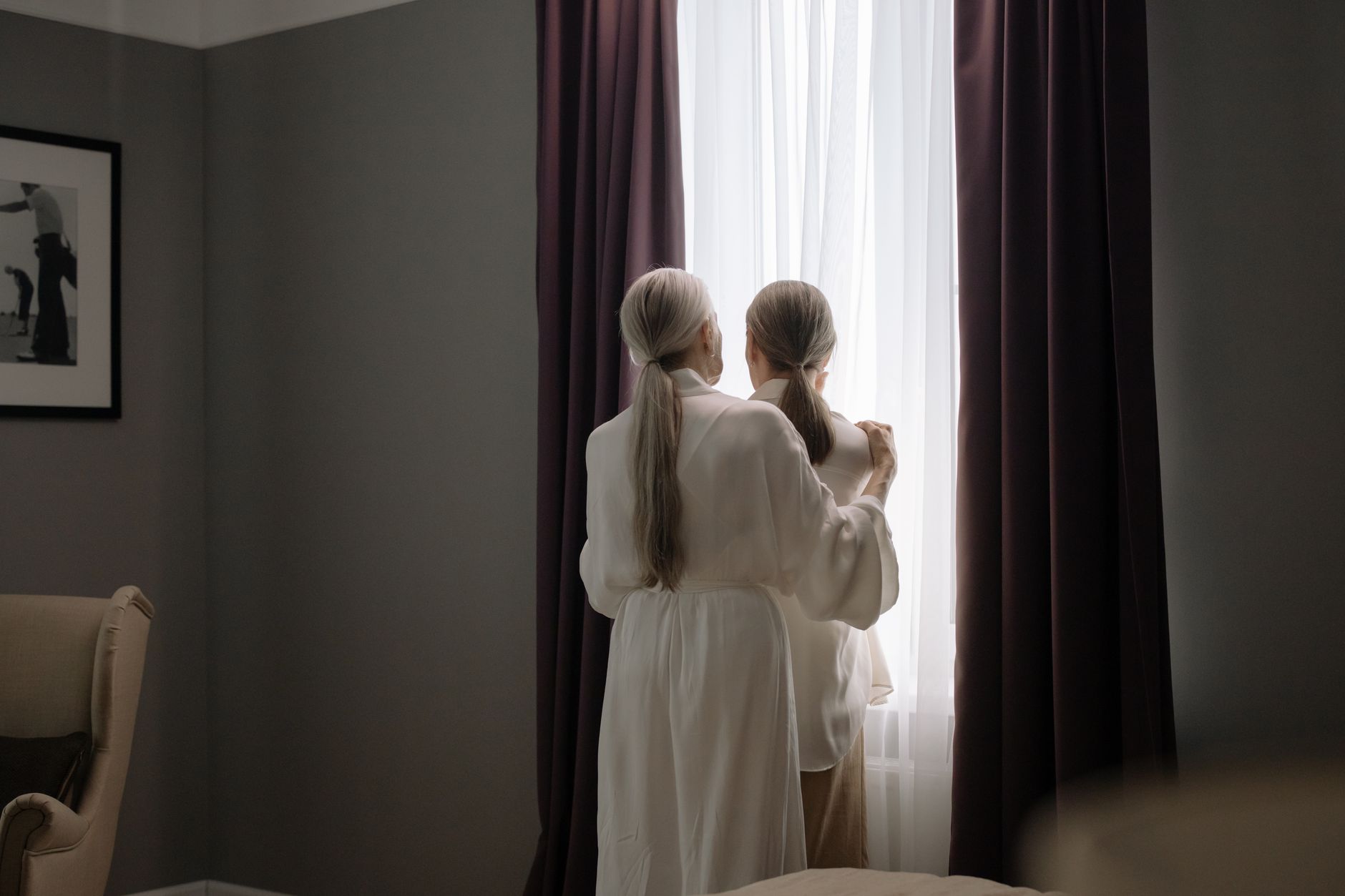
She flew to Ohio that fall. I went to the airport, the small regional one, and I stood at the bottom of the escalator the way you do, scanning every face, terrified I would not recognize her, and then I saw a small white-haired woman come around the corner with a tilt to her head, that skeptical girlhood tilt, looking for me, and forty years fell away so completely that I was twenty-two again and so was she, and we were two girls in a narrow room, and I was not making myself small anymore, I was running, an old woman running through an airport with her arms already open.
We held onto each other at the bottom of that escalator for a long time. People moved around us the way water moves around a stone. I felt her shaking, or I was shaking, or we both were. She smelled like a garden, like something green, the way she always had. When we finally let go enough to look at each other, she put her hand on my face, on my old soft cheek, and she said, *There you are. I have been looking for you for forty years.* And I said the only true thing I had. *I’m sorry I made you carry it alone.* And she shook her head and said, *You did not make me. I chose it. The only thing you did wrong was believe me. And I worked very hard to make you believe me. So we will call it even.*
We will call it even. As if forty years could be made even by two old women deciding to let it. But here is what I have learned, sitting in the years since, and it is the thing I most want to leave with you: it can. Forgiveness is not a feeling you wait to arrive. It is a decision you make, and then keep making, on a Tuesday, at a kitchen table, with the tea going cold. Ruth and I decided. And then every day we kept deciding, and the deciding became, over a year or two, simply the truth. We were sisters again. Not the sisters we would have been with forty years of birthdays and Sunday dinners and shared grandchildren. Those sisters are gone, and I do mourn them, two phantom women who got to grow old in the same town. But the sisters we are now are real, and we are here, and we are not finished.
She has been back to Ohio twice more. I have flown to Oregon, my first time on a plane in twenty years, and I met the children with my blood in them, the great-nieces and great-nephews, and they were shy with me at first and then they were not, and one of the little ones, a girl of six, climbed into my lap on the second day and said *Are you the aunt from the story,* and I said, *I am, baby, but the story was wrong, and your grandma and I are writing a better one.* Ruth heard me say it from across the room and had to leave to compose herself in the kitchen, and I let her go, because some things you have to feel alone in a kitchen for a minute, our family has always known that.
We talk every Sunday now. We have a standing call, the two of us, two old women, and we talk about nothing, the garden, my knees, her grandchildren, the weather two thousand miles apart, and the nothing is the whole point, the nothing is the forty years of ordinary Sundays we did not get, poured one Sunday at a time into the time we have left. Last Sunday she told me the zinnias were up. I told her the Christmas lights were finally where they belonged, on the tree, which made us both laugh until we could not breathe, because if the lights had been where I thought they were that day in the attic, I would have come down with the lights and never opened the box, and we would have died strangers, two sisters who lived eighty miles apart in the same heart and never knew it.
I keep the letter framed now. It hangs in my front hall where I see it every morning. Forty years it spent unsent, and now it has finally been delivered, just to a different version of me, an old woman instead of a young one, at a different address, on a different street, at the only moment I was finally ready to read it right. Ruth says the letter did exactly what it was meant to do. It just took the long way.
If you are reading this, and there is a name you have not said in years, a sister, a brother, a child, a friend, someone you put down so long ago that picking them back up feels impossible, I want to tell you what the box told me. You do not know the whole story. You think you do. I thought I did, and I was so sure, for forty years, and I was wrong in a way that cost two old women most of their lives together. There may be a letter you have not found. There may be a sentence that would undo half of what you believe. And even if there is not, even if the story is exactly as bad as you remember, you are still allowed to put it down. Ruth was right. We do not get to be angry and be family both, and we do not have so many days that we can afford to feed them to the dead.
I am seventy-three now. Ruth is seventy-five. We are going to be old together for as long as the good Lord allows it, two girls from a narrow house on Bellflower Street who found their way back to the same room. It took a soft box and a misplaced string of Christmas lights and a letter that waited forty years for the right reader. I would not have believed, that day in the attic, that the worst loss of my life would turn out to have a door in it. But it did. They almost always do. We are just usually too sure of the story to go looking for the handle.
Call her. Call him. Climb up into your own attic, whatever it is, and open the soft box you have been carrying past for years. You might find that the person you put down was holding you up the whole time, in a way you could not see, from a place you could not reach, waiting all those years for you to be ready to read it right.
There you are. I have been looking for you.

Lila Hart is a dedicated Digital Archivist and Research Specialist with a keen eye for preserving and curating meaningful content. At TheArchivists, she specializes in organizing and managing digital archives, ensuring that valuable stories and historical moments are accessible for generations to come.
Lila earned her degree in History and Archival Studies from the University of Edinburgh, where she cultivated her passion for documenting the past and preserving cultural heritage. Her expertise lies in combining traditional archival techniques with modern digital tools, allowing her to create comprehensive and engaging collections that resonate with audiences worldwide.
At TheArchivists, Lila is known for her meticulous attention to detail and her ability to uncover hidden gems within extensive archives. Her work is praised for its depth, authenticity, and contribution to the preservation of knowledge in the digital age.
Driven by a commitment to preserving stories that matter, Lila is passionate about exploring the intersection of history and technology. Her goal is to ensure that every piece of content she handles reflects the richness of human experiences and remains a source of inspiration for years to come.