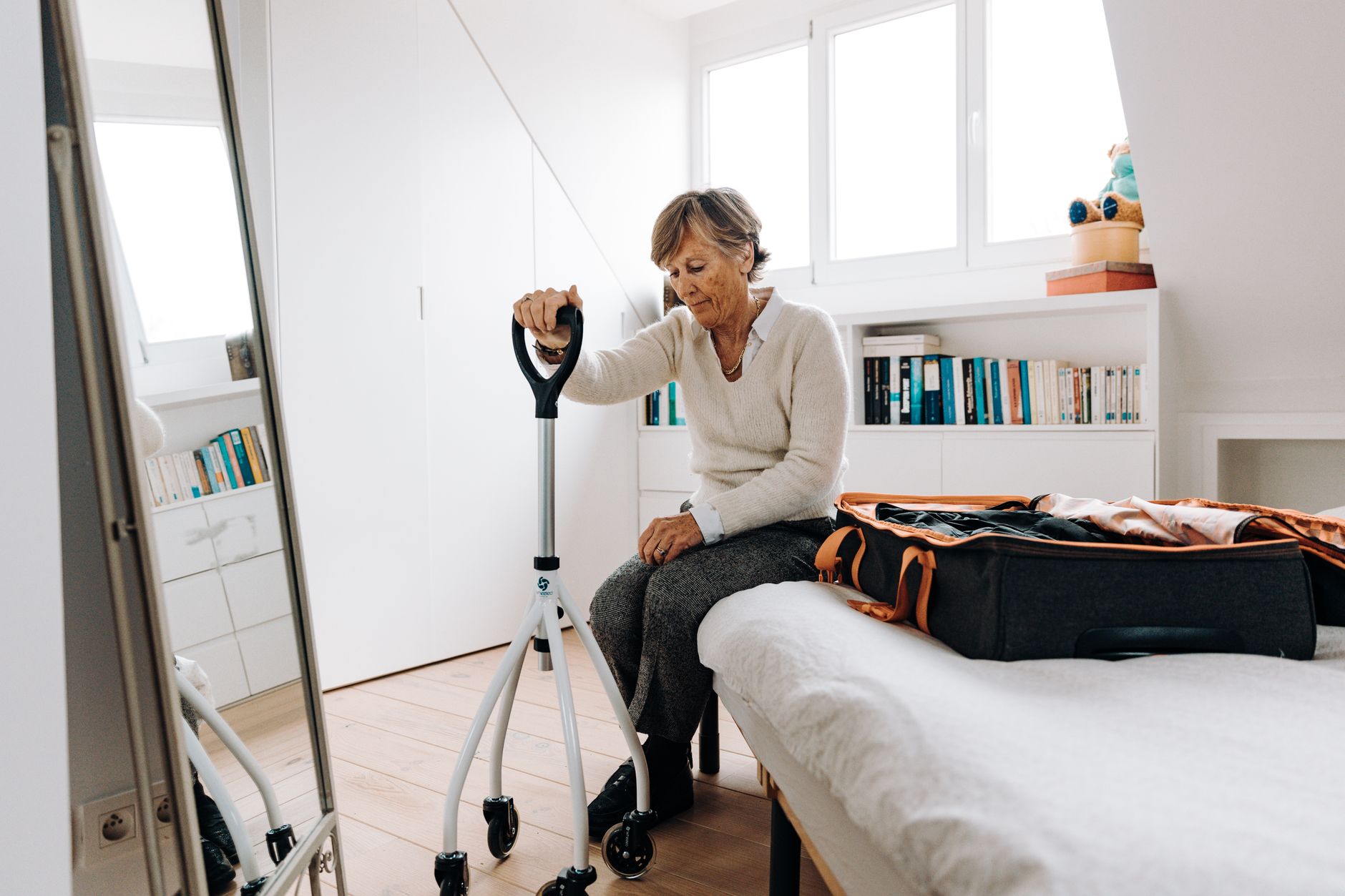
The day Vivian came to move me out of my own house, she wore the navy blazer she saves for parent-teacher nights and bank appointments, the one that says trust me without her ever having to open her mouth. She parked her SUV across the bottom of my driveway so the moving van could back in, and she stood on my porch holding a clipboard, of all things, like a woman come to take inventory of a stranger.
“Ruth,” she said, and she smiled the way you smile at a child who has been told three times to put on her shoes. “We talked about this. Today’s the day. Let’s make it easy.”
We had not talked about this. Vivian had talked about it. My son Daniel had nodded along at his kitchen table while she did the talking, the way he had nodded along to everything she’d said for eleven years, and I had sat there with a cup of coffee going cold in my hands listening to the two of them decide my life as if I were a wall they were repainting.
I was seventy-one years old that spring. I had buried my husband Carl eighteen months before. I had a house that Carl and I bought in 1979 and paid off in full by the time Daniel finished high school, a garden I could still kneel in if I went down slow and held the trellis, and a mind that worked, on most days, better than the two of theirs put together. I want you to hear that clearly, because everything that comes after rests on it. I was not confused. I was not failing. I was a widow with money in the bank and a paid-off house, and that, it turned out, is one of the most dangerous things an old woman can be.
Let me start where the trouble started, which was the casserole.
After Carl died, Vivian became attentive in a way she had never once been while he was alive. Carl never trusted her. He never said an unkind word about her to my face, but I would catch him watching her at Thanksgiving the way a farmer watches a sky that’s going green, and he told me once, quietly, drying a dish, “That one counts what’s in other people’s pockets.” I told him to hush. I told him she was Daniel’s wife and the mother of my grandchildren and I would not have it. He hushed. Carl always hushed when I asked him to. I have thought about that a great deal since.
So when Vivian started coming by twice a week with casseroles and a worried forehead, I let myself believe grief had softened her. She would walk through my house while the chicken and rice warmed in the oven, and she would touch things. My mother’s hutch. The grandfather clock in the front hall. Carl’s gun cabinet. She touched them the way a buyer touches things at an estate sale, turning over the price tag, and I told myself I was a bitter old woman for noticing.
Then the questions started. Soft questions, dressed up as caring.
“Do you ever feel lonely in this big house, Ruth?”
“Are the stairs getting to be a lot? I worry about you on those stairs.”
“Have you thought about what happens with the house, just, you know, down the road? It’s smart to plan.”
And then the one that gave the whole game away, although I did not understand that yet. She asked it on a Tuesday, with her reading glasses pushed up on her head, sitting at my kitchen table with a yellow legal pad she had brought from home.
“Ruth, where do you keep all your important papers? The deed, the accounts, all that. Daniel and I just want to make sure everything’s organized, in case anything ever happened. So we’re not scrambling.”
I told her they were organized. I told her not to worry about my papers. And I watched something flicker across her face, a small irritation, quickly hidden, and that flicker is the thing I keep coming back to. Because a daughter-in-law who only wants you safe does not get irritated when you tell her you have your affairs in order. She gets relieved. Vivian got irritated. I filed that away and I said nothing, because I had learned a long time before, raising a son and burying a husband, that the most powerful thing a quiet woman owns is the things she chooses not to say out loud.
What Vivian did not know, what none of them knew, was that Carl and I had spent a great deal of time, in his last two years, making sure of exactly the thing she was fishing for. Carl had a cousin, Bernard, who had been swindled out of his house in his eighties by a son who meant well and a daughter-in-law who did not, and Carl watched that whole slow robbery happen and swore it would never touch us. So we had sat down with a lawyer named Harold Finch, a small careful man with an office over the pharmacy on Main Street, and we had put things in order. Properly in order. The kind of order that does not show up when somebody goes through your kitchen drawers.
I am getting ahead of myself. Let me go back to the porch, and the clipboard, and the day they came to take me away.
The week before, Daniel and Vivian had invited me to dinner, which was unusual, because dinner at their house meant Vivian cooking, and Vivian did not like to cook for me. We sat down to roast chicken and Daniel could not look at me. That was my first warning. My boy, my only child, forty-three years old with gray coming in at his temples, and he was cutting his chicken into smaller and smaller pieces and not eating any of it.
Vivian did the talking. She always did the talking.
“Ruth, we’ve been so worried about you. Daniel and I both. You’re out there all alone in that house, and Carol next door told me she saw you take a spill in the garden last month.”
I had not taken a spill. I had knelt down to pull crabgrass and lost my balance for a second and caught the trellis, exactly as I had described it to myself a hundred times, the small careful arithmetic of an aging body. But I could see how it would look from a kitchen window. I could see how it would be useful.
“We found a place,” she went on, sliding a glossy brochure across the table. Maple Crest Senior Living. There was a photograph on the front of a silver-haired woman laughing at something off-camera, holding a cup of tea, a younger person’s hand on her shoulder. “It’s beautiful, Ruth. It’s the nicest one in the county. They have activities, and a nurse on every floor, and you’d never have to worry about the stairs or the yard or any of it ever again. You could just rest.”
Just rest. As if I were tired. As if seventy-one years and a paid-off house and a working mind amounted to a woman who needed to be put down for a nap that does not end.
I picked up the brochure. I looked at the laughing woman. And then, on the back, in small print, I found the number that mattered, the way I always find the number that matters, because forty years of keeping the books for Carl’s heating and cooling business taught me that the whole truth of any arrangement lives in the small print. Maple Crest was eight thousand four hundred dollars a month. For a one-bedroom unit. The memory-care wing, which Vivian had circled in pen, helpfully, was eleven thousand two hundred.
Eleven thousand two hundred dollars a month. I did the math in my head while Daniel pushed his chicken around. At that rate, the money Carl and I had spent forty years putting away, the money that was supposed to go to my grandchildren and to the church and to keeping me with dignity until the end, would be gone in a little under four years. And the house, my house, would have to be sold to keep paying once the savings ran dry. Sold by whoever held power over my affairs.
And that, of course, was the whole point.
“Who’d manage the house if I went?” I asked. My voice was very calm. I have a calm voice. People mistake it for weakness all the time, and that mistake has saved me more than once.
“Well,” Vivian said, and now she leaned forward, and her voice got warm and practical at the same time, the voice of a woman closing a sale, “we’d take care of all of that. Daniel’s your son, it makes sense for him to handle things while you’re getting settled. We’d just need you to sign a power of attorney, that’s all, so we can pay the bills and keep everything running for you. So you don’t have to think about a single thing.”
A power of attorney. So they could pay the bills. So I would not have to think about a single thing, like the eleven thousand two hundred dollars a month draining out of accounts I would no longer control, in a wing for people whose minds have left them, while my mind sat there sharp as a tack with nothing to do but watch.
I want to tell you that I stood up from that table and told them exactly what I thought of them. I did not. I have been in this world long enough to know that the worst thing you can do, when you have caught a thief reaching into your purse, is to slap their hand. You let them think the purse is open. You let them reach all the way in. And then you close it on their wrist when there is a witness in the room.
So I smiled. I let my eyes go a little watery, which is not hard at seventy-one, and I said, “Oh, it’s a lot to take in. I do worry about the stairs. Let me think on it.”
Vivian smiled back, and the relief on her face was a terrible thing to see, because it told me how badly she wanted it, and how little she had ever cared for me at all.
“Of course, Ruth. Take your time.” A pause. “Although the unit won’t hold forever. These places fill up. Maybe we could get the paperwork started this week, just so we don’t lose the spot?”
Just so we don’t lose the spot. There it was. The hurry. Thieves always hurry. An honest arrangement can wait a season. A theft has to happen before the mark wakes up.
I went home that night and I sat in Carl’s chair in the dark for a long time, and I’ll tell you, I cried. Not for the house. Not for the money. I cried because my boy, my Daniel, the baby I had walked the floor with through three nights of croup, the boy I had taught to ride a bicycle on Pearson Street, had sat at that table and let a woman talk about putting his mother in a memory ward to get at her bank accounts, and he had not said one word. He had cut his chicken smaller and smaller. That is what broke my heart. Not the cruelty of the woman who was never mine. The silence of the man who was.
And then I dried my eyes, because Carl always said I was the most stubborn woman in three counties, and I made a phone call the next morning to Harold Finch, the small careful lawyer over the pharmacy.
Harold remembered me. He remembered Carl. He remembered, more importantly, every document we had signed in his office, because Harold Finch was the kind of man who kept his files the way I keep my recipe box, alphabetical and complete and exactly where he left them.
“Ruth,” he said, when I had told him everything, the casseroles and the questions and the brochure and the power of attorney. “I want you to listen to me carefully. Do not sign anything. Do you understand? Not a single piece of paper they put in front of you, no matter how it’s described. Come see me. Bring your reading glasses. We have some things to go over that I think will set your mind at ease.”
So I went to see Harold Finch. And what he laid out on his desk that afternoon is the thing Vivian never knew, the thing that turned the whole picture on its head, and it is the reason I can tell you this story from my own kitchen table instead of from a wing where they wheel you to the window for an hour a day.
I am going to keep some of that for later, the way Harold taught me, because Harold’s first lesson was that you do not show your hand to the table. You show it to the dealer, privately, and then you wait.
What I will tell you now is what I did with what he told me. Because knowing you hold the winning cards is not the same as winning. You still have to let the other players bet.
I called Vivian that evening, sweet as pie. I told her I had thought it over and she was right, the stairs were a lot, and the garden was getting to be too much, and I supposed it was time. I could hear the smile come back into her voice through the phone. I told her I wanted to do it properly, with everyone there, so it didn’t feel like I was being snuck off in the night. I said I wanted Daniel and the grandkids to come, and I wanted to sign whatever needed signing all at once so it was done and I didn’t have to keep thinking about it.
“That’s so smart, Ruth,” she said. “That’s so brave of you.”
Brave. She actually said brave. I held the phone away from my ear for a second so she wouldn’t hear me breathe.
“And bring your lawyer,” I added, light as anything. “Carl always said never sign a thing without your lawyer in the room. I’d feel better. You don’t mind, do you?”
There was the smallest pause. A thief’s pause. And then she recovered. “Of course not. That’s very wise. We’ll have everything ready.”
I did not tell her which lawyer I meant.
We set it for the following Saturday. My house. Eleven in the morning. And I spent that week doing something I had not done with real purpose since Carl got sick. I prepared.
I called my neighbor Carol, the one who had reported my so-called spill, and I invited her for coffee, and over the coffee I told her, plainly, that my son’s wife was trying to move me into a facility I did not need and take control of my money, and that I would like her to be at my house on Saturday at eleven as a witness, and to bring her phone. Carol, God bless her, had watched the casseroles come and go all spring and had her own opinions about Vivian’s blazer, and she said she would be there with bells on.
I called Harold Finch and asked him to come too, and to bring the file. The whole file.
And I called the bank. I had one more piece of business at the bank, a quiet piece, the kind that takes a few days to clear, and I will tell you about that when we get there.
Then I baked. I made a lemon pound cake and a pot of coffee and I set out the good cups, because if you are going to spring a trap, you may as well do it like a lady.
Saturday came bright and clear. Vivian arrived first, at quarter to eleven, in the navy blazer, with a leather folio under her arm that I knew held the power of attorney and the Maple Crest admission papers and probably a pen with a good heavy click to it. Behind her came Daniel, who hugged me too hard and too long and would not meet my eyes, and behind him the two grandchildren, sixteen and fourteen, on their phones, herded in by their mother to make the morning look like a family occasion instead of what it was.
And behind them, to Vivian’s visible surprise, came a man she did not recognize, in a brown suit a little out of fashion, carrying a battered leather satchel. Harold Finch. He had parked down the block. He is a careful man.
“Who’s this?” Vivian asked, the smile holding but the eyes going hard.
“This is Mr. Finch,” I said pleasantly, taking his coat. “My attorney. You said you didn’t mind.”
Right behind Harold, Carol came across the lawn in her good cardigan with her phone already in her hand, and I introduced her as my dear friend who had come to keep me company on a big day, and Vivian’s face did a thing that I will treasure until I die. It was the face of a woman who had laid out a clean board and watched extra pieces walk onto it.
We sat in the front room. I poured the coffee. I cut the cake. And Vivian, because a closer cannot help but close, got right to it.
“Well,” she said, setting her folio on the coffee table and opening it. “Why don’t we get the paperwork out of the way, and then we can all relax and enjoy the cake. Ruth, these first ones are just the power of attorney, so Daniel can help manage things for you. And then we’ve got the Maple Crest admission packet. They were able to hold the memory-care unit for us, which was lucky.” She slid the top page across to me and uncapped a pen with a good heavy click, exactly as I had pictured. “Just sign here, and here, and initial these.”
I did not pick up the pen.
“Harold,” I said. “Would you look these over first? I promised Carl.”
Harold Finch put on his reading glasses and took his time. He read every page. He is a slow reader on purpose, the way a slow witness is the most dangerous kind, and the longer he read the more Vivian’s foot bounced under the coffee table. Finally he set the papers down, folded his glasses, and spoke in the mildest voice you ever heard.
“This power of attorney,” he said, “is a durable general power of attorney. It would give Daniel, and through him his wife, complete authority over all of Mrs. Calloway’s finances, real property, and personal affairs, effective immediately upon signing. Not upon any finding of incapacity. Immediately.” He looked up over his glasses. “Mrs. Calloway, were you told this took effect immediately, or only if you became unable to manage your own affairs?”
“I was told,” I said, “that it was just so they could pay the bills.”
“It is considerably more than that,” Harold said.
The room had gone very quiet. The grandchildren had looked up from their phones. Carol’s hand, holding her own phone, had drifted up to rest on her knee, and I saw the small red dot on her screen, and I knew she had started recording the moment Harold put his glasses on, which is exactly what I had asked her to do.
Vivian’s smile did not leave her face. That is the thing about a certain kind of person. The smile is structural. It holds the face up. She said, smooth as oil, “I think there’s been a misunderstanding. We just want what’s best for Ruth. She fell in the garden. She’s all alone out here. Surely her own lawyer can see that the kindest thing is to make sure she’s cared for and that her money is protected from, you know. Scams. Older people get taken advantage of all the time.”
I want you to sit with that for a moment, the way I had to. Older people get taken advantage of all the time. She said that, while reaching into my purse, and she said it without a flicker, and that was the moment I stopped feeling sad and started feeling something colder and clearer that has served me very well ever since.
“That’s true,” I said. “They do.”
And then I asked the question I had been saving all spring, the one I had practiced in Carl’s chair in the dark.
“Vivian,” I said. “Before I sign anything, I’d like to understand the money. If I move into the memory-care unit at eleven thousand two hundred a month, and I live another fifteen years, which the women in my family tend to do, that’s just over two million dollars. Carl and I saved a little under nine hundred thousand. So somewhere in year four, the savings run out. What’s the plan for years five through fifteen?”
The pen stopped clicking.
“Well,” Vivian said carefully, “the house, eventually, would be sold to cover the care. That’s normal. That’s what the house is for, at a certain point.”
“The house I’m sitting in,” I said.
“You wouldn’t be living in it anymore, Ruth.”
“No,” I agreed. “I wouldn’t.”
And there it was, said out loud, in front of a lawyer and a neighbor with a phone and two teenagers who were now staring at their mother as if they had never seen her before. The whole arrangement, laid bare in her own voice. Sign the power of attorney. Go into the locked wing. Watch the savings drain. Sell the house out from under me to keep the drain running. And at the end of it, nothing left for the grandchildren staring at her now, because it would all have gone to Maple Crest, and Daniel and Vivian would hold the empty bag and the empty deed and call it love.
Except for one thing. The thing Harold Finch had laid on his desk for me a week before. The thing I had kept from you, as he taught me, until there was a witness in the room.
“Harold,” I said. “Would you explain to my son and his wife how my affairs are actually arranged?”
Harold opened his battered satchel.
“With pleasure,” he said.
He took out a thick folder, and he laid the documents on the coffee table one at a time, on top of Vivian’s untouched admission packet, the way you lay down winning cards, slow, face up.
“Three years ago,” Harold said, “Mr. and Mrs. Calloway came to my office and established a revocable living trust. The Calloway Family Trust. Mrs. Calloway is the trustee. Upon her death or incapacity, the successor trustee is not Daniel.” He paused. “It is the First Methodist Church’s trust officer, acting jointly with me, with distributions specified in writing to the two grandchildren in equal shares, held until each turns twenty-five, and a bequest to the church. Daniel is named, but only as a contingent beneficiary, after the grandchildren, after the church. He cannot sell, mortgage, or manage one dollar of it.”
You could have heard a pin drop on the carpet.
“Furthermore,” Harold went on, and he slid the next document across, “the house you are sitting in does not belong to Mrs. Calloway personally. It was deeded into the trust three years ago. It cannot be sold to pay for any care without the consent of the trustee, who is Mrs. Calloway, and after her, the church officer and me. No power of attorney signed today, by anyone, reaches it. The trust owns the house. The trust owns the accounts. Mrs. Calloway controls the trust. And the trust cannot be amended by a power of attorney. It can only be amended by Mrs. Calloway, in person, in my office, in sound mind, which I have just spent ten minutes confirming she is, in front of all of you.”
Vivian’s smile finally, finally came down. I watched it go. It was like watching scaffolding come off a building and finding nothing behind it.
“That’s not,” she started, and stopped. “Carl never said anything about a trust.”
“No,” I said. “He didn’t. Carl was a quiet man. He learned it from me.”
There was one more thing. The quiet piece of business at the bank, the one I told you I would explain when we got there. We were there now.
“There’s also the matter of the joint account,” Harold said, almost gently. “Mrs. Calloway, do you want to tell them, or shall I?”
“I’ll tell them,” I said.
I looked at my son. Just at Daniel. Not at Vivian.
“Eight years ago,” I said, “your father and I set up a small joint checking account, Daniel, with you on it. Five thousand dollars, for emergencies, so if something happened to us you’d have walking-around money right away while the rest got sorted out. You probably forgot it existed. I almost did.” I took a breath. “I went to the bank on Wednesday and I closed it. I moved the five thousand into the trust. I did that because on Tuesday I sat in your father’s chair and I understood that you had let your wife sit in my kitchen and plan to sell my house out from under me, and you said nothing. So there is nothing of mine, Daniel, not five thousand dollars, not five, that runs through your hands anymore. I’m sorry. You did that. Not me.”
My boy started to cry. Forty-three years old, gray at the temples, and he put his face in his hands at my coffee table and cried like he had croup again, and the worst part, the part I will carry, is that I do not fully know to this day whether he was crying because he was sorry or because the money was gone. I have decided, because I am his mother and I have to live in this world, to believe it was the first one. But I am not a fool. I keep both possibilities in the same drawer.
Vivian stood up. She gathered her folio, her power of attorney, her Maple Crest packet with the memory-care unit they had so luckily held, and she did the thing that told me everything I would ever need to know about her, which is that she did not say one word to me. Not a denial, not an apology, not even an insult. She simply looked at me the way you look at a door that has been locked against you, and she said, to Daniel, “Get the kids. We’re leaving.”
And here is the part I am proudest of, and I tell it not to boast but because I think some woman reading this needs to hear that it is allowed.
I stood up too. I walked them to the door, because it is my house and I am a hostess. And on the porch, where she had stood with her clipboard, I touched Vivian’s arm, lightly, the way she used to touch my mother’s hutch, and I said, in my calm voice, the voice people mistake for weakness:
“Vivian. You were right about one thing. Older people do get taken advantage of all the time. That’s exactly why Carl and I planned for it three years ago. We just didn’t know, back then, that we were planning for you.”
She pulled her arm away and walked to her SUV and never set foot on my porch again.
Now. I told you Harold taught me not to show my hand to the table until there was a witness in the room. There was a reason for the witness beyond the satisfaction of it, and you, being sensible, have probably already guessed it.
A power of attorney obtained from a confused elderly person by relatives who stand to gain is not just a sad family story. In our state it is a crime. Financial exploitation of a vulnerable adult. Carol’s recording, which she had texted to herself and to Harold and to me before anyone left the driveway, showed Vivian saying, in her own voice, that the plan was to put me in memory care and sell my house to pay for it, while I sat there demonstrably in sound mind, having just been examined on the record by my attorney. Harold did not call the police that day. He is a careful man, and I am, it turns out, a careful woman, and we discussed it privately the following Monday over the pharmacy.
I chose not to press charges. I want to be honest about why. It was not mercy, though I let people believe it was. It was Daniel, and it was the grandchildren, who had done nothing but be born into a house run by a woman who counts what is in other people’s pockets. A criminal case would have landed on all of them. So instead Harold drafted a letter, on his letterhead, that laid out precisely what the recording showed, precisely what the law called it, and precisely what would happen to that recording if Vivian ever again so much as suggested I was incompetent, contested my trust, or attempted to interfere with my affairs. He sent it certified. She signed for it. I have the green card in the recipe box, behind the lemon pound cake.
She has not spoken to me since. I find I can live with that better than I could ever have lived with her casseroles.
Daniel and I are slowly, carefully, finding our way to something. He comes on Sundays now, alone, and he does not touch my hutch and he does not ask about my papers. He mows the lawn that Vivian once told me was too much for me, and he is right, it is too much for me, and it is a fine thing to watch your son mow your grass for the right reason instead of waiting to inherit it. We do not talk about that Saturday. Once, at the door, he said, “Mom, I’m so sorry,” and I said, “I know,” and that was the whole of it, and it was enough, or it will have to be.
The grandchildren come too, on their own steam now, which startled me. The sixteen-year-old asked me one afternoon how I had known, how I had planned three whole years ahead for something I couldn’t have seen coming, and I told her the truest thing I know, which is this, and I will leave you with it the way Carl would have wanted me to.
A woman spends her whole life being told her caution is paranoia, her noticing is bitterness, and her quiet is weakness. They tell you to smile, to not make a fuss, to trust the people who love you. And mostly you should. But there is a difference, child, between trust and surrender, and the world will work very hard to blur it for you, especially once you are old and your hands shake a little and you have something worth taking. So you keep your own counsel. You keep your papers in order. You find your own Harold Finch. And you remember that the calm voice they mistake for weakness is the same voice that closes the purse on the wrist, with a witness in the room, and a slice of lemon pound cake going around.
I am seventy-three now. I am still in my house. The garden is too much for me and I do it anyway, slow, holding the trellis. The trust is sound. The grandchildren will be all right. And every single morning I sit in Carl’s chair with my coffee, in the home no one could take from me, and I think the same thing.
They came to put me away to get at my savings.
They left with nothing but the green card I made them sign.
And I kept everything. Including, in the end, the only things that were ever worth keeping.
*This is a dramatization inspired by the kinds of stories our readers share. Names and details are invented.*

Lila Hart is a dedicated Digital Archivist and Research Specialist with a keen eye for preserving and curating meaningful content. At TheArchivists, she specializes in organizing and managing digital archives, ensuring that valuable stories and historical moments are accessible for generations to come.
Lila earned her degree in History and Archival Studies from the University of Edinburgh, where she cultivated her passion for documenting the past and preserving cultural heritage. Her expertise lies in combining traditional archival techniques with modern digital tools, allowing her to create comprehensive and engaging collections that resonate with audiences worldwide.
At TheArchivists, Lila is known for her meticulous attention to detail and her ability to uncover hidden gems within extensive archives. Her work is praised for its depth, authenticity, and contribution to the preservation of knowledge in the digital age.
Driven by a commitment to preserving stories that matter, Lila is passionate about exploring the intersection of history and technology. Her goal is to ensure that every piece of content she handles reflects the richness of human experiences and remains a source of inspiration for years to come.