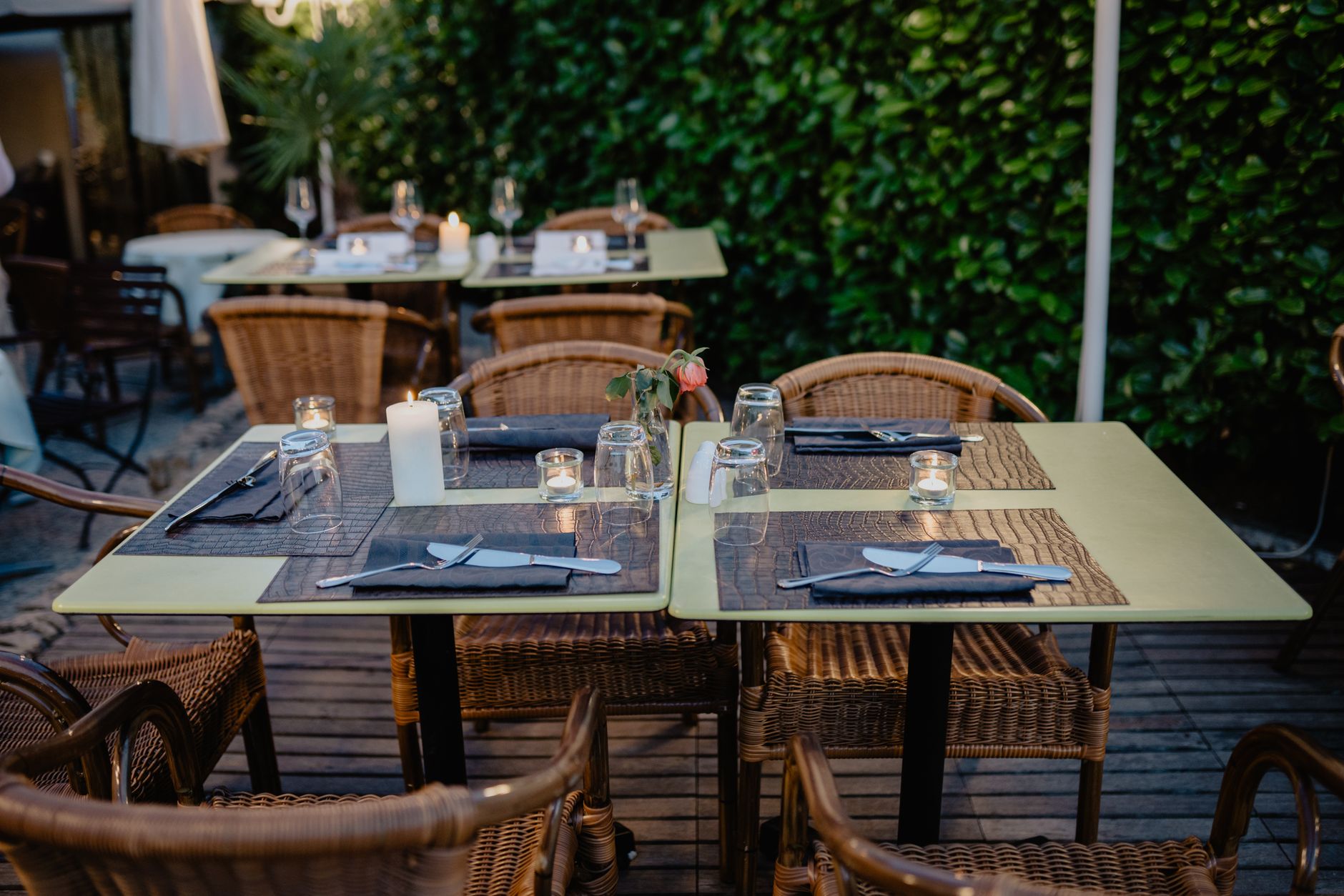
For four hundred and eleven days I set two places at a table built for one widow.
I counted them. That is the thing nobody tells you about grief, that you become a bookkeeper of it, that you tally the days the way you once tallied anniversaries, and that the counting feels less like sickness and more like the last job your love is allowed to do. Four hundred and eleven mornings I came down the stairs in Harold’s old cardigan, the gray one with the leather buttons, and I took down two plates from the cupboard. Two forks. Two knives, blade in. Two folded paper napkins, because Harold thought cloth napkins were putting on airs and I had given up arguing with a man about napkins thirty years before he died.
I set his place at the head of the table where he had eaten every meal of our married life. I set mine to his right. And then I cooked for two and ate for one, and scraped the second plate into the bin after, and washed both anyway, and dried both, and put both back, so that the next morning I could take them down again.
My daughter Renee called it a phase. She is a kind woman and she said it kindly, which is its own small cruelty, the kindness that means I have decided you are not well and I am being patient with you. “Mom,” she said, “it’s been over a year. You have to stop setting Dad’s place. It isn’t healthy.” She said the word healthy the way the young say it now, like a moral category, like a person could be good or bad at being alive.
I did not tell her the truth, which was this. I was not waiting for Harold to come back. I was sixty-eight years old and I had buried my mother and my father and a brother in Korea and two miscarriages and now a husband, and I knew exactly what death was and exactly what it was not. I set his place because the alternative was to admit that the table was a table for one, and I was not ready to be a woman who ate alone. There is a difference between believing a man will walk back through the door and refusing to rearrange the furniture of your faith to match his absence. Renee could not see the difference. I could not explain it. So I let her think it was a phase, and I kept setting two plates, and the days kept stacking up like dishes that never got put away.
That is where the story would have stayed, I think, a quiet woman in a quiet house feeding a ghost, if it had not been for the night of the storm and the knock at the door.
—
We get hard weather in the valley in the early spring. The kind that comes down off the ridge with no manners at all, that turns the county road into a black river and knocks the power out for the whole township at once. That night it came in around six. I had the radio on the battery and a pot of chicken and dumplings on the stove, because dumplings were Harold’s and I made them on the bad-weather nights the way I always had, and I had just set the two places when the lights went.
I lit the kerosene lamp we kept for exactly this. I sat in the dark in the orange light with two bowls of dumplings cooling, one in front of me and one in front of nobody, and I listened to the storm beat the windows like it had a grievance against the house.
Then somebody knocked.
You have to understand where I live. I am four miles past the last streetlight, down a road that does not go anywhere a person would want to go unless they meant to come to my house specifically. Nobody knocks on my door after dark. Renee calls first. The propane man comes Tuesdays. A knock at my door at six-thirty on a black storming night was a thing that simply did not happen, and I sat there with my heart going and the dumplings steaming and the lamp throwing its little circle, and I thought, the way any woman alone would think, of all the bad ways a night like this can end.
The knock came again. Not hard. That is what made me get up, if I am honest. A bad man knocks hard. This was almost an apology, three soft taps, then quiet, then I heard a voice through the door say, “Ma’am, I’m sorry. I saw your light. I’m sorry to bother you.”
I am not a fearless woman. But I am a Christian woman, and there is a verse my mother made me learn before I could spell my own name, the one about entertaining strangers and angels unawares, and it came up in me right then the way scripture does when you have buried it deep enough, not as a thought but as a kind of pressure behind the breastbone. I put the chain on. I opened the door the four inches the chain allows.
There was a man on my porch. Soaked to the bone, no coat worth the name, an old canvas jacket gone black with rain. He was maybe sixty. Gray stubble, a face that had been out in weather a long time, longer than one storm. He had his hands held up and open at his chest, the way a man does when he wants you to see he is not holding anything, and water was running off the bill of his cap in a steady little rope.
“My truck went off the road,” he said. “Back at the low bridge. Water came up over it. I’ve been walking. I saw your light.” He stopped. He looked at me through the four inches of door and I watched him decide to say the next part. “I’m not going to lie to you, ma’am. I don’t have anywhere to be. I’m not expected anyplace. I just saw your light and I’m awful cold.”
A younger woman would have shut the door. A smarter woman, maybe. I stood there with the chain biting my hand and the storm at his back and I thought about the second bowl of dumplings going cold on my table, the place I set every single day for a man who was never coming to eat it. And I thought, God help me, this is not how I pictured it, but a place is a place and it is set.
I took the chain off. I opened the door.
“You’ll catch your death out there,” I said. “Come in and sit down. Supper’s already made.”
—
His name was Earl.
He stood just inside the door dripping on my mat and would not come further until I told him twice it was all right, and even then he walked on the balls of his feet like a man trying not to take up space in the world. I gave him one of Harold’s flannel shirts and a pair of Harold’s wool socks, which I had not been able to give to Goodwill, which were folded in the bottom drawer where I had folded them, and watching this stranger pull Harold’s dry shirt over his cold shoulders did something to me I did not expect and could not name at the time.
I sat him at the table. And here is the part I have turned over a thousand times since. I sat him at the head of the table. In Harold’s place. With Harold’s bowl of dumplings, the one I had set for nobody, already steaming in front of him.
I did not decide to do it. There was only the one place set besides my own, and it was the one I always set, and he was the one who had come in out of the dark, and the bowl was already there. I sat him down where the place was set. That is all it was, in the moment. It only became the whole story later.
He looked at the bowl. He looked at the head of the table, at the worn arms of the chair, at the way the place was laid out so particular, fork and knife and folded napkin, a place that had clearly been set by someone who set it the same way every time. He was not a stupid man. He understood he was sitting in a dead man’s chair eating a dead man’s supper. I saw him understand it. And he did the thing that I think saved both of us that night, though neither of us knew it yet.
He took off his cap. He set it on his knee. And he said, “Whose place is this, ma’am?”
Not what’s for supper. Not thank you, which would have been fine, which is what most would have said. He asked whose place it was. He asked about the absence, not the food. As if he had walked into my kitchen and seen the shape of the missing person before he saw the dumplings, and decided the missing person deserved to be spoken to first.
“My husband’s,” I said. “Harold. He passed last spring.”
Earl nodded slow. He did not say sorry for your loss, which is the phrase that has been worn down to nothing from too much handling. He looked at the place setting, the careful fork, the folded napkin, and he said, “You still set it for him.”
It was not a question and it did not need an answer and I did not give it one. I sat down in my place to his right, where I had eaten ten thousand suppers, and for the first time in four hundred and eleven days there was a warm body in the chair beside me, and I picked up my spoon, and my hand was shaking, and I was sixty-eight years old crying into chicken and dumplings in front of a man whose last name I did not know.
He let me cry. That is a thing not one person in fifty knows how to do. He did not reach over. He did not say there there. He ate his supper slow and quiet and let me have my crying the way you would let a person have their coat, like it was mine and I would put it down when I was ready.
And while I cried I was not in the kitchen at all. I was back in the front room the spring before, where we had put the hospital bed because Harold could not do the stairs by then, and I was nineteen months back into the worst year of my life, the dying year. People talk about losing a husband like it is one event, one phone call, one bad morning. It is not. It is a hundred small losings strung out over months. I lost his walking, then I lost his appetite, then I lost the man who could turn the pages of his own newspaper, and at the very end, the cruelest theft of all, I lost his words, the cancer or the medicine or the plain exhaustion of dying taking the talk right out of a man who had talked to me across a table every day for forty-one years. I fed him crushed ice off a spoon those last weeks. I learned which side of his mouth still worked. I slept in the wing chair beside the hospital bed with my hand through the rail so that if he woke in the dark and was afraid he would feel that somebody had hold of him. Three months of that. And the worst part, the part I had told no living soul, was that some nights I had been so tired and so worn down to the nub that I had wished it over, had lain there in the dark wishing my own husband’s suffering would end, and then hated myself for the wish, and then was so ashamed when it did end that the grief and the guilt came down on me together and I could not tell them apart.
That was what I had been carrying for four hundred and eleven days. Not just that Harold was gone. That I had wished him gone, at the end, out of love and exhaustion both, and that the table set for two was the only way I knew to tell him I was sorry, every single day, in the only language we had ever really shared, which was a meal laid out and a chair pulled and a place kept.
I did not tell Earl all of that. But I think he heard the shape of it through the crying, the way he had heard the shape of the missing person before he saw the dumplings. When I was ready he passed me my napkin without a word, the folded one I had laid out, and I wiped my face and I said, “I’m sorry. I don’t know what’s come over me.”
“Nothing’s come over you,” Earl said. “You’ve got company for supper. That’s all. It’s been a while, I’d guess.”
—
We talked for three hours by the kerosene lamp while the storm wore itself out against the house.
He told me about himself the way a careful man does, in pieces, watching to see if each piece was safe to set down before he set down the next. He had been a long-haul driver thirty years. He’d had a wife, Lorraine, and a daughter. The wife was gone, not dead, just gone, the kind of leaving that happens slow over years of a man being on the road and then is suddenly all the way finished. The daughter did not speak to him. There had been a stretch with the bottle, he said, plainly, not making excuses, the way a man says it when he has been on the other side of it long enough to look back without flinching. He had been sober eleven years. He drove now for a produce outfit out of two states over and he was between hauls and he had taken the back roads because he liked them better than the interstate, and the low bridge had taken his truck, and that was how he came to be standing dripping on a widow’s porch on the worst night of the spring.
“You’ve got nobody,” I said. Not unkind. Just saying the shape of it.
“I’ve got the Lord and the road,” Earl said. “Some weeks that’s plenty. Some weeks it’s thin.” He turned his coffee cup a quarter turn on the table, a thing I noticed he did when he was deciding whether to say something. “I’ll tell you the truth, ma’am, since you fed me. I stopped expecting to sit at a table like this. A real table. Set for somebody. I eat standing up at a counter most nights, or in the cab. You forget there’s another way. And then a woman opens her door on a night like this and there’s a place already laid, and dumplings, and a chair pulled out, and you think, well. Somebody still does it this way. Somebody still sets a place.”
I want to tell you what that did to me, but I am not sure I have the words even now.
For four hundred and eleven days my daughter and the women at church and the grief pamphlet from the funeral home had all been telling me the same thing in different voices, that setting Harold’s place was a sickness, a refusal, a thing I did because I could not accept that he was gone. And here was a worn-out stranger eating out of the place I set, telling me it was the most human thing he had seen in years. Not a sickness. A welcome. A place laid for whoever the night sent, and the night had sent him.
“I didn’t set it for you,” I said. I do not know why I needed him to know that. “I set it for Harold. I set it every day.”
“I know,” Earl said. “That’s what makes it mean something. If you’d set it for me, it’d just be supper. You set it for him, and I got to sit in it.” He looked at the place, the head of the table, the worn arms of the chair. “He must have been a lucky man, your Harold. To be missed like this. Most of us won’t be missed half this hard. I won’t be.” He said it without an ounce of pity for himself, just a man reporting the weather of his own life. “But for one night I got to find out what it feels like to sit in the chair of a man who was.”
—
The power came back a little after ten. The lights came up all at once and the refrigerator shuddered awake and the spell of the lamp broke, the way it does, and we were two ordinary people again, an old widow and a stranger in her dead husband’s shirt, sitting in a too-bright kitchen.
He stood up right away. “I’ve kept you long enough. I’ll walk down to the bridge, see about the truck. Tow won’t come till morning in this, but I can sleep in the cab if it’s not full of river.”
I would not hear of it. There was a daybed in the sewing room that had been my mother’s and I made it up for him with the good quilt, and I lay awake upstairs most of the night, not afraid, just awake, the way you are when the shape of your house has changed. I could hear him breathing through the wall. A breathing house. I had forgotten what that was.
In the morning I came down and set two places. Out of habit, my hands did it before my head caught up, two plates, two forks, two folded napkins. And then I stood there with the second place set and Earl came in from the sewing room in Harold’s flannel shirt, and he stopped in the doorway and he looked at the table set for two, and something moved across his face that I will not try to name except to say I have seen it on the faces of men coming up out of cold water.
“You set two,” he said.
“I always set two,” I said. And then, because the morning light makes you braver than the night does, “Sit down, Earl. There’s a place for you.”
He sat down at the head of the table. In Harold’s place. And we ate breakfast, and the tow truck came at nine, and by noon he was gone down the county road in a borrowed truck with a promise to call when he reached the depot, and I did not believe he would call, the way you do not let yourself believe a good thing twice in a row at my age.
He called.
—
This is the part where my daughter Renee comes back into the story, because I have not been fair to her and she deserves better than the way I have told it.
Renee drove out that next Saturday like she did every other Saturday, and she came into the kitchen and she saw the table, and she saw three places set, and she stopped dead in the doorway.
Three.
Because Earl had taken to coming Sundays. He drove a route that brought him back through the valley every week or so, and he had started timing it so he came through on a Sunday, and he would come for supper, and he sat at the head of the table in Harold’s place, and I had stopped thinking of it as Harold’s place by then and started thinking of it as the place, the place that was always set, the place the night had sent somebody to fill. And that Saturday I had set three because Earl was coming the next day and my hands had started getting ahead of themselves again, the way hands do.
“Mom,” Renee said, and her voice had the careful sound in it, the patient sound, the one that meant she had decided something was wrong with me. “Who’s the third place for?”
So I told her. I told her about the storm and the knock and the man on the porch with his hands held up and open, and the dumplings, and the three hours by the lamp, and the flannel shirt, and the Sundays. And I watched my daughter’s face go from worry to alarm to something I had not expected, which was a kind of slow caving-in, like a bank giving way along a river.
She sat down hard in her own chair. She put her face in her hands. And when she took them away she was crying, my grown daughter, fifty-one years old, crying at my kitchen table, and she said, “Mom, I’ve been so worried about you. I thought you were losing your mind. I told the women at church I thought you were losing your mind. And you weren’t. You were setting a place at the table and the Lord put a lonely man in it.”
I did not correct her theology. I have never been sure the Lord works that direct, with truck breakdowns and low bridges, or whether it was only weather and a kind woman and a hungry man, and I have decided in my old age that the difference between those two things is smaller than the young believe. The man came in out of the dark to a place that was set. Call it providence or call it dumplings. I know what it felt like from the inside.
“I wasn’t keeping it for Harold,” I told Renee. “Not the way you thought. I wasn’t waiting for him. I was keeping the table the way a table is supposed to be. Open. With room. Your father, he never let anybody go hungry, do you remember? He’d pull a stranger in off the road, a man whose car broke down, and feed him, and your grandmother before him did the same. I wasn’t setting that place to bring Harold back. I was setting it because that’s how Harold and I kept a house, and I wasn’t going to stop keeping a house that way just because I was the only one left to keep it. And then a man knocked, and the place was set, and I had something to give him because I’d never stopped setting it.”
Renee did not say it was unhealthy. She never said that word to me again.
—
Earl is not a love story. I want to be plain about that, because people hear an old widow and a lonely man at a table and they reach for the obvious shape. It was not that. I loved Harold and I love him still and there is no room in this old heart for another man in that particular chamber, and Earl was not looking for that either, he was a man who had lost his own family by inches and was learning, late, that a person can be welcome at a table without being owed anything in return.
What it was, was this. It was two people who had been alone, taught by one storm that the place you keep open for your grief is the same place that lets the next person in. Earl told me once, months later, over a Sunday supper, “You know what you did for me that night? You didn’t fix me. You didn’t try to. You just had a place set, and you let me sit in it. Nobody’s let me sit anywhere in years.”
And I told him, “You did the same for me. I’d have set that place till I died, alone, and called it faithful, and it would have just been lonely. You sat down in it. You turned my keeping-faith into a supper. You made the thing I did into a thing that fed somebody.”
That is the part I most want the women my age to hear, the ones who are setting a place tonight for somebody who is gone, the ones whose children think they have lost their minds. There is nothing wrong with you. Keep the place set. Not because the dead will come back. They will not, and you know it, and you are not a fool. Keep it set because a table with an open place at it is the last and best thing your love built, and you do not have to tear it down just because you are grieving at it. Keep it open. Keep it laid. Sooner or later the night sends somebody cold to your door, and you will have somewhere to put them, and you will find out the thing I found out, which is that the place we set for the ones we lost is, all along, the place we were keeping for the ones still out there in the dark.
—
Earl passed two winters ago. His heart, in a motel outside Knoxville, between hauls, the way he’d half-promised me he would go, on the road, not in a bed in a home. His daughter called me, the one who had not spoken to him in years. He had my number in his wallet on a card that said, in his blocky driver’s hand, *if anything happens, call this woman, she’ll know what to do with me.* And I did. We buried him beside a sycamore in a county he had no people in, and his daughter came, and she stood at the grave and she said to me, “He told me once a woman saved his life with a bowl of dumplings. I thought he was drunk again. He wasn’t, was he.”
“No,” I said. “He wasn’t. But he had it backwards. He saved mine.”
I am seventy-one now. Renee still comes Saturdays. The valley still gets its hard weather off the ridge. And every single night, God as my witness, I come down to that kitchen and I take two plates from the cupboard, two forks, two folded paper napkins, and I set the head of the table for whoever the night might send. Some nights it is just me and the quiet and the memory of two good men. But the place is set. It is always set.
Because I learned the thing they could not teach me with their pamphlets and their patient voices. Setting a place for the dead is not refusing to let them go. It is refusing to close the door they spent their whole lives holding open. And if you keep it open long enough, out of love, in faith, against all the good advice of people who want you to be well, one cold night the Lord, or the weather, or the plain mercy of the world, will send somebody up your porch steps with their hands held open in the rain.
And you will have a place already set.
And you will say the only words that ever mattered, the words my Harold said his whole life, the words I will say until I cannot say them anymore.
Come in and sit down. Supper’s already made.

Adrian Hawthorne is a celebrated author and dedicated archivist who finds inspiration in the hidden stories of the past. Educated at Oxford, he now works at the National Archives, where preserving history fuels his evocative writing. Balancing archival precision with creative storytelling, Adrian founded the Hawthorne Institute of Literary Arts to mentor emerging writers and honor the timeless art of narrative.