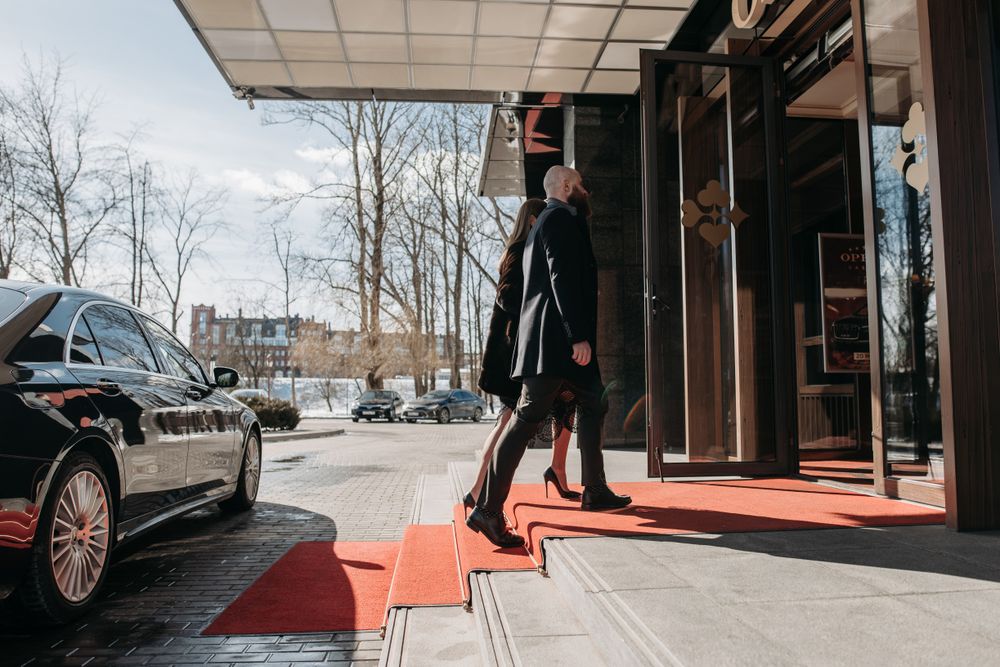
“Stop calling. I’m in a meeting,” my husband snapped.
But at that moment, I was standing in front of the hotel watching him walk in with his mistress.
I didn’t call him again. Not because I was afraid of his temper. David had never frightened me, not really, but because I didn’t need to. In that moment, standing beneath the polished brass canopy of the Hilton Garden Inn off Route 17, everything I needed to know had already unfolded in front of me, slow and precise, like a scene I had somehow rehearsed without realizing it.
The air smelled faintly of citrus and disinfectant, the automatic doors opening and closing behind me as guests passed in and out. Business travelers. A couple with suitcases. A man on his phone speaking too loudly about quarterly numbers. Ordinary life, predictable, safe, except for what I had just seen.
David, my husband of fifteen years, had stepped out of a rideshare car and paused just long enough to adjust his jacket, glancing around, not nervously, not exactly, but carefully, the way a man checks a room before he commits to entering it. Then she appeared from the other side of the entrance. Younger, not dramatically so, but enough. Early thirties, maybe. Dark hair, sleek, deliberate. She didn’t hesitate. She walked straight up to him, close enough that their shoulders touched before either of them spoke. Then they went inside together. No distance, no pretense, no meeting.
I remember noticing something small, almost absurd in its detail, the way his hand brushed lightly against the small of her back as the doors slid open. It wasn’t even intimate in a dramatic sense. It was practiced. Familiar. The kind of gesture that doesn’t ask permission.
I stood there longer than I should have, my phone still in my hand, the screen dimming and lighting again, as if waiting for me to decide what version of reality I was willing to accept.
For a long time, I had told myself that marriage, real marriage, not the kind people post about online, was built on patience, on the quiet work of understanding another person. Over the years, David and I had built something steady. Not perfect, but stable. We had routines, shared accounts, a house in a quiet neighborhood outside Dallas. Weekends that followed a pattern so predictable I could map them out months in advance. Sunday breakfasts at the same diner. Grocery runs on Saturday mornings before the crowds. A glass of wine on the porch most evenings while the light went soft over the yard. Predictability I had always believed was a form of trust.
Now, standing in front of that hotel, I realized something else. It was also a form of blindness. The very rhythm I had mistaken for intimacy had given him cover. A man who never deviated from his patterns was a man no one thought to watch closely. I had been one of those people.
I stepped inside. The lobby was cool, softly lit, the kind of neutral decor designed to offend no one and impress no one either. No sign of David. Of course not. They wouldn’t linger.
I didn’t walk up to the desk right away. Instead, I took a seat, crossed my legs, and placed my phone face down on the table. I let myself breathe slowly, deliberately, because I knew that whatever I did next would matter more than anything I might say in anger.
There are moments when your life shifts not loudly, not with drama, but with a quiet, irreversible clarity. This was one of them.
I thought back over the past few months. The late evenings. The sudden client dinners. The way he had started keeping his phone face down, always within reach. The small irritations I had dismissed because they didn’t fit the version of him I had built over years.
And then there were the finances. That part surfaced more slowly, like something my mind had been avoiding. A few weeks ago, I had noticed a charge on our joint credit card that didn’t quite make sense. A boutique hotel in the city. He had explained it away easily. Something about a last-minute booking when a meeting ran late. I hadn’t questioned it.
Now, sitting in that lobby, I understood how easily trust can be repurposed into something else. Something convenient.
I stood up and walked to the front desk.
“Hi,” I said, keeping my voice even. “I’m trying to confirm a reservation. My husband may have checked in a little earlier.”
“I can certainly try to help, ma’am. Do you have a name?”
“David Carter.”
She typed for a moment, her eyes scanning the screen, then paused. There it was, that subtle shift. Not alarm, not suspicion, just recognition.
“I’m sorry,” she said carefully. “I can’t share guest information without proper authorization.”
“Of course,” I nodded as if I had expected nothing else.
And I did. This wasn’t going to be solved with confrontation at a front desk. It wasn’t going to be resolved by catching him in a hallway. This required something else. Something quieter.
I stepped outside. The late afternoon sun had shifted, casting longer shadows across the parking lot. I leaned against my car for a moment, letting the reality settle, not as a shock, but as a structure I needed to understand before I could dismantle it.
I didn’t drive home right away. Instead, I opened my phone and pulled up our banking app. Joint accounts, savings, credit lines, everything we had built together documented in neat rows of numbers and transactions. I scrolled slowly, and there it was again. The hotel charges weren’t isolated. They formed a pattern. Different dates, different locations, but all within a certain radius. Consistent. Repeated. Intentional.
My stomach didn’t drop. It settled. Because now, for the first time, I wasn’t reacting. I was seeing.
Fifteen years. That’s how long it had taken to build this life. And in less than ten minutes, standing in front of a hotel, I had seen exactly how it could unravel. But I wasn’t going to let it unravel on his terms.
I got into my car and drove in the opposite direction, toward a part of town I hadn’t visited in years, where quiet office buildings sat behind manicured lawns and discreet signage. Places where decisions were made carefully, documented properly, executed without noise.
I parked, turned off the engine, and took a breath. Because if there was one thing I understood now, it was this. What I had seen today wasn’t the end of something. It was the beginning of something else.
And this time, I was going to be the one in control.
I didn’t sleep much that night. Not because I was heartbroken, at least not in the way people imagine, but because my mind refused to stay still. It kept moving, organizing, connecting things I had overlooked for months, maybe longer. Small details I had filed away as coincidence now returning with a different weight.
By morning, I wasn’t asking if something was wrong. I was asking how much.
David left early as usual. He kissed my cheek in the kitchen, a quick practiced gesture, his hand already reaching for his keys. “Big day,” he said, grabbing a travel mug. “Back-to-back meetings.”
I nodded, watching him carefully this time. Not suspiciously, not accusingly, but with a kind of quiet attention I hadn’t used before. It was remarkable how easy it was to miss things when you believed you didn’t need to look.
“Long day?” I asked.
“Yeah. Probably won’t be back until late.”
The door closed behind him, and just like that, the performance ended.
I waited exactly ten minutes before moving. Not because I was afraid he might come back, but because I needed to feel the space settle, needed to shift from the role I had been playing for years into something more deliberate.
I went upstairs. David’s office was at the end of the hallway, a room we rarely used for anything but storage and occasional work calls. He kept it neat, almost aggressively so. Files aligned, drawers closed, everything in its place. It had always struck me as a sign of discipline. Now it felt more like control.
I sat at his desk and opened the top drawer. Nothing unusual. The second drawer held older files, tax returns, insurance documents. But the third drawer was locked. I had never seen him lock anything in this house before.
I stood up and considered it not emotionally, but practically. Whatever was in there mattered enough for him to secure it. I didn’t try to force it open. Instead, I went back downstairs and called the bank.
“Hi. I’d like to review some recent transactions on our joint account.”
The representative was polite, efficient. Within minutes I had access to more detailed records than the mobile app had ever provided. I took notes as we spoke. Dates, locations, amounts, patterns.
The hotel I had seen yesterday wasn’t an isolated incident. There were at least six different charges over the past three months, all in similar ranges, all at mid-tier business hotels within driving distance. Not extravagant. Not reckless. Just careful enough to avoid attention.
Except attention was exactly what they deserved.
And then there was something else. A transfer. Two weeks ago, a significant amount had been moved from our joint savings into an account I didn’t immediately recognize. Not large enough to trigger alarms. Large enough to matter.
I opened my laptop and logged into our shared financial portal. The transfer was there. Destination, a separate account under his name. An individual account. He had opened it recently.
That changed things. Because this wasn’t just about secrecy. It was about planning.
I leaned back, letting the pieces settle into place. The hotels, the late nights, the separate account. Each one could be explained on its own, just barely, but together they formed something else entirely.
Intent. And intent, unlike emotion, leaves a trail.
There was a version of this story where I confronted him immediately, threw the evidence on the table, demanded explanations, forced everything into the open. But that version relied on his honesty, and I no longer trusted that.
I picked up my phone and scrolled to a number I hadn’t called in years.
“Linda,” I said when she answered. “Emily.”
Her voice carried a note of surprise. “It’s been a while.”
“It has. Are you still with the firm?”
“Of course. Why?”
I hesitated just long enough to choose my words. “I need to understand my options. Legally.”
A brief silence on the line. Not uncomfortable. Knowing.
“Come by this afternoon. We’ll talk.”
The office was exactly as I remembered, quiet, understated, efficient. Linda greeted me personally, ushering me into her office with a professionalism that softened slightly once the door closed.
“All right,” she said, taking a seat across from me. “Tell me what’s going on.”
I did. Not everything. Not the emotional weight of it, but the facts. The hotel. The transactions. The separate account. The pattern.
She listened without interrupting. When I finished, she leaned back slightly. “Do you have proof?”
“Some. Not everything.”
“That’s fine. You don’t need everything yet. You need enough.”
“Enough for what?”
“Control.”
The word settled between us.
“Here’s what matters,” she continued. “You’re dealing with two issues. Infidelity and financial activity. The first is emotional. The second is legal. And in situations like this, the second one is what determines outcomes.”
“What do I do?”
“You don’t confront him. Not yet. You gather. You document. You understand exactly what you’re dealing with before you make any moves.”
“And the account?”
“We’ll look into it. If funds were moved improperly, that becomes important. Very important.”
I exhaled slowly. For the first time since standing outside that hotel, I felt something shift. Not relief, not exactly, but direction.
“This isn’t about catching him,” Linda said, as if reading my thoughts. “It’s about positioning yourself.”
I stood up to leave. She handed me a folder.
“Start here,” she said. “And Emily. Don’t underestimate how much you don’t know yet.”
The next forty-eight hours unfolded with a kind of quiet precision I didn’t recognize in myself before. I moved through my routine as usual, but beneath it, everything had shifted. Every word, every glance, every silence. I was paying attention now. And when you start paying attention, patterns don’t just appear. They sharpen.
David’s schedule, once I stopped taking it at face value, was almost too predictable. The late meetings clustered around certain days, Tuesdays, Thursdays, always within the same time window. The hotel charges aligned with those days. The separate account showed transfers just before them. It wasn’t chaotic. It was structured, which meant it could be mapped.
On Thursday afternoon, I drove back to the hotel. This time I went in with a plan.
The same receptionist was behind the desk, looking tired, the end of a long shift settling into her posture.
“Hi,” I said, offering a small measured smile. “I was here a couple of days ago.” I placed a sealed envelope on the counter, not sliding it toward her, just letting it sit there between us. “I don’t need information. I don’t need confirmation. I just need this to be handed to my husband when he checks out.”
“I can’t guarantee.”
“I understand. But if he checks out tomorrow morning, and he will, this will make sense.”
She looked at me for a long moment. “What’s his name?”
“David Carter.”
She reached for the envelope. “I can leave it with his room number. But I can’t confirm anything beyond that.”
“That’s enough.”
I didn’t go home right away. Instead, I drove a few blocks and parked where I could see the hotel entrance from a distance. I sat there for nearly an hour, the engine off, the late afternoon light fading slowly into early evening. Then I saw him.
David stepped out of the same rideshare service, dressed differently this time, more casual, but the outcome was the same. She met him at the entrance. No hesitation. They went inside together.
I didn’t feel anything sharp. No surge of anger. Just confirmation. I started the car and drove away.
The envelope had taken less time to prepare than I expected. Inside, I placed three things. First, copies of the financial statements, highlighted, organized, impossible to misinterpret. Second, a printed consultation summary from Linda’s firm, not a formal filing yet, but enough to make one thing clear: this was no longer private. And third, a single sheet of paper. No paragraphs, no accusations. Just one sentence.
I know everything, and I’m done protecting you.
I didn’t sign it. I didn’t need to.
The next morning, I woke up before David. I moved through the house quietly, making coffee, letting the routine settle into place again. When he came downstairs, he looked exactly the same as always.
“Morning,” he said, pouring himself a cup.
“Morning.”
No tension. No indication that anything had changed, because for him it hadn’t. Not yet.
He left around eight, the same way he always did. I waited five minutes, then picked up my phone. The call came sooner than I expected. Just after nine. David’s name flashed on the screen. I let it ring once, twice, three times. Then I answered.
“Hello.”
A pause long enough that I could hear his breathing uneven. “Emily,” he said. Just my name, nothing else.
“What is this?” he asked finally.
Not anger. Not denial. Confusion.
“Check the envelope again,” I said quietly.
“I don’t understand.”
For the first time since all of this began, I almost smiled, because that was the truth. He didn’t understand. Not yet.
“You will,” I replied. Then I hung up.
He came home less than twenty minutes later, faster than I expected. The front door opened hard, not violently, but with urgency. I stayed in the kitchen. When he appeared in the doorway, the envelope was still in his hand, slightly crumpled, the edges no longer neat. His face wasn’t anger. It wasn’t even fear. It was something closer to realization.
“You went through my accounts?”
Not, did you see her? Not, what is this about? That was his first question.
“Is that what concerns you?” I asked.
He stared at me, searching for an opening, a weakness, a version of this conversation he could control. But that version didn’t exist anymore.
“You don’t understand,” he said quickly. “It’s not what it looks like.”
“Then explain it,” I said calmly.
He opened his mouth, closed it again, because explanations require coherence, and lies once exposed rarely have that.
The silence stretched between us. And in that silence, something shifted. Not loudly, not dramatically, but permanently. For the first time in our marriage, David wasn’t the one controlling the narrative. I was.
He took a step forward, his hands open at his sides like a man approaching something that might startle. “Emily. We need to talk.”
“Yes,” I said. “We do.”
We stood there for a long moment, facing each other across the kitchen. Two people who had shared fifteen years of life, now separated by something neither of us could pretend away anymore.
David set the envelope down on the counter, smoothing it instinctively. “Emily. You’re jumping to conclusions.”
“I’m not jumping anywhere. I followed a pattern, and it led me exactly where it was supposed to.”
“This isn’t what you think it is.”
“Then say what it is.”
Another pause. Another calculation, because now he had to decide which version of the truth he could afford to tell.
“It’s complicated,” he said finally.
“No. It’s not.”
That was the first moment he looked unsettled, not by what I knew, but by how I was responding. There was no anger to deflect, no emotional surge to manage, just clarity. And clarity leaves very little room to hide.
“You went through my accounts,” he said again, returning to the point that mattered most to him.
“I reviewed our finances.”
“The ones with my name on them.”
“That money is still ours,” he said quickly.
“For now.”
The words landed harder than I intended, but I didn’t take them back.
“Emily, we can fix this,” he said, his voice softening into something almost familiar. “We’ve been through worse.”
I thought about that. The years we had built together, the small arguments, the reconciliations, the quiet understanding that comes from long-term partnership. There had been difficulties, yes, but they had always existed within the same structure. This was different.
“This isn’t something that broke,” I said. “This is something you built.”
He flinched. Just slightly. But enough.
“I made mistakes,” he said, shifting his approach. “I admit that. But it doesn’t mean everything is over.”
“Mistakes happen once. Patterns happen by choice.”
We moved to the living room, not because it made the conversation easier, but because it gave us physical distance to match what had already formed between us.
“Okay,” he said, leaning forward, elbows on his knees, as if resetting the conversation. “Let’s just talk about this rationally. The account. You’re making it sound worse than it is. I needed flexibility for some investments. It was easier to separate certain funds.”
“Without telling me.”
“It wasn’t intentional. Things moved faster than I expected.”
I watched him carefully. The words were structured, but the logic wasn’t.
“And the hotels?” I asked.
He hesitated longer this time. “That’s separate.”
“Is it?”
Another silence.
“I didn’t plan for any of this,” he said finally, his voice quieter now. “It just happened.”
There it was. The version of events that reduces deliberate actions into accidents.
“I don’t believe you,” I said.
The statement wasn’t loud. It didn’t need to be, because belief once withdrawn doesn’t come back easily.
He leaned back, exhaling slowly. “What do you want?” he asked.
A different question. A practical one. For the first time, we were having the same conversation.
“I want clarity,” I said. “And I want control over what happens next.”
“We can work this out.”
“No,” I said, shaking my head slightly. “We can’t. I spoke to an attorney yesterday.”
The air in the room shifted instantly. Whatever assumptions he had been operating under about reconciliation, about negotiation, they no longer applied.
“You did what?”
“I got information. That’s all.”
“Emily, that’s not necessary. We don’t need to involve”
“It already is.”
“Are you serious?”
“Yes.”
The next few days unfolded in a way that felt both surreal and entirely logical. David moved through the house carefully, as if every step might trigger something unpredictable. His calls were quieter. His phone was no longer left unattended. The casual familiarity that had once defined our interactions was replaced with something more measured, something cautious.
A week later, we met with Linda. David arrived tense but composed, his demeanor shifting into something more formal as soon as we entered the office. This was his environment: contracts, negotiations, structured conversations. He understood these rules, or thought he did.
Linda laid out the facts clearly. The financial records. The transfers. The obligations tied to our shared assets. Nothing exaggerated, nothing emotional, just reality.
David listened, his expression tightening with each point. “This is unnecessary,” he said. “We can settle this privately.”
“That depends,” Linda replied calmly, “on what your definition of settle is.”
He hesitated, because now, for the first time, the situation wasn’t abstract. It had structure. Consequences.
“You’re overcomplicating this,” he said finally.
“No. We’re clarifying it.”
When we left the office, he turned to me in the parking lot. “This isn’t what you want.”
I looked at him for a long moment. “Yes,” I said quietly. “It is.”
Because in the end, this wasn’t about destroying his life. It was about taking mine back.
The house sounded different once the paperwork began. Not quieter, just clearer. Every room held its shape without the soft noise of assumption, without the small automatic adjustments I used to make to accommodate someone else’s habits. Mornings were simpler. One cup of coffee. One light. One unlocked door. It wasn’t loneliness. It was precision.
David moved out two weeks after the meeting with Linda. There was no scene, no shouting. We scheduled it like everything else had become: time blocks, lists, signatures.
“I’ll come back for the rest next weekend,” he said at the door, his voice measured.
“That’s fine.”
He lingered for a second, looking past me into the house. “Emily. We don’t have to finalize everything this quickly.”
“We’re not rushing,” I said. “We’re being clear.”
He nodded slowly and left. The door closed behind him, and for the first time in years, the silence that followed wasn’t waiting for something. It simply existed.
The legal process moved forward with a steady rhythm. Documents filed, disclosures exchanged, numbers reviewed and re-reviewed. Linda kept everything structured, efficient, unemotional, which mattered because emotion complicates clarity. The financial picture, once fully laid out, was exactly what I had expected and slightly worse than I had hoped. The separate account had grown faster than I realized. Gifts. Travel expenses. Small but consistent withdrawals that added up to something significant. Not devastating, but deliberate.
David didn’t deny any of it once the documentation was complete. Denial requires uncertainty, and there was none left.
“I wasn’t trying to hide anything from you,” he said during one of the final meetings, his tone quieter now.
“You just didn’t want me to see it,” I said.
He didn’t respond, because the distinction didn’t help him.
I saw her once more. Not by accident, not exactly. It was late afternoon, a grocery store near my office. I was in the produce section when I noticed her at the end of the aisle, examining a display of packaged salads. She looked the same. Composed. Intentional. Unaware.
For a moment, I considered walking away. There was nothing to gain. But then she turned slightly and our eyes met.
“Excuse me,” I said, stepping closer.
She looked up, polite but distant.
“You were at the Hilton on Route 17. Last Thursday.”
The shift was instant, not dramatic, but unmistakable. “I think you have the wrong person.”
“I don’t.”
A pause. “I don’t know what you’re talking about.”
“His name is David Carter,” I continued. “He’s my husband.”
There it was. The moment. Not explosive, not theatrical, just real.
Her expression changed not into guilt, exactly, but into something more practical. Understanding. Distance.
“I didn’t know,” she said.
I believed her. Not completely, but enough.
“That doesn’t change anything,” I replied.
“No,” she agreed quietly. “It doesn’t.”
We stood there for a moment, surrounded by ordinary life, shopping carts rattling past, overhead announcements about a sale on produce, the hum of refrigeration units, two people connected briefly by a situation neither of us had created alone.
“I’m sorry,” she said finally.
I nodded. “Take care of yourself,” I replied, and then I walked away.
Because closure doesn’t always come from confrontation. Sometimes it comes from recognizing that the other person was never the center of the story.
The divorce was finalized three months later. There were no surprises, no last-minute reversals. Assets divided. Accounts settled. Obligations assigned. Fair. Not perfect, but fair.
David tried once to reach out after it was done. A message. Simple. I never meant for it to end like this.
I read it. Then I set my phone down, because intent doesn’t undo action and understanding doesn’t restore trust.
Life didn’t transform overnight. There was no dramatic reinvention, no sudden clarity about the future. Instead, there was something quieter, a gradual return to myself. To decisions made without negotiation. To days that unfolded without the need to interpret someone else’s behavior.
I repainted the living room, not because I needed a change, but because I wanted one. I chose the color myself, stood in the paint aisle for twenty minutes without anyone waiting on me, without anyone half listening while checking their phone. I started taking morning walks, something I had always postponed for a more convenient season that never arrived. I met friends I hadn’t seen in years, conversations picking up where they had left off as if time had simply paused, waiting patiently for me to come back to myself.
People talk about revenge as if it’s loud, as if it requires confrontation, destruction, some visible act that proves a point. But what I learned was different. Real revenge, the kind that lasts, is quiet. It’s the moment when you stop protecting someone who is willing to let you carry the burden alone. It’s the decision to move forward without needing them to understand what they lost. And most of all, it’s choosing not to become the person who hurt you.
I didn’t destroy David’s life. I didn’t need to. He made his choices, and I made mine.
The difference was I chose to see the truth. And once you see it, you can’t go back.
You can only move forward.

Laura Bennett writes about complicated family dynamics, difficult conversations, and the quiet moments that change everything. Her stories focus on real-life tensions — inheritance disputes, strained marriages, loyalty tests — and the strength people find when they finally speak up. She believes the smallest decisions often carry the biggest consequences.