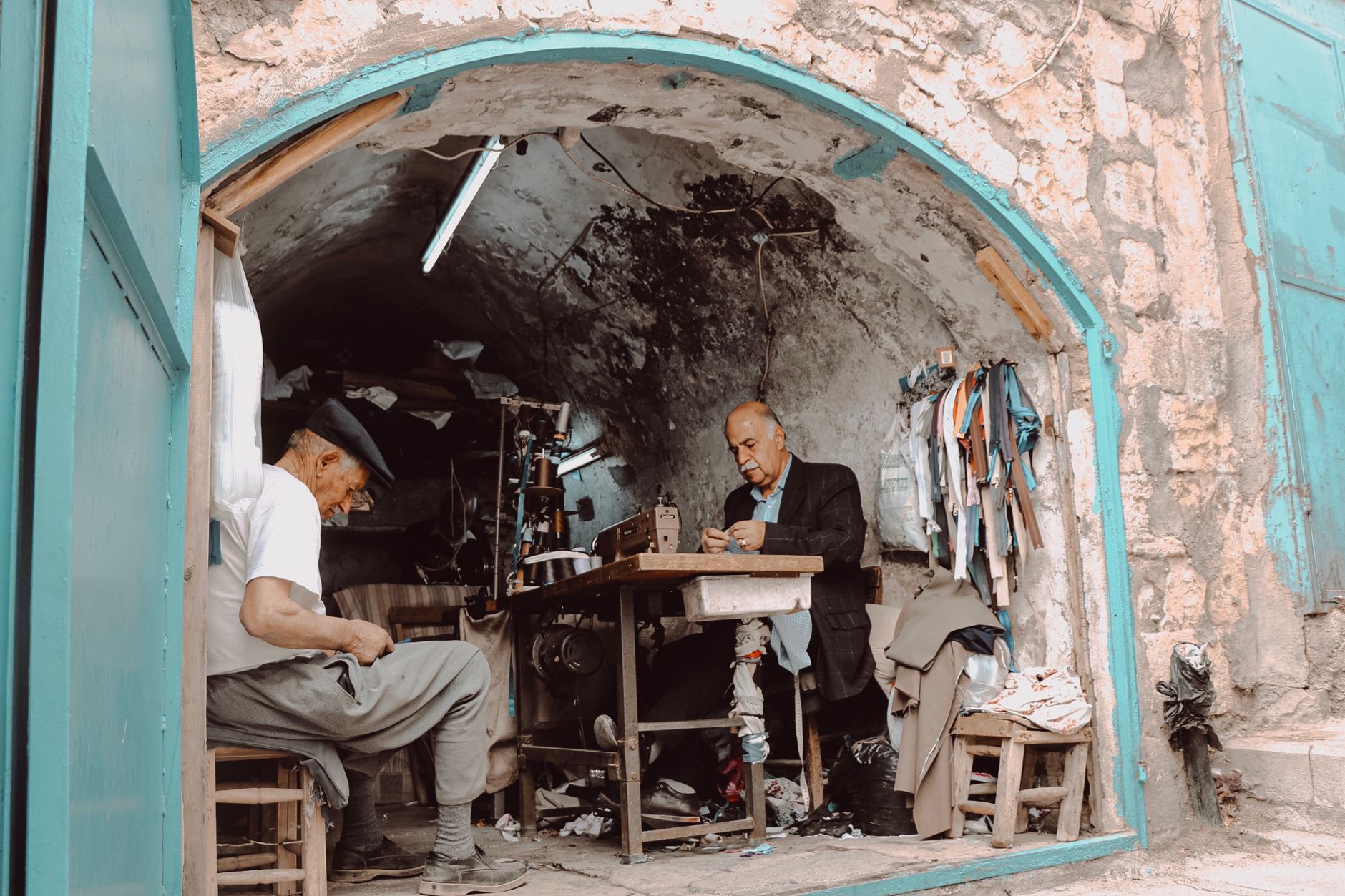
The first time Odette Marchetti made me feel small, she did it with a smile and a pair of reading glasses she did not need.
I was sixty-one years old and standing in the front room of her boutique on the square in Halvorsen, the county seat, the kind of town where the courthouse clock has been four minutes slow since the Carter administration and nobody has the heart to fix it. I had walked in carrying a garment bag over my arm because I had heard, from Wenna Pruitt at the feed store, that the new boutique owner was looking for someone to take in alterations. Wenna said the woman had moved up from the city, leased the old Krauss building, hung a French name on the door, and was charging the kind of prices that made farm wives suck their teeth.
I had altered clothes in this county for thirty-eight years. Hems and seams and wedding gowns and the funeral suits of men who had shrunk inside them. I had a treadle machine my mother left me and a newer Bernina I had saved two winters to buy. I figured a boutique that did not do its own alterations might want a woman who did. I figured wrong about how she would receive me, but right about everything that came after, though it took me the better part of a year to know it.
Odette took the garment bag from me the way you take a wet umbrella from a stranger. She unzipped it on her marble counter and lifted out the sample I had brought, a wool coat I had recut for a banker’s wife the spring before, taken from a boxy size sixteen down to something that fit the woman like it had been born on her. I was proud of that coat. The collar rolled just so. The bound buttonholes were hand-stitched, every one, because I do not trust a machine with a buttonhole the way I trust my own fingers.
She put on the reading glasses. She turned the coat inside out. She ran one manicured nail along my seam allowance, and then she looked up at me over the top of those glasses, and she said the line I have repeated to myself ten thousand times since.
“This is competent,” she said. “For a barn. People up here don’t know better, so I suppose it sells. But I have standards, Mrs. Tibbetts. My clientele expects couture, not 4-H.”
Nessa Tibbetts is my name. I have been called many things in this life. I have been called a widow and a churchwoman and the woman who took in the Loomis boys when their mother went away, and I have answered to all of them with my chin up. But I had never, not once, been called 4-H like it was something to wipe off a shoe.
I took my coat back. I zipped the bag. I said, “Thank you for your time,” because my mother raised me to be polite to people who were not, and I walked out onto the square where the courthouse clock said it was twenty minutes past a time it was not, and I sat in my Buick for a while before I could trust myself to drive.
I want to tell you I went home and plotted my revenge. I did not. I am not built for revenge, and anyway revenge is a young woman’s hobby. What I did was go home to the little house on Querry Street that my husband Ansel left me when his heart quit at the co-op, and I made myself a cup of coffee, and I cried a little, the cheap kind of crying that is mostly about being tired, and then I did what I have always done.
I went to work.
—
You have to understand what Odette Marchetti walked into when she came to Halvorsen, because she never bothered to learn it, and that was the whole of her undoing.
This is corn-and-soybean country, flat to the four horizons, the kind of place where the radio gives you the hog report before the weather. We have one stoplight downtown and a second one out by the new Casey’s that the old-timers still call new though it has been there twenty years. The boutique sat on the south side of the square between Lindqvist Drug and the insurance office. Across from it was the diner, the Bluebird, where I have eaten a patty melt every Thursday since Ansel passed because Thursday was our day and I will not give it up.
The women of this county do not buy couture. They buy a good dress for their granddaughter’s confirmation and they want it to last and they want it to fit, and when it does not fit they bring it to someone like me. That has always been the arrangement. The big store in the city sells you the dress. The woman down the road makes it fit your actual body, the one that carried four babies and lifted forty years of feed sacks and has the right hip that aches before a rain.
Odette did not see any of that. She saw a town she could improve. She filled her windows with stiff little jackets nobody around here had an occasion to wear, and she priced them like she was still on a city avenue, and the farm wives came in once out of curiosity and never came back. But here is the thing about a town like ours. We are polite. Nobody told Odette her store was failing. They just stopped coming, the way water stops coming up a dry well, quietly and all at once, and she did not notice for the longest time because she had decided in advance that we were too simple to know quality when we saw it.
I went back to my own work. I had a steady trade out of my front room. The sign by my door is the same hand-painted board Ansel made me the year we married: TIBBETTS ALTERATIONS, and under it, smaller, Mending and Made-Over. People knew where to find me. They had known for thirty-eight years. The school called me when the marching-band uniforms split. The funeral home called me, quietly, when a family brought in a suit two sizes too big for the man it was meant to bury, and I would sit up half the night taking it in so that a son could say goodbye to a father who looked like himself. The Bluebird called me when their waitresses’ aprons wore through. I was not couture. I was the thread that held the town’s clothes, and its bodies, together.
Let me tell you about one of those nights, so you understand what I mean when I say I held the town together, because it is easy to say and harder to know.
In the August before Odette came, old Mr. Bittrich died. He had farmed out on the Halvorsen blacktop his whole life, eighty-some years, and like a lot of men out here he had gotten thin at the end without anyone quite admitting it, the way a strong man will hide inside his own clothes so his wife does not fuss. When his family brought his good suit to the funeral home it hung on him in the casket like a flag on a still day. His daughter Marisol came to me at nine o’clock on a Tuesday night, knocked on my door at Querry Street with the suit over her arm and her eyes swollen shut from two days of crying, and she said, “Mrs. Tibbetts, the viewing is tomorrow at eleven and my daddy looks like a stranger.”
So I sat up. I took that suit in at the shoulders and the sides, working by the lamp at my treadle, slow, because you cannot rush the wool of a dead man’s suit, it has to be done by hand and it has to be done with respect, and I thought about Mr. Bittrich the whole time, who used to bring me sweet corn off his truck and would not take a dime for it. I finished at half past three in the morning. Marisol came at seven. She took the suit to the funeral home, and at eleven o’clock old Mr. Bittrich lay in his casket looking like himself, like the man who farmed the blacktop, and three hundred people filed past and not one of them knew that the seamstress on Querry Street had spent the night making sure of it. That is the work. That is what Odette Marchetti called 4-H. She had never sat up till three with a dead man’s suit in her lap. She did not know that there is a kind of sewing that has nothing to do with couture and everything to do with letting a daughter say goodbye to a father who looks like her father. I knew it. The whole county knew I knew it. And a county does not forget a thing like that, not ever, not for a French name and a marble counter.
What I did not have, after the day in Odette’s boutique, was any plan at all to compete with her. I assumed she would do fine. City woman, fancy store, French name. I assumed she would skim off the few well-off families in the county and I would go on hemming choir robes, and our paths would never cross again.
Then in October the Vandersloot wedding happened, and everything I assumed went out the window.
—
Imelda Vandersloot was getting married in November, which is a foolish month for a wedding in this state but she was marrying a man who farmed and you do not get married during harvest, so November it was, the slack week between the combines coming out of the fields and the first hard freeze.
Imelda had bought her gown from Odette. The whole town knew it, because Imelda had told the whole town, the way a young bride does. She had paid more for that dress than her mother Saretta paid for her first car, and Saretta told me so herself, standing in my front room three days before the wedding with the gown over her arm and a look on her face like she had swallowed a wasp.
“Nessa,” she said, “I need you to save this dress, and I need you to never tell a living soul I was here.”
The gown was a disaster. Not the fabric, the fabric was beautiful, but the fit was a crime. Odette had sold Imelda an off-the-rack sample and promised to alter it herself, and then she had taken it in all wrong, pulling the bodice so the seams stood away from the body in little tents, hiking the hem crooked so it dipped a full inch on the left, and worst of all she had cut, actually cut, into the seam allowance so there was almost nothing left to let out. The girl could not breathe in it. She had a fitting that morning and had cried in the dressing room, and Odette had told her, told a bride three days from her wedding, that the problem was the girl’s posture.
I have a temper. I keep it folded up small and put away, like good linen, but I have one, and it came out of the drawer that afternoon. Not at Saretta. At the work. At a woman who would call my hand-bound buttonholes 4-H and then do that to a child’s wedding gown.
I told Saretta to leave the dress and go home and not to worry. Then I did not sleep for two nights.
I let out what could be let out. Where Odette had cut into the allowance and there was nothing left, I did the thing you are not supposed to be able to do, I built it back, setting in narrow gussets of matching fabric I found by writing the mill in the city that morning and paying for next-day shipping out of my own pocket, hidden under the boning where no eye but God’s would ever find them. I rehung the hem true. I reset the bodice so it lay against the body the way the designer drew it before Odette got her shears on it. I worked at my mother’s treadle for the fine seams because the rhythm of it steadies my hands, and I finished Imelda Vandersloot’s gown at four in the morning on the day before her wedding, and when Saretta came to fetch it she put it on her daughter in my front room, and that girl looked in my mirror and she did not cry. She laughed. She turned around and around and she laughed like a child, and Saretta gripped my arm so hard she left a mark, and neither of us said the name of the woman who had nearly ruined it.
But you cannot keep a thing like that quiet in Halvorsen. A wedding is a public event. Two hundred people saw Imelda Vandersloot come down the aisle of First Lutheran in a gown that fit her like water, and at the reception in the VFW hall, with the hog roast going and the band tuning up, Saretta had three glasses of the good wine and she told her sister, and her sister told the choir, and by Monday the whole county knew two things. One, that the boutique gown had been a ruin. Two, that Nessa Tibbetts had saved it overnight.
I did not say a word about it. I have never had to. In a town this size your work talks for you, and it does not lie, and it does not forget.
—
That was the beginning of the turn, though I want to be honest with you, it did not feel like a turn at the time. It felt like one more late night and one more dress. The thing about an earned reputation is that you cannot see it the way the town can. You are too close to it. You are just doing the next hem.
But the town could see it. And the town began to move.
It started small. Birdie Halloran, who runs the Bluebird, took down the little card by her register that had Odette’s boutique number on it for “wardrobe emergencies” and wrote out my number on the back of an order ticket and taped it up instead. The funeral home, which had quietly always used me, started saying my name out loud to grieving families instead of just handing them my card, because grief makes people forget a card but they remember a name a man says while he shakes their hand. The high-school drama teacher, a young fellow named Cosmin Drozd who had come from two counties over and did not know the old arrangements, asked around about who could build him eighteen costumes for the spring play on a budget of nearly nothing, and four different people told him the same name before he had finished asking the question. He came to my front room and we did it together, him hauling bolts of cheap muslin and me making them look like brocade, and that boy told everyone at the school that the seamstress on Querry Street was a magician.
There was the matter of the Knutson twins, too, which I should tell you, because it is the kind of small thing that a town stacks up into something large. Berdina Knutson had two girls graduating the same spring, and she could not afford two new dresses, so she brought me one dress and asked, half-ashamed, whether there was any way on earth to make it work for both ceremonies, the one girl being tall and the other built like their late grandmother, short and strong. I told her to leave it with me. I made that one dress into two, taking the extra from a length of fabric Berdina did not know I had been saving, and I did not charge her for the second because I had the cloth and she had the worry, and worry is dearer than cloth. Berdina cried in my front room. Then Berdina went to church and to the elevator and to the school and to the auxiliary, and Berdina told the story of the two dresses to anyone who would hold still, and that is four more lines in a ledger I could not see, written in a hand I never held.
I did not feel like a magician. I felt like a sixty-one-year-old widow with a sore right hip whose front room smelled permanently of pressing cloth and machine oil. But something was happening that I could not see from inside it. My name was traveling. Not on a sign, not in an ad, I have never bought an ad in my life, but mouth to mouth, the way every true thing travels in a county like this, from the feed store to the church basement to the line at the pharmacy.
And the same network that was carrying my name was carrying hers, in the other direction.
Because here is what nobody tells you about a small town, and what Odette Marchetti, city woman, never understood. The same web of talk that builds you up is the one that takes you down, and it keeps perfect books. Every farm wife who walked into that boutique and got the over-the-glasses look. Every bride who heard what happened to Imelda. Every woman who had ever been made to feel like 4-H by a stranger who had been here eighteen months, all of them were a single ledger, and the ledger was filling up, line by line, and Odette could not read it because she had decided we could not write.
—
By spring her windows were not changing as often. By summer there was a hand-lettered SALE sign in the boutique that did not match the French elegance of the rest of the store, the way a hem does not match when it is taken up in a hurry. The well-off families she had counted on turned out to be exactly the families with the longest memories, because money in this county is old and quiet and married into everything, and those women had not forgotten how she talked to their cleaning ladies and their daughters-in-law. The Vandersloots banked at the same bank as half the county. Saretta sat on the hospital auxiliary with women whose husbands owned the elevator and the implement dealership and three thousand acres apiece, and those women asked Saretta where she got Imelda’s gown saved, and Saretta, God bless her loud and loyal heart, told them every single time.
I was getting busier than I had been in years. I had to start telling people no, or telling them to wait, which I had never done. I took on Loomis’s youngest, the girl Tansy whom I had half-raised, and taught her to run the Bernina while I did the handwork, and for the first time since Ansel died there were two of us in that front room, and it sounded like something living again, two machines going and a radio low and a kettle on.
I would like to tell you I never thought about Odette in those months. That would be a lie. I thought about her every time my hip ached at the machine past midnight, finishing work she would have called 4-H. I thought about her the way you worry a sore tooth with your tongue. But I never went near her store, and I never said her name in anger to a soul, because I had learned a long time ago, burying a husband and raising other women’s children, that the best answer to being told you do not matter is to simply keep mattering, quietly, in front of everyone, until the truth of it is too heavy for anyone to lift.
The reckoning, when it came, did not come from me. That is the part people do not believe when I tell it. I did not engineer one thing. The town did it, the way a town does, slow and then sudden.
—
It was a Thursday in September, almost a year to the day from when she called my work 4-H, and I was at my booth at the Bluebird eating my patty melt when Odette Marchetti walked in.
I had never seen her anywhere but behind her marble counter. She looked smaller out in the world. She had a garment bag over her arm, and I knew the posture of a woman carrying work she cannot do, because I had watched Saretta carry it through my own door, and I felt something I did not expect to feel, which was not triumph. It was recognition.
She did not see me at first. She went to the counter and asked Birdie, in a voice that had lost some of its city polish, whether Birdie knew of anyone, anyone at all, who could do fine alterations, because she had a customer, an important customer, a judge’s wife from the city who summered at the lake, and the woman needed a gown taken in for a gala and Odette could not, she said, she could not get it right, the fabric was difficult, and she needed someone who really knew how.
And Birdie Halloran, who had taken Odette’s card down off her register a year before and put up mine, looked at that woman for a long moment. Birdie is not cruel. Birdie has fed this town through three recessions and a flood. She did not gloat. She just reached under the counter and brought up the order ticket with my number on the back, the one that had been taped there for a year, soft and brown at the edges now from a thousand hands, and she said, “There’s only one person in this county does work like that. She’s sitting right behind you.”
I watched Odette Marchetti turn around. I watched her see me. I watched a year of the town’s bookkeeping arrive in her face all at once.
She knew me. Of course she knew me. You do not call a woman 4-H and then forget her. The reading glasses were not on her face this time. There was nothing between us but the steam off my coffee and a year of everything she had not bothered to learn.
I could have said any number of things. I had rehearsed a few, in the dark, the way you do. I could have said, “For a barn, I suppose I do all right.” I could have made her stand there in front of Birdie and the breakfast crowd and the hog report on the radio and eat every word.
I did not. Not because I am a saint. I am not. But because by then I did not need to. The whole room had already said it for me, just by being the room it was, a room where my number was taped to the register and hers was not. Cruelty would have been hot, and it would have made her the wronged one, and I had not spent a year being quiet to hand her that at the finish.
So I set down my fork, and I wiped my mouth, and I said, “Bring it by Querry Street this afternoon. I’ll have a look at it.”
That was all. Bring it by. I’ll have a look. The most ordinary thing one seamstress says to another, except one of us had once been told her hands belonged in a barn, and now the other one was carrying her finest customer’s gown across the square to that barn’s door, because there was nowhere else in the county left to take it.
She brought it. Two o’clock, the garment bag held against her like a child. She stood in my front room, under Ansel’s hand-painted sign, with my mother’s treadle in the corner and Tansy’s Bernina humming and the smell of pressing cloth thick in the air, and she watched me turn the judge’s wife’s gown inside out and run one finger along the seam, the very gesture she had used on me a year before, except I was not looking for something to mock. I was reading the work the way you read it when you actually know how, finding where it could give and where it could not, and I told her, plainly, professional to professional, what could be done.
She said, very low, not quite looking at me, “I never learned to build a gusset like the one in the Vandersloot dress. I heard about it. The whole town heard about it. I came here a year ago thinking I had nothing to learn from any of you.”
I let that sit. I did not rush to fill it. Then I said, “You can stay and watch how I set it, if you like. It’s not couture.” I let myself have that one. “It’s just competent. But it’ll hold.”
She stayed. She watched me work for two hours, the city woman and the barn seamstress, and somewhere in the second hour she stopped being my enemy and became just a tired person who had picked a fight with a town and lost, which is a thing I understood, because I had been a tired person plenty of times myself, only I had never been fool enough to pick the fight.
—
The boutique closed before Christmas. I did not celebrate. There is no joy in watching a store go dark on the square, even one with a French name, because a dark window on the square is bad for all of us. The Lindqvists worried about their drugstore. Birdie worried about the foot traffic. A town wants its square full, not empty, and I am of this town, so I worried too.
But here is the part I tell the young ones, Tansy and the Loomis girls and anybody who comes to my front room low because somebody made them feel like 4-H. I did not beat Odette Marchetti. I want to be clear about that, because the story gets told around here now and it grows in the telling, and I have heard versions where I stood up in the Bluebird and dressed her down to the studs, and that is not what happened and I correct it every time. I did not beat her. The town did, and the town did it with its memory, which is the longest and most honest thing a small place owns.
She told me my work belonged in a barn. So I let the whole county decide whether that was true. I did not argue the point. I just kept setting true hems and building hidden gussets and sitting up till four in the morning so a son could bury a father who looked like himself, and I let every one of those nights write a line in the ledger that everyone in this county keeps and nobody ever shows you. And when the ledger was full, it did not need me to read it out loud. It read itself, in a diner, on a Thursday, in front of God and Birdie Halloran and the hog report, and all I had to do, the only thing left for me to do, was to be the woman whose number was taped to the register and say, kindly, to the woman whose was not, bring it by, I’ll have a look.
I am sixty-three now. Tansy runs half the trade and is better at the Bernina than I ever was. The sign still says TIBBETTS ALTERATIONS, Mending and Made-Over, and Ansel’s hand is still in the paint. The other day a young bride from two counties over drove an hour to my front room because someone, somewhere, had told her there was a woman in Halvorsen who could save any gown, and she did not know any of the rest of it, the boutique, the barn, the year I went quiet. She just knew the name. The name had traveled to her the way true things travel here, mouth to mouth, over a year and forty miles, and arrived without a single word of mine attached to it.
That is the only revenge worth having. Not a scene in a diner. Not a French store gone dark. Just your name, said true, by a town that keeps its own books and settles its own accounts, traveling on past you into rooms you will never enter, doing the one thing your work was always for.
Holding something together.

Laura Bennett writes about complicated family dynamics, difficult conversations, and the quiet moments that change everything. Her stories focus on real-life tensions — inheritance disputes, strained marriages, loyalty tests — and the strength people find when they finally speak up. She believes the smallest decisions often carry the biggest consequences.