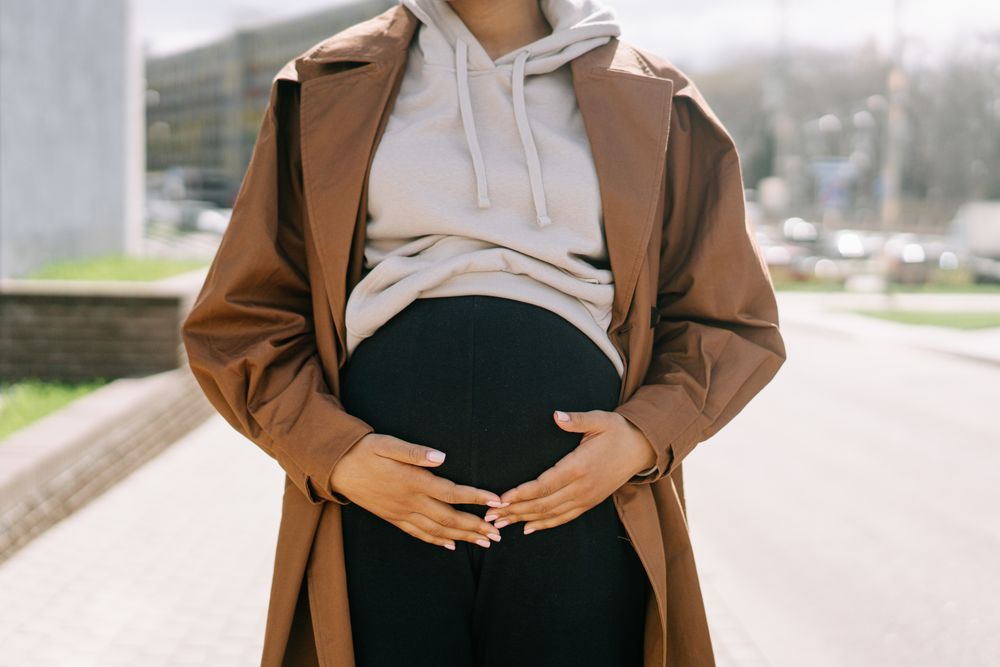
The doorbell rang once, sharp, and for a moment I thought I had imagined it.
Then another contraction tore through me so violently that my vision blurred. I collapsed against the side of the couch, clutching my stomach, pressing my forehead to the cushion and trying to breathe through something that felt less like pain and more like the world coming apart at its seams.
The bell rang again.
I dragged myself across the floor toward the front door. Every movement sent a new wave of agony through my body. The door looked impossibly far away. I thought several times that I would not reach it.
When I finally unlocked the deadbolt and pulled it open, a man in a dark uniform stood on the porch. Not a police officer. A paramedic. Behind him sat an ambulance. The relief hit me so hard that my eyes filled before I could stop them.
He took one look at me and his expression changed completely. “Ma’am, are you alone?”
I nodded.
Within seconds, two more medics came inside with equipment. One of them looked down and said something low and sharp. There was blood on the floor. Not a small amount. A dangerous amount.
“What happened?” he asked.
“My husband,” I managed. “He left.”
The medics exchanged a look. One immediately grabbed his radio. “Dispatch, we have a high-risk twin pregnancy, possible emergency delivery. Patient appears abandoned and showing signs of severe distress.”
Abandoned. The word passed through me like something with edges. It was exactly the right word. They loaded me onto a stretcher, and as they wheeled me out of the house, I looked back at the living room. The scattered medical papers. The soaked carpet. The overturned chair. The trail of blood from the kitchen. It looked like the scene of something violent, and in a way it was, though the violence had been quieter than a crime scene photograph could capture. The violence had been a decision made hours earlier by people who drove away with shopping bags.
The twins arrived three hours later by emergency C-section at Mercy General. Tiny and fragile, but alive. Both alive. The first time I heard them cry, I came apart completely, not from the pain or the fear, but from the particular relief of knowing they had survived the people who should have protected them. The surgeon told me afterward that another thirty to forty minutes might have cost one or both babies their lives. I stared at the ceiling after he left, and then I asked for my phone.
I did not call Blake. I did not call Diane. I called my attorney.
Blake returned home at 9:47 that night. He still had mall bags hanging from his arms. Diane was laughing about something. His sister carried three shopping bags. His father held a box of new shoes. The front door swung open, and they froze.
The living room looked the way it does in photographs taken before the police close the scene. Blood stained the carpet. Medical paperwork covered the floor. A broken lamp lay beside the couch. A paramedic had left behind an emergency trauma wrapper near the hallway. No lights were on. No television. No sound. No me. No babies. Nothing.
Blake dropped his keys. He called my name. When silence answered, the panic started. He ran through the house, kitchen to bedroom to bathroom to garage, and found nothing. Then he noticed what was sitting on the dining table. A white envelope with his name written across the front.
His hands shook as he opened it.
The first line read: “Doctors have informed me that another delay could have killed me and our children.”
By the second paragraph, his knees gave out. The shopping bags slipped from Diane’s hands. His father went still. Because behind the letter was another document, an official report from Mercy General, with one line underlined in red: PATIENT ARRIVED IN CRITICAL CONDITION. PREGNANCY COMPLICATIONS EXACERBATED BY DELAYED EMERGENCY TRANSPORT.
Blake stared at those words for a long time. Then his phone rang.
He answered immediately. The voice on the other end was calm, professional, and entirely without warmth.
“Mr. Harrison?”
“Yes.”
“This is Attorney Michael Reynolds. I represent your wife.” A pause. “My client has requested that all future communication go through legal counsel. We also advise you not to attempt contact with the hospital nursery. Hospital security has been informed.”
Blake’s breathing stopped. Diane stepped forward. The attorney ignored her.
“Additionally, Child Protective Services and hospital administration have been provided copies of witness statements from emergency responders regarding the circumstances in which your wife was found. Multiple medical professionals have documented that she was left alone during a life-threatening labor despite repeated requests for emergency transportation.” The attorney paused. “Mr. Harrison, you should prepare yourself for what comes next.”
The line went dead.
Nobody moved. Nobody spoke. The silence afterward had weight to it, the particular weight of consequences that could not be undone. For the first time in his life, Blake understood something clearly. His wife had survived. The twins had survived. But the family he thought would always be waiting for him at home was already gone. And by sunrise, the police would be asking questions that none of them were ready to answer.
What they did not know was that one of the paramedics had been wearing a body camera.
The knock came at 7:12 the next morning. Three measured knocks, not loud or angry, that echoed through the Harrison house like the start of something that could not be stopped. Blake had barely slept. He was still on the living room floor where he had collapsed the night before, the hospital report spread open in front of him, my letter beside it. His mother stood near the kitchen pretending to make coffee. His father stared through the front window.
When the knock came again, Diane whispered, “Don’t answer it.”
But through the frosted glass, several figures were already visible. A detective. Two uniformed officers. And a woman carrying a leather portfolio with the state seal on the front.
Blake opened the door with trembling hands.
“Mr. Harrison? I’m Detective Angela Brooks.” She held up a folder. “We’re investigating the circumstances surrounding your wife’s medical emergency yesterday afternoon.” She glanced past him at the bloodstained carpet that was still waiting to be cleaned. “I’d like everyone who was present yesterday to remain inside while we conduct interviews.”
Diane forced a laugh. “This is ridiculous. She simply went into labor.”
The detective’s expression never changed. “So we’ve been told.”
The woman beside her opened her portfolio. “I’m Karen Whitmore with Child Protective Services. We’re here because the hospital submitted an emergency safety referral. Medical personnel reported possible neglect of both the mother and the newborn children.”
Blake looked like someone had taken the air from him. “Neglect?”
“According to three independent witnesses, your wife repeatedly requested emergency transportation during active labor.” Karen turned a page. “According to emergency responders, she was found alone, bleeding heavily, unable to stand, while experiencing complications associated with a high-risk twin pregnancy.”
Each sentence landed without drama, which made it worse. Blake slowly looked toward his parents, then toward his sister. No one would meet his eyes.
Detective Brooks spoke again. “Mr. Harrison, were you aware that your wife had written instructions from her obstetrician stating, in capital letters, ‘DO NOT DELAY TRANSPORT’?”
Blake closed his eyes. “Yes.” The word barely escaped him.
“And despite knowing that,” the detective said quietly, “you left.”
He could not lie anymore. Not about this. “Yes.”
Diane stepped forward. “It wasn’t his fault. I told him to drive us to the mall first. I said she’d be fine for a few hours.”
Detective Brooks looked at her with something that might have been sympathy if it had been directed toward anyone else. “But he wasn’t married to you.” A pause. “He was married to her.”
The silence afterward was comprehensive. Then the detective reached into another folder. “We’ve also reviewed preliminary footage captured by the responding paramedics.”
Blake went pale before she even finished the sentence.
“The recording begins with your wife unlocking the front door while barely conscious.” She read directly from the transcript. “Responding medic asks if she is alone. She confirms. She then states: ‘My husband left.’ And shortly afterward: ‘Please save my babies.'”
Blake covered his face with both hands. He began crying before anyone in the room understood he was crying. Not loudly, not theatrically. Just with the specific broken quality that comes from hearing what someone said while believing they might die, and understanding that you were the reason they were alone when they said it.
Miles away, inside Mercy General, I sat in the chair beside the neonatal nursery and watched both of my daughters sleeping beneath warm lights. They were impossibly small. Tiny fingers. Tiny noses. Tiny breaths rising and falling with a reliability that I had not yet learned to take for granted. I pressed one finger to the incubator wall.
“I’m sorry,” I whispered. “I couldn’t protect you from your own family.”
A nurse standing beside me shook her head gently. “No,” she said. “You did.”
She handed me an envelope. The paperwork from my attorney: the petition for emergency divorce, temporary custody, exclusive possession of the marital home, protective orders. Every signature line was waiting. I never hesitated. I signed every page, and then I looked through the nursery glass at my daughters.
“You’ll never have to wonder why I left,” I said softly. Because one day they would ask. And one day I would tell them the truth: that their mother almost died because the people who promised to love us chose a shopping trip instead.
To understand what had happened, you would need to understand Diane Harrison.
She was the kind of woman who believed her preferences organized other people’s obligations. She spoke about her needs the way other people speak about facts, without the expectation of disagreement, because disagreement with Diane had always been reframed as personal attack. She had spent thirty years treating Blake as an extension of herself, a instrument for carrying out decisions she had already made, and she had done it so thoroughly and for so long that Blake had genuinely stopped knowing where her will ended and his began.
He loved me. I believed that then and I believe it now. He was, in the ordinary ways, a caring person. He remembered important dates. He came home from work and asked about my day and actually listened to the answer. He put his hand on my stomach in the evenings and talked to the twins before they were born, quietly, as if they could already hear him. These are real things. I do not revise them.
But love in Blake’s life had never been something that overrode the immediate social pressure of his mother’s expectations. He had been trained out of that capacity before I ever met him. Diane’s approval was the water he swam in. Disappointing her produced in him a kind of physical anxiety that I had learned to recognize over three years of marriage: the jaw, the way his hands moved, the half-formed sentences that trailed off when she was in the room. He was a fundamentally kind man who had never developed the muscles required to hold a position against his mother, because he had never needed to. She had always simply been right, in the logic of the world he grew up in, and the rightness of Diane’s opinions had become so thoroughly absorbed into his sense of reality that he could no longer reliably distinguish her wants from his own judgment.
I had been eight months pregnant with twins when the doctor began using phrases like high-risk and complication window and written protocols. He had given us a printed sheet with emergency instructions, my name at the top, DO NOT DELAY TRANSPORT underlined twice. I had shown it to Blake. He had read it. He had nodded. I had thought, then, that we understood each other.
What I had not understood was that Diane’s planned shopping trip, which she had announced at dinner the night before with the authority of an established fact, had already superseded every other consideration in Blake’s internal hierarchy. When I went into labor that afternoon, I told him I needed an ambulance. He told me to breathe. That it was probably early contractions. That Diane had been waiting months for this trip and that first-time mothers, which I was not exactly, but close enough in his estimation, often panicked unnecessarily in the early stages.
I called the paramedics myself. I can still remember sitting on the kitchen floor with the phone in my hand, talking to the dispatcher, giving my address, answering the questions they asked. Blake came into the kitchen while I was on the call. He looked at me for a moment. Then he went back to the living room. I heard Diane say something. I heard the front door open. I heard his car in the driveway.
He left while I was still on the phone with emergency services.
I do not know exactly what he told himself in the car. I have thought about it many times and I genuinely do not know. Perhaps he thought I was being dramatic. Perhaps Diane convinced him the paramedics were already on their way and there was nothing more he could do. Perhaps some part of him simply could not sustain the discomfort of choosing me over her, and the easiest available narrative was that I would be fine.
I do not say this to make him a villain in a way that requires simplification. He was not a cruel person. He was a person who had never been required to choose between his mother and his wife, and when the choice arrived in its most extreme form, he did not choose at all. He simply did what he had always done: he went with Diane.
The month following the birth was a sequence of legal and institutional processes that moved with a precision I found steadying. Detective Brooks filed her report. Karen Whitmore’s documentation went to the hospital administration and the family court. My attorney, Michael Reynolds, was methodical, unhurried, and completely without sentiment about any of it, which was exactly what I needed from him.
I was still in the hospital with the twins for the first week. The neonatal staff were kind with a specificity that I found, during that time, more meaningful than any generalized warmth. They called the girls by name. They explained everything they were doing and why. They noticed when I was exhausted in a way that went beyond physical, and one of the nurses, a woman named Theresa, brought me tea without being asked and stayed nearby while I sat with it.
Blake attempted contact through text messages in those first days, then a handwritten letter delivered to my attorney’s office. I did not read the letter. Reynolds summarized it: Blake was devastated. He wanted to see the girls. He blamed himself. He was no longer living with his parents. The letter was documented and filed.
Diane called my phone directly twice before the protective order was in place and then stopped. I had no particular feelings about the stopping. The calls had been brief and composed of the language people use when they are still trying to manage a situation they have already lost. I remember one phrase precisely: “This has all gotten very out of hand.” I hung up and called Reynolds.
The divorce hearing was scheduled six months after the twins were born.
It lasted less than forty minutes.
The judge had reviewed the evidence in advance: the emergency dispatch recording, the body camera footage from the paramedic who answered my door, the photographs of the living room, the testimony of my obstetrician, the surgeon who performed the C-section, and the nurses who had watched me ask repeatedly whether my babies were still alive. Every piece of evidence pointed toward the same conclusion. The delay had nearly killed all three of us.
Blake did not contest any of it. He sat at the opposite table looking nothing like the man who had once talked over my concerns with the breezy confidence of someone who believed urgency was usually an overreaction. His suit hung loosely. Dark circles shadowed his eyes. He held his hands together on the table in the specific way of someone who has nothing left to project.
When the judge asked whether either party wished to make a final statement, my attorney stood.
“Your Honor, this case is not about a marriage that failed. It is about a husband who abandoned his wife during a life-threatening medical emergency.” He looked toward Blake. “My client did not lose trust because of an affair, a financial betrayal, or irreconcilable differences. She lost trust because, while believing she and her unborn children might die, the one person who had promised to protect her chose to leave.”
He returned to his seat.
The judge turned toward Blake, who stood slowly.
For several seconds, he could not speak. Then he looked at me.
“I’m sorry.” His voice cracked on the word. “I’ve apologized a thousand times in letters I never sent. I kept thinking if I found the right words.” He stopped and shook his head. “There aren’t any.”
He swallowed.
“I listened to my mother my entire life. They taught me that keeping them happy was my responsibility.” His shoulders fell. “But the day you needed me, I chose them over you. I will regret that choice for the rest of my life.”
He looked toward the two infant carriers beside my chair. Both girls were asleep, entirely unaware that the adults around them were trying to sort out the wreckage created before they had taken their first breaths.
“I don’t expect forgiveness,” he said, barely above a whisper. “I just hope one day they’ll know I never stopped loving them.”
I looked at him for a moment. I had thought many times about what I would say at this hearing. I had rehearsed it, revised it, and eventually let go of the rehearsed versions.
“They’ll know you loved them,” I said. “But they’ll also know that love means nothing if it disappears the moment someone needs you most.”
His face crumpled.
The judge quietly removed his glasses and signed the final order.
“Mrs. Harrison. The marriage is dissolved. Sole legal and physical custody of the minor children is awarded to the mother. The father shall have supervised visitation until further order of this court. The temporary protective order is hereby made permanent as to Diane Harrison.”
The pen touched the bench.
“It is so ordered.”
Outside the courthouse, reporters waited behind barricades. Someone called my name. Another asked whether I had anything to say to my ex-husband. I paused once, without turning around.
“The day my daughters were born, I almost lost my life,” I said. “They’ll grow up knowing that family isn’t defined by blood. It’s defined by the people who stay when you’re at your weakest.”
Then I kept walking.
I want to say something about what Blake’s apology in the courtroom was and was not. It was real. I watched him carefully during those few minutes he stood and spoke, and I have watched people perform remorse too many times in my adult life to confuse the performance with the real thing. He was genuinely broken by what he had done, and he understood the specific shape of it, not just abstractly but in the actual terms of what he had left me to face alone. That understanding was, in its way, the most he could offer.
But understanding is not the same as repair. Grief for an act does not reverse the act. He could spend the rest of his life regretting what happened on that floor, and it would not put a second adult in the room when I was lying there counting contractions and talking to an emergency dispatcher by myself. I believe he regrets it. I also believe that regret costs him something every day. Both of these things are true, and neither of them changes what I needed to do for my daughters.
The year that followed was quieter than I expected. Quieter, and slower, and more ordinary than the emergency it grew from. I moved into a small white house with a front porch and a yard with room for what I imagined, eventually, might become a garden. The twins grew the way babies do, faster than any documentation could capture and slower than impatience would prefer. They developed opinions about things. They found each other hilarious. They slept in patterns that defied logic and woke at hours that tested mine.
I found that I was rebuilding something, though I could not always name what it was. The capacity to sleep without listening for something to go wrong. The ability to eat a meal without mentally cataloging what I might owe for the peace. The slow, unfamiliar experience of making a decision and then simply living with it, without waiting for someone to second-guess or correct my interpretation of my own wants.
I started a garden that summer. It was a modest thing, a raised bed along the south-facing wall of the backyard, tomatoes and herbs and one very ambitious squash plant that ultimately needed more space than it was given. The twins were not yet old enough to help in any productive sense, but they sat in the grass nearby and watched with the focused interest of people who had recently discovered the world and found it worth paying attention to. I talked to them while I worked. I told them the names of things. I explained what the plants needed. I narrated what I was doing without expecting them to understand yet, because understanding was something that would come later, and there would be time.
There was time. That was the thing I kept arriving at. There was time. We had survived the worst day we were going to be given, and there was time now, ordinary and unspectacular and full of small decisions that belonged entirely to us.
Diane was not permitted within a specified distance of me or the children, by court order. Blake’s supervised visits began tentatively and were conducted in a facility with a social worker present. The girls were too young to understand what supervised meant, which was its own kind of mercy. I focused on what I could control and tried not to spend energy on the rest.
About a year after the twins were born, an envelope arrived with no return address. Inside was a photograph of Blake standing alone beside a small lake. He looked healthier than he had at the hearing. Older. Quieter, somehow, in a way the photograph communicated without words. On the back, in neat handwriting, a single sentence.
I spend every birthday thanking God He gave you the strength I didn’t.
No request. No excuse. No plea. Just a statement of fact that had taken him a year to be capable of writing.
I folded the photograph and placed it in a small memory box on the shelf in my closet. I thought about it for a few days afterward, about why I kept it at all, and I arrived at an answer I found I could live with.
My daughters would ask about their father. This was a certainty. Children ask about absent parents the way they ask about anything that shapes the world they are growing up in, with a directness that adults often find startling because it bypasses the social fictions adults use to manage difficult facts. When they asked, I would tell them the truth. Not a simplified version. The truth. That their father loved them and had loved their mother, and that love is necessary but not sufficient. That the people who love you can fail you in ways that are real and costly and not entirely reconcilable with the love itself. That a person can be genuinely sorry and still have done something that permanently changed the shape of a life.
The photograph would be part of that conversation. Not as evidence of his guilt but as evidence that he had, eventually, arrived somewhere more honest than where he had been. People can do both. They can abandon you on the floor of your own home and later become the kind of person who would not. Both things are true, and my daughters deserved to know both, because the world they were growing into was full of people who contained contradictions, and learning to see that clearly was going to matter.
I did not keep the photograph for his sake. I kept it for theirs.
I drove home from wherever I had been that afternoon and unlocked the front door. Two small voices burst into laughter from the living room before I had even stepped inside. The sound stopped me.
One year earlier, another front door had opened onto blood and fear and a silence that held nothing good inside it. This one opened onto laughter.
I went in.
I picked up both of my daughters and held them close in the way that always made them protest mildly before settling. I pressed my face to their hair, which smelled the way small children’s hair smells, of warmth and sleep and something that had no name.
“You never have to earn love,” I told them. “You never have to beg someone to choose you.”
They were too young to understand the words. That was fine. There would be time. I would say them again when it mattered, in the ways that mattered, and I would keep saying them until the understanding was so deep and so ordinary that it required no instruction.
Outside, the sun went below the trees. Inside, the house was filled with whatever the opposite of silence is when the silence you escaped was the worst kind. Not noise exactly. Not celebration. Just the ordinary sounds of a life that had survived the worst day it had been given, and kept going.
I no longer saw the blood on the living room floor when I thought about that afternoon. I had stopped seeing it sometime in the months following, and I was not sure exactly when. What I saw instead, when the memory arrived, was the two small faces that had made every subsequent morning make sense.
Sometimes justice is not watching the people who hurt you lose everything. Sometimes it is waking up on an ordinary morning, hearing your children laugh from the next room, and understanding that they will grow up in a home where no one will ever have to beg to be chosen.
That was the life I had promised them. And unlike the promises that had been made to me, I intended to keep it.

Specialty: Quiet Comebacks & Personal Justice
David Reynolds focuses on stories where underestimated individuals regain control of their lives. His writing centers on measured decisions rather than dramatic outbursts — emphasizing preparation, patience, and the long game. His characters don’t shout; they act.