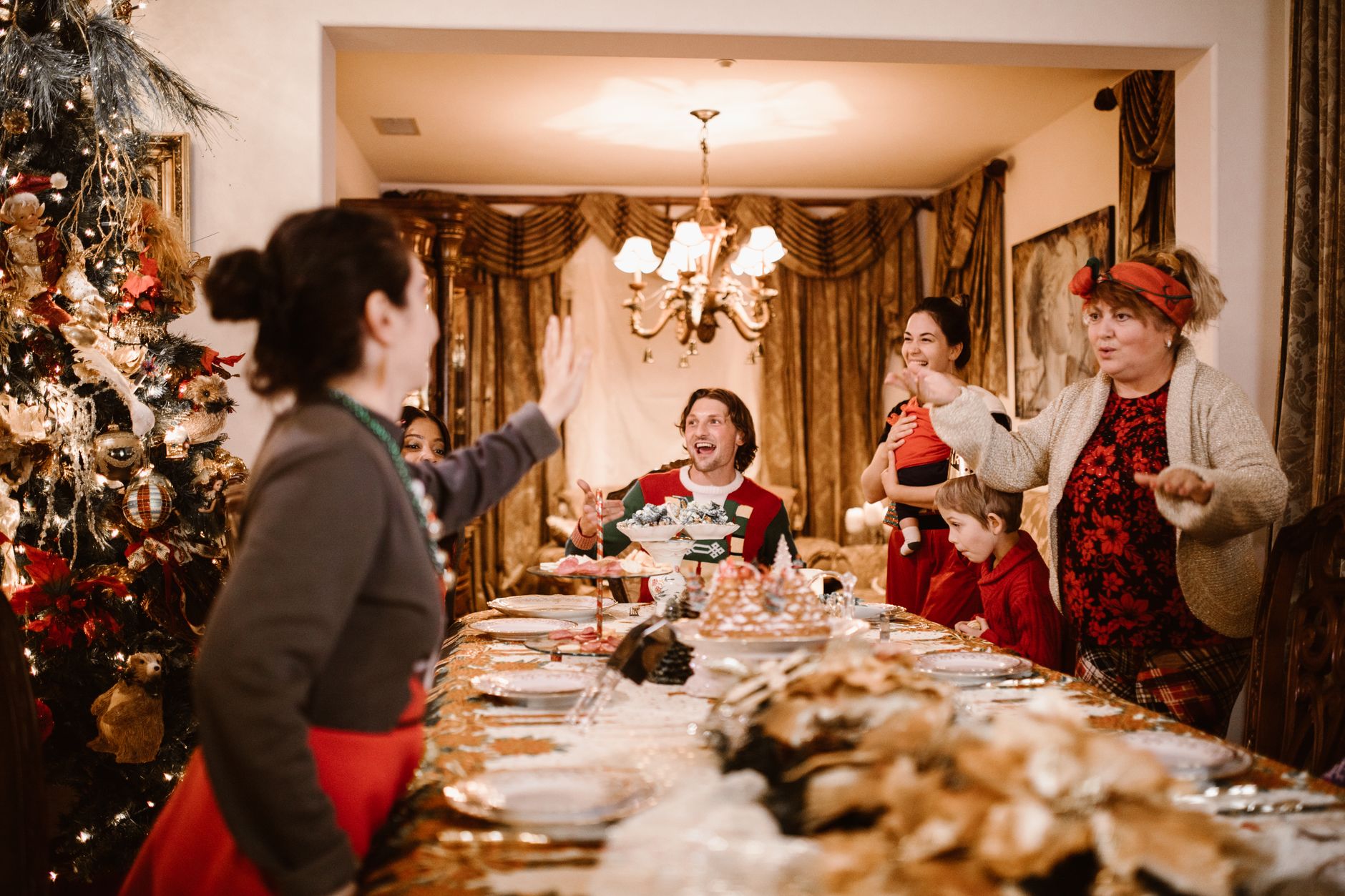
My son Victor pulled out Alma’s chair at the head of the table, the chair my wife sat in for forty-one years, and he seated the woman we pay by the hour in it, then he touched my shoulder and told me it would be easier for everyone if I ate with the grandchildren tonight.
I want you to understand what that chair was before I tell you what he did with it.
Alma bought that dining set the year Victor started first grade. We did not have the money for it. We had a kitchen table with a wobble in one leg that I had shimmed three times with folded matchbooks, and Alma decided, the way she decided everything, quietly and completely, that our family was going to eat at a real table. She cleaned houses for the Delgados and the Pruitts and the doctor whose name I will not say because his granddaughter still lives in this town, and she put aside a little each week in a coffee can behind the flour, and when the can was full she took the bus to the furniture store on Commerce Street and paid cash for a walnut table with six chairs and a leaf that pulled out for company. The man loaded it into my brother-in-law’s truck. I remember Alma sitting in the truck bed the whole way home with one hand flat on the tabletop like she was afraid it would blow away.
The chair at the head was hers. Not by argument, not because I gave it to her. It was simply where she sat. When you build a house, there is a place the walls decide to be strong, and in our house that place was Alma’s chair. She carved the Thanksgiving turkey from that seat because her hands were steadier than mine. She held Victor’s forehead over a bowl from that seat the winter he had the fever that scared us both so bad I slept on the floor beside his bed. She read the letter from the bank from that seat the year the mill cut my hours, and she folded it in half and said we would be fine, and we were fine, because Alma said so.
She died in the spring. Two years ago now, though I still reach for the phone to tell her things. It was her heart, quick at the end, which the hospice nurse told me was a mercy and I suppose it was, though mercy is a strange word to use about the worst morning of my life. I sat in my chair, the one to the right of hers, and I held her hand across the corner of the table while the coffee went cold, and I have not been able to make myself sit in her chair since. Not once. I set the mail on it. I drape my church jacket over the back of it. But I do not sit in it. A man knows where his wife sat.
My name is Reynaldo Ibarra. I am seventy-three years old. I worked the paper mill in this town for thirty-one years and I raised one son in the small house my father bought when he came up from Michoacan with a wife and a suitcase and eleven dollars. I am not a soft man. I do not cry at movies. I carried Alma’s casket with my own hands because I would not let strangers carry her, and I did not weep until I got home and saw her reading glasses folded on the windowsill where she left them. So understand me when I tell you that what happened at that dinner did something to me that even her funeral did not do. It made me feel like a guest in my own life.
Let me tell you how it started, because it did not start at the table. Cruelty rarely announces itself. It moves in slow, the way water gets into a foundation, and by the time you see the crack the damage is already done.
I should tell you first what a night looked like in this house, so you understand what my son thought he was rescuing me from. The nights are the hard part. The days I can fill. There is Mass, there is the yard, there is the hardware store on Fourth where old men my age stand around the nail bins and talk about nothing because talking about nothing is how men my age say we are still here. But the nights. Alma and I used to sit in the front room after supper, she with her crossword and me with the ball game turned low, and we would not talk much, because forty-one years takes the pressure off talking. She would read me a clue sometimes. Seven letters, a river in Italy. And I never knew, I never once knew a river in Italy, and she would laugh at me the same way every time like it was the first time, and that laugh was the sound of my evening. After she passed, the front room went silent at seven o’clock and stayed silent, and I learned that a quiet house is not restful. A quiet house is loud in a way that gets into your teeth. I took to leaving the radio on the Spanish station all night just so the house would have a voice in it that was not mine.
The fall off the back step was in October. I had the trash bag in my right hand and my left was reaching for the rail that my father put up in 1961, and my foot found the edge of the step wrong, and there was that terrible weightless second where the body knows before the mind does, and then I was down in the gravel with the trash spilled around me and a pain in my hip like a hot nail. I lay there. I want to be honest about how long I lay there because it is the fact that started all of this. It was cold, and getting dark, and I could not get my legs to answer me, and I lay in my own driveway in the gravel for what the neighbor later said was near an hour before Mrs. Kaminski saw me from her kitchen window and came running in her house slippers. She called Victor. She called the ambulance. Nothing was broken, as it turned out, only bruised deep and my pride broken worse than my body, but I had lain in the cold for an hour, and my son got a phone call that his father was on the ground in the dark, and I understand now that Victor never really got up off that gravel. Some part of him is still standing over me in that driveway, afraid.
That is the thing about the notebook I have to be fair about. It did not start as a weapon. It started in a driveway, in the cold, with a boy’s fear that he was about to lose the second parent inside of one year.
But fear that is not spoken turns into something else. It curdles. And by the winter, what had started as a frightened son checking on his father had become a man quietly assembling the evidence he needed to take a life apart for its own good.
After Alma passed, I managed. I want that on the record. I managed. I cooked my own eggs. I kept the yard. I went to seven o’clock Mass on Sundays and I sat in our pew, third from the front on the left, and I put a five in the basket like we always did. But in the fall I fell off the back step carrying the trash and I could not get up for a while, and a neighbor found me, and after that Victor decided I needed help. He did not ask me. He decided. That is a thing about my son I did not fully understand until this year. He does not ask. He informs you of the conclusion he has already reached, and if you argue he looks at you with a patience that is worse than anger, like you are a slow child he has to wait for.
The help came in the form of a woman named Brenda. I will be fair to Brenda, because none of this was her doing and I have made my peace with her. Brenda was a caregiver from an agency two towns over. Fifty or so, blond going gray, a smoker who chewed gum to cover it, competent hands. She came four days a week to start, then five, then she had a key. She did the shopping and the pills and she drove me to the foot doctor. She was not unkind to me. She called me Mr. Ibarra and she learned to make the coffee the way I like it, strong enough to stand a spoon in. If Victor had simply hired Brenda to help an old man keep his house, I would have nothing to tell you. But Victor does not do simple things.
Somewhere in the winter, Brenda stopped being the woman we paid and started being the woman Victor consulted. He would call the house and ask to speak to her, not to me. He would ask her how I was eating, how I was sleeping, whether I seemed confused. Confused. That word started showing up. I would forget where I set my keys, the way any man of seventy-three forgets where he set his keys, and Brenda would mention it to Victor, and Victor would write it down. I know he wrote it down because I found the notebook. A little spiral notebook in his jacket pocket the day he left it on my couch, and God forgive me, I read it, and it was a record. Dates. Times I repeated myself. The day I called him by his cousin’s name because the light was bad and my eyes are not what they were. He was building a case. A father does not want to know his son is building a case against him, but there it was in my son’s own handwriting, and I put the notebook back in the pocket and I did not say anything, because I did not know yet what he was building it for.
I found out at Thanksgiving.
Understand, in our family the holiday is at my house. It has always been at my house. Alma cooked for twenty people out of a kitchen the size of a closet and never once let anyone see her sweat. After she passed, the family kept coming to my house, and I liked that. I liked the noise of it. My daughter-in-law, Marisol, she is a good woman, she would come early and do most of the cooking now, and I would sit and peel potatoes and it was not the same but it was something. The grandchildren would tear through the house. My cousin Efren would bring his terrible homemade wine that we all pretended to drink. It was the one day the house sounded the way it used to sound, and I lived for it.
This year I woke up early and put on the good shirt Alma bought me, the blue one, and I made the coffee myself, and I waited for my family in the house my father built. Marisol came at nine with the turkey already brined. The kids came like a storm. Efren came with the wine. Victor came last, at noon, with Brenda.
I did not understand at first why Brenda was there. It was a holiday. She did not work holidays. But Victor had brought her, and he had brought her not in her caregiver clothes but in a nice blouse, like a guest, and something in my stomach turned over and I did not know why yet.
We sat down to eat at two. And here is the part I have played over in my mind a thousand times, looking for the moment I should have stood up, and I cannot find it, because it happened too fast and too smooth, the way a practiced thing happens.
The table was set. Marisol had set it beautifully, Alma’s good plates, the ones with the blue rim, and the leaf pulled out and everyone’s place laid. I went to my chair, the one to the right of the head, and I put my hand on the back of it to pull it out. And Victor said, easy, casual, not even looking at me, “Dad, we set you up at the other table this year. With the kids. It’s easier, you’ve got more room, you won’t have to reach over everybody.”
There was a card table in the front room. A folding card table with a paper tablecloth and the three youngest grandchildren already sitting at it with their plastic cups. My place was there. Victor had set my place at the card table in the other room, away from the family, at the table where the children eat.
I looked back at the big table to understand, and that is when I saw it. Brenda was sitting in Alma’s chair. At the head. In my wife’s place. She had a napkin in her lap and she was reaching for the rolls, and she looked, I will say this, uncomfortable, like she knew something was wrong but had been told to sit there and did not know how to refuse. Victor was pulling out the chair beside her, the one to the right, my chair, and he was sitting down in it. My son sat in my chair, and he put the hired woman in my wife’s chair, and he sent me to eat with the babies in the front room, and when I did not move he looked up at me with that patient face and he said the thing I will hear for the rest of my life.
He said, “It’s just easier for everyone, Dad.”
Easier. For everyone.
I want to tell you that I roared. I want to tell you I flipped the table and threw the wine and put the fear of God into my son the way my own father would have. But I did not. Something happened to me instead that I did not expect. I went very quiet and very cold, and the room got far away, and I stood there with my hand still on the back of my chair, the chair that was no longer mine, and I looked at the faces around the table.
Marisol had frozen with the gravy boat in her hand. She was staring at Victor with her mouth a little open. My cousin Efren had gone still. The older grandchildren, the teenagers, they were looking down at their plates because they were old enough to know that something ugly was happening and young enough to be afraid of it. Nobody said anything. That is the part that cut the deepest. My whole family sat there and watched my son move me out of my place and nobody said a word.
And Brenda, in Alma’s chair, she looked up at me and her face was miserable, and she started to rise, and she said, “Mr. Ibarra, I can move, I don’t need to sit here,” and Victor put his hand flat on the table, not on her, just on the table, but it stopped her, and he said, “Brenda, you’re fine. Sit. Dad, go on, the food’s getting cold.”
Here is what a man learns at seventy-three that he does not know at forty. Anger is loud because it is weak. It is the sound a thing makes when it is breaking. The strongest thing in that room was not my son’s voice. It was the quiet. And I understood, standing there with my heart going like a hammer, that if I shouted I would lose. If I shouted I would be the confused old man in the notebook, the one who gets worked up, the one who cannot manage his emotions, the one who needs to be managed. He wanted me to shout. Some part of my son, God help him, wanted a scene at that table, because a scene would prove his notebook right.
So I did not give him one.
I took my hand off the back of the chair. I straightened up as much as my back would let me, which is not as much as it used to be, but enough. And I walked, slowly, past my son, past the hired woman in my wife’s chair, to the sideboard against the wall. The sideboard was Alma’s too. On it stood the things Alma kept there, her things, the ones I have not moved in two years because moving them would mean she is really gone. And I picked up the one that mattered.
It was a small framed photograph. Alma and me on our wedding day, 1979, outside the church that is still standing on Third Street, her in the dress her mother sewed, me in a borrowed suit two sizes too big, both of us so young and so certain. And beside the photograph, in a little dish, was Alma’s wedding ring. I had it sized to fit my smallest finger after she passed so I could keep it near, and on the days my hands swell I set it in that dish by her picture so I do not lose it.
I picked up the picture and I put the ring on my finger, and I turned around to face the table, and I said the only thing I said that whole afternoon. I said it quietly. I did not raise my voice one inch.
I said, “This is my wife’s chair. In her house. And I am her husband. I will sit where she sat, because there is no one else at this table with the right to.”
Then I walked to the head of the table.
Brenda was already up. She had risen the moment I started speaking and she stepped back from the chair with her hand over her mouth, and I could see she was near tears, and I did not blame her, I have never blamed her. I set Alma’s photograph on the table at the head, facing out, so my wife could see her family. And I pulled out her chair. And for the first time in two years, I sat down in it.
It did not feel like taking a throne. It felt like coming home to a house I had locked myself out of. The seat still held the shape of her. I know that is not possible after two years and a hundred meals, but I felt it anyway, the give of the cushion where she sat all those years, and I put both my hands flat on the walnut table the way she did in the truck bed forty-five years ago, and I looked down the length of my family, and I was the patriarch again. Not because I claimed it. Because it was true, and everyone in that room, my son included, knew it was true, and the truth had finally been said out loud in the room where it lived.
Victor’s face. I will not enjoy describing my son’s face, because he is my son and I love him even now, even after, but I will tell you the truth of it. He looked like a boy caught. All the patience drained out of it. For one second he was not the man with the notebook, he was Victor at nine with his hand in the cookie jar, and then the second passed and he tried to gather himself and he said, “Dad, come on, don’t make this a thing.”
And my cousin Efren, God bless that man, Efren spoke up for the first time. He said, “Victor. Sit down and eat your dinner. Your father is at the head of his own table. There is nothing to make.” And Marisol set down the gravy boat and pulled out the chair next to me, my old chair, and she sat in it, on my right hand, and she reached over and squeezed my arm, and she said, loud enough for the whole table, “Reynaldo, will you say the blessing? You always say it best.”
I said the blessing. My voice did not shake, though I thought it might. I thanked God for the food and for the hands that made it and for the family at the table, and I thanked Him for Alma, by name, the way I do every night alone, only this time out loud, in front of everyone, and I heard Marisol crying quietly beside me and I heard one of the teenagers sniff, and when I said amen the whole table said amen back, and it was over. The thing that had been done was undone. I was home.
We ate. It was strange for a while and then it was not strange, because a family at a table finds its way back to itself if someone lets it. The kids in the front room came in and squeezed onto the ends. Efren opened his terrible wine and for once I drank a full glass of it. Brenda ate at the far end, quiet, and after the pie she came and stood beside me and she said, low, so only I could hear, “Mr. Ibarra, I want you to know I told him no. When he set it up. I told him it wasn’t right and he told me it would help him. I should have refused harder. I’m sorry.” And I told her the truth, that she was a good woman doing a hard job and that none of it was her fault, and I meant it, and I still mean it. She quit the account the following week. I do not blame her for that either.
I need to stop here and tell you about the youngest grandchild, because she is the one who broke the thing open, and I did not see it until later. Her name is Sofia. She is six. She was at the card table in the front room, the table where I was supposed to eat, and while all of the grown business was happening at the big table, Sofia had been watching from the doorway the way children watch, seeing everything and understanding it sideways. When I sat down at last in Alma’s chair and set the photograph out, Sofia climbed down off her chair in the front room and she walked into the dining room and she stood at my elbow, and she looked at the photograph, and she said, in the plain voice a six-year-old uses, “Is that Grandma Alma?” And I said yes. And Sofia said, “She’s smiling at you.” And then she climbed up into my lap without asking, the way a child does, and she stayed there through the blessing, and I said the words with my granddaughter’s weight against my chest and my dead wife smiling at me from the table, and if there was a moment in that whole terrible day where I nearly did break, it was not when my son moved me. It was a six-year-old telling me my wife was smiling at me. Children do not know they are doing this. Sofia does not know to this day that she saved her grandfather’s dinner. But she did. She reminded the whole table, without meaning to, what the table was for.
After the pie there was that loose, warm hour a good holiday has, where nobody wants to get up and start the dishes, and the men lean back and the women talk over the wreckage of the meal, and one of the teenagers, my grandson Mateo, who is fifteen and thinks I do not notice him, he leaned over to me while his father was in the other room and he said, quiet, “Grandpa. I’m sorry I didn’t say anything. When he moved you. I should have said something.” Fifteen years old. He had been so ashamed of his own silence that he had to come to me and lay it down. And I told him the thing I most needed him to know, which is that it is a hard, hard thing to speak up against your own father at a full table, and that most grown men cannot do it, and that the fact he wanted to already put him ahead of most grown men. And I told him the day would come when he would need to speak into a silence like that one, and that he would remember this Thanksgiving, and he would speak. He nodded. I believe he will. That may turn out to be the best thing that came out of the worst dinner of my life, that a fifteen-year-old boy learned what silence costs before he was old enough for it to cost him everything.
Now I have to tell you the harder part, because a story that ends at the table would be a lie, and I do not lie about my family, not even to make myself look better.
Victor did not come to dinner to be cruel. That is what I have had to sit with. My son is not a monster. I raised him and I know his heart, and his heart is frightened. He watched his mother die fast and he decided, in the way that grief makes a man decide foolish things, that he would not watch his father slip away slow. The notebook was not malice. It was terror dressed up as paperwork. He wanted to move me somewhere safe before I could fall again, and he had convinced himself that the way to do it was to prove, in writing, that I could not manage. The chair was going to be his proof. If the old man could be quietly moved out of his own place at his own table and nobody objected, then the old man could be quietly moved out of his own house too, and it would be for his own good, and it would be easier. For everyone.
He told me all this three weeks later, in this kitchen, crying like I had not seen him cry since he was a boy. He came on a Tuesday night after Marisol sent him, I think, and he sat right there where you might be sitting now and he put his head down on Alma’s table and he said, “I don’t know how to lose you too, Dad.” And I put my hand on the back of my son’s neck the way I did when he was small, and I told him the thing he needed to hear, which is that he does not get to decide when I am done. That I will tell him when I need to move, and I will, when the day comes, because I am not a fool. But that day is mine to name, and until then I am the man at the head of my own table, and he does not get to move me out of my life to make his own fear easier to carry.
He heard me. That is the mercy of it. Some sons would not have heard me. Victor heard me, and he asked me to forgive him, and I did, because he is my son and because forgiveness is the last thing a father can give that no one can take back.
We changed some things after that. I still have help, a woman named Dolores now, three days a week, and I chose her myself and I pay attention to what she is for and what she is not for. Victor comes on Sundays after Mass and we eat together, him and Marisol and the kids, and I sit at the head, and Alma’s chair is my chair now, which I never thought it would be, and it turns out that is not a betrayal of her. It is the opposite. She would want me sitting there. She would be furious at me for two years of setting the mail on her chair like a shrine. “Reynaldo,” she would say, “sit down, you foolish man, it’s a chair, it was always your chair too.” I hear her say it. I sit down.
There is a photograph on the sideboard still, the two of us in 1979, and it faces the table now instead of the wall, because I turned it around that Thanksgiving and I never turned it back. Alma watches her family eat. And every Sunday when I say the blessing I thank God for her by name out loud, and nobody at the table thinks it is strange anymore, because a man should be able to say his wife’s name at the table she bought with a coffee can full of other people’s floor-scrubbing.
I am seventy-three. My back is bad and my eyes are worse and I forget where I put my keys. All of that is true, and none of it means what my son thought it meant. A man is not the strength in his hands. A man is the place the walls decide to be strong. In my house, for forty-one years, that place was Alma’s chair, and now, God help me, it is mine, and I will sit in it until the day I cannot, and I will tell you myself when that day comes.
It has not come yet.
Not by a long way.

Adrian Hawthorne is a celebrated author and dedicated archivist who finds inspiration in the hidden stories of the past. Educated at Oxford, he now works at the National Archives, where preserving history fuels his evocative writing. Balancing archival precision with creative storytelling, Adrian founded the Hawthorne Institute of Literary Arts to mentor emerging writers and honor the timeless art of narrative.