Grady Lofton stood at the head of that banquet table, looked me in the eye with my son’s folded flag sitting in my lap, and told me, “Warren, we had to make a call.”
I was seventy years old, and I had driven ninety minutes on a two-lane county road to a VFW hall I had never seen, in a town called Halverson that I had only ever passed through on the way to somewhere else. I had put on the one suit I owned, the gray one I wear to funerals, and I had pressed a white shirt at six in the morning with an iron my wife Ruth used to run over my collars before she passed. I had brought two things with me. I had Danny’s dress blues on a hanger, sheathed in a dry-cleaner bag, laid flat across the back seat of the truck the way you would lay down a sleeping child. And I had the flag. The triangle of blue and white stars they had handed me at Arlington eleven years ago, folded thirteen times by seven men in white gloves, sitting in the cardboard box it came in until I could not stand to look at the box anymore and moved it into a wooden case I built myself out of walnut in my garage.
I brought those two things because Grady Lofton had called me on a Tuesday afternoon in the middle of April and told me the men of the 2nd Battalion, the ones who had served alongside my son, were putting together a reunion banquet. He said it would be at the VFW hall in Halverson. He said there would be a program. He said, and I remember the exact words because I wrote them on the back of an electric bill so I would not forget, “We want to recognize the fallen, Warren. We want to put Danny front and center. He’d have the seat of honor.”
The seat of honor. I said those words back to Ruth’s photograph that night, standing in the kitchen with the phone still warm in my hand. I told her picture, Ruthie, they are going to honor our boy. She had been gone four years by then, and I still talked to her more than I talked to anyone living. I told her they were going to stand him up front. And I want to tell you the truth about what that did to a man like me, because if you have not lost a child you cannot know it, and if you have, I do not have to explain it.
Danny Ashby was a Corporal in the United States Marine Corps. He was killed in action at twenty-three years old. He had freckles across his nose that never faded from the time he was a boy, and he laughed like his mother, this loud honking laugh that would fill up a whole room and make strangers turn around and smile. He wanted to be a game warden when he got out. He had it all planned. He was going to come home to the county, put on the green uniform of the state, and spend his life on the river checking fishing licenses and pulling drunk teenagers out of the current before they drowned. He used to say he wanted a job where he got to save people who did not even know they were in trouble.
He never got out. And for eleven years the hardest part of every single day was not the missing him, though God knows the missing him is a stone I carry in my chest that never gets any lighter. The hardest part was the fear that he would be forgotten. That the world would close over the place where he stood the way water closes over a dropped rock, and in twenty years nobody would say his name out loud, and it would be as though a boy with freckles and his mother’s laugh had never walked the earth at all.
So when Grady Lofton said seat of honor, he was not offering me a chair at a dinner. He was offering me the one thing I wanted more than anything left on this earth. He was offering to keep my son from disappearing.
That is why I need you to understand exactly what it meant when I walked into that hall.
The drive in
The morning of the banquet, I was awake at four. I had not slept much, which is nothing new, but that morning it was the good kind of not sleeping, the kind where your mind will not settle because it is running ahead of you to something. I made coffee. I stood in the garage a long time with my hand on the walnut case. I had built that case in the winter after Ruth died, because I needed something to do with my hands that was not drinking, and because the cardboard box the flag came in felt like an insult to what was inside it. I sanded that walnut until it was smooth as a river stone. I lined the inside with a piece of navy felt. When I set the folded flag inside and closed the glass, I sat down on an overturned bucket and I cried like I had not cried since the two Marines came up my driveway in their blues.
I took the flag out of the case that morning. I wrapped the triangle in a clean pillowcase and set it in a canvas bag, because I did not want anyone at that dinner to see me carrying a wooden box like a strange old man, but I could not bear to leave the flag home either. And I got the dress blues down off the rack in Danny’s old room, which I have not changed in eleven years, and I laid them across the back seat.
The drive took ninety minutes. I know these roads. Flat land, then the low hills, then the river bottoms where the fog was still lying in the fields at six in the morning like something spilled. I passed a feed store with the lights just coming on and a man in a cap unlocking the front. I passed three churches. I passed a diner where the parking lot already had a dozen trucks in it, farmers getting their eggs before the day started. This is my country. This is the world my son wanted to come home to and protect. I had the radio off the whole way. I just drove, and I talked to him a little, the way I do, out loud in the cab where nobody can hear an old fool.
I told him, we made it, bud. They are going to stand you up front today. I told him his mother would have worn the blue dress. I told him I was proud of him, which I had told him a thousand times when he was alive and could hear it and had gotten embarrassed and told me to knock it off, Dad.
I want you to hold onto that drive. Hold onto the fog in the fields and the man opening the feed store and an old man in a gray funeral suit talking to his dead son in the cab of a truck, so proud he could barely keep his hands steady on the wheel. Because I need you to feel the drop when it came.
The hall
The VFW hall in Halverson is a low brick building with a flagpole out front and a hand-painted sign. Inside it was decorated up nice. Somebody had put white cloths on the round tables and little jars with flowers, and there was a long banner across the far wall that said WELCOME HOME 2ND BATTALION. There were maybe eighty people already there when I came in, men my son’s age, some of them, filling out and going gray now, with wives and kids, and older folks too, parents like me. There was a smell of coffee and green beans and that particular banquet-hall smell of a hundred people in their good clothes.
And there was a table up front. Raised up on a little platform, set apart from the rest, with a white cloth and a black tablecloth over it and a folded flag already displayed on a stand, and an empty chair, and a framed photograph.
My heart came up into my throat. There it was. The seat of honor. I could see the frame from the door but not the face in it, and I started across that room with the canvas bag in one hand and the dress blues over my other arm, thinking I would introduce myself, thinking I would set Danny’s things right up there where they belonged, thinking, oh Ruthie, look, look what they did for our boy.
I got close enough to see the photograph.
It was not Danny.
It was a young man in blues, yes, a good-looking kid, but not my son. No freckles. Dark hair where Danny was sandy. And under the photograph, on a little printed card in a frame, was a name that was not my son’s name. And a word under the name that stopped me cold in the middle of that room with everyone milling around me.
The word was not “in memoriam.” The word was not “fallen.” The card said the young man’s name, and it said “our returning hero.”
Returning. He had come home. He was alive.
I stood there in the middle of the floor holding my dead son’s uniform and I could not make it make sense. This was the seat of honor. This was the front table. This was the flag and the frame and the raised platform Grady Lofton had described to me on the phone, the very thing I had driven ninety minutes for, and it was set for a living man and his family.
“We had to make a call”
I found Grady Lofton by the coffee urn. I knew him by his voice before I saw his face, that same smooth phone voice, working the room, a big man with a big handshake, the kind of fellow who is the president of three things and knows everybody’s name. He was the organizer. He was the one who had called me.
I said, “Grady. Warren Ashby. Danny’s father.”
And I watched his face do a thing I will not forget. It closed up. It went from the wide public smile to something careful and tucked-in, the face of a man who has been dreading a conversation and here it finally is.
He took my elbow and steered me a little to the side, away from the coffee, lowering his voice, and he said, “Warren. I’m real glad you made the drive. Listen. About the front table.”
I said, “I brought his blues. I brought his flag. You said the seat of honor.”
And Grady Lofton looked at me, and he said the words I have carried around in my chest for a long time now. He said, “We had to make a call.”
I did not understand him. I said, “A call about what.”
He said the Boyd family had put a lot into this reunion. He said Craig Boyd, the boy in the photograph, the living one, his father had donated to the hall, had paid for the tables and the caterer, had bought the banner. He said the Boyds were, and this is the word he used, invested. He said Craig Boyd had served with distinction and come home and it was a happy thing, a thing to celebrate, and the family wanted the recognition, and they had earned it with everything they had given.
I said, “But Danny died. Your program is to honor the fallen. You told me that on the phone.”
And Grady Lofton looked at his shoes, and then he looked back up at me, and he said, “It’s a delicate thing, Warren. The Boyds are still in this community. They’re here every week. You’re, well, you’re ninety minutes out. We had to make a call about the front table, and we made it. There’s a real nice spot for you at table nine. You’re at the program either way. Danny’s on the list.”
The list. My son was on a list. A living boy whose father wrote checks had my son’s seat of honor, and my boy who died for his country was on a list at table nine, ninety minutes out, easy to forget, easy to move, easy to set aside because the grieving old man was not around every week to make anybody uncomfortable.
I want to tell you what I felt, and I have thought about how to say it honest. It was not hot. It was not the kind of anger where you shout. It was a cold, sinking thing, like the floor of that hall had turned to ice water and I was going through it. Because Grady Lofton had just told me, in his careful tucked-in voice, that my son’s memory was a thing you could trade for a caterer and a banner. That eleven years of me being terrified my boy would be forgotten was not a fear at all. It was a plan. And this smooth man was carrying it out with a hand on my elbow and a real nice spot for me at table nine.
Table nine
I went to table nine. I am not proud of that, but I want to be honest with you about how it went, because I think a lot of people who have been made small by a room understand this part. I did not make a scene. I did not have it in me right then. I was seventy years old and shaking and I had just been told my dead son did not rate the front table, and some part of me, the beaten-down part that a hard life installs in you, said, sit down, Warren, do not make trouble, you are the outsider here, sit at table nine and be grateful you are on the list at all.
So I sat. I put the canvas bag with the flag in it on the empty chair beside me, and I laid the dress blues across my knees under the table so nobody would see them, and I folded my hands, and I watched.
I watched them serve the Boyds first at the front table. I watched Craig Boyd, the living hero, a perfectly nice-looking young man who I do not blame for one second, because none of this was his doing, laugh and shake hands and get his back slapped. I watched his father, a heavy man in a good jacket, hold court up there like a king. I watched Grady Lofton stand at a little podium and welcome everyone and thank the Boyd family, by name, three times, for their generosity. I watched a slideshow of photographs from the deployment go up on a screen, and I looked for Danny in every single one, and he was in two of them, way in the back, out of focus, and nobody said his name.
And I thought about the drive in. I thought about the fog in the fields and me telling my son they were going to stand him up front. I thought about how happy I had been at four o’clock that morning, ironing a shirt with Ruth’s iron. I thought I had never in my life felt so foolish, so used, as I did sitting at table nine watching a living man’s family eat off my son’s honor.
There was a woman across from me at table nine, older than me, with a cane hooked on the back of her chair. She had been watching me. She leaned over and she said, quiet, “You’re the Marine’s father. Corporal Ashby. I remember when it happened. I’m so sorry, honey.” And she put her hand on my arm.
And that was the thing that started to turn the cold water in me back into something with a fire under it. Because a stranger at table nine remembered my son’s name and his rank, remembered when it happened, was sorry. A stranger. And the man who called me and used the words seat of honor to get me in a truck for ninety minutes could not be bothered to say Danny Ashby out loud one time.
What I decided at table nine
I sat there through the green beans and the sliced beef and a speech from Craig Boyd’s father about supporting our troops, and somewhere in the middle of that speech, a thing settled in me. It settled the way a decision settles when it is the right one, quiet and heavy and final.
I was not going to make a scene. I have never been a scene-maker. But I was not going to eat this either. I was not going to drive ninety minutes home in the dark having let a room full of good people believe that my son was a name on a list at table nine. My boy earned the front. He earned it with everything a man can give, which is all of it, which is his one life. And no amount of money any living family gave to any banquet hall changed the arithmetic of that. It could not. It is not a thing you can buy your way into or out of.
So I waited. Grady Lofton got up to the podium after the beef was cleared, and he said, before dessert, they wanted to take a moment to recognize the men of the 2nd Battalion, and would everyone who served please stand and be recognized. And the veterans stood up around the room, and there was applause, and it was a good moment, an honest one, and I clapped too.
And when the applause died down and Grady Lofton opened his mouth to move things along to the dessert and the raffle, I stood up.
I stood up at table nine with my son’s dress blues over my arm and the canvas bag in my hand, and I said, in a voice that carried more than I expected it to, because a lifetime of hollering across pastures gives a man a voice, “Before we get to the raffle, I’d like to say something about a Marine who can’t stand up, because he’s not here.”
The room went quiet. Grady Lofton’s face did the closing-up thing again, up there at the podium.
Standing up
I want to tell you what I said, as close as I can remember it, because I have gone over it many times since, and I think it is the most important thing I have said out loud in eleven years.
I said, “My name is Warren Ashby. I drove up from the county this morning, ninety minutes, because a man called me and told me my son would have the seat of honor tonight. My son was Corporal Danny Ashby, United States Marine Corps. He was killed in action at twenty-three years old serving alongside the men in this room.”
I heard the room take a breath.
I said, “Some of you knew him. He had freckles he never grew out of and he laughed like his mother, God rest her. He wanted to come home and be a game warden. He wanted a job saving people who didn’t know they were in trouble. He didn’t get to come home. He gave that up. He gave up all of it, every single thing he was ever going to have, so the rest of us could keep ours.”
I lifted the canvas bag and I took the flag out of the pillowcase, right there, and I unfolded the pillowcase off it so the triangle showed, the blue and the white stars.
I said, “This is the flag they folded over my son’s casket. Thirteen folds, by seven men in white gloves. They handed it to me at Arlington and they said, on behalf of a grateful nation. A grateful nation. That’s what they told me. And I have believed it for eleven years, because I had to.”
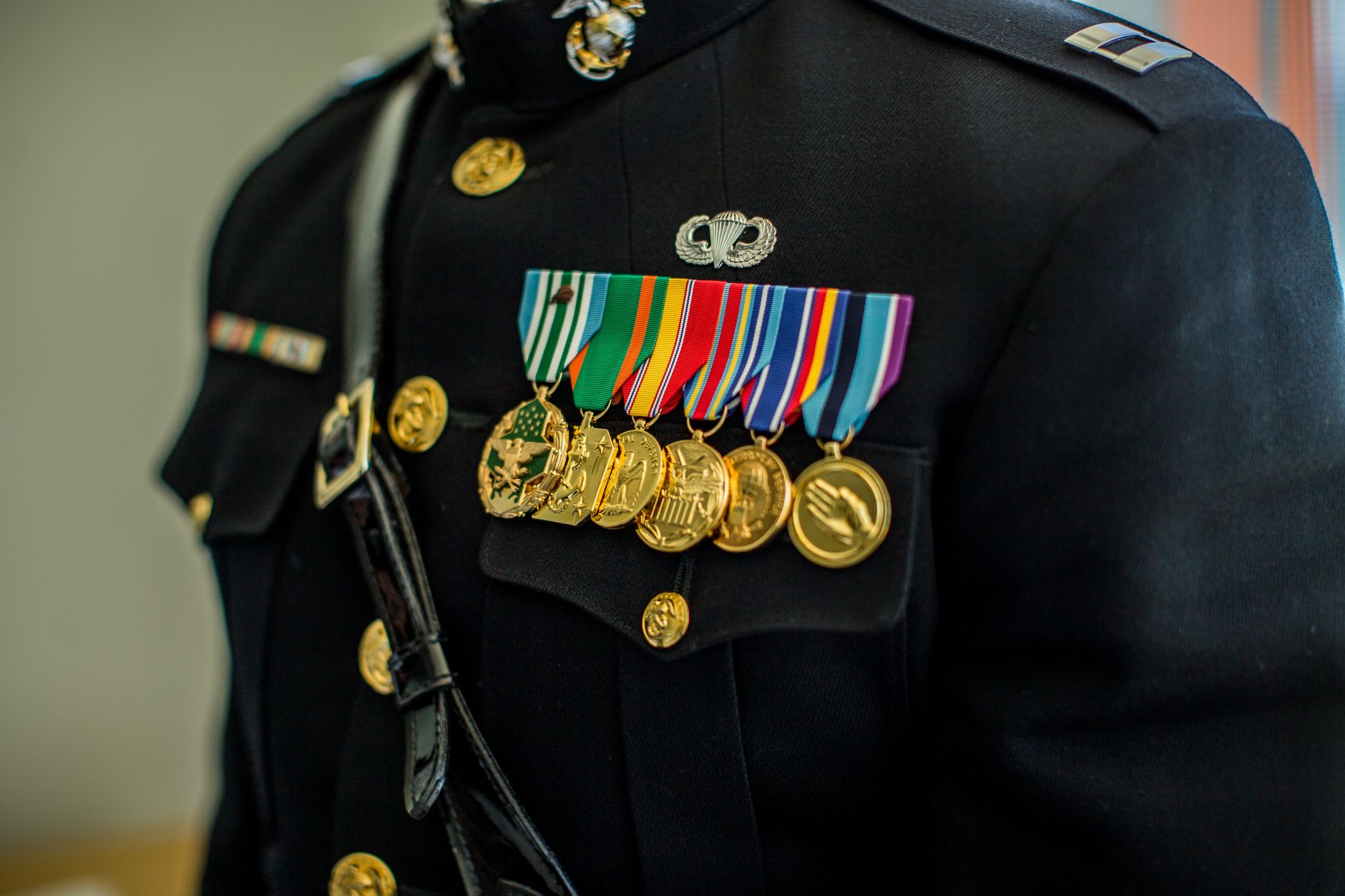
I set the flag down on the white cloth of table nine, and I lifted the dress blues, still on their hanger, and I held them up so the whole room could see them, the sharp navy, the red trim, the buttons.
I said, “These are his blues. I keep them in his room, which I have not changed since the day two Marines came up my driveway. I brought them here tonight because I was told my son would be honored. I was told there was a seat of honor for him.”
And then I turned and I looked at the front table, at the raised platform, at the framed photograph of a living man, and I said the only hard thing I said the whole night, and I said it quiet, so they had to lean in.
I said, “I was told the seat of honor was my son’s. When I got here, it belonged to a family that could pay for it. I don’t blame that young man up there. He served, he came home, thank God, and I hope he has a hundred good years. But somebody in this room decided that my boy’s death was worth less than another family’s checkbook. Somebody decided a dead Marine could be moved to table nine, ninety minutes out, where he wouldn’t make anybody uncomfortable. I’d just like the men my son served with to know that’s the call that got made. I’d like them to decide for themselves whether it was the right one.”
And I picked up the flag, and I folded the pillowcase back over it, and I started for the door, because I had said my piece and I did not intend to stand there and be argued with.
The room
I did not get to the door.
A man stood up at one of the middle tables. He was Danny’s age, heavyset now, with a beard going gray, and he said, loud, “Sit down, sir. Please. Don’t you go anywhere.”
I stopped.
He came across the room to me, this big man, and he stuck out his hand, and there were tears standing in his eyes, and he said, “Corporal Ashby pulled me out of a truck. I’m here tonight, I’ve got two kids at home, because your son came back for me when he did not have to. I have thought about him every single day of my life. I did not know you were here. I did not know you were at table nine.” And his voice broke on the words table nine, and he turned around to the room, still holding my hand, and he said, “This is Danny Ashby’s father. Some of you owe your lives to that man’s son the same as I do. And they put him at table nine.”
Another man stood. Then another. Not for the raffle, not for the speech, but for my son. One of them said, “Danny should be up front.” Another said it louder. And it went around that room like a fire catches dry grass, these men who had served with my boy getting to their feet, one after another, until it was not a few of them, it was most of them, and their wives standing with them.
And the big man who Danny pulled from the truck, he did a thing I will remember until I die. He walked up to that front table, that raised platform with the white cloth and the flag stand and the framed photograph of the living hero, and he did not touch the Boyd boy’s picture, he was respectful of it, but he cleared a space right in the center of that table, and he turned around and he looked at me, and he said, “Bring him up here, sir. Bring Corporal Ashby up where he belongs.”
The front table
I have carried a lot of hard things in my life. I carried Ruth’s casket. I carried the folded flag. I have carried eleven years of the fear that my son would be forgotten.
I have never carried anything the way I carried Danny’s dress blues across that room to the front table, with eighty people on their feet and silent, watching an old man walk his dead son up to the seat of honor at last.
I laid the blues across the center of the front table. I stood the flag up beside them. The big man, whose name I learned was Wallace, took the photograph of Danny out of my hand, because I had one, a small one in my wallet, the one from his graduation from Parris Island with the freckles and the barely-hidden grin, and he propped it up against the flag so the whole room could see my son’s face.
And the men of the 2nd Battalion, the ones who were there with him, they came up one at a time, and they stood at that table, and they told me about him. One of them told me Danny gave him his own socks when the man’s feet were coming apart. One told me Danny carried more than his share, every day, without being asked. One told me a joke my son used to tell, and I laughed, standing there at the front table, I laughed out loud with the flag beside me, because it was exactly the kind of dumb joke Danny would tell, and for one second it was like he was in the room.
The woman with the cane from table nine had made her way up. She took my hand and she said, “Now that’s a seat of honor.”
Grady Lofton
I want to tell you about Grady Lofton, because a story like this is not complete without the reckoning, and I promised you I would give you the whole thing.
Grady stood at that podium the entire time, and his face went through everything a face can go through. At first he tried to smile, tried to fold what was happening back into his program, and he leaned into the microphone and said something about how we honor all our heroes tonight. And not one person paid him any mind. The room had gone past him. The room had made its own decision about where the seat of honor belonged, and it did not need Grady Lofton’s podium to do it.
When the men had finished coming up to the front table, and I was standing there with my son’s blues and his flag and his freckled face propped against the stars, one of the older veterans, a man who I later learned had been Danny’s platoon sergeant, a man everybody in that room clearly respected, walked up to Grady Lofton at the podium. He did not shout. He said something to Grady quiet, just the two of them, and I could not hear the words. But I watched Grady Lofton’s face, and I watched him set the microphone down, and I watched him walk away from that podium and out a side door, and he did not come back.
I found out later what the platoon sergeant said. Wallace told me, on the phone, weeks after. The sergeant told Grady Lofton that he would never organize another reunion for these men as long as he lived, that the men would see to it, and that if Grady had one ounce of decency left he would go home and think about the fact that he had looked a Gold Star father in the eye and told him his dead son was worth less than a banner.
I do not take pleasure in a man being brought low. I am too old and I have lost too much to enjoy anybody’s downfall. But I will tell you that when I saw Grady Lofton walk out that side door, I felt the cold water in me drain out for good, and something like peace come in behind it. Not because he was punished. Because the room, the room full of the men who actually knew what my son gave, had answered the question I stood up and asked them. I asked them to decide for themselves whether it was the right call. And they decided. They decided with their bodies, standing up, and with their hands, carrying my son to the front, and with their voices, telling me who he was. They gave me back the one thing I was afraid of losing forever.
Driving home
I drove home in the dark. Ninety minutes back down the same two-lane road, past the diner closed now, past the churches dark, past the feed store shut up for the night. And I want to tell you it was the lightest drive of my life.
I had Danny’s blues laid back across the seat, and the flag beside me on the front seat this time, out of the bag, riding up front like a passenger. And I talked to him the whole way, the way I do. But it was different than the drive up. On the drive up I had been telling him what I hoped would happen. On the drive home I got to tell him what did.
I told him, they stood up for you, bud. Every one of them. I told him about Wallace and the socks and the truck. I told him a stranger with a cane remembered his name. I told him that a man tried to sell his memory for a banner and a caterer, and the men he served with would not have it, they would not stand for it, and they made it right in front of the whole room. I told him he had the seat of honor after all. He earned it, and he got it, and nobody in that hall will ever forget it or him.
I told him his mother would have worn the blue dress and cried the whole night and been the proudest woman in the county.
What I want you to take from this
I am not a man who talks much. Ruth used to say getting words out of me was like getting water from a stone. But I have thought about that night for a long time, and there is a thing I want to say, because if you have read this far you have given me your time and I owe you something true for it.
The world will try to tell you what your loss is worth. It will try to move you to table nine. It will do it with a smooth voice and a hand on your elbow, and it will tell you it had to make a call. And the terrible thing, the thing that will get inside you if you let it, is that some quiet beaten-down part of you will believe it. Will tell you to sit down, do not make trouble, be grateful you made the list.
Do not sit down.
I do not mean make a scene. I made no scene. I told the truth in a plain voice and I let the room decide. But I stood up. At seventy years old, shaking, an outsider ninety minutes from home, I stood up and I said my son’s name and his rank out loud and I set his flag on the table where a whole room could see it. And the truth did the rest. The truth almost always does, if you will just stand up and give it a chair.
My son was Corporal Danny Ashby, United States Marine Corps. He had freckles and his mother’s laugh and he died at twenty-three so the rest of us could keep what we have. He was not a name on a list at table nine. He had the seat of honor, and he has it still, in the room, in those men, and in me, until the day I go to join him and his mother, and I get to tell them both, in person, how the men he saved stood up for him one more time.
I keep his blues in his room. I keep his flag in the walnut case I built. And I have never once been afraid, since that night, that my boy will be forgotten.
They tried to give his seat to the wrong family. And a room full of the men who loved him carried him up to the front where he belonged.

Laura Bennett writes about complicated family dynamics, difficult conversations, and the quiet moments that change everything. Her stories focus on real-life tensions — inheritance disputes, strained marriages, loyalty tests — and the strength people find when they finally speak up. She believes the smallest decisions often carry the biggest consequences.