My father arrived uninvited at my son’s seventh birthday party with a lawsuit threat in one hand and a gift bag in the other, and the strangest part, looking back, is how ordinary the afternoon had been right up until the moment he stepped through the gate.
He had not seen me since I was fifteen. He had never once met my son. But he came through my backyard as though he still had some standing claim on my life, as though twenty years of silence hadn’t cost him anything at all.
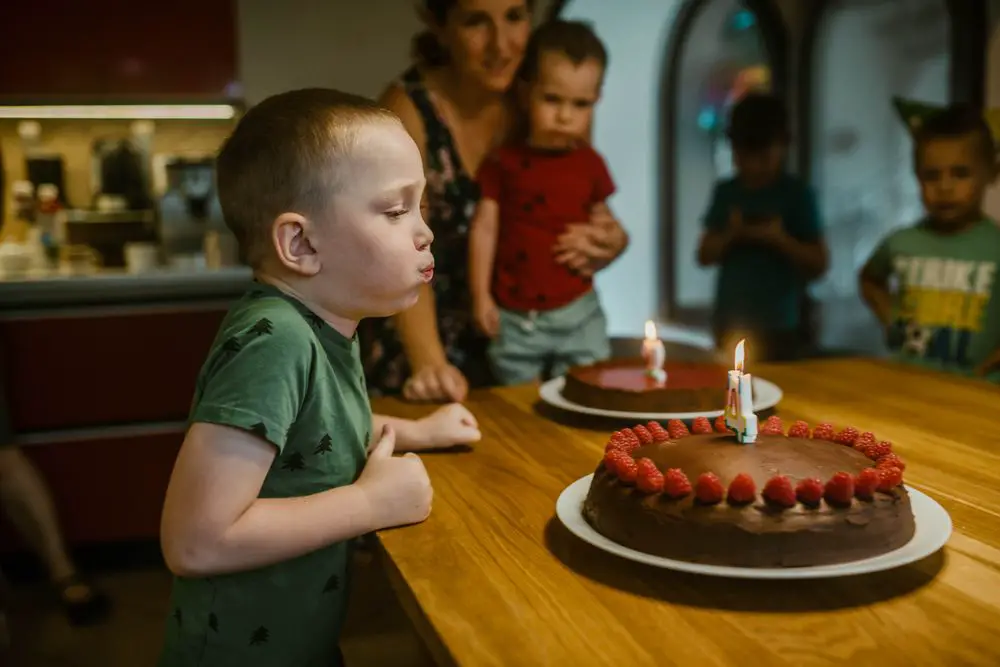
The children were chasing balloons across the lawn. My husband Marcus was crouched over the cake, lighting candles with the particular concentration he brought to everything domestic, as if a birthday cake deserved the same care as a spreadsheet. My son Noah was laughing with frosting smeared across one cheek, holding court among a small crowd of six and seven year olds who had already decided the dinosaur cake was the best thing they’d ever seen. And then my father stepped onto the patio, wearing a suit that looked like it had been pressed specifically for the occasion of intimidating someone, and said, “We need to talk.”
I froze for half a second. Not because I was afraid of him. Because I remembered.
At fifteen I had come home from school on an ordinary Tuesday and found my clothes stuffed into black trash bags sitting on the porch, the zippers straining against winter coats and school uniforms and the stuffed rabbit I’d slept with since I was four, all of it crammed together like garbage waiting for pickup. My father stood in the open doorway with his arms crossed and told me I was too much trouble, that I should figure it out. My mother had died two years earlier, cancer moving through her fast enough that I still sometimes forgot, in dreams, that she was gone at all. My aunt Diane took me in that same night, drove three hours from her apartment the moment I called her crying from a payphone outside the pharmacy two blocks from the house I could no longer enter. My father never called after that. Not for my sixteenth birthday. Not for my high school graduation, where I scanned the audience out of some stubborn, humiliating hope before I stopped scanning entirely. Not for my wedding, where my uncle walked me down the aisle instead. Not when Noah was born, three days of labor ending in a boy with my mother’s exact chin, a fact I noticed through the exhaustion and thought, distantly, that my father would never know.
Nothing, for twenty years. And now he stood on my patio beside my son’s dinosaur cake, the same cold eyes I remembered from that doorway, as though no time had passed at all for him even while it had reshaped my entire life.
I want to explain what those twenty years actually looked like, because the version my father would have told, if anyone had asked him, was probably something about an ungrateful daughter who cut off contact for no good reason, the kind of story men like him always seem to have ready, polished smooth from repeated telling. The truth was slower and considerably less dramatic than any story he could have invented. I finished high school living in Diane’s spare room, the one that had been her home office before I arrived and became, almost overnight, a teenage girl’s bedroom with secondhand furniture and a secondhand life to match. I got a partial scholarship to the state university two hours away, worked two jobs to cover the rest, and graduated with a degree in mechanical engineering that felt, at the time, like the single most improbable achievement of my life. I met Marcus in my second job out of college, at a manufacturing startup neither of us particularly loved, bonding first over bad coffee and then over everything else, slowly, the way real things tend to build rather than arrive all at once.
We married in Diane’s backyard, the same yard, coincidentally, where I’d later throw Noah’s seventh birthday party after we bought the house from her when she decided to downsize. My uncle walked me down a makeshift aisle of folding chairs because Diane was too busy making sure the caterer hadn’t forgotten the vegetarian option to walk anywhere herself, and because some part of me still couldn’t quite picture asking a man to walk me toward a future when the last man in my life had walked me toward a trash bag on a porch instead. Marcus and I started our own company four years into the marriage, a small engineering consultancy that grew slower than either of us expected and then, somewhere around year six, faster than either of us was fully prepared for. By the time Noah turned seven, the company employed thirty two people and had just closed its most profitable year yet, a fact that had apparently reached my father through some channel neither of us ever identified, probably a mutual acquaintance from the small town we’d both once called home, word traveling the way it always does in places small enough that everyone still half remembers everyone else’s business.
None of that mattered to him, of course, except as a number attached to my name, a figure he could apparently justify demanding half of simply because we shared blood he had spent two decades actively disowning.
“Leave,” I said.
He smiled at me the way you’d smile at a child throwing a tantrum, patient and slightly amused. “You don’t want to make a scene.”
I looked past him at the children still chasing balloons, oblivious. Then at Marcus, who had already set down the lighter and started walking toward us, his face carefully neutral in the way I recognized as controlled fury.
My father lowered his voice, leaning in slightly. “I know you have money now. Your little company did well for itself. I’m owed something, after everything I sacrificed for you.”
I nearly laughed out loud, right there on the patio, at the word sacrificed. He had thrown away a child and then returned, decades later, the moment that child became useful to him.
“How much,” I asked, mostly to see how far he’d let the number climb before he heard himself.
His smile widened, and I understood he’d been waiting for exactly that question. “Fifty thousand. Call it repayment. Or I can sue you for elder support instead. Maybe tell a judge you abandoned your own father in his old age.”
My hand stayed steady around the paper cup I was holding, though something in my chest had gone very still and very cold.
“You abandoned me at fifteen,” I said.
He shrugged, an actual shrug, as though I’d brought up something trivial. “You survived.”
That single sentence erased the last soft place I had apparently, foolishly, still been keeping for him somewhere, some small locked room I hadn’t known I was still maintaining until I felt it go dark all at once.
Noah came running toward us then, holding a balloon shaped like a triceratops, his face bright with the particular joy only a seven year old at his own birthday party can produce. My father bent down toward him too quickly, too eagerly, a stranger’s hunger dressed up as affection.
“I’m your grandpa,” he said.
I stepped between them before I’d fully decided to move.
“No,” I said.
His face hardened instantly, the patient smile gone. He reached past me toward Noah anyway, as though blood alone gave him permission to touch my son, as though genetics were a passport that never expired regardless of what a person did with the years attached to it.
I caught his wrist before his hand reached my son and pushed it back, firmly, my voice dropping into a register I didn’t recognize as entirely my own.
“Do not reach for my child.”
For the first time since he’d walked through the gate, my father looked uncertain, something flickering behind his eyes that might have been surprise or might simply have been recalculation, the particular look of a man realizing his usual approach wasn’t landing the way it always had before.
I leaned closer, keeping my voice low enough that it wouldn’t carry to the children still playing twenty feet away.
“You have five minutes to leave,” I told him.
He laughed, a short, humorless sound through clenched teeth. “Or what?”
I looked up at the security camera mounted above the patio door, the one Marcus had installed the year before after a string of package thefts in the neighborhood, a small practical detail that suddenly felt like something closer to providence.
“Or everyone sees exactly why I stopped being afraid of you,” I said.
My father’s eyes moved to the camera, then swept across the guests scattered around the yard, several of whom had gone quiet, sensing the shift in the air the way people always do at parties when something is about to break. Then his eyes came back to me.
“You’re threatening me?” he asked.
“No,” I said. “I’m documenting you.”
Marcus stepped up beside me then, his voice level and unhurried in a way that somehow made it more effective than shouting would have been. “Sir, the gate’s that way.”
My father’s smile returned, weaker now, more brittle. “So this is the man who thinks he can replace me.”
“You left the position vacant,” Marcus said simply, and I felt something in my chest loosen slightly at hearing it put that plainly, that calmly.
Several of the adults nearby had fallen completely silent by then, watching. My aunt Diane stood near the cake table, her face gone pale with an anger I hadn’t seen in her since the year she first took me in. She was the one who had collected me off that porch twenty years earlier, who had bought my school shoes every August without ever once mentioning the cost, who had signed every permission slip and shown up to every parent conference and held me the one night I finally asked her, sobbing into her shoulder, why my own father hadn’t wanted me.
I remembered that night clearly, more clearly than I remembered most of my actual childhood before it. I was sixteen, maybe seventeen, sitting on the edge of the secondhand bed in what used to be her office, and I’d finally asked the question I’d been carrying around silently for months, why doesn’t he want me, what’s wrong with me. Diane hadn’t tried to soften it into something easier to swallow, the way some adults might have. She’d simply held me and said, there is nothing wrong with you, there was never anything wrong with you, some people are just too small inside to hold onto the good things life hands them, and your father was always one of those people, even before your mother died, I watched him be that way for years. I hadn’t fully believed her at the time. It took me most of my twenties to actually believe her, to stop quietly auditing myself for the flaw that must have driven him away, but she never once wavered in repeating it to me, birthday after birthday, until eventually the words became mine instead of just hers.
She walked forward now, slowly, deliberately, the way she used to walk toward trouble when I was a teenager living under her roof.
“Robert,” she said, using his first name the way you’d address a stranger rather than family, “leave.”
He sneered at her. “Of course you’re here. You always did fill her head with lies about me.”
Diane’s hands trembled slightly at her sides, but her voice held perfectly steady. “I filled her fridge, Robert. You filled trash bags.”
That silenced even him, for a moment, the words landing with more weight than any shout could have managed.
I took out my phone then and opened a folder I had built years earlier, back when my therapist first told me that healing didn’t mean pretending the past had no paperwork attached to it, that some wounds needed documentation as much as they needed forgiveness, maybe more. Inside were photographs of the trash bags on the porch, taken by a neighbor who’d texted them to me years later out of some belated guilt. Messages from that same neighbor, describing what she’d witnessed that afternoon. A copy of the abandonment report Diane had filed with the county when I first moved in with her, back when she was still hoping, foolishly, that it might force some kind of accountability. A letter from my father’s own attorney, sent when I was sixteen, formally refusing to provide any support because I had, in his words, voluntarily left the family home.
I turned my phone screen toward him.
“You want to sue me,” I said. “Start with this.”
His face lost whatever color it had left.
Behind me, Noah had started crying, overwhelmed by the sudden tension replacing what had been, until ten minutes earlier, the happiest afternoon of his year. That was the only sound in the yard that actually mattered to me in that moment, the small, confused sob of my son trying to understand why the grown ups around him had stopped smiling.
My father looked past me toward him one more time. “He deserves to know his grandfather.”
“No,” I said. “He deserves peace.”
That was when my attorney, Priya, who happened to be one of the other mothers at the party, the parent of one of Noah’s classmates, stepped forward with her own phone already raised, recording.
“Mr. Ellis,” she said, her voice crisp and entirely professional despite the balloons and the half eaten cake around us, “I’d suggest you leave before this becomes a police matter.”
He stared at her, clearly trying to place her, clearly recalculating the odds of this encounter going anywhere close to how he’d planned it.
“And if you contact my client again,” Priya added, “we’ll be the ones filing first.”
My father walked out through the gate a few minutes later, the gift bag still hanging from his hand, unopened, unwanted, whatever was inside it never destined to matter to anyone in that yard. Nobody clapped as he left. Nobody needed to. The silence that settled over the party afterward felt cleaner and more complete than applause ever could have managed.
I knelt down beside Noah and wiped the last of the frosting and tears from his cheek with my thumb. “I’m sorry, baby,” I told him.
He sniffed, still catching his breath. “Was he mean to you?”
I looked at my son, at his small dinosaur shirt already smudged with cake, at the birthday candles slowly hardening into wax puddles on the frosting, and I chose the truth, but without the poison attached to it.
“Yes,” I said. “But he doesn’t get to be mean here. Not in our yard. Not at your party. Not ever again.”
Marcus relit the candles. Diane cut the cake, her hands steadier now than they’d been minutes earlier. The party continued, quieter at first, the other parents exchanging careful glances over their children’s heads, and then gradually louder again, because children have an instinct for pulling joy back into a room that adults have nearly ruined, an instinct I found myself grateful for in a way I couldn’t fully articulate at the time.
One of the other mothers, a woman named Kate whose daughter was in Noah’s class, found me a little later by the drinks table, where I was pretending to reorganize a cooler I didn’t actually need to reorganize, mostly as an excuse to have somewhere to put my hands.
“You okay?” she asked quietly, not making a production of it.
“I think so,” I said, and found, saying it out loud, that it was mostly true.
“For what it’s worth,” Kate said, “my mother did something similar when my daughter was born. Showed up after fifteen years wanting to be part of things right when it was convenient for her. It took me a long time to understand that showing up isn’t the same thing as staying.” She squeezed my arm briefly and went to go referee a dispute over whose turn it was on the trampoline, leaving me standing there with a strange, unexpected sense of not being quite as alone in this particular experience as I’d assumed.
Priya found me a few minutes after that, phone finally lowered, her expression softer now than it had been during the actual confrontation. “For what it’s worth,” she said, echoing Kate’s exact phrase without either of them knowing it, “you handled that about as well as anyone could have. Most people either fold immediately or they escalate into something ugly. You did neither.”
“I had a lot of practice imagining it,” I admitted. “Different versions of this exact conversation, for years. I just never thought it would actually happen at Noah’s birthday party, of all places.”
“They never pick a convenient moment,” Priya said. “That’s usually the point.”
By the time the last guests left that evening, the yard littered with deflating balloons and cake crumbs ground into the grass, I felt something close to exhaustion, but a clean kind, the tired that comes after finally putting down something heavy rather than the tired that comes from carrying it a while longer.
That night, after Noah had fallen asleep with two plastic dinosaurs tucked under one arm, I sat at the kitchen table and sent Priya every file I had. The photographs, the neighbor’s messages, the abandonment report, the old letter from my father’s attorney. I hadn’t looked at most of it in years, and going through it again felt like handling something fragile and dangerous at the same time, the way you might handle a piece of glass you know is sharp but need to move anyway.
The next morning, right on schedule, my father emailed a formal demand letter. Fifty thousand dollars. A public apology. Supervised access to his grandson going forward. Priya responded within the hour with a cease and desist, attaching the abandonment records, the security footage from the party, and a clear warning that any false elder support claim would be met immediately with a counterclaim for harassment alongside the documented history of past neglect. He did not sue. People like my father, I was starting to understand fully for the first time in my adult life, relied entirely on fear rather than facts, and once the facts were laid out plainly in front of a lawyer, the fear lost its only real leverage.
Two weeks later I received one final voicemail from him. You became cold, his recorded voice said, tinny and distant through the phone speaker. Your mother would be ashamed of you. I listened to it exactly once, sitting alone in my car in the school pickup line, and then I deleted it without a second listen. My mother, I thought, closing the app, would have been ashamed of the man who left her child on a porch in trash bags. Not of the woman who had since built a locked gate around her own son’s peace of mind.
A month after the party, Noah asked me, apropos of nothing, while we were building a puzzle at the kitchen table, whether the mean grandpa was coming back.
“No,” I told him, keeping my voice light and steady. “Some people don’t get a second chance just because they finally decide to show up.”
He nodded, apparently satisfied with that answer in the uncomplicated way children can be satisfied with things adults spend years working through, and turned his attention back to fitting a puzzle piece shaped like a stegosaurus tail into its place.
I sat there a while longer after he wandered off to play, thinking about that answer, turning it over the way you turn over something you’ve said out loud and are only just now hearing the full weight of. Some people don’t get a second chance just because they finally decide to show up. I thought about all the years I’d spent, quietly and without quite admitting it to myself, leaving a small light on somewhere inside me for my father, the way you leave a porch light on for someone who told you plainly, decades earlier, that you were too much trouble to keep around. I thought about how long it had taken me to understand that the light wasn’t for him at all, not really. It had been for the fifteen year old girl standing on that porch with her whole life zipped into garbage bags, the one who needed, for a long time, to believe her father might someday come back and explain that it had all been some terrible mistake, that she’d been wanted after all.
He never did explain it, of course, not that afternoon in my backyard, not in the demand letter that followed, not in that final voicemail dripping with the same cold disappointment he’d worn in the doorway when I was fifteen. And somewhere in the weeks after the party, sorting through old photographs for the file I sent Priya, I finally understood something I wished I’d known back then, standing on that porch with my whole childhood packed into black plastic. Being abandoned had never meant I was unwanted in any final, permanent sense. It had simply meant I was free, eventually, once I stopped waiting for an apology that was never coming, to build an entirely different kind of family, one where no child would ever again have to beg simply to be allowed to stay.
I thought, too, about the version of this story my father would eventually tell himself, if he told it at all, the version where I was the cold one, the ungrateful one, the daughter who wouldn’t extend a hand to an aging man simply asking for what he was owed. I understood, sitting with those photographs spread across my kitchen table, that I would never be able to control that version, that he would likely carry it with him to whatever end he was heading toward, unchanged and unexamined, the same way he’d carried the story of a difficult fifteen year old daughter for twenty years without ever once revisiting whether it was true. That used to bother me more than it did now. I had spent so long, in my twenties especially, wanting him to eventually understand what he’d done, to arrive at some late accounting of himself that matched the one I carried. Standing in my kitchen that evening, I realized I no longer needed that from him. His understanding, or his permanent lack of it, had stopped being my responsibility to manage the moment I closed the gate behind him.
My father came to my son’s seventh birthday party asking for fifty thousand dollars and the right to call himself a grandfather. He left with the only thing, in the end, he had actually earned across twenty years of silence.
Nothing at all.
That evening, once Noah was asleep and the last of the balloons had started their slow deflation in the corner of the living room, Marcus and I sat together on the back patio where it had all happened just hours earlier, drinking the last of the lukewarm coffee from the party thermos.
“You okay?” he asked.
I thought about it honestly before answering, watching the porch light throw its small circle of gold across the grass where my father had stood.
“I think I finally am,” I said. “I kept waiting for that moment to feel like something enormous, some huge confrontation I’d need years to recover from. But it didn’t feel like that at all. It felt like closing a door that had been standing open for twenty years, letting all the cold air in without me even noticing how cold the house had gotten.”
Marcus reached over and took my hand, and we sat there a while longer in the quiet, the porch light humming faintly overhead, the house behind us finally, completely warm.
“Do you think he’ll try again,” Marcus asked eventually. “Another letter, another lawyer, something.”
I considered the question honestly rather than answering it reflexively. “Maybe,” I said. “People like him don’t usually just quit the first time they hear no. But I think whatever he tries next, it’ll feel different to deal with. Not because he’ll come at it differently, but because I already know exactly what I’m capable of now. I didn’t know that this morning.”
“You were something else out there,” Marcus said. “I’ve known you seven years and I don’t think I’d ever quite seen that particular version of you before.”
“I don’t think I had either,” I admitted. “I keep thinking about how automatic it felt, once it started. Like some part of me had been rehearsing that exact conversation for twenty years without telling the rest of me it was practicing.”
We sat there until the porch light drew the first moths of the evening, and eventually went inside to check on Noah, who had shifted in his sleep but hadn’t woken, one dinosaur still tucked firmly under his arm, the other having slipped somewhere down near his feet during the night. I stood in his doorway a long moment, watching him breathe, thinking about the particular kind of vigilance that comes with loving a child the way I loved mine, fierce and specific and entirely without the conditions my own father had apparently attached to loving me.
A year passed. Then another. The demand letters stopped after the second one went unanswered by anyone but Priya’s firm. My father moved, according to a distant cousin who mentioned it at a funeral I attended more out of obligation to the extended family than any personal grief, to a smaller town two states away, where, as far as any of us knew, he lived quietly and told whatever version of his story he needed to tell to get through his days. I did not seek out further information. I did not need to know how his story ended in order to know how mine was continuing.
Noah is nine now, and he doesn’t ask about the mean grandpa anymore, though every so often, usually around his birthday, some flicker of that afternoon crosses his face when the doorbell rings unexpectedly during a party, a small residue of a memory he’s mostly outgrown but hasn’t entirely shed. I’ve told him, in pieces appropriate to his age, a little more of the real story each year, careful never to let bitterness do the telling for me, wanting him to understand the facts of it without inheriting the particular ache that used to live in me before that afternoon in the backyard.
What I hope he carries instead, when he’s old enough to carry the whole of it, is something simpler than a grudge. That love, the real kind, doesn’t show up decades late with an invoice attached. That a locked gate can be an act of love just as much as an open door can be, depending entirely on who’s standing on the other side of it. And that the family you build, deliberately and with your own two hands, can outweigh, completely and without much effort in the end, the family that only ever showed up when it wanted something back.

Laura Bennett writes about complicated family dynamics, difficult conversations, and the quiet moments that change everything. Her stories focus on real-life tensions — inheritance disputes, strained marriages, loyalty tests — and the strength people find when they finally speak up. She believes the smallest decisions often carry the biggest consequences.