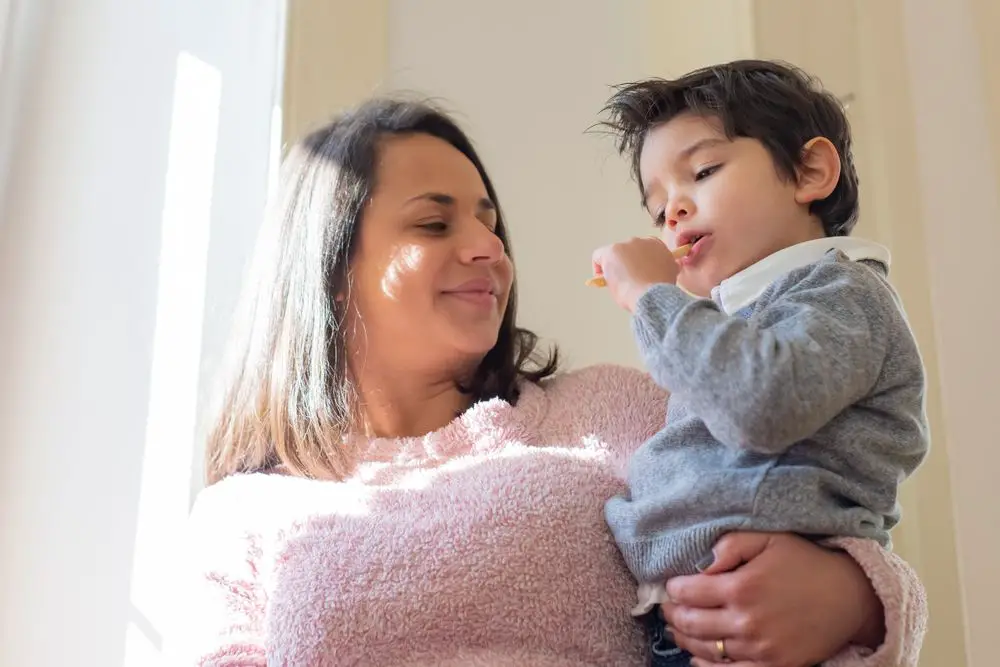
My mother-in-law came over to see her grandkids on a gray Tuesday afternoon, carrying cinnamon rolls and the kind of confidence only a woman with no idea what had happened can bring into a broken house.
The porch was wet from a thin, cold rain. The baby monitor hissed on the counter. Somewhere in the laundry room, the dryer had stopped hours earlier, leaving another load wrinkling because I had run out of energy before I ran out of chores.
Milo was eight months old and fever-warm from teething, one damp fist tangled in the sleeve of my oversized hoodie. Ruby was three, cross-legged on the rug, building a tower out of plastic blocks and humming to herself in that serious little way she had when she was trying not to need anything from me.
That was what motherhood had felt like for three weeks. A baby on my hip. A toddler watching my face. A house full of ordinary objects that had suddenly become evidence of someone leaving.
The empty hook where Eric’s keys used to hang. The laundry basket with only three people’s clothes in it. The silver wedding frame above the television with no picture inside.
I had removed the photo at 1:12 in the morning the night before, because I could not keep walking past our smiling faces while my husband slept in another woman’s apartment.
At 2:18 in the afternoon, the doorbell rang.
I thought it was the diaper delivery. I had been refreshing the tracking page since breakfast, because Milo was down to the last handful, and even that small problem had felt enormous.
When I opened the door, Diane Caldwell stood under the porch roof in her camel coat. Her blonde bob was smooth in spite of the drizzle. Her pearl earrings caught the weak afternoon light. A bakery bag hung from her wrist, and warm cinnamon drifted through the doorway like a memory of a life where people still had clean counters and husbands who came home.
“Surprise,” she said. “I was nearby and thought I’d stop in to see my grandbabies.”
Diane was not a woman who stopped by. She scheduled visits. She texted first. She noticed dust, spotted fingerprints on the microwave, and asked questions in a tone that made you feel like your answer was being entered into a file.
She loved Eric with the kind of loyalty that sounded sweet until you were the woman standing between him and accountability.
For six years, I had tried to be good with her. I had remembered her birthday. I had brought green bean casserole to Thanksgiving even after she told me Eric preferred the way she made it. I had sent her pictures of Ruby’s first steps and videos of Milo laughing in his high chair. I had trusted her with access to my children, because I believed loving them meant she would have to see me as part of the family too.
That was the trust signal I gave her. The children.
And now I had to find out whether she loved them more than she defended him.
Ruby looked up from the rug and squealed, “Grandma!”
So I stepped aside.
Diane came in with the bright, practiced joy of someone entering a house she expected to understand. She kissed Ruby’s hair. She stroked Milo’s cheek. Then she glanced toward the kitchen and asked, “Where’s Eric? Still at work?”
My throat tightened so hard I could barely swallow. I had imagined telling her a hundred different ways. In all of them, I had showered. In all of them, the kitchen table was clean. In none of them was my daughter sitting close enough to learn that adults can destroy a room without raising their voices.
“He’s not here,” I said.
Diane’s smile twitched. “Not here where? Store? Gym?”
“Diane,” I said, “can we sit down?”
She did not sit. Her eyes moved around the living room. The stroller beside the couch. The bottles in the sink. The unopened mail under the TV remote. The toys spread across the rug.
Then she saw the frame.
The silver frame was still standing on the shelf above the television. The wedding picture was gone.
Her face changed. Not gently. It sharpened.
“Why is that frame blank?”
Milo fussed, and I bounced him on my hip because my hands were shaking and motion was the only way to make it look like I still had control.
“Eric moved out three weeks ago,” I said.
The words seemed to hit the air and hang there.
Diane stared at me. “He is living with someone else,” I added. “He was seeing her before he left.”
Ruby’s block tower tipped over. It was only plastic. A soft little clatter on the rug. But in that room, it sounded like a plate shattering.
“No,” Diane whispered.
I almost wished she had yelled.
“Eric wouldn’t do that.”
That was the first wound she chose. Not “Are you okay?” Not “What about the children?” Not “Where is my son?” Just no. Just Eric wouldn’t.
I carried Milo to the couch, kept one hand behind his head, and reached for the folder on the coffee table.
It was not dramatic. It was a cheap blue folder from a multipack I bought at the grocery store. But inside it were the things that had kept me from falling apart completely. A printed screenshot of Eric’s message from 1:43 in the morning. The lease page showing he had removed his name. A bank notification from 7:06 the morning money left our joint account. The date he packed the gray suitcase. The notes I wrote after the county clerk explained temporary custody and child support forms.
The first hard lesson of being abandoned is that pain does not become real to other people until you can organize it.
So I had organized it.
I unfolded the screenshot and held it out.
Diane took it. She read the first line. Then the second. Then all of it.
Eric had written that he deserved happiness. He had written that being home felt like being buried alive. He had written that I brought too much stress into his life. He had written it while his son was asleep in a crib and his daughter had a drawing of our family taped to the refrigerator.
I watched Diane’s fingers tighten until the page bent. I watched the color leave her face. For one brief second, I thought truth would do what I could not. I thought it would make her turn toward me. I thought it would make her see the two children in the room instead of the son in her head.
Then she looked up. Her eyes were cold.
“What did you do to make him leave?”
The sentence was so quiet it took me a second to understand it.
Milo made a small, miserable sound against my shoulder. Ruby picked up one red block and held it in both hands. Diane kept looking at me, as if I had been caught.
“Men don’t walk away from families for no reason,” she said.
The bakery bag swung gently from her wrist. The smell of cinnamon suddenly made me sick.
“Eric has always been responsible. If he left, something happened here.”
There it was. The little courtroom she had carried inside her all along. Her son at the center. Me on trial. The children as exhibits.
For one ugly heartbeat, I wanted to scream so loudly Ruby would remember the sound forever. I wanted to tell Diane that her responsible son had left while Milo had a fever. That he had not asked whether we had diapers. That he had transferred money before the electric bill cleared.
Instead, I lowered Milo into his bouncy seat, tucked the blanket under his legs, and opened the folder.
I slid the bank notification across the coffee table.
Diane glanced down because she thought she already knew what kind of wife I was.
Then she saw the number.
Her face shifted. Not all the way. Not into apology. But enough.
“Where did this come from?” she asked.
“Our joint account.”
“When?”
“7:06 in the morning,” I said. “The morning after he packed the gray suitcase.”
She looked at the page again. Then at the lease copy. Then at the custody forms.
I did not speak for a moment. The refrigerator hummed. Rain tapped the window. Ruby’s block clicked softly against another block, but she was not building anymore. She was making small movements because stillness had become too scary.
Diane’s mouth opened, then closed.
My phone buzzed on the coffee table. Eric’s name lit up on the screen.
For three weeks, I had avoided his calls unless they were about the kids. He preferred messages, because messages let him choose his tone. This time, his timing was perfect in the cruelest way.
Diane stared at the phone.
Ruby whispered, “Daddy?”
That one word did what my evidence had not. It made Diane flinch. The bakery bag slipped from her wrist and hit the rug. One cinnamon roll rolled halfway out onto the carpet, leaving a smear of icing near Ruby’s blocks.
Diane looked at me. Not polished now. Not certain. Just pale.
“Answer it,” she whispered.
I pressed speaker.
Eric’s voice filled the living room. “Are you ignoring me now?”
Diane closed her eyes.
I looked at the phone, then at her. “Your mother is here,” I said.
Silence. It was not long, maybe two seconds. But I heard everything inside it. Calculation. Irritation. Fear.
Then Eric laughed softly. “Oh,” he said. “So this is what we’re doing.”
Diane’s face tightened. “Eric,” she said.
His voice changed immediately. “Mom. You shouldn’t be there.”
“Why not?”
“Because she is going to twist everything.”
I felt something in me go very still. Not anger. Worse than anger. Still.
Diane picked up the screenshot again, slowly this time. “I read your message,” she said.
Eric sighed. “Mom, you don’t know what it was like living with her.”
Diane looked at the bottles in the sink. The baby in the bouncy seat. Ruby on the rug with icing near her sock.
“What was it like?” she asked.
“She made everything heavy,” Eric said. “Every day it was bills, the baby, Ruby, groceries, daycare waitlists. I couldn’t breathe.”
I had heard versions of that before. Never with his mother listening.
Diane’s hand went to her throat. “And the woman you’re with?” she asked.
He paused. “Her name is Ashley.”
The name entered my living room like one more thing I had not invited in.
Diane’s lips parted. “How long?”
“Mom, don’t do this.”
“How long?”
Another pause. “Before I moved out.”
Ruby looked up at me. “She doesn’t need to hear this,” I said.
Eric snapped, “Then maybe don’t put me on speaker.”
Diane’s expression changed at that. It was small. A crack across the surface. She looked at me, and for the first time that afternoon, she seemed to see my hoodie, my tired eyes, Milo’s flushed cheeks, the floor full of toys, the folder full of forms.
She saw the house her son had left behind.
“Did you take money from the account?” she asked.
Eric went quiet again.
“Eric.”
“I moved what I needed,” he said.
“For what?”
“Deposit. First month. Some furniture.”
Diane looked at the bank page. Her fingers trembled. “Furniture,” she repeated.
The word sounded unfamiliar in her mouth. As if she had never imagined her son choosing a couch over diapers.
I sat beside Milo and pressed two fingers gently to his warm cheek. He blinked at me, exhausted and trusting. That was the thing about babies. They do not know who has failed them yet. They just keep reaching.
Eric kept talking. He said I was dramatic. He said I had turned the house against him. He said he loved his kids, of course he loved his kids, but he needed to be happy too. He said child support would have to be fair, because he could not be punished for leaving a miserable marriage.
Diane lowered herself onto the edge of the couch. The woman who had entered my house like an inspector suddenly looked old.
“Eric,” she said, “Milo is sick.”
He was quiet.
“Did you know that?”
“He’s always teething.”
“Ruby heard me ask where you were,” Diane said. “She heard her mother tell me you were gone.”
“Mom, don’t let her make you feel guilty.”
That was the last wrong sentence.
Diane stood. Her whole body looked unsteady, but her voice did not.
“Do not tell me what to feel when your children are standing in the wreckage you made.”
Eric said nothing.
I watched Diane press her fingers against the folded screenshot. The paper shook.
“You will send back what you took from that account,” she said.
“Mom.”
“You will answer her messages about the children.”
“Mom, you’re overreacting.”
“And you will not speak about your wife like she is a weather pattern that ruined your day.”
The silence after that was enormous.
Ruby leaned against my knee. I put my hand on her hair.
Eric’s voice came back smaller. “You don’t understand.”
“No,” Diane said. “I think I finally do.”
Then she ended the call.
For a moment, none of us moved. Rain slid down the front window in thin lines. The small American flag by the porch steps flicked in the wind.
Milo whimpered, and Diane turned toward him as if the sound had pulled her out of a trance.
“May I?” she asked.
It was the first question she had asked me that day that did not feel like an accusation.
I nodded.
She picked him up carefully, one hand under his head, the other under his little body. Milo fussed once, then settled against her coat. Diane’s eyes filled.
“I am so sorry,” she whispered.
I did not rush to comfort her. That was not mine to do.
“I don’t need you to hate him,” I said. “I need you not to help him erase what he did.”
She nodded, tears sliding down her face now. “I won’t.”
Ruby stared at the cinnamon roll on the rug. Diane followed her eyes and gave a broken little laugh that became almost a sob. “I brought dessert,” she said.
Ruby did not smile. “Daddy left?” she asked.
The question split the room open in a way no adult sentence had.
I knelt in front of her. “Yes, baby,” I said. “Daddy is living somewhere else right now.”
“Because Milo cried?”
“No.”
“Because my blocks are messy?”
“No, sweetheart.”
Diane covered her mouth with one hand.
I held Ruby’s face gently between my palms. “Daddy made grown-up choices,” I said. “They are not your fault.”
Ruby looked at Diane. “Grandma mad at Mommy?”
Diane closed her eyes. When she opened them, she came down slowly onto the rug, still holding Milo.
“No,” she said, voice shaking. “Grandma was wrong.”
Ruby studied her the way children do when an apology is too big for them to understand but not too big for them to feel.
Then Ruby pushed the red block toward Diane. “You can help,” she said.
Diane took it. Her hand trembled around that little plastic block as if it weighed more than anything in the folder.
The next morning, Diane drove over again. This time she texted first. She brought diapers, fever drops, and a grocery bag with soup, applesauce, and paper towels. She did not walk in like she owned the room. She knocked, waited, and asked what I needed.
That mattered more than the groceries.
Later that week, she sat beside me in the family court hallway while I filed the temporary custody and child support paperwork. No dramatic speech. Just a hard plastic chair, a county clerk calling numbers, and a grandmother who had finally stopped asking me to protect her son from the truth.
Eric did send back part of the money. Not all of it at first. Enough that the electric bill cleared. Enough that I could buy diapers without calculating ounces of formula in my head.
Diane did not become perfect. People do not unlearn a lifetime of defending someone in one afternoon. There were days she still started a sentence with “Eric probably meant” and stopped herself halfway through. There were days I had to remind her that access to the children went through me, not around me. But she tried. She showed up for Ruby’s preschool pickup when Milo had a checkup. She learned which bottles he liked. She folded the laundry without commenting on how many loads there were.
Once, while Ruby napped and Milo slept against my shoulder, Diane stood in front of the shelf above the television and looked at the empty silver frame.
“Do you want me to put it away?” she asked.
I looked at it for a long time. That frame had once held proof of a promise. Then it had become proof of a lie. Now it was just an object waiting for me to decide what it meant.
“No,” I said. “Not yet.”
A week later, Ruby drew a picture with four people in it. Me. Milo. Herself. And Grandma. She taped it to the refrigerator at toddler height, crooked and proud.
Diane saw it when she came in with a bag of groceries and stopped so abruptly the milk carton bumped against the counter. She touched the corner of the paper with one finger. Then she looked at me, and neither of us said anything, because there was nothing to say that the drawing had not already said better.
My children had almost lost their grandmother that day, because Diane had walked into my house ready to protect the wrong person. But sometimes the truth does not arrive as thunder. Sometimes it arrives as a blank wedding frame, a printed screenshot, a bank notification, and a child asking if messy blocks made her father leave.
I documented because hurt was not always enough. But the part that finally changed Diane was not the paperwork. It was Ruby’s small voice in the middle of the wreckage. It was Milo’s feverish cheek against her coat. It was the moment she understood that loyalty to her son could cost her the children he had left behind.
And from that day on, whenever Diane came to the door, she did not ask where Eric was first. She asked, “How are my grandbabies?” Then, a little quieter, she asked me, “How are you?”
The months that came after were not a straight line. Grief with two small children never is. It came in waves that had nothing to do with logic. I could get through a custody mediation with my voice steady and my folder in order, and then break down completely a week later because I found one of Eric’s old socks behind the dryer. Some nights I stood in the kitchen at two in the morning, the same hour I had taken down our wedding photo, and let myself cry where the children couldn’t hear. Then I washed my face, checked on them both, and went back to bed. Morning always came whether I was ready for it or not, and two small people needed breakfast either way.
Eric drifted in and out during that time, the way a man does when he wants the title of father without the weight of it. He would go quiet for two weeks, then send a flurry of messages about his rights. He asked for a weekend, then canceled it the night before because Ashley had planned something. Ruby stopped asking when she would see him after the third cancellation. I did not poison her against him. I did not have to. Children keep their own quiet ledgers, and they notice who shows up.
What surprised me was who did.
Diane came every Wednesday, and then Wednesdays and Sundays, and then whenever I needed her, which I slowly learned to admit that I did. It took me a long time to trust it. For weeks I kept waiting for the old Diane to resurface, for the inspector’s eyes to come back, for a sentence that began with a defense of her son. But something had genuinely shifted in her that gray Tuesday, and it held. She had walked into my house certain she knew the story, and she had walked out of it holding a feverish baby and the knowledge that she had almost chosen wrong.
She told me once, folding a basket of Milo’s tiny onesies on the couch, that she kept thinking about the moment she had said what did you do to make him leave. That it woke her up at night. “I looked at you holding a sick baby,” she said, not meeting my eyes, “and I still reached for him first. My whole life I reached for him first. I don’t know when I decided he could do no wrong.” She smoothed a onesie flat across her knee. “I think I made him this way. A little. By never once letting him be wrong.”
I did not tell her she was blameless, because I don’t think she was, and I think she would have known I was lying. But I told her what was true, which was that she was here now, that she folded laundry and remembered which bottle Milo liked and never once made Ruby feel like her father’s leaving was a shame she had to carry. “You can’t fix the beginning,” I said. “You’re changing the middle. That counts.”
The money worked itself out the slow, grinding way these things do, through paperwork and deadlines and a court order that finally made child support something other than a favor Eric felt he was doing me. It was never generous. But it was steady, and steady was what I needed to stop doing math in my head every time Milo went through a growth spurt. I went back to work part-time when he turned one, and Diane watched the children two afternoons a week, and for the first time in a long time the ground under my feet felt like it might actually hold.
Ruby started preschool that fall. She marched in on the first day in light-up sneakers she had chosen herself, and she did not cry, and I did in the car afterward, the good kind of crying, the kind that means a child feels safe enough to walk away from you and toward the world. She made friends. She learned songs I didn’t know and taught them to Milo, who was walking now, wobbling after her through the house on fat unsteady legs, worshipping his big sister the way little brothers do.
The drawing of the four of us stayed on the refrigerator until the tape gave out, and then I moved it to a real frame and hung it in the hallway. Ruby was proud of that. She would point it out to anyone who came over. “That’s my family,” she would say. Me, her, Milo, and Grandma. She did not draw Eric, and I never asked her to. It was her picture. She got to decide who was in it.
And the silver frame above the television stayed empty for almost a year.
Then one Sunday, going through a box of photos I’d been avoiding, I found a picture from the hospital the day Milo was born. Ruby was in it, three years old and gap-toothed, leaning over the bassinet to look at her brother with an expression of pure astonishment. I was in the background, exhausted and glowing, holding the baby. Eric was not in the frame. He had been the one taking the picture, which felt, looking at it now, like the truest thing a photograph had ever accidentally said.
I put it in the silver frame and set it back on the shelf.
Diane noticed it the next time she came over. She stood in front of it for a long moment, the way she had once stood in front of the empty one. Then she smiled, a little sadly, and didn’t say anything, and neither did I. Some things you decide without words. The frame had held a promise, and then a lie, and now it held the truth, which was that my family was whole. It had been whole all along. It just wasn’t the shape I had thought it would be.
People had wondered, in the beginning, how I could stand there and hand my mother-in-law a folder full of evidence against her own son. As if love should have made me protect him. But that was never how it worked. I documented because a broken heart is not proof, and I needed proof, not for the courts, but for the one person whose belief could have erased everything I had lived through. I needed Diane to see it. Not to punish Eric. To keep him from rewriting the story while the ink was still wet.
And she saw it. That was the part I never expected. She saw it, and she chose her grandchildren over the comfortable version of her son, and in doing so she became the kind of grandmother those children deserved. It cost her something. Loyalty always does when you finally aim it at the right person.
Milo does not remember any of it. He was too small. To him, Grandma Diane is simply a fact of life, as constant as the sunrise, a soft coat and a lap and the person who always has crackers in her purse. Ruby remembers a little, in the blurred way of early childhood, but what she remembers is not the wreckage. She remembers that a red block passed from her small hand to her grandmother’s shaking one, and that afterward everything was better. Children keep the ending, not the middle. She kept the part where Grandma stayed.
I keep all of it. The gray Tuesday. The cinnamon rolls on the rug. The blank frame and the folder and the phone call on speaker. The moment a woman I had almost given up on set down her certainty and picked up a sick baby instead.
Because that is the thing no one tells you about being left. You brace for the ending of everything. You take the photo down at one in the morning and you think the whole structure is coming down with it. And sometimes it does. But sometimes, in the rubble, someone you had written off surprises you. Someone reaches for the right person at last.
The frame is full again. The drawing is in the hallway. The children are asleep down the hall, safe and loved and surrounded by exactly the people who chose to stay.
And when the doorbell rings on a gray afternoon now, I am not afraid of who might be standing on the other side.
It’s just Grandma. And the first thing she says, every single time, is, “How are my grandbabies?”
Then, a little quieter, “And how are you?”

Specialty: Quiet Comebacks & Personal Justice
David Reynolds focuses on stories where underestimated individuals regain control of their lives. His writing centers on measured decisions rather than dramatic outbursts — emphasizing preparation, patience, and the long game. His characters don’t shout; they act.