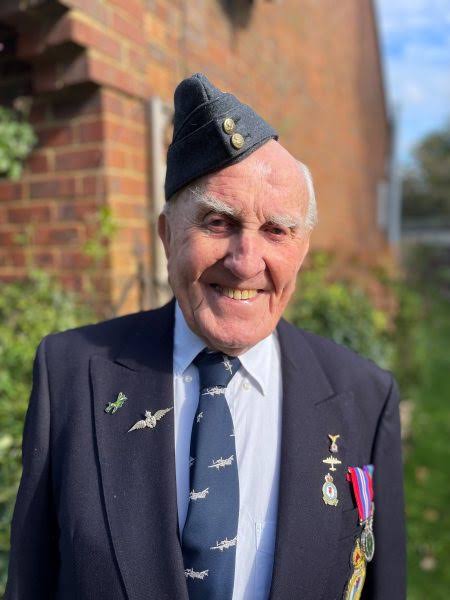
I was twenty-two, exhausted, and desperate when I took the strangest job of my life. I got paid to spend Sundays pretending to be a blind veteran’s granddaughter. I had no idea he’d end up changing my entire life.
By day I sat in college classes. By night I stocked shelves at a grocery store. Every spare minute went to helping my mother take care of my younger brother, Noah.
Noah was only fourteen, but hospitals had already become a regular part of his childhood. His treatments cost more than we could ever keep up with, and every new bill that came in the mail felt heavier than the last one. My mother never complained about any of it. She worked double shifts as a nurse’s aide and still found it in her to smile whenever Noah got scared before a treatment. But I saw the truth underneath all that smiling. I saw the unpaid bills stacked on the kitchen table. I saw her crying quietly after midnight when she thought nobody was awake to hear it. I saw the fear she worked so hard to keep hidden from both of us.
One rainy Thursday, another hospital bill arrived. My mother stared at it for a long time before folding it and setting it under the rest of the pile.
That night I searched online for every side job I could find. Dog walking. Tutoring. House cleaning. Then one listing stopped me cold.
Seeking young woman, age 20–25, to spend Sundays with elderly blind veteran. Generous pay. Must be willing to act as family companion.
At first I thought it was some kind of scam. Then I kept reading. The veteran’s actual granddaughter had stopped visiting years ago. His family wanted him to feel loved in whatever years he had left. Whoever they hired would pretend to be a granddaughter figure for him.
It felt wrong. Almost cruel. I nearly closed the browser tab.
Then I looked over at Noah’s hospital bill sitting next to my laptop.
And I applied.
A week later I met Linda, the veteran’s daughter.
“My father’s name is Walter Harrison,” she explained. “He lost his sight six years ago. He served in the military. He’s stubborn, proud, and lonelier than he’ll ever admit out loud.” She looked tired as she added, “My daughter stopped visiting years back, after a family disagreement. Dad still asks about her.”
I understood the request, even as it twisted something uncomfortable in my stomach.
“What do I need to do?” I asked.
“Visit him every Sunday. Talk to him. Eat lunch with him. Let him feel like someone still comes for him.”
“And pretend to be his granddaughter?”
Linda lowered her eyes. “Yes.”
I accepted the job.
The first Sunday, I was terrified. Walter lived in a small white house surrounded by flowers and old oak trees. When I knocked, he opened the door almost immediately. Even though he couldn’t see me, he smiled.
“There you are.”
My throat tightened. “Hi, Grandpa.”
The word felt like theft coming out of my mouth. But Walter reached for my hand and said warmly, “Come inside.”
That first visit ran four hours long. Walter told me stories about his military service, about repairing trucks, about fishing trips, about his wife Margaret, who he’d loved for more than fifty years. Whenever he mentioned her, his voice went soft around the edges.
“Margaret could make anybody laugh,” he said. “Even me.”
And for a little while, I actually forgot I was pretending.
The Sunday visits kept going. Weeks turned into months, and something I didn’t expect happened along the way. Walter stopped feeling like a job. He became someone I genuinely cared about. He remembered everything I told him — my exams, my mother’s endless shifts, Noah’s treatments, all the little worries I usually tried to laugh off in front of everyone else.
One afternoon he asked, “How’s your brother doing?”
I froze for a second, then realized I’d told him everything about Noah over the months. Not because it was part of the job. Because I trusted him.
“He’s having a rough week,” I admitted.
Walter squeezed my hand. “He’s lucky to have you.”
Those five words nearly broke me right there on his porch.
Eventually I started showing up even on weeks I wasn’t getting paid. I brought cookies. We sat on the porch for hours some days, or just sat quietly listening to birds move through the oak trees. The lie faded away completely. What was left in its place was real. I wasn’t actually replacing his granddaughter. He wasn’t replacing my grandfather. But somehow, without either of us planning it, we’d become family anyway.
Then one Sunday I arrived and immediately sensed something was different. Walter sounded weaker. His breathing had slowed down. His voice shook a little as he greeted me at the door.
“You okay?” I asked.
He chuckled softly. “Getting old isn’t for cowards.”
I smiled, but fear had already settled into my chest.
Over the following months his health declined quickly. Hospital visits became routine. Walking got harder, then became impossible altogether. Still, every single Sunday, he wanted me there beside him.
One afternoon, while I was adjusting his blanket, he reached for my hand.
“You know something?” he said quietly.
“What?”
“You changed my final years.”
Tears filled my eyes. “No, Walter,” I whispered. “You changed mine.”
He smiled. Neither of us needed to say anything else after that.
Three weeks later, Linda called. The moment I heard her voice on the line, I already knew.
“He’s gone.”
I sat on my bed and cried for hours. Not because I’d lost a job. Because I’d lost someone I loved.
The funeral was held the following week. Veterans came. Neighbors came. Old friends came out to pay their respects. I sat in the back row and listened as person after person got up to talk about Walter’s courage, his kindness, his loyalty, his sense of humor. Every single story sounded exactly like the man I knew.
After the service, Linda hugged me tightly. “Dad adored you,” she whispered.
I couldn’t manage to answer her.
A week after that, my phone rang. A man introduced himself as Attorney James Whitaker.
“There’s a matter concerning Mr. Harrison’s estate,” he said.
My stomach dropped straight through the floor. “I think you have the wrong person.”
“I assure you, I don’t. Mr. Harrison specifically requested your presence.”
The following Friday I walked into the lawyer’s office. Several relatives were already seated. Some of them stared. Some whispered.
“That’s the girl.”
“The fake granddaughter.”
I wanted to disappear into the floor.
Then Attorney Whitaker opened a thick folder. “Before Walter Harrison passed away,” he said, “he left one final instruction concerning Miss Emily Carter.”
Every head in the room turned toward me. My heart was pounding so hard I could feel it in my ears. Then the lawyer began reading Walter’s letter aloud.
To my family. You may be surprised to see Emily here. Many of you know she was not my biological granddaughter. But I want you to understand something. I knew from the beginning.
Gasps went around the room. I stopped breathing entirely. Walter had known?
The lawyer kept reading. The first day Emily came to my house, I knew she was not the granddaughter I remembered. People assume blindness means ignorance. It does not. I recognized a different voice, different footsteps, a different way of moving through a room. I knew.
Tears blurred everything in front of me. All those Sundays. All those long conversations. He’d known the whole truth from day one.
At first, I allowed the arrangement because I was lonely. But after a few weeks, Emily stopped pretending. She became herself. And that person brought more kindness, patience, and love into my life than I ever expected.
Nobody in the room spoke. Some of the relatives looked down at the floor, ashamed. The lawyer’s voice went softer.
Many people share your blood. Very few share your heart. Emily did not keep coming because she was paid. She stayed because she cared. That difference matters.
I was openly crying by then. So was Linda.
Then came the part that left the whole room silent. Therefore, my final instruction is this: a portion of my estate shall be placed into a trust for Noah Carter’s medical treatments and future education. No child should suffer because his family cannot afford care. This fund shall be known as The Second Chance Trust.
The room went completely still. I could barely breathe.
Attorney Whitaker looked at me. “The trust contains two hundred thousand dollars.”
I broke down completely. Two hundred thousand dollars. It would cover Noah’s treatments, his therapy, his whole future. My mother would never have to work herself into the ground again. For the first time in years, all three of us could actually breathe.
But Walter had left one more note. The lawyer handed me a sealed envelope, his handwriting across the front.
Emily. If you are reading this, then I am probably somewhere arguing with angels and telling old stories. Thank you for every Sunday. Thank you for every conversation. Thank you for treating an old blind man like he still mattered. Family is not always the people we are born with. Sometimes it is the people who choose to stay. You chose to stay. And that made you my granddaughter in every way that counts. Love, Grandpa Walter.
By the time I finished reading it aloud, almost everyone in that room was crying, including some of the relatives who’d been whispering about me an hour earlier.
That was three years ago. Today, Noah is healthy and thriving. I graduated college. My mother finally works normal hours instead of every double shift she could pick up. And every Sunday, I still drive out to Walter’s little white house. Linda owns it now, but she leaves the porch open for me. I sit in Walter’s old rocking chair and tell him about my week, about Noah, about life. Sometimes, when the wind moves through those oak trees, I swear I can almost hear his voice.
How’s your brother doing?
And every single time, I smile, because thanks to one lonely blind veteran who somehow saw more clearly than anybody else in my life, I can finally answer the way he always hoped I would.
“He’s doing great, Grandpa.”
And somehow, I think Walter already knows that.
Five years have passed now, and people often ask me what the greatest gift Walter Harrison ever gave me was. Most people assume the answer is the money. They’re wrong.
The trust did save Noah’s life, there’s no denying that. His treatments continued without a single interruption. He finished high school stronger than anyone thought he’d be able to, earned a scholarship to study physical therapy, and now spends his days helping frightened children whose families are living through the same fear ours once knew intimately. Every time I watch him crouch down to encourage some scared little boy before a session, I think of Walter squeezing my hand on that porch, saying, “He’s lucky to have you.” Now other children are lucky to have Noah.
Life has a beautiful way of passing kindness on from one heart to the next.
As for me, I became a social worker. It wasn’t the career I’d planned back when I was twenty-two and desperate. Back then I just wanted a stable paycheck and enough money to keep my family together under one roof. But Walter changed the whole direction of my life without ever meaning to. He taught me that loneliness can hurt just as much as illness. That the people who smile the most are often quietly waiting for somebody, anybody, to ask if they’re actually okay. And that just showing up can save someone in ways you’ll never fully understand from the outside.
So I started visiting elderly people who had no family nearby. Some lived in nursing homes. Some lived alone in tiny apartments with nobody checking in on them. Some just needed someone to drink a cup of tea with on a quiet Sunday afternoon. Every single visit reminded me of him.
One rainy afternoon, nearly six years after Walter passed, I was leaving a retirement center when a little girl ran up to me. She couldn’t have been older than eight.
“Excuse me,” she called out.
I turned around. She held out a folded piece of paper. “My grandpa wanted me to give this to you.”
Confused, I looked over toward the garden. An elderly man in a wheelchair smiled and waved at me. I walked over.
“I don’t think we’ve met,” I said gently.
He chuckled. “We haven’t. But I’ve watched you visiting people here every week for almost two years now.”
I smiled politely. “It’s nothing, really.”
“Oh, but it is.” He pointed toward the little girl beside him. “She’s my granddaughter. I wanted her to see what kindness looks like before the world has a chance to teach her otherwise.”
My throat tightened up. He nodded toward the letter still in my hand. “Read it later.”
That evening I unfolded the paper. Inside were only a few short sentences.
Dear Emily. Some people inherit money. Some inherit houses. You inherited a heart that refuses to leave lonely people behind. That’s worth more than any fortune. Please don’t stop.
There was no signature. There didn’t need to be one. I cried anyway, not because I was sad, but because I finally understood something clearly. Walter’s kindness hadn’t ended when his life did. It had simply continued on, through mine.
Years later, Linda called me with some unexpected news. “I think you should come by the house,” she said. “I found something while cleaning out the attic.”
When I got there, she carried down a dusty wooden box. “I’ve never opened it.” Inside were dozens of photographs — Walter as a young soldier, Margaret laughing beside a fishing boat, Linda growing up through the decades. Then, tucked underneath the old albums, I found an empty scrapbook. Only the first page had anything written on it, in Walter’s careful handwriting.
For the memories still waiting to happen.
Linda covered her mouth with one hand. “He bought this after Mom died,” she whispered. “He said one day life would give him new memories worth keeping.”
Without saying much else, the two of us started filling it in together. The first page held a picture of Walter sitting on his porch. The second showed Noah’s high school graduation. The third showed my mother smiling without any exhaustion behind her eyes, for what felt like the first time in years. Birthdays followed. Christmas dinners. My college graduation. Noah’s white coat ceremony. Linda becoming a grandmother herself. Every photograph told the same underlying story — one lonely man had loved people who weren’t born into his family, and because of that love, none of us were lonely anymore either.
Last Sunday I visited Walter’s grave. The flowers around his headstone were blooming just like they always had around his little white house. I sat down in the grass with a cup of coffee beside me, old habit, and smiled up at the quiet sky.
“You were right,” I whispered. “Family isn’t always the people we’re born with.”
The breeze moved through the oak trees overhead, and for just a moment, it sounded almost like laughter.
I looked down at the words engraved on his headstone. Beloved Husband. Proud Veteran. Loyal Friend. I traced the letters with my fingertips, then quietly added the words that weren’t carved into the stone but had always been true anyway.
My Grandpa.
As I stood up to leave, I noticed another family walking through the cemetery nearby. A little boy held his grandfather’s hand as they laughed together about something only the two of them understood.
I smiled and kept walking, because I finally understood the greatest lesson Walter ever taught me, without ever meaning to teach it at all.
Love isn’t measured by blood. It isn’t measured by time. It isn’t measured by what someone leaves you in a will.
Love is measured by who stays. Who listens. Who shows up. Who chooses you, again and again, without ever needing an obligation to do it.
Walter chose me. And because he did, I’ve spent the rest of my life choosing others right back.
If heaven has visiting hours, I hope Walter knows I’m still keeping our Sunday appointment. Only now, instead of pretending to be his granddaughter, I truly am.

Adrian Hawthorne is a celebrated author and dedicated archivist who finds inspiration in the hidden stories of the past. Educated at Oxford, he now works at the National Archives, where preserving history fuels his evocative writing. Balancing archival precision with creative storytelling, Adrian founded the Hawthorne Institute of Literary Arts to mentor emerging writers and honor the timeless art of narrative.
Love the stories they always hit the hearts