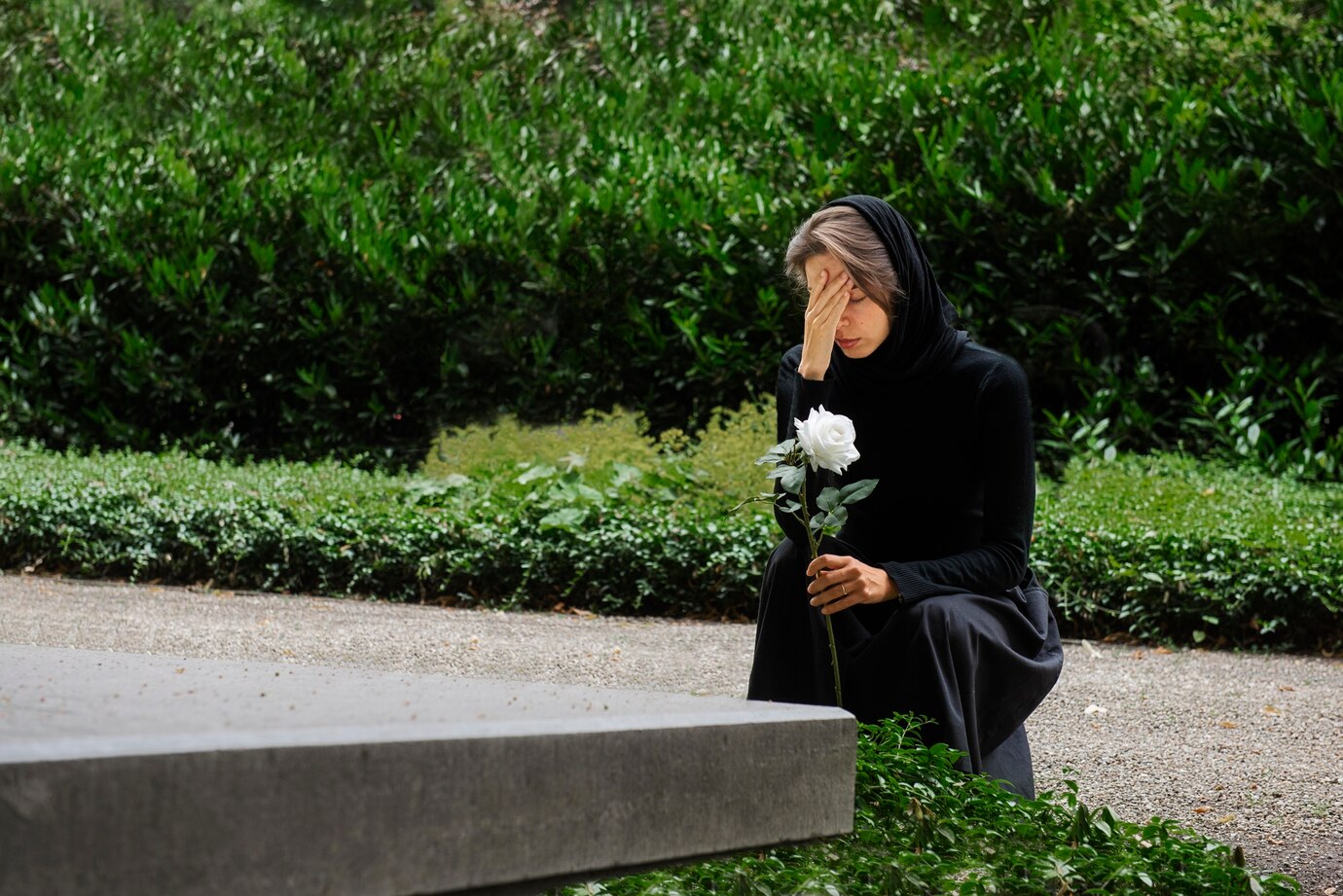
I always believed the dead should rest in peace. My mother used to say it herself, more times than I could count over the years. “It’s the living who need your attention, Laura, not the dead.” She said it so often when I was growing up that I used to think she’d read it somewhere once and just decided to adopt it as her personal philosophy. I never questioned it. I never had a reason to. My mother wasn’t a woman who explained herself much, and I’d learned a long time ago not to push.
But something changed in me after she died. I found myself drawn back to the cemetery again and again, bringing fresh flowers to her grave every single week, driving out there on Sunday mornings before the rest of the world had really woken up yet. My name is Laura, and this is the story of how a stranger throwing away my mother’s flowers ended up giving me a sister I never knew I had.
My mother, Diane, passed away eight months before any of this happened. A stroke, sudden, no warning, no long goodbye. One Tuesday she was calling me about a recipe she wanted to try, and by that Friday I was picking out a casket. I hadn’t been ready for how much silence a death like that leaves behind. My father had died four years earlier, slower, more expected, cancer that gave us time to prepare in the clumsy way anyone prepares for something like that. But my mother’s death didn’t give me anything. It just happened, and then she was gone, and I was left standing in her kitchen holding a grocery list in her handwriting that she’d never get to use.
I wasn’t a particularly religious person, and I wasn’t especially sentimental either, at least not before that year. But something about the finality of it pulled me toward the cemetery in a way I couldn’t fully explain to my husband, Mark, or to my brother, Ethan, who lived three states away and mostly grieved over the phone. I just needed somewhere to go. Some place to put the feeling.
At first, the visits felt comforting in a simple, uncomplicated way. I’d park near the old oak tree by the east gate, walk the familiar gravel path to my parents’ plots, and place fresh flowers on my mother’s grave first, then my father’s beside it. Tulips for her, because she’d always kept a vase of them on the kitchen table every spring. Something simpler for him, usually carnations, because he never cared much about flowers one way or another and I didn’t know what else to bring. It became a small ritual that helped, in the strange, quiet way grief sometimes gets easier to carry when you give it a shape and a schedule.
But after a few weeks of doing this, I started noticing something that didn’t sit right with me.
The flowers on my father’s grave stayed exactly where I left them, week after week, slowly wilting the way flowers are supposed to, browning at the edges, drooping a little more each visit until I’d finally clear them away myself and replace them with new ones. But the ones on my mother’s grave kept disappearing. Every single time. Not wilted, not blown away by the wind — just gone, completely gone, as if someone had come and cleared them away entirely and left no trace behind.
At first I told myself it was probably the wind, or maybe some animal dragging them off into the grass somewhere, a groundhog or a deer looking for something to chew on. Cemeteries have maintenance crews too, I reasoned. Maybe someone was tidying up the older arrangements before they turned to compost right there on the grass. I mentioned it to Mark once, almost in passing, and he shrugged and said maybe the caretakers had rules about how long flowers could sit out before they got cleared.
But the flowers on my father’s grave, sitting not three feet away from hers, never moved an inch. Only my mother’s disappeared, over and over, without fail, no matter what day of the week I came or what time. The more I turned it over in my mind, the less it felt like a coincidence. Someone was taking them. Deliberately. Every week. But who would do that, and why would they only target my mother’s grave and never my father’s?
I decided I needed to find out for myself.
That Sunday I came earlier than usual, well before sunrise really started to break through, determined to catch whoever was behind it. I told Mark I couldn’t sleep and wanted to get an early start on errands, which wasn’t exactly a lie, just not the whole truth either. The cemetery was quiet in that particular way cemeteries are quiet — not silent exactly, just muted, the only sound the soft rustle of leaves moving in the early morning breeze and my own footsteps on the gravel. I walked slowly down the path, my heart pounding harder than the situation probably called for. When I reached my parents’ graves, I stopped cold.
A woman was standing at my mother’s headstone, her back turned to me. She wasn’t there to pay her respects, not in any way I recognized. She was picking up the flowers I’d placed just the week before and dropping them, one bunch at a time, into a small trash bag she’d brought with her, methodical about it, like this was a task she’d done many times before.
“Excuse me,” I said, my voice shaking more than I wanted it to. “What are you doing?”
She turned around slowly, unhurried, like she’d been half-expecting someone to eventually catch her at it. She looked about my age, maybe a couple years younger, sharp features, dark hair pulled back tight, a kind of cold, guarded look in her eyes that made something in my stomach tighten before she’d even said a word. She wasn’t dressed like someone visiting a cemetery out of grief. There was a briskness to her, like she had somewhere else to be.
“These flowers were wilting,” she said flatly, like it was the most obvious explanation in the world. “I’m just cleaning up.”
“They were fine three days ago,” I said. Anger flared up in me before I could stop it. “Those were my mother’s flowers. You had no right to touch them.”
She shrugged, not even bothering to soften the disdain on her face. “Your mother? Well. I suppose she wouldn’t mind sharing, given the circumstances.”
“Sharing? What are you even talking about?” I asked, confusion and fury tangling together in my chest so tightly I could barely get the words out clearly.
She smirked at me, a small, tight expression that made my skin crawl. “You don’t know, do you? I’m her daughter too.”
Her words landed like a physical blow, something that actually knocked the breath out of me for a second. I actually took a step back, my hand going out to steady myself against the cold edge of my father’s headstone without really thinking about it. “What?” was all I could manage to get out.
“I’m your mother’s daughter, from another man,” she said, as casually as if she were commenting on the weather, like this was old, settled information she was mildly annoyed to have to repeat. “I’ve been visiting this grave long before you ever thought to show up here.”
I stared at her, my mind spinning uselessly in circles, trying to find some thread of logic that would make what she’d just said untrue. “That’s not possible. My mother never — she would have told me.” Even as the words left my mouth, doubt was already creeping in underneath them. My mother had always been a private person, reserved in ways I’d never thought much about at the time. There were whole decades of her life before I was born that I knew almost nothing about, a first marriage that ended before I was even a thought, years spent somewhere in the Midwest that she rarely talked about except in vague, general terms. Could she really have kept something this enormous hidden from me my entire life?
The woman crossed her arms, watching my reaction like she was almost enjoying it, like this was a moment she’d rehearsed in her head more than once. “Believe whatever you want. It’s true. She had a whole other life. A life you knew absolutely nothing about.”
I couldn’t stop staring at her. This stranger, this woman claiming to be my sister, had just taken a sledgehammer to everything I thought I understood about the woman who raised me. My mind raced, trying frantically to fit this new information into the shape of my mother’s life, trying to make it make sense, and failing every time. I thought of my mother at sixty, at fifty, at forty, all the versions of her I’d known, trying to find room in any of them for a second daughter she’d never once mentioned.
I wanted so badly to believe this was some kind of cruel prank, some strange grief-fueled delusion this woman was working through. But the look in her eyes told me she wasn’t lying. Nobody fakes that particular flavor of resentment, the kind that’s had years to settle and harden into something almost calm.
“How,” I finally managed, my voice barely above a whisper. “How is that even possible? When?”
“Before you,” she said simply. “Long before you. She had me when she was twenty-three. Gave me up. Different circumstances back then, different man, none of it worked out the way she wanted. I found her again about six years ago. We didn’t exactly have a Hallmark reunion, but we talked. I came here sometimes, after. Started coming more after she died.”
“Six years,” I repeated. Six years my mother had known this woman existed, had apparently spoken with her, and never once mentioned her name to me. Six Thanksgivings, six Christmases, six ordinary Tuesday phone calls about nothing in particular, and never once did she say, Laura, there’s something I need to tell you.
Could my mother really have kept something this massive from me? The same woman who tucked me in every single night when I was small, who taught me right from wrong, who was there for every skinned knee and every heartbreak of my entire childhood — had she really been hiding an entire second life the whole time, right up until the day she died? A sharp pain settled into my chest, a betrayal so deep and so sudden it nearly left me breathless standing there in the grass.
I remembered, in that moment, how my mother used to lean over my bed at night and whisper that I was her “precious little girl.” How many times had she whispered those exact words to me while somewhere else in the world, she was carrying the weight of another daughter, a secret one, one she’d never once mentioned even in her final years, even when she must have known time was running short? Every warm memory I had of her suddenly felt tainted, twisted just slightly out of shape by this one revelation, like a photograph you find out was cropped to hide someone standing just out of frame.
But even with all that anger boiling up in me, I found I couldn’t quite bring myself to hate her for it. She was still my mother. The woman who had shaped nearly everything about who I’d become. Could I really condemn her for a decision she’d made long before I was even born, one I had no context for, one I hadn’t even known to ask about? A twenty-three-year-old woman in circumstances I knew nothing about, making a choice that must have haunted her for the rest of her life in ways she never let show.
I didn’t know. I genuinely didn’t know what to feel, standing there in that thin morning light with a stranger who shared my mother’s blood.
And then there was this woman standing in front of me. My sister, apparently. I tried, for just a moment, to imagine what her life must have looked like from the other side of this secret — always kept in the shadows, never once acknowledged publicly, maybe visiting this same grave for years with some complicated mixture of love and resentment tangled up inside her, standing exactly where I was standing now but never allowed to call it what it was. How many times had she stood here, feeling like she didn’t belong at all, watching some other daughter’s flowers sit fresh and undisturbed on a grave she had every bit as much right to grieve? I couldn’t fully imagine that particular kind of loneliness, but I could see the shape it had carved into her, in the set of her jaw, in the careful distance she kept even now.
Standing there, caught somewhere between anger and an unexpected wave of sympathy, I made a decision. Maybe I didn’t know the full story yet. But I did know one thing for certain — this woman had suffered, in her own way, just like I was suffering right now, standing in this same patch of grass. She wasn’t my enemy. We were both, in a strange and complicated way, victims of the exact same secret, just standing on opposite sides of it.
I took a breath and let my voice soften. “I can’t imagine what this has been like for you,” I said. “I didn’t know about you. I’m sorry for that. But maybe — maybe we don’t have to keep hurting each other over something neither of us chose.”
She looked at me, suspicion still flickering behind her eyes, but something in her posture shifted slightly, some of the tension going out of her shoulders. “What are you saying?”
“I’m saying we’re both her daughters. We both have a right to be here, to grieve her in whatever way makes sense to us. Maybe we could try to actually know each other. It doesn’t have to keep being like this, you throwing my flowers away and me finding out about you by accident on a Sunday morning.”
She hesitated. I could see her walls still standing, thick and well-practiced, but there was a small crack showing through somewhere in her expression, something almost tired underneath the hardness. “Why would you even want to do that? You don’t know me. For all you know I’m making this whole thing up.”
“You’re not,” I said, and I believed it even as I said it. “And I want to do it because the alternative is that we both keep coming out here alone, resenting each other over something that was never either of our fault to begin with. That doesn’t seem like something either of us needs more of.”
“Because I think it’s what she would have wanted,” I added, and I felt the truth of it as I said it out loud for the first time. “She wasn’t perfect. Clearly. But I want to believe she loved both of us, in her own complicated way. Maybe she was just too scared to ever bring us together while she was alive. Scared of what it would mean, what it would break.”
Her expression softened, just barely, the corner of her mouth twitching in something that wasn’t quite a smile yet. “You really believe that?”
“I do,” I said. “And I think she’d want us to find some kind of peace with each other now, even if she couldn’t manage to do it herself while she had the chance.”
She looked down at the headstone, her fingers tracing lightly over the letters of our mother’s name carved into the granite, an oddly gentle gesture from someone who’d just been throwing flowers into a trash bag ten minutes earlier. “I never wanted to hate you,” she said quietly, almost to herself. “But I didn’t know how else to feel about any of this. It felt like she chose you over me. Even after she was already gone. You got the funeral, the obituary with your name in it, the house probably. I got nothing. Not even an invitation to say goodbye.”
That landed hard. I hadn’t thought about the funeral from any angle but my own grief. I hadn’t thought about who might have been standing outside the church, unable to walk in, unable to explain why she belonged there too.
“I understand,” I said, and I meant it as much as I could, even though I knew I couldn’t fully understand something I hadn’t lived. “But it doesn’t have to stay like that. We could start over. We could try to be — sisters, maybe. I don’t know exactly what that looks like for us, given everything. But I’d like to find out, if you’re willing.”
She looked up at me then, a single tear slipping down her cheek before she seemed to notice it herself, wiping it away almost angrily with the back of her hand. “I don’t know if I can just forget everything that’s happened. The years of nothing. The way she kept me separate like some kind of secret she was managing instead of a person.”
“You don’t have to forget any of it,” I told her. “I don’t think either of us should forget it, honestly. But maybe we can find a way to move forward anyway. Together, instead of apart. Instead of you standing here alone every week throwing away flowers because it’s the only way you know how to say you’re angry.”
For the first time since I’d walked up on her, she smiled. Small, tentative, barely there at all, but real. “I’d like that,” she said. “I think I’d actually like that a lot. I’m tired of being angry at a grave. It doesn’t even hear me.”
“I never even learned your name,” I said.
“It’s Casey,” she said, and the smile held, a little steadier this time.
“Laura,” I said, and she nodded like she’d already known that, probably had, from whatever research she’d done to find her way to this exact plot of grass in the first place.
We stood there together in silence for a while after that, two women who’d been complete strangers to each other twenty minutes earlier, standing side by side over the same grave, neither of us quite sure what to say next but neither of us quite ready to leave either. The wind moved through the leaves above us, and for the first time since I’d started coming here, the cemetery didn’t feel cold or lonely at all. It felt, strangely, almost peaceful, like something that had been off balance for a long time had just barely started to right itself.
Before we parted that morning, I asked for her number, and she gave it to me without hesitating, which surprised me more than I let on. A few days later, we met for coffee at a small place near her apartment, a part of town I’d never had a reason to visit before. It was awkward at first — the kind of stilted, careful conversation you have with someone you’re not sure how to categorize yet, sister feeling like too big a word and stranger feeling wrong now that we knew the truth. We talked about small things first. Where she worked, an accounting firm downtown, steady but not exciting, her words. Whether she had kids. She didn’t, not yet, though she mentioned a boyfriend named Theo almost shyly, like she wasn’t sure if that was the kind of thing you shared with a sister you’d just met.
But as we kept talking, the walls between us started coming down piece by piece. Casey told me about her childhood, about growing up with an adoptive family in Ohio who loved her well enough but never quite filled the specific hole shaped like a birth mother she didn’t know. She told me about finding our mother six years earlier through one of those DNA testing services, working up the courage for months before finally sending the first message. She told me about their first meeting, in a diner, both of them too nervous to eat anything, and how it never turned into anything close to the relationship she’d hoped for. Diane had been kind, Casey said, kind but distant, always careful, always keeping some door half-closed between them.
“She sent birthday cards,” Casey said, stirring her coffee without drinking it. “Every year. No return address on the envelope. Like she was scared of what would happen if I wrote back too many times.”
I told her stories about our mother in return — the good ones, the funny ones, the way she used to burn the first pancake every single Sunday morning like it was some kind of sacrifice to the griddle, and how she cried at every single one of my school plays even when I only had one line. But I also told her some of the harder ones, the parts of our mother that hadn’t always been easy to live with, the way she went quiet for days sometimes with no explanation, the way she flinched anytime anyone brought up her life before my father. I’d never had the context for that flinching before. Now, looking at Casey across the table, I finally did.
We laughed more than I expected to, especially once Casey started doing an uncannily accurate impression of our mother’s specific way of saying “we’ll see” whenever she meant no but didn’t want the argument that came with saying it outright. We cried some too, both of us, in that particular way strangers cry together when the crying isn’t really about the moment in front of them but about years of something else finally finding somewhere to go. And somewhere in the middle of all of it, without either of us really deciding to, a bond started forming, fragile but real, the kind of thing that needed careful handling but wasn’t going to break at the first weight put on it.
We started visiting the grave together after that, most Sundays, each of us bringing our own flowers, not as some kind of competition the way it might have looked from the outside a few weeks earlier, but as a shared gesture of love and remembrance for the same complicated woman who’d shaped both our lives in such different ways. We weren’t trying to erase what had happened, or pretend the secret hadn’t hurt either of us. Casey still had hard days about it, days where she’d go quiet mid-sentence and I’d know exactly what she was circling back to in her mind. I had my own version of that too, moments where I’d remember some ordinary family dinner and suddenly wonder what my mother had been thinking about while she passed the potatoes, whether Casey had crossed her mind that night, whether she ever almost said something and stopped herself. We weren’t trying to erase any of that. We were trying to build something new on top of it instead. Something that honored our mother’s memory in a way that neither of us could have managed entirely on our own.
Over time I came to understand that this whole encounter had changed me — not just because of what I’d learned about my mother, but because of what it ended up teaching me about forgiveness, and about second chances I never expected to get. My mother’s secret had brought a genuine kind of pain into my life, one I still hadn’t fully worked through even now, one I doubted I ever fully would. But it had also, unexpectedly, brought me a sister I hadn’t known I needed until she was standing right in front of me with a trash bag full of my flowers and an expression that dared me to be angry at her.
Standing together at the grave one quiet afternoon a few months later, the two of us having fallen into an easy rhythm by then, trading off who brought the flowers some weeks and who brought the coffee, I looked over at Casey and felt something settle in my chest that I can only describe as peace. Our mother had been right about one thing, at least — it really is the living who need tending. And now, in our own halting, imperfect way, Casey and I were tending to each other, slowly healing a wound that had once kept us apart before we even knew the other existed, back when all either of us had was an empty space where a sister should have been.
“I think she’d be proud of us,” I said softly, watching the afternoon light move across the rows of headstones, the whole cemetery gone gold at the edges the way it does right before evening.
Casey nodded, resting her hand lightly on the top of the stone, right over the letters of our mother’s name. “Yeah,” she said. “I think so too. Took us long enough to get here, but yeah.”
“She should have just told us,” I said. “Both of us. Years ago.”
“Maybe,” Casey said. “Or maybe she knew we’d end up here eventually, one way or another, and figured that was close enough.”
I didn’t have an answer for that, and I wasn’t sure Casey needed one. Some things about our mother we were never going to fully understand, not now, not with her gone and unable to explain herself. There would always be a gap where the explanation should have been, a silence neither of us could fill no matter how many Sundays we spent standing in this exact spot.
But in that moment, standing there together, I understood that the road ahead of us wasn’t going to be simple or easy. There were still years of missing context between us, still questions neither of us would ever get answered now that our mother was gone, still the occasional flare of old resentment that would probably surface for years to come, on birthdays, on holidays, on ordinary days when one of us least expected it. But for the first time since that cold morning I’d caught her throwing away my flowers, I knew we were finally walking down that road together, instead of standing on opposite sides of the same grave, strangers to each other, each of us grieving the same woman completely alone.

Lila Hart is a dedicated Digital Archivist and Research Specialist with a keen eye for preserving and curating meaningful content. At TheArchivists, she specializes in organizing and managing digital archives, ensuring that valuable stories and historical moments are accessible for generations to come.
Lila earned her degree in History and Archival Studies from the University of Edinburgh, where she cultivated her passion for documenting the past and preserving cultural heritage. Her expertise lies in combining traditional archival techniques with modern digital tools, allowing her to create comprehensive and engaging collections that resonate with audiences worldwide.
At TheArchivists, Lila is known for her meticulous attention to detail and her ability to uncover hidden gems within extensive archives. Her work is praised for its depth, authenticity, and contribution to the preservation of knowledge in the digital age.
Driven by a commitment to preserving stories that matter, Lila is passionate about exploring the intersection of history and technology. Her goal is to ensure that every piece of content she handles reflects the richness of human experiences and remains a source of inspiration for years to come.