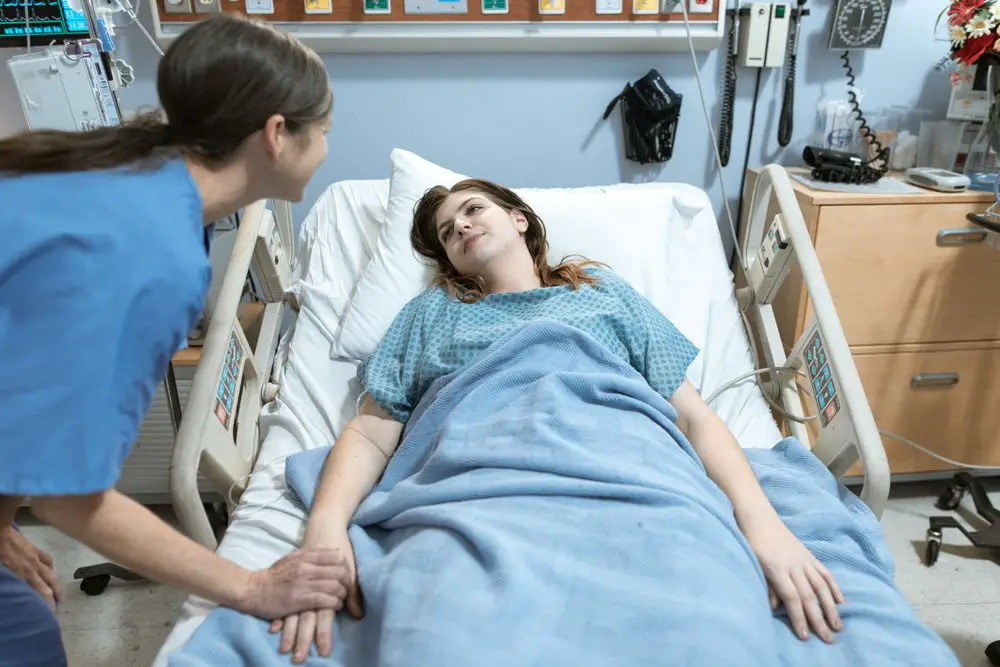
I counted the calls because the clock on the hospital wall was mounted directly across from my bed, and there was nothing else in that room to look at.
Nine.
Nine times my thumb trembled against the buttons of the hospital phone while the monitors beeped their steady rhythm beside me. Nine times I called my mother, then my father, then the family group chat that had eleven people in it and no one who picked up. Nine times the same answers came back: voicemail, silence, voicemail again, and finally one brief text from my mother that said, We’re at Lauren’s. Is this urgent?
I stared at the word urgent while a nurse adjusted the IV line taped into the back of my hand.
The day before, a delivery truck had run a red light on Bellmore Avenue and driven into the driver’s side of my car at forty-two miles an hour. I do not remember the impact. I remember pulling away from a stop sign, and then I remember the ceiling of an ambulance, and then I remember nothing until a surgeon in green scrubs was leaning over me telling me they had removed my spleen and that I had been very lucky. My injuries were serious. Three broken ribs, a punctured lung, internal bleeding they had spent four hours chasing. The doctors had warned me that the next twenty-four hours would be critical, that the risk of complications was real, that I should have someone with me.
So yes, I thought, looking at that text message. Yes, Mother. It was urgent.
My sister Lauren, however, had closed on a new house in Ridgefield eleven days earlier. Four bedrooms, a white kitchen with a marble island she had photographed from six angles, and a nursery she was not using yet but had already painted a soft sage green because she and Kyle were “planning ahead.” Kyle was her husband, a man who had somehow reached thirty-four years of age believing that lifting boxes was beneath his dignity as a person who worked in commercial insurance.
My parents had driven out to Ridgefield “for a few hours” on the morning after my surgery. They had left the hospital parking lot without ever coming inside, because they had not been at the hospital at all.
At 6:40 that evening, my phone buzzed against the tray table.
Lauren had posted a video.
“Couldn’t have done today without Mom and Dad!” she sang into the camera, spinning it around to catch them in the frame.
My father was carrying a lamp across the living room, grinning at something off screen.
My mother was arranging throw pillows on a sofa I had never seen before, laughing, patting one into shape and stepping back to admire the effect.
I watched it three times. Then I set the phone face down on the blanket and lay there for a long while listening to my own heart on the monitor.
And then I pressed the call button. Not for a nurse. Not for pain medication. Not for water.
When Marisol came in and leaned down beside the bed, I asked her to make a call for me, because my hands were not steady enough to be trusted with the numbers. I told her the contact was saved under Harding and Vance, Estate. My voice was weak and each word cost me something in my ribs, but I spoke every one of them clearly.
She looked at me for a moment. “Are you sure? It’s after six.”
“He’ll come,” I said. “And yes. Completely.”
By 8:15, my estate attorney, Julian Vance, was standing at the foot of my bed in a navy suit with his briefcase resting on the visitor’s chair. He had represented me since I sold my medical software company two years earlier, a company I had built in a rented office above a dry cleaner with three employees and a line of credit I had personally guaranteed. He was fifty-one, precise, and had never once in two years asked me a personal question that wasn’t strictly necessary.
He asked one that night. “Miranda. Are you doing this because you’re in pain, or because you’ve decided?”
“Because I’ve decided,” I said. “The pain just made it obvious.”
My parents knew I was comfortable. They knew there had been a sale. They had no idea of the actual number, because I had never told them, and because some quiet instinct I had never fully examined had kept me from telling them. But they knew enough to talk about it at Christmas dinners with a certain proprietary pride, the way people talk about a horse they once bet on.
More importantly, they had no idea they were still listed in my will. And they had certainly never considered that the listing was a decision I made rather than a law of nature.
Julian sat down and opened his briefcase and we worked for an hour and a half while a nurse came in twice to check my vitals and left without comment. He read every change aloud to me, slowly, and had me confirm each one, and made a careful note in the file about my orientation, my responsiveness, and the absence of any narcotic in my system beyond a dosage that the attending physician had signed off on as non-impairing. He is a thorough man. That night I was grateful for it in a way I had never been before.
My parents were removed as beneficiaries.
Lauren was removed entirely.
Their access to my emergency medical accounts was revoked.
The lake house in New Hampshire, the one my mother had started referring to as “our place” within a year of my buying it. The education trusts I had funded for Lauren’s future children, children who did not yet exist but whose college tuition my mother had already begun mentioning at family gatherings. The seats on the board of the charitable foundation I had endowed, seats my father talked about at his golf club as though he had built the thing himself.
Gone. All of it, in ninety minutes, in a hospital room that smelled like antiseptic and the cold coffee Julian had brought up from the lobby.
At 10:03 p.m., my mother finally walked in holding a takeout cup and wearing an expression of tremendous forbearance.
“Miranda,” she sighed. “You scared us.”
Julian turned from the window where he had been standing.
I looked at her, and then past her at my father in the doorway, and I said it very quietly, because quiet was all my ribs would allow.
“No. You scared me.”
My father froze halfway through the door, still wearing the old gray sweatshirt he pulled on whenever he wanted people to perceive him as practical and hardworking. There was a strip of packing tape stuck to one sleeve, curled at the end. My mother had foundation settled into the creases beneath her eyes but her hair was immaculate, curled and sprayed for the photographs Lauren had been posting all afternoon.
And behind them both, Lauren peered in around the doorframe with the mild curiosity of someone touring an open house she had no intention of bidding on.
“Why is he here?” my father asked, jerking his chin toward Julian.
Julian closed his briefcase with a quiet click. “I’m here at my client’s request.”
My mother’s coffee cup trembled slightly. “Client? Miranda, sweetheart, you’re drugged. You can’t be signing anything in this condition.”
“I’m not drugged enough to forget nine calls,” I said.
Lauren rolled her eyes so hard I could see it from across the room. “Oh my God. Are we really doing this right now? Mom said the nurses told her you were stable.”
“No nurse told her that.”
Marisol had appeared in the doorway behind Lauren, and her voice was calm but carried an edge that made everyone in the room turn. She was a small woman in her forties with reading glasses pushed up into her hair, and she had been on shift for eleven hours.
“I personally called the emergency contacts listed for Ms. Caldwell at 11:18 this morning,” she said. “I spoke to a woman who identified herself as her mother. I said she was in critical post-surgical recovery and that immediate family should come. It’s documented in the chart, with the time and the substance of the conversation, because that is what we are required to do.”
My mother’s face did something complicated and did not settle on anything.
My father’s expression hardened, and what was in it was not shame. It was irritation. Pure, undiluted annoyance at being contradicted by a stranger.
“Families have more than one emergency at a time,” he said.
I almost laughed, and the attempt sent a bar of white pain across my chest. “Unpacking a sectional is not an emergency.”
Lauren stepped fully into the room now. “You always do this. You make everything about you. I just bought a house, Miranda. It was a big day for me.”
Julian looked down at his notes. Even he needed a moment.
My mother came closer to the bed and lowered her voice into that particular register she had used my entire life, the one that dresses up a demand for obedience as an expression of concern. “Miranda. Sweetheart. Whatever you changed, we can fix it later, when you’re feeling more like yourself. You’re upset. You know you’ve always been a little dramatic when you feel left out.”
Left out.
I was missing a spleen. I had two units of someone else’s blood in my body. I had a chest tube scar that would still be pink in a year. And according to my mother, standing there in her good coat, my problem was that I felt left out.
“No,” I said. “We fixed it tonight.”
My father’s eyes narrowed. He has always understood money considerably faster than he understands feeling. “What exactly did you change?”
Julian answered before I could, in the flat professional cadence of a man reading a weather report. “Ms. Caldwell has executed updated estate documents, healthcare directives, trust amendments, and beneficiary removals. All properly witnessed and recorded this evening. She has also revoked prior family authorization for financial access and for medical decision-making on her behalf.”
The room went completely still.
Lauren looked from Julian to me. “What does that mean?”
“It means,” I said, “that you don’t get rewarded for abandoning me.”
My mother made a small wounded sound, the sound she has deployed at every family conflict for thirty-eight years. “After everything we sacrificed for you?”
“You sacrificed my childhood to manage Lauren’s comfort,” I said. “You missed my college graduation because Lauren had a dance recital in Hartford. You missed my engagement dinner because Lauren had a breakup and needed you. You missed my thirtieth birthday because Lauren was moving apartments. And today you sacrificed my life for her guest room.”
Lauren’s mouth twisted. “You’re insane.”
“No,” Marisol said quietly from the door. “She’s awake, oriented, and legally competent. It’s documented in her chart, and the attending confirmed it two hours ago.”
My father jabbed a finger toward Julian. “This won’t hold.”
Julian’s expression did not shift by a millimeter. “It will.”
And that was the moment my mother understood. Not the whole of it, I think, but enough. I watched it move across her face in stages, like weather crossing a field. The lake house. The mortgage payments I had quietly taken over on their home four years ago and never once mentioned. The private care plan I had established and funded so that neither of them would ever have to worry about long-term care. The entire comfortable future they had assumed was structural, permanent, load-bearing, a thing that would hold regardless of how they treated me.
She reached for my hand on the blanket.
I pulled it away.
For the first time that night, nobody spoke. Only the monitors did, marking every beat of my heart like a witness giving a statement nobody had asked for.
It was my father who broke the silence, and he broke it the way he always did, by changing the terms of the argument.
“Miranda,” he said, and his voice had shifted into something reasonable and warm, the voice he used with clients back when he sold industrial flooring. “Nobody’s saying we handled today perfectly. Your mother and I are human. We got there and Lauren was overwhelmed, and Kyle’s back was out, and we lost track of the time. That’s all this is. You’ve got a lawyer standing here at ten at night because you’re frightened and you’re hurting, and I understand that. I do. But this isn’t a decision. This is a reaction.”
It was very good. I want to be fair to him. It was genuinely well done, and ten years earlier it would have worked, and I would have apologized to him before the night was over.
“You didn’t lose track of the time,” I said. “Mom texted me at 3:40 asking if it was urgent. She knew where I was. She had a number and a room and a nurse’s message from that morning. She made a choice, and then she kept making it for another six hours, and then she posted a video.”
“Lauren posted the video,” my mother said.
“You were in it. Smiling.”
“So we’re not allowed to smile now?”
And there it was. The pivot I had been waiting for my entire life without ever having a name for it. The moment the conversation stopped being about what had happened and became about whether I was being fair, whether I was being reasonable, whether I was being kind enough about the harm done to me.
I did not take it. That was new.
“Julian,” I said. “Would you walk them through it, please. Specifically.”
“Miranda,” my mother said sharply.
Julian opened his briefcase again. He is a man who enjoys specificity the way other people enjoy music.
“As of this evening,” he said, “Mr. and Mrs. Caldwell are no longer beneficiaries of Ms. Caldwell’s estate under any instrument. They are removed as successor trustees. They are removed as agents under her financial power of attorney and her healthcare proxy, both of which have been replaced. The revocable trust that held the New Hampshire property has been amended, and the property will be sold or retained at Ms. Caldwell’s sole discretion. Two education trusts previously funded for the benefit of Ms. Lauren Meyer’s future issue have been dissolved and the assets returned to the grantor. Ms. Lauren Meyer’s designated position on the advisory board of the Caldwell Family Foundation has been terminated effective immediately, as has Mr. Caldwell’s. Additionally, the recurring payments Ms. Caldwell has been making toward the mortgage on the property at 14 Wren Hollow Road will cease at the end of the current billing cycle, with sixty days’ written notice to follow tomorrow.”
My father’s face changed color.
“What mortgage payment,” Lauren said.
Nobody answered her.
“You’ve been paying our mortgage?” my mother said, and her voice had gone thin and strange.
“For four years,” I said. “Since Dad’s business closed. You never asked why the bank stopped calling.”
“You never told us.”
“I know.”
“Why?”
I looked at her, and I found that I had an answer, and that it had been sitting fully formed inside me for a very long time waiting for someone to ask.
“Because I thought if you didn’t know it was me, it would count,” I said. “I thought maybe I’d finally be loved for some reason that wasn’t a transaction. I thought if I just took care of everything quietly, one day I’d walk into a room and one of you would be glad to see me. Not glad about what I could do. Glad about me.”
The monitor kept its rhythm. Somewhere down the hall a call button chimed twice.
My mother said, “That’s not fair.”
And I realized, listening to her say it, that she had heard the entire speech and had extracted from it only the accusation against herself. Not the loneliness. Not the four years of secret payments. Just the part that required her defense.
That was when I stopped being angry, which I had not expected. Anger is loud and hot and it takes a great deal of energy, and I did not have energy. What replaced it was something quieter and much worse for them: I simply stopped needing anything from her.
“Marisol,” I said. “I’d like everyone to leave now.”
My father took a step toward the bed. “Miranda, we are not finished.”
“Sir,” Marisol said, and she had not moved from the doorway, “this patient is thirty-one hours post-op and her heart rate has been elevated for eleven minutes. I’m going to ask you to step out. Security is on this floor if that would be helpful.”
I have thought about that sentence many times since. If that would be helpful. Marisol Reyes, forty-four years old, eleven hours into a twelve-hour shift, offering my father the dignity of leaving on his own.
He took it. They all did.
Lauren was the last one out, and she stopped in the doorway and looked back at me with an expression I could not read at the time and understand perfectly now. It was not remorse. It was calculation. She was already working out what this cost her and who she would need to call.
“You’re going to regret this,” she said.
“Probably,” I said. “Not tonight, though.”
The next morning I woke at 5:50 to gray light and a physical therapist named Dev who wanted me to sit on the edge of the bed for four minutes. It took twenty. I cried at minute three, not from the pain but because there was nobody there to see it, and then I finished the four minutes anyway.
That afternoon my phone had forty-one notifications.
I read them all in one sitting, propped up on two pillows, with the deliberateness of a woman doing an inventory. My mother had sent eleven messages, moving through a recognizable progression from wounded to conciliatory to threatening and back to wounded. My father had sent two, both of them short and both of them about the mortgage. Lauren had sent nothing to me directly and had instead posted a story to nine hundred followers about “family who only show up when there’s something in it for them,” which was a sentence I had to read four times before I could believe the direction it was pointed.
My aunt Rosalind called. She was my father’s older sister, seventy-three, and she had been at odds with him since roughly 1994.
“I heard you got hit by a truck,” she said.
“I did.”
“I heard your parents were hanging curtains.”
“Also true.”
There was a pause. “Well,” Rosalind said. “I’m coming Thursday. I’ll bring the good crossword book, not the one for children.”
She came on Thursday. She stayed six days at a Hampton Inn eleven minutes from the hospital and arrived every morning at nine-thirty with two coffees, one of which she drank herself and one of which she held for me until I was allowed to have it. She did not once ask me about the will. On the fourth day she said, apropos of nothing, “Your father was a selfish boy and he grew into a selfish man, and your mother married him because being needed by a selfish person feels like being loved. That’s the whole thing, Miranda. That’s the entire mystery. Don’t spend another decade on it.”
I was discharged on a Tuesday, nineteen days after the accident, and Rosalind drove me home.
The pressure campaign started properly about two weeks after that.
It began, as these things do, with people who had nothing to do with it. A cousin I had not spoken to in three years texted to say she’d heard I was “going through something” and that family was everything. A woman from my mother’s church emailed my work address. My father’s brother left a voicemail about how my father was “not doing well” and how “this thing with the house” was eating at him.
Then came the letter from an attorney in Bridgeport, six pages long, asserting on behalf of my parents that the estate documents executed on the night in question had been signed under duress, while I was medically incapacitated, and under the undue influence of a party with a financial interest in the outcome, that party being Julian.
I forwarded it to Julian at 7:15 in the morning. He called me at 7:22.
“Do you want the long answer or the short one?”
“Short.”
“They have nothing. You had a documented Glasgow score of fifteen, a note from your attending confirming competency, two witnesses who are hospital staff with no interest in your estate, a notary, and a recording of the entire execution that you consented to on tape. I have been doing this for twenty-six years and I have rarely seen a cleaner file.”
“And the long answer?”
“The long answer is that they know they have nothing, and the letter is not really a legal document. It’s a bill they hope you’ll pay to make it go away. People do, quite often. It’s cheaper than litigation and it feels like peace.”
“Is it peace?”
“No,” Julian said. “It’s an installment.”
I did not pay it. Julian’s response was two paragraphs and referenced the recording, and the Bridgeport attorney withdrew within a month, and I never heard from him again.
What I heard instead, in early autumn, was my mother’s voice on my doorstep.
She came on a Saturday morning without warning. I opened the door because I had thought it was a grocery delivery, and there she was in the good coat, holding nothing, which I noticed immediately because my mother has never in her life arrived anywhere without a dish.
“Can I come in?”
I let her in. I want to be honest that some part of me was glad to see her, and that this is the humiliating fact at the center of the whole story, and that anyone who has had a parent like mine already knows it.
She sat on the edge of my sofa. I sat across from her. My ribs still ached when I sat down too quickly, and I did, and she watched me wince and did not say anything about it.
“Your father doesn’t know I’m here,” she said.
“All right.”
“The house is going on the market in November. We can’t carry it.”
“I know.”
“Do you.” It wasn’t a question, quite.
“Mom, I gave you sixty days’ notice and it’s been ninety. I assumed you’d made a plan.”
She looked at her hands. “I’m not asking you to reverse it.”
“Okay.”
“I’m asking you to explain it to me. Because I’ve turned it over every night since June and I cannot get it to make sense. We’ve done everything for you girls. Everything. And you did this over one afternoon.”
And there it was again, the last defense of the indefensible: reduce it to the smallest possible unit. One afternoon. Not thirty-eight years. Not a pattern with the density of bedrock. One afternoon, one bad day, one regrettable lapse of scheduling.
“It wasn’t one afternoon,” I said.
“Then what was it?”
I thought about the answer for a long time. Long enough that she started to fidget.
“When I was nine,” I said, “I had my tonsils out and you stayed with me both nights in the hospital and you slept in a chair and you brought me lime popsicles because you remembered I didn’t like the red ones. Do you remember that?”
She nodded, and her eyes had filled.
“I remember it too. I have remembered it constantly, my whole life. Every time you chose Lauren, I took that memory out and I looked at it and I told myself, she does love me, look, here’s the proof, she just has a lot going on right now. I used that popsicle for twenty-nine years, Mom. I have worn it out. There’s nothing left of it.”
“Miranda.”
“When Marisol called you at 11:18 and told you I was in critical recovery, and you drove to Ridgefield anyway, and you stayed for eleven hours, and then you asked me by text whether it was urgent, I finally understood something I should have understood a long time ago. It’s not that you don’t love me. I think you probably do, in whatever way you’re able. It’s that your love for me has never once required you to be inconvenienced. And a love that has never cost you anything is not something I can build a life on. I’ve tried. I built a whole company and paid off your house trying.”
She was crying properly now. “So this is punishment.”
“No,” I said, and this is the truest thing I said that entire year. “Punishment would mean I still want something from you. This is just an accurate accounting. I stopped giving my money to people who wouldn’t come to a hospital. That’s all it is. There isn’t a hidden lever. There’s nothing you can say today that opens it back up, and I’m telling you that plainly so you don’t waste your years on it the way I wasted mine.”
She sat with that for a while.
“Your sister is very angry with you,” she said finally.
“I imagine she is.”
“She says you’ve turned us into a story people tell.”
“Lauren posted the video, Mom. She turned us into a story. I just stopped paying for the ending she wanted.”
My mother left about ten minutes later. At the door she turned and said, “I don’t know how to be your mother if I’m not managing something for you,” and I think it was the only entirely honest sentence she has ever said to me, and I have never been able to decide whether it was a confession or an excuse.
“I know,” I said. “You could just call sometimes. Not about anything.”
She said she would.
She did, twice, in the following year. Both times about something.
Here is where things ended up, as of the writing of this, which is two years and one month after a delivery truck ran a red light on Bellmore Avenue.
My parents sold the house on Wren Hollow Road in January and bought a condominium in Milford that they can afford on my father’s social security and the remainder of my mother’s teacher’s pension. My father tells people at his golf club that they downsized deliberately, for the freedom of it. I have decided that he is welcome to that story. It costs me nothing and it is nearly true.
Lauren and Kyle refinanced the house in Ridgefield within a year and I am told the payment is difficult. She has not spoken to me since the hospital, except once, eight months in, when she sent a long message at 1 a.m. that began with an apology and arrived, four paragraphs later, at a specific figure. I did not reply. She unsent it the next morning, which is a thing the application allows you to do, though of course I had already read it. I understand she is expecting a child in the spring. I found out from Rosalind. I sent a gift, unsigned, through a shop, because I could not work out what to write and because I wanted the child to have a good blanket regardless of anything else.
The foundation is now run by a board of five people, none of whom share my last name, and last year it funded rehabilitation equipment for two rural trauma units in New Hampshire and a scholarship in Marisol Reyes’s name for nursing students at the community college where she trained. I did not ask her permission first, which she has never let me forget. She sends me a photograph of the recipient every August and signs the message still awake, still oriented.
The lake house I kept. Rosalind uses it in July. I go in September when the water is too cold for anyone else and the town is empty, and I sit on the dock with a book I don’t read and listen to the loons, and I do not feel triumphant, because triumph was never what this was.
What I feel is something plainer and much harder to explain to people who want the story to end with a speech.
I feel like a woman who spent thirty-eight years mistaking her own usefulness for her own worth, and who, on the one night she had nothing to offer anybody, finally found out what she was actually worth to the people who had been happy to take it. The answer was: less than a sectional sofa and an afternoon of throw pillows. It is a brutal number to receive. But it is a real one, and a real number is the only thing you can ever actually build on.
Nine calls. I still count them, sometimes, when I can’t sleep. But I have noticed that the counting has changed. For a long time each one was an accusation, a small stone I turned over in the dark. Now they feel more like a receipt. Proof that I asked. Proof that I asked nine separate times, clearly, from a hospital bed, with everything I had.
Nobody can ever tell me I didn’t try. That’s mine now. That’s the part I got to keep.
And when the tenth call came, four months later, from a number I recognized, on a Tuesday evening while I was making dinner in my own kitchen with my ribs finally healed and the window open to the street, I looked at the screen for a long moment.
Then I set the phone face down on the counter, and I finished cooking, and I ate at my own table, and I slept eight hours straight through.

Lila Hart is a dedicated Digital Archivist and Research Specialist with a keen eye for preserving and curating meaningful content. At TheArchivists, she specializes in organizing and managing digital archives, ensuring that valuable stories and historical moments are accessible for generations to come.
Lila earned her degree in History and Archival Studies from the University of Edinburgh, where she cultivated her passion for documenting the past and preserving cultural heritage. Her expertise lies in combining traditional archival techniques with modern digital tools, allowing her to create comprehensive and engaging collections that resonate with audiences worldwide.
At TheArchivists, Lila is known for her meticulous attention to detail and her ability to uncover hidden gems within extensive archives. Her work is praised for its depth, authenticity, and contribution to the preservation of knowledge in the digital age.
Driven by a commitment to preserving stories that matter, Lila is passionate about exploring the intersection of history and technology. Her goal is to ensure that every piece of content she handles reflects the richness of human experiences and remains a source of inspiration for years to come.