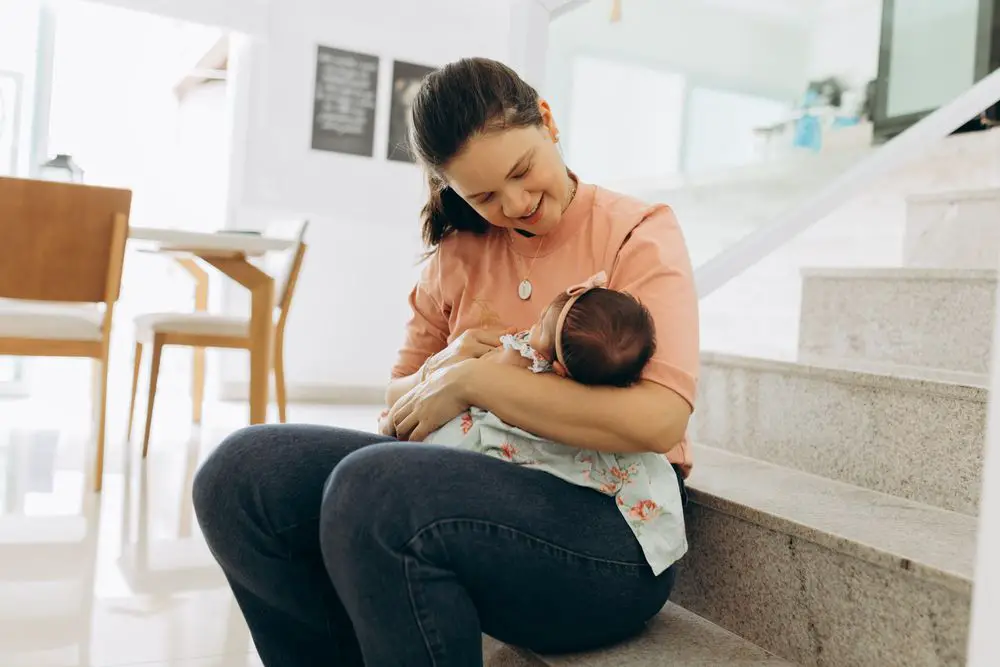
The three knocks echoed through Emily’s little blue house like a warning.
For one breath, nobody moved.
Noah slept on, his tiny mouth slightly open, one fist curled against the blanket near his cheek. The Christmas lights along the window blinked softly red and gold, their glow falling across the bottles on the coffee table, the folded burp cloths, the half-empty mug of tea going cold beside the couch.
But Emily had changed completely.
A moment ago she had been exhausted and tearful. Now she looked cornered.
“Emily,” I said quietly. “Who is that?”
She didn’t answer.
The knocking came again. Three hard strikes. Controlled, not frantic. Whoever stood out there was not guessing. They knew someone was home.
Emily backed toward the hallway with Noah pressed against her chest. “Don’t open it.”
The fear in her voice cut straight through the anger I had arrived with. Whatever jealousy had driven me to her door, whatever wounded pride had pushed me into this house, all of it vanished the instant I saw the way she held our son, as though the world itself had come to take him.
“Tell me who it is,” I said.
Her lips parted, but only a whisper came out. “Please, Gavin.”
A voice called from the porch. “Emily? I know you’re in there.”
A woman’s voice. Older. Firm.
Emily closed her eyes. Recognition flickered across her face, but it wasn’t relief.
I walked toward the door.
“Gavin, no.”
I stopped with my hand above the lock and looked back at her. Five months ago we had stood in a courthouse hallway with lawyers between us and a silence stretching wider than the life we had lost. I remembered thinking her calmness meant she no longer cared.
Now I wondered how much of that calmness had been survival.
“I’m not letting anyone frighten you in your own house,” I said.
Her eyes filled. “You don’t understand.”
“Then help me understand.”
Outside, the third knock came, slower.
I opened the door.
Cold air swept in, carrying snowflakes and the smell of pine from the wreath Emily had hung. On the porch stood a woman in a charcoal wool coat with a red scarf wrapped neatly at her throat. Late fifties, maybe older, silver-blonde hair tucked beneath a hat, sharp blue eyes that took in everything at once.
Her gaze landed on me. Surprise flashed across her face.
“Gavin Rowan,” she said.
I frowned. “Do I know you?”
“No.” She looked past me into the house. “But I know Emily.”
Emily stepped into view, still holding Noah. Her voice was fragile. “Margaret.”
The woman’s expression softened for half a second at the sight of the baby, then tightened again. “Thank God you’re here. We need to talk.”
“You shouldn’t have come,” Emily said.
“I waited as long as I could.”
I looked between them. “Someone had better explain what’s going on.”
Margaret’s eyes shifted to me. “I’m Dr. Margaret Vale. I was Emily’s obstetrician.”
That should have eased something in me. Instead it made the room colder. Emily had gone through an entire pregnancy with this woman beside her while I knew nothing at all.
“I see,” I said, though I saw nothing.
Margaret stepped closer to the threshold. “May I come in? This isn’t a porch conversation.”
Emily hesitated.
I wanted to say no. I wanted to shut the door and turn to my ex-wife and demand the truth that had been interrupted twice already. But Noah stirred then, making a sound barely more than a sigh, and Emily immediately lowered her chin to soothe him.
That small movement decided it.
I stepped aside.
Margaret came in, brushing snow from her shoulders, removing her gloves slowly as though choosing her words while the warmth thawed her fingers. Emily moved toward the couch but didn’t sit. She stayed standing, swaying gently with the baby.
I closed the door. “Start talking.”
Margaret looked at Emily. “Does he know?”
Emily’s face tightened. “He knows Noah is his,” she whispered.
Something sharp passed through me at hearing it said out loud. Noah is his. My son. The words still didn’t feel real enough to touch.
Margaret exhaled. “Then he needs to know the rest.”
“The rest of what?”
Emily looked down at the baby. Her lashes trembled. “I tried to tell you. So many times.”
I almost snapped back that she hadn’t tried hard enough. The words rose easily, fed by months of hurt and the raw shock of the last hour. But then I saw her hands. They were shaking.
So I made myself be quiet.
Margaret sat on the edge of the armchair beside the tree. “Emily found out she was pregnant shortly after you separated.”
The room seemed to press inward. “Shortly after?”
“Three weeks after you left,” Emily said.
I remembered that week with cruel clarity. The signed separation agreement. The box of her books she refused to take from the penthouse. The way she had stood by the elevator with red eyes while I pretended to read an email, because looking at her felt like looking at the only failure my money couldn’t fix.
“You should have told me,” I said, my voice rough.
“I was going to.”
“When?”
Her eyes lifted. “The day you announced the Singapore expansion.”
I went still.
Four months ago. A black-tie event. Cameras, investors, applause. I had stood on a stage and talked about vision and discipline and the future of Rowan Technologies. Emily had been there because my mother invited her, saying appearances mattered until the divorce was final in the eyes of society.
I remembered seeing her near the terrace doors. Pale. Nervous. Waiting.
I also remembered my assistant pulling me away because a board member wanted a word.
“I waited for you in that hallway for almost an hour,” Emily said. “When you finally came out, you were with Vivian.”
Vivian Cole. My chief financial officer. Brilliant, ambitious, polished. The kind of woman business magazines loved to photograph beside me because together we looked like power that had learned to smile.
“We were discussing a deal,” I said.
Emily gave a faint, sad smile. “She was touching your arm. Laughing. Then she looked straight at me and said you were unavailable.”
I swallowed. The memory sharpened. Vivian had been unusually insistent that night, pulling me into conversations, steering me away from the edges of the room. At the time I assumed she was managing investors.
Now unease crawled through me.
“I called you the next morning,” Emily said.
I reached for my phone by instinct, though it was in my coat pocket and the past could not be retrieved so easily. “I never got a call.”
“I left a voicemail.”
“No, you didn’t.”
“Yes,” she said, and there was no anger in it, only a tired certainty that hurt far worse. “I said I needed to see you. That it was important. You never called back.”
I stared at her.
For years I had built my life on systems. Calendars, alerts, encrypted servers, assistants who filtered every human interruption until only the profitable ones survived. Nothing reached me unless someone decided it should.
“Who managed your personal messages then?” Margaret asked.
I turned to her slowly. “Vivian.”
The name changed the atmosphere in the room.
Emily hugged Noah closer.
Margaret nodded once, as though confirming a suspicion she had carried alone for too long. “There’s more.”
Emily looked at her fast. “Margaret.”
“He deserves to know.”
“No,” Emily said, voice breaking. “Not like this.”
“Emily,” I said. “Please.”
The word felt strange in my mouth. I had used commands for so long that gentleness had become a language I’d forgotten.
She looked at me, and for the first time that night I saw not only fear but an exhaustion so deep it had become part of her. She had carried our son alone through winter mornings, doctor appointments, sleepless nights, and whatever secret now sat between us like a closed door.
Finally she sank onto the couch.
Noah stirred again. His small face wrinkled, then relaxed when she touched her lips to his forehead.
“I didn’t keep him from you because I wanted to punish you,” she said. “I need you to believe that.”
“I don’t know what to believe.”
“That’s fair.”
The quiet honesty of it disarmed me completely.
She took a breath. “After the voicemail, I tried emailing you. Twice. Both messages bounced back.”
“That’s impossible.”
“I thought so too. Then an envelope arrived at my house.”
“What envelope?”
She glanced at the drawer of the side table.
I crossed the room, opened it, and found a cream envelope beneath a stack of hospital pamphlets. My name was handwritten on the front. Or a version of it.
Gavin R.
Inside was a single sheet of paper. No letterhead. No signature. Four typed lines.
Stay away from Gavin Rowan.
He has chosen his future.
Any child you claim is his will be challenged.
Do not test people who can bury you in court.
The room blurred at the edges.
“That didn’t come from me,” I said.
Emily’s eyes glistened. “I know that now.”
“Now?”
“At the time, I didn’t.”
I read it again. Each sentence cold, legalistic, cruel in its precision. Not emotional. Not impulsive. Written by someone who understood fear and reputation and leverage.
Someone who understood my world.
“I would never threaten you,” I said.
“I wanted to believe that.”
“But you didn’t.”
Her silence answered.
It should have made me angry. Instead it hollowed me out. What kind of husband had I been that a typed threat could sound like something I might permit? What kind of man had I become that the woman who once slept beside me believed power mattered to me more than truth?
I lowered the letter. “I’m sorry.”
Emily’s eyes widened slightly, as though she had braced for denial and gotten something else entirely.
“I’m sorry I made it possible for you to believe this,” I said. “I’m sorry I left you alone long before I walked out.”
For a moment the only sound was the hum of the heater and wind brushing snow against the glass.
Margaret rose. “There’s another reason I came tonight.”
Emily’s face tightened again. “The records?”
Margaret nodded.
“What records?” I asked.
She reached into her purse and removed a manila folder, the kind that made my stomach tighten on sight because it belonged in offices and courtrooms, places where lives turn into paperwork.
“I shouldn’t have brought these,” she said. “Technically I shouldn’t even be here. But something happened at the clinic this afternoon.” She opened it. “Someone requested Noah’s birth records.”
I stepped forward. “Who?”
“That’s the problem. The request came through an internal administrative channel. Marked as authorized by Emily.”
Emily shook her head. “I didn’t authorize anything.”
“I know. That’s why I came.” Margaret handed me a copy of the form. “The signature isn’t hers.”
Emily took one look and whispered, “That’s not even close.”
I scanned the page. The forgery was clumsy, but the attached release had been processed anyway.
“Who received the records?”
Margaret’s mouth pressed into a line. “The destination was hidden behind a legal services firm. Barton, Keel and West.”
I knew the firm.
Not because Rowan Technologies used them. Because my mother did.
A chill that had nothing to do with the weather moved through me. I looked toward the mantel, where Emily had hung three stockings. One with her name. One tiny one with Noah stitched in blue thread.
The third was blank.
My throat tightened.
“Gavin?” Emily said.
I folded the paper carefully, buying myself a second. “My mother uses that firm.”
Emily’s face shifted with an emotion I couldn’t quite read. Not surprise. More like the confirmation of something she had feared and refused to say aloud.
“Why would your mother want Noah’s records?” Margaret asked.
I knew the answer before I wanted to.
Because Helena Rowan believed the family name was a dynasty, not a family. Because she saw marriage as strategy, children as legacy, and vulnerability as an illness to be treated with control. Because Emily had never been enough in her eyes. Not wealthy enough, not connected enough, not easily managed.
And because a secret grandson changed everything.
“I don’t know,” I lied.
Emily looked at me. She knew I was lying.
That hurt most of all.
My phone buzzed in my coat. All three of us turned toward the sound.
Mother.
Her name glowed on the screen with the confidence of someone who expected to be answered. I stared at it until the call ended.
Then a message arrived.
Christmas Eve or not, I expect you at dinner by eight. We need to discuss the Carter situation.
The Carter situation. Not Emily. Not Noah. A situation.
My hand tightened around the phone.
Emily read my expression. “She knows.”
I nodded slowly.
The baby woke then, as though reacting to the tension that had filled the room. His eyes opened, unfocused and green, and his face crumpled with a tiny hungry cry.
Emily shifted him immediately. “It’s okay, sweetheart. I know.”
The sound went through me like something sharp. I had negotiated billion-dollar mergers without my pulse changing. I had faced lawsuits, hostile investors, two market crashes.
My son’s cry undid me completely.
“Can I—” My voice failed.
Emily looked at me.
I held out my hands uncertainly, suddenly terrified of doing it wrong. “Can I hold him?”
For the first time that night, she smiled. Small and tired, but real. “Sit down first.”
I obeyed without thinking.
She placed Noah in my arms carefully, guiding my hand beneath his head. He was impossibly light. Warm. Real in a way nothing in my life had been real for years. His cries softened as he blinked up at me, his tiny mouth rooting against the blanket.
“He’s hungry,” Emily said. “But he’s curious.”
“About me?”
“Maybe.”
I looked down at him and something in my chest cracked open. Not violently. Like ice giving way under spring sun.
“Hi, Noah,” I whispered.
His fingers opened and brushed the edge of my thumb.
I nearly broke.
Emily looked away, wiping quickly beneath one eye.
Margaret gave us a moment. Then, softly: “Emily, I need to know where you want to be tonight.”
Emily’s shoulders stiffened. “Where I want to be?”
“I don’t think you should stay here if someone is trying to access records without your permission.”
“I’m not running.”
“You wouldn’t be running. You’d be protecting your peace until you know what’s happening.”
I looked up. “She can come with me.”
Emily shook her head instantly. “No.”
The refusal was immediate, and I deserved it.
“Not the penthouse,” I said. “There’s another place. My father’s old house on Bainbridge. No staff. No press. Nobody uses it.”
“I can’t just disappear with a newborn.”
“You wouldn’t be disappearing. You’d be resting somewhere warm while I find out who forged that request.”
“And then what?” Her voice sharpened, not with anger but with fear. “You walk into a boardroom, make some calls, solve everything the way you always do?”
I looked at Noah, then back at her.
“No,” I said. “This time I ask before I decide.”
The words settled between us.
Emily studied me for a long moment, as though searching for the man she once loved beneath the one who had disappointed her.
Margaret closed the folder. “For tonight, I agree with Gavin. Not because of his money. Because whoever requested those records expected Emily to be alone.”
Emily’s face changed at that.
Alone. The word seemed to land in the deepest part of her.
She looked around the room. At the laundry basket of baby clothes. At the tree with its mismatched ornaments. At the tiny stocking on the mantel. At the quiet home she had built out of the ruins of our marriage.
Then she looked at me holding our son.
“What about my things?” she asked softly.
“We’ll pack what Noah needs,” I said. “And whatever you need. Nothing else matters tonight.”
She hesitated, then nodded.
The next hour passed in a strange hushed rhythm. Margaret made tea she barely drank. Emily packed diapers and blankets and bottles and tiny clothes with careful precision. I moved through the house feeling accused by every object in it.
The rocking chair by the window, worn from use. The stack of parenting books on the kitchen counter. The calendar on the refrigerator marked with appointments I had missed. Ultrasound. Glucose test. Pediatric visit.
One square stopped me.
December 18. Noah born. 3:12 a.m.
Six days ago.
I touched the square with two fingers.
Emily came up quietly behind me. “He was early.”
I turned. “Was it hard?” The question felt painfully inadequate even as I said it.
She leaned against the counter. “Yes.”
“Were you alone?”
“No.” She glanced toward the living room. “Margaret was there for most of it. And my neighbor Ruth drove me to the hospital.”
Not me. The answer hung unspoken between us.
I nodded, swallowing against the ache in my throat.
“I kept thinking you’d walk in,” she admitted. “Which was foolish, because you didn’t know. But when things got scary, my mind kept going to you.”
“Things got scary?”
She looked down. “He had trouble breathing at first. Just briefly. They took him across the room and I couldn’t see him clearly. I remember begging them to tell me if he was okay.”
The kitchen blurred again.
“I should have been there.”
“Yes,” she said.
No cruelty in it. No comfort either. Just the truth.
I took it, because it was mine to carry.
When the bags were packed I carried them out to the Aston Martin while snow collected on my shoulders. The car suddenly seemed absurd. A sleek machine built for speed and image, not car seats and midnight feedings.
Emily stood beside it with Noah bundled against the cold. “We need a car seat.”
I looked at the passenger seat like an idiot.
For the first time all night she almost laughed. “It’s already in mine. We’ll take my car.”
Her car was an aging silver Subaru with a dent near the rear bumper and a pine air freshener hanging from the mirror. I moved the bags while she secured Noah with practiced gentleness, and I stood there uselessly watching every strap and buckle.
“You’ll learn,” she said without looking up.
Those two words did something dangerous. They gave me hope.
Margaret followed us partway before turning off toward her own house, after making Emily promise to call if anything felt wrong.
The ferry crossing was quiet. Emily sat in the back with Noah. I stood outside the car for most of it, watching dark water fold beneath the ferry lights. Seattle glittered behind us, sharp and distant. For years I had believed that city belonged to me because my name was on buildings and my company shaped its skyline.
Now, with my newborn son asleep in the back of a Subaru, I understood how little I had ever actually possessed.
Emily came out halfway across, arms wrapped around herself beneath her coat. “He’s asleep.”
“Good.”
Snow drifted over the railing and dissolved when it touched the black water.
For a while neither of us spoke. Then she said, “I didn’t name him Carter to hurt you.”
I turned toward her.
“I gave him my last name because I didn’t know what would happen,” she said. “I didn’t know if you’d believe me. I didn’t know if your family would try to take over. I just wanted one thing that made him feel safely mine.”
“I understand.”
She searched my face. “Do you?”
“I’m trying to.”
Her expression softened in the dim light. “I used to wish you’d fight for me,” she said. “Then by the end, I just wished you’d notice me.”
The words were quiet, but they landed harder than shouting would have.
“I noticed,” I said. “I just didn’t know how to stop failing you.”
“That’s not the same thing.”
“No. It isn’t.”
She looked back toward the car. “You always came home with your body exhausted and your mind somewhere else. I’d tell you about my day and you’d nod, but I could see you solving problems behind your eyes. After a while, I stopped telling you things.”
I remembered the silence at dinner. The way I had mistaken it for peace.
“I thought giving you everything meant providing everything,” I said.
She gave a sad little smile. “I never needed everything.”
“What did you need?”
“For you to come home and actually be there.”
The ferry horn sounded low across the water. I had no defense.
“I don’t know how to fix five years of becoming someone you couldn’t reach,” I said.
She looked at me a long moment. “Maybe you don’t fix it. Maybe you just tell the truth and see what’s left.”
We reached the Bainbridge house a little before ten.
My father bought the property when I was a boy, back before Rowan was a name people said with calculation. The house sat well back from the road among tall evergreens, windows dark, roof powdered with snow. It smelled of cedar and dust and old memories when we stepped inside.
I turned on the lights.
Emily paused in the entryway. “It’s beautiful.”
I looked around, seeing it through her eyes. Wood beams. Stone fireplace. Bookshelves my father built by hand. Wide windows facing the water. Not grand. Not cold. Just quiet.
“My father loved it here,” I said.
“You never brought me.”
“I know.”
“Why?”
The answer surprised me with how simple it was. “Because this place mattered. And I was afraid that if I shared it, I’d have to admit how much I still missed him.”
Her face softened.
My father had died two years into our marriage. After the funeral I was back at work within forty-eight hours. Emily had begged me to slow down and I told her the company needed me. Maybe I had needed the company, because grief has no quarterly report, no action plan, no measurable victory.
She carried Noah into the living room while I built a fire badly enough that she eventually had to take over.
“You’re a billionaire who can’t light kindling,” she said.
“I outsource selectively.”
This time she laughed. The sound was small but bright, and for a second the years between us thinned to almost nothing.
We settled Noah in a portable bassinet. He made tiny sleeping sounds, each one pulling my attention like gravity. I sat near him far longer than necessary, half afraid he’d disappear if I looked away.
Emily watched from the couch, wrapped in a blanket. “You can touch him.”
I brushed one finger over his hand. He curled around it reflexively.
My heart stumbled. “I missed so much.”
“Yes.”
I glanced up. “You’re not going to make that easier for me, are you?”
“No,” she said softly. “But I’m not trying to make it harder either.”
Fair enough.
Around midnight, after she finally ate some soup from a can I found in the pantry, I stepped outside to call my mother.
She answered on the first ring. “Gavin. Where are you?”
“Why did your law firm request Noah’s birth records?”
Silence. Not confusion. Calculation.
“I see Emily has been busy,” she said.
Something cold moved through me. “Answer the question.”
“I was protecting you.”
“From my son?”
“From uncertainty.”
“There is no uncertainty.”
“You saw the child for one evening.”
“He’s mine.”
“You don’t know that legally.”
“I know it as his father.”
She sighed, as though I were being emotional in a board meeting. “Gavin, listen carefully. Emily Carter concealed a pregnancy throughout a divorce. That alone raises questions.”
“She was frightened.”
“By whom?”
The question was too clean. Too rehearsed.
I gripped the phone. “Did you send her a letter?”
“What letter?”
“The one warning her to stay away from me.”
Another pause. “I did no such thing.”
I believed she hadn’t typed it herself. That is not the same as innocence.
“Did Vivian?”
Her voice sharpened. “Vivian has been loyal to this family and this company in ways Emily never understood.”
There it was. Not an answer. Something worse.
“Stay away from Emily and Noah,” I said.
“Don’t be foolish. A Rowan child cannot be raised in hiding by a woman who has already demonstrated poor judgment.”
“He’s not a company asset.”
“He is your heir.”
“He is six days old.”
“And already vulnerable, because you are thinking with guilt instead of reason.”
I looked through the window. Inside, Emily sat beside the fire with her head bowed and one hand resting on the edge of Noah’s bassinet. The scene was so gentle that my mother’s words felt obscene by comparison.
“My family is not your strategy,” I said.
For the first time, her tone lost its polish. “You have no idea what Emily is capable of.”
I went still. “What does that mean?”
“It means you married a woman you never bothered to truly investigate.”
“What are you talking about?”
Her voice lowered. “Ask her about the settlement she refused. Ask her why she never touched a cent of the trust your father established for future Rowan grandchildren. Ask her why she visited him three weeks before he died.”
The world narrowed to a point.
“Emily visited my father?”
“You didn’t know?” she said, almost satisfied. “How interesting.”
The line went dead.
I stood in the snow with the phone still against my ear.
My father had been sick for months before he died, but Emily had never once mentioned seeing him privately. Why wouldn’t she? And what trust? My father’s estate had been complicated, but I had signed whatever my mother and the attorneys put in front of me because I was drowning in grief and hiding inside work.
Through the window, Emily looked up. She saw my face and slowly stood.
I came back inside.
“What happened?” she asked.
I removed my coat, buying a few seconds, but there was no gentle way to ask it. “My mother said you visited my father before he died.”
Her hand tightened on the blanket.
So it was true.
“Yes,” she said.
“Why didn’t you tell me?”
“Because he asked me not to.”
The fire cracked softly.
I stared at her. “My father asked you to keep a secret from me?”
She nodded.
“What secret?”
Emily looked toward Noah, then back at me. “Gavin, I think you should sit down.”
“I’ve done enough sitting tonight.”
She flinched slightly and I hated myself for the edge in my voice. I softened it. “Please. Tell me.”
She walked to her bag and unzipped the front pocket. From inside she took a small envelope, worn at the edges, sealed long ago and reopened more than once.
“I’ve carried this for two years,” she said. “I almost gave it to you a dozen times.”
My name was on the front in my father’s handwriting.
Gavin.
My knees weakened. I took it like it might burn me.
Inside was a letter. The paper smelled faintly of cedar and age. His handwriting was thinner than I remembered, but unmistakable.
Gavin,
If you are reading this, then I failed to say what I should have said while I still had the strength. Your mother will tell you that love makes men weak. She is wrong. Fear makes men weak. Pride makes men lonely. I see too much of both in you, because I put too much of both in myself.
Emily came to see me today. Not for money. Not for influence. She came because she is worried about you, and because she loves you enough to risk my disapproval. That makes her braver than anyone in our family has been in years.
There are things about Rowan Technologies and the family trust that you do not know. I made choices I regret. Helena made choices I allowed. Someday those choices may reach your marriage.
Trust Emily when that day comes.
She sees the man beneath the name.
Don’t lose her trying to protect the name.
Dad
I read it once. Then again. The words blurred.
My father, who had rarely spoken of feelings in his life, had left me the one thing I needed most, and I had never received it, because Emily had been carrying it like a fragile flame through the collapse of our marriage.
“Why didn’t you give it to me?” I asked.
Her eyes shone. “At first because he told me to wait until you were ready.”
“And later?”
“Because by then, every time I tried to reach you, someone was standing in between. Your mother. Vivian. Your schedule. Your anger. My hurt.” She wiped at her cheek. “Then after the divorce, I told myself the letter would only reopen wounds.”
I looked down at the page. Trust Emily.
I had done precisely the opposite.
“What choices was he talking about?” I asked.
She shook her head. “I don’t know everything.”
“But you know something.”
She hesitated.
Then Noah began to fuss, and the timing felt almost merciful.
She lifted him gently, changed him with efficient tenderness, prepared a bottle. I watched, trying to reconcile the woman in front of me with the secrets now unfolding around us. She wasn’t mysterious in the way my mother had implied. She was simply someone who had carried too much alone because everyone around her had made honesty expensive.
When Noah was fed, she handed him to me. “He needs to be burped.”
I stared at her. “Me?”
“You’re his father.”
So I held him against my shoulder while she showed me how to support him. His warm little body rested against my chest. I patted his back as gently as I could, terrified of being too firm or too careless or too late.
After a minute, he burped.
Emily smiled. “There.”
Pride hit me with ridiculous force. “I did something.”
“You did.”
For a few minutes the mystery receded entirely. There was only firelight and a sleepy newborn and two people learning how to stand in the same room without bleeding on old wounds.
Then the house phone rang.
I had forgotten the old landline still worked. The sound startled both of us. Nobody had that number except family.
I placed Noah in Emily’s arms and crossed to the kitchen wall. The caller ID read UNKNOWN.
I answered.
Static for a moment. Then a man’s voice. “Mr. Rowan?”
“Yes.”
“My name is Daniel Price. I was your father’s attorney.”
I gripped the receiver. “How did you get this number?”
“Your father gave it to me years ago. He instructed me to use it only under specific circumstances.”
Emily appeared in the doorway, Noah asleep against her shoulder.
“What circumstances?” I asked.
Price exhaled. “The birth of your first child.”
My eyes locked with Emily’s. “How do you know about Noah?”
“Because a notification triggered when someone accessed records tied to the Rowan family trust.”
The floor seemed to tilt. “What trust?”
“Your father created it before he died,” Price said. “He believed there might come a time when your mother attempted to control the family through inheritance, company shares, or custody pressure. The trust was designed to prevent exactly that.”
“My mother said Emily refused money from it.”
“That is not accurate. Mrs. Carter never had access to the trust. She was named as a protector.”
Emily’s lips parted.
“She didn’t know?” I said.
“Your father asked me not to involve her unless it became necessary. Tonight it became necessary.”
I pressed a hand flat against the counter. “What does protector mean?”
“It means that if you had a child, and if anyone attempted to use Rowan assets or influence to separate that child from either parent without cause, control of a significant voting block in Rowan Technologies would temporarily shift.”
“To whom?”
A pause.
“To Emily Carter.”
The kitchen went silent.
Emily stared at me, horrified. “I don’t want that,” she whispered.
I repeated into the phone, “To Emily?”
“Yes. Your father trusted her judgment. He did not entirely trust yours at the time, and he trusted your mother’s even less.”
A laugh almost escaped me and caught in my throat instead.
My father had seen all of us more clearly than we had ever seen ourselves.
“Why tell me now?” I asked.
“Because someone attempted to access Noah’s records with forged authorization, which activated a review. Mr. Rowan, there’s something else.”
I closed my eyes. Of course there was. “What?”
“The trust file was opened earlier this evening from inside Rowan Technologies’ executive system.”
“By whom?”
“I can’t confirm from my end. But the access credential belonged to the office of the chief financial officer.”
Vivian.
“Gavin?” Emily said.
I couldn’t answer her yet.
Price continued, his voice careful. “There is one final matter. Your father left a recorded statement to be delivered when the trust activated.”
“When can I see it?”
“I can send it now. But Mr. Rowan.” He hesitated, and the hesitation chilled me. “You should watch it with Mrs. Carter. Your father was very specific about that.”
Five minutes later my laptop sat open on the kitchen table. Emily stood beside me with Noah in her arms. A video file appeared in my inbox. The subject line read: For Gavin and Emily.
My hand hovered above the trackpad.
“You don’t have to,” she said quietly.
“Yes,” I said. “I do.”
I clicked play.
My father appeared, seated in his study in this very house. Thinner than I remembered. His eyes were still steady.
“Gavin,” he began, his voice rough. “Emily. I hope this message never becomes necessary. If it has, then I imagine fear has already done its damage in our family.”
Emily’s breath caught.
“I built Rowan Technologies with ambition, but I allowed ambition to invite people into our lives who valued control over loyalty. Helena believed she was protecting the family. Perhaps she still believes that. But protection without love becomes possession.”
I sat frozen.
“There are documents Daniel Price will provide. They concern voting shares, a private agreement, and decisions I made when Gavin was young. Some of those decisions were mistakes. Some were compromises.” He paused. “One was a lie.”
My pulse pounded in my ears.
He leaned closer to the camera. “Gavin. Before you confront your mother, before you trust Vivian Cole, before you sign anything anyone places in front of you, ask Daniel for the sealed blue file.”
The video crackled slightly.
Then he said the sentence that emptied the room of air.
“It contains the truth about why I chose Emily to protect the trust. And why Noah may not be the first Rowan child they tried to hide.”
The video ended.
For several seconds neither of us moved. Outside, snow kept falling over the dark water, soft and silent, covering every road back to the life I thought I understood.
Then Noah opened his eyes. Green, like mine. Like my father’s.
And a new email arrived from Daniel Price with one attachment.
THE BLUE FILE.
The attachment sat unopened on the screen, and those two words managed to make every small sound in that kitchen feel sharper. The fire settling in the next room. The hum of the refrigerator. Wind moving through the evergreens. Noah’s tiny breaths against Emily’s shoulder.
Noah may not be the first Rowan child they tried to hide.
Emily stood across from me with one hand cupping the back of Noah’s head, the other pressed lightly against his blanket as though she needed to feel him breathing.
“Gavin,” she whispered. “What does that mean?”
“I don’t know.”
It was the most honest answer I had given anyone in years.
For a long time I had believed uncertainty was something to be defeated. In business I hunted missing numbers, unreliable partners, hidden clauses. I built systems to keep surprises out. But this was not a forecast or a failed deal. This was my family. My father. My mother. My newborn son asleep in a house I had avoided for two years because grief had made a coward of me.
“Are you going to open it?” Emily asked.
My hand hovered over the trackpad.
Everything in me wanted to click. Another part wanted to shut the laptop and protect the fragile peace we had barely begun to build. Only hours earlier I had walked into her house as a jealous ex-husband certain I had been replaced. Now I stood in my father’s kitchen with the mother of my child, one click from learning that my family’s history might be built on something far worse than distance.
I looked at her. Her eyes were exhausted, but steady. She had been frightened all evening. Hurt. Overwhelmed.
She had not once run from the truth.
Neither could I.
“We open it together,” I said.
Something softened in her expression. A small thing, but I saw it.
Together. Not I’ll handle it. Not stay out of this. Not trust me while I make all the decisions.
She nodded.
I clicked.
A password prompt appeared.
“What password?” Emily asked.
I let out a humorless breath. “Of course.”
Below the prompt was a hint. THE PLACE WHERE GAVIN FIRST LEARNED TO LISTEN.
Emily looked at me. “Do you know?”
I almost said no. Then a memory rose, sudden and complete.
I was nine years old, sitting on the dock behind this house, furious because my father had refused to replace the sailboat I’d wrecked by ignoring his instructions. He sat down beside me and said nothing for an hour. Finally I snapped, “Aren’t you going to lecture me?”
And he said, “Not until you stop arguing with the lake.”
At nine it made no sense to me. At thirty-eight I understood exactly.
“The dock,” I said, and typed it.
Incorrect password.
Emily leaned closer. “Maybe not the place. Maybe what he called it.”
I searched the memory again. My father had a name for everything. The old cedar bench was the judge. The sagging guest room was the cave. And the dock was—
“The listening place,” I murmured.
I typed LISTENINGPLACE.
The file opened.
Inside were scanned documents, handwritten notes, photographs, and one audio file. At the top sat a letter from Daniel Price.
Mr. Rowan and Mrs. Carter,
Per your father’s instructions, this file is now available due to the triggering event involving unauthorized access to records connected to Noah James Carter.
Review carefully. Do not forward electronically. Do not sign any new corporate, personal, or custody-related documents until we meet in person.
There are details here that may be incomplete. Your father believed the truth was divided among several people, and that no single document would explain everything.
I can come to Bainbridge tomorrow morning.
Emily read it twice. “The truth was divided among several people,” she said softly.
The phrasing sounded exactly like him. Careful. Burdened.
The first scanned document was a trust summary, signed two months before his death. The language was dense and legal, but the meaning surfaced piece by piece. A portion of Rowan Technologies voting shares had been set aside in a protected instrument. If a child of mine was born, and if anyone attempted to manipulate custody, inheritance, medical records, or identity documents without the consent of both parents, temporary oversight transferred to an independent protector.
Emily Carter.
She read beside me in silence, her face tightening with every page.
“I didn’t know,” she said. “Gavin, I swear I didn’t know.”
“I believe you.”
The answer came without any struggle at all.
She looked at me as though she had braced for doubt.
“I believe you,” I said again.
Her eyes filled, but she blinked it back. “Thank you.”
Those two words carried five years of marriage, five months of divorce, and one night of beginning again.
The next document was stranger. An old memorandum from a private investigator my father had hired. Names blacked out. Dates circled. Several lines referring to H.R. and V.C.
I did not need a lawyer to fill in those initials.
Then we reached a photograph.
A young woman standing outside a hospital entrance, holding an infant carrier. The image was grainy, taken from a distance. Dark hair, large sunglasses, a scarf pulled up around her chin. Beside her stood my father, older but unmistakable, one hand on the handle of the carrier.
Emily leaned in. “Who is that?”
“I don’t know.”
But something about the woman pulled at me. Not recognition, exactly. More like the echo of a memory I had never been permitted to keep.
I opened the audio file.
My father’s voice filled the kitchen, older and weaker than in the video.
“Daniel, if Gavin is hearing this, then one of two things has happened. Either he has become a father and danger has followed the child, or I waited too long to repair what I helped break.”
A pause. The rustle of paper.
“I did not know everything Helena did. That is not an excuse. A man who chooses not to see still bears responsibility for what happens in the dark.”
Emily lowered herself into the nearest chair, still holding Noah.
“Years ago,” my father said, “before Gavin married Emily, there was another young woman connected to our family. Her name was Claire.”
My breath stopped.
Claire.
The name went through me like a key turning in a lock I had welded shut fifteen years ago.
For one second I was twenty-three again, standing outside a café near the university, laughing with a girl who had paint on her sleeve and rain in her hair.
Emily saw my face change. “You know her.”
I couldn’t answer.
The recording went on. “Gavin believed Claire left him without explanation. That was not the whole truth. I learned too late that pressure had been applied. Money. Legal threats. Family influence. By the time I understood the scale of it, Claire was gone.”
The kitchen tilted around me.
“Gavin?” Emily whispered.
I gripped the edge of the table.
Claire Morgan. My first real love. The girl I never spoke about, because the wound had long since hardened into pride. We met before Rowan Technologies became a public empire, before my name opened rooms without knocking. She had been studying art restoration. I had been pretending not to care that my entire future had already been planned for me.
For eight months I was someone lighter with her.
Then one day she was simply gone. A note arrived at my apartment, cold and brief.
Gavin, this life is not for me. Please don’t contact me. Claire.
I had believed it, because believing otherwise would have required admitting I was powerless.
My father’s voice lowered. “I do not know whether the child was Gavin’s. I only know Claire was pregnant when she disappeared.”
Emily gasped softly.
Noah made a tiny sound in his sleep.
“I found evidence after the fact,” he continued. “Receipts. A sealed agreement. A medical note. Helena denied direct involvement. Vivian, who had recently joined the finance department, had handled several transfers connected to a private account. I failed to act with courage. I told myself Gavin was young, that the company was fragile, that scandal would destroy what we’d built. In truth, I was afraid of losing control of my own family.”
I stepped away from the table. The air felt too thin to breathe.
Emily rose carefully with Noah still in her arms. “Gavin. Sit down.”
I shook my head. “I might have a child.”
The words sounded impossible, and yet they had been waiting in that room long before I said them out loud.
Her face softened with pain. Not jealousy. Not anger. Compassion.
“Or you might not,” she said gently. “Your father said he didn’t know.”
“But someone knew.”
My mother. Maybe Vivian. Maybe my father, more than he admitted even at the end.
I looked toward the dark windows. Somewhere across the water Seattle was glittering with Christmas Eve parties and locked offices and people who believed the Rowan name meant certainty.
I had never felt less certain about anything.
The recording ended with one last instruction.
“If Gavin has a child with Emily, protect them both. If the old secret rises, do not let Helena frame truth as betrayal. Sometimes the past returns not to punish us, but to ask whether we have finally become brave enough to face it.”
Silence.
Emily walked to me and, without asking permission, placed her free hand over mine.
The gesture nearly broke me.
“I’m sorry,” she said.
“Why are you sorry?”
“Because this hurts.”
That was Emily. Even after everything, she could still recognize pain without turning it into a weapon.
I covered her hand with mine. The warmth of her fingers steadied me.
“I spent years thinking people left because I wasn’t enough without the company,” I said. “Claire left. Then you left. I told myself love was unreliable and work wasn’t.”
Her eyes glistened. “I didn’t leave because you weren’t enough. I left because I couldn’t reach you anymore.”
I nodded, even though it hurt.
“And Claire may not have left at all,” I whispered.
Noah stirred between us, his face wrinkling.
Emily adjusted him. “Whatever happened then, this is now. Noah needs you steady tonight.”
Noah needs you.
Not the board. Not my mother. Not the family name.
My son.
I took a long breath. “You’re right.”
“I know.”
Despite everything, a small laugh escaped me, and it surprised us both.
We spent the next hour reading only enough of the file to understand the shape of the danger without drowning in it. References to a private settlement account. A birth clinic in Oregon. A forwarding address in Vermont, crossed out by hand.
No final proof. No birth certificate. No name of a child.
Just fragments, each one suggesting that Claire had not simply walked away.
By two in the morning Emily could barely keep her eyes open.
“You need sleep,” I said.
“So do you.”
“I don’t think I can.”
“You can try.”
It was such a practical, motherly answer that I almost smiled.
I carried her bags up to the guest room with the best view of the water. She followed slowly with Noah, moving with the careful exhaustion of someone still healing. At the doorway she paused.
“You can use your father’s room.”
I looked down the hall toward the closed door. “I haven’t slept in there since he died.”
“Maybe tonight isn’t the night.”
She understood without making me explain.
“I’ll take the couch.”
“Gavin, that couch looks like it was designed by someone with a grudge against spines.”
“My spine deserves consequences.”
This time her smile lasted longer. Then her expression grew serious.
“Before I sleep, I need to say something.” She waited until I looked at her. “I’m still hurt. About the divorce. About being alone. About the fact that I believed, even for a little while, that you might choose your family’s reputation over our child.”
“I know.”
“I don’t know what happens to us.”
“I don’t either.”
“But tonight, you listened.” Her voice softened. “That matters.”
I swallowed. “It mattered that you let me hold him.”
She looked down at Noah. “He deserves to know his father.”
“And his mother deserves not to feel alone.”
Her eyes lifted to mine, and for one fragile second the past and the future stood very still between us.
Then Noah made a squeaky little sound and she smiled down at him. “He has opinions.”
“He gets that from you.”
She gave me a look.
“Possibly from both sides,” I amended.
I made sure the room was warm, brought her water, found extra blankets, and stood awkwardly near the door while she settled Noah into the bassinet.
“Gavin?”
“Yes?”
“Don’t call your mother again tonight.”
“I won’t.”
“And don’t call Vivian.”
“I won’t.”
She studied me to make sure I meant it.
“For once,” I said, “I’m not going to react first and understand later.”
I went downstairs but did not sleep. I sat by the dying fire with my father’s letter in one hand and the blue file open on the coffee table. Snow fell all night, covering the deck and the dock and the steps down to the water.
I thought about Claire Morgan’s laugh. About Emily’s lonely calendar. About Noah’s hand closed around my thumb.
I thought about my father saying that fear makes men weak.
Near dawn my phone buzzed. Vivian.
Gavin, I heard you left the city unexpectedly. Helena is concerned. We need to meet before you do anything irreversible.
Then a second message.
Emily is not telling you everything.
For the first time in my adult life, I did not immediately chase the accusation.
I turned the phone face down.
At seven the house began to wake. Noah cried first, then I heard Emily’s soft voice upstairs, calm and soothing despite her exhaustion. I made coffee, burned toast, and somehow produced oatmeal under instructions shouted gently from the second-floor landing.
When she came down, her hair was loose around her shoulders and Noah was tucked against her in a wrap. She looked at the blackened toast.
“Breakfast?”
“An apology to breakfast.”
She laughed, and the sound filled the kitchen with something almost like morning.
For twenty minutes we were not solving a family conspiracy. We were two tired parents negotiating coffee and baby socks and the strange intimacy of shared exhaustion. She showed me how to warm a bottle properly. I learned Noah preferred being held upright after eating. I discovered that newborn socks are engineered to vanish even while being worn.
At eight-thirty, headlights swept the front window.
Emily stiffened.
I stepped toward the door and then stopped myself.
Ask before deciding.
“It should be Daniel Price,” I said. “Do you want to stay in the kitchen, or come with me?”
“I’ll come.”
We opened the door together.
Daniel Price was a thin man in his seventies with careful posture, a navy overcoat, and eyes that had spent a lifetime reading what people tried not to say. He carried a leather briefcase worn soft at the corners.
“Mr. Rowan.” Then, turning, “Mrs. Carter.”
Emily adjusted Noah. “Emily is fine.”
His expression softened at the baby. “And this is Noah.”
“Yes.”
Something moved across Daniel’s face that he quickly contained. “Your father would have been very moved.”
The words struck harder than I expected.
We sat in the dining room. He set the briefcase on the table but did not open it.
“I want to begin by saying I’m sorry,” he said. “To both of you. There were safeguards in place, but safeguards are not the same thing as truth spoken at the right time.”
“Why didn’t my father tell me about Claire?” I asked.
He folded his hands. “Because by the time he had enough evidence to suspect what had happened, he was already ill. He feared that confronting Helena without proof would only make it easier for her to destroy what little trail remained.”
“And Vivian?”
“Vivian was young then, but already close to your mother’s circle. She handled financial details that others preferred not to touch. Your father believed she knew where Claire went.”
“Do you?”
Daniel hesitated.
Emily caught it immediately. “You know something.”
“I know Claire was alive three years ago,” he said.
The words hit me like cold water.
Alive. Not a memory. Not a sealed wound.
“How?” I asked.
“She contacted your father’s old investigator after seeing news of his death online. She asked whether certain protections still existed.”
“What protections?”
Daniel looked at Emily, then at Noah. “For a child.”
Emily’s hand moved instinctively to Noah’s back.
I pushed away from the table and stood. The room seemed too small. “A child.”
“She did not provide a name. She did not confirm paternity. She only asked whether the Rowan family could still reach her.”
“And what did the investigator say?”
“That your father was gone, but that Daniel Price could be trusted.”
I stared at him. “Then why didn’t she come to you?”
“She disappeared again before we could arrange contact.”
Of course she did. Every answer was another locked door.
Emily spoke gently. “Was she afraid?”
Daniel’s expression was grave. “Very.”
I turned toward the window, looking out at the snow-covered dock. Claire had been alive three years ago. There might be a child somewhere. Mine, or not. But even the possibility changed something structural inside me. It expanded the night’s shock into a deeper and much older grief.
Behind me, Noah fussed. Emily murmured to him.
That sound brought me back.
I returned to the table. “Tell me what we can prove.”
Daniel opened the briefcase. “We can prove unauthorized access to Noah’s records. We can prove the trust has activated. We can prove your father created protections for Emily and any child of yours. And we can prove that Vivian Cole’s office accessed the trust file last night.”
“And my mother?”
“We must be careful. Your mother rarely leaves fingerprints.”
That sounded exactly like Helena Rowan.
Emily leaned forward. “What happens now?”
“Now you both make no sudden legal decisions. Emily, as protector, you have temporary oversight authority regarding the trust shares. Gavin, you remain Noah’s father, but paternity documentation should be handled properly and peacefully. No dramatic filings. No public statements. No confrontations that would allow anyone to portray either of you as unstable.”
I almost smiled. “You knew my father well.”
“I knew what frightened him near the end.”
“What was that?”
He looked directly at me. “That you would become powerful enough to be isolated, and lonely enough not to notice.”
The words landed with quiet force.
Emily looked down, giving me privacy she did not need to give.
I reached under the table and found her hand. She let me hold it.
That small permission felt like more than I deserved.
The meeting lasted nearly two hours. Daniel explained the immediate steps: secure Noah’s records, document the forgery, place a hold on internal Rowan Technologies action related to the trust, and quietly request access logs before Vivian could bury them in procedure.
Then he gave us one item from the blue file that had not been scanned.
A small photograph.
Claire Morgan, older than when she left me, standing in front of a red covered bridge. Beside her stood a child of about ten or eleven, turned partly away from the camera. Dark hair. A navy coat. One hand raised as if to block the photographer.
On the back, in my father’s handwriting, three words.
Find them gently.
Emily stared at the photo. I couldn’t stop looking at the child.
“Is there a date?” I asked.
“Three years ago.”
The age matched too well. If Claire had been pregnant when she disappeared, that child would be around fourteen now.
Fourteen. A whole childhood.
I pressed my fingers against my eyes.
“Gavin,” Emily said softly.
“I’m here.”
And I was. Not calm. Not okay. But present.
That, for one day, was something.
After Daniel left, Emily and I stood in the entryway while Noah slept nearby.
“I need to ask you something difficult,” she said.
I nodded.
“If Claire has a child, and if that child is yours—”
“They matter,” I said.
Her eyes filled with relief and something more complicated. “Yes,” she whispered. “That’s what I hoped you’d say.”
“But so do you,” I added. “And Noah. I’m not going to chase the past by abandoning the present.”
She looked at me a long moment. “That sounded like the man I married.”
The words nearly undid me. “I’d like to become him again. Maybe better, if that’s possible.”
She smiled faintly. “Better would be nice. He forgot anniversaries.”
“He was underdeveloped.”
“He also bought apology jewelry instead of apologizing.”
“He was poorly trained.”
“Very.”
The warmth between us returned quietly, cautiously, the way sunlight finds its way through heavy cloud.
That afternoon, while Noah slept and Daniel worked from town, we walked down to the dock. The snow had stopped. The world was white and still, the water dark beneath a silver sky. Emily wore one of my old coats over her sweater, the sleeves covering half her hands.
“This is the listening place?” she asked.
I nodded. “My father brought me here when I was too angry to hear anything.”
“Did it work?”
“Eventually.”
She stood beside me looking out over the water. “I was angry too. For a long time.”
“You had reason.”
“So did you, maybe. Not for everything. But for some things.” She glanced at me. “We were both hurt. We both made assumptions. Mine were just quieter.”
“I should have asked more questions.”
“I should have found another way to tell you about Noah.”
I turned to her. “You were scared.”
“I was.” She looked down at her hands. “But fear still made choices for me.”
My father’s words came back. Fear makes men weak.
Maybe fear makes everyone smaller than they were meant to be.
I reached for her hand slowly enough that she could refuse.
She didn’t.
“I don’t know what we become,” I said. “Co-parents. Friends. Something more someday. Or not. But I want to earn trust instead of demanding it.”
Her fingers tightened slightly around mine. “That’s a beginning.”
Behind us, from inside the house, Noah began to cry.
We turned at the same moment.
Emily smiled. “Your son is summoning us.”
“Our son,” I said.
Her eyes met mine. “Our son.”
For the first time since I walked into her house on Christmas Eve, the words did not feel like a secret or a wound. They felt like a promise.
Inside, my phone was buzzing on the kitchen counter. Not my mother this time. Not Vivian.
Marcus Hale, head of security at Rowan Technologies.
I answered on speaker so Emily could hear.
“Gavin,” Marcus said, his voice low. “Sorry to bother you on Christmas Day, but you asked me months ago to flag unusual executive access if it involved personal archives.”
“I did.”
“At 11:42 last night, someone using Vivian Cole’s credentials opened a sealed legacy folder.”
“The trust file.”
“That too. But not only that.”
Emily went very still beside me.
“They also accessed an old personnel archive connected to a woman named Claire Morgan.”
My pulse sharpened. “What did they do?”
“Copied a file, then deleted the original access trail. We recovered part of it.”
“What part?”
A pause. “An address.”
Emily gripped the back of a chair.
“Where?” I asked.
“Vermont. A small town called Bellweather Falls.” He hesitated. “But Gavin. The address isn’t registered to Claire Morgan anymore.”
“Who is it registered to?”
Paper shifted on his end.
“A minor,” Marcus said carefully. “Fourteen years old. Name listed as Eli Morgan.”
The kitchen blurred.
Emily covered her mouth.
Eli. A child carrying Claire’s last name. Fourteen years old.
I leaned one hand on the counter to steady myself.
Marcus wasn’t finished. “There’s something else. The emergency contact attached to the school record isn’t Claire.”
I forced the words out. “Who is it?”
He took a breath.
“Helena Rowan.”
The room went completely silent.
Upstairs, Noah cried again, small and urgent, calling us back to the life already in our arms while another life, hidden and distant and impossibly connected, waited somewhere beyond the snow.
Emily reached for my hand.
This time, I held on first.

Laura Bennett writes about complicated family dynamics, difficult conversations, and the quiet moments that change everything. Her stories focus on real-life tensions — inheritance disputes, strained marriages, loyalty tests — and the strength people find when they finally speak up. She believes the smallest decisions often carry the biggest consequences.
It would have been great to get the full story. Grrr!!!