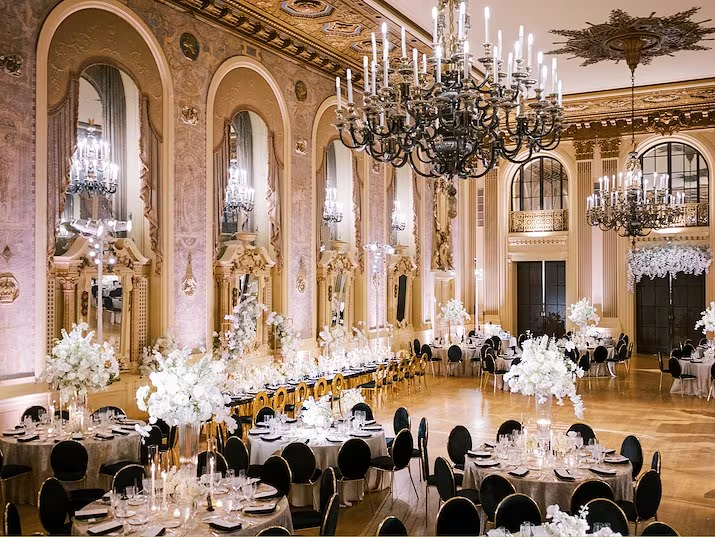
My mother told a ballroom full of decorated officers that I should have died instead of my brother.
She did not shout it. Meredith Whitaker never shouted when she wanted to hurt someone. She lowered her voice, smiled with her mouth, and let the cruelty arrive dressed like manners. That was how she had survived for decades in rooms full of donors, military families, politicians’ spouses, and cameras that loved her best from the left side. My mother understood the power of a polished voice. She knew how to make cruelty sound like grief, how to make punishment look like posture, and how to make an entire room believe she was the wounded one even while her hand was still holding the knife.
The gala was being held in a private ballroom above the Potomac, where the glass walls made Washington shimmer behind us like a rented backdrop. The city below glowed in blue, white, and gold, all monuments and moving headlights, all history and money pretending not to know each other. The room smelled of white lilies, chilled champagne, hairspray, expensive perfume, and old influence. Every table had a silver card with my mother’s foundation name embossed across it. The Owen Whitaker Legacy Foundation. Every officer in the room had medals pinned to his chest. Every camera seemed to know exactly where my sister Celeste was sitting.
Not me.
My mother had placed me near the end of the family table, half-hidden behind a marble column, beside a retired colonel’s second wife and a defense contractor who kept checking his phone under the tablecloth. The seat had a place card with my name printed correctly, but nothing else about it was accidental. Meredith never made a seating chart by accident. I had learned that by the time I was nine, when she seated me at the kids’ table during my father’s retirement dinner even though every cousin my age had been placed with the adults. By fourteen, I knew how to read her punishments before anyone else noticed them. By twenty, I understood that in my family, love was public theater and disappointment was stored in private until it became useful.
I wore my Army dress uniform anyway. I had pressed it myself in the hotel bathroom at 5:40 that evening, using a towel spread over the counter because the ironing board rocked on one broken leg. I checked every crease twice. I adjusted the ribbons until they sat exactly where they belonged. I pinned my aviation badge with hands that did not shake, though my stomach had been tight since the invitation arrived weeks earlier. Then I stood in front of the mirror and told myself I would not let my mother make me feel like an intruder in a uniform I had earned.
Major Nora Whitaker. United States Army aviation. Invited as family. Seated like a warning label.
Downstairs, I signed the event security log at 6:12. The young woman at the check-in table looked at my last name, looked at my uniform, and then looked past me toward the door, as if Celeste must be coming up right behind me. I was used to that. Celeste had always been the daughter who matched the room. She knew how to hold a champagne flute. She knew which donors liked handwritten thank-you notes. She knew how to tilt her head when my mother talked about Owen, as if grief had trained her posture years ago and she’d never once questioned the lesson.
That night, she sat at Meredith’s right in a cream silk dress, still and polished and beautiful in the way old money teaches a girl to be beautiful. Useful. Quiet. Reflective. Everything my mother loved in a daughter.
I had never been useful in the right way. I was the practical one. The blunt one. The one who took apart broken radios as a child and asked why the housekeeper ate in the kitchen when the guests had finished their meal. I was the one who joined ROTC instead of the debutante charity circuit, the one who learned to fly, the one who chose Army aviation when my mother wanted me photographed beside Celeste in a law school brochure.
Owen had been different from both of us. He was sunlight. That was the only word that ever fit him. My brother had the kind of laugh that made strangers turn around and smile before they even knew what he was laughing about. He was two years younger than me, taller by the time we were teenagers, and incapable of walking past a dog without greeting it like an old friend he hadn’t seen in years. He was the golden son, yes, but not because he ever asked to be. My mother adored him. Donors adored him. Officers adored him. Waiters adored him. Children adored him.
And I adored him too. That was the part Meredith never understood. She thought love was a competition because she had lived that way long enough to mistake it for truth. Owen and I were not competitors. We were conspirators. He covered for me when I slipped out of a foundation luncheon to take an aviation exam. I wrote half his college essays because he could talk a room into tears but could not organize a paragraph to save his life. He sent me ridiculous care packages overseas — hot sauce, socks with airplanes printed on them, handwritten notes scrawled on cocktail napkins, one plastic dinosaur he swore in all seriousness was a tactical morale asset.
He died six years before the gala. Captain Owen Whitaker, United States Army, age thirty-two, killed during an evacuation mission in Afghanistan that my mother had since turned into a monument, a foundation, a fundraising video, and a story in which I existed only as the daughter who came home when he did not.
What she never said publicly was that I had been there. Not nearby. There. I had been the pilot.
My helicopter had taken fire on approach. We had been sent in after a humanitarian convoy was hit outside a village that was not supposed to be hot that day. That is the sentence the Army uses when reality embarrasses the planning that came before it. Not supposed to be hot. But war does not care what a briefing says the day before.
Owen was on the ground with the security element. I was in the air. By the time we arrived, smoke had turned the sky into something gray and alive. The first landing zone was compromised. The second was worse. Command told us to hold. Owen came over the radio, calm in the way he got when everyone else around him was scared.
“Nora, there are children down here.”
I can still hear his voice. Not every day anymore. But often enough.
We landed anyway. Twice. The second time, a blast hit near the eastern wall just as Owen was moving a wounded medic and two local children toward cover. I saw the dust rise. I saw men disappear into it. I saw my crew chief turn toward me with blood on his face. I saw the world narrow down to instruments, rotor noise, fire, and one impossible decision after another, each one arriving faster than the last.
We saved fourteen people. Not all. Never all. Owen was among the bodies recovered later.
For nearly a year, parts of the after-action report remained restricted because the operation had tangled with intelligence sources, civilian contractors, and mistakes no one in Washington was eager to lay out on a banquet table for public consumption. The public story was simplified until it became useless. Owen died saving civilians. That was true. Nora survived. Also true. My mother filled the space between those two truths with poison.
She never said directly, not at first, that I should have died. She said I had “come back with complicated feelings.” She said Owen had “always been the brave one.” She said grief made families strange. She said, “Some people are spared for reasons we may never understand,” while looking at me across a church reception hall with cameras nearby, close enough to catch every word she chose to say into the microphone stand near the podium. Then, over time, the implication hardened. Owen was gone because he was noble. I was alive because I was lucky. And luck, in my mother’s worldview, was vulgar when given to the wrong child.
At the gala, my mother began the evening exactly as expected. She worked the room with Celeste at her side, greeting generals, donors, ambassadors, and widows who had flown in from three states to support the foundation. She wore midnight blue, diamonds at her ears, and a grief so elegant it almost passed for kindness. Every time someone mentioned Owen, she touched the pendant at her throat, the one containing a fragment of his uniform cloth pressed behind glass. People admired that pendant. I knew because they told me. How beautiful. How meaningful. How brave. No one knew she had refused the dog tags I brought home myself, because they had passed through my hands first.
I sat through the first course while my mother gave me nothing but two glances. One when I entered. One when a photographer accidentally included me in a shot of Celeste. That second glance was worse. It said, quite plainly, Move. I did not.
The dinner continued. There were speeches from foundation board members, a video montage of Owen smiling in uniform, Owen teaching kids to throw footballs, Owen in sunglasses beside a helicopter, Owen holding a puppy in a place where none of us should have had time for puppies at all. The room laughed softly at the right moments. Then it cried at the right moments too. I kept my face still. Not because I felt nothing. Because I felt too much.
A man across the table leaned toward me after the video ended. “You served with him?” he asked.
I looked at the ribbon rack on his chest. Retired colonel. Infantry. Older. Careful eyes.
“Yes.”
He waited, sensing there was more to it than that single word.
“My brother,” I said.
His expression changed instantly. “Oh.”
That happened often. People never quite knew what to do with me once they understood. The surviving sister. The pilot. The one the foundation brochures did not mention. The family member seated beside a marble column instead of beside the mother of the fallen hero.
Before he could ask another question, Meredith’s voice reached us from the far side of the table. “Nora has always preferred not to discuss that day.”
The colonel looked uncomfortable. I looked at my mother. She smiled at me over the flowers. “Isn’t that right, darling?”
Darling. When Meredith Whitaker called you darling, you were already bleeding somewhere you hadn’t noticed yet.
“I discuss it when it’s relevant,” I said.
A flicker passed through her eyes. Not anger. Warning. Celeste lowered her gaze to her plate. That hurt more than my mother’s smile did. Celeste had been seventeen when Owen died. Young enough to be shaped by Meredith’s grief. Old enough, now, to know better. She had never been cruel to me in any direct way. She did not mock. She did not accuse. She simply stood beside my mother while Meredith erased me, one polite sentence at a time. Sometimes silence is not neutral. Sometimes it is inherited.
The keynote speaker that night was Lieutenant General Benjamin Harlan, newly retired, a man with a lined face, white hair, and the kind of posture that made waiters nervous without knowing why. He had known my father. He had known Owen. He knew me too, though not socially. Professionally. He had been in the operations chain years after the mission, when review boards began cleaning up old records and correcting awards that had been delayed by classification. He had called me three months before the gala.
“Nora,” he said, “I’m going to be in Washington in November.”
“So I heard.”
“Your mother’s event.”
“Yes.”
“I need you there.”
I almost laughed. “My mother does not need me anywhere.”
“I didn’t say for her.”
That was all he told me at the time. General Harlan was seated two tables away that night, close enough to see me, not close enough to explain anything further. When I arrived, he gave me one small nod. I returned it. That was the extent of our conversation, right up until Meredith decided to turn grief into a weapon in a room full of witnesses.
It happened between the main course and dessert. A donor’s wife, softened by wine and emotion, leaned across Celeste and told my mother, “You are so strong. I don’t know how you bear losing a child.”
Meredith touched her pendant. “One does not bear it,” she said softly. “One learns to stand with the wound.”
The woman nodded, already misty-eyed. “And your daughters,” she said, glancing first at Celeste, then vaguely toward my end of the table, as though I were a point on a map she’d almost forgotten to check. “What a comfort they must be.”
Meredith’s mouth curved. “Celeste has been my anchor.”
The omission sat there, heavy, in the middle of the table. No one knew what to do with it. The donor’s wife, perhaps sensing trouble but unable to stop herself, added, “And Major Whitaker must be such a source of pride as well.”
For the first time that night, my mother looked directly at me. The ballroom hummed around us. Silverware. Glass. Low voices. A camera flash near the stage. Jazz drifting from hidden speakers somewhere overhead.
Meredith lifted her champagne glass. “Nora,” she said, “has always had her own way of surviving.”
There were polite smiles around the table. Then she leaned slightly toward the woman, lowering her voice just enough to pretend privacy while ensuring everyone within ten feet could hear it clearly.
“The truth is, some nights I still believe the wrong child came home.”
The room around our table stopped breathing. The donor’s wife went still. The retired colonel beside me put down his fork. Celeste’s face drained of color. My mother’s smile remained perfect.
I looked at her. All my life, I had wondered what I would feel if she finally said it plainly, out loud, in front of witnesses. Rage, maybe. Collapse. A speech. A thrown glass. But when the words actually arrived, I felt none of that. I felt a strange quiet. Like a helicopter cockpit after the engine cuts and the blades are still turning but the world beyond the windshield has already changed.
I placed my napkin beside my plate. Then I stood. Not quickly. Not dramatically. I simply rose.
My mother’s eyes sharpened. She expected me to leave. Or cry. Or give her the emotional disruption she could later use as proof that I was unstable, bitter, damaged by war, unable to handle grief with the kind of dignity she’d spent a lifetime performing.
Instead, I picked up my glass. The room’s attention shifted in that subtle way rooms shift before they know why. I raised the glass slightly.
“To Owen,” I said.
My voice carried farther than I expected. Heads turned. General Harlan looked up. My mother froze.
I continued. “My brother was brave, funny, reckless with kindness, terrible at paperwork, loyal beyond reason, and the only person in our family who ever told me not to make myself smaller just because a room preferred me that way.”
The ballroom was quiet now. Not fully. But enough. Celeste’s eyes filled with tears. Meredith’s face hardened beneath its polished surface.
I looked at my mother. “He would have hated what grief has made you willing to say.”
A sound moved through the guests, low and uncertain. My mother set her glass down carefully. “Nora,” she said softly, dangerously, “this is not the time.”
“No,” a man’s voice said from two tables away. “I think it is.”
General Harlan stood. Every officer in the room turned before the donors did — that’s what rank does, even after retirement, it alters the gravity of a room without a word being said. He walked slowly toward the stage. The event coordinator looked panicked. My mother looked worse.
“General,” she said, “we’re not scheduled for your remarks yet.”
“I’m aware.”
He reached the microphone. The ballroom became silent. Truly silent. General Harlan adjusted the microphone once, then looked out over the crowd.
“Ladies and gentlemen, forgive the interruption. I had intended to make these remarks later in the evening. Given what was just said at the Whitaker family table, I believe the record should be corrected now.”
My mother’s face went white. Corrected. There are words powerful enough to undo entire houses.
General Harlan continued. “For six years, the public has known Captain Owen Whitaker as a brave officer who died saving civilians and fellow soldiers during a compromised evacuation mission. That is true. It is not the whole truth.”
I felt my heartbeat in my throat. No, I thought. Not here. But another part of me, the part that had sat behind marble columns and swallowed poison for years, stood very still and waited.
The general looked toward me. “Major Nora Whitaker was the aircraft commander on that mission.”
Murmurs moved through the ballroom. My mother stared straight ahead, unmoving.
“Owing to operational sensitivities, several details of that day were not publicly available. Those restrictions were recently lifted in part. The Army has since completed review of actions taken during the evacuation.”
He removed a folded paper from inside his jacket. I knew that paper. Not physically. But I knew what it was, in the way your body sometimes knows a thing before your mind lets you finish the thought. My vision blurred slightly at the edges.
“Major Whitaker made two contested landings under hostile fire after her original landing zone became unusable. She evacuated fourteen wounded personnel and civilians. She remained on station after sustaining damage to her aircraft and after receiving orders to withdraw, because her crew still had survivors in sight.”
He paused. No one moved.
“Captain Owen Whitaker was killed while moving wounded civilians toward the extraction point. His actions saved lives. So did his sister’s.”
My mother’s hand went to her pendant. General Harlan’s voice roughened slightly. “Owen did not die because Nora lived. That is not how combat works. That is not how sacrifice works. And it is a disservice to every service member in this room to allow grief to rewrite courage as blame.”
Celeste covered her mouth with both hands. The retired colonel beside my empty chair whispered, “My God.”
General Harlan looked down at the paper. “Tonight, with authorization from the Department of the Army, and with apologies for the delay circumstances required, it is my honor to announce that Major Nora Whitaker has been awarded the Distinguished Flying Cross for extraordinary achievement during aerial flight under hazardous conditions.”
The ballroom erupted. Not in applause at first. In shock. Then the applause came, slow at the beginning, then thunderous. Officers stood first. Then the rest of the room followed, because the room understood, all at once, that standing was now required by something larger than etiquette.
I did not move. I could not. For six years, I had lived with two realities. What I knew. And what my family allowed to be said. Now the wall between them had cracked open in public, in front of everyone who mattered to her.
General Harlan stepped away from the microphone and came toward me. A younger officer followed behind him with a small presentation box. My mother remained seated. Celeste stood. That mattered. It mattered so much I almost broke right there at the table.
General Harlan stopped in front of me. “Major Whitaker,” he said quietly, just for me, “your brother was proud of you. He said so in his last transmission.”
The room blurred. I knew the last transmission. I had heard it in nightmares, over and over, the same six words. Nora, go. Take them home. I had never known there was more to it than that.
General Harlan opened the box. Inside lay the medal. My hands stayed at my sides. For a second, I was no longer in a ballroom. I was back in dust and smoke, my headset full of voices, Owen laughing over the comms two days earlier about how Meredith would hate the field coffee if she ever had to drink it. Owen’s arm slung around my shoulders in an old photograph. Owen slipping the plastic dinosaur into my flight bag before deployment, grinning like he’d gotten away with something.
I swallowed hard. General Harlan waited. He did not rush me. That kindness nearly undid me more than anything else that night.
Finally, I stepped forward. He pinned the medal to my uniform with steady hands. The applause rose again. I did not look at my mother. Not yet. I looked at Celeste. She was crying openly now. Not elegantly. Not usefully. Honestly. For once, Meredith did not control how grief looked in the room.
After the medal presentation, the gala could not return to what it had been. People tried, because polite society is trained to continue through catastrophe, but the air had changed. Donors whispered behind their programs. Officers approached me one by one throughout the rest of the evening. Some shook my hand. Some said, “Well earned, Major.” Some said nothing at all, which was often better than any words could have been.
The retired colonel beside me returned with tears in his eyes and said, “Your brother would have wanted the whole story told.”
I nodded because I could not speak.
My mother disappeared to the ladies’ lounge. Celeste followed her. I did not. I went to the balcony outside the ballroom instead. The November air was cold enough to clear my head. Below, the Potomac moved black and silver under the city lights. I stood with both hands on the railing and took the first full breath I had taken all evening.
The door opened behind me. I expected General Harlan. It was Celeste.
She had wrapped a shawl around her shoulders, but she was still shivering. Mascara marked the skin beneath her eyes in two dark lines.
“Nora,” she said.
I looked back at the river. “Did she send you?”
“No.”
That answer surprised me enough to turn around. Celeste’s face crumpled.
“I should have stood up sooner,” she said.
There were many things I could have said. Yes. Why didn’t you? Do you know what it cost me? Instead, I said, “Yes, you should have.”
She nodded quickly, as if she deserved that answer and was grateful someone had finally given it to her plainly. “I was afraid of her.”
“I know.”
“She made me feel like if I didn’t stay beside her, Owen’s memory would fall apart.”
My throat tightened. “Owen’s memory was never hers to hold hostage.”
Celeste cried harder. “I know that now.”
I looked at my little sister, though she was thirty now and not little by any measure anymore. She had been a teenager when Owen died. Meredith had folded her into grief like a flag and never let her unfold since. Celeste had been rewarded for loyalty, praised for poise, seated at the right hand, photographed, protected, and trapped, all at once, in a role she never quite chose for herself. That did not excuse her silence. But it explained the shape of it.
“What did Mom say in the lounge?” I asked.
Celeste wiped her face with the edge of the shawl. “That General Harlan humiliated her.”
I laughed once, not kindly. “Of course.”
“And that you planned this.”
My eyes closed briefly. Of course again.
“Nora,” Celeste said, “I told her no.”
I opened my eyes. She looked terrified but determined, standing there in the cold with her arms wrapped around herself.
“I told her what she said was unforgivable. I told her Owen would have been ashamed of her. I told her I won’t sit beside her if she ever speaks about you that way again.”
The wind moved between us. For a moment, I could only stare at her. Then I said, “And what did she do?”
“She slapped me.”
The words hit me hard. Celeste lifted her chin.
“Not hard. But enough.”
Enough. That was another family word. Enough to warn. Enough to mark a line. Enough to remind a daughter who owned the room, even now, even after everything.
Something cold moved through me. “Come with me,” I said.
She looked startled. “Where?”
“Inside.”
When we returned to the ballroom, Meredith was back at the head table as though nothing had happened at all. Her face was composed. Her lipstick refreshed. Her pendant centered exactly where it always sat. She looked at Celeste first. Then at me. Her eyes moved to the medal on my uniform, and for the first time in my life, I saw something like fear in my mother’s face.
Not guilt. Fear. Because the room had changed allegiance, and powerful people can survive many things. What they cannot tolerate is losing control of the story.
I walked to the stage. The foundation board chair, a nervous man named Arthur Bell, tried to intercept me. “Major Whitaker, perhaps we should—”
I looked at him. He stepped aside.
I took the microphone. A hush fell so fast it almost felt physical. My mother stood.
“Nora, don’t.”
I looked at her. For a moment, the entire ballroom saw us as we truly were. Not the grieving mother and difficult daughter. Not the foundation matriarch and the uncomfortable soldier. Just a woman who had used grief as a throne, and the daughter who had finally stopped kneeling in front of it.
“I will keep this brief,” I said into the microphone. My voice was steady. “The Owen Whitaker Legacy Foundation was created in my brother’s name. Owen believed service meant protecting people who could not protect themselves in that moment. He believed courage was not a performance. He believed kindness without action was just decoration.”
I looked at the donors scattered across the room. “Many of you gave because you loved him, knew him, served with him, or believed the story you were told. I thank you for that.”
Then I looked at my mother. “But no foundation built on a soldier’s name should ever be used to punish the living members of his family, or revise the truth of his service.”
Meredith’s face hardened. “Nora,” she whispered.
I continued. “As of tonight, I will be requesting a formal review of the foundation’s public materials to ensure they accurately represent Owen’s life, service, and family. I will also be stepping into the advisory role my father’s original trust documents granted to the surviving service member in the family.”
My mother went completely still. There it was. The thing she had hoped I did not know. But I did. My father had not been perfect. He had been distant, stern, more comfortable with commands than feelings, a man who showed love through structure rather than words. But before he died, he made one attempt to protect Owen’s legacy from becoming Meredith’s private kingdom. The foundation trust included an advisory seat reserved for any Whitaker child with active or prior military service.
Meredith never told me. My father’s old attorney did, three weeks before the gala, over a phone call I’d nearly let go to voicemail.
Arthur Bell’s face had gone pale beside the podium. My mother looked at him. Good. Let her wonder who had spoken.
I finished with the only words that mattered. “My brother’s name will not be used as a weapon anymore.”
I placed the microphone down. No applause came at first. Then someone stood. General Harlan. Then the retired colonel. Then a Gold Star mother near the front, tears streaming freely down her face. Then others. Not everyone. Enough.
My mother did not stand. That was all right. The world no longer depended on her permission.
The fallout was quiet at first. That is how real power protects itself. It does not explode immediately. It goes into meetings instead. Within two weeks, the foundation board announced a review of governance and public materials. Within a month, Meredith took a “temporary leave” from day-to-day leadership. By spring, the leave became permanent. The public statement was graceful, full of gratitude for her years of service and vague acknowledgment of necessary organizational growth.
My mother hated every word of it. I know because she left me a voicemail at midnight the night it was released. “You have taken everything from me,” she said. I listened once. Then I deleted it. Not because it did not hurt. Because I had finally learned the difference between pain and obligation.
Celeste resigned from her ceremonial role and took a real job with a veterans’ mental health nonprofit downtown. At first, I wondered if it was guilt. Maybe part of it was. But she stayed. She learned the work. She stopped wearing cream silk to every event. She started calling me without Meredith on the line.
Our relationship did not heal quickly. It could not. Too much had been said, and worse, too much had never been said at all until that night. But one afternoon, six months after the gala, Celeste came to my apartment in Arlington with two coffees and an old shoebox tucked under one arm.
“I found these in Mom’s storage,” she said.
Inside were Owen’s letters. Not the ones my mother had displayed in frames around the foundation office. The real ones. Messy. Funny. Folded badly. Full of jokes, complaints, sketches, and one note addressed to me that Meredith had never given me.
Nora, it read. If Mom starts turning me into a saint while I’m gone, remind her I once got caught sneaking tacos into church. Also, if anything ever happens, don’t let them make you the hard one just because you survive things differently. You are the best pilot I know. Don’t argue. I’m dead serious. Well, hopefully not dead. Bad joke. Sorry. — O
I read it twice. Then I laughed and cried at the same time, both at once, in a way I hadn’t done since before he died. Celeste cried too. For once, we did not perform grief correctly. We simply had it, sitting on my kitchen floor with cold coffee and an open shoebox between us.
My mother and I did not speak for nearly a year. Then one cold morning, she wrote a letter. Not long. Not enough. But realer than anything she had said before.
Nora, it began. I have spent years calling my grief love because grief was easier than admitting I was angry. I was angry Owen died. I was angry you lived. I was angry because I needed someone to blame, and you were there. That was not motherhood. It was cowardice. I do not ask you to forgive me. — Meredith
She signed it Meredith. Not Mom. That was the first honest thing in the entire letter.
I kept it. I did not answer right away. Some wounds do not close simply because the person who made them finally names the knife out loud. But naming matters. It matters because truth gives you something solid to stand on, even if you end up standing far away from where the wound was made.
A year later, the foundation held its first gala without Meredith as chair. It was smaller. Warmer. Less grand than any of the ones before it. The lilies were replaced with simple white roses, because Owen had hated lilies. He used to say they smelled like a funeral home trying too hard to convince you it wasn’t one. The video montage included not only Owen in uniform, but Owen laughing with his sisters, Owen dancing badly at Celeste’s graduation, Owen making faces behind my father at a formal dinner, Owen holding the ridiculous plastic dinosaur he later mailed to me overseas in a box that also somehow contained three bags of beef jerky and a pair of socks printed with tiny airplanes.
My seat was at the front table. So was Celeste’s. There was no marble column between us and the room.
When I spoke that night, I wore my uniform again. Not to prove anything. Because it was mine. I told the crowd about Owen smuggling tacos into church. The room laughed. I told them about his last mission. The room listened. I told them that courage and grief both become dangerous when we turn them into statues instead of letting them remain human.
Afterward, an older woman came up to me. She was small, with silver hair and a Gold Star pin on her lapel.
“My son died in Iraq,” she said.
I took her hand. “I’m sorry.”
She nodded. “For years, I was angry at the man who survived the attack. I never said what your mother said, but I thought it.” Her eyes filled with tears. “Tonight helped me understand something.”
“What?” I asked gently.
“That my son’s death was not another boy’s debt.”
I held her hand tighter. “No,” I said. “It wasn’t.”
That conversation alone would have made the whole night worthwhile, even without everything else.
Later, Celeste and I stood on the balcony overlooking the Potomac. The city shimmered below us again, beautiful and indifferent, exactly as it had been the night everything changed. She leaned her elbows on the railing.
“Owen would have liked this version better,” she said.
“He would have complained about the speeches.”
She smiled, the first real smile I’d seen from her all night. “And stolen dessert.”
“Definitely.”
For a while, we stood there quietly, watching the lights move on the water. Then she said, “Do you miss flying?”
The question surprised me. People usually asked about the danger. The trauma. The medal. Not the flying itself.
I looked out at the lights. “Every day.”
“Will you go back?”
“I never really left.”
She looked at me. I smiled.
“I’m still Army, Celeste. My life didn’t end at that gala. Or on that mission. Or in Mom’s version of the story.”
Her eyes softened. “No,” she said. “It didn’t.”
That was the truth I had been fighting for all along. Not a medal. Not applause. Not even public vindication in front of a ballroom full of witnesses. The right to be more than the worst thing my mother could say about me. The right to love my brother without being buried beside him. The right to survive without apologizing for the simple fact that I did.
My mother told a ballroom full of decorated officers that I should have died instead of Owen. She meant to reduce me to the child grief rejected. Instead, she forced the truth into the open. Owen was brave. So was I. Owen was loved. So was I, even if not well enough by the woman who should have known how. Owen died saving lives. I lived saving lives. Those facts can stand together. They do not cancel each other out. They never did.
For years, my mother had treated my survival like an error in the story she wanted to tell. But survival is not an apology. It is not theft. It is not betrayal. Sometimes survival is simply the final order you are given by someone you love.
Nora, go. Take them home.
I did. And finally, after all those years of sitting behind marble columns in rooms built entirely from my brother’s memory, I came home to myself too.

Specialty: Legal & Financial Drama
Michael Carter covers stories where money, power, and personal history collide. His writing often explores courtroom battles, business conflicts, and the subtle strategies people use when pushed into a corner. He focuses on grounded, realistic storytelling with attention to detail and believable motivations.