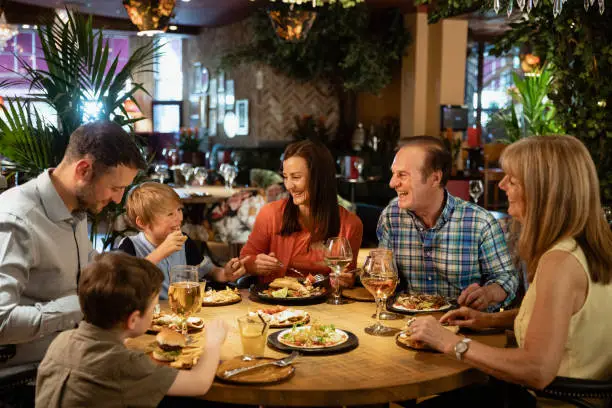
The first bite never made it to my mouth. I was sitting in a private room at one of the nicest steakhouses in Nashville, staring at a plate I had spent three weeks planning around, when my younger brother leaned toward me and said, “Try not to eat too much. You didn’t pay for this.”
Before I could even process that, my aunt gave a little laugh and added, “Maybe we should let the real family enjoy it.”
I am Claire Bennett. I’m 35 years old. And up until that exact moment, I had still been telling myself this night might finally be different.
I had arranged every part of my parents’ anniversary dinner in secret. The room, the food, the music, the photos on the wall — all of it. I did it because I wanted to give them one beautiful night that felt thoughtful and warm and worthy of everything they had built together in 35 years of marriage. Instead, I found myself sitting there with a smile frozen on my face while the people at that table treated me like some extra guest who had wandered into the wrong room.
What hurt even more was that nobody stopped them. My mother looked down. My father reached for his glass. Nobody said, “That’s enough.” Nobody said, “She belongs here.”
So I set my fork down, picked up my coat, and walked out before the cake was cut. I didn’t argue. I didn’t cry. I just left.
What none of them knew was that the private room, the full dinner, and the entire bar tab were already sitting on my card. And when the banquet manager came back to that table an hour later, the night they thought they were controlling turned into something none of them were ready for.
But I should tell you how we got to that table. Because people like my brother never say something that cruel out of nowhere. It only sounds sudden if you haven’t lived inside the pattern long enough to recognize it.
My parents had been married 35 years, and for most of my life I watched them build a family around one simple rule: keep the peace, no matter who pays the price for it. My mother, Elaine, believed in smoothing everything over. My father, David, worked hard, kept his head down, and hated conflict so much he could sit through almost anything in silence if he thought it would keep dinner from turning into a fight. And my younger brother, Mason, learned very early that if he smiled at the right time and played offended at the right time, the whole house would rearrange itself around his feelings.
I was the one who got praised for being responsible — and then quietly expected to need nothing. Mason was the one who got excuses. He still lived close to our parents. He still drifted from one unstable job to the next. And he still somehow got treated like the center of the family, because he was the one who was always around.
I lived 25 minutes away with my husband, Evan. I worked long hours. I had built a life that looked solid from the outside. In my family, that translated into exactly one thing: Claire is fine. Claire doesn’t need help. Claire can take it. Somewhere along the way, being dependable turned me into the person everyone felt safe disappointing.
My aunt Linda made it worse. She was my father’s older sister — recently divorced, permanently bitter, the kind of woman who treated every other woman’s success like a personal insult. She had decided years ago that I thought I was too good for the family, mostly because I left home, got married, and didn’t spend every weekend parked in my parents’ kitchen pretending nothing was wrong. If I brought wine to dinner, I was showing off. If I missed a barbecue because of work, I was “too important now.” If I paid for something, I was trying to make everyone look bad. It didn’t matter what I did. In Linda’s mind, I had betrayed some invisible code by becoming a version of myself she couldn’t control.
That’s why the party mattered to me more than I want to admit. I didn’t put it together just to celebrate my parents. I put it together because some part of me still wanted proof that effort could change the script. I wanted one night where nobody rolled their eyes when I helped. One night where my parents could feel cherished and maybe, just maybe, see me clearly.
I spent three weeks planning everything in secret. I booked the private room through Tessa, an old college friend who managed events at the restaurant. I worked with her on the menu, because my father loves a good steak dinner but my mother always orders salmon if she thinks nobody’s paying attention. I built a playlist out of the old songs they used to play in the house when I was little. I had framed copies of their wedding photos placed along the wall. I even arranged a small anniversary cake with the same simple white frosting my mother used to make for birthdays when money was tight.
Every detail had a reason. Every detail was me trying, one more time, to love my family in a language I hoped they would finally understand.
The only thing I didn’t tell them was that I was paying for all of it. The room, the catering, the drinks, the service charge — everything. I wanted it to feel like a gift, not a performance.
By 6:30 that evening I was at the restaurant with my hair pinned up, my phone in one hand, and my nerves stretched tight enough to snap. The private room looked exactly the way I had pictured it at two in the morning on the nights I couldn’t sleep. Warm light. Clean white linens. Framed wedding photos lined along one wall. The cake sat off to the side under a glass cover — elegant without feeling stiff.
Tessa walked through the final details with me while servers polished glasses and adjusted place settings. She asked if I wanted my name on the little welcome card near the entrance.
“No,” I said. “Just ‘Happy Anniversary, Mom and Dad.’ Keep it simple.”
She smiled and told me it was one of the nicest family events she’d seen all month. I remember standing there for a second, looking around that room, thinking maybe this would be the night I stopped bracing myself before every family gathering. Maybe this time I could just be a daughter doing something loving for her parents, and let that be enough.
Mason and Aunt Linda were the first to arrive, and the second they stepped into the room, I felt that old familiar shift in the air.
Mason looked around with his hands in his jacket pockets and gave a low whistle, like he’d walked into a place he had no intention of respecting. “Nice,” he said, drawing the word out just enough to make it sound like an accusation instead of a compliment. “Somebody really wanted to make an impression tonight.”
Aunt Linda barely looked at me before asking one of the servers about the top-shelf whiskey selection. Then she turned, gave me a slow up-and-down glance, and said, “You got all dressed up for a family dinner, huh?”
I was wearing a dark green dress and low heels. Nothing dramatic. Nothing flashy. But with Linda, it didn’t matter. If I wore jeans, I was sloppy. If I looked polished, I was trying too hard.
I gave them both a smile so practiced I almost hated myself for it. “I just wanted tonight to feel nice for Mom and Dad.”
Mason grabbed an appetizer before the rest of the family had even arrived. Linda ordered a second drink before she finished the first. And by seven o’clock, when my parents were supposed to walk in, they still weren’t there. I texted my mother and got back a short message saying they were running late because my father had changed his shirt twice and then couldn’t find the jacket she wanted him to wear. That was normal enough to almost make me laugh.
So I waited. 7:10 turned into 7:20. Mason picked at the charcuterie board like he was doing the restaurant a favor by showing up. Linda wandered along the wall of framed wedding photos — not in a touched way, but the way people inspect something when they’re looking for a reason to criticize it. She paused at one of my parents’ wedding pictures and said, “Your mother was so tiny back then. Life comes at you fast.”
I looked away before she could see my face.
Then, finally, at 7:45, the door opened and my parents walked in together. Everyone shouted, “Surprise!”
And for one shining stretch of minutes, it was exactly the evening I had wanted.
My mother put both hands over her mouth and started crying before she made it three steps into the room. My father stopped cold, looked around at the photos and the flowers and the candlelight, and then looked straight at me with an expression I hadn’t seen in years. Not suspicion. Not distraction. Just pure emotion. He wrapped me in a hug and whispered, “You did all this.”
I didn’t say yes out loud. But I think he knew.
My mother kept touching the frames on the wall and laughing at the old pictures. My father actually relaxed. Mason behaved himself for about twenty minutes. Even Linda managed to stay quiet once the food started coming out. That’s the part that almost makes what happened next feel unreal — because it is always worse when someone ruins a moment that had the chance to be beautiful.
The first course came and went. Then the main plates arrived one by one, set down in a hush of polished service and warm steam. My father got the ribeye. My mother got the salmon. Mason had some expensive bourbon-glazed thing he absolutely would not have ordered if he thought he was paying for it himself.
My plate went down in front of me, and I remember feeling so hungry my hands almost shook when I picked up my fork. I had barely eaten all day. I’d been too busy making sure every detail was right.
I cut into the first bite and had just started lifting it when Mason leaned toward me with that lazy, smug half-grin he always wore right before saying something cruel enough to pass off as a joke.
“Try not to eat too much, Claire,” he said. “You didn’t pay for this.”
For a second, I honestly thought I’d misheard him.
Then Aunt Linda laughed — not loud, just sharp enough to cut through everything else at the table. “Let the real family enjoy it for once,” she said. “You can take home leftovers. If there are any.”
The room didn’t go silent all at once. It collapsed into silence in pieces. My fork stopped in the air. My mother looked down at her napkin. My father reached for his glass and did not speak.
Nobody told Mason to shut up. Nobody told Linda she’d crossed a line. Nobody said, “Claire, that was ugly. Are you okay?”
I set my fork down very carefully, because my hand had started to tremble. Then I looked at Mason. Then at Linda. Then at my parents.
“Did you really just say that to me?”
Mason shrugged, already smiling, already sliding back into safety. “Relax. It was a joke.”
Aunt Linda leaned back in her chair and gave me the expression she always wore when she wanted me to feel ridiculous for reacting to something mean. “Don’t start. This is your parents’ night.”
My mother finally looked up and touched my wrist for half a second. “Honey, don’t be so sensitive.”
That was it. Not Mason. Not Linda. My mother.
That was the exact moment something in me stopped asking to be understood.
I sat there looking at the people I had spent three weeks trying to honor, and I realized I had two choices. I could stay and swallow it like I always did. Or I could leave before I lost the last bit of dignity left on that table.
So I stood up. No speech. No scene. I picked up my coat from the back of the chair and slipped it on.
My mother frowned. “Claire, where are you going? We haven’t even cut the cake yet.”
I looked at her. Then at my father. Then at the center of that beautifully arranged table, where I suddenly felt like a stranger who had paid for the privilege of being insulted in public.
“You all should enjoy the rest of the evening,” I said quietly. “Really. Please do.”
Mason laughed under his breath. “There she goes. Dramatic as usual.”
I didn’t answer him. I walked out of that room with my back straight and my face calm, even though my chest felt like it had been cut open. The whole way down the hallway — past the music, the clinking glasses, the polished restaurant hush — I held on to one simple thought.
None of them knew whose card had paid for every bite on that table. Not yet.
I made it halfway down the hallway before I let myself stop. Not because I was about to run back in, and not because I expected anyone to follow me. I stopped because I needed one full breath before I said anything at all. My heart was pounding so hard it felt like it had moved into my throat. But the strangest part was how clear my head suddenly felt. I was done arguing with people who only knew how to call cruelty a joke after they got caught being cruel. I was done begging for basic respect from people who thought silence counted as innocence.
Tessa spotted me before I even reached the host stand. She was coming out of another event room with a tablet in her hand, and the second she saw my face, her expression changed.
“Claire. Are you okay?”
I nodded once. “I need you to do something for me.”
We stepped away from the main dining room so nobody could overhear. I kept my voice calm, because by then calm felt stronger than anger.
“In one hour, I need you to take the closing folio back to that room and ask who is signing for the event. Room charge, catering, bar overages, gratuity — everything. And if they act confused, tell them the event was booked and paid for by Claire Bennett.”
Tessa stared at me for half a second. Then her eyes widened, because she understood immediately. She didn’t ask if I was sure. She’d heard enough in my voice to know I was.
“Are you leaving?”
“Yes. I’m done for tonight.”
She looked past me toward the hallway that led back to the party, then back at me. “Claire, I’m sorry. You worked so hard on this.”
I gave a small smile that didn’t feel like much of anything. “I know. That’s kind of the point.”
She squeezed my forearm once, just enough to feel human. “I’ll handle it.”
I thanked her, forwarded her the final authorization from my phone in case she needed it for the file, and walked out through the front doors into the warm Nashville night.
There’s a moment after you leave a place like that when your body still thinks you’re in danger, even though the room is behind you. I sat in my car with both hands on the wheel, staring through the windshield without seeing anything. My hands were shaking. My face was hot. My stomach was empty, which somehow made the whole thing feel even meaner. I had paid for a dinner I didn’t get to eat, for a room I had decorated, for a celebration I had built by hand — and I had walked out of it like I was the one who didn’t belong.
But underneath all of that hurt was something steadier than pain. Certainty. For once, I had not stayed long enough to be crushed into pretending everything was fine. I had left before they could rewrite what happened.
I drove home with the radio off and my phone face down in the cup holder. At red lights I kept picturing the room I’d left behind. Mason leaning back in his chair, still smirking. Linda picking up her drink like nothing important had happened. My mother smoothing the moment over in her mind before dessert even arrived. My father saying nothing, because saying nothing had been his favorite refuge for years.
I knew exactly how the next hour would go. They would keep eating. They would tell themselves I overreacted. Mason would probably do an impression of me leaving, and Linda would laugh like she hadn’t just humiliated me in a room I paid for. My mother would say, “Give her time. She’ll calm down.”
And then the folio would appear.
The bill wouldn’t hit them as numbers first. It would hit them as a fact. Claire was the host. Claire paid for the room. Claire paid for the food. Claire paid for the open bar they’d been drinking from while treating her like an outsider.
By the time I pulled into my driveway, I almost felt sorry for them. Almost.
Evan wasn’t home yet, which I was grateful for, because I needed ten quiet minutes to take off my heels, drop my purse on the counter, and let the silence settle around me. I poured a glass of water and stood there in my own kitchen, still in my coat, staring at my dark reflection in the window.
Then my phone lit up with a message from Tessa. She had done it exactly when I asked.
“I just left the room. Nobody could speak for a full minute. Your brother turned white. Your aunt asked me three times if I was serious. Your mom looked like she might cry. Your dad just kept saying, ‘She paid for all of this.'”
I read it twice, then set the phone down. I didn’t smile right away. What I felt first was relief. Relief that the truth had finally walked into that room, even if I wasn’t there to watch it happen. Relief that for one brief moment, nobody could talk over me, dismiss me, or tell me I was imagining things. The facts had done what I no longer needed words to do.
I turned the phone face down before the calls could start, because I knew they were coming. And for that one quiet stretch of night, I wanted them to sit with the shock of it.
Evan walked in twenty minutes later, took one look at me still standing in the kitchen in my coat, and knew something had gone very wrong. He didn’t ask right away. He just set his keys down, crossed the room, and said, “Tell me.”
So I did. I told him about the room, the dinner, the way everything looked exactly right until it didn’t. I told him what Mason said when I lifted my fork. I told him what Linda added. And I told him the part that hurt worse than both of them put together — my mother touching my wrist and telling me not to be so sensitive, while my father stared at his glass like silence was somehow neutral.
Evan listened without interrupting, but I could see the anger rising in his face with every sentence. When I finished, he actually took a step back, like he needed the extra space to process it.
“Let me get this straight. You spent weeks planning a beautiful anniversary dinner for your parents. Paid for the whole thing yourself. Got insulted at your own table. And nobody defended you.”
“That about covers it.”
My phone started buzzing on the counter. He looked at it, then back at me. “You’re not answering that, right?”
I shook my head. “Not tonight.”
“Good,” he said. Then he ordered takeout from the little pizza place near our house, because the one thing I hadn’t done all evening was actually eat. There was something so absurd about sitting in my kitchen in a nice dress, eating pepperoni pizza out of a cardboard box after paying for a private steakhouse dinner I never got to touch, that I started laughing. And once I started, I couldn’t stop. Not because any of it was funny. Because sometimes the only alternative is crying, and I was too angry to give them tears.
My phone kept vibrating through dinner. Mason. My mother. A number I knew was Linda. Then my father. Then Mason again. I turned the screen over and kept eating. Around 10:30 I picked it up just long enough to see the previews without opening them. Where did you go. Call me now. You embarrassed everyone. There has been a misunderstanding. Your mother is very upset. Linda had even left a voicemail. I deleted it without listening.
That night I put the phone on silent and left it face down on my dresser. For once, I did not feel obligated to manage the fallout from somebody else treating me badly.
The next morning I woke up before Evan, made coffee, sat at the kitchen table in an oversized sweatshirt, and finally turned my phone over.
Fifty-two missed calls. Seventy-nine text messages. Most had come in between 9:45 and midnight, which told me exactly how long it took the truth to land and then turn into panic. Mason had called sixteen times. Linda ten. My mother had left four voicemails. Even my father — a man who avoided direct confrontation like it might physically injure him — had called six times.
There was also the family group text I had muted years ago, now lit up like a Christmas tree. Mason had gone in hard and early: “So that was your big plan. Humiliate us and disappear.” Linda jumped in right after with something about how tacky it was to use money to make family look small. My mother had posted three different versions of “Please stop this.” My father had written only four words: “Call your sister.” And then came the little messages that always arrive when people know they’re wrong but can’t bring themselves to say it plainly. You could have handled this differently. Nobody meant it that way. It was supposed to be a joke. Your mother is crying.
It was incredible how quickly the story had become about their embarrassment instead of what they had actually done.
I took a long sip of coffee and called my mother first, because I knew if I didn’t, she would keep escalating until she convinced herself she was the victim. She answered before the first full ring.
“Claire, thank God. Where have you been?”
“At home. Where I went after being insulted at a dinner I paid for.”
She went quiet for half a second, then rushed right past my point, as if speed could change facts. “Honey, the banquet manager came in with that folio and nobody understood what was happening. Mason thought there’d been some kind of mistake. Linda was mortified. Your father was blindsided.”
I laughed once, softly, because of course that’s where she started. Not with “I’m sorry.” Not with “what Mason said was cruel.” With their confusion.
“There was no mistake, Mom. I booked it. I paid for it. It was my gift to you and Dad.”
Another pause. Then she said the sentence I had known was coming. “Mason was joking, Claire. You know how he is.”
“No, Mom. I know exactly how he is. That’s the problem. And I know how Linda is. And I know how you are when he says something nasty and you need me to swallow it so nobody else feels uncomfortable.”
Her voice changed then. Thinner. Defensive. “This is not fair. We were all caught off guard. You left before we could fix it.”
“I didn’t leave before you could fix it. I left after none of you did.”
She started crying — or forcing herself close enough to crying that I was supposed to back down out of guilt. But I had nothing left for that move. I told her I was done having the same conversation in a different costume, and I ended the call before she could hand the phone to Mason.
It didn’t matter. He called thirty seconds later anyway. I let it ring twice before answering. He didn’t bother with hello.
“What the hell is wrong with you?”
“Interesting way to start.”
“You made me look like an idiot.”
“Me?” I nearly smiled into my coffee. “Mason, you managed that on your own, the second you told me not to eat too much of the food I paid for.”
“It was a joke. Everyone jokes around.”
“No. Jokes are supposed to be funny. What you did was check whether you could humiliate me in public and get away with it.”
He started talking over me, louder and faster, trying to drag me into the old rhythm where if he flooded the room first, nobody noticed he was wrong. I cut him off and said something I should have said years ago.
“I am not your punching bag just because this family trained me to be the reasonable one.”
Then I hung up on him. And for the first time since I left that restaurant, I felt something shift. Not in them. In me. The guilt was starting to burn off, and underneath it was something cleaner. I was finally done confusing love with permission.
For two days, things were strangely quiet. Not peaceful, exactly. Quieter than I expected. Mason stopped calling. Linda stopped sending long, offended messages about family loyalty. My mother texted once to say she was praying everyone would calm down — which in my family usually meant she was hoping time would blur the facts enough for us to pretend nothing had happened. I didn’t respond. I went to work, came home, had dinner with Evan, and enjoyed the kind of ordinary evenings that used to feel boring and now felt almost luxurious. No tension. No sarcasm. No waiting for someone to say something mean and then call it a joke.
I should have known the silence wasn’t acceptance. It was buildup.
On the third afternoon, I left work early after a meeting got canceled. It was just after 4:30 when I pulled into the driveway, and the first thing that felt off was the front door. Not wide open. Not broken. Just not fully shut — resting against the frame like someone had gone in a hurry and failed to pull it closed.
I sat there for one second with my hand still on the steering wheel, staring at it. Evan wouldn’t be home for at least another hour. He never left the door like that. Neither did I.
I got out of the car quietly and walked up the front path with my pulse kicking harder in my throat. The house wasn’t loud inside, but it wasn’t empty either. I could hear movement upstairs. A drawer sliding. Something set down too hard.
I didn’t call out. I stepped just far enough inside to look at the alarm panel, and I saw it had been disarmed with the backup code. My mother’s backup code. The one I’d never changed, because I never imagined she would hand it to someone who had no business being in my house.
That was the moment fear turned into anger.
I texted Evan — come home now — and started up the stairs. I didn’t have to wonder long. The guest room door was open, and I could hear Aunt Linda talking in the smug, irritated tone she used when she thought she was being practical and righteous at the same time.
“I told you she kept it,” she was saying. “She always keeps things.”
Mason answered from somewhere near the closet. “Well, if she wants to embarrass everybody, she doesn’t get to hold on to family stuff like she earned it.”
I stepped into the doorway and saw both of them at once. Linda was standing beside the storage cabinet where I kept framed photographs, holiday dishes, and a few boxes of things that had belonged to my grandmother. Mason was crouched near an open tote, holding the old silver serving set my parents had given me after my wedding. Other things were already piled on the bed. A crystal bowl. A photo album. Two framed prints. A bottle of bourbon Evan had been saving.
For one long second, nobody moved. Mason looked up first, and instead of shame, the first thing on his face was annoyance at being interrupted.
“Claire,” he said, standing too fast. “You’re home early.”
I looked at the bed, then at the tote on the floor, then back at him. “What exactly do you think you’re doing in my house?”
Linda crossed her arms, as if I was the one being difficult. “Don’t start with the drama. Your mother said it was fine for us to come by and pick up a few family things.”
“Family things,” I repeated. “You used my mother’s code to let yourselves into my house while I was gone, and you started packing up my belongings.”
Mason gave a short, humorless laugh. “Belongings? That’s rich. Some of this should have stayed with Mom and Dad anyway. And after the stunt you pulled at the restaurant, nobody feels particularly bad about evening things out.”
Evening things out.
I took a step into the room, and my voice dropped so low that even Linda stopped moving. “I paid for that dinner. You both insulted me in front of my parents. Then you spent two days calling me cruel because the truth embarrassed you. And now you’re standing in my home trying to act like theft is some kind of moral correction.”
Mason straightened his shoulders the way he always did right before saying something stupid and committing to it fully. “We’re not stealing. We’re taking back what matters to the family. You made it pretty clear where you stand.”
There it was again. The same rotten idea wrapped in slightly different words. Real family. Family things. As if the only people who counted were the ones who stayed close enough to control. As if paying, planning, loving, and showing up meant less than being the loudest person in the room.
I pulled out my phone and lifted it in front of me. “Smile if you want. I’m recording now.”
Linda immediately snapped at me to put the phone down — which told me everything I needed to know about how innocent she thought this looked. Mason took a step toward me, then stopped, because downstairs the front door opened and Evan called my name.
I didn’t look away from my brother when I answered. “Upstairs.”
Evan came up fast. He took in the open cabinets, the pile on the bed, Mason in the middle of the room, Linda standing there like a trespassing queen in a clearance-rack blazer. His whole expression changed. He didn’t yell — that would almost have been less effective. He just looked at Mason and said, “Put everything down and get out of my house.”
Mason tried the same weak defense he’d used on me. “This is family business.”
Evan didn’t blink. “No. Family business is a phone call. This is unlawful entry.”
Linda started talking then — something about permission, about a misunderstanding, about how Elaine had told them it was fine. It collapsed under its own ugliness the second I said, “I never gave either of you permission to be here. Not once. Not ever.”
Evan took out his phone. “If either of you touches one more thing, I’m calling the police before you make it to the driveway.”
That finally got through. Mason looked at me like he was still waiting for me to rescue him from the consequences of his own choices. And when I didn’t, something ugly flickered across his face. Not regret. Resentment. Deep, childish, furious resentment.
Linda muttered that I was tearing the family apart. I almost laughed, because by then I understood something I wish I’d learned years earlier. Families don’t fall apart when one person finally sets a boundary. They fall apart when everyone else is allowed to keep crossing it.
Mason dropped the serving set onto the bed hard enough to make me flinch, and he and Linda brushed past us on the stairs without another word. The front door slammed. Then the house went still.
Evan locked the door, turned back to me, and said, “We’re changing every code tonight.”
I nodded, but I was barely hearing him. Because all I could think about was one detail I couldn’t shake. My mother had given them access. Not by accident. Not out of confusion. On purpose.
And when my phone started ringing less than ten minutes later with my father’s name on the screen, I knew this was no longer about one cruel remark at dinner. This had become something much bigger, and nobody in my family was going to be able to hide from it much longer.
I answered on the second ring. My father’s voice sounded tired. Old, almost.
“Claire. Your mother told me she gave them the code.”
“Then she knows they used it to enter my house and take my things.”
He was quiet for a long moment. When he finally spoke, his voice was steadier than I’d heard it in years. “I’m sorry. I should have spoken up at the restaurant. I should have spoken up years ago. Come to the house tomorrow evening. Bring Evan. It’s time this family had a conversation we should have had a long time ago.”
The next evening, Evan and I walked into my parents’ living room. Mason was there, arms crossed, slouched into the couch like a teenager waiting out a lecture. Linda sat beside him looking offended instead of ashamed. My mother had clearly been crying. And my father stood by the fireplace — and for the first time in my life, he did not hide behind silence.
He looked at Mason first. “You insulted your sister at a dinner she paid for. Then you went into her home without permission and started taking her things. That ends now. Tonight.”
Mason opened his mouth. “Dad, if you’d just let me—”
“No.” One word, and the room went still. My father had never used that voice on Mason. Not once in 30 years. “You’ve had every chance to speak. You spoke at the restaurant. You spoke in her house. Now you listen.”
He turned to Linda. “You are not welcome at family gatherings until you can apologize to Claire without blaming her for your cruelty. And everything you touched in her house goes back. All of it.”
Linda sputtered something about how she was only trying to help, how this was all being blown out of proportion. My father just looked at her until she stopped talking.
My mother whispered from her chair, “David, please. I just want everyone to stop fighting.”
And my father said the sentence I never thought I’d hear in that house. “Elaine, protecting Mason from consequences is not love. It’s how we got here.”
The terms came down like a gavel. Mason had thirty days to move out of the apartment my parents had been quietly subsidizing. My father stopped paying his phone bill, his car insurance, his “emergency” expenses that arrived like clockwork every month. Linda returned everything she had touched and delivered an apology — stiff, reluctant, but real enough. And both of them paid me a thousand dollars each. Not because I needed it. Because consequences needed to feel real, and for people like Mason and Linda, nothing feels more real than money leaving their hands.
Two weeks later, I donated that money to a local family support center. It felt right — turning the price of their cruelty into something useful for families who actually needed it.
Things did not become perfect. I won’t pretend they did. Mason and I barely speak, and what he feels toward me these days is closer to a grudge than to remorse. Linda sends stiff birthday cards now, signed with just her name. My mother and I are slowly, carefully finding our way back to each other, one honest conversation at a time — and the honesty is new, and it’s uncomfortable, and it’s worth more than 35 years of smoothed-over peace.
But my father calls me every Sunday now. Just to talk. Just to ask how I am. And a few weeks after everything settled, he and my mother came to our house for dinner — a simple roast chicken at my own kitchen table, no private room, no folio, no performance. Halfway through the meal, my father set down his fork, looked at me, and said, “That night at the restaurant was the most beautiful thing anyone has ever done for us. I’m sorry it took me an hour and a bill to say so.”
I learned something through all of it that I’ll carry for the rest of my life. Family without respect isn’t family. It’s just a place where people expect you to bleed quietly. Walking away from that table was never about revenge. It wasn’t even about the money. It was about finally teaching the people I love that love does not mean unlimited permission to hurt me.
They thought I left that room with nothing. The truth is, I walked out with the only thing that was ever really mine — my self-respect. And an hour later, when the manager laid that folio on the table and their faces went pale, they finally understood what I’d known all along.
I was never the outsider at that table. I was the reason there was a table at all.

Specialty: Quiet Comebacks & Personal Justice
David Reynolds focuses on stories where underestimated individuals regain control of their lives. His writing centers on measured decisions rather than dramatic outbursts — emphasizing preparation, patience, and the long game. His characters don’t shout; they act.