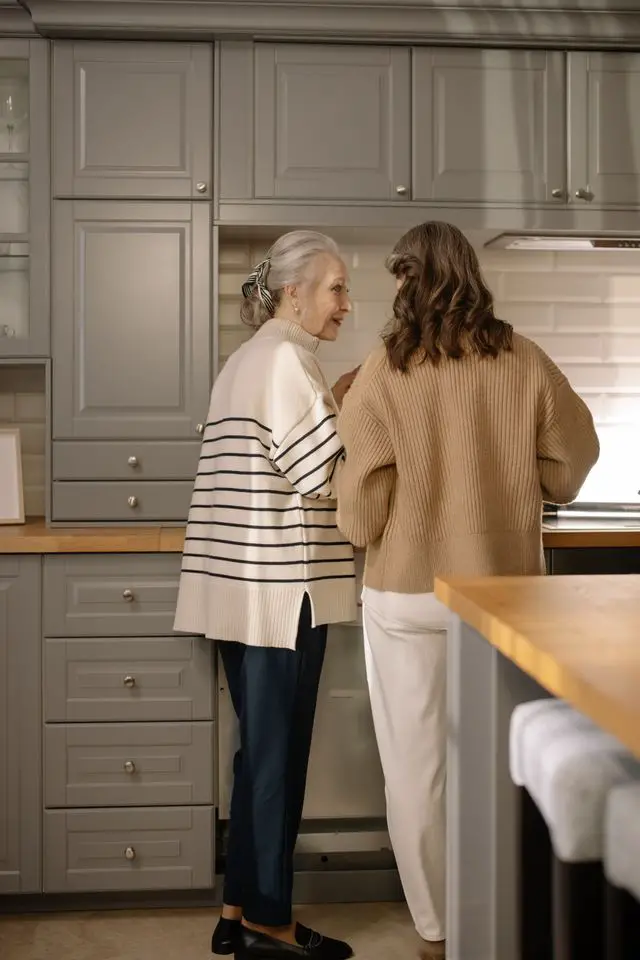
She said it without even looking at me.
“Your husband’s new girlfriend is arriving. She’s rich. Don’t say anything.”
That was it. No softening. No apology for what the words meant or what they implied or the casual brutality of delivering them the way you’d mention rain in the forecast.
My mother-in-law, Diane Hartwell, sixty-one years old, dressed in a cream blouse she ironed herself every Sunday morning, stood at the kitchen window of the house I had spent four years helping to renovate and gave me my instructions the way she always had. With the quiet authority of a woman who had decided, somewhere very early in my marriage to her son, that I was temporary.
I was thirty-nine years old. I was standing in the hallway outside the kitchen holding a pan of sweet potato casserole I had made from scratch that morning, because I always brought something homemade, and Diane always accepted it without comment and placed it at the far end of the buffet where it would not be noticed.
My name is Caroline Voss. I had been married to Marcus Hartwell for eleven years.
And in the thirty-seven seconds that followed what Diane said to me, I did not cry. I did not drop the casserole. I did not ask her to repeat herself or explain what she meant.
I understood exactly what she meant.
I walked into that kitchen, set the dish on the counter with both hands, and smiled.
“Of course,” I said. “I understand.”
And I did understand. I understood far more than she had any idea, because I had been understanding things for nine months by that point. Collecting them. Filing them. Storing them in a folder on a personal laptop my husband had never touched and did not know the password to.
I had been building a case the way you build a wall. One brick at a time.
And as I stood in that kitchen on that November afternoon, while Diane relocated my casserole to a spot near the trash bags, I felt something settle inside me.
Not rage. Not grief. Just a door clicking shut.
The kind of shut that doesn’t open again.
She was already there when the rest of the family arrived. That was strategic, and I understand it now. Diane had invited her early, given her time to settle in, time to feel at home in a space where I had cooked and cleaned and hosted and smiled for over a decade.
Her name was Priscilla Adair.
I’ll tell you more about her shortly. But first I want you to understand who I was, because the story of what happened in that house, and then in the months that followed, doesn’t make sense unless you understand what had already been taken from me long before that afternoon.
My mother used to say I was the kind of girl who loved with her whole chest. She meant it as a compliment. She meant that when I committed to something, I gave it everything I had.
I was like that with school. Graduated summa cum laude from the University of Arizona with a degree in business administration, spent two years at a consulting firm in Phoenix, then got recruited to a midsize commercial real estate firm where I became, by thirty-one, one of the youngest senior acquisitions managers they had ever promoted.
I was like that with my friendships. The kind of friend who remembers your sister’s birthday and drives forty minutes to sit on your couch when something goes wrong.
And I was like that with Marcus.
I met him at a fundraising dinner in the spring, ten years before that November. He was thirty-four, broad-shouldered, wearing a navy suit that fit the way expensive suits do, with that easy confidence that reads as kindness until you learn the difference. He was a commercial developer building mid-market mixed-use properties around the Phoenix metro. He called me two days after we met, which in my experience with men at that time was unusual enough to be notable.
He said he’d been thinking about something I’d said at the dinner. Something about negotiation strategy. Something professional. He wanted to hear more about it.
I thought that was the most attractive thing anyone had ever said to me.
We were engaged fourteen months later and married in a garden in Sedona with eighty guests and a ceremony I planned almost entirely by myself, because his mother had opinions about flowers that differed from mine in ways that never quite got resolved.
That should have been a signal.
But I was in love, and love at thirty-one has a particular kind of confidence to it. The kind that believes it can negotiate most problems.
The first years were good. Not perfect. Marcus worked constantly, and there were weekends that dissolved into conference calls, and he had a habit of making financial decisions about shared things without quite consulting me first.
But I told myself that was marriage. That was partnership. That two driven people had to find their rhythm.
We bought a house in North Scottsdale. Four thousand square feet, warm tile floors, a pool out back I learned to love in the summers. I had the kitchen renovated. I planted a garden along the south fence. I turned that house into something that felt like a home, and I was proud of it in the specific way you are proud of something you built with your own hands.
Diane was present from the beginning in the way a third party is present in some marriages. Not constantly. But consistently enough that you feel the weight of her.
She lived twenty minutes away. She had opinions about how Marcus spent his weekends, how he ate, whether we were attending the right church, whether I was, as she once phrased it, keeping the house in a way a man like Marcus deserved.
She never said she disliked me directly. That wasn’t her style.
Her style was the pause that ran slightly too long before she answered a question I’d asked. The way she addressed Christmas cards to Marcus Hartwell and family rather than to both our names. The way she once told her son, in my presence, that his father had always said a man should choose a wife who improves his life trajectory, and then looked at me for half a second too long before changing the subject.
Marcus laughed it off. “She doesn’t mean anything by it. That’s just how she is.”
And I, loving with my whole chest, believed him and kept showing up to family dinners with homemade food and genuine effort, because I wanted to be the kind of woman who could build something good even where the soil was difficult.
I see now what that cost me. Not just the energy, though it cost enormous energy.
It cost me perspective. I was so focused on performing grace that I stopped paying close attention to what was actually happening in the places where I wasn’t looking.
The first thing I noticed, the first thing I allowed myself to consciously register, was the phone.
Marcus had always kept his phone near him, but sometime around three years ago he began keeping it face down at all times. Not occasionally. Always. Screen against the table, or the nightstand, or his thigh, like a secret he was physically covering.
I asked about it once, casually, sometime during what I now know was the second year of the affair. He said he’d been getting spam calls and it was easier to just ignore them.
I accepted that. I told myself I was not the kind of woman who went through her husband’s phone. I was trusting. I was evolved.
I was an idiot.
He started working late twice a week with a consistency that was just irregular enough to seem organic. Tuesdays, sometimes Thursdays. He was building out a new mixed-use development in Tempe. The permits were complicated. The contractor had issues. There was always a reason, and the reason always came with enough specific detail to be plausible.
And I would make dinner and save his portion. Sometimes he’d be home by nine, sometimes closer to eleven. I learned to read his mood the moment he came through the door, so I would know whether he wanted to talk or just wanted to be in the same room with me in silence.
What I did not know then was that Diane knew.
She had known from almost the beginning.
Because Priscilla Adair was not a woman Marcus had stumbled into. She was a woman Diane had introduced him to at a property investors’ luncheon eighteen months into the affair.
A luncheon I had not been invited to because, as Diane explained afterward, it was really more of a professional event and she hadn’t thought I’d be interested.
I was a senior acquisitions manager in commercial real estate.
The idea that I would not be interested in a property investors’ luncheon is so plainly absurd that I have to believe she knew I’d see through it. She simply gambled that I wouldn’t push back.
She was right.
What I eventually pieced together from documents and messages and one long phone call I’ll get to shortly is that Diane hadn’t introduced them hoping something would happen. She introduced them because something was already happening, and she wanted to give the relationship a sanitized origin story her son could tell without having to account for how they actually met.
They actually met at a hotel bar in Tempe fourteen months earlier.
The receipts, literal receipts, hotel bills, dinner tabs at restaurants I had never heard of, would eventually end up in a folder on my laptop.
Priscilla Adair was forty-four years old, five years my senior, with the particular poise that comes from having a great deal of money for a long time. She had built a boutique hospitality company in her thirties: three upscale hotels in the Sedona and Verde Valley corridor, sold at fifty percent above projected value when the market peaked.
She was, by any reasonable measure, a success.
She wore her dark hair in a low chignon and dressed the way wealthy women in Arizona dress when they’re trying to suggest they aren’t trying too hard. Expensive things in neutral colors that cost more than some people’s rent. Not physically striking in the conventional sense, but she had the kind of presence that fills a room, the kind built out of years of being the person at the table with the most resources.
She walked through Diane’s front door at 4:15 that afternoon and scanned the room with practiced efficiency.
She saw me almost immediately, and something happened on her face. Not guilt. Not discomfort. Calculation. A rapid assessment.
She crossed the room toward the kitchen, and I watched her come, and my heart stayed perfectly steady, which surprised me, because there had been a time not long before when the sight of this woman would have destroyed me.
She held out her hand and introduced herself. Her grip was firm.
And then she looked at me with an expression that shifted from polite social interest into something much more specific.
“I’m sorry,” she said, with complete sincerity, not as a provocation at all. “This is going to sound like a very odd question. But didn’t you buy my company?”
The room was loud with family conversation. There were children running somewhere behind me. Diane was at the buffet table with her back turned, arranging things.
And my husband’s girlfriend was looking at me with an expression I can only describe as genuine puzzlement.
“I did,” I said. “About eight months ago. The Sedona properties.”
Because I had.
Let me back up nine months, to when I first knew with certainty what was happening. That’s where the real story starts. Not the story of the betrayal. The story of what I decided to do about it.
It was a Tuesday night in late February. Marcus was allegedly at his office in Tempe. I was at home going through financial documents for a development project I was consulting on independently, a side project I’d maintained throughout the marriage, partly because I loved the work and partly because some deep instinct in me had always kept a portion of my professional identity entirely separate from my husband.
I was using our joint account login to transfer funds for a vendor payment. And when the page loaded, I saw a transaction I did not recognize.
A wire transfer of eighteen thousand dollars to an entity I had never heard of. A limited liability company called AV Holdings.
Initiated three days earlier.
I sat with that for a moment. My hands were completely still.
I did not close the browser. I took a screenshot.
Then I opened a new tab and searched for AV Holdings LLC. The results were sparse. A recently formed entity registered in Nevada. But when I dug one layer deeper, I found a name listed as registered agent.
Not Marcus’s name. A woman’s name. An initial and a last name.
The initial was P. The last name was Adair.
I closed my laptop and went and stood in the kitchen for a while. The refrigerator hummed. The pool filter ran outside. It was 9:14 in the evening, and my husband was allegedly at his office, and one hundred and eighteen thousand dollars of our money had gone somewhere with someone else’s name attached to it.
I did not confront him that night. Or the next morning. Or the day after.
What I did was make a list.
I have always been good at lists. I have always been good at taking the emotion out of a problem and looking at it structurally, the way you’d look at a property acquisition. What are the known variables? What are the unknowns? What’s the risk exposure? What’s the exit strategy?
I had never, until that night, applied that skill to my own marriage.
I applied it now.
Over the following two weeks I reviewed every transaction in our joint account going back eighteen months. I built a spreadsheet. I assigned categories. Known. Plausible. Unexplained.
The unexplained column grew.
Nine wire transfers totaling one hundred and twelve thousand dollars to AV Holdings across fourteen months. Hotel charges I’d never been told about. Restaurant bills from Tempe and Chandler. And one, memorably, from a hotel in San Diego during a weekend Marcus had told me he was at a development conference.
I had suggested joining him on that trip. He told me the hotel was fully booked and the schedule was brutal and I’d be bored.
I believed him and stayed home and planted new herbs along the garden wall while he spent four days in San Diego with Priscilla Adair.
I kept the spreadsheet on a personal drive not connected to any device Marcus used. I printed nothing. I said nothing. I smiled at dinner and asked about his day and refilled his coffee on weekend mornings and waited.
Six weeks after I found that first transfer, I called a divorce attorney.
Her name was Sandra Quan. She’d been recommended by a friend of a colleague, someone with no connection to my social circle in Scottsdale, someone Diane would not know, someone whose name would never reach Marcus.
Sandra was fifty-three, with twenty-two years of family law experience and a particular expertise in complex asset discovery. Short gray-streaked hair and the kind of unflappable delivery that made you feel immediately that you were in competent hands.
We met on a Tuesday afternoon, the same hours Marcus was allegedly working in Tempe. I brought a printed copy of my spreadsheet.
She read it for a long time. Then she looked up at me.
“You’ve already done a significant portion of my job.”
She was not being warm about it. She was observing a fact.
“What you have here is a pattern,” she said. “What we need now is documentation that can be presented formally, and we need to understand the full financial picture. Because in my experience, when you find this”—she gestured at the pages—”you’re usually only seeing part of it.”
She recommended a forensic accountant. I agreed immediately.
His name was David Park. Forty-seven, eight years as a forensic investigator for the IRS before moving into private practice. He and Sandra had worked together before. He was thorough and quiet and systematic in the way that makes you understand why someone might find him terrifying if they had something to hide.
I want you to understand that I did all of this while maintaining my life. While making casseroles and attending family functions and sitting across from Marcus at dinner and asking about the Tempe project.
I’m not telling you that to congratulate myself. I’m telling you so you understand what containment costs. What it takes to keep a performance running while your hands stay steady and your mind is somewhere else entirely, filing things, noting things, waiting for the right moment.
There was a particular kind of cold focus I developed during those months that I have never felt before or since.
Not rage. I’d moved past rage in the first two weeks.
This was colder and far more useful than rage. This was intention.
David Park spent six weeks working through the financial documentation Sandra’s office subpoenaed.
Some of what he found I had suspected. Some of it I had not.
The hundred and twelve thousand to AV Holdings was confirmed and documented.
But there was more. Marcus had opened a business line of credit in the name of one of his development entities and had been drawing on it to fund what David’s report described as personal expenditures. Dinners. Hotels. Gifts. Two significant cash withdrawals that coincided precisely with dates Priscilla Adair had posted travel photos on a private Instagram account.
The line of credit had been drawn down by two hundred and forty thousand dollars.
There was also a property. A condominium in Chandler purchased fourteen months earlier, titled solely in Marcus’s name, funded through a private loan from his business partner and structured specifically to avoid appearing in our joint financial picture.
The condo was currently occupied.
David did not need to tell me by whom.
I asked Sandra how this affected our position.
She was quiet for a moment. The good kind of quiet. The kind where someone is organizing a great deal of information before speaking.
“Significantly and favorably,” she said. “Marital funds used to fund an affair. Marital assets concealed. Fraudulent financial structuring. All of it discoverable, and all of it affects what the court considers equitable distribution. Arizona is a community property state. Everything he tried to hide is still marital property. We can claim it.”
If you want to know what eleven years of trying to build something looks like when it finally works in your favor, that was the moment.
I sat in Sandra’s office and thought about the herb garden, and the pool filter humming at nine at night, and a hundred and twelve thousand dollars leaving our account while I was home making dinner.
And I felt, for the first time in nine months, something that wasn’t cold calculation.
It was closer to fire.
But even then I didn’t let it become impulsive. I still had more to do.
The next piece involved Diane.
Here’s what I knew. She had been present at the luncheon where Marcus claimed to have met Priscilla officially. He’d mentioned it once in passing.
“Your mother introduced you?” I’d asked.
“Yes. She knows people in that space.”
I’d found that slightly odd at the time and hadn’t investigated it.
But now, with David’s timeline laid out in front of me, the introduction became revealing. It had happened eight months into the affair. Which meant Diane hadn’t introduced two strangers. She had introduced two people who were already involved.
She had laundered the relationship’s origin story.
I thought about that a great deal. About sitting across from her at family dinners while she knew. About the casseroles she moved to the end of the buffet while she knew. About the time she told me, in that careful modulated voice, that Marcus worked very hard and needed a home life that didn’t create additional stress. A comment I had understood at the time as a mild criticism of a disagreement we’d had about renovation costs.
Which I now understood as something else entirely.
She had been managing me. For years.
Keeping me compliant. Keeping me doubting myself. Keeping me from seeing clearly while her son used our joint finances to fund a second life.
She had looked me in the face at Thanksgiving and at Easter and at Marcus’s forty-third birthday dinner, and she had known.
And she had said nothing at all, except, in her subtle and devastating way, to make me feel like the problem.
I asked Sandra whether Diane could be named in any civil action. Sandra said it was worth examining whether there was evidence of specific assistance, not merely passive knowledge.
David’s team went back through the communications and found two things.
The first was a text exchange between Marcus and his mother, pulled from a backup discovered during formal discovery, in which Marcus told her that Priscilla was expecting the Chandler condo to be put in her name eventually and he was still working out how to handle that.
Diane’s reply: Be careful and make sure the paperwork isn’t something Caroline’s people could find.
Her son was concealing marital assets. Her response was to advise him on concealment strategy.
The second was a wire transfer. Twelve thousand dollars from Diane’s personal account to Marcus, described in her banking records only as loan. The timing coincided exactly with a month in which Marcus had overextended his available cash on the Chandler purchase.
Her own money. Into the funding stream. Into the purchase of a property bought with marital funds.
I sat with that information for a very long time.
I thought about all the times she had looked at me and seen someone she was actively working against, and I had looked at her and seen someone difficult to love but worth the effort.
I had spent eleven years trying to be the kind of daughter-in-law who might eventually earn her genuine warmth.
I understand now that warmth was never available. I was not a person to her. I was an inconvenience with a legal claim on her son’s assets.
Now I need to tell you about the acquisition.
Eight months before that November dinner, I’d been working through a commercial real estate project independently. A boutique hospitality portfolio I was evaluating for a small investor group I occasionally consulted for.
Three upscale hotels in the Sedona and Verde Valley corridor. Owned by a hospitality company being offered for sale by its founder. Asking price of $2.8 million.
My investor group was interested. I did the due diligence. I drove up to Sedona. I walked the properties. I evaluated the financials.
The numbers were good. Strong occupancy, premium positioning, loyal clientele, minimal deferred maintenance. The owner was motivated to sell.
The acquisition made sense.
I did not know, when I made that trip, that the founder of that company was Priscilla Adair.
I want to be very clear about that. I did not know.
Her name appeared in the company’s legal documents, but she had structured the sale to be handled through a brokerage intermediary, and I dealt only with the broker. And at that stage I had not yet connected AV Holdings to anyone, and the name Adair in a real estate filing did not set off any alarm at all.
The acquisition closed seven and a half months before Diane told me to be quiet and let Priscilla walk through her front door.
I had bought her company. My investor group had bought her company, and I was listed as the managing consultant on the transaction.
She had received $2.8 million through an intermediary, in a deal I led.
And she had known.
I confirmed that eventually. The broker had disclosed my name and firm affiliation during the due diligence period. Priscilla had reviewed that disclosure. She knew she was selling to a firm where the lead consultant was named Caroline Voss.
Whether she knew Caroline Voss was Marcus’s wife, I was less certain at first.
But the look on her face in Diane’s living room was not the look of someone encountering a stranger.
It was the look of someone whose arithmetic had just caught up with her.
“Didn’t you buy my company?”
“I did. About eight months ago. The Sedona properties.”
And then a pause of maybe four seconds, during which the air in that room changed. I could feel the temperature shift. I watched her put it together, watched the realization move across her face like weather coming across a valley.
And then I said, very calmly and very quietly, “We should find a time to sit down. I think we may have some things to discuss.”
And I smiled, and picked up a glass of sparkling water from the tray on the table behind me, and turned to say hello to Marcus’s cousin, who was standing nearby looking at his phone.
I left her standing there with whatever was happening behind her eyes.
I did not look back.
Marcus found me twenty minutes later near the kitchen doorway. He had a look I recognized. The slightly too controlled expression of a man processing information very fast and trying not to show it.
He touched my elbow. “What did you say to Priscilla?”
“I said hello. We discovered we’d been in a business transaction together. Small world.”
“What do you mean, a transaction?”
“I led the acquisition of her hospitality portfolio eight months ago. Is something wrong?”
He looked at me for a long moment. There was something in his eyes. Not guilt, exactly. More like the specific anxiety of a man who can feel the edges of his control beginning to fray without yet being able to locate where the fraying started.
“No. No, it’s fine. I just didn’t know you two had crossed paths professionally.”
“There are a lot of things we haven’t talked about lately.”
And I smiled and walked back into the party, and I left him standing in a doorway the way I had been left standing in doorways for years, looking at a space someone had just walked out of.
That night, when we got home, Marcus tried to have a conversation with me.
He poured himself a whiskey and stood in our kitchen. Our kitchen, with the renovation I had designed and managed.
He started with, “I think we need to talk.”
Which is the sentence people say when they still believe they control the information. When they think they get to decide what gets disclosed and when.
“Okay,” I said.
“I’ve been aware for a while that things between us have not been—” He paused, searching for a frame that favored him. “That things have not been where they should be.”
I said nothing. I waited.
“I’ve been spending time with someone. I should have told you sooner. I didn’t handle it well, and I know that.”
He was confessing to an edited version. The version small enough to control. The version where it was just an emotional thing that got out of hand.
The version that kept the financial picture invisible. And his mother invisible. And the Chandler condo invisible. And the hundred and twelve thousand dollars invisible.
He was betting that I knew enough to want a conversation but not enough to dismantle the story.
I let him finish. I waited a full beat after he stopped.
Then I said: “I know about Priscilla. I know you’ve been seeing her for over two years. I know about the Chandler condo. I know about AV Holdings and the hundred and twelve thousand in marital funds you transferred to it. I know about the business line of credit you drew down to fund your personal expenses with her. I know about San Diego. I know about your mother’s twelve-thousand-dollar wire transfer. And I know she introduced you officially to a woman you’d already been involved with for eight months, because you needed a story that didn’t start at a hotel bar in Tempe.”
I watched his face go completely still.
That’s the thing about a person who has been managing you. When you stop being manageable, they don’t react immediately. They freeze. The machinery of the performance stops, because it has no script for this moment.
“My attorney’s name is Sandra Quan,” I said. “Her office will contact yours this week. If you have questions about what I’ve documented, direct them to her.”
“Caroline—”
“I’m going to sleep in the guest room tonight. I’d like you gone by next Friday. If you need more time to arrange housing, your attorney can work out a timeline with Sandra.”
And I walked out of the kitchen.
My hands were steady. The pool filter was running outside. The clock on the microwave said 11:47.
I had been married eleven years, and in the moment I walked out of that kitchen I was walking out of something else entirely. The performance. The management. The careful maintenance of a marriage that had been a fiction for at least two of the years I’d spent inside it.
I did not cry until I was in the guest room with the door closed. And even then it wasn’t the crying that comes from grief. It was the kind that comes from releasing pressure. The kind that happens when something held very tight is finally allowed to let go.
I cried for about twelve minutes. Then I washed my face, opened my laptop, and emailed Sandra to proceed.
The following months were not clean or simple. Nothing about the end of a marriage is clean, even when you’re fully prepared, even when you know it’s right.
Marcus moved into a furnished rental in Tempe. Not the Chandler condo, which his attorney correctly advised him not to occupy given the legal circumstances of its purchase. He hired a man named Peter Galloway who had a reputation for aggression in high-net-worth proceedings.
Galloway tried several things.
He argued that the AV Holdings transfers were legitimate business investments. David Park’s documentation made that unviable within two weeks.
He argued the Chandler condo had been purchased with business funds outside the marital estate. Sandra’s discovery filings demonstrated the funding structure connecting it directly to marital assets.
He argued Marcus’s text to his mother about the paperwork had been taken out of context. The full thread was submitted.
At one point he threatened a counterclaim alleging I had been mismanaging my own consulting income and concealing assets on my side. This was entirely untrue and completely unsubstantiated, and Sandra dispatched it with what I can only describe as professional pleasure.
Marcus called me three times in the first month. I didn’t answer. He sent two emails that were part plea, part threat, part the emotional reframing people attempt when they’ve run out of factual ground to stand on. Sandra’s office acknowledged receipt and reminded his counsel that communication should go through attorneys.
Then he tried Diane as an intermediary.
She left a voicemail. Formal, strained, the voice of a woman who had been told by her son to try. She hoped we could find a way to talk. She had always cared about my wellbeing. She hoped I’d be open to a conversation.
I did not return the call.
Whatever caring she claimed for my wellbeing had apparently coexisted very comfortably with advising her son on how to conceal assets from me, and I was not interested in the version of herself she would offer now that consequences were attached.
David Park’s final report ran to sixty-one pages.
I have read it several times. It documents, in organized and precise detail, all of the following.
Nine wire transfers totaling $112,000 to AV Holdings. A business line of credit drawn down by $240,000 for personal expenditures. The Chandler condominium purchased using a combination of a private loan and funds drawn from a jointly held development company in which I held an indirect interest. $23,800 in travel and entertainment charged to business accounts for non-business purposes.
And Diane Hartwell’s twelve thousand dollars, which David’s report described as a personal contribution to the concealment funding stream.
Total documented marital assets diverted, concealed, or misused: just over $512,000.
Arizona’s community property law is specific about this. Marital waste, the dissipation of marital assets on an affair, is a factor courts weigh in property division.
Sandra filed a comprehensive complaint incorporating David’s findings in full. Galloway’s office went quiet for about a week afterward, which Sandra told me was the sound of an attorney realizing the actual shape of what he was dealing with.
The discovery even I hadn’t anticipated came in week six.
David found a life insurance policy. A whole life policy with cash value that Marcus had opened eight years into our marriage, titled solely in his name, funded through premium payments from a corporate account.
Cash value: $190,000.
It had not been disclosed on his initial financial affidavit.
The non-disclosure of a marital asset on an affidavit filed with a court is not a minor issue. Sandra filed a motion. Galloway was left attempting to explain how his client had forgotten a hundred and ninety thousand dollar insurance policy.
The court was not receptive to the explanation.
During this period, something happened I hadn’t expected. Priscilla Adair reached out to me directly.
Not through an attorney. A text message to my personal cell, which I had never given her and which she had obtained, as best I can determine, through a contact from the business transaction.
I know this isn’t appropriate and I understand if you don’t respond, but there are things about this situation I don’t think you know and that I think you deserve to know. I would like to speak with you if you’re open to it.
I showed it to Sandra immediately. Her advice was careful. Anything Priscilla said could be useful, but I needed to remember that she had her own interests and her own exposure, and that she might be reaching out because she needed something from me rather than because she owed me something.
I understood. I agreed to a phone call, with Sandra aware it was happening.
It lasted forty-seven minutes.
Here’s what I learned, stripped of the emotional content, which was considerable.
Priscilla had known before the Sedona acquisition closed that the consulting lead on the transaction was named Caroline Voss. She had not known until the deal was further along that Caroline Voss was Marcus’s wife. When she found out, she said she felt ill. She said she considered withdrawing from the sale but that it had progressed to a stage where withdrawal would have meant absorbing significant transaction costs.
And she had, and here her voice became complicated in a way I decided to take at face value, told herself that the deal was the deal. That it was a professional transaction. That she was not obligated to disclose to me what she knew about my husband.
“That is exactly right,” I said. “You weren’t obligated. And you made a choice.”
She was quiet for a moment.
She told me that when the relationship with Marcus began, she hadn’t known he was married. She said they’d met at a bar event in Tempe and he’d told her he was separated, that the divorce was in progress, that it was amicable.
This is not an unusual story. I don’t know how much of it to believe.
What I do know, and what I told her, is that by the time of Diane’s luncheon, eight months into their relationship, she had been given enough information by Marcus’s own mother to understand that the separation story was not accurate.
And she continued anyway.
“I know,” she said. “That’s what I have to live with.”
“The other thing you have to live with,” I said, “is that my documentation of this situation includes your role in the financial arrangement. AV Holdings. The condo. The business credit. Those things are in court filings that are now part of the public record.”
She already knew. Her own attorney had told her.
“I’m not going to do anything further with that information,” I said. “But I’m also not going to protect you from the consequences of what’s already out there.”
She said she understood. The call ended.
I sat in my kitchen. My kitchen, in my house, which I was in the process of negotiating to retain under the settlement.
And I felt something I hadn’t expected, which was a kind of exhausted clarity.
Not forgiveness. Do not misread this as forgiveness.
I hold no forgiveness for Priscilla Adair. She made informed choices with information she had access to, and she made them in ways that harmed me. That she was also, in certain respects, lied to does not erase that. It qualifies it slightly. It contextualizes it. It does not erase it.
What it changed, marginally and specifically, was that I decided not to pursue a civil claim against her directly.
Sandra and I had discussed it. Grounds existed.
I decided against it not out of sympathy but out of exactly the same calculation I had applied to everything else. The additional legal cost, time, and exposure did not serve my interests as well as focusing entirely on the divorce settlement and recovering the maximum possible from Marcus.
That decision was mine. I made it with clear eyes. I want that understood.
The divorce was finalized seven months after I walked out of that kitchen.
The settlement, negotiated with the full weight of David Park’s sixty-one pages and Sandra Quan’s twenty-two years of experience applied to every clause, included the following.
I retained the marital home, with Marcus responsible for buying out my equity at fair market value, which came to $460,000. I received sixty percent of the joint investment portfolio, a deviation from the standard split that the court found justified given the documented marital waste. The Chandler condo, determined to have been purchased with marital funds, was ordered sold and the proceeds divided under the same adjusted distribution. The life insurance cash value was counted as marital property and split. The business line of credit debt created for personal expenses was assigned to Marcus in full.
In total, the settlement resulted in my receiving approximately $1.1 million in cash, property equity, and asset distributions, against what would have been a considerably smaller standard split had the concealed assets never been discovered.
Marcus walked away with his company restructured, diminished by legal costs and the debt assignment, but still operational.
He also walked away without the condo. Without Priscilla, who had ended the relationship during the proceedings. And without his reputation in the Scottsdale development community, where the details of David Park’s report became known in the specific way things become known in professional circles. Not through announcements. Through the quiet spread of people who know people and who read court filings.
He walked away, from what I understand through mutual acquaintances I still occasionally see, into a smaller and quieter version of his life. Renting an apartment in Chandler. His company handling smaller projects. Several former business contacts maintaining a polite distance.
Diane has her own smaller life now.
That twelve thousand dollar wire transfer. Diane Hartwell, who never once brought a homemade dish to anything, who ironed her blouses on Sunday mornings and placed my casseroles at the far end of the buffet.
That transfer is referenced in the court filings.
I did not pursue a separate civil action against her, for the same calculated reason I did not pursue one against Priscilla. It was not the most efficient use of my resources.
But the fact of her involvement is now part of a public record. Her standing in the church community she values so highly, in the neighborhood association she leads, in the social fabric she has maintained for thirty years, now coexists with a court document describing her as having contributed personal funds to a concealment effort in her son’s divorce.
I understand her relationship with Marcus has shifted too, in the particular way relationships between a controlling parent and a child shift when the child loses and the parent has to live with the cost of what they enabled.
They aren’t estranged. But they aren’t what they were.
Consequences have a texture. People feel that texture differently at different distances.
As for Priscilla, the publicly available details of the case, in a community where she had business relationships and a professional reputation, were not containable. The Sedona hospitality world is not large. An investor she was working with on a new venture withdrew. A partnership she’d been negotiating in the Verde Valley stalled permanently.
I did not cause those things directly. I simply did not stop them.
I want to tell you about the morning the settlement was signed.
It was a Thursday in early July. Sandra’s office is on the third floor of a building in downtown Phoenix with windows facing east. I arrived at 8:30. The sunlight came in at a low angle, and the air conditioning was cold in the specific clean way of a professional space.
Marcus was represented by Galloway. Neither of them was in the room, because we’d agreed on a staggered process.
I sat at the table and read every page.
Not because Sandra hadn’t already read every page and explained every word, but because I had made a decision eleven months earlier that I would understand every document in this process. That nothing would be filed or signed without my complete comprehension of what it meant.
When I signed the final page my hand was steady. I wrote my name. Caroline Voss. Not Caroline Hartwell. I had already begun the process of returning to my own name.
Normal handwriting. Not rushed. Not shaking. In the space where it was supposed to go.
Sandra put her hand briefly on my arm, which is the closest she comes to a gesture of warmth, and I looked out those east-facing windows at the Phoenix skyline in the morning light.
And something I had been carrying for a very long time set itself down.
After signing, I drove straight to a café in Arcadia, a neighborhood I’d always liked but rarely visited during the marriage, because Marcus found it too trendy, which meant too expensive, which meant it generated conflict if I suggested it.
I sat by the window with a cappuccino and a plate of ricotta toast with honey and watched people go by on the sidewalk.
A woman came toward me with a dog, clearly late for something, coffee in one hand and phone in the other, the dog pulling hard sideways toward a bush. She looked up, and we made eye contact for half a second, and she laughed at herself. At the comedy of the morning. At whatever.
And I laughed too. Actually laughed. The real kind, the kind that arrives without calculation or strategy.
It surprised me so much that I sat with it for a moment after it was gone, just noticing that it had happened.
That is what recovery feels like, in my experience. Not the dramatic moments. Not the signed settlement page. Not the confrontation in the kitchen. Not Priscilla asking whether I’d bought her company.
The recovery is in the laugh you weren’t expecting. In the ricotta toast you ordered for yourself. In the café you chose because it was where you wanted to go and not where someone else was comfortable. In morning light through east-facing windows that belongs to nobody but the people who got up early enough to see it.
I’m forty now.
I live in a two-bedroom apartment in Arcadia. Fourteen hundred square feet, a small balcony where I’ve managed a container herb garden, morning light in the kitchen that I did not share with anyone for the first eight months I lived here and now share occasionally with someone I’m not going to describe in detail, because some things belong only to themselves.
The apartment smells like coffee and basil. And sometimes, when the balcony doors are open early, like that particular warm dry smell of a Phoenix day that hasn’t gotten hot yet.
I go to work. I go to the gym. I have dinner with Priya, my colleague and closest friend, who was one of two people who knew what was happening during those eleven months. Who sat across from me in a restaurant in Biltmore six weeks after I found the AV Holdings transfer and listened without saying a word until I was finished, and then said, “Okay. So what do we do first?”
Priya, who brought me dinner the week I moved out of the Scottsdale house. Who drove me to my first appointment with Sandra. Who never once said I told you so, even though she had, in fact, three years into my marriage, quietly mentioned that Diane made her uneasy in a way she couldn’t fully articulate, and I had dismissed it.
Priya knew things before I was ready to know them, and she waited until I was ready. And then she was there.
She’s forty-four. She makes extraordinary pasta from scratch. She is one of the most important people in my life.
I also have a therapist now, Dr. Angela Torres, who has an office in central Phoenix and a gift for sitting in silence until the right question surfaces on its own. I started seeing her two months before the confrontation with Marcus, and I still see her every other week.
She’s the one who helped me understand that what I did during those eleven months, the containment, the documentation, the performance of normalcy, was not cold-bloodedness.
“There’s a difference between detachment and strategy,” she said once. “I think you had both. And neither of them was wrong.”
I’ve been thinking about that ever since.
What do I know at forty that I didn’t know at thirty?
Quite a lot.
I know that loving with your whole chest is not the problem. The problem is not knowing when to stop. The problem is confusing a commitment to love with an obligation to protect someone who stopped deserving your protection years before you noticed.
I spent a significant portion of my thirties managing someone else’s image, someone else’s comfort, someone else’s version of reality. I was very good at it. I’m not proud of that. Not because it was weakness, but because the skill was wasted on the wrong recipient.
I know that documentation is not revenge.
I want to say that clearly, because there’s a version of this story that could be told as the story of a cold and calculating and vengeful woman, and that is not what happened.
What happened is that I found evidence of something I needed to understand. I organized that evidence the way I would organize any professional problem. I presented it to qualified people who could tell me what it meant and what my options were. And then I chose my options methodically and executed them.
That isn’t cold. That’s intelligent.
That’s what you do when you understand that impulsive confrontation protects the person you’re confronting. It hands them the chance to perform remorse, to reset the narrative, to shift the focus from what they did onto how you reacted.
I was not going to give Marcus Hartwell that gift.
I know that a house is not a home when the person you share it with is building a different home somewhere else. I know that sounds obvious. It took me eleven years and a sixty-one page forensic accounting report to fully understand it.
I know that women who keep quiet about what was done to them are not being gracious. They are protecting the person who hurt them.
I am not interested in protecting Marcus Hartwell. I am not interested in protecting Diane Hartwell. I am not interested in constructing a polite silence around what happened in my marriage in order to make anyone else more comfortable.
Comfort was the entire currency of that marriage. I spent all of mine and received very little in return. And I am done spending it.
I know that the people who stand by while something is done to you, who know and say nothing, who look you in the face and smile while holding the information, are also responsible. Not to the same degree as the person who acted. But responsible.
Diane Hartwell chose to protect her son at the expense of a person she had allowed to love her family for eleven years. She chose that clearly and repeatedly, and at financial cost to herself.
She earned what came back to her.
I think about the opening of this sometimes. The moment she said it without even turning to look at me.
Your husband’s new girlfriend is arriving. She’s rich. Don’t say anything.
I think about what she expected to happen next.
I think she expected me to do what I had always done. Absorb it. Compose myself. Perform grace. Move through that afternoon the way I had moved through eleven years of family dinners. Present. Accommodating. And ultimately invisible in my own discomfort.
What she did not know was that I had already done everything.
Every transfer documented. Every receipt photographed. Every bank statement in a folder. Sandra’s retainer paid. David Park four weeks into the financial review.
The only thing left was to watch, and wait, and let the day unfold into the shape it had always been going to take.
When Priscilla Adair asked whether I’d bought her company and I said yes, I was not performing. I was not executing a plan in that moment.
I was simply telling the truth and letting the truth be sufficient.
That has been, in retrospect, the clearest gift of the entire experience. Understanding that the truth, once you’ve given it enough time to organize itself properly, does not need your help.
It needs only your willingness to stop protecting the lies that were trying to outlast it.
I drove home from Diane’s house that evening after the family dinner ended. Marcus sat beside me in the passenger seat and said almost nothing for the whole drive.
The freeway was clear. It was a cool night. I had the window cracked and I could smell the desert, that dry clean smell Phoenix takes on after dark.
I thought about Priya. I thought about Sandra. I thought about David Park’s spreadsheet and what it had already become and what those pages were going to become.
I thought about east-facing windows in an office downtown and a morning that was, at that point, still many months away.
And I thought about the herb garden along the south fence of the Scottsdale house. The basil I’d planted two springs earlier. The rosemary that had taken over the end of the bed. The thyme that came back every single year whether I tended it or not.
I had worried about leaving that garden. I worried about it the way you worry about small living things that depend on you.
But I took cuttings before I moved.
They’re in containers on my balcony in Arcadia now. The rosemary has gotten enormous. The basil gets morning light for exactly three hours a day, and I have learned to work with that.
Nothing that truly belongs to you can be left behind. You carry it forward in whatever form it can take in the new space.
That’s the thing I would want you to hold onto.
Whatever is being taken from you, whatever is being managed, whatever you’re being kept quiet about, you are not imagining it. That feeling in your chest, the one that sounds like something is wrong, that sounds like you know something you haven’t been allowed to name yet.
That feeling is information. Trust it.
And then don’t react immediately. Document. Find people who can help you understand what you actually have. Give yourself the time to build something that protects you fully instead of partly.
You are not required to protect someone who is not protecting you. You are not required to keep a secret about what was done to you in order to manage somebody else’s comfort. You are not required to absorb it quietly and call that grace.
Grace is choosing how you act.
It is not the same as choosing to say nothing. It is not the same as pretending.
And it is certainly not the same as setting a casserole down at the end of a buffet and smiling and saying of course, I understand when someone tells you to be invisible in a room where you have cooked and cleaned and shown up with love for eleven years.
I understood everything.
And I acted accordingly.

Laura Bennett writes about complicated family dynamics, difficult conversations, and the quiet moments that change everything. Her stories focus on real-life tensions — inheritance disputes, strained marriages, loyalty tests — and the strength people find when they finally speak up. She believes the smallest decisions often carry the biggest consequences.