That morning began like any other in the small Brooklyn apartment Emily and Jason had built together.
The smell of fresh coffee drifted from the kitchen, mixing with the warm scent of the avocado toast Emily was preparing at the counter. That routine had always been her anchor. Simple, quiet, familiar — the kind of morning that made her believe her five-year marriage was steady, loving, and safe. She placed two plates on the table, poured coffee into Jason’s favorite mug, and smiled to herself. She was happy with that simplicity. She thought it would last forever.
Then Jason walked into the dining area with an oddly heavy step.
His face, usually cheerful in the morning, was tense in a way he could not hide. Emily noticed immediately. She set her knife down and looked at her husband with concern.
“Honey, what’s wrong? Why do you look so tense?”
Jason sighed deeply, as if gathering strength to deliver bad news. He sat across from her, but his eyes would not meet hers. His gaze stayed fixed on the steam rising from his coffee.
“Emily, I’m so sorry,” he said in a low voice. “I have some bad news. My sister just called from back home in Charleston. Mom is in very bad shape.”
Emily’s world stopped for a moment. Carol, her mother-in-law, had never been an easy woman to love. She was sharp, proud, and often made subtle comments about Emily’s humble background. But Emily had always respected her. She was still the mother of the man she loved.
“What happened to her, Jay? How is that possible? I just spoke with Jessica two days ago and she said your mom was perfectly fine.”
“She collapsed suddenly last night. Her blood pressure went very high. She’s bedridden. I have to go right away, Emily. I’m her only son. I have to be there.”
Without hesitation, Emily stood from her chair. “Of course. Let’s go, Jay. I’ll get ready right now. We’ll go together. I can help take care of your mother.”
Jason looked up then, and for the first time that morning, he met her eyes.
But his gaze was strange. For one brief second, panic flashed across his face before he covered it with a forced smile.
“No, honey,” he said quickly. Too quickly. “You don’t need to come.”
Emily frowned. “Why not? I’m your wife. I’m her daughter-in-law. It’s normal for me to go help. I can ask for the day off.”
“It’s not that.” He reached across the table and took her hand, squeezing it tightly. “I’m only going for a couple of days, just until Mom is stable. The drive down to Charleston is long and exhausting. I’d feel terrible putting you through that. Besides, the house there is small. A lot of family will be coming over. You wouldn’t be comfortable. I promise I’ll keep you updated every moment.”
The reasons sounded logical. They sounded like concern. But a small voice in Emily’s heart whispered that something was not right. Why was her husband so determined to keep her from going? In a situation like this, wasn’t a wife’s support supposed to matter most?
“But Jay, I—”
He cut her off, his tone suddenly firmer, leaving no room for debate. “You stay here, take care of the apartment, and pray for Mom to get well soon. That will be more than enough. Now please help me pack a bag, okay?”
Emily finally gave in. She pushed the unease down and told herself Jason was only trying to spare her the trouble. With a heavy heart, she went to their bedroom and packed his shirts, his pants, even his vitamins and personal medication, making sure her husband would lack nothing. Every piece of clothing she folded felt like a prayer — a sincere hope that her mother-in-law would recover quickly and Jason would come home soon.
An hour later, he was ready to leave. He hugged her at the door. The hug felt empty and rushed.
“I’m leaving, Emily. Take care. I’ll call you when I get there.”
She nodded, trying to smile through the uneasiness in her chest, and watched his car pull away until it disappeared around the corner. The cool morning air suddenly felt sharp. The apartment that usually felt warm now seemed silent and strangely hollow.
After locking the door, Emily returned to the dining room to clear the dishes. As she picked up the denim jacket Jason had left on the back of a chair, a small piece of paper slipped from the pocket and fluttered to the floor. It was crumpled, as if it had been folded and hidden for days. She picked it up without suspicion, expecting a receipt.
But when she unfolded it, her eyes froze.
It was letterhead paper bearing the logo of a well-known luxury catering company from Jason’s hometown. Below the logo was a detailed order — hundreds of buffet servings, food stations, floral arrangements, champagne service. Emily’s heart began to beat faster. Then she saw the handwriting at the bottom. Jason’s handwriting.
Final 50% payment due on the eve of Jessica’s event.
Emily read the sentence over and over, as if trying to translate a foreign language. Jessica’s event. The eve of Jessica’s event. Didn’t that mean tomorrow? Why was there a luxury catering order for Jason’s sister at the exact moment Carol was supposedly bedridden?
Her logic fought her feelings. Maybe it was an old note. Maybe it was for some small family celebration planned long ago. She tried to find any explanation that could calm her heart.
But she could not ignore the date printed in the corner of the paper. It was for the following day.
What lie were they hiding from her?
The first day without Jason felt endless. The apartment became a lonely cage. Emily kept the note in her dresser drawer, where it sat like a ticking bomb. Every time she glanced at the drawer, her heart raced. She told herself not to think negatively. She tried to trust her husband.
That afternoon, Jason finally called.
“Hi, Jay. How’s your mom?” she asked immediately.
“Hey, honey. I just got here.” His voice sounded tired — but there was something else in it too. Something forced. And the background of the call was strangely quiet. No voices. No family moving around. No sounds of a house with a sick person in it. Just silence.
“How is she? What did the doctor say?”
“Mom is resting. The town doctor saw her. He said she needs rest. No stress. I just finished helping her get comfortable.”
“Why don’t you take her to the hospital, Jay? If her blood pressure is that high, it could be dangerous.”
“She doesn’t want to. You know how Mom is about hospitals. Come on, don’t worry so much. Just pray for her, okay?”
His tone made it clear he wanted the conversation over.
“I want to talk to her, Jay. Just for a moment. I want to hear her voice.”
“You can’t. She’s sleeping deeply after her medication. It’s not good to wake her. I have to go — I’m going to take a shower. I’ll call you later.”
Before Emily could answer, the call disconnected. She stared at her phone, feeling emptier than before. The conversation hadn’t reassured her. It had only fed her suspicions.
A few hours later, she called him back. Declined. A moment later, a text appeared. “Sorry, honey. The reception here is terrible. I’ll get back to you later.”
Bad reception. Since when did his mother’s house have bad reception? They’d installed a new cell tower near that neighborhood a month ago. The lie was too obvious. Too careless.
That night, Emily could not sleep. She felt like a fool being openly deceived. To be sure, she tried calling Jessica. Then several of Jason’s cousins. No one answered. It was as if they had all agreed to shut her out of the truth.
By the next day, her anxiety had turned into obsession. She needed proof. She needed certainty. She opened her laptop and began searching social media — a desperate thing she’d never imagined doing in her own marriage. Jessica’s account: private. Distant relatives: nothing. After nearly an hour, she was about to give up. Maybe she really was overthinking.
Then one name caught her attention. A distant cousin of Jason’s who lived in another city — one who posted constantly. With slightly trembling hands, Emily opened the profile.
Her heart leaped. The most recent post, uploaded thirty minutes earlier, was a photo. Not a photo of a sick person. Not a quiet family gathering. A huge bouquet of white roses and lilies on a satin-covered table — and in the background, the unmistakable decor of a lavish wedding altar.
She held her breath and read the caption.
“Congratulations on your new life, Jessica and Mark. May you be happy and blessed. Sorry I couldn’t be there, but my best wishes are with you, Jessica.”
That name again. Jessica.
So her gut had been right. The catering note wasn’t old. Today was Jessica’s wedding day. A lavish wedding they had hidden from her. And Carol’s terrible illness? Emily felt a wave of nausea. It had all been a lie. Carol’s collapse. Jason’s concern. The urgent trip. All of it — a performance designed to keep her away.
Anger, pain, and humiliation churned in her chest. But she did not cry. Her tears seemed to freeze into something colder.
So this was why she couldn’t go. This was why everyone had gone silent. They didn’t want her there. They had decided she wasn’t worthy of their family’s happy day.
With fingers trembling from anger, Emily typed the name of the wedding planner from the catering note into Instagram. The account appeared instantly. At the top of the profile, a colorful ring showed they were broadcasting live.
Her heart pounded in her throat. With one tap, she entered the live stream.
And her world shattered.
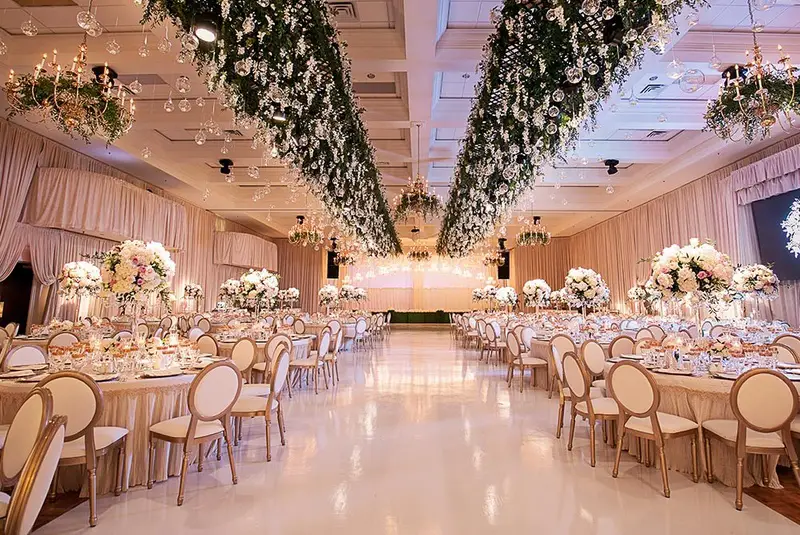
The first thing she saw was a hotel ballroom transformed into a dream garden. Thousands of white roses, lilies, and orchids hung beneath crystal chandeliers. Round tables with silk tablecloths. Guests in elegant gowns and evening suits. A soft orchestra filling the room with luxury. This was not a family gathering. It was a display.
The camera panned across the room and settled on the bride and groom at a magnificent altar. There was Jessica, looking like a princess in a crystal-covered dress that caught every light in the room. Beside her stood Mark, handsome and smiling.
There was no sadness anywhere. No worry. No sign that a mother had collapsed the night before.
Emily searched the screen for Jason and Carol. It didn’t take long.
The camera moved toward the family row near the altar, and there was Carol. Healthy. Radiant. Proud. She wore a custom sage-colored designer gown covered in shimmering detail. Her hair was perfectly styled. Gold jewelry rested on her neck and wrists. Her face glowed as she greeted guests, presiding over her daughter’s triumph.
No IV lines. No pale face. No trace of a woman who had suffered a health scare.
And next to Carol stood Jason. Her husband. The man who had hugged her that morning with a lie in his mouth. He was not wearing the casual clothes she had packed for a family emergency. He wore a tailored suit that fit him perfectly. His hair was neatly styled, and a smile never left his face. He laughed with relatives. He shook hands. He patted friends on the back. He looked exactly like a proud brother on his sister’s wedding day. Not like a son worried about his mother.
Watching them together inside that circle of happiness, Emily felt something in her break. She had not simply been uninvited. Her existence had been erased under the cover of a cruel lie. They considered her so embarrassing, so unnecessary, that they had invented a health emergency to make sure she stayed away.
Then, as if fate wanted to pour fuel on the fire, the camera zoomed in on Carol, chatting with a polished middle-aged woman near the floral arch. The music softened just enough for their conversation to carry through Emily’s phone speaker.
“The party is spectacular, Carol. Congratulations on Jessica’s wedding.”
Carol laughed — satisfied, proud. “Thank you, dear. You know how it is. As parents, we want to give our children the best. Everything has to be perfect.”
“Of course. By the way — where is Jason’s wife? I haven’t seen her all night.”
Emily stopped breathing.
Carol clicked her tongue and waved one hand in the air, as if shooing away something unpleasant. “Oh, don’t even mention her. Thank goodness Jason’s wife didn’t come. She would have embarrassed us in front of the whole family. People would think we let our family marry just anyone. Better she stays home.”
Emily’s phone slipped from her hand and hit the floor with a dull sound.
Embarrassed us. Better she stays home.
The words echoed inside her head. So this was the truth. This was the verdict they had passed on her long ago. In their eyes, she was nothing more than a stain to be covered. All her kindness for five years meant nothing. The meals she cooked. The gifts she remembered. The patience she showed. All the times she stayed quiet while Carol looked down on her. In front of status and image, Emily was just an embarrassment to hide.
The laughter and music kept playing from the phone on the floor. It felt like the party itself was mocking her.
After the live stream ended, Emily sat on the floor for hours. She did not scream. She did not break anything. She just sat still and let the pain move through her. First came emptiness. Then the tears finally broke loose — for her foolishness, for the five years she had given a man who helped his family humiliate her.
She walked unsteadily to the bedroom and opened their wedding album. In the photos, she and Jason smiled with hope. Now those smiles looked like a cruel joke. She hugged the frame to her chest, her tears wetting the glass. Every corner of the apartment reminded her of a lie. The sofa where they watched TV. The kitchen where she cooked his favorite meals. The bed where they once shared dreams. Everything felt contaminated.
She cried until her eyes were swollen and her voice was gone.
But as night gave way to morning, and the first light slipped through the curtains, something inside Emily changed. The tears stopped. The burning sadness cooled into something harder and sharper. A cold anger. A clear determination.
She looked at her reflection in the mirror. Swollen eyes. Pale face. Tired shoulders. That was not who she was. She was not a victim. She would not let them turn her into a weak woman who accepted humiliation as her fate.
Carol had called her an embarrassment. Jason had treated her like one. Now they were about to learn what the woman they underestimated could do.
An idea began forming — so bold it scared her at first. But the fear dissolved beneath one stronger desire. She wanted her dignity back.
She would not drive to Charleston and confront them. That would be too easy. Too predictable. They would call her dramatic and use her pain as proof she didn’t belong. No. The best answer was not to beg for a seat at their table. The best answer was to show them her world would not collapse just because they had excluded her from theirs.
Her mind moved to the one thing they had always underestimated. Her financial independence.
For years, Jason had insisted her salary go into a joint account. “It makes it easier to manage the household, honey,” he always said. The account was in Emily’s name, with Jason as an authorized user. She had trusted him. She had never dwelled on the fact that almost ninety percent of the balance came from her own work — her overtime, her bonuses, her careful savings. That money had quietly funded Jason’s lifestyle. It had helped his family whenever they asked. It had propped up the image they flaunted.
And now Emily understood something important. She had control.
With hands that no longer trembled, she opened her laptop and logged into the bank. Her heart pounded at the balance on the screen — years of work and sacrifice. Without hesitation, she moved the funds. Every dollar that belonged to her went into a personal account she had opened before the marriage — an account Jason had never known existed.
In seconds, it was done. She had taken back what was hers.
Next, she opened an airline website. Her fingers typed a destination she had once told Jason was her dream — a dream he had laughed at. “Rome is too expensive,” he’d said. “Unnecessary.”
Rome, Italy. She found the next available flight, that very night. She did not look at the price. She booked a one-way ticket.
One-way. A silent declaration that she had no plan to return to a life built on lies.
Before shutting the laptop, she texted her best friend Lauren. “I’m leaving the apartment key under the planter by the front door. I need to be away for a while. If Jason looks for me, tell him I went to find the dignity I lost.”
Then she packed — and packing became choosing. She passed over the simple blouses and neutral colors and long skirts she’d bought because Carol once said a good daughter-in-law didn’t dress too casually. Those clothes belonged to someone else now. She reached to the back of the closet for the pieces that felt like her. The dresses she’d bought with her own money and rarely worn. The jeans that fit perfectly. She gathered her diploma, birth certificate, passport. Her laptop. And a small framed photo from the bedside table — her, laughing with her late parents. Her real source of strength.
Her eyes landed on the jewelry box. Inside were the gold necklaces and bracelets Jason had given her early in the marriage. She had once thought them signs of love. Now they felt like chains. She closed the box and left it.
Then she looked at her left hand. Her white gold wedding band, a small diamond at its center. She remembered their wedding day. Jason’s vows. The look of love that had turned out to be false. That ring had once symbolized their union. Now it felt like a mark of ownership.
With slow, deliberate movement, she pulled it off. The skin beneath looked pale and strange. Her finger felt light. Free.
She didn’t throw it. Explosive anger was not her style. She placed it carefully on the dresser beside their silver-framed wedding photo — and then turned the photo face down.
The message was clear. This marriage was over.
At the door, she paused and looked at every corner of the apartment one last time. The sofa where she’d fallen asleep waiting for him. The kitchen where she’d experimented with recipes to please him. The walls she had painted herself. This home had been built with her love. Leaving it felt like tearing away a part of her soul. But she knew the part that remained would grow stronger.
She slid the key under the planter, got into the waiting taxi, and watched New York flicker goodbye through the window. Her mind held no rage now. No sadness. Something else. Anticipation.
At JFK, families hugged and travelers hurried and Emily walked alone through the crowd — but she did not feel lonely. For the first time in a long time, she felt whole. When boarding for Rome was announced, she walked steadily to the gate, took her window seat, and buckled in. The point of no return. The plane roared down the runway and lifted, and she watched the lights of New York shrink beneath her.
At thirty thousand feet, when the seatbelt sign turned off, Emily took out her phone and opened her contacts. She found Jason’s name. Her finger hovered for a moment.
Block.
Then Carol. Block. Then Jessica. Block. One by one, she cut every digital bridge to that family. Then she switched the phone to airplane mode, leaned back, closed her eyes — and for the first time in two days, felt peace.
Rome greeted her with cool autumn air and a language she barely understood. Instead of frightening her, it thrilled her. She had booked a small, clean studio in Trastevere — she didn’t want to feel like a tourist on the run. She wanted to feel like a woman beginning again.
The first days were made of small victories. Navigating the supermarket with a translation app. Cooking her first simple pasta. Eating carbonara alone in a tiny trattoria without anyone criticizing her. Buying a transit pass. Learning the metro. Ordering coffee in hesitant Italian. Each small success stitched her confidence back together.
One afternoon, she realized her New York jacket wasn’t warm enough for Roman nights. Instead of a problem, she saw an opportunity. On Via del Corso, her eyes landed on a long camel-colored coat of soft wool — elegant, warm, expensive. The old Emily would never have dared. Jason would have complained about extravagance. Carol would have said she was dressing above her place. But the woman in the mirror looked calm, confident, and graceful. Emily bought it with her own money. Wearing it felt like putting on armor. The next day, she cut her long hair into a shoulder-length bob. The old Emily was gone. A new one was stepping forward.
One morning about a week in, she woke to a strange golden quiet, opened the curtains, and lost her breath. The sun covered the rooftops in gold. Fallen leaves filled the street in shades of ochre and red. The golden autumn looked like a blank page. She put on the coat and walked to the little park near her apartment, where children laughed in the leaves and elderly men read newspapers on benches. Emily walked alone, and felt no envy. Only peace. She stood under a nearly bare tree, breathing the cool air, and realized she was happy. Free. Alive.
She wanted to capture the moment — not for anyone else. For herself. She asked a passing tourist to take her picture. She stood in the middle of the park with autumn blazing behind her, and she did not pose sadly. She smiled the most genuine smile she had given in years. A smile of victory. Of freedom. Of hope.
Back in her warm apartment, she looked at the photo. The woman in it looked nothing like the woman who had cried on a Brooklyn floor. On an impulse, she opened her Instagram — always private — and switched it to public. She uploaded the photo and thought for a moment about the caption. No anger needed. No explanation. No message to Jason. Her dignity was too high for that.
She wrote one simple line.
“Finding warmth in the middle of autumn. A new chapter begins.”
One tap, and the photo entered the world. She set the phone face down and sipped her hot chocolate, unaware that thousands of miles away, that simple post was about to land inside Jessica’s wedding like a spark in dry grass.
In the glittering Charleston ballroom, the wedding was in full swing. Carol stood near the altar accepting compliments with her chin lifted, as if the luxury around her were proof of her family’s status. Jason played the perfect brother — greeting friends, laughing at unfunny jokes, making sure important relatives felt noticed. In their bubble, Emily was just a problem they had successfully removed.
They didn’t know the problem had become a disaster.
It began not with shouting, but with a whisper. A young cousin, bored during a lull, opened Instagram — and her eyes widened. She nudged the aunt beside her. “Auntie, look. It’s Jason’s wife.”
The phone changed hands. The aunt’s eyes widened. She passed it on. Within minutes, Emily’s post moved from table to table like a rumor with wings. The joyful buzz changed. Laughter became forced. Glances darted toward Jason and Carol. The warm atmosphere cooled into a strange, charged tension.
An aunt from the groom’s side — who had never liked Carol’s arrogance — saw her chance. With a sweet smile, she approached Carol mid-brag.
“Carol, dear. Congratulations, the event is wonderful. Oh, by the way — how lovely to see your daughter-in-law Emily on vacation. Italy, no less. Jason is lucky to have such an independent wife.”
Carol frowned. “On vacation? Emily is at home. You must be mistaken.”
“Oh, really?” The aunt pulled out her phone with a rehearsed gesture. “Well, look. She posted this an hour ago. She looks gorgeous, dear. I almost didn’t recognize her.”
Carol stared at the screen. Emily’s face, smiling against a golden Roman autumn. The elegant camel coat. The caption. A new chapter begins.
Carol’s glowing face turned pale. Her smile vanished — first shock, then anger. “Jason,” she hissed. “Come here.”
Jason walked over. “What’s wrong, Mom?”
“Look at this.”
He saw the photo. He saw Emily’s smile — a smile he had never seen at home. Not the soft, obedient smile he was used to. The smile of a free woman. The caption hit him like a slap. How could Emily be in Rome? When did she leave? With whose money?
As panic gripped him, another problem arrived. A professional-looking woman with a badge reading Event Director approached with a tight smile.
“Good evening, Mr. Jason. I’m sorry to bother you, but as per our contract, I need to confirm the remaining fifty percent. Our finance team is ready in the back room.”
“Later, please. The event isn’t over.”
“I’m sorry, sir,” she said, low but firm. “Payment must be completed before the event ends at ten. It’s already past nine.”
Carol nudged him harshly. “Finish this at once. Don’t make a spectacle of us.”
With panic, anger, and humiliation churning inside him, Jason followed the director to the payment table in the corner. Several guests watched. He pulled out his debit card with a small, arrogant flourish, trying to salvage his dignity. “Here you go.”
The assistant swiped it. A few seconds passed. The machine beeped.
Transaction declined.
Silence. “I’m sorry, sir. It was declined.”
“It must be the connection. Try again.”
Same result.
“There must be a problem with the machine,” Jason said, his voice starting to tremble. He forced a laugh that came out dry and strange. “I’ll just do a transfer from my phone.”
In front of the director, whose eyes had narrowed with suspicion, Jason opened his banking app. His fingers felt stiff. He typed his password and checked the balance.
When the number appeared, he stopped breathing.
$14.82.
Not four figures. Not five. Not the amount that was supposed to be there. The money was gone.
With trembling hands, he opened the transaction history. At the top: a transfer made the previous afternoon. A very large amount. The receiving account meant nothing to him — but the account holder’s name was perfectly clear.
Emily Garcia.
The truth hit him like a truck. Emily hadn’t simply left to upset him. She had planned it. She had taken back every dollar that was hers. The money he’d expected to use for the rest of Jessica’s wedding — the money propping up his family’s luxury and arrogance that very night — had vanished with the woman they had mocked.
Jason looked up from the screen. The event director waited. Around him, the whispers grew louder. In his mind, Emily’s smiling face in Rome played on a loop. He was trapped. Exposed. And in the middle of the most lavish party his family had ever thrown, he had just discovered he was broke.
The silence in that corner of the ballroom felt thick enough to stop the music. Carol hurried over, face red. “What is taking so long? Just pay her. Don’t turn this family into a spectacle.” She snatched the phone from his hand — and saw the balance. For one moment she didn’t understand. Then she saw the transaction history. She saw Emily’s name.
Carol’s face went from red to white. She swayed slightly, as if the air had been knocked out of her. “This can’t be,” she whispered. Then she turned on her son, and her fury exploded before she could contain it. “You foolish boy! What have you done? Why was all your money in her hands? Why couldn’t you control your own wife?”
Her voice carried. The nearby music seemed to stop. Every eye turned toward them. The drama that had been whispered about was now the main event. Guests stopped eating. They watched openly as the proud family at the center of the wedding began to unravel.
Word of the unpaid balance spread backstage, and one by one, the vendors came. The caterer. The decoration manager. The head of sound and lighting. They formed a tense semicircle around the family. The magnificent wedding had become a public collections negotiation.
“Excuse me, Mrs. Carol, Mr. Jason,” the caterer said. “We also need our final payment. My employees need to be paid tonight.”
“Exactly,” the decorator added. “Imported flowers don’t pay for themselves with promises.”
Jason’s father tried to intervene. “Ladies and gentlemen, please. Of course we will pay. Just give us a little time.”
“The contract says tonight,” the caterer cut him off, loudly enough for the guests to hear. “If payment is not made, we stop service now. No dessert. No coffee.”
The whispers surged. Phones came out. Jessica rushed down from the altar, her crystal gown suddenly looking like a costume in a show gone wrong. “Mom, Dad, what is happening?” she sobbed. “Why is this happening?”
And then, in the middle of her desperation, Carol did the thing everyone present would remember forever. With trembling hands, she unclasped the heavy gold necklace she had worn so proudly all evening — her symbol of status — and thrust it toward the caterer.
“Take this as collateral,” she said tightly. “It is worth more than enough.”
The image of a high-society matriarch handing over her jewelry to cover a wedding debt, in front of hundreds of guests, was too dramatic to ignore. Camera flashes flickered across the room. Carol’s dignity — the thing she had protected so fiercely for years — cracked in front of everyone.
The party ended in chaos. Guests left quickly, not out of sympathy, but to be first to tell the story. They left with full stomachs and gossip that would feed Charleston for weeks.
An hour later, the once-glowing ballroom stood nearly empty. Only the family remained, surrounded by lavish decorations that now looked like monuments to failure. The silence broke when Carol turned on Jason again.
“This is all your fault. The fault of that woman you chose. I told you from the beginning not to marry her. Look what happened.”
“It’s not Emily’s fault, Mom,” Jason said, his voice hoarse. “It’s ours. Your fault for humiliating her. My fault for being too cowardly to defend her. We pushed her away.”
“How dare you blame your mother—”
“Enough.” Jason’s father, who had endured the shame in silence, finally raised his voice. Everyone froze. “You are both the same. Your arrogance, Carol, and your stupidity, Jason, have destroyed this family’s name. Now figure out how we are going to pay these debts.”
The wedding meant to crown their social success had become the burial place of their reputation.
The drive back to Brooklyn felt to Jason like a journey toward judgment. All night he tried to reach Emily — his phone, his father’s phone, a borrowed phone at a gas station. Nothing connected. Nothing delivered. Emily had built an impenetrable digital wall. It was like shouting into the dark.
When he finally reached the apartment at dawn, a small irrational hope rose in him. Maybe it had all been a nightmare. Maybe he’d open the door and find her asleep on the sofa.
That hope shattered the moment he stepped inside.
The apartment felt different. Not just quiet. Hollow. The air was cold and stale. Her slippers were gone from beside the door. Her work bag was not on the table. The kitchen was sterile — no sticky notes on the refrigerator. The living room was too tidy, the cushions perfectly arranged, as if no one had lived there in days.
His heart pounding, he went to the bedroom. The closet stood slightly open. Her side was empty — bare hangers. His side untouched, which somehow made it lonelier.
Then his eyes found the dresser.
There it was. The white gold wedding band, lying on the wood. Beside it, their silver-framed wedding photo, turned face down.
He approached like a sleepwalker and picked up the ring. It was cold. Lifeless. He turned the photo over, and Emily’s face smiled up at him from the past — full of sincerity and love. The smile of a woman he had betrayed in the cruelest way.
The regret hit him so hard he could barely breathe. He sank onto the edge of the bed, buried his face in his hands, and the sobs he’d been holding finally broke loose.
The days that followed were a living nightmare. He moved like a ghost through his own home. He barely ate or slept. The shame of the wedding followed him to New York — coworkers connected to the family began keeping their distance. Then came the financial blows. His phone rang constantly — not with Emily’s voice, but with banks and credit card companies. Automatic payments bounced. The bills he had always ignored, assuming Emily’s salary would cover them, piled up like paper walls closing in.
He realized, far too late, that he had been living inside an illusion. Emily had not just been his wife. She had been the financial backbone of his entire life. And the backbone was gone.
Exactly one week after his return, a courier delivered a large brown envelope. His heart pounded. Could it be a letter from her? An explanation? With trembling hands, he tore it open.
Inside was a stack of official documents. At the top of the first page: Summons for Initial Hearing of Divorce Petition. His name as respondent. Emily Garcia, petitioner. Family court had already set the date. It all felt final. Irrevocable.
As he pulled out the rest, a small object fell into his lap. A savings passbook. A personal passbook in Emily’s name — one he had never known existed. He opened it and saw the record of careful, patient transactions stretching back years. Then a folded note slipped from the last page. Emily’s neat handwriting stared up at him.
“Thank you for managing the fruits of my hard work all this time. Now enjoy the fruits of yours.”
No rage. No pleading. No sorrow. Just a cold statement of fact. The final checkmate.
Jason felt the strength leave his body. He slid from the chair to his knees on the floor, the court papers and the note scattered around him. He had lost everything — his wife, his dignity, his future. All because of his own cowardice and arrogance.
Six months later, time had fully separated the two worlds that marriage had once joined.
In a bright Manhattan office, Emily stood before a whiteboard, explaining her business concept with sharp, bright energy. On the wall hung the logo of the company she had built from scratch — Free Spirit Journeys. The tagline was simple. Empowering women, one trip at a time.
Her appearance had transformed. The chic cut framed a brighter, more determined face. She wore a tailored blue pantsuit. But the greatest change was in her eyes. No insecurity lived there anymore. Only intelligence, confidence, and peace. Her travel business — built for solo female travelers — was becoming a success. She wasn’t just selling trips. She was selling courage. A reminder that a woman could rebuild her life from ruins into something more beautiful than what she’d lost.
Meanwhile, in another world, Jason’s family was paying the price. To cover the wedding debts, they were forced to sell the family home in Charleston, and the sale became the talk of the town. Carol, once so proud of her position, grew quiet and withdrawn, hiding in a small rental from the sharp eyes of neighbors who knew everything. Jessica’s marriage never recovered from its beginning — Mark’s family brought up the humiliation and the debts every time an argument started. And Jason’s fate was the most bitter of all. The pressure of the divorce and the financial ruin destroyed his focus at work until he was let go. He sold his car to pay down credit card debt. The man who once wore polished suits now worked part-time as an event waiter at a five-star hotel, a job secured through the pity of an old friend, and lived in a tiny rented room on the edge of the city.
Fate, with its strange sense of timing, brought the two worlds together one last time.
Emily was celebrating the launch of her spring travel packages at an elegant café inside that very hotel. She sat at the center of it all, surrounded by travel bloggers and journalists, laughing, answering questions, radiating a success impossible to ignore.
Jason, in an ill-fitting black-and-white waiter’s uniform, was assigned to that section. His job was to fill water glasses and clear plates.
When he saw her for the first time in months, the air left his lungs. The woman who used to make him breakfast — the woman he had let his family hide and mock — sat there like someone from another world. Beautiful. Confident. Unreachable.
Shame consumed him. He tried to pass unnoticed, moving between tables like a shadow. But as he reached for a tray of empty glasses near her table, his nervous hands betrayed him. The tray slipped. Glass shattered on the floor.
Everyone turned. Including Emily.
For a fraction of a second, their eyes met. Jason looked at her with a thousand emotions — shame, regret, longing, the crushing awareness of everything he had thrown away.
Emily looked back at him. There was no hatred in her eyes. No anger. Not even pity. Only calm recognition — the look one gives a familiar face from a distant past. She gave him a small, polite nod. The kind one gives a hotel employee who has made a minor mistake. An acknowledgment. Not an invitation.
Then she turned back to her interviewer as if nothing important had happened.
“I’m sorry,” she said smoothly. “Where were we? Ah, yes. Safety tips for women traveling solo to Rome.”
For Emily, it was a brief interruption. For Jason, her quiet indifference hurt more than any insult could have. He had been erased. Reduced to a stranger. As he knelt to collect the broken glass, he heard her confident laughter in the distance — the sound of a world he could never enter again.
Two years later, on a golden autumn afternoon, Emily walked through a beautiful Roman park — the same park where she had once taken the photo that changed her life. But this time she was not alone. Behind her walked the newest group from Free Spirit Journeys, women of every age and background, listening as she spoke. Her business had grown beyond anything she’d imagined — a team in New York, local partners across Italy. Her clients were women at crossroads. Newly divorced. Burned out. Grieving quiet losses. Needing to reconnect with themselves.
That afternoon, a young woman named Sarah approached her, eyes sad. “Emily — seeing you so passionate and happy here is incredible. I came on this trip because I just left a job that was making me miserable. I feel lost.”
Emily stopped and looked at her with warmth, seeing a reflection of her old self in the young woman’s face.
“Two years ago,” she said calmly, “I came to this very park for the first time. It was autumn. I came alone — not on vacation, but because I needed to leave a life that made me feel small. I felt lost too.”
“Really?”
“Really. But being lost isn’t always the end. Sometimes we have to get lost to find the path that truly belongs to us. Don’t think of this trip as running away. Think of it as your first step.”
That evening, after her clients were safely back at their hotel, Emily sat alone by the window of a small café in Monti, sipping hot ginger tea, watching people pass in the lamplight. She felt completely at peace. Her happiness no longer depended on a man’s approval or a family’s acceptance. It came from her work. Her freedom. The quiet strength she had earned. She had found her true soulmate. Herself.
And thousands of miles away, in a small room with a barred window that looked out on a brick wall, Jason ended another identical day the way he ended them all — scrolling through the public account of Free Spirit Journeys, watching his ex-wife’s success unfold in polished photos and joyful captions. He didn’t hate her. That had faded long ago. What remained was bitter admiration and endless loss. He knew the woman on the screen existed because of choices he had made.
Emily, high above Rome on the Pincian Hill that weekend, watched the sunset spread over Piazza del Popolo, the city lights blooming below her like a carpet of stars, surrounded by the laughter of women she had helped set free. Her world felt wide. Her future felt bright.
Jason, low in his room in New York, sighed into the heavy dark and saw no horizon at all. Only a wall.
They were no longer connected. But their lives remained reflections of choice. One was a portrait of courage. The other, a portrait of regret.
Because in the end, the strongest justice was not the destruction of the people who hurt her. It was the life Emily built — so high, so bright, and so completely her own that their shadows could no longer reach her.

Adrian Hawthorne is a celebrated author and dedicated archivist who finds inspiration in the hidden stories of the past. Educated at Oxford, he now works at the National Archives, where preserving history fuels his evocative writing. Balancing archival precision with creative storytelling, Adrian founded the Hawthorne Institute of Literary Arts to mentor emerging writers and honor the timeless art of narrative.