The chainsaw had barely stopped when Delilah Thornwick screamed that I was destroying her son’s inheritance.
She stood in my driveway, red-faced and trembling, while fresh pine dust floated between us like smoke after a gunshot. What she did not know was that a sealed document hidden beneath my basement had already turned her family’s entire empire into evidence. Before it was over, her son would be in handcuffs, her husband would be running from investigators, and half the valley would learn who truly owned the ground beneath their homes.
My name is Marcus Holloway. I was forty-five when my life collapsed in a way that looked permanent.
My twenty-year marriage ended. The suburban house was sold. The divorce lawyers charged more in an hour than I earned in a day. I walked away with my grandfather’s carpentry tools, thirty-seven thousand dollars he had saved for me, and a note written in his careful block letters.
Build something that matters.
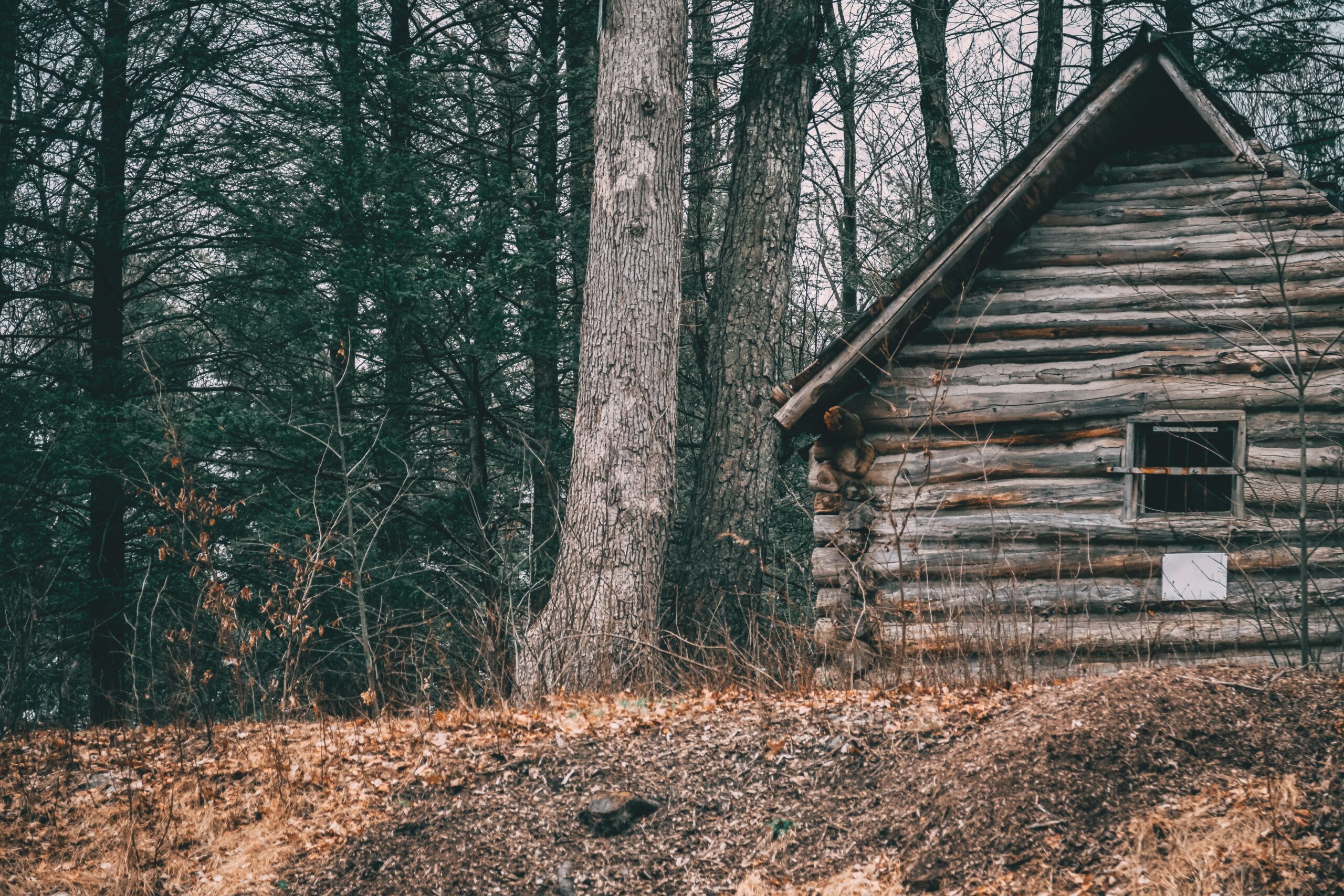
At two in the morning, scrolling listings I couldn’t afford in a life I no longer had, I found a county auction posting for an abandoned log cabin in Millbrook Valley. Built in 1873. Fifteen wooded acres. Neglected long enough for vines to climb through the porch railings.
The first time I walked inside, I smelled damp stone, chestnut timber, and possibility. The beams were hand-hewn. The foundation was stacked rock. Every scar in the wood had been made by someone who expected the cabin to outlive him.
I bought it for forty-seven thousand dollars.
And for the first time since the divorce, I slept through the night. I woke before sunrise, made coffee on a camp stove, and started pulling rotten boards from the porch with my grandfather’s hammer.
Three days later, Delilah arrived.
Her white Escalade came up my gravel road too fast. She stepped out in designer jeans and expensive boots, wearing the expression of a woman who had just discovered a mechanic touching her jewelry.
“I’m Delilah Thornwick,” she announced. “President of the Millbrook Estates Homeowners Association. My husband owns Thornwick Construction.”
“Marcus Holloway.”
Her smile sharpened. “This property has complications. My son Bradley had an understanding with Mr. Henderson. He was supposed to inherit it.”
“Henderson died without heirs. The county sold it legally.”
“A county auction does not erase a century of family history.”
I pulled the deed from my truck. “It does establish ownership.”
Her eyes moved from the paper to my worn flannel shirt, doing the math on what I was worth and how fast I could be moved. “People here value community standards.”
I knew that tone. I’d heard it my whole working life from managers who praised my craftsmanship and promoted men with cleaner hands.
“I bought the cabin,” I said. “I’m restoring it. I’m not leaving.”
“We’ll see.”
The following Monday, the county building office called to tell me my renovation permits had been accidentally deleted. Two days later, an inspector named Frank Morrison arrived with a clipboard and two citations. He claimed I had altered a historical structure without approval and created an illegal burn pile. The fines totaled twenty-three hundred dollars.
I stopped work and drove to the county archives instead.
My cabin predated Millbrook’s first zoning law by almost ninety years. Eleanor Vasquez, a seventy-year-old attorney with silver hair and a stare that could peel paint, confirmed what I suspected.
“The structure is grandfathered,” she said. “They cannot retroactively regulate what was legal when it was built.”
Then she opened a thick file and slid it across her desk.
Inside were eight cases involving newcomers to the valley. A mechanic. A retired nurse. A young couple restoring a farmhouse. Each had suffered permit delays, anonymous complaints, supplier problems, insurance threats, and surprise inspections. Each had eventually sold cheap and left town.
“Delilah has done this before,” Eleanor said. “Document everything.”
That evening, I found Delilah standing at my property line with a professional camera.
“Maintenance concerns,” she called out, snapping photographs.
“My land is not in your HOA.”
“Everything in Millbrook Valley affects our community.” She climbed into her SUV, lowered the window, and smiled at me. “I would be careful with that burn pile, Marcus. The fire department responds very quickly to anonymous tips.”
Her taillights disappeared into the trees, and my phone buzzed with a notice for an emergency HOA meeting. The agenda named exactly one threat to property values.
My cabin.
The community center smelled like burnt coffee and nervous sweat. Thirty residents sat in folding chairs while Delilah stood beside a projector, polished and confident. A photograph of my cabin filled the screen, taken from the worst possible angle, making my stacked lumber look like wreckage.
“This project threatens our safety,” she announced. “Unregulated construction. Fire hazards. Possible transient housing.”
The next slide proposed a five-hundred-dollar assessment from every household to fund legal action against me.
Mrs. Henderson, an elderly widow in the front row, raised her hand. “Wasn’t that cabin built by the first settlers? Shouldn’t we be preserving it?”
Delilah’s smile froze. “Historical sentiment does not override modern standards.”
I stood up in the back. “Since you’re discussing my property, perhaps I should answer.”
Every head turned. Delilah’s face drained.
“This is a private meeting.”
“It was posted as public.”
The rear door opened, and Eleanor walked in carrying her briefcase. She placed the HOA incorporation documents on the table like she was dealing a winning hand.
“Mr. Holloway’s property was never included within Millbrook Estates jurisdiction,” she said. “Additionally, the former owner was charged HOA dues illegally for seventeen years.”
The room went silent.
Bradley Thornwick jumped to his feet. He was thirty, dressed like a country-club advertisement, with anger where judgment should have been. “My family has managed this community for decades!”
“Managed is not the same as legally governed,” Eleanor replied.
Residents began shouting questions. Delilah packed her laptop with shaking hands. Outside, she cornered me beside my truck.
“My family knows every commissioner, legislator, and business owner who matters.”
“None of them can redraw a deed.”
By six the next morning, Thornwick Construction had excavated the water line beside my property. Dean Thornwick supervised in a spotless hard hat. “Emergency repair,” he said cheerfully. “Your pressure may be low until Friday.”
By noon, three suppliers had refused my deliveries. That afternoon, my insurance agent suspended my coverage, citing anonymous reports of fire hazards and structural defects.
The pressure was coordinated. So was the fear behind it.
Police Chief Rita Gonzalez came to my kitchen that evening. She was direct, tired, and careful.
“I am being pushed to investigate you,” she said. “The complaints are vague, but the pattern is obvious. Keep records. Install cameras. Do not confront anyone alone.”
After she left, Bradley’s BMW passed my property four times. On the fourth pass, I filmed him photographing the cabin.
The next morning, Bob Kettering arrived from the hardware store carrying two coffees and a manila envelope.
“Dean threatened my supplier credit if I keep selling to you,” he said. “I told him he could go to hell.” Inside the envelope were five years of Thornwick Construction permits. Every single application had been approved in record time by Frank Morrison, the same inspector who had fined me.
“They bought the system,” I said.
“Or built it,” Bob replied.
Saturday morning, I went down into the basement to reinforce a sagging joist. My crowbar struck what looked like solid foundation stone.
Instead of a dull impact, I heard a hollow echo.
I removed one loose rock, then another. Behind them was a cavity the size of a shoebox. Inside sat a bundle wrapped in cracked leather and tied with rawhide.
I carried it upstairs with my heart pounding. The bundle smelled of old paper, dust, and oil.
The first document was an official territorial land grant dated September 15, 1873. A red wax seal was still pressed into the corner. The paper granted fifty acres, including timber, mineral, and water rights, to one man and his heirs in perpetuity.
Ezekiel Holloway.
My family name.
The second document was a hand-drawn survey map. The boundaries ran from the creek to the northern ridgeline. They covered my fifteen acres, most of Millbrook Estates, and the land beneath the Thornwick mansion itself.
A letter lay beneath the map, in faded, careful ink.
To my descendants: should any man challenge our rightful claim, present these papers. This grant cannot be diminished by local ordinance or later settlement.
I sat down hard on a sawhorse and called Eleanor.
“What did you find?” she asked.
I stared at the name written a hundred and fifty years ago.
“The reason they need me gone.”
Eleanor arrived with Dr. Patricia Morris from the State Historical Society. Patricia examined the paper fibers, the ink, the handwriting, and the wax seal under specialized lights. After two hours, she sat back.
“Preliminary findings support authenticity,” she said. “If the state archives confirm it, this grant may supersede later property claims.”
Eleanor looked at the survey map and smiled slowly. “Marcus, you may own half the valley.”
The sentence did not feel real. I had spent months worrying about lawyer bills and whether my truck would survive another winter. Now a document hidden behind a stone claimed fifty acres, water rights, timber rights, and everything beneath the soil.
The mineral rights mattered most. Local records mentioned natural gas beneath the ridge. A geological report from the 1980s hinted at rare-earth deposits. The Thornwicks had spent generations controlling development in this valley while quietly blocking every deeper survey.
By Sunday morning, my kitchen had become a war room. Bob brought coffee. Martha Caldwell, a retired teacher, brought genealogy records and Ezekiel’s original field notes from the county museum. Chief Gonzalez brought a criminal-investigation file. Eleanor brought a plan.
First, a quiet-title action. Second, full authentication. Third, a licensed surveyor to mark the original boundaries. And Chief Gonzalez would refer the permit scheme and the harassment pattern to state and federal investigators.
Martha tapped her folder. “There’s another piece. Ezekiel was a Civil War veteran and a territorial surveyor. His notes mention gas seepage and unusual mineral-bearing rock along the northern ridge.”
A geologist arrived that afternoon and took samples. Before sunset, he told me the indicators were significant.
The next morning, the Thornwicks stopped pretending.
Dean’s crew tore apart my access road under the excuse of emergency maintenance. A plumber found rags packed into my septic cleanout. Then came six inspectors in a single day. Environmental. Fire. Health. Agriculture. Structural. Water. Every complaint anonymous. Every inspection finding nothing.
That night, my cameras caught three figures moving through my trees. I hit them with the brightest flashlight I owned and shouted that police were on the way. They fled, leaving behind spray paint, sugar meant for a fuel tank, a telephoto camera, and one wallet.
Bradley Thornwick’s.
Chief Gonzalez stared at his driver’s license and shook her head. “Privilege does not improve intelligence.”
On Tuesday, Dean came to my cabin wearing a suit and carrying a briefcase. He opened it on my kitchen table.
Two hundred thousand dollars in cash.
“Walk away quietly,” he said. “Start somewhere else.”
I looked at the money. It could have erased every debt from my divorce. It could have bought a new house, a new truck, a life without anonymous complaints. Then I thought of the eight families Delilah had driven out of this valley.
“If the cabin is worth forty-seven thousand,” I asked, “why are you offering two hundred?”
“Peace has value.”
I set my phone on the table and started recording. “You know about the land grant.”
His smile vanished.
“You are making a catastrophic mistake.”
“That sounds like a threat.”
“My family has connections at every level of government.”
“So did the people who signed this grant.”
Dean slammed the briefcase shut and left. Eleanor listened to the recording twice that evening.
“He just connected himself to the conspiracy,” she said. “And he confirmed knowledge of the grant without admitting it directly.”
“How could they possibly have known?”
She turned toward the old survey map. “Because someone in the Thornwick family has probably seen a copy.”
That answer changed everything. Their campaign had never been about Delilah wanting the cabin for Bradley. It began because my arrival, my name, threatened a secret they had guarded for generations.
The following morning, I opened my front door and found three dead rabbits, a possum, and a cat arranged across my porch. Chief Gonzalez photographed the scene and the tire tracks beside my garden. They matched Bradley’s BMW.
That afternoon, my ex-wife Jennifer called from Phoenix. Delilah had contacted her office, accused me of criminal activity, and suggested reopening our divorce to have me declared mentally unstable.
“She knew my address,” Jennifer whispered. “Marcus, how did she know where I live?”
The question was still hanging in my mind when darkness fell.
At 9:20, a motion alert lit up my phone. A man in black clothing was moving behind my workshop.
He was carrying a gasoline can.
I called 911 before I stepped onto the porch.
“I can see you,” I shouted into the dark. “The fire department is coming.”
The figure dropped the can and ran. My cameras caught his face clean as he crossed the security light.
Bradley.
The volunteer fire department arrived first. Chief Gonzalez came behind them with two state investigators. They found gasoline splashed near the workshop wall, cloth rags, shoe prints, and Bradley’s fingerprints on the container.
Detective Sarah Mills watched the footage twice. “Attempted arson,” she said. “Interstate stalking involving your former wife. Conspiracy. Property sabotage. Civil-rights violations. We have enough.”
Bradley was arrested at his parents’ mansion before midnight. Local television showed Delilah screaming about political connections while officers folded her son into a patrol car. A federal judge issued a restraining order before sunrise. No Thornwick could come within five hundred yards of me or the cabin.
The emergency town hall happened Thursday night.
Three hundred people crowded into the community center. Reporters lined the walls. Sheriff’s deputies guarded the entrances. County officials sat onstage looking like men summoned to their own funerals. Delilah sat in the front row between two lawyers. Her hair was perfect. Her face looked ten years older.
Commissioner Williams began reading a statement about recent developments. Delilah stood up before he finished.
“My family is being persecuted by a drifter who bought stolen property!”
I rose from the back of the room. “Stolen property is an interesting phrase.”
Eleanor walked beside me carrying the authenticated grant. Patricia followed with the state report. The room went so quiet I could hear camera shutters clicking from across the hall.
Eleanor held up the document. “This is an original territorial land grant issued in 1873 to Ezekiel Holloway and his heirs. It conveys fifty acres, together with timber, water, and mineral rights, in perpetuity.”
Patricia explained the authentication. Period paper. Proper ink aging. Official fibers in the wax seal. Matching territorial records. Ezekiel’s own survey notes preserved at the county museum. “The document is genuine,” she said.
The survey map appeared on the projection screen. A red outline crossed my cabin, the valley floor, dozens of Millbrook Estates lots, and the Thornwick property.
People began murmuring. Then shouting.
Eleanor raised her voice over it. “The Thornwick family developed and sold land without resolving the Holloway claim. Evidence also indicates they knew of the competing grant and engaged in a coordinated campaign to force Mr. Holloway away before he discovered it.”
One of Delilah’s attorneys whispered urgently in her ear. She shoved him away.
“This is fraud!” she screamed. “My family built this community!”
“On land my family never surrendered,” I said.
Chief Gonzalez stepped forward with a thick folder. “The FBI has opened an investigation into official corruption, organized harassment, attempted deprivation of property rights, and conspiracy. Bradley Thornwick has been charged with attempted arson. Warrants have been issued for Dean Thornwick and building inspector Frank Morrison.”
Delilah’s face emptied. The commissioner gripped the edge of the table. Judge Patricia Harrison, who had traveled from the state capital, adjusted her glasses.
“The quiet-title evidence is substantial,” she said. “Pending final adjudication, no transfer, construction, extraction, or encumbrance may occur on the disputed land. The restraining order against the Thornwick family is permanent.”
Residents who had once avoided my eyes now stared at Delilah with open disgust. Mrs. Henderson stood slowly in the front row.
“You charged my husband dues for seventeen years,” she said. “You told us that cabin belonged to Bradley.”
Delilah looked around the room for loyalty and found none.
Dean was arrested before the meeting ended. Frank Morrison surrendered the next morning. Search warrants uncovered altered permit files, payment records, and one item that proved everything: a century-old photocopy of the Holloway survey, locked in a cabinet inside the Thornwick mansion.
They had known. All along.
They had not mistaken my cabin for Bradley’s inheritance. They had spent decades waiting for the last Holloway claim to die out, and I had walked into the valley carrying the name they feared most.
But I had one decision left, and it was bigger than the Thornwicks.
Technically, I could challenge every home built inside the original boundary. Families who had never heard of Ezekiel Holloway could lose everything over crimes committed before they were born. At the courthouse, reporters asked whether I planned to evict half the valley. I saw Delilah behind her lawyers, smiling for the first time in days. She thought greed would finish what harassment couldn’t. She thought I’d turn the whole community against myself.
Then I told the judge what I intended to do.
“I will not punish innocent families for the Thornwicks’ fraud.”
The homeowners would receive permanent residential easements and corrected deeds. No one who had bought in good faith would lose their home. In return, the title insurers, the Thornwick companies, and the responsible officials would fund every legal correction.
The Thornwick family would receive no such protection until full restitution was paid.
Delilah’s smile disappeared for good.
Six months later, the criminal cases ended in plea agreements. Dean received two years for corruption and conspiracy. Frank Morrison lost his position and admitted taking payments to fast-track Thornwick projects while obstructing everyone they wanted gone. Bradley got probation after county time, plus five hundred hours restoring public historical properties, which felt almost poetic.
Delilah faced federal civil-rights and fraud charges. To reduce her sentence, she surrendered the construction company, sold the mansion, and funded restitution for all eight families her campaigns had driven from Millbrook Valley.
She never apologized. I never asked her to. Some debts get paid in currency other than words.
The quiet-title judgment confirmed the Holloway grant. Geological testing found commercially viable natural gas beneath the northern ridge, and the mineral lease was valued at roughly twelve million dollars. But I refused open-pit extraction or anything that would scar the valley. The final agreement used limited directional drilling from outside the residential area, strict environmental monitoring, and a permanent conservation zone around the creek and the original oak grove.
I used the first payment to finish the cabin.
The chestnut beams were cleaned, not replaced. The stone foundation was rebuilt by hand, stone by stone, the way it was first laid. I added modern wiring, plumbing, and fire protection without hiding a single mark left by the people who built the place in 1873. Every scar stayed part of the story.
Bob’s hardware store survived the Thornwick collapse and expanded. Martha became chair of the new historical commission. Chief Gonzalez was elected county sheriff after the investigation exposed the officials who had protected the Thornwicks for years. Eleanor kept telling everyone she planned to retire, then accepted three new cases involving property harassment, because some people are built for the fight.
The first annual Millbrook Valley Heritage Festival opened on a warm June morning. Bluegrass drifted across the meadow. Children ran between craft tables. Bob’s barbecue smoke mixed with honeysuckle and fresh-cut grass. In the restored barn, the new Heritage Center displayed a reproduction of Ezekiel’s grant, his original survey tools, and the story of the eight families who had been driven out and finally made whole.
Sarah Chen, the reporter who broke the corruption story, moved to Millbrook to write a book about the case. Over months of interviews, she became the first person since my divorce who could sit beside me in silence without making it feel empty.
That evening, after the festival ended, we sat on the cabin porch watching fireflies rise over the field.
“Any regrets?” she asked.
I thought about the threats. The inspections. The dead animals on my porch. The gasoline can beside my workshop. I thought about Dean opening that briefcase, offering me enough cash to make surrender look like wisdom.
Then I looked through the open cabin door. My grandfather’s tools hung above the workbench. Beneath them, his note.
Build something that matters.
“I regret that eight families had to lose their homes before someone fought back,” I said. “I regret that people were afraid for so long.”
Sarah rested her hand over mine. “But leaving?”
“Not once.”
The cabin settled behind us with the soft creak of old timber cooling after sunset. Somewhere beyond the meadow, children were still laughing while their parents packed up the last festival tents.
I had come to Millbrook Valley believing I was buying fifteen acres and a broken house. Instead, I recovered fifty acres, cleared my family’s name, exposed a corruption network, and helped a frightened town remember that power is not the same thing as ownership.
Delilah had called the cabin Bradley’s birthright.
She was almost correct. It was a birthright.
Just not his.
And the document that proved it had waited a hundred and fifty years behind one loose stone, for the only Holloway stubborn enough to keep digging.

Specialty: Emotional Turning Points
Rachel Monroe writes character-driven stories about betrayal, second chances, and unexpected resilience. Her work highlights the emotional side of family conflict — the silences, the misunderstandings, and the moments when someone quietly decides they’ve had enough.