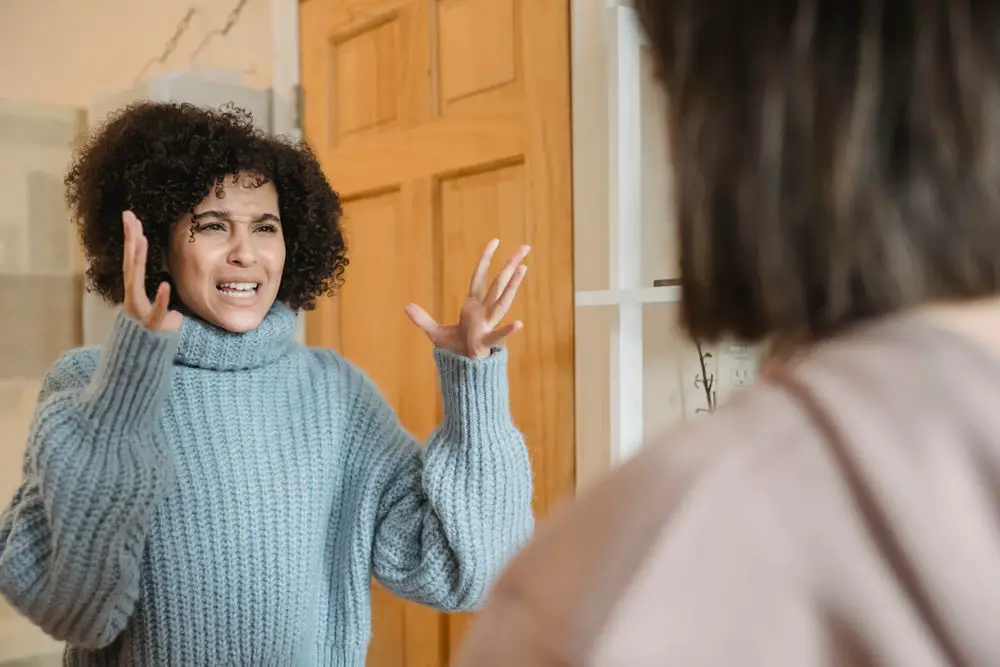
My daughter stood at the head of her dining table, pointed toward the front door, and said, “Apologize to my mother-in-law, or get out of my house.”
The room went completely silent.
Even the children stopped moving.
I was sixty-eight years old, seated at a card table near the coat rack while sixteen other people occupied Lauren’s polished walnut dining table. My plate had been balanced beside a stack of unopened Christmas cards, and every time someone came through the mudroom, a gust of December air swept across the back of my neck. I had arranged my napkin and my silverware and my water glass with the care of someone who has learned to make dignity out of small adjustments.
Margaret Miller sat in the place of honor beneath the chandelier.
Her silver hair had been swept into a smooth twist. A strand of pearls rested against her cream silk blouse, and one hand remained curled around the stem of her wineglass with the practiced ease of a woman who had never held anything she did not intend to keep. She wore a small, satisfied smile, the smile of someone who believed the evening had finally arranged itself in her favor.
Lauren’s husband, Ethan, studied his plate.
He had been studying the same piece of prime rib for nearly a full minute.
“Lauren,” I said quietly, “you should think carefully before asking me to apologize.”
“I have thought about it.” Her voice shook, but she raised it anyway. “You accused Margaret of using my name in some scheme. You embarrassed her in front of everyone. You have spent years treating this family like suspects, and tonight you went too far.”
Margaret lowered her eyes with practiced modesty.
“I told Lauren not to make a scene,” she said. “Helen is emotional. She sees threats where there are none.”
A few people shifted in their chairs.
No one defended me.
Not Lauren’s friends from the country club. Not Ethan’s uncle, who had spent the entire dinner describing a ski weekend in Aspen. Not the neighbors who had arrived carrying expensive wine and compliments about the house.
My grandson Owen sat at the far end of the main table, his fork suspended halfway to his mouth. His younger sister, Chloe, stared at me with frightened brown eyes.
I did not want either of them to remember their grandmother begging for a place in their family.
So I folded my napkin, set it beside my untouched plate, and stood.
Margaret’s smile widened.
She thought I was walking over to surrender.
I crossed the room slowly, feeling every eye follow me. When I stopped beside her chair, she lifted her chin and waited with the composure of someone accustomed to winning.
I looked directly at her.
“I will not apologize for stopping you from making my daughter the fall woman for your crimes.”
The smile disappeared.
Lauren drew a sharp breath.
Ethan’s hand closed around his fork.
Then the doorbell rang.
Nobody moved at first.
It rang again, followed by three firm knocks that carried through the house like a pronouncement.
Ethan pushed back his chair so quickly it scraped the hardwood.
“What did you do?” he asked me.
Before I could answer, blue and red lights swept across the windows.
The colors moved over the dining room walls, across the framed family photographs, and over Margaret’s carefully composed face.
Someone near the front window pulled back the curtain.
“There are federal agents outside.”
The room came apart.
Chairs scraped. Glasses tipped. Ethan moved toward the hallway while Margaret reached for her handbag. Voices overlapped and nobody finished a sentence. The catered prime rib cooled in its silver tray while the world Lauren had spent years constructing began to come down around her holiday garlands and matching place settings.
I stayed where I was.
I had spent years being treated like the least important person in that family. But as the front door opened and agents stepped into the house carrying a search warrant, every person in the room turned toward me as if I were the only one who understood what was happening.
In a way, I was.
But the truth had not begun at that dinner table. It had started months earlier with a certified envelope, a property I had never seen, and my daughter’s signature on a document she did not know existed. And long before that, it had started with something quieter and harder to name, the slow, careful disappearance of the daughter I had raised.
Lauren and I had once been close enough to finish each other’s sentences.
After her father died, it was just the two of us in a small apartment in Aurora, east of Denver. The building had brown carpeting in the hallways, a laundry room that swallowed quarters, and a heater that knocked all winter like an impatient neighbor. We did not have much, and we did not discuss that fact because discussing it would have meant sitting still inside it, and we were always moving forward.
I worked at a King Soopers grocery store, first as a cashier and later at the customer service desk. During busy weeks I took extra closing shifts. Lauren would sit in the break room after school with her textbooks spread across a plastic table, drinking vending-machine cocoa and waiting for me to finish. On the drive home she told me everything. Which teacher had embarrassed a student. Which girl had been crying in the restroom. Which book she loved. Which future she imagined.
She wanted to work in an office where people wore nice clothes and no one’s shoes hurt from standing for nine hours. She wanted a house with stairs. She wanted a refrigerator that made ice through the door.
I wanted those things for her too.
When she was accepted into community college, I sat in my old Buick in the campus parking lot and cried until a security guard tapped on the window to ask whether I needed help.
“I’m fine,” I told him. “My daughter just got a chance.”
Lauren worked hard. She studied business administration while answering phones at a dental clinic. She paid what she could toward tuition, and I covered the rest with overtime and a loan against my small retirement account. We never spoke of sacrifice. It was simply what we did, the way breathing is simply what you do.
Saturday mornings meant pancakes from a boxed mix and coffee at the kitchen table. Sundays meant yard sales, library books, and long drives through neighborhoods where we could not afford to live. Lauren liked to choose houses and invent stories about the people inside.
“That one belongs to a retired judge,” she would say.
“The one with the plastic flamingos?”
“He’s eccentric.”
“And the house with the broken gutter?”
“A famous novelist lives there. She’s too busy writing to notice.”
We laughed easily then. I can still hear it when I let myself remember those years.
Lauren was thirty when Ethan Miller walked into the dental clinic for a routine cleaning. He was tall, polished, and charming in a way that made people feel chosen. He remembered the receptionist’s name. He held doors. He sent flowers to the office after his second date with Lauren, not just for her but for every woman who worked there. When I first met him, he brought a bottle of wine and called me Mrs. Ward until I asked him to stop.
“You raised an extraordinary woman,” he said.
I liked him for saying it. More than that, I liked the way Lauren looked when she was near him. She seemed lighter, as if she had finally stepped into the life she had been imagining since those long evenings in the grocery-store break room.
Ethan worked for Harbor Ridge Realty Group, the company his mother had founded with her late husband. They bought struggling properties, renovated them, and resold them throughout Colorado. At least, that was how Ethan explained it. Harbor Ridge occupied two floors of a glass office building near the Denver Tech Center. Its brochures featured mountain views and smiling families and words like integrity and legacy.
Margaret Miller used those same words in conversation.
I met her at a Sunday dinner in the gated community where she lived south of the city. Her house overlooked a man-made lake, and a fountain bubbled in the center of the circular driveway despite the temperature being barely above freezing. She opened the door wearing pearls and a tailored navy dress.
“You must be Helen,” she said. Her smile was polite. Her eyes were not. “I’ve heard so much about you.”
“All good, I hope.”
She paused just long enough to make the answer clear. “Lauren speaks very fondly of her childhood.”
It sounded kind until you heard what she had placed inside it.
At dinner she described my work at the grocery store as honest, with the particular warmth people reserve for things they consider beneath them. I smiled and told her it had kept people fed. The table went quiet for half a second. Then Margaret laughed as though I had made a charming joke, and Lauren squeezed my knee beneath the tablecloth.
On the drive home, Lauren asked me not to take Margaret personally.
“She’s just formal,” Lauren said. “She grew up differently.”
“So did I.”
“Mom.”
“I’m not criticizing her.”
“You make a face.”
“What face?”
“The face you make when you’ve decided someone is full of baloney.”
I laughed, and after a moment Lauren did too. But even then, I understood that Margaret’s approval mattered to her in a way that was deeper than preference. Lauren had spent her childhood looking through the windows of places like that house. Now someone had opened the door and invited her inside, and she did not want me pointing out that invitations could be withdrawn.
Ethan proposed six months later. The wedding was held at a country club in the foothills, where the ballroom windows framed the Rockies like a painting. There were white roses, a string quartet, and a cake taller than my first refrigerator. Lauren looked beautiful. I told myself nothing else mattered.
Then I found my name on the seating chart.
I had been placed near the kitchen doors with two of Margaret’s distant cousins, Ethan’s former tennis instructor, and a woman who spent the entire meal complaining about airport parking. Margaret sat beside Lauren at the family table, in the seat that should by every reasonable measure have been mine.
When I asked the coordinator whether there had been a mistake, she checked her clipboard. “No, ma’am. Mrs. Miller approved the final arrangement.”
I looked across the ballroom at my daughter. She was laughing at something Ethan had whispered, and the chandelier caught the small bracelet on her wrist, an old yard-sale treasure I had given her when she was twelve.
I returned to my assigned seat. I did not mention it that night or afterward. Mothers learn to swallow many things in the name of their children’s happiness. What I did not yet understand was that swallowing things teaches people they can keep serving them to you.
The changes that followed were small at first and easy to explain away. Lauren asked me to call before visiting. Then she began returning calls a day or two late. Sunday breakfasts became difficult because the children had activities. Holiday plans had to be coordinated with Margaret. Birthday parties became small family gatherings, though photographs online showed dozens of guests.
The exclusion that finally broke something in me happened on Owen’s eighth birthday.
He loved old superhero comics, so I spent weeks visiting used bookstores and flea markets until I found six issues he had been trying to collect. I wrapped them carefully in blue paper and drove across town with the box on the passenger seat like something fragile.
I called Lauren from a stoplight. “What time should I come?”
There was a pause. “Mom, I’m sorry. We may have to cancel.”
“Is Owen sick?”
“No. Ethan got pulled into work, and the kids are tired. We’re just going to keep it quiet.”
I looked at the blue-wrapped box beside me. “Of course. Tell him Grandma loves him.”
That evening, one of Margaret’s friends posted photographs from a party at the Millers’ lake house. Catered trays. A balloon arch. Rented arcade games. A three-tier cake decorated like a comic-book city. Margaret stood behind Owen with her hands on his shoulders and the look of a woman receiving credit for someone else’s joy.
Everyone was there. Everyone except me.
I did not call Lauren. I placed the wrapped comics in my closet and cried into a bath towel because it felt less pathetic than crying into a pillow. Then I heated some soup and watched a program I cannot remember and went to bed with the particular loneliness of someone who has been erased from a life they helped build.
Thanksgiving came without an invitation. Then Christmas Eve. I worked the late shift and came home to a dark apartment, warmed canned soup, and sat beside a three-foot artificial tree while a holiday movie played to an empty room. Just before midnight my phone buzzed. Lauren had sent a photograph. She, Ethan, Margaret, Owen, and Chloe stood in matching red pajamas before a twelve-foot tree. Silver packages filled the room. Everyone was smiling.
There was no message attached. Not Merry Christmas. Not wish you were here. Only the photograph.
I stared at it until the screen went dark, and I understood that this was how distance enters a family, not through one terrible argument but through dozens of polite decisions made by someone who has learned that your forgiveness can be counted on.
By the time the certified envelope arrived, I had grown accustomed to being left out.
It came on a Tuesday morning in September. The mail carrier knocked because a signature was required. The envelope bore the seal of Jefferson County and was addressed to Lauren Ward, her maiden name, at my apartment. Lauren had not lived with me in more than fifteen years.
I almost called her immediately, but a line printed below her name stopped me.
Cedar Peak Holdings LLC.
I had never heard of it.
I set the envelope on my kitchen table and walked around it for an hour while pretending to clean. Finally, I called Lauren.
“Did you register a company at my address?”
“What company?”
“Cedar Peak Holdings.”
She went quiet. “I don’t think so.”
“You don’t think so?”
“Ethan handles investments. It may be connected to one of the properties.”
“Why would they use my address?”
“I’m sure it’s an old form. Don’t open it. I’ll pick it up.”
She arrived that evening in a hurry and did not remove her coat. When I handed her the envelope, she glanced at the return address, placed it inside her handbag, and changed the subject.
“How are your knees?”
“My knees did not register a company.”
She sighed. “Mom, please. Ethan deals with complicated paperwork all day. There is probably a simple explanation.”
“Then ask him.”
“I will.” She kissed my cheek and left.
Three days later I received a notice from the county assessor. It listed my address as the mailing address for a property on West Twenty-Ninth Avenue in Wheat Ridge. The owner was Cedar Peak Holdings LLC. The registered manager was Lauren Ward Miller. The assessed value was just under nine hundred thousand dollars.
I called Lauren. She did not answer. She texted twenty minutes later: Ethan says it’s routine. Please stop worrying.
I read that sentence several times. Lauren had always been careful with money. When she was nine, she kept birthday cash in three envelopes labeled spend, save, and emergency. Yet now her name was attached to a million-dollar property, and she was not curious enough to ask why. That was the detail that frightened me most.
A week later, a man named Diego Morales called me. He introduced himself as a licensed investigator working with an attorney who represented former Harbor Ridge clients. He explained that my address had appeared on a public business filing and asked if we could meet.
I nearly hung up. Then he mentioned the property on West Twenty-Ninth Avenue.
We met at a diner near my apartment, where the coffee was strong and the vinyl booths had been repaired with black tape. Diego arrived carrying a worn leather folder and placed his business card on the table before sitting down.
“You should verify my license,” he said. “You should also feel free to call the attorney listed there before we discuss anything.”
I did both. Only then did I listen.
Inside the folder were copies of public property records. Cedar Peak Holdings had purchased the Wheat Ridge property from another company connected to Harbor Ridge. Six months later, the property had been sold again at a greatly inflated price. Lauren’s name appeared as manager on one document and guarantor on another. He showed me other companies. Blue Mesa Residential. Front Range Renewal. Silver Creek Property Services. Different names on different filings, but several shared office addresses, notaries, or bank contacts connected to Harbor Ridge. Houses moved between them in ways that made no ordinary business sense.
Diego did not call it money laundering. Not at first. He said only that federal investigators were examining possible wire fraud, false lending documents, and the misuse of other people’s identities.
“People’s names are sometimes placed on companies to create distance from the real decision-makers,” he explained. “If authorities start asking questions, the person on paper becomes very important.”
“My daughter is not a criminal.”
“I’m not saying she is.”
“She volunteers at the children’s school. She organizes the book fair.”
“I believe you. That is why the sooner her lack of knowledge can be documented, the better.”
I left the diner with copies of the public filings in a grocery bag and spent two nights barely sleeping. I thought about every time Lauren had mentioned signing papers Ethan placed in front of her. Refinancing forms. Insurance updates. Documents for college funds. Routine business matters, he called them. She had trusted her husband, and she had trusted Margaret, and they had surrounded her with enough comfort and social approval that asking questions must have felt like an insult to everything they had given her.
I invited Lauren for coffee the following Sunday.
She arrived alone and kept checking her phone. I placed the property documents on the table. Her expression changed as she read them.
“I’ve never been to this house,” she said.
“Your name owns the company that bought it.”
“No. Ethan must have—” She stopped.
“Must have what?”
“He sometimes asks me to sign corporate documents. He says it simplifies taxes.”
“Do you read them?”
Her shoulders stiffened. “Of course I read them.” Then, after a moment, “Most of them.”
“Lauren.”
She looked away.
“Ethan would never put me at risk.”
I held her gaze. “Then ask him to explain every page.”
Her phone buzzed. She glanced at it. “I have to go. Margaret is waiting.”
“Margaret can wait.”
She pushed the documents back across the table. “You have never trusted them. You always think people are looking down on you. Sometimes a form is just a form.”
“That is what people say when they do not want you to read it.”
She left. I sat at the kitchen table for a long time with the documents in front of me and a cold cup of coffee and the particular helplessness of someone who can see a wall coming and cannot make the people inside it look up.
Two days later, Ethan came to my apartment. He brought supermarket flowers and stood in the doorway wearing a charcoal coat and a careful smile.
“I hear you received some business mail,” he said.
“I received documents with my address and Lauren’s name.”
“An administrative mistake.”
“How does an administrative mistake purchase a house?”
His smile remained but the warmth left it entirely. He told me that real estate structures could look irregular to someone unfamiliar with the industry. He used Margaret’s language so precisely I could hear her in every sentence. When I suggested that Lauren take the documents to an independent attorney, the smile disappeared.
“You don’t need to frighten her,” he said.
“I am trying to protect her.”
“From her husband?”
“If necessary.”
He looked around my small kitchen with the patient expression of someone calculating the distance between your life and his. Then he placed the flowers on my counter and told me to send any future correspondence directly to his office, and that discussing company matters with outsiders could damage reputations.
I walked to the door and opened it.
After he left, I called Diego. That was the moment I stopped hoping the paperwork was harmless.
Diego connected me with an assistant U.S. attorney who was involved in a broader investigation. She did not ask me to spy or enter offices or take anything. She asked me to preserve whatever came legally into my possession and to document what Lauren told me. She told me not to place myself at risk and not to confront anyone about the investigation.
I tried to reach Lauren. She had stopped returning my calls.
Margaret moved her deeper into the life they had built together, more charity lunches, more weekends away, more photographs of Lauren smiling beside women in tailored coats beneath banners for children’s hospitals and food banks. Harbor Ridge sponsored a table at nearly every major fundraiser in Denver. Respectability was Margaret’s favorite form of armor, and she had been polishing it for decades.
Then in late October, Lauren called and asked me to watch Chloe for an afternoon. It was the first time in weeks she had sounded like herself.
I arrived at the house early. Lauren was in the kitchen signing a stack of documents while a mobile notary placed colored tabs along the pages. Ethan stood behind her, scrolling through his phone, and the scene had the rehearsed quality of something done many times before.
“What are those?” I asked.
“Refinancing documents,” Ethan said.
“For which property?”
He met my eyes. “One of ours.”
Lauren signed another page. I set my purse down.
“Have you read them?”
“Mom, not now.”
The notary glanced between us.
“I can give you more time,” she offered.
“We’re fine,” Ethan said.
“No,” I replied. “Lauren needs more time.”
He stepped closer. “This is a private financial matter.”
“My daughter’s signature is not private when my address is on the company.”
Lauren dropped the pen. I looked at the page in front of her. The heading included the name Blue Mesa Residential LLC, a name I recognized from Diego’s folder.
“Do not sign that.”
Ethan stepped between us. Margaret arrived ten minutes later, which told me he had called her from the hallway. She entered without knocking, carrying a leather bag and an expression of grave concern.
“Helen,” she said, “this obsession has gone far enough.”
“Lauren is signing documents she has not read.”
Margaret turned to Lauren with the unhurried confidence of someone who has never needed to raise their voice.
“Your mother cannot understand the responsibilities that come with building generational wealth. That is not her fault. But you cannot allow her fears to undermine your marriage.”
“A life should not require blindness,” I said.
“This is what jealousy looks like when it gets old.”
Lauren flinched. I did too. But I held my ground while the notary quietly packed her bag and let herself out without completing the signing.
That unfinished document later became one of the clearest pieces of evidence showing that Lauren had been pressured and had begun to hesitate. At the time, all it did was deepen the silence between us.
For the next month, Lauren did not allow me inside her house.
I mailed the children’s Christmas gifts. She returned them. The box arrived on a snowy Thursday with RETURN TO SENDER written across the label, and inside, Owen’s sweater and Chloe’s art set were still wrapped in the paper I had folded myself. I sat on my kitchen floor beside the box and wondered whether protecting my daughter would cost me the right to be her mother.
A week before Christmas, the attorney’s office called to say I should stay calm if the investigation became visible.
“Visible how?” I asked.
“I cannot answer that.”
I hung up and looked at the old photograph on my refrigerator. Lauren at eleven, missing a front tooth, holding a pancake she had accidentally burned too dark. My arm around her waist. Both of us laughing.
I wanted to reach into that photograph and warn us. Not about Ethan. Not about Margaret. About how easily love can be confused with access, and approval, and the fear of losing both.
The dinner happened three days later.
Lauren had invited me only because Owen had asked why his grandmother was not coming. I learned that later. At the time, I thought my daughter was opening a door.
A valet managed the cars lining the cul-de-sac. White lights wrapped the porch columns. Through the front windows I could see guests gathered beneath garlands and red velvet bows, and the house looked the way Margaret had always needed it to look, like evidence of something permanent and earned.
Lauren greeted me with a stiff hug. I held out the orchid I had brought for Margaret. She appeared behind Lauren within seconds and took the plant from me with a gracious smile and handed it to a catering server without looking at it again.
My place had been set at a folding card table beside the mudroom. Three other chairs surrounded it. No one sat in any of them. The main table had room for sixteen. There were sixteen other guests. Lauren avoided my eyes.
When I reached for the hall closet to hang my coat, Margaret touched my arm.
“Guests’ coats are being kept in the primary suite,” she said pleasantly. “Yours can go on the hook.”
She pointed to a brass hook beside the back door, above a pile of wet boots.
I hung my coat there.
I had spent years believing that enduring small humiliations with grace made me the better person. That night, sitting beside the coats at the folding table while December air brushed my neck, I finally understood that silence sometimes teaches people exactly how much they can continue to take from you.
Dinner progressed. Margaret told a long story about a charity board. Ethan described a new development near Boulder. Lauren smiled when expected and refilled glasses before anyone asked, and she moved through her own dinner party like a person performing the role of someone who lived there. I watched her carefully. She looked tired, not ordinary tired, but the kind of tired that comes from holding up a life that has grown too heavy to hold naturally.
Halfway through the main course, Margaret tapped her wineglass.
“I have a small announcement.”
She reached into her handbag and removed a cream folder. She explained that Harbor Ridge was expanding, that Ethan and Lauren would be taking on a more significant role, that a family trust had been created to consolidate several properties and protect the children’s future.
Ethan placed a pen beside Lauren’s plate.
My stomach tightened. “What exactly is she signing?”
Margaret did not look at me. “A routine acknowledgment.”
“Then there is no reason she cannot have an attorney review it first.”
Lauren closed her eyes. “Mom.”
Ethan leaned toward her. “It’s the same document we discussed.”
“No,” Lauren said quietly. “You discussed it. I didn’t agree.”
His expression shifted. Only for a second. But I saw it, and so did Margaret, and the room felt the change in pressure the way a room does before weather arrives.
Margaret smiled at her guests. “Families sometimes make simple matters more complicated than necessary.”
I stood. “Lauren, do not sign anything tonight.”
Margaret turned toward me with the slow patience of someone who has never needed to hurry.
“You are seated at my daughter-in-law’s table, eating food provided by my family, and accusing us of dishonesty.”
“I am seated beside the coats.”
A few guests looked down at their plates.
Margaret’s voice went softer, which made it crueler.
“Helen, your resentment has become an embarrassment. Lauren has spent years trying to include you, but you reject every effort because you cannot bear seeing her rise beyond the life you gave her.”
The words struck the room like something dropped and shattered.
Lauren’s face tightened. I waited for her to object. She did not.
I looked at my daughter.
“Your name is on properties you have never seen. Companies you cannot explain. Loans you did not negotiate. Ask them why.”
Margaret pressed a hand to her chest. “This is outrageous.”
“You used my address on one of the filings.”
“An administrative error.”
“That is exactly what Ethan said.”
Lauren rose so abruptly her chair struck the wall.
“Stop,” she said. Her hands were shaking. “Stop this right now.”
“I will stop when you stop signing.”
“You don’t know what you’re talking about.”
“I know enough.”
“You have humiliated me in front of everyone I know.”
“I would rather embarrass you tonight than visit you through glass later.”
Her face crumpled for half a second, something real and unguarded moving across her features before the anger rushed in to protect it.
She pointed toward Margaret and said the words that had been prepared for her, perhaps not by anyone in the room that evening, but by years of small decisions and cultivated fear.
Owen whispered her name.
Margaret settled back in her chair and believed she had won.
I thought of every double shift. Every pancake morning. Every night Lauren had waited beneath grocery-store lights while I counted a cash drawer.
I crossed the room, stood beside Margaret, and told her I would not apologize for stopping her from making my daughter the fall woman for her crimes.
The doorbell rang.
Federal agents entered with warrants. Ethan tried to block the hallway and was instructed to step aside. Margaret reached for her phone and was told to place it on the table. The birthday guests moved away from her and Ethan the way people move away from something that has suddenly revealed itself to be dangerous, not from courage, but from the instinct to ensure no one thinks they were standing together.
Lauren stood in the center of the dining room unable to speak.
Agents went upstairs. Others photographed the cream folder beside Lauren’s plate. The Christmas lights still glowed outside, cheerful and indifferent.
Lauren turned toward me.
“What is happening?”
Before I could answer, an agent approached her.
“Mrs. Miller, we need to speak with you about several businesses registered in your name.”
She looked at Ethan.
He would not meet her eyes.
That was the moment my daughter understood that the danger was real and that she had been standing inside it for a very long time.
The search continued for hours. Guests slipped out through the front without saying goodbye. I stayed because the children were frightened. Owen sat beside me on the stairs and asked whether his father was in trouble. I told him I did not know everything yet. He asked whether I was leaving.
I looked at him. “Not unless your mother asks me to.”
Lauren stood ten feet away. She heard me. Her face folded, and she turned before I could see whether she was crying.
Just after midnight, Ethan was taken for questioning. Margaret left separately with an attorney who had arrived still buttoning his overcoat. Lauren was not arrested. She was instructed not to destroy records or move assets, and her passport was temporarily surrendered while investigators evaluated her role.
When the last agent left, Lauren sat at the dining table alone. The folding card table remained beside the coats. I made hot chocolate for the children and put them to bed. When I came downstairs, Lauren was holding a property record from the inventory the agents had left behind.
“How long have you known?” she asked.
“A few months.”
“You went to the government?”
“I spoke to an investigator after my address appeared on a company filing.”
“You could have tried harder with me.”
I looked at her steadily. “I tried until you returned your children’s Christmas gifts.”
She pressed her lips together.
“You wanted this to happen.”
“No mother wants to watch her child’s home searched.”
“You hated them.”
“I distrusted them.”
“You hated the life I had.”
“I hated what you had to become to keep it.”
She asked me to leave. The words hurt, but less than they might have. Perhaps there is a limit to how many times the same wound can surprise you. I put on my coat from the brass hook, and at the door I told her to find an attorney who had never worked for Harbor Ridge, to tell the truth even when it embarrassed her, and to remember that those two things were connected.
I left.
For eleven days I heard nothing.
The investigation broke publicly the next morning. Television crews gathered outside Harbor Ridge’s offices. Reporters showed footage of Ethan entering the federal courthouse and Margaret leaving her lake house behind dark glasses. Her charity partnerships disappeared from the company website. She resigned from two boards before either could remove her. People who had applauded her at fundraising dinners began telling reporters they had always sensed something unusual about the operation, and I thought about how quickly respectability dissolves when it is no longer useful to maintain it.
Lauren’s attorney called two weeks later. Her name was Susan Park, recommended not by the Millers but by the federal public defender’s office.
“Lauren has authorized me to speak with you,” she said. “We need to document your conversations about the property filings.”
I gave Susan everything. The envelopes. The county notices. The dates of every conversation. A photograph of the returned Christmas package because the shipping label helped establish the timeline of when Lauren had cut off contact after I raised concerns. The unfinished Blue Mesa packet was especially significant. The notary confirmed that Lauren had stopped signing after I intervened, and that Ethan had appeared angry. For the first time, my interference was not described as jealousy or obstruction or the meddling of a resentful woman.
It was evidence.
Two weeks after the raid, Lauren arrived at my apartment with Owen, Chloe, three suitcases, and a laundry basket full of school uniforms. Snow clung to her hair. The mortgage accounts had been tied to disputed funds and the property placed under legal restraint. Ethan had controlled most of their finances, and her personal account held almost nothing.
I stepped aside. She and the children moved into my two-bedroom apartment. I gave Lauren my room and slept on the pullout couch.
She did not thank me the first night. I did not expect her to. Shame had wrapped itself around her too tightly for gratitude to fit alongside it.
For several days we spoke only about practical things. School pickup. Laundry. Attorney calls. Whether Chloe had finished her spelling homework. Lauren spent hours at my kitchen table reviewing documents she had once signed without reading, and with every page she learned another piece of her life had belonged to someone else. The lake house was owned by an LLC. The cars were leased through Harbor Ridge. The children’s education accounts had been used as collateral. Several pieces of jewelry Margaret had given her were company assets purchased before charity galas. Even the credit card Lauren used for groceries had been paid through a business account under investigation.
One evening she held up a statement. “I don’t own anything.”
“You own what matters.”
She gave me a tired look. “Please don’t say the children.”
“I was going to say your name. It is still yours. You can decide what it means from now on.”
She cried in the bathroom that night because she did not want Owen and Chloe to hear. I sat outside the door. I did not offer advice or reassurance. I simply stayed there until she opened it.
The children adjusted faster than we did. Owen slept on an air mattress in the living room. Chloe shared my bedroom with Lauren. They complained about the slow internet and the upstairs neighbor’s heavy footsteps, but they also rediscovered things they had forgotten they liked. We made pancakes on Saturday mornings. We walked to the public library. We bought a string of colored lights from a discount bin and put them around the apartment window, and the apartment looked, in the evenings, like somewhere people actually lived.
On Christmas Eve, Owen brought out a dented metal box. Inside were the superhero comics I had purchased for his eighth birthday, still wrapped in blue paper, the tape slightly yellowed.
“Mom found them in the garage before we left,” he said.
I looked at Lauren.
She was standing by the stove. “I never threw them away,” she said.
“I thought you did.”
“I couldn’t.”
It was not an apology. But it was the first brick removed from the wall between us, and sometimes that is where forgiveness begins, not with a statement but with a small proof that something was preserved.
The real apology came in January. Lauren had spent the morning with federal investigators and returned carrying a legal pad filled with notes. She removed her coat. Then she took mine from the hook beside the door and hung it in the hall closet, beside hers.
Such a small thing. I nearly cried over it.
She sat at the kitchen table and told me that Margaret was blaming her for the creation of Cedar Peak. That Ethan was saying she had handled the paperwork. Her voice was flat and exhausted, the voice of someone who has used up everything that was keeping her together.
I sat across from her and let her talk.
Then she stopped and looked at her hands.
“I called you jealous,” she said.
“Yes.”
“I let them seat you by the kitchen at my wedding.”
“Yes.”
“I lied about Owen’s birthday.”
I said nothing.
She looked toward the living room, where the children were doing homework. “I knew it was wrong. Every time. I knew.”
“Why did you do it?”
“At first I thought I was keeping the peace. Then I realized Margaret’s approval felt more permanent than yours. You would always forgive me. She might not.” She paused. “That sounds terrible when I say it out loud.”
“It sounds honest.”
“She made everything feel conditional. The school. The house. Ethan’s position in the company. If I disagreed about anything, she would go quiet, and Ethan would tell me I had embarrassed him. They never raised their voices. They never had to.”
“Polite cruelty is still cruelty.”
“I became good at it too,” she said.
“Yes.”
She looked at me, surprised by the answer. I reached across the table.
“I love you too much to lie about what happened.”
Tears gathered in her eyes. “I’m sorry, Mom. Not just for that dinner. For all of it.”
I wanted to forgive her immediately. That is a mother’s instinct, to erase the bill before the child has understood the cost. But I had spent too many years making myself smaller so that her life could feel larger, and we could not rebuild anything real on the same foundation.
“I believe you are sorry,” I said. “But an apology does not repair everything. It is where repair begins.”
She nodded slowly. “What do I do?”
“Tell the truth. Accept that I may need time. And do not teach your children that love means choosing the most powerful person in the room.”
Lauren covered her face and cried in the way people cry when they have finally stopped managing how they appear.
I moved my chair beside hers.
Forgiveness did not arrive like a decision. It came through ordinary days, the way most things that last are built. Lauren found temporary work at a physical therapy clinic, scheduling appointments and managing phones with the same competence she had always had and been persuaded to apply to someone else’s interests. She took the city bus when I needed the car. She met with investigators, answered every question, and surrendered emails that helped establish Ethan and Margaret had concealed the purpose of the companies from her.
She also began therapy, which surprised me. In my generation it was something people whispered about. Lauren mentioned it plainly over breakfast one morning, the way she might mention a dentist appointment.
“My counselor says I confused being accepted with being safe,” she told me.
“That sounds expensive.”
She laughed. It was the first real laugh I had heard from her in months, and it filled the small apartment the way it used to fill a grocery-store car on the drive home from work.
By spring, prosecutors formally identified Lauren as a cooperating witness. The relief was real and incomplete. Her marriage ended. Several friendships went quiet. Parents at the children’s school avoided her in the pickup lane. A woman who had attended Margaret’s birthday dinner crossed an entire grocery aisle to avoid eye contact.
Lauren noticed. “So this is what it felt like for you,” she said.
“No. They excluded me because I did not impress them. They are excluding you because you remind them they were fooled.”
“That doesn’t make it better.”
“No. But it makes it less personal.”
Ethan eventually pleaded guilty to conspiracy and wire fraud. Investigators proved that he had directed employees to prepare documents in Lauren’s name and had signed electronic forms using credentials she did not know he possessed. Margaret fought longer. In court she described herself as a charitable businesswoman betrayed by people beneath her. The evidence told a different story. Emails showed her directing employees to place vulnerable properties under relatives’ names. Recorded calls captured her discussing which family members would be easiest to manage. In one message she referred to Lauren as presentable, loyal, and unlikely to read beyond the signature tab.
Lauren saw that message before sentencing.
She sat at my kitchen table holding the printed page. “Presentable,” she said quietly.
I understood what hurt her. Margaret had never considered her family. She had considered her useful. There is a particular grief that comes with that understanding, and it does not resolve neatly, because you cannot mourn someone who was never quite what you believed them to be.
At the sentencing hearing Lauren walked to the lectern in a navy suit bought on clearance and addressed the court. Then she turned toward her mother-in-law.
“You taught me that family loyalty meant silence,” she said. “You gave me comfort and called it love, then used my gratitude as permission. When my mother tried to warn me, I humiliated her because disappointing you felt more dangerous than hurting her.”
The courtroom was still.
She looked toward me.
“My mother worked double shifts so I could have choices. I used one of those choices to become ashamed of where I came from. Then, when she risked losing me to protect me, I ordered her out of my house.”
I held very still.
“She did not destroy my life,” Lauren said. “She saved what was left of it.”
Margaret received a federal prison sentence and a restitution order. Justice, I learned, is not a clean ending. It is paperwork and waiting rooms and delayed hearings and imperfect attempts to return what cannot be fully restored. But it was enough to stop her from continuing.
A year after the raid, Lauren rented a modest duplex in Lakewood. Two bedrooms, a narrow backyard, a kitchen with dated oak cabinets. The refrigerator did not make ice through the door. When she first showed it to me, she seemed embarrassed by the size of it.
“The carpet needs replacing,” she said.
“It has stairs,” I said.
She looked at me.
I smiled. “You always wanted stairs.”
She laughed and hugged me in the empty living room.
We spent two weekends painting the walls. Owen chose gray for his room. Chloe chose a lavender so bright it seemed to hum. Lauren bought most of the furniture secondhand, and at a yard sale she found a walnut dining table with scratches along one side. The owner apologized for the damage.
“We have children,” Lauren said. “It will fit right in.”
Our first Thanksgiving at the duplex was small. No caterer. No valet. No place cards. Lauren cooked the turkey too long and I forgot the sugar in the cranberry sauce and Owen burned the dinner rolls while Chloe tried to hide them under a dish towel. We laughed until Lauren had to lean against the counter to stay upright.
Before dinner, I reached for my coat.
Lauren opened the hall closet.
Inside were her jacket, the children’s winter coats, and an empty wooden hanger. She took my coat from my hands and hung it beside theirs. Not near the boots. Not by the back door.
With the family’s.
When we sat down, Lauren pulled out the chair beside hers.
“This is your place,” she said.
I looked at the table. There was room for five and no one had been pushed aside to make room for me. I sat down.
Halfway through dinner, Chloe asked the kind of question only children ask directly.
“Grandma, are you still mad at Mom?”
Lauren stopped cutting her turkey.
I considered the answer. “No. But being forgiven and being trusted are not the same thing.”
Chloe frowned. “How do you get trusted again?”
“Slowly.”
“How slow?”
Lauren smiled, and it was a sad smile but a real one. “As long as Grandma needs.”
I reached for her hand beneath the table.
“Not forever,” I said.
Outside, snow began settling over the small backyard. The duplex was not impressive. No fountain stood in the driveway. No one at that table sat on a charity board. The glasses did not match and the chandelier had come from a hardware store. But Owen was telling a terrible joke and Chloe was feeding turkey to the dog under the table and Lauren’s hand was warm in mine.
For the first time in years, no one in the room was performing happiness for anyone else.
After dinner Lauren brought out a small cream envelope with my name on it.
“What is this?” I asked.
“Open it.”
Inside was a photograph from her wedding. I was standing near the ballroom doors in the blue dress I had saved six months to buy, alone, watching Lauren dance with Ethan. The chandelier light caught the bracelet on her wrist.
On the back she had written: I’m sorry I left you standing at the edge of my life. Thank you for refusing to stay there.
I read it twice. Then I folded it carefully and returned it to the envelope.
Lauren watched me. “I know a note doesn’t fix it.”
“No,” I said. “But it tells the truth.”
That photograph now sits on my dresser.
Not because I enjoy remembering the woman standing alone by the kitchen doors, but because I respect her. She believed silence was dignity. She believed that swallowing humiliation was the price of keeping her daughter close. She was wrong on both counts, and it took a federal warrant and an empty Christmas box and a folding table near the coats for her to understand that.
Standing up did not make me cruel. Telling the truth did not destroy Lauren’s family. The family had already been damaged by secrets, by fear, by the belief that wealth and social approval could excuse the way a person is made to feel small in the places where she should be most at home.
The truth only turned on the lights.
And once the lights were on, my daughter finally saw who had been standing beside her all along. Not Margaret, with her pearls and her charity tables and her careful management of every room she entered. Not Ethan, with his charcoal coat and his supermarket flowers and his precise, practiced warmth.
Just me. In a blue dress. Near the kitchen doors.
Waiting.

Lila Hart is a dedicated Digital Archivist and Research Specialist with a keen eye for preserving and curating meaningful content. At TheArchivists, she specializes in organizing and managing digital archives, ensuring that valuable stories and historical moments are accessible for generations to come.
Lila earned her degree in History and Archival Studies from the University of Edinburgh, where she cultivated her passion for documenting the past and preserving cultural heritage. Her expertise lies in combining traditional archival techniques with modern digital tools, allowing her to create comprehensive and engaging collections that resonate with audiences worldwide.
At TheArchivists, Lila is known for her meticulous attention to detail and her ability to uncover hidden gems within extensive archives. Her work is praised for its depth, authenticity, and contribution to the preservation of knowledge in the digital age.
Driven by a commitment to preserving stories that matter, Lila is passionate about exploring the intersection of history and technology. Her goal is to ensure that every piece of content she handles reflects the richness of human experiences and remains a source of inspiration for years to come.