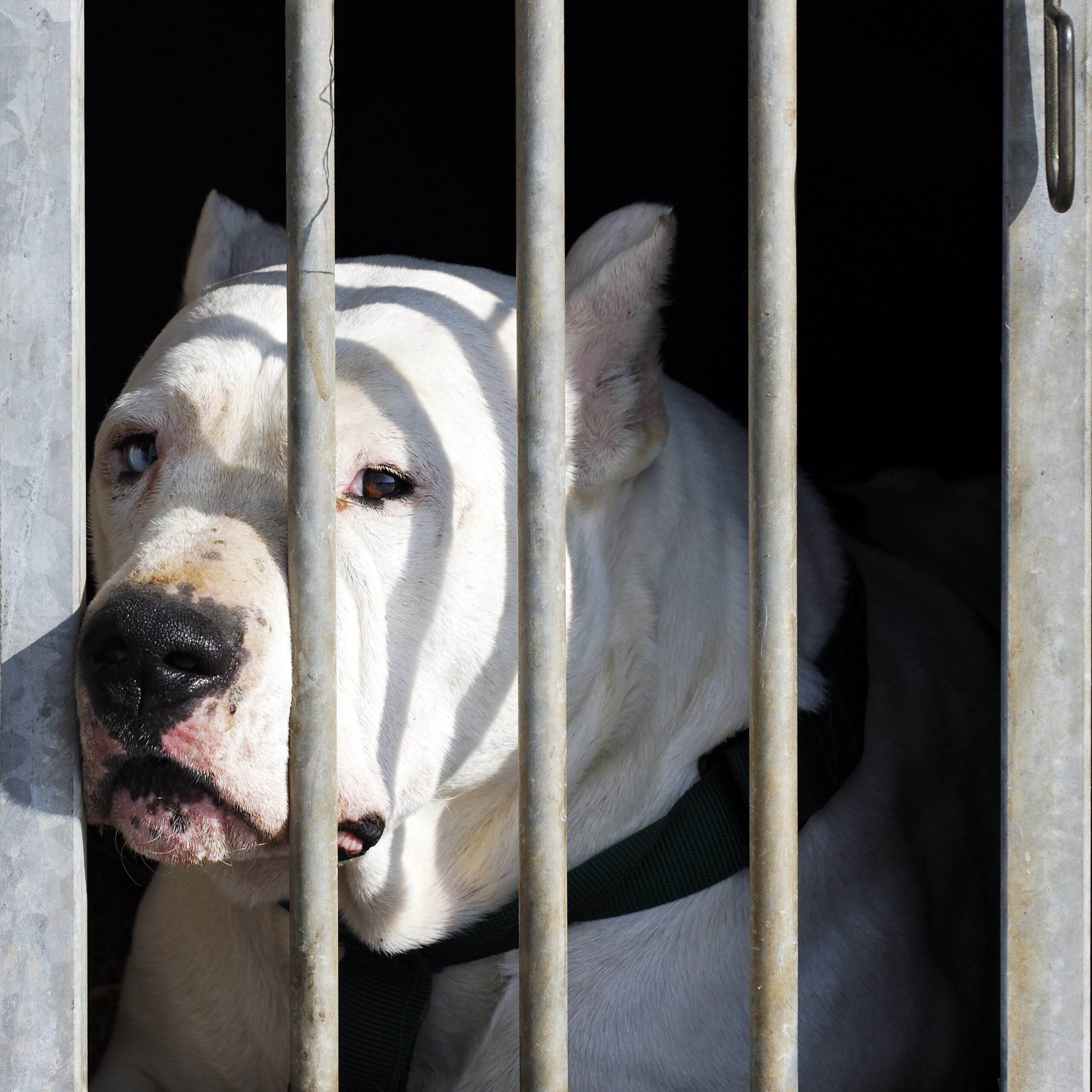
Nobody at the county shelter could remember the last time a sound had changed the temperature of a building.
Then the Malinois arrived.
Animal control brought him in on a Monday afternoon, two officers sweating through their uniforms and one bent kennel gate rattling loose in the back of the truck.
Black face. Tan body. Filthy from the road. So exhausted his legs shook underneath him.
And still, every single person who stepped toward that kennel saw the same warning in his eyes.
Come closer and I will do the job I was built to do.
Brenda Yates had run that shelter for eleven years and she had seen fear wear a lot of faces.
She’d seen puppies shake in laundry baskets. She’d seen old hounds press their faces into corners like they were trying to get through the wall. She’d seen dogs snap because pain had made the world too loud for them.
This one was different.
He wasn’t confused in the ordinary way. He watched doors. Hands. Feet. Keys. Shoulders. Breathing.
He studied people the way people study a storm coming in over a field.
By the second day he had refused food, flipped every water bowl they slid in, and hit the front of a kennel hard enough to split a weld.
By the third day they’d moved him into the old quarantine run.
Brenda hated that room. Concrete and steel. It was built for short emergencies, not for a living creature with a mind still burning behind his eyes.
But she had two young techs, one veterinarian, a lobby full of adopters, and a staff who had started flinching every time the back hallway shook.
Rules exist because fear spreads faster than compassion does.
That Tuesday morning, Samuel Gage rolled in the feed delivery like he always did.
He came every week in an old pickup with a cracked dashboard and hay dust in the bed. Tall in a quiet way. Weathered face, pale eyes, and hands that looked like they’d fixed fences and pulled calves and buried dogs and never once asked anybody for sympathy about any of it.
Most people saw a farmer.
Dr. Anya Sharma had always seen a little more.
Her father served twenty-two years in the Marines, and some things stay in a person’s body long after the uniform comes off.
Samuel stood too straight for a man who supposedly spent his life stooped over feed sacks.
He turned through doorways like he already knew where every exit was.
And he listened before he spoke. Always. Every time.
When the growl rolled down that back hallway, Samuel stopped with both hands still on the cart.
Maya stepped in front of him.
“Sir, I appreciate you bringing the feed, but you can’t go back there.”
He didn’t look offended. He looked past her, toward the quarantine door.
“Has he taken any water?”
That question was the thing that made Anya set down her chart.
Not did you give him water. Not is there water in the room.
Had he taken it.
That’s the question of a person who understands that an animal can be surrounded by help and still be completely unable to accept any of it.
Brenda answered before Maya could.
“No. He lunges. He knocks it over. We can’t get close enough to help him.”
Samuel nodded once.
It wasn’t approval. It was a man adding a fact to a map he was building inside his head.
Then Kevin Finch came through the front doors with a catch pole in one hand and the dart rifle in the other.
Kevin was good at his job most days. Young, strong, used to frightened animals becoming manageable the second the right tool came out of the truck.
But that Malinois had made him look foolish the day before, in front of two coworkers, and embarrassment can make a man a lot louder than he needs to be.
“Better clear out, pops,” Kevin said. “We’re about to have ourselves a little rodeo.”
Samuel looked at the rifle.
“The dart won’t work.”
The room paused around that sentence.
Kevin gave a dry laugh. “You a dog expert now?”
Samuel’s voice stayed low.
“A dog like that will read the dart as an attack. He’ll fight the drug until he can’t fight his own heart anymore.”
Anya felt the small hairs come up along her arms.
That wasn’t a guess.
That was experience.
Brenda was trying to hold on to the shape of the day.
There are forms for aggressive animals. There are risk notices. There are procedures for sedation and evaluation and, if everything else fails, for euthanasia.
She hadn’t slept well the night before, because that last word had already crept up onto the edge of the decision.
It wasn’t cruelty that had brought her there. It was responsibility with no better tool in its hand.
Samuel looked down the hallway again.
“He’s dying from fear.”
Nobody corrected him.
“He’s alone in hostile country,” Samuel said. “Everyone at that door is an enemy. He doesn’t know the rules anymore.”
Anya heard her father’s language in that sentence.
Hostile country. Rules. Enemy.
The man was standing there in boots dusted with feed meal. But something older and considerably sharper had just stepped forward behind his eyes.
“Let me try,” he said.
Brenda almost said no fast enough to save herself from having to think about it.
Then the dog slammed that chain against the concrete again and the whole shelter answered with terrified barking, forty animals at once.
Anya moved closer to Brenda.
“If we sedate him in this state, we may kill him.”
Brenda closed her eyes for one second.
A shelter director learns to make decisions that leave bruises nobody else can see.
When she opened them she looked at Samuel.
“If I let you in there, Kevin stays at the door.”
He nodded.
“If he moves wrong, Kevin fires.”
He nodded again.
Then he handed his work gloves to Maya, and her fingers were shaking when she took them.
The hallway seemed longer than it was when he started down it.
Kevin followed with the rifle. Anya followed Kevin. Brenda came last, hating every step and taking it anyway.
At the quarantine door Samuel lifted one hand to stop them.
He didn’t let Kevin swing the door all the way open. He opened it a crack. And then he waited.
The barking exploded. Then it slowly folded back down into a growl.
Samuel stood there through all of it without moving.
Patience isn’t doing nothing.
Sometimes patience is the first language a frightened creature can still understand.
“Lower the rifle,” Samuel said.
Kevin stiffened.
Anya gave him a look carrying every ounce of medical authority she had ever had.
The rifle came down.
Samuel slipped into the room and pulled the door nearly closed behind him.
Through the barred window, Anya could see the dog at the far end of that chain.
He was magnificent in the most painful way possible. Coat matted. Eyes red from exhaustion. A body built for speed and command, and every line of it bent into pure survival.
Samuel did not stare at him.
He checked the corners. The anchor bolt. The length of the chain. The door, the bowl, the floor drain.
Then he crouched down sideways and rested his forearms on his knees.
The dog snarled.
Samuel murmured something low. Anya couldn’t hear the words through the glass.
The dog stiffened.
It was the wrong language. Or almost the right one, which seemed to make the animal angrier.
Kevin brought the rifle up again.
“Wait,” Anya whispered.
Samuel stopped speaking.
He closed his eyes for half a breath.
And when he opened them he looked younger and very far away.
Then he whispered one word.
“Kestrel.”
The growl stopped.
It didn’t soften. It stopped, all at once, like somebody had cut a wire.
The dog’s head came up.
His teeth disappeared behind closed lips. His ears came forward.
And for the first time since he’d arrived at that building, the Malinois looked at a human being without measuring the space between them.
He looked at Samuel like he’d just heard home in one syllable.
Brenda made a sound behind the glass.
Kevin forgot to breathe.
Samuel didn’t move toward him yet. He waited. He let the animal finish crossing the invisible bridge between terror and memory at whatever speed it took.
Then he said, “Stand.”
The dog stood.
Not loosely. Not hopefully.
Precisely.
His body found its alignment the way a hand finds an old scar in the dark.
Samuel rose slowly and stepped forward.
The chain stayed taut. The dog did not lunge.
When Samuel reached the collar he showed both hands first, palms open, like he was asking permission from somebody who outranked him.
His fingers worked through the clasp with calm practiced care.
The Malinois lowered his muzzle and touched Samuel’s wrist.
The sound he made was not a growl.
It was a thin, broken whine.
Anya felt her eyes fill before she understood why.
The thing people call danger is sometimes just pain with no translator.
Samuel unclipped the chain.
The heavy links dropped against the concrete.
Every person outside that room flinched.
The dog did not.
“Heel,” Samuel said.
The Malinois moved to his left side and sat with his shoulder pressed against the old man’s leg.
No leash. No pole. No dart.
Just a word, a posture, and a trust that had somehow survived underneath all that fear.
Samuel opened the door and stepped out into the hall with the dog beside him, and that building went silent in a way no order could ever have produced.
Brenda covered her mouth with both hands.
Maya was crying openly.
Kevin lowered the rifle until it hung useless at the end of his arm.
For once in his life, he had no joke ready.
Anya looked from the dog to the man.
“Who are you?”
Samuel ran his hand once over the dog’s head.
And the Malinois leaned into it like he’d been holding himself upright for weeks and had finally been given permission to stop.
“Just a farmer now,” Samuel said.
Anya shook her head.
“No. That is a military working dog.”
Something in Samuel’s face changed at the word military.
Not much. Just enough.
“Something like that.”
Anya crouched down near the dog only after Samuel nodded that it was all right.
Inside the left ear, half hidden under road dirt, was the tattoo.
CX117B.
She wrote it down with hands that did not feel entirely steady.
Samuel saw the number and went quiet.
“Kestrel wasn’t a pet name,” Anya said.
“No.”
His eyes stayed on the dog.
“It was a call sign.”
That was the moment the shelter stopped being a place with an aggressive dog problem and became a place holding a veteran that nobody had known how to recognize.
Anya started making calls.
The first office transferred her twice. The second gave her a number that no longer worked. The third told her to send an email and allow ten business days.
Samuel sat on the floor of an open kennel while bureaucracy moved at the speed of cold honey.
Kestrel drank water out of a bowl held between Samuel’s boots.
He drank slowly at first, like he didn’t trust the world not to snatch it away from him.
Then he drank until the bowl was empty and Samuel refilled it and he drank that too.
Anya cleaned the raw patches on his legs where the road had worn him down.
He allowed it, because Samuel told him to allow it.
Kevin stood in the doorway watching with shame making him look about nineteen years old.
“Sir,” he said finally. And this time the word meant what it’s supposed to mean. “I’m sorry.”
Samuel looked up.
“You were trying to keep people safe.”
“No, sir.” Kevin shook his head. “I was trying to win.”
Samuel studied him for a moment.
Then he nodded.
“That’s different.”
Kevin took the correction, because it was true, and because it had been handed to him without any cruelty attached.
By late afternoon the calls finally reached a person who knew what that tattoo meant.
Kestrel had been retired off a classified military contract and transferred through a private security company.
There’d been a transport accident two states away. He’d escaped through a bent gate in the back of a truck.
For six weeks he had crossed roads and fields and drainage ditches and gas station lots with no handler, no command structure, and not one safe person anywhere in the world.
Every stranger who saw him had tried to catch him like a stray.
And every single attempt had confirmed exactly what his fear already believed.
The world had become enemy territory.
Brenda listened to that explanation with her eyes wet.
She thought about the form sitting on her desk. She thought about the line where her own signature would have ended him inside of about forty-eight hours.
Then she looked through the window at Samuel sitting on the concrete floor with one hand resting on Kestrel’s neck, and the dog asleep with his head in the old man’s lap.
Some rules protect life.
And some rules need a human being standing beside them to remember what life actually looks like.
The security company wanted to retrieve him by morning.
Brenda heard herself say no before she had any plan at all behind it.
Then she went and found one.
She told them the dog had bonded with a qualified former handler.
She did not say everything she suspected about Samuel Gage’s past. She didn’t need to.
She talked about risk and stability and retirement and the quiet farm outside town where the loudest sound most days is wind moving through pasture grass.
She talked like a woman who knows policy well enough to bend it toward mercy without breaking it.
By sunset the company had agreed to surrender Kestrel to the shelter.
And the shelter agreed to adopt him out to Samuel.
The paperwork took less time than the silence that came after it.
Brenda brought the folder back to the kennel and held it against her chest.
“If you’ll have him.”
Samuel looked at the dog.
Kestrel was awake now, sitting straight up, watching him the way only a working dog watches the person holding the next command.
For a moment the old man’s face looked as tired as the animal’s had that morning.
Then he blinked hard, twice.
“I reckon I’ve got room for one more,” he said.
Anya turned away to give him the dignity of not being watched too closely.
Kevin signed as witness. Maya brought Samuel’s gloves back, and she had folded them like they were something important.
When the kennel door opened, Kestrel stepped out and went to Samuel’s left side.
Nobody told him to.
He just knew where he belonged.
Samuel walked out through the lobby with the dog at heel, and every animal in that building seemed to go quiet as they passed.
At the front door, Brenda stopped him.
“Mr. Gage. How did you know the word?”
Samuel’s hand rested on Kestrel’s head.
“I helped build the first program that used them.”
It was a small sentence. It changed the size of the room.
“We didn’t call them dogs back then,” he added. “Not when it mattered.”
Anya thought about her father and understood before he said it.
“What did you call them?”
Samuel looked down, and the old dog’s eyes came up to meet his.
“Partners.”
Outside, the evening had turned gold across the parking lot.
Samuel opened the passenger door of the pickup.
Kestrel jumped up with careful strength, turned around once, and settled like he had practiced that exact motion a thousand times years before.
Samuel climbed in behind the wheel.
Before he started the engine, he reached to the dash and picked something out of the ashtray.
It was an old strip of leather with a collar tag on it, rubbed nearly smooth.
Anya, standing at the shelter door, saw only one word etched faintly into that metal before he closed his hand around it.
Kestrel.
The name hadn’t only saved the dog.
It had called back the part of Samuel Gage that had been standing quietly at attention for years, waiting for somebody to say it out loud.
The truck pulled out of the lot slow and steady.
In the passenger seat, the lost war dog sat facing forward, watching the road.
And on the farm road home, Samuel drove with one hand on the wheel and the other resting lightly on Kestrel’s neck.
Neither one of them looked rescued.
They looked relieved to be back on duty together.

Lila Hart is a dedicated Digital Archivist and Research Specialist with a keen eye for preserving and curating meaningful content. At TheArchivists, she specializes in organizing and managing digital archives, ensuring that valuable stories and historical moments are accessible for generations to come.
Lila earned her degree in History and Archival Studies from the University of Edinburgh, where she cultivated her passion for documenting the past and preserving cultural heritage. Her expertise lies in combining traditional archival techniques with modern digital tools, allowing her to create comprehensive and engaging collections that resonate with audiences worldwide.
At TheArchivists, Lila is known for her meticulous attention to detail and her ability to uncover hidden gems within extensive archives. Her work is praised for its depth, authenticity, and contribution to the preservation of knowledge in the digital age.
Driven by a commitment to preserving stories that matter, Lila is passionate about exploring the intersection of history and technology. Her goal is to ensure that every piece of content she handles reflects the richness of human experiences and remains a source of inspiration for years to come.