I stepped out of the shadows, and Ashley turned toward me, and every drop of color drained from her face.
Emily lifted her head slowly. The moment our eyes met, the heavy pot slipped from her trembling hands and slammed against the concrete floor with a sound that echoed through the service kitchen like the whole evening had been waiting for a signal to collapse.
Before anyone could speak, I reached into my jacket pocket and pulled out my phone. The screen was already lit. Already recording. Ashley’s eyes dropped to it for half a second, and in that half second, the confident mask she had spent years perfecting shattered completely.
“Daniel,” she whispered, and her voice sounded nothing like the sister I had grown up with.
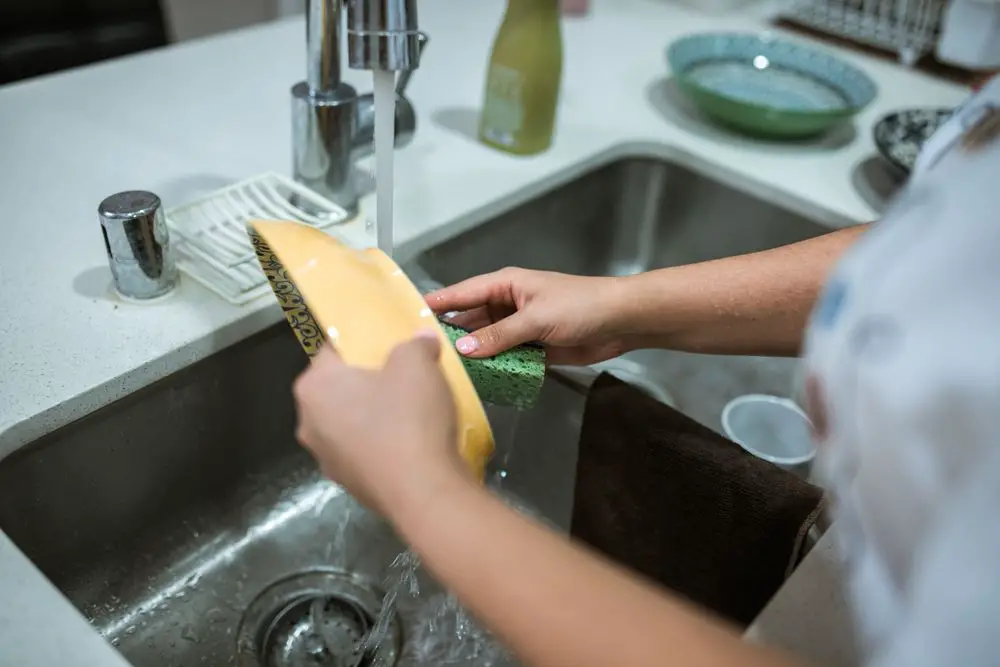
Behind her, the faucet still ran. Steam rose from the sink. Grease floated in cloudy rings over the dishwater. Emily stood frozen beside it, her red and cracked hands curled against her chest, as if she no longer knew whether she had permission to move in her own home.
That was the thing that broke me. Not the money. Not the party going on in my dining room. Not the toast my brother had made using my champagne in my house while I was working. It was the way my wife looked at me with fear before relief, and the way she held herself like someone who had learned to take up less space.
“Turn off the water,” I said.
Ashley blinked. “Daniel, I can explain—”
“I wasn’t talking to you.”
Emily reached for the faucet. Her fingers slipped. I stepped forward and turned it off myself, and up close I could see the rawness around her knuckles, the small cracks in her skin, the particular exhaustion that settles into a person’s face when they have been carrying something alone for too long.
“Emily,” I said, softening my voice. “Are you hurt?”
She opened her mouth and nothing came out.
Ashley made a sound that might have been a laugh if the room were different. “Daniel, this looks strange, I know, but Emily insisted on helping. She wanted to be useful. We were only keeping the house running while you were away.”
Emily flinched.
It was a small thing. Almost invisible. But I had come home specifically because something had felt wrong across the distance of twelve time zones and months of calls that sounded like yes when they should have sounded like something else.
“Say that again,” I said to my sister.
Ashley swallowed. “She wanted to help.”
I looked at my wife. “Is that true?”
For a long moment, Emily stared at the floor. Her shoulders trembled, not dramatically, not loudly, just enough to show how hard she was working to hold herself together.
Then she said, very quietly, “No.”
One word. Simple. Enough to change the temperature of the entire room.
Ashley’s face tightened. “Emily, don’t do this. You know how confused you’ve been lately.”
Something cold moved through me. “Confused?”
Ashley found her footing again, straightening as if she had remembered a script. “Yes. She’s been emotional. Overwhelmed. Forgetful. Our mother and I have both been worried about her for months.”
Emily shook her head. “That’s not true.”
“It is,” Ashley said, sharper, then recovered her tone when she noticed I was watching. “Daniel, you weren’t here. You don’t understand how difficult things became. She stopped answering calls, she wouldn’t leave the house, she was constantly crying—”
“Because you took my phone,” Emily said.
The words were quiet but the room received them like a stone thrown into still water.
Ashley stared at her. “I did no such thing.”
Emily looked up then. Her eyes were wet, but something steadier and more determined was building behind them. “You took my phone. You told me Daniel was too busy to hear from me. You said every message I sent made things harder for him, that he needed peace to work. You said if I kept reaching out, I would damage his reputation with his partners.”
My chest tightened with a specific and terrible recognition. I had wondered why her texts became shorter. Why her voice on the phone always seemed rushed. Why whenever I asked if she was okay, she said yes in a register that never quite sounded like yes.
“We were protecting you,” Ashley said to me.
“From his wife?” I said.
She had no answer.
From the dining room, laughter crossed the patio. Music moved through the glass. Someone called for more champagne. The sounds were careless and bright, and Emily seemed to shrink against them.
I moved so that I was standing between my wife and my sister.
“Go inside,” I said. “Tell everyone the party is over.”
“Daniel—”
I held up my phone. “Or I can go in there and play the last three minutes for them.”
Ashley’s eyes filled with panic, and she turned and walked toward the house with her heels clicking hard against the stone path.
The second she disappeared, Emily’s knees seemed to give. I caught her before she sank, and she apologized immediately, which was the saddest part of all, that her first instinct after everything was still to apologize to me.
“Don’t,” I said. “You have nothing to apologize for.”
She pressed her forehead against my chest and breathed, and I could feel each breath shaking through her. I had spent five years crossing time zones, buying properties, building a name, believing I was securing a future. I had measured my success in expansion and in press coverage and in the pride I felt when I saw my name attached to something that had not existed before. But standing there in the heat of the service kitchen with my wife’s damaged hands against my shirt, I understood something I had been too busy to learn.
A future meant nothing if I lost the person I built it for.
I took off my jacket and put it around her shoulders. “Come with me,” I said.
She looked toward the house. “They’ll be angry.”
“Let them.”
We walked inside through the back corridor. Emily moved carefully, the way a person moves when they have spent months being told they are fragile. I kept my hand around hers.
In the hallway near the laundry room, she stopped. She looked down at her soaked blouse, her stained apron, her bare feet in old rubber sandals.
This was my wife. The woman who had stayed awake beside me when I was writing my first business plan on a secondhand laptop. The woman who had worked double shifts when my first restaurant nearly failed. The woman who had once sold her grandmother’s bracelet so I could make payroll, and then smiled and told me jewelry didn’t matter.
And now she was ashamed to walk through her own home.
I reached into my pocket and took out the velvet box I had been carrying since the airport. Emily stared at it, confused. I opened it. The diamond necklace glittered under the hallway light, delicate and entirely out of place against the smell of soap and steam and dishwater.
“I bought this for you,” I said. “I thought I was coming home to surprise you.”
Her eyes filled. “Daniel.”
“I had a whole plan,” I said. “Dinner first. Maybe flowers. A speech.” I paused. “I’m not giving that speech anymore.”
She looked at me.
“Only if you want to wear it,” I said.
She was silent for a moment. Then she turned slightly and lifted her damp hair from her neck with trembling fingers. I fastened the clasp, and the necklace settled at her throat, and it did not fix anything. The stains were still there. Her hands were still raw. My family was still in my dining room eating food bought with money they had stolen from our peace. But Emily stood a little straighter. Not because of the diamonds. Because I had asked. Because she had chosen.
We walked into the dining room together.
The party had quieted but not ended. People still stood with drinks in hand, talking in clusters. My mother sat at the head of the table with the composed authority of a woman who considers any room she occupies her own territory. Michael was at the bar, pale and performing amusement. Ashley stood with her husband Brent, arms crossed.
My mother recovered first when she saw us, which was characteristic. “Daniel,” she said warmly. “What a wonderful surprise. You should have told us you were coming home.”
“I know,” I said. “That would have made things much easier for everyone.”
Her smile twitched.
She looked at Emily, and something cooled in her face before she smoothed it. “Emily, dear, go clean yourself up. We’ll speak with Daniel alone.”
Emily’s fingers tightened around mine.
“She stays,” I said.
“This is a family matter.”
“She is my wife.”
“And we are your family.”
There it was. The sentence my mother had used my entire life as a key that opened every lock. It had excused criticism, guilt, entitlement, demands. It had turned my success into an obligation and my limits into betrayal. She had used it for so long she probably no longer noticed she was using it.
I pulled out a chair for Emily. She hesitated. “Sit down,” I said gently. She sat.
I looked at the room. “To anyone who isn’t family: the party is over. Please see the staff for any outstanding payment. Everyone else, thank you for being here.”
Heels clicked. Car doors closed. The front door shut behind the last guest with a sound that felt almost like punctuation.
When the room was only family, my mother folded her hands. “You embarrassed us.”
I looked at her for a moment. “Emily was washing pots in the service kitchen while you wore jewelry bought with my money.”
Margaret’s eyes narrowed. “Careful.”
“I’ve been careful for too long.”
Michael pushed away from the bar. “Danny, come on. Don’t make this dramatic. You told Mom to manage the house.”
“I told Mom to make sure Emily had support.”
“She had a roof,” Ashley said quickly. “Food. Clothes.”
Emily lowered her eyes.
I turned to my sister. “Don’t speak about my wife as if allowing her to survive was an act of generosity.”
Brent cleared his throat. “Maybe we should look at the facts.”
I placed my phone on the table. “Good idea. The facts are: I’ve been sending money into accounts described as household expenses and family support. Two cars I never authorized are in my driveway. My wife has been isolated from me, denied her phone, treated as staff, and my family has been hosting parties in my home while I was working abroad.”
My mother’s voice sharpened. “You have no idea what we protected you from.”
That stopped me. Not because I believed her. Because she said it with the specific certainty of someone who has rehearsed that sentence until it feels like truth.
“What does that mean?” I asked.
Margaret looked at Emily, and Emily went very still.
“Should I explain?” Margaret said. “Or would you like to tell him?”
Ashley reached into her purse and removed a folded envelope with shaking hands. She slid it across the table.
Inside were photographs. Emily outside a medical building. Emily speaking to a man in a dark jacket. Emily getting into a silver car that was not ours. Dates printed in the corners from the last three months.
My heart changed rhythm.
“What is this?” I asked.
Emily closed her eyes briefly. When she opened them, something had resolved in her expression.
“That man is a doctor,” she said.
My mother laughed softly.
“His office is above a clinic,” Emily continued. “I used that entrance because it was the only way I could be dropped off without the driver reporting back to Margaret.”
I looked at my mother. “You were having her followed?”
Margaret said nothing.
Emily pressed on. “Three months ago, a bank statement came to the house by mistake. It was for one of the accounts your mother said was used for household expenses. I opened it because our names were both on the property. There were withdrawals I didn’t recognize. Transfers to companies that didn’t exist in any records I could find. I asked Margaret about it.”
“You accused me in my own home,” my mother said.
“In my home,” Emily said.
The room held those three words.
Emily looked at me. “After that, everything changed. My phone disappeared. The household staff started answering to Ashley instead of me. Margaret told everyone I was unstable. She said if I contacted you, it would affect your business relationships. That you were under pressure and needed peace.”
I looked at my mother. “Did you tell her that?”
She said nothing.
Emily wiped her cheek. “Rosa helped me. Your housekeeper, the one your mother said quit.”
“Rosa didn’t quit,” I said.
“She was fired because she saw Ashley yelling at me. Before she left, she gave me the number of her cousin. He works as a financial investigator. That’s who’s in the photographs.”
I stared at the pictures again. The man in the dark jacket. The parking lot. The clinic entrance. I had been handed the evidence of my wife’s resourcefulness and been expected to read it as guilt.
“What did the investigator find?” I asked.
Emily glanced at Margaret, then looked back at me. “Shell companies. At least three. Some payments listed as consulting fees. Others as property management. One company had Ashley’s name. Another had Michael’s.”
Michael cursed under his breath. “That’s not what it sounds like.”
“What does it sound like?” I asked.
He looked trapped. “Mom said it was temporary. That you owed us. After everything she gave up.”
Ashley snapped, “Don’t put this on me. Mom handled the accounts.”
Brent touched her arm. “Ashley.”
“No,” she said, voice rising. “I am not going down for something I didn’t set up.”
My mother turned slowly toward her daughter.
The room went cold.
Ashley’s voice cracked. “You told us he would never check. You said he trusted you completely.”
My mother’s expression did not change, but her silence was its own confession.
I felt Emily’s hand find mine under the table. My wife had survived this alone for months. Doubted. Watched. Isolated. Maneuvered by people I had invited into her life by trusting them with mine.
I looked at my mother. “How much?”
She lifted her chin.
“How much?”
Emily reached into the pocket of her apron and produced a folded sheet, damp at the edges from being hidden too long inside the work of pretending everything was ordinary. She placed it on the table.
I unfolded it.
The number at the bottom did not ruin me. It would not. But it represented something money cannot quantify: the years I had spent believing I was building safety while the people inside my home were quietly dismantling it.
My mother finally spoke. “You were going to waste it.”
I looked at her.
“You married a woman with no experience in what our family could become. You were giving money to employees, funding scholarships, buying properties in neighborhoods no serious person would touch. I made choices. I sacrificed. Then you became successful, and suddenly I was meant to step aside while she played mistress of a house she never earned.”
Emily’s face tightened. She did not look away.
“I kept this family alive,” Margaret continued. “Your father died leaving nothing but debts and pride, and I made something from what remained. I am not ashamed of that.”
I stood. “Emily never played anything. She is the owner of this house.”
“Because she loved you when you were poor? And that entitles her to everything you built?”
Emily stood too. The necklace at her throat caught the light.
I stepped toward my mother. “You don’t know her at all.”
“I know she made you weak.”
“She made me human,” I said. “There’s a difference.”
For the first time that evening, my mother looked wounded rather than calculating. And I understood, standing there, that she might even believe her own version of events. That the story she had told herself for so long had become indistinguishable from what she considered truth.
That understanding didn’t excuse what she had done. But it clarified something about the kind of harm people are capable of when they have convinced themselves they are being generous.
An hour later, my family was gone.
Security changed the codes. My mother paused at the front door on her way out and looked at me with the expression of someone who expects to resume a conversation later from a position of greater strength. “This isn’t finished,” she said.
“I know,” I said. “But tonight it is.”
When the doors closed, the house held us in a silence that felt enormous. Emily stood in the middle of the dining room, her borrowed courage fading now that the performance was over.
“Come upstairs,” I said.
In our bedroom, she looked immediately at the armchair near the balcony, where a folded blanket sat beside it.
“You’ve been sleeping there,” I said.
She nodded, embarrassed. “Your mother moved into our room for a while. After she left, I couldn’t sleep in the bed. It didn’t feel like ours.”
I sat down slowly.
Emily went to the bathroom and stood at the sink, looking down at her hands. “I don’t understand why I let it get this bad,” she said.
I leaned in the doorway. “Because they isolated you. They made you doubt yourself. You were trying to protect me.”
She shook her head. “I should have been stronger.”
“You survived in a house full of people working to convince you your voice didn’t matter,” I said. “That is what strength looks like when no one is watching.”
She looked at me in the mirror. “I was angry at you.”
“I know.”
“You kept saying you were building this for us. But you were never here. Every time I needed you there was another flight, another opening, another emergency only you could handle.”
The honesty of it landed precisely where it was meant to.
“I thought providing was the same as being present,” I said.
“It isn’t.”
“I know that now.”
She turned around, tears sliding quietly. “Do you? Because I don’t need a mansion, Daniel. I never did. I needed my husband.”
I crossed the room and took her hands, careful around the raw places. “You have him. Not the version who calls from airports. Not the one who sends gifts instead of coming home. Me. Here.”
She searched my face. “I canceled the Singapore expansion,” I said. “Before I flew back. I restructured the company. I’m stepping back from daily operations. I was already planning to when I got on the plane, before I knew any of this had happened.”
Her eyes widened.
“I could feel something slipping between us,” I said. “I didn’t know what it was. I told myself it was the distance. But I was afraid it was something I had done and wouldn’t be able to name until it was too late.”
Emily covered her mouth.
“I came home to give you a necklace,” I said. “But really I came home because I missed my wife.”
For the first time that night, she stepped into my arms without trembling, without apology, without the particular carefulness of someone who has learned to ask permission before asking for comfort.
Later, after she showered and changed, I made tea in the small breakfast kitchen she had always loved because it caught the morning sun. She sat at the island, ointment on her hands, watching me fail to find the right cabinet.
“You still don’t know where anything is,” she said.
Something small and real moved into her voice.
“I own the house,” I said. “I never claimed to understand it.”
She almost smiled.
“What happens now?” she asked.
“Lawyers in the morning. Full audit. We document everything properly and see what the evidence actually shows.”
“And your family?”
“They’ll have the chance to be honest. What comes after that depends on what they decide to do with it.”
She looked at her hands. “There’s something else.”
My stomach tightened. “What?”
“Something I found before tonight. Before any of this came to a point.” She slipped off the stool and went to the small drawer beneath the built-in desk, removed a plain envelope, and placed it on the counter.
My name was written on the front. Not Daniel. Danny. The way only one person in my life had ever written it.
My father.
My hands went cold.
He had died when I was nineteen. Heart attack, my mother had always said. Sudden. No time for goodbye. No money left, only debts and warnings about becoming too soft for the world she had needed me to be ready for.
I opened the envelope.
The paper was yellowed at the edges, but the handwriting was unmistakable.
Danny,
If you are reading this, it means your mother kept this from you longer than I hoped she would. I am sorry. There are things I should have told you myself, but I thought I had more time.
I looked up. Emily was watching me with the careful attention of someone who has already read a thing once and is now watching someone else discover it.
I read on.
There is money set aside for you. Not much compared to what I pray you will build one day, but enough to give you a start and keep you free from anyone who tries to control you. The trust is in your name, though Margaret has temporary authority until you turn twenty-five. After that, it belongs only to you.
I set the letter down.
I was thirty-five.
“There’s more,” Emily said quietly.
I also need you to know the truth about why I left the company. I was not ruined by bad luck. I was betrayed by someone close. I have proof, but I cannot keep it in the house. If anything happens to me, find Leonard Shaw. He will know what to do.
I folded the letter.
Leonard Shaw. My father’s attorney. A name my mother had spent years explaining away as a man who had vanished after betraying our family, a man not to be trusted, a man who had stolen from us in our most vulnerable moment.
Before either of us could speak, the landline rang.
Emily startled.
Nobody used that number except security, management, and a handful of contacts from the years before I switched everything to mobile.
I answered.
“Mr. Cole?” I said.
A pause. Then an older man’s voice, calm and measured.
“Daniel. This is Leonard Shaw. I was told you came home tonight. There is something you need to know before your mother reaches me first.”
For a moment, I could not speak.
Emily looked at me, and I turned the phone so she could hear.
Leonard’s voice continued. “Before your father passed, he asked me to protect certain documents. He believed you would come looking for them one day. When you didn’t, I assumed Margaret had succeeded in keeping you away. She apparently had.”
“Why are you calling now?” I asked.
“Because Rosa contacted me.”
Emily’s breath caught.
“Your housekeeper,” Leonard said. “She was frightened. She said Margaret had been searching the house recently. Then tonight, she called again to say you had returned and removed your family from the property.”
I looked at Emily.
She whispered, “She knew. She was watching even after she left.”
Leonard’s voice softened. “Daniel. Your father did not lose everything. He protected part of it. He created a trust for you with temporary administrative authority given to Margaret until you turned twenty-five. After that, legally, control should have transferred to you entirely.”
“She never told me.”
“No. And the records I have suggest she continued moving assets for years afterward.”
I gripped the counter. “There’s more?”
“Your father also believed he had been betrayed. Not simply by bad fortune. He believed someone inside his circle was working against him. He named your uncle Victor.”
The name landed with unexpected weight. Victor. My father’s older brother. A man I had met only a few times as a child, always arriving with gifts and leaving before dinner ended. My mother had told me he moved overseas after my father’s death, that grief made it impossible for him to stay.
“Meet me tomorrow morning,” Leonard said. “I’ll send the address from a secure line. Bring Emily. And Daniel: do not let Margaret back into the house for any reason tonight. Not for clothes, not for photographs, nothing.”
“What is she looking for?”
Leonard answered quietly. “The same thing she has been afraid of for sixteen years. Proof that your father trusted someone else more than he trusted her.”
The line clicked dead.
Emily and I sat in the small kitchen for a while without speaking, each of us inside our own version of what we had just heard.
Then she said, “When your father said not to let Emily become someone who lives on the leftovers of your ambition.”
I looked at her.
“He knew something,” she said. “About how easy it is to believe you’re giving someone everything while actually leaving them with nothing.”
I set down my cup. “I thought I was building a life for us.”
“You were building a life. You just kept leaving me in it alone.”
The words were honest without being cruel. That was the thing about Emily, the thing I had taken for granted and nearly lost. She had never needed me to be perfect. She had needed me to be present.
We arrived at the café Leonard had chosen just before ten the next morning. He was already seated at a corner table, older than I expected, silver-haired and careful in his movements, but with eyes that were sharp and attentive behind wire-rimmed glasses.
He stood when he saw us.
“Daniel,” he said. My name in his voice carried something older than recognition.
He turned to Emily. “Mrs. Cole.”
She nodded. “Thank you for calling.”
“I should have found a way sooner,” he said.
He had a leather folder on the table, worn at the edges. Before he opened it, he looked at me.
“Your father loved you deeply,” he said. “Whatever you discover in these documents, do not let anyone convince you that he abandoned you or left you unprotected intentionally. He made mistakes. He trusted some people too long. But he was always trying to build something for you.”
Emily reached under the table and took my hand.
Leonard opened the folder. Trust agreements. Bank records. Property deeds. Old letters. And a small digital recorder in a sealed sleeve that I looked at immediately.
“We’ll get to that,” Leonard said.
He walked me through the documents with the patient precision of someone who has been holding a story for sixteen years and wants to tell it correctly. My father’s trust, established when I was seventeen. Temporary administrative authority given to my mother. Transfer of full control to me on my twenty-fifth birthday.
Then a series of amendments that Leonard had not drafted and could not verify as legitimate.
Returned certified mail sent to addresses where I had supposedly lived. A signed statement waiving contact with Leonard’s office, made in my name, with a signature that was almost mine.
“I never signed that,” I said.
Leonard nodded. He pulled out another document. A deed to a building downtown.
The address made everything in my chest go quiet.
“That’s my first restaurant,” I said.
Emily turned to me.
“The building you thought you were renting,” Leonard said, “belonged to a holding company your father created years before he died. The rent was structured to be accessible. He wanted to give you a foundation without making it feel like charity.”
Emily’s hand tightened around mine. “He helped you,” she said softly.
I had spent years believing my first restaurant was the proof that I had built something from nothing. That I was the first in my family to create real success. That I had overcome whatever weakness my father had represented.
I had not started from nothing. I had started from love. Quiet, invisible, carefully arranged love that had been waiting for me in a building downtown, and no one had told me.
Leonard placed the recorder on the table.
“Would you like to hear him?” he asked.
The café sounds faded around us. I looked at Emily. She nodded, and I saw the tears already in her eyes before the recording began.
Static. A cough. Then my father’s voice, older than I remembered it but unmistakable.
“Danny, if you’re hearing this, then I owe you an apology.”
My throat closed.
“I wanted to tell you everything myself. But fathers make the mistake of thinking there will always be more time.”
Emily bowed her head beside me.
“You are seventeen right now, and I can see in your face how afraid you are of becoming me. I notice, son. I notice everything.”
I closed my eyes.
My father’s voice continued. He spoke about the trust, about Victor, about his belief that he had been betrayed from inside. He spoke carefully, without anger, with the measured honesty of someone who knows a recording may be the last conversation he gets to have.
And then, near the end, he said the thing that made me understand he had seen clearly what I had not.
“Build something honest. Love someone who sees you before the world applauds you. And when you find that person, do not make her live on the leftovers of your ambition.”
The recording ended.
None of us spoke for a long moment.
Then Emily said, barely above a whisper, “He knew.”
She was not crying with sadness. She was crying with the particular relief of someone who has been misunderstood for a very long time and has just been told, by someone they will never meet, that they were always worth understanding.
Leonard pushed toward me one final document. The property. The downtown building. A note clipped to the deed in my father’s handwriting: For Danny. When he’s ready. Leave him the door but don’t carry him through it.
I sat with that for a while.
On the drive home, Emily rested her head against the window. The city moved past in ordinary pieces: traffic lights, palm trees, a father carrying a sleeping child across an intersection. She was quiet, and so was I, and the quiet between us felt different from the silence of the last few years. Less like distance. More like two people finally occupying the same moment.
I reached for her hand.
She gave it without looking away from the window.
“When this settles,” she said, “I want to go back to the first restaurant.”
“Why?”
“Because your father was there, in a way. And because that place was ours before everything got so large and complicated.”
I smiled faintly. “You hated the freezer.”
“I still hate the freezer.”
“And the ceiling.”
“The ceiling was a problem.”
“But you loved the corner booth.”
Her smile came in, soft and real. “Because that’s where you fell asleep over the menu and I drew a mustache on you with eyeliner.”
“That was a serious business meeting.”
“You drooled on the appetizer list.”
I laughed. Not loudly. Not because everything was resolved. Because something living had survived everything done to bury it.
When we reached the gates, security met us with news that my mother had attempted entry. She had left a note.
Emily read it aloud, quietly: You think Leonard is telling you the truth because your father trusted him. Ask him why your father changed the second trust two days before he died. Ask him who the hidden beneficiary really is. And ask your wife why Rosa knew where to find that letter.
Emily lowered the note.
The question in it was real. The way my mother had constructed it, targeting Emily specifically, suggested she was looking for a wedge. But it also suggested she was frightened of something specific. The kind of frightened that comes not from guilt but from a particular fact she did not want surfaced.
I photographed the note and sent it to Leonard.
Then my phone buzzed. An unknown number. One photograph, no caption.
A blue leather ledger on a wooden table. Beside it, an old family photograph. My father. My mother. Victor. Leonard Shaw.
And standing slightly apart from the others, younger but recognizable: Rosa.
Emily looked at the screen.
“Daniel,” she said.
I stared at the photograph for a long time.
Whatever the next chapter of this held, whatever Rosa’s presence in that photograph meant, whatever my mother had been protecting and whoever had finally decided to stop protecting it along with her, I understood one thing with complete clarity.
The truth my father had spent the last weeks of his life trying to preserve had survived him.
It had waited in a letter behind a drawer in a borrowed room.
It had waited in the careful notes of a man who kept the ledger when everyone else stopped keeping records.
It had waited in the courage of a woman who hid documents in the pocket of an apron and kept walking.
I took Emily’s hand and we went inside together.
The door opened on everything that was still to be learned.
We walked through it without hesitating.

Specialty: Emotional Turning Points
Rachel Monroe writes character-driven stories about betrayal, second chances, and unexpected resilience. Her work highlights the emotional side of family conflict — the silences, the misunderstandings, and the moments when someone quietly decides they’ve had enough.