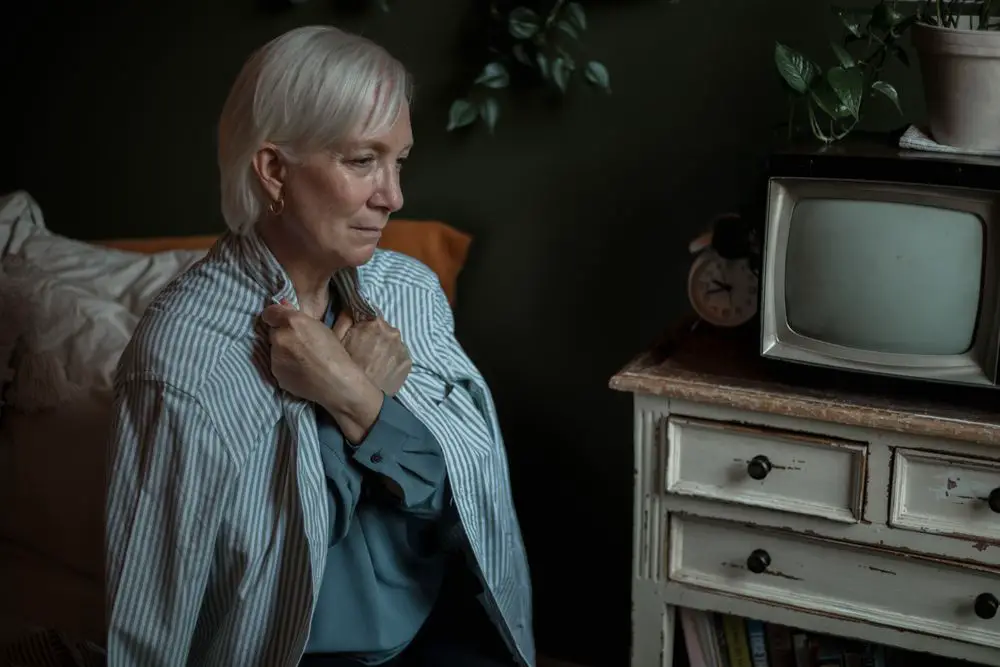
My daughter-in-law changed the locks while I was at church. When I came home, my own key did not work. I stood on the porch holding a Bible in one hand and a still-warm casserole dish in the other, staring at a door I had walked through for thirty-one years, and I did not understand at first what I was looking at. The key slid halfway in and stopped. I pulled it out and checked it, as though I might have grabbed the wrong one, though I had carried only that one key on my ring since the summer we moved in, back when Marcus was small enough to ride on his father’s shoulders through the empty rooms.
Through the front glass I could see Renee sitting on my couch, her legs crossed, scrolling through her phone the way a person waits for a bus. She had the ease of someone in her own living room. Behind her, my son appeared in the hallway, and when our eyes met through the window, he looked away first. He looked down at the floor like a boy caught taking money from my purse, except he was not a boy anymore, and this was so much worse than money.
That single glance told me everything I needed to know. She had not done this alone. He had agreed to it. He might even have suggested it. A woman can lock a door, but a son has to hand her the reason.
I knocked. She took her time. When she finally opened it, she leaned against the frame with one hip and looked at me the way you look at a delivery that came on the wrong day.
“We thought you’d be gone longer,” she said.
Not hello. Not sorry. Not even a clumsy, embarrassed excuse to paper over what she had done. Just a flat little note of disappointment that I had come home too soon and interrupted whatever this was meant to be before it was finished.
My name is Lorraine, and until that Sunday afternoon, I still believed that grief was the hardest thing I would ever have to survive.
James had been gone less than a year. I was still reaching for him in a hundred small, involuntary ways. In the recliner in the corner that still held the shape of his shoulders. In the coffee mug no one else was allowed to use. In the quiet weekly rhythm of church and home and the long slow work of trying to make peace with being the one left behind. I had thought that was my whole task now, learning to live in a house full of a man who wasn’t in it. I had no idea that the house itself was about to be taken out from under me.
I stepped inside and set the casserole down on the counter. My hands were steady, which surprised me even then, but something underneath had already shifted, the way the ground shifts a half second before anyone actually feels the earthquake.
Marcus stood near the hallway with his arms folded across his chest, and he would not look at me. I asked him, as calmly as I could manage, why the locks had been changed.
He cleared his throat. “Renee thinks it’s best if we manage who comes and goes,” he said. “For security.”
Security. In the house where I had raised him. Where his father and I had carried him through chickenpox and thunderstorms and every childhood nightmare, where we had measured his height in pencil marks on the inside of the pantry door, marks that were still there, that Renee had painted around rather than over because painting over them would have taken more effort than she cared to spend on my memories.
Renee smiled at me then, the kind of smile that has teeth hidden somewhere behind it. “You’ll get a copy of the new key eventually,” she said. “Once we figure out the arrangement.”
I asked what arrangement she meant.
She glanced at my son, and it was the particular glance married people share when they have rehearsed a thing in the car on the way home and are now performing it for an audience. He finally spoke, and his voice came out stiff, like he was reading from a card someone else had written for him.
“Mom, we need to talk about the house. Renee’s student loans, all of it. We need three hundred and twenty thousand dollars, and we need you to either help us or step aside so we can refinance.”
Step aside. That was the phrase. In the home James and I had paid off three full years early, the two of us sitting right at that kitchen table with the final statement between us, holding hands like teenagers. In the house where we had brought Marcus home from the hospital wrapped in a yellow blanket, where we had sat up with him through fevers and bad dreams and the first heartbreak he swore would kill him and no longer even remembered. And now my own son was standing in the hallway asking me to step aside from all of it, because his wife had done some arithmetic and decided I was in the way of the sum.
James used to tell me, “People do not show you who they are when life is easy, Lorraine. They show you when they want something you have.” At the time I would laugh and tell him he sounded suspicious for no good reason, that he saw angles everywhere because he’d spent his working life around men who cut corners. Standing in my own kitchen with a shiny new deadbolt on the door behind me, I understood at last that my husband had not been suspicious. He had simply been right, and he had been right about it long before I was willing to be.
I did not always see my son this way, and I want that written down somewhere, because a mother should be honest even when honesty costs her. For most of his life, Marcus was the kind of boy who made strangers smile in grocery store lines. He was gentle as a child, tender in a way that worried his father a little. He brought home stray cats. He cried in the fall because he was certain the trees were hurting when their leaves came down, and no amount of explaining seasons to him would settle it. James used to say that Marcus had enough heart for three people but not always quite enough spine for one, and I did not understand what he meant back then. I understand it now, standing on this side of a changed lock. A man can be soft everywhere a person is supposed to be strong, and softness in the wrong places just means he bends toward whoever is pushing hardest.
Marcus and Renee were only supposed to stay with me for a few months after the wedding, while they saved for a place of their own. That was two and a half years ago.
The first year, I kept telling myself it was temporary, that young people need a running start, that James and I had gotten one from his parents and it was only right to pass it forward. The second year, I began to notice how easily the word temporary can quietly harden into the word territory. Renee rearranged my kitchen so that I could no longer find my own spices in my own cabinets. She replaced the curtains I had sewn myself. She ordered new furniture and had the delivery men carry mine out to the curb without so much as asking, and she began to speak about my home in a tone that turned possession into assumption, that made me feel like a long-term guest in the rooms where I had spent my entire adult life.
When she moved James’s recliner out to the garage without a word to me, I found my voice and told her that chair was staying exactly where it was. She rolled her eyes. “It’s just a chair, Lorraine,” she said. “You can’t live in the past forever.”
I waited, in that silence, for my son to defend me. For him to say that it was his father’s chair, that it mattered, that his mother mattered. Instead he studied the floor and said, “She has a point, Mom.” And that was the moment something cold slid into the space between us and settled there for good. It was not a fight. Fights I could have handled. It was something quieter and much worse. It was distance, opening up between a mother and the child she had carried, and I could feel it widening even as I stood there.
After that, Renee began to talk about money the way some people talk about the weather, constantly and casually and always as though the damage were somebody else’s doing. She made little remarks that were never quite complaints, about how unfair the world had become for young couples, about how people who owned their homes outright simply could not comprehend the pressure her generation was under, about how four bedrooms was an awful lot of space for one person to be rattling around in all alone. Then, so gradually I almost did not track the change, “your house” became “our house.” And then “our house” became “the house we really need to do something about.”
The morning they changed the locks, I finally understood that I was no longer being nudged toward the exit. I was being managed toward it.
That night, Renee sat across from me at the kitchen table with a glass of red wine in one hand and a folded document in the other. She slid the paper across to me the way a waiter slides over the check, and told me that this was simply the cleanest path forward for everyone. A quitclaim deed. I would sign the house over to Marcus, they would refinance it against the equity, pay down what they owed, and I could stay on in the guest room for as long as I needed to.
The guest room. I had a master bedroom, the one James built the closet shelving for with his own two hands, and they were offering me the guest room in my own house and calling it a kindness.
I did not shout. I asked to see the refinance terms. I asked for the loan breakdown, the interest rate, the repayment schedule, the numbers a person is entitled to see before signing away the roof over her head. Marcus sighed the long-suffering sigh of a child whose mother is being unreasonable at bedtime. “Mom, just sign it,” he said. “We can go over all the details later.”
I said no.
Just that. One word, plain and quiet, set down on the table between us.
Renee’s face changed first, the smile falling away to show what had always been behind it. Then Marcus’s changed too. It was the particular look people get when the person they have been steadily pushing plants her feet at last and simply stops moving. Renee leaned back in her chair and let a silence stretch out, and then she said, very softly, in a voice with no wine-warmth left in it at all, “Think carefully, Lorraine. You are not in a position to say no forever.”
A few nights after that, I was lying in my bedroom in the dark with the light already off when I heard Renee out in the hallway, laughing on the phone. She thought I was asleep. The house was quiet the way it only gets late at night, and her voice carried.
At first I caught only fragments. My name. The house. Something about Christmas. And then I heard the piece that turned every conversation before it into so much smoke.
“Once we refinance, I’ll pay off the cards, and then we flip the house in a year, easy.”
The cards.
Not student loans. Credit cards. Three hundred and twenty thousand dollars of spending, dressed up in a cap and gown so that my son could repeat it out loud without ever once hearing how ugly it truly was. Trips, I would learn later. Clothes. A leased car. A lie polished so smooth and so often that Marcus had stopped feeling the edges of it. And then, out in my own hallway, she laughed again and said the thing I will carry to my grave.
“These old women are all the same. They’d rather lose everything than make a scene.”
I lay perfectly still and stared up at the dark ceiling until her footsteps faded away toward the master bedroom that used to be mine. My hands were cold under the blanket. But my mind, for the first time in months, since well before James died, was absolutely clear.
Because James had left me something.
Two weeks before the stroke that took him, he had placed a sealed manila envelope in the bottom of my dresser drawer, underneath the winter sweaters, and he had held both my hands and told me, “Lorraine, if things ever go sideways, and I’m not here to help you, you open this. Not before. And you don’t let another living soul see it but you.” I never asked him what was inside, because James was not a man who spoke in warnings unless he had already thought the whole thing three steps ahead and knew exactly what he was doing.
For five years that envelope sat untouched beneath the sweaters and a bundle of old birthday cards. Even after he was gone, I could not make myself open it. Opening it felt too much like admitting he was never coming back to sit at the table and explain it to me in that low, patient voice.
But after the changed lock, and the quitclaim deed slid across my own table like a bill, and the glossy assisted-living brochures that had started appearing on the kitchen counter as if by accident, and the soft little threat delivered over a glass of my own wine, I finally understood what my husband had meant by sideways. This was it. This was the day he had seen coming from five years off.
I got out of bed, crossed the dark room, and knelt down beside the dresser James had built with his own hands the first year we were married. The envelope was still there at the very bottom, the tape gone yellow and brittle at the edges. I lifted it out and held it for a long while. It was not heavy. But it felt important in the way a key feels heavy in your palm when you don’t yet know which door it opens, only that whatever waits on the other side is going to change everything that comes after.
Downstairs I could hear Renee moving through my kitchen, opening and closing my cabinets, already living inside the walls as though the paperwork were only a formality. Somewhere in the house my son was lying awake or asleep, still choosing his silence and still calling it keeping the peace. I sat on the edge of my bed with James’s envelope in my lap and listened to that woman make plans for the rest of my life as though I were already dead and gone. And then I slipped my finger under the brittle old tape and opened the one thing my husband had told me to save for the day everything turned ugly.
Inside were three things. A letter in James’s blocky, careful handwriting, the hand of a man who had filled out city work orders for twenty-seven years. A smaller sealed envelope, thick, with a lawyer’s name and a downtown Richmond address printed in the corner. And a single brass key on a plain ring, taped to an index card, with an account number written beneath it in his numbers.
I read the letter first. I read it three times, and by the third time I was no longer cold at all.
Lorraine, it began, if you are reading this, then either I am gone or I am not myself anymore, and you have run into the kind of trouble I always prayed you wouldn’t. You were never suspicious enough for your own good, and that is one of the things I loved most about you, so let me be suspicious for the both of us one last time.
He wrote that he had never fully trusted the ease with which our son bent to whoever stood closest, that he had watched Marcus give away his lunch, his allowance, his backbone, to anyone who asked with enough confidence, and that he had married a good boy who would one day need protecting from himself. He wrote that he had not liked what he saw beginning in Renee even in the short while he knew her before the stroke, the way she counted the rooms of our house with her eyes when she thought no one was watching.
So here is what I did, he wrote, and I did it quietly, and I did it right, the way I do everything.
The house, James wrote, was never as simple as our son believed it to be. Three years before he died, on the advice of the very lawyer whose name was on the inner envelope, James had placed our home into a living trust. Not in his name. Not in mine to sign away under pressure at a kitchen table. In a trust, with me as the trustee for my lifetime, and the property protected from exactly the kind of refinancing scheme a desperate person might try to talk a grieving widow into. The house could not be quitclaimed. It could not be borrowed against. It could not be flipped in a year by anyone but me, and I had no intention of flipping anything. Any deed Renee put in front of me was worth precisely nothing, and had been worth nothing from the first night she slid one across the table.
And the accounts, he wrote. You know about the ones I told you about. There are others. The key goes to a safe deposit box, and the account number is what’s left of thirty years of overtime I never spent on myself. It was always meant to be yours, to keep you comfortable and free and beholden to no one. Do not let anybody convince you it belongs to them. It doesn’t. It’s yours, and after you, it’s yours to give to whoever has actually earned it.
The last line was the one that undid me, sitting there on the edge of my bed in the dark.
Don’t move into the guest room, Lorraine. It’s your house. It was always your house. Make them leave.
I folded the letter along its worn creases and I sat with it a long time while the house went quiet below me. And I understood that James had done more than leave me money and a trust and a key. He had reached forward five years through his own death to put his hand on my shoulder on the worst night of my life and tell me I was not, in fact, alone, and that I was not, in fact, powerless, no matter how carefully the two people downstairs had worked to make me feel like both.
I did not confront them that night. That was the old Lorraine’s instinct, the one who wanted to fix things before dawn, who could not bear a bad feeling in the house overnight. But I had heard Renee laughing in the hallway, and I had read my husband’s letter, and I was learning something new about myself at sixty-three years old. Some things are better done in daylight, with a lawyer’s phone number in your pocket and the tape already peeled back from the truth.
I slept, and I slept well, which I had not expected.
In the morning I dressed carefully, the way you dress for something that matters. I made myself coffee in my own kitchen while Renee watched me over the rim of her cup with a wariness she couldn’t quite name, because I was moving differently and she could feel it even if she couldn’t see the reason. Then I told them both, pleasantly, that I would be out for a few hours running errands, and I drove downtown to the office of the lawyer whose name James had printed on that inner envelope five years before.
His name was Mr. Okafor, and he was an older man now, close to retirement, and when I said my husband’s name his whole face softened. “James,” he said. “I wondered if this day would ever come. He surely hoped it wouldn’t.” He remembered everything. He pulled the trust file, thick and complete and unassailable, and he walked me through it line by line the way James would have wanted, slowly, patiently, making sure I understood every word before we moved to the next. The house was mine to control, fully and legally, and no signature obtained under pressure at my own table could touch it. The accounts were mine. And the two people currently occupying my home had exactly as much right to be there as I chose to grant them, and not one inch more.
“They’re not on the deed,” Mr. Okafor said. “They’re not on a lease. In the eyes of the law, Mrs. Lorraine, they are guests. And guests,” he said, sliding a fresh sheet of paper across his desk toward me, and how differently it felt to have a paper slid toward me by a man who was on my side, “can be asked to leave.”
He helped me draw up a formal notice to vacate, the kind that starts the clock ticking whether they liked it or not. He gave me the name of a locksmith, because there is a particular justice in that, and the number of a colleague who handled these things when guests decide they don’t want to stop being guests. And then he did something James would have appreciated more than any of it. He made me copies of everything, and he told me to keep the originals somewhere safe that was not my house, and he shook my hand and said, “Your husband loved you very much. This is what love looks like when it has to plan ahead.”
I stopped at the bank on the way home. I used James’s brass key. I will not tell you the number that was written under it on that index card, because some things a woman keeps, but I will tell you that I sat in that small private room the bank keeps for such moments and I put my hand flat on top of thirty years of my husband’s silent overtime, and I understood for the first time the full size of how he had loved me. Not with flowers. With foresight. With a man’s whole working life quietly set aside so that his wife would never, not for one single day, be at the mercy of anyone.
I came home that afternoon, and I made a pot of coffee, and I asked Marcus and Renee to sit down at the kitchen table. The same table. I set three copies of three documents in front of them, one set each, the way Renee had once set that deed in front of me, and I folded my hands.
Renee reached for hers first, because control had always been the way she dressed her fear in clean clothes. I watched her read. I watched the wine-warmth drain right out of her face as she understood, one line at a time, that the house was in a trust she could never touch, that the deed she had waved at me was so much wasted paper, that the widow she had been laughing about in my hallway had known exactly who she was for weeks and had simply been waiting for the right morning to say so.
“This isn’t real,” she said, but her voice had lost its floor.
“It’s very real,” I said. “My husband made sure of it a long time ago. He wasn’t a suspicious man. He just knew people. Turns out he knew you before he ever met you.”
Marcus had gone gray. He picked up his own copy with hands that shook a little, and I watched my gentle boy, the one who cried over falling leaves, read the notice to vacate with his father’s protection wrapped around every clause of it. “Mom,” he started. “Mom, we can talk about this.”
“We can,” I said. “But not about the house, and not about the money, because those things were decided by your father, and I won’t be moving off of what he decided. We can talk about credit cards, though. We can talk about the three hundred and twenty thousand dollars in credit cards that I heard about through my own bedroom wall. Would you like to talk about that, Marcus? Because I don’t think you know the number is cards and not loans. I think your wife told you loans, and I think you never once asked to see a statement, the same way you never once asked to see mine before you told me to sign.”
The silence that came down over that table was the most honest thing that room had held in two and a half years. Marcus turned and looked at Renee, and I watched him see her clearly, maybe for the first time since he’d married her. Whatever passed between them in that look was not my business and not my repair to make. I had spent a decade of Sundays trying to give my son a spine he had to grow himself.
They did not leave that day, or the next. There was shouting from Renee, and then there was cold silence from Renee, and then there was a lawyer of her own who called Mr. Okafor once and never called back, because there was nothing to say to a trust that airtight. There were tears from Marcus, some of them real. But the clock Mr. Okafor had started went right on ticking regardless of the noise, the way clocks do, the way schedules and systems and my husband’s careful planning all went right on regardless of who in that house sounded the most certain of themselves.
Three weeks later, they were gone.
I changed the locks myself the afternoon they moved out. There was, as Mr. Okafor had gently predicted, a particular justice in it. I stood on my own porch in the Richmond evening and turned a key that worked, a key that was mine, in a lock that was mine, on a door that had always, it turned out, been mine and would stay that way. I brought James’s recliner back in from the garage where Renee had exiled it, and I set it in its corner, in the light by the window, in the exact spot where it had held the shape of his shoulders for all those years. I sat down in it. It still fit him better than it fit me, and I decided I liked it that way.
Marcus called, after a while. Not right away, and not with an apology polished for the occasion, but a real one, a halting and shamed one, the kind that costs a person something to say out loud. He told me the credit cards had been Renee’s, all of it, that she’d hidden the statements, that he had believed her about the loans because believing her was easier than the alternative, the same way believing everything is easier for him than standing up against anything. I told him I knew. I told him his father had known too, years ago, and had loved him enough to build a wall around his mother that not even his own son could talk her over. That was a hard sentence for a mother to say and a harder one for a son to hear, but James had left me instructions written in his own hand, and none of them told me to lie to make it softer.
I don’t know yet how the story ends between Marcus and me. Some doors, once the locks are changed, take a long time to trust a new key. He is trying. He shows up now on the actual day, for the actual reason, and stays until the work is done, which is more than he managed for the last two and a half years, and I have learned to let that be enough for now without deciding it’s enough forever.
Renee I have not seen since the afternoon she carried the last box out to a car she was still leasing on someone else’s dime. I don’t expect to. She was right about one thing, that night in my hallway, and I think about it sometimes when the house is quiet and James’s chair is warm from the window and the coffee is only for me. She said old women like me would rather lose everything than make a scene.
She was wrong about the woman she was talking to. But she wasn’t entirely wrong about the type, and that is exactly what the men who plan ahead are counting on when they plan. My husband knew I would rather not make a scene. So he made sure, five years before he died, that I would never have to. He didn’t leave me a scene to make. He left me a trust, a key, and a letter, and a single line at the bottom of it that I have framed now and hung on the wall beside his chair, where I can see it from the kitchen table every single morning of the life he made certain would be mine.
It’s your house. It was always your house. Make them leave.
So I did.

Lila Hart is a dedicated Digital Archivist and Research Specialist with a keen eye for preserving and curating meaningful content. At TheArchivists, she specializes in organizing and managing digital archives, ensuring that valuable stories and historical moments are accessible for generations to come.
Lila earned her degree in History and Archival Studies from the University of Edinburgh, where she cultivated her passion for documenting the past and preserving cultural heritage. Her expertise lies in combining traditional archival techniques with modern digital tools, allowing her to create comprehensive and engaging collections that resonate with audiences worldwide.
At TheArchivists, Lila is known for her meticulous attention to detail and her ability to uncover hidden gems within extensive archives. Her work is praised for its depth, authenticity, and contribution to the preservation of knowledge in the digital age.
Driven by a commitment to preserving stories that matter, Lila is passionate about exploring the intersection of history and technology. Her goal is to ensure that every piece of content she handles reflects the richness of human experiences and remains a source of inspiration for years to come.