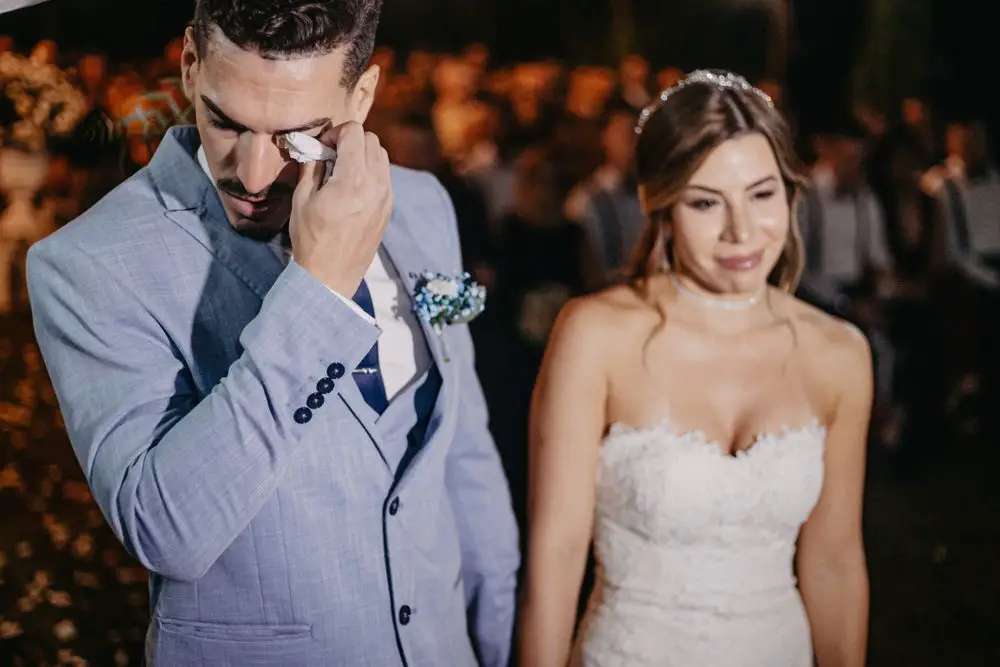
At 1:43 in the afternoon, my bouquet hit the bridal-suite floor because my sister texted me to say no one was coming.
The sound was not dramatic. It was a soft, humiliating thud. White roses tipped sideways across the beige carpet. Eucalyptus leaves scattered near the hem of my dress. The ribbon slipped loose and curled against my shoe like even it had given up.
The bridal suite smelled like hairspray and hotel coffee and the vanilla lotion Elise had rubbed into my hands ten minutes earlier because I would not stop wringing them. I had thought I was nervous about walking down the aisle. I had not understood yet that I was about to learn the difference between nerves and abandonment.
My phone stayed lit in my palm.
The message was from Chloe.
Calm down. No one’s coming.
I stared at the words until they stopped looking like words and started looking like a door closing. Then I read them again. The wedding was supposed to start in seventeen minutes. My father’s seat was saved in the front row. My mother’s seat was beside it. Aaron’s was two chairs down. Chloe had complained about the ceremony time for weeks, but she had promised.
She was my sister. She had borrowed my shoes for prom. She had slept in my dorm room for three nights after her first breakup. She had called me crying when Preston had not texted her back for a weekend, and I had driven across town with drugstore ice cream and a phone charger because she said she could not be alone.
That is the cruelty of being the dependable one. People remember that you gave without making them feel guilty. They do not remember what you gave.
Elise grabbed my elbows just before my knees gave.
“Grace.”
Her voice was tight. Not loud. Tight, like she was trying to hold both of us together with one syllable.
“Look at me.”
I tried. My eyes kept going back to the phone.
Then another notification appeared. An email from my mother. The subject line was Today. There were four sentences, and I still remember every one of them, but only the last one truly entered: You’ll be fine alone, Grace. Chloe’s night is important.
Alone.
At my wedding.
There are sentences your body refuses to let in immediately. Your mind stands at the door and says not this one, not right now. Then the sentence finds another way in, and you feel it somewhere deeper than thinking.
My father was forty minutes away at Chloe’s engagement dinner. My brother Aaron was there. My mother was there. My mother had bought a blue dress for my wedding and worn it to my sister’s party instead. It was not an emergency. Nobody was sick. Nobody had misunderstood the address. They had chosen appetizers and champagne and the kind of evening that looked good in photographs over the one I had been planning for eight months.
Preston’s family had money. My mother never said that directly because she preferred words like opportunity and connection. But we all knew what she meant. Chloe’s engagement dinner mattered because it gave my parents a room where they could perform the family they had always wanted people to believe they were. My wedding was smaller. Less useful. Less worth the drive.
Daniel knocked once and stepped in before I answered.
That was how Daniel moved through the world. Not rude. Just certain. He believed a closed door was usually protecting something rather than rejecting him. He had believed in me the same way, from the earliest months we dated. He had sat beside me during tax season while I worked late at the kitchen table. He had brought coffee at eleven at night and never once asked why my parents called during dinner whenever a bill was due. He had noticed more than I gave him credit for.
When he saw my face, he stopped. His hand was still on the door.
I handed him the phone.
He read Chloe’s text. He read my mother’s email. He scrolled through Aaron’s message telling me not to be dramatic. He read Chloe’s laughing emojis. He read my mother’s phrase about my little ceremony.
I watched his jaw tighten.
He did not raise his voice. He did not curse. He did not tell me to forgive them because it was my wedding day.
He only asked, “Do you want to do this?”
That question saved me. Not because it fixed anything. Because it put the choice back in my hands when everything else had just been taken from them.
I said, “Yes.”
The word scraped coming out.
Daniel bent and picked up my bouquet. He tucked the ribbon back around the stems and placed it in my hands like the flowers still belonged there. Then he adjusted the strap of my dress where it had slipped off my shoulder. He did not make a speech. He looked at me until I nodded. Then he walked out to wait for me at the altar.
Elise walked me down the aisle.
Not my father.
My best friend.
The ballroom was bright with afternoon light. The windows were tall, the chairs were white, and the aisle runner looked too clean for what had just happened. Three rows on my side sat empty. They were not just empty seats. They were reserved spaces for people who had decided my pain would be easier to manage than Chloe’s disappointment.
Daniel’s family filled their side so completely that his grandmother had to sit on the aisle. She was already crying before the music started. His mother saw my empty rows and pressed one hand to her mouth. His father looked toward the doors like he genuinely expected someone to come running in late.
No one did.
The room held its breath in the particular way people do when humiliation is happening in public and everyone has decided, out of courtesy, not to name it. Programs rested in laps. A cousin shifted in her chair. Someone’s bracelet clicked softly against the wooden armrest. Elise held my arm so firmly I could feel her fingers through the satin.
Nobody said what everyone could see.
I said my vows anyway.
When my voice shook, Daniel stepped half an inch closer. When I lost my place, Elise made a sound that was half sob and half laugh, and then I laughed too, and the officiant lost his composure because Elise was crying so hard, and Daniel laughed, and the whole room softened around that moment like it had been waiting for permission.
For one hour, I let the people who came be louder than the people who did not.
That became the first mercy of my marriage.
Daniel’s family did not pretend the empty seats were invisible. They simply refused to let them be the only thing in the room. His grandmother hugged me after the ceremony and whispered, “You looked beautiful, baby,” with a certainty that nearly broke me open.
At 11:47 that night, I sat on the edge of the hotel bed in my wedding dress and turned my phone back on.
Seventy-four notifications appeared.
A small and stupid part of me still expected apologies. There were none. There were no missed calls from my father. No remorse from Aaron. No sudden realization from Chloe.
What I found instead was Chloe’s post.
She had posted photos from the engagement dinner while I was saying my vows. There was my mother in the blue dress that had been bought for my wedding. There was Aaron holding a champagne glass. There was my father with his arm around Preston, looking like a man who had not missed anything important at all.
The caption said: When family shows up for your happiest moments.
I stared at that line until the edges of the phone blurred.
Daniel took the phone from my hand and set it face down on the comforter.
“Not tonight,” he said.
I could have argued. I could have called them. I could have ruined the only night we were supposed to have. For one ugly second, I imagined calling my mother and letting every word I had swallowed for seven years come out sharp enough to cut. I imagined asking my father what the appetizers tasted like while his daughter walked alone. I imagined telling Chloe I hoped the champagne was worth it.
Then Daniel touched my wrist.
I stayed.
We ordered room service in our wedding clothes and ate fries on the bed. Daniel got ketchup on his cuff and acted as though this were the greatest tragedy of the evening. We talked about Portugal. We talked about train stations and ocean air and whether two people could survive two weeks on carry-on bags alone. We did not talk about the three empty rows sitting in my chest.
Not that night.
The next morning at 7:14, I opened my laptop at the small hotel desk. Daniel was still asleep. Pale light came through the half-open curtains. My coffee went cold beside the keyboard.
I am a senior financial analyst. Numbers calm me. Systems tell the truth even when people will not. My family had been treating me like a system for years, reliable and quiet and easy to draw from without anyone having to ask whether the account was ever replenished.
I started doing the arithmetic.
My father’s truck insurance. My parents’ cell phone lines. The emergency Visa card that was never actually used for emergencies. Aaron’s rent assistance. The grocery delivery account that had quietly become essential to my mother’s weekly schedule. Streaming subscriptions. The deposit I had been making monthly into a savings fund for Chloe’s future wedding before she even had a serious boyfriend.
That last one embarrassed me the most. Not because I had helped. Because I had helped so quietly that Chloe had come to experience it as something she was simply owed.
Over seven years, direct transfers alone came to $34,200. That did not include gifts. That did not include the last-minute grocery orders I placed when my mother called crying because my father had forgotten a renewal date. That did not include the dozens of times I had been available at eleven at night to talk someone down from a crisis they had manufactured out of ordinary adult inconvenience.
Family help is supposed to be a bridge. Mine had become a road they drove on without ever wondering who paved it.
I started with the phone plan. I removed my parents’ lines and scheduled cancellation notices. Then I changed the passwords on every shared account. I froze the emergency Visa. I canceled the autopay on my father’s truck insurance. I stopped Aaron’s rent transfer. I ended the grocery delivery account. I closed the monthly savings deposit for Chloe’s wedding fund.
Every click made less noise than the bouquet had.
Every click mattered more.
Then I opened a new document and typed one email.
Effective immediately, I am discontinuing all financial support, account access, and shared services. Please make your own arrangements.
I read it twice. I added no insult, no explanation, no apology. Then I sent it to my parents, Aaron, Chloe, Aunt Rebecca, and Uncle Thomas. Two witnesses. Documentation matters.
My mother called at 7:31.
I watched the phone buzz against the desk until it stopped. Then she called again. Then a third time.
Daniel woke during the third call. He looked at me, then at the laptop.
“You did it,” he said.
I nodded.
He did not ask if I was sure. That was another mercy.
For four days, my family treated it like a tantrum.
Aaron texted first: You’ll give in by Friday. Then Chloe: You’re just mad my dinner was better than your sad little wedding. Then my mother: Stop this nonsense immediately. My father sent nothing, which hurt in a different way. He had always been quieter than my mother, but quiet is still a choice a person makes.
The first bill hit on day five.
My father’s truck insurance lapsed. My mother called six times in one hour. Aaron’s landlord sent a notice. Aaron called Daniel, which told me everything I needed to know about how desperate he was, because Aaron hated asking men for help when a woman had already said no.
Daniel did not answer.
My mother’s grocery card declined at a checkout. She left me a voicemail from the parking lot, her voice sharp with humiliation. “Grace, people were behind me.” I deleted it.
Then Chloe’s venue deposit bounced.
That was when the calls became vicious. Chloe said I was trying to ruin her future. Aaron said I had always thought I was better than everyone. My mother said family did not keep score.
That one almost made me laugh out loud.
People who spend your money without asking hate receipts.
One month after my wedding, I woke to 102 missed calls on my phone.
The number looked absurd. Not tragic. Absurd, like something from a story someone had embellished. I made coffee. I sat at the kitchen table. Daniel put a mug beside me and did not speak.
I opened the folder I had been building.
Chloe’s text at 1:43 p.m. My mother’s email. Aaron’s message. The engagement photos posted during my ceremony, with timestamps I had screenshotted before anyone could think to delete them. The banking records. The canceled transfers. The exact dates each bill had failed. The folder was not revenge. It was a mirror. It was the truth in a format no one could interrupt or reframe.
At 9:12 a.m., I called Aunt Rebecca.
She answered on the second ring.
“Grace,” she said, and her voice already sounded worried.
I looked at the spreadsheet on my screen. “You were told the wedding was postponed,” I said.
There was silence. Not confusion. Not surprise. The particular silence that has weight, the kind a person produces when they are processing something they already partly knew.
“Your mother told us the venue had an issue,” Aunt Rebecca said finally.
I closed my eyes.
She continued. My mother had told the wider family that the ceremony had been moved. That Daniel’s family wanted something more intimate. That I was embarrassed by the confusion and did not want people making a fuss over a rescheduled date.
Every sentence built a second wedding in my mind. Not the one where I walked past empty chairs. The one my mother had invented to explain why those chairs were empty.
“Grace,” Aunt Rebecca whispered. “Did she lie to us?”
I sent her the screenshots while we were still on the phone. First the text from Chloe. Then my mother’s email. Then the post with the blue dress. Then Aaron’s message telling me not to be dramatic.
Aunt Rebecca was quiet for so long I thought the call had dropped. Then I heard her crying.
“I would have been there,” she said.
That was the sentence that finally reached somewhere the rest of the morning had not. Not because it fixed what had happened. Because I believed her. For one month, I had been carrying the empty rows as proof that nobody cared enough to come. Now I understood that some of them had never been given the chance. An entire family had been managed around my humiliation. Not by accident. By email. By timing. By a story polished enough to make everyone else stay home.
Twelve minutes later, Aunt Rebecca forwarded me another email.
My mother had sent it that morning at 9:08, apparently after seeing Aunt Rebecca’s name in my call log somehow or anticipating the call. The subject line was Please Do Not Engage Grace’s Behavior.
I read it out loud to Daniel.
My mother claimed I had cut everyone off because Chloe’s engagement dinner had outshined me. She said I was using money to punish the family. She said no one should reward financial bullying.
Daniel’s face changed when I reached that phrase. He had been angry before at various points in the month. This was different. This was the specific stillness of someone who is choosing their next words very carefully because all the easy ones are too sharp.
Aunt Rebecca called back with Uncle Thomas on speaker.
“Your father is on his way to your mother’s house,” Uncle Thomas said. “He doesn’t know Rebecca called you first.”
My phone buzzed. A new text from my mother: Open the door when we get there.
For the first time in my life, her command did not make my body move before my mind caught up. I just looked at the message. Then I looked at the folder on my laptop.
Daniel sat beside me. “What do you want to do?”
Same question as the bridal suite. Different aisle.
I clicked the file marked FAMILY LEDGER. Inside were seven years of transfers. Dates, amounts, notes, screenshots, insurance confirmations, rent receipts, phone statements. Every quiet rescue they had renamed obligation, organized into a format that was clear and complete and impossible to argue your way around.
When my parents arrived twenty-eight minutes later, I did not go out to meet them on the porch. I did not let them turn the driveway into a stage.
Daniel opened the door and told them they could come in if they spoke respectfully.
My mother walked in first. She looked smaller than I expected. Anger does that sometimes. It shrinks people into the version of themselves they most want to hide. My father followed her with his cap in his hand. Aaron came behind them, red-eyed and furious. Chloe was last, sunglasses on top of her head and her phone in her hand like she was ready to record if the scene went the way she wanted.
It did not.
Aunt Rebecca and Uncle Thomas were already on a video call on my laptop.
My mother saw their faces on the screen and stopped moving.
“What is this?” she demanded.
“Documentation,” I said.
Chloe laughed once. It sounded nervous.
I turned the laptop so everyone could see the first page of the ledger.
The format was simple. Date. Amount. Recipient. Purpose. I had built it for myself initially, as a way of seeing clearly what I had been doing. Then I had realized that the truth needed a format no one could interrupt or edit with a better memory of events.
My father stared at the first line. Truck insurance renewal. My mother stared at the second. Phone plan. Aaron stared at the rent transfers and looked at the floor.
Chloe looked bored until she saw the wedding savings fund.
Then her mouth opened.
“You were saving for me?” she said.
The room went quiet. It was the first honest silence she had given me in years.
“Before Preston,” I said. “Before the venue. Before you decided my wedding was smaller than your dinner.”
My mother tried to speak. Aunt Rebecca cut in from the screen.
“Mary, did you tell the family Grace’s wedding was postponed?”
My mother lifted her chin. “I was trying to prevent drama.”
Uncle Thomas’s voice was flat and cold. “You created it.”
My father sat down at the kitchen table without being invited. He looked at the ledger for a long moment the way you look at something written in a language you recognize but cannot fluently read.
Then he looked at me.
“Grace,” he said quietly. “I didn’t know it was this much.”
That sentence could have been an apology if he had stopped there.
He did not.
“But you should have talked to us before embarrassing everyone like this.”
Something in me finally settled. Not broke. Settled. The particular settling that happens when you stop waiting for a thing to become something it was never going to be.
For years I had mistaken exhaustion for peace. I had mistaken silence for kindness. I had mistaken being useful for being loved.
“You missed my wedding,” I said.
My father looked away.
“Grace,” my mother snapped. “This is exactly what I mean. You always make everything about your feelings.”
Daniel stood up.
He did not raise his voice. He simply looked at my mother.
“Her wedding was about her feelings,” he said.
Nobody answered him.
Chloe looked at the ledger again, running her finger along the line with her name on it. “So what happens now? You just cut us off forever?”
I looked at my sister. I remembered her crying in my dorm room. I remembered the ice cream I had driven across town to bring her. I remembered every emergency that had become mine because I loved her and she knew I would come.
Then I remembered the text. Calm down. No one’s coming.
“No,” I said. “I cut off the money. What happens to the relationship depends on what you do without it.”
My mother scoffed. “Don’t talk like some therapist.”
“Fine. Then I’ll talk like an analyst. The accounts are closed. The transfers are canceled. The card is frozen. The phone plan is ending. The passwords are changed. Nothing is being restored today.”
Aaron cursed under his breath.
Uncle Thomas heard it. “Aaron,” he said, “you are a grown man.”
Aaron looked like that particular sentence, coming from another man, landed differently than anything I could have said.
Chloe started crying then, but not the way she cried when she was sorry. I knew her different cries. This was the one she used when the room had stopped working in her favor.
My mother put an arm around her. She was wearing a cream sweater and jeans, ordinary clothes for an ordinary consequence. The blue dress was long gone, at a dry cleaner or already forgotten in a closet.
“You are tearing this family apart,” my mother said.
I looked around my kitchen. At Daniel beside me. At Aunt Rebecca’s face on the laptop screen. At Uncle Thomas sitting stiff and furious. At my father staring at his own hands. At Aaron avoiding the rent lines on the screen. At Chloe finally understanding that the wedding savings fund had existed before her engagement dinner ever did.
“No,” I said. “I’m showing you where the tear already was.”
Nobody had a quick answer for that.
My father rubbed both hands over his face. He looked old suddenly, in the way that people look old when the performance they have been maintaining for years becomes too heavy to hold up.
“I should have been there,” he said.
My mother turned toward him sharply. “Don’t start.”
He did not look at her. “I should have been there,” he said again, to me.
It was the first true thing he had said all morning. It was not enough. But it was true, and I noticed the difference.
Chloe whispered, “I thought you’d get over it.”
I nodded once. “I know.”
That hurt her more than anger would have. Because anger still argues. Knowing just closes the door.
They left without a resolution. Real life rarely gives you a single clean scene where everyone confesses and the music swells. My father paused at the doorway. He looked back at me.
“Can I call you tomorrow?” he asked.
My mother made a sound of disgust.
“You can call,” I said. “I don’t know if I’ll answer.”
He nodded like that was more than he deserved. Maybe it was.
After they left, Daniel closed the door and leaned his forehead against it for a moment. Then he turned around and opened his arms. I stepped into them.
I did not cry right away. The body is strange that way. It will hold a flood until the floor is finally safe enough to get wet.
That afternoon, Aunt Rebecca posted one photograph from our wedding.
It was not a dramatic image. Just Daniel and me at the altar, Elise beside me with her eyes swollen, Daniel’s grandmother crying in the front row. The empty chairs were visible behind us. Aunt Rebecca had not cropped them out.
Her caption was simple.
We were told the wedding was postponed. It was not. Grace, I am sorry we were not there. You deserved better from all of us.
My mother called within six minutes. I did not answer. Chloe texted within eight: Delete that. Aaron texted at ten: This is going too far.
My father did not text until that evening. His message was different from the rest.
I am sorry I missed your wedding. I am sorry I let your mother decide what mattered. I am sorry I let you carry us.
I read it three times. Then I set the phone down.
Forgiveness is not a vending machine. You do not insert an apology and receive immediate access. Some apologies are the beginning of something, and some are just the first thing someone says when they finally understand what they lost. I was not yet sure which kind my father’s was. I intended to find out slowly, over time, by watching what he did next.
Over the following months, I kept the money boundary exactly where it was.
My parents got their own phone plan. My father reinstated his truck insurance on his own timeline, and I did not help him navigate it. Aaron found a cheaper apartment after complaining for six weeks that it was impossible. Chloe postponed her venue deposit and told everyone it was because she wanted a longer engagement. Maybe that was partly true. I stopped trying to determine what portion of it was pride and what portion was genuine reconsideration. It was no longer my job to manage the story she told herself.
My father called the next day, as he said he would.
I answered.
We talked for fourteen minutes. He did not ask me to restore anything. He did not explain the engagement dinner away or blame my mother for the decision entirely, which would have been easy and dishonest. He said he had not understood, for a long time, how much weight I was carrying. He said he had let himself not understand it because understanding it would have required him to do something about it.
I told him I appreciated him saying that.
I did not tell him everything was fine.
I told him I was still figuring out what came next.
He said he thought that was fair.
Chloe and I did not speak for several months. When she finally called, she did not open with an apology. She opened with a question about whether I was happy. It was the first personal question she had asked me in years, possibly ever, that was not somehow attached to something she needed from me. I told her I was getting there. She said she was sorry. I asked her what exactly she was sorry for, because I had learned that specific apologies were the only kind worth accepting.
She was quiet for a moment. Then she said, “For the text. For the post. For the years I called you when I needed something and disappeared when I didn’t.”
I told her I heard her.
I did not tell her we were fine. But I told her she could call again.
Daniel and I went to Portugal in the spring.
We took two carry-on bags. He got lost in Lisbon within three hours and insisted it was cultural exploration. I laughed harder than the joke deserved. We ate dinner outside on our first night under yellow lights while music drifted up from a street somewhere below, and Daniel lifted his glass.
“To the people who showed up,” he said.
I lifted mine.
Elise, who had held my arm through the aisle so firmly I could feel her fingers through the satin. His grandmother, crying before the music started. Uncle Thomas and Aunt Rebecca on a laptop screen, bearing witness. The officiant who lost his composure because the room needed to laugh. Every person who had come prepared to celebrate and stayed prepared to refuse to let my humiliation be the only thing in the room.
For one hour on my wedding day, I had let the people who came be louder than the people who did not.
Now I was learning to let that be true for the rest of my life.
Not every empty chair needs to be filled. Some of them are warnings dressed as invitations. Some of them are the most important information you will receive about who someone has always been. And some of them, when you finally stop paying for people’s attendance, reveal that what certain people were coming for was never you at all.
The bouquet hit the floor at 1:43 in the afternoon.
By sunrise the next day, seven years of one-sided financial support had been undone with a series of quiet clicks that made less noise than the roses had.
Neither sound was the end of anything.
Both were, in their own way, the beginning.

Lila Hart is a dedicated Digital Archivist and Research Specialist with a keen eye for preserving and curating meaningful content. At TheArchivists, she specializes in organizing and managing digital archives, ensuring that valuable stories and historical moments are accessible for generations to come.
Lila earned her degree in History and Archival Studies from the University of Edinburgh, where she cultivated her passion for documenting the past and preserving cultural heritage. Her expertise lies in combining traditional archival techniques with modern digital tools, allowing her to create comprehensive and engaging collections that resonate with audiences worldwide.
At TheArchivists, Lila is known for her meticulous attention to detail and her ability to uncover hidden gems within extensive archives. Her work is praised for its depth, authenticity, and contribution to the preservation of knowledge in the digital age.
Driven by a commitment to preserving stories that matter, Lila is passionate about exploring the intersection of history and technology. Her goal is to ensure that every piece of content she handles reflects the richness of human experiences and remains a source of inspiration for years to come.