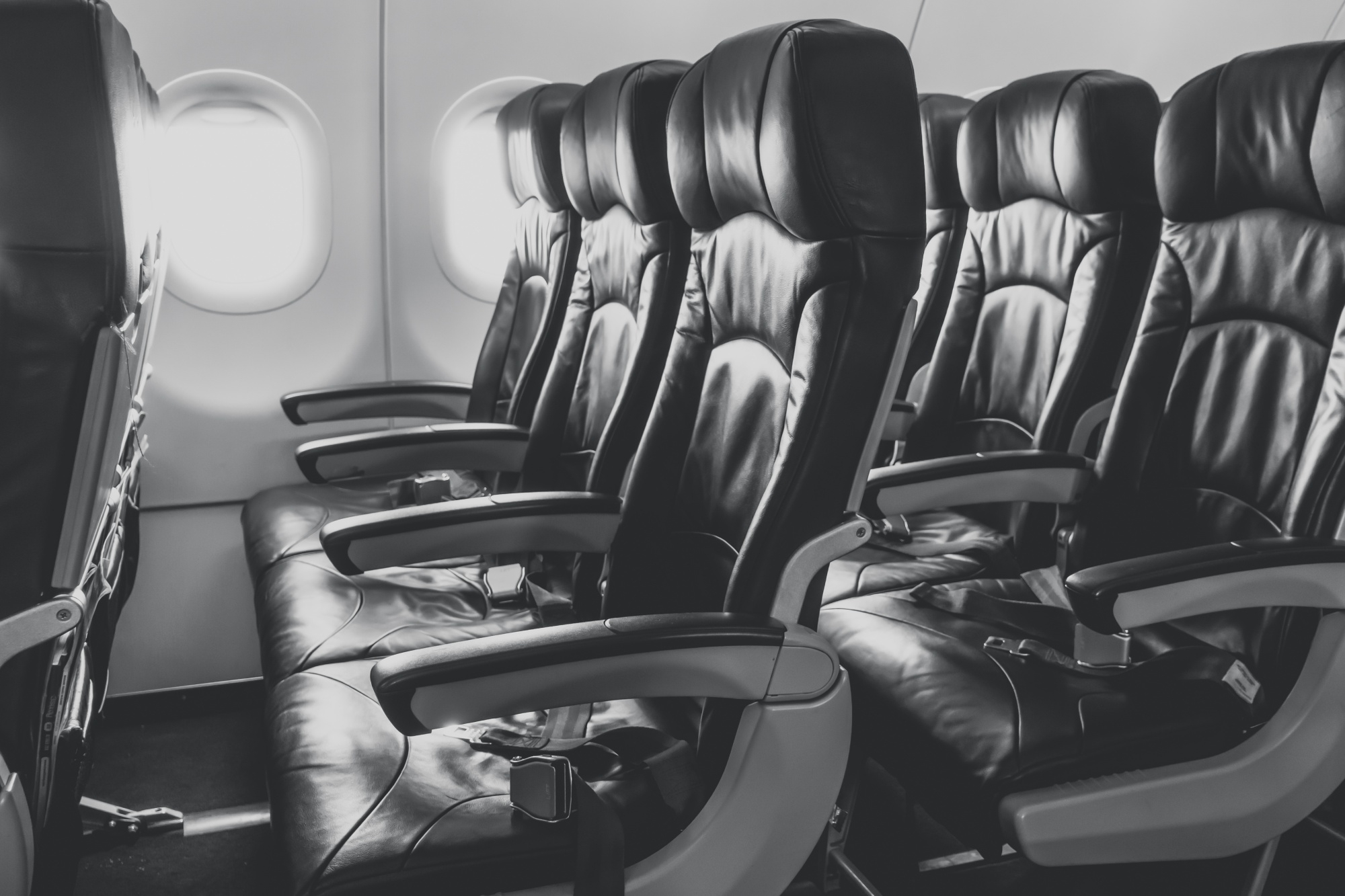
Row 12
Noah had been asleep for eleven minutes, which was long enough that I had stopped checking his face every thirty seconds and had begun, cautiously, to believe the flight might go well.
He was five weeks old. Five weeks and two days, if I was counting, which I was, the way you count everything in those early weeks because the numbers feel like evidence that you are surviving something. He slept in the carrier against my chest, his cheek pressed to my collarbone, his breath warm and steady through my shirt. I had timed the feeding so he would go down just before boarding. I had packed the bag with the precision of someone planning a small military operation. I had done everything I knew how to do.
Lily walked beside me down the jetway holding her own backpack, the purple one with the constellation patches she had been collecting since second grade. She was ten, tall for her age, with the particular self-possession of a child who has spent a lot of time around adults navigating difficult things and has quietly absorbed their methods. She carried her own boarding pass and she did not need to be told to stay close.
“Row twelve,” she said, reading the sign as we entered the cabin.
“Row twelve,” I confirmed.
I had purchased the seats three weeks earlier, extra legroom, adjacent, because traveling alone with a newborn and a ten-year-old is the kind of thing you want every possible advantage for. The extra legroom meant space for the diaper bag without blocking the aisle. The adjacent seats meant Lily could help me if Noah needed something during the flight and I needed both hands. I had thought it through. I had planned it carefully.
The woman in row twelve had her shoes off before we reached her.
She was perhaps fifty, with the settled comfort of someone who had decided the space around her was an extension of herself, the way some people expand into public spaces as though the social contract is a document they signed with reservations and have since stopped honoring. Her coat occupied the aisle seat. Her bag occupied the overhead compartment in the dense, space-filling way that leaves just enough room to technically claim innocence. Her bare foot was pressed against the bulkhead wall.
She was in Lily’s seat.
My coat and bag were in mine, which she appeared to have redistributed to the middle in order to reclaim the armrest.
“Excuse me,” I said. “Those are our seats.”
She looked at me. Then she looked at Noah against my chest, assessing, and something in her expression made a small calculation and arrived at a conclusion, and she put her headphones back on.
“I’m already settled,” she said, the way you say something to someone you have decided not to take seriously.
I held out the boarding passes.
She looked at them. She looked at me. She rolled her eyes in a way that was theatrical enough to be intended for an audience.
“Mothers with babies always expect everyone to accommodate them,” she said loudly, to the general air of the cabin rather than to me specifically. “You chose to travel with two children. That is not my problem.”
Noah stirred slightly at the sound, his face doing the small preparatory movements that precede waking. I put my hand on his back and he settled again, and I took a breath that was slower than I felt.
The flight attendant appeared. She was young, maybe twenty-five, with the expression of someone who has been awake since five in the morning and is managing it through professionalism alone. She looked at the boarding passes, then at the seat assignment on her tablet, and her face did something careful and controlled.
“There appears to have been a double booking on this seat,” she said quietly, to me rather than to the woman. “There’s an open seat three rows back. Would you mind taking it so we can complete boarding?”
The woman smiled.
It was a particular kind of smile, the kind that belongs to someone who has just won a small contest they entered privately, without telling the other person a contest was happening.
“Why should she move?” she said pleasantly. “She’s the one who brought all that.” She gestured toward Noah with a small wave of her hand, the kind you use to indicate something in the way, something inconvenient, something that is not a person.
Noah was five weeks old and weighed eight pounds, four ounces. He smelled like the baby shampoo I had used that morning and he had, the previous week, learned to focus his eyes on my face with an expression of such complete and uncomplicated recognition that I had cried for ten minutes afterward from something I still couldn’t name.
I looked at the flight attendant. She looked at me with an apology she could not make louder than her expression.
The people in the rows behind us were beginning to shift. I could feel the impatience of a full cabin wanting to sit down, the collective pressure of it, the way a crowd’s restlessness becomes a kind of argument.
Lily had been standing beside me through all of this quietly.
“It’s okay, Mom,” she said. Her voice was even. Not performed, not trying to be brave, simply matter-of-fact in the way she gets when she is deciding something. “I’ll be fine.”
I looked at her for a moment.
I kissed her forehead and moved back to row fifteen.
Row fifteen was a middle seat between a man in his sixties who was already asleep against the window and a younger man with earbuds who moved his knee cooperatively to let me past without being asked, which I appreciated more than he knew. I settled Noah in the carrier, rearranged the diaper bag under the seat in front of me, and looked forward through the rows of headrests to where I could see the top of Lily’s head in row twelve.
She was sitting very straight the way she does when she is in a situation she is handling alone and wants me to see that she is handling it.
The woman beside her had redistributed her coat to the overhead compartment, grudgingly, the way you make a concession that you want everyone to understand you are recording. She had her headphones on again and her face turned toward the window and her posture communicated, clearly and without ambiguity, that she had erected a border between herself and the ten-year-old now occupying the seat she had wanted.
I watched Lily notice something.
She was looking at the floor near the woman’s seat, and whatever she had seen made her lean slightly forward and then turn toward the woman and say something. I could not hear it from three rows back but I could see the shape of it, careful and quiet, the tone she uses when she is trying to do something considerate for someone who hasn’t asked her to.
The woman pulled one headphone aside.
Said something short.
Put it back.
Lily sat back. She looked at her hands for a moment. Then she looked at me, through the gap between the seats, and I gave her what I hope was a look that said I see you and you’re doing well and we’re almost there.
She gave me a small nod.
Takeoff was smooth. Noah stayed asleep through it, which I accepted as the gift it was. The engines found their cruising register and the seatbelt sign chimed off and the cabin settled into the distributed quiet of a long flight beginning.
I let out a breath I had been holding since the jetway.
Then Lily’s voice rose above the engine noise.
Not shouting. Not performing. Simply clear, the way she speaks when she has decided that something needs to be said properly and she is going to say it properly.
“Ma’am,” she said, “my mom taught me never to embarrass someone in public. That’s why I tried to tell you quietly the first time.”
The woman turned from the window.
The people in the surrounding rows, in the particular way of airplane cabins where proximity makes everyone an involuntary audience, turned too, the way attention moves toward something unexpected.
“Then be quiet,” the woman said.
Lily unzipped her backpack.
She stood up slowly, which in a plane requires the specific careful movement of someone who understands the space and doesn’t want to disturb anyone unnecessarily. She reached toward the seat pocket in front of the woman. Her arm angled toward the floor near the woman’s feet. She straightened up.
She was holding a wallet.
Brown leather. Slim. She held it out toward the woman with both hands, which is how she was taught to hand things to adults, with a deliberateness that indicates respect for what you’re offering.
“I’ve been trying to tell you,” Lily said. “This was under your leg. I didn’t want to just take it because it’s not mine. I didn’t want anyone to think I took something.”
The cabin was very quiet.
The man beside me had woken up. The young man with earbuds had one of them out. Two rows ahead I could see a woman with silver hair who had turned almost completely around in her seat.
The woman in row twelve looked at the wallet in Lily’s hands.
She looked at Lily.
She took the wallet, slowly, and opened it and looked inside and then closed it and held it in both hands and said nothing for a moment.
Lily sat back down with the composed unhurriedness of someone who has completed a task and doesn’t need acknowledgment for it.
“It might have fallen when you were settling in,” Lily said. “I didn’t want it to get lost.”
The flight attendant, the young one who had been managing boarding, had come down the aisle at some point during this and was standing just past row eleven with her hands clasped, not intervening, simply present in the way you are present for something you are witnessing.
The woman in row twelve opened her mouth.
She closed it.
She looked down at the wallet.
She said, “Thank you.”
It came out smaller than anything else she had said in the past forty minutes. It came out with something else inside it, something that the previous hour had not contained, something that might have been the first edge of understanding what had actually happened here.
Lily said, “You’re welcome,” and took out her book.
I did not see what happened next directly because Noah chose that moment to wake up and wake up fully, the sudden transition from sleep to urgency that newborns accomplish without intermediate stages, and I spent the following fifteen minutes attending to him with the focused concentration that excludes most other information.
When I looked up again, the flight attendant was crouching in the aisle beside row twelve, speaking quietly to the woman there. I could not hear the words. What I could see was the woman’s face, which had rearranged itself into something that looked tired and, possibly, smaller than it had before.
A few minutes later the flight attendant came back to me.
She crouched beside my seat with the naturalness of someone who does this all the time, which she does.
“The passenger in row twelve would like to offer your daughter her original seat back,” she said. “She’s asked if she can move to the open seat in fifteen C, next to you. She’d like to apologize.”
I looked at her.
“She asked if she could apologize,” the flight attendant said again. “She’s not asking you to accept it. She just asked if she could.”
Noah had found his rhythm and was eating with the focused determination of a five-week-old and I looked at him for a moment and then out the window at the flat white of cloud cover thirty-five thousand feet below us.
“Send Lily back to her seat,” I said. “As for the other, she can sit there if the seat is available. I’m not going to tell her she can’t sit somewhere.”
The flight attendant nodded and moved forward.
I watched Lily gather her backpack and her book and move back to row twelve with the quiet ease of someone returning to a place that had always been hers. She passed the woman, who was standing in the aisle with her coat and bag, and I saw the woman say something to her. Lily stopped and listened and then she nodded, which is Lily’s way of receiving something she is still deciding what to do with.
The woman came back to fifteen and settled into the middle seat I had occupied, and I moved to give her room and we did not speak for a while.
Noah finished eating and went back to sleep with the immediacy of someone who has gotten what he needed and sees no reason to stay conscious.
After some time the woman said, “That’s a good kid.”
I looked at her.
“She didn’t have to tell me,” the woman said. “About the wallet. She could have waited until we landed and handed it to an attendant. She’d already tried once and I’d told her to be quiet.”
She said this not looking at me but at the seat back in front of her, with the tone of someone narrating something that happened to someone else.
“She could have just let it be my problem,” the woman said. “It would have been my problem.”
“She doesn’t do things that way,” I said.
“No.” A pause. “I could see that.”
I looked forward through the rows to where I could see the top of Lily’s head, steady and settled, her book open, the constellation patches on her backpack visible over the seat back. She was already absorbed in her reading, finished with the incident the way she finishes things when she considers them complete.
“I wasn’t having a good day,” the woman said. “I know that isn’t an excuse.”
“No,” I agreed. “It isn’t.”
She nodded. She seemed to accept this as fair.
“What’s the baby’s name?”
“Noah.”
She looked at him against my chest. Whatever she saw there did something brief and honest to her face.
“He’s very small.”
“Five weeks.”
“And you’re flying alone with both of them.”
“Yes.”
She was quiet again for a moment.
“I’m sorry,” she said. “For what I said about your children. That was wrong.”
I looked at her. I thought about the gesture she had made toward Noah, the small dismissive wave. I thought about standing in the aisle holding my boarding pass while she looked at me and decided she did not have to take me seriously.
I thought about Lily at ten years old, standing in a plane cabin holding a stranger’s wallet in both hands because she had been taught that things belong to people and people deserve to have them returned, even when those people have not been kind to her.
“Okay,” I said.
It was not forgiveness, exactly, and not its opposite either. It was the honest middle distance between them, which is where most real things live.
She seemed to understand this, or at least to accept it.
We did not talk much after that. The flight was two hours and forty minutes and Noah slept for most of it and the man by the window slept through all of it and the young man with the earbuds offered me a hand once when I needed to adjust my position while not waking the baby, wordlessly and without making anything of it.
We landed twenty minutes ahead of schedule.
In the baggage claim, Lily stood beside me with the stroller and the diaper bag while I shifted Noah from the carrier to the crook of my arm, and she did it with the practiced helpfulness of a kid who has spent weeks figuring out how to be useful with a newborn in the house.
“You okay?” I asked her.
“I’m fine,” she said, watching the carousel start up. “She apologized to me. On the plane. Did you see?”
“I saw her say something to you.”
“She said she was sorry for telling me to be quiet. And for before, when she said the stuff about you choosing to bring us.” Lily considered this, watching the first bags begin to appear. “I said it was okay.”
“Was it okay?”
She thought about this with the seriousness she brings to honest questions.
“I think she felt bad,” she said. “She looked like she felt bad. I didn’t want her to feel bad the whole way home.” A pause. “Is that wrong? Should I not have said it was okay?”
I thought about what to tell her.
“I think,” I said carefully, “that you get to decide what to do with an apology when someone gives you one. There’s no rule about it. You can accept it or you can need more time or you can say thank you for saying that and not yet know what you think. What you did was generous. That’s not wrong. Generous is never wrong.”
Lily looked at this from different angles.
“She probably won’t do it again,” she said. “To someone else on a plane. She probably learned something.”
“Probably,” I agreed.
“So it’s useful,” Lily said, with the satisfaction of someone who has placed something in the correct category. “Being generous is useful.”
Our bags came around and I watched her lift hers off the carousel without being asked, correctly, bending with her knees the way I had taught her, and I thought about the kind of person she was becoming and felt the specific gratitude that is different from ordinary gratitude, that sits deeper and has no adequate word.
Noah opened his eyes and looked at the baggage claim with the unfocused interest of someone very new to the world, for whom everything is still equally astonishing, equally worth attending to.
“Hello,” Lily told him, leaning close. “We landed. We did good.”
He looked at her face the way he looks at things he is beginning to recognize.
Outside the terminal, the city was bright and loud and we walked into it together, Lily with her backpack and her constellation patches, me with Noah and the bag and the stroller, all of us intact and headed somewhere we were expected.
It had not been an easy morning.
It had been, I thought, exactly what it needed to be.

Ethan Blake is a skilled Creative Content Specialist with a talent for crafting engaging and thought-provoking narratives. With a strong background in storytelling and digital content creation, Ethan brings a unique perspective to his role at TheArchivists, where he curates and produces captivating content for a global audience.
Ethan holds a degree in Communications from Zurich University, where he developed his expertise in storytelling, media strategy, and audience engagement. Known for his ability to blend creativity with analytical precision, he excels at creating content that not only entertains but also connects deeply with readers.
At TheArchivists, Ethan specializes in uncovering compelling stories that reflect a wide range of human experiences. His work is celebrated for its authenticity, creativity, and ability to spark meaningful conversations, earning him recognition among peers and readers alike.
Passionate about the art of storytelling, Ethan enjoys exploring themes of culture, history, and personal growth, aiming to inspire and inform with every piece he creates. Dedicated to making a lasting impact, Ethan continues to push boundaries in the ever-evolving world of digital content.