He stood up in front of my blind daughter and told two hundred people not to clap for her.
I wanted to kill him. I’m not going to pretend I didn’t. I want to tell you this story honestly, and honestly, in that moment, if my husband hadn’t been between me and the aisle, I don’t know what I would have done. A stranger in a leather vest, standing up in a school gymnasium, roaring at a crowd to stop cheering for a nine-year-old blind girl frozen in the middle of a stage.
But I need to back up, because you can’t understand that night without understanding how we got there.
My daughter Lily is nine. She lost her sight to meningitis when she was four. I can tell you the exact week. One Tuesday she was in her booster seat pointing out the car window yelling “Bird! Mama, bird!” at every crow in the county, and by Friday she was in a hospital bed with a fever of a hundred and four, and by the next Tuesday she was asking me why the lights were off.
The lights were on. Every light in that room was on. I was standing right under one of them, holding her hand, and my four-year-old was looking straight through me asking why it was so dark.
The doctors used words like optic nerve damage and cortical involvement, and they said it gently, in a little room with a box of tissues placed in the exact center of the table, which is how you know before anyone says anything. The lights never came back for her. She has a little bit of shadow perception on a bright day, they think, but Lily herself will tell you flat out, “I see nothing. It’s fine. Stop making the face.” She can hear me making the face. Don’t ask me how. She can hear everything.
That’s the thing I didn’t understand for five years. That’s what this whole story is about, really. I just didn’t know it yet.
For five years after the hospital, I was Lily’s eyes, or that’s what I called it. I held her elbow everywhere. I narrated the world like a sports announcer. Step down, chair on your left, fork at three o’clock. I moved the furniture back to its exact spot if it drifted an inch. I cut her food until she was eight and made her hold the handrail with two hands and walked her into her classroom every single morning past kids half her size who got dropped at the curb. I told myself I was a good mother because my blind child never bumped into anything.
You already know where this is going. I didn’t.
The talent show was Lily’s idea. Not the piano, she’d been playing since before she got sick, and after she lost her sight the piano was the one place where nothing had changed. The keys were exactly where they’d always been. Middle C didn’t move on her. She’d sit there for hours, and Mrs. Danvers, the music teacher, said she had the best ear of any student she’d taught in thirty years.
No, the piano wasn’t the idea. The idea was the walk.
She told me at the kitchen table on a Sunday in September. She had her hands folded like she was conducting a business meeting, which is what she does when she’s decided something and is preparing to manage my reaction.
“I’m doing the talent show,” she said. “I’m playing Clair de Lune. And I’m walking to the piano by myself. From the curtain. No cane. Nobody’s arm.”
“Lily.”
“I already counted the steps with Mrs. Danvers. It’s twenty-two.”
“Lily, the stage will be crowded, there’s equipment, the—”
“Twenty-two steps, Mom.”
I fought her on it. God help me, I fought her for weeks. I brought it up in the car, at dinner, at bedtime, sideways and straight on. I said Mrs. Danvers could walk her out and nobody would think anything of it, kids get walked on stage all the time, and Lily sat at that kitchen table, nine years old, and said the sentence I will be repeating to myself for the rest of my life.
“Mom, everybody already thinks something of it. I want them to think something different.”
What do you say to that? I said okay. Then I went and ran the bathroom fan so she wouldn’t hear me cry, which never works, and she knocked on the door and said, “I can hear you, you know,” and I said “I have allergies,” and she said, “Okay, Mom,” the way you’d humor an elderly relative.
She practiced for three months. Not the piano, the piano was ready in a week. The walk. Every day after school, Mrs. Danvers let her onto the empty stage and Lily walked it. Curtain, twenty-two steps, bench. She’d trail her hand along the piano’s side, find the edge, sit, reach out with her right thumb and land on middle C like a plane touching down. Over and over. Some days I watched from the back of the gym, and I noticed she’d sometimes pause partway and tilt her head, just listening, and I thought it was nerves. I want you to remember that. I thought the listening was nerves.
The night of the show, the gym was packed. Folding chairs on the floor, bleachers full, maybe two hundred people, kids with recorders and hula hoops going in and out. Dave had the camera. I had my heart in my throat.
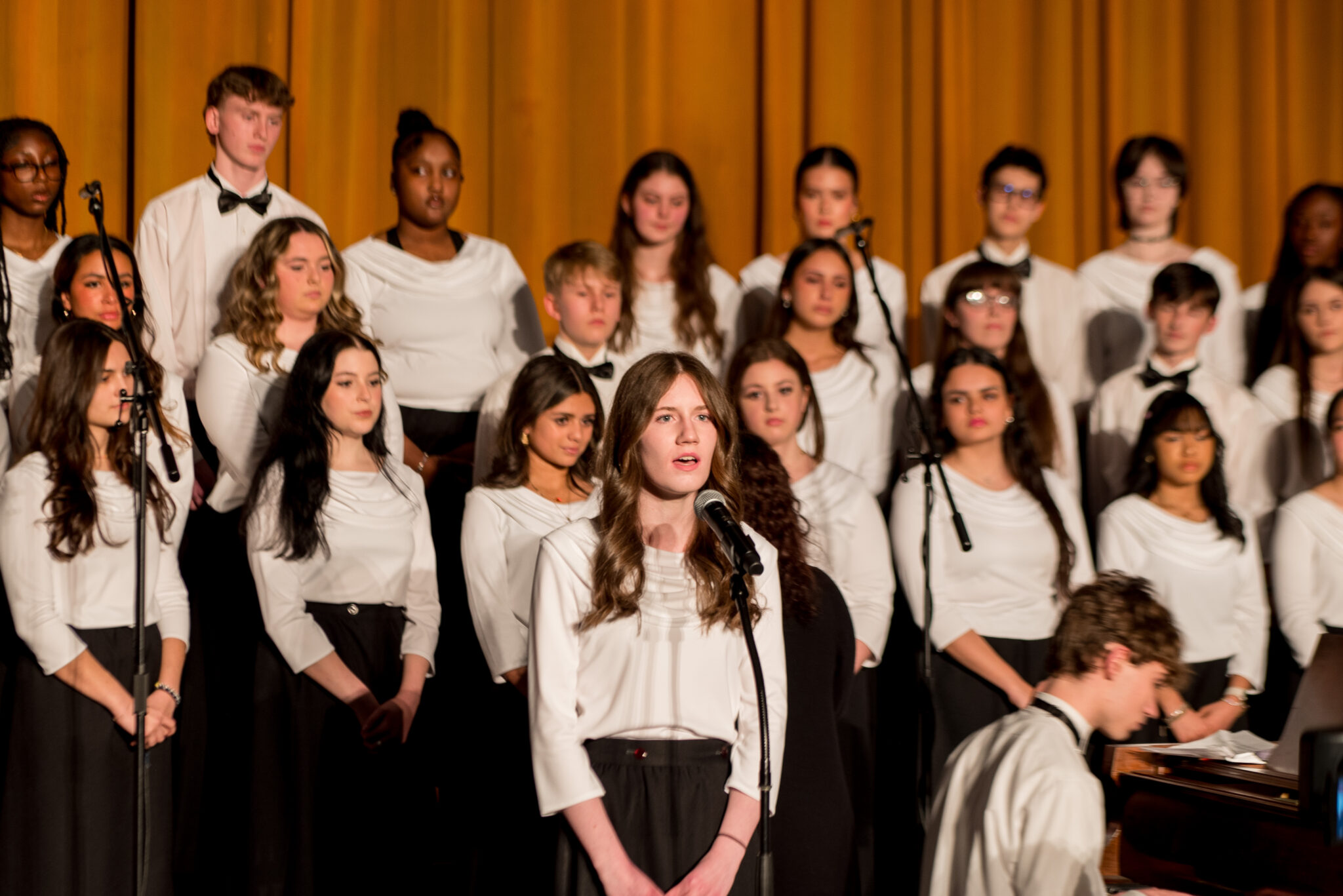
They announced her name. “And next, playing Claire de Lune… Lily!” And my daughter stepped out from behind the curtain in her blue dress, chin up, and the whole gym erupted.
I mean erupted. Everyone in that school knows Lily. Parents came off their seats. Kids were screaming her name. Somebody, and I hope you’re reading this, somebody brought an air horn. It was a wall of love, two hundred people loud, and I was clapping too, clapping and crying, so proud I could have burst.
And Lily froze.
Right there, four steps out from the curtain, in the middle of all that cheering, she just stopped. Her hands started shaking at her sides. I could see her lips moving, counting, losing the count, starting over. Her head began tilting, left, right, the way it does when she’s searching for something, and her chin started to crumple, and every second the crowd cheered louder, because they thought they were helping, they thought they were lifting her, and my baby was drowning in front of two hundred people and I was the only one who could see it.
I was halfway out of my seat when he stood up.
Third row of the bleachers. A mountain of a man. Leather vest covered in patches, gray beard down his chest, arms like fence posts, dark glasses. A man I had never seen at one single school event in my life, and believe me, I would have remembered.
He turned around to face the whole gym, and he roared. There’s no other word. It came from somewhere down in the ground.
“STOP. Nobody claps. Not one sound.”
The gym went dead silent. Instantly. The kind of silence that has weight to it, that presses on your ears. Two hundred people staring at a stranger in a biker vest who had just shouted down a room full of children cheering for a blind girl. The woman behind me whispered, “What kind of animal shames a blind child?” A man near the aisle said, “Hey, buddy—” and half rose.
Dave was already pushing out of his seat and his hands were fists. My husband is the calmest man alive. His hands were fists.
But the biker wasn’t looking at any of us. He had turned back toward the stage, toward my daughter, and when he spoke again his voice came out so gentle it didn’t belong to the same body.
“Take your time, sweetheart. The room’s all yours now.”
And Lily lifted her head.
I watched it happen. I watched her shoulders come down from around her ears. In the silence I heard, we all heard, the buzz of the exit sign, the hum of the air vent, the creak of the bleachers settling, all the little sounds of a quiet room, and Lily’s lips started moving again, steady this time. Five. Six. Seven. And then my daughter walked across that stage like there was a rope pulling her, twenty-two steps without one hitch, trailed her hand down the side of the piano, sat, adjusted the bench, and found middle C with her thumb.
She played Clair de Lune. All of it, every rising, falling, aching bar of it, in a gymnasium so silent I could hear the pedal creak under her foot. Two hundred people did not breathe for four minutes. I have never in my life heard anything like it and I don’t expect to again.
When the last note faded, nobody moved. Nobody dared. And then the biker stood up again, raised both arms over his head like a man signaling a plane, and bellowed, “NOW.”
The roof came off. That’s the only way to describe it. People came off those bleachers stomping, whistling, sobbing. The air horn guy redeemed himself. And Lily stood up next to the piano, faced the noise, and did a wobbly little curtsy, and her smile was so big I had to sit back down.
I found him after the show. He was standing by the exit doors, alone, helmet under one arm, angled toward the parking lot like a man planning to disappear before anyone could make a thing of it.
I didn’t let him. I marched.
“You,” I said. “I need to talk to you.”
“Ma’am.” He nodded, calm as Sunday.
“When you stood up, I thought you were going to humiliate my daughter. I thought my husband was going to have to drag me off of you. And then you…” My throat closed. I pushed through it. “How did you know? How did you know what she needed? I’m her mother. I’m her mother and I didn’t know.”
He was quiet for a second. Then he reached up and took off the dark glasses.
His eyes didn’t find mine. They aimed somewhere over my left shoulder and stayed there, still and clouded, one of them crossed by an old scar through the brow.
The man was blind.
“Name’s Merle,” he said, and held his hand out into the space between us, waiting, patient, for me to take it. “Been blind twenty-six years. Machine shop accident. Hydraulic line let go about eight inches from my face. I was thirty-one.”
I shook his hand. I couldn’t speak.
“I heard her freeze,” he said. “Everybody else saw a little girl get stage fright. I heard what actually happened. All that cheering wiped her map out.”
“Her map?”
“Ma’am, your girl doesn’t cross that stage on memory alone. She crosses it on sound. The echo off the back wall. The dead spot where the curtain hangs. That exit sign buzzing. The vent over the third row. That’s her map. She reads a room the way you read street signs.” He tipped his head back toward the gym. “Two hundred people screaming is a whiteout. You ever drive through snow so thick you can’t find the lines on the road? That’s what they did to her. They loved her so loud they blinded her twice.”
I stood in that hallway and cried in front of a stranger, and I’ll tell you exactly why. Because in five years of holding her elbow and narrating her world and calling myself her eyes, I had never once understood how my daughter actually finds her way through it. This man understood it in half a second, from the third row, with his eyes closed forever. The pauses on the practice stage. The head tilts. She hadn’t been nervous. She’d been reading. And I’d stood in the back of the gym for three months watching my child read a room in a language I never bothered to learn.
“How’d you even end up here?” I finally managed, wiping my face with the back of my hand. “You have a kid at this school?”
“Nephew. Plays the trumpet. Badly.” He grinned inside the gray beard. “My brother rides me over to these things. I’m what you call permanent cargo now. Thirty years riding my own Harley. Now I hold onto my little brother’s belt like a sack of laundry.”
He said it light. There was gravel underneath it.
That’s when Lily found us. She came down the hallway with Dave, one hand trailing the wall, and stopped a few feet from us with her head tilted, sorting us out of the noise.
“You’re the man who yelled,” she said.
“Guilty.”
“You made everybody be quiet.” She stepped closer. “You knew I couldn’t hear the piano.”
“I knew you couldn’t hear anything, darlin’. Room like that turns into soup.”
And then my daughter said something that put a crack straight through the middle of me.
“Nobody ever knew that before. I tell people the clapping mixes me up, and they say sorry, and then they do it again anyway. They think being nice is being loud.”
Merle crouched down so their faces were level, his knees popping like firecrackers on the way.
“Let me tell you a secret,” he said. “Being nice is asking. Everything else is just noise.”
Lily reached out and found the patches on his vest with her fingertips and started reading them like Braille, tracing wings, letters, borders. He held still and let her. She stopped on one over his heart.
“What’s this one?”
“That one says Blind Guy On Back. My club made it for me so nobody wonders why I don’t wave.”
She laughed so hard she snorted. Then the laugh stopped, and her hand went flat on the patch, and she got very still.
“Wait. You’re blind? Like me?”
“Like you.”
She was quiet for a long moment. Her hand stayed on his vest. And then she asked him the question. The one she has never asked me, not once in five years, and I think I know why. I think she knows I’d fall apart, and my daughter has spent five years managing my face without ever seeing it.
“Does it stop being scary?”
The hallway went very small. Dave’s hand found my shoulder and gripped it.
Merle didn’t flinch and he didn’t sugarcoat it. “The dark doesn’t get less dark,” he said. “But you get bigger than it. Big enough that it fits inside you, instead of you inside it. Takes a while. You’re already ahead of where I was.”
“How do you know?”
“Because I was thirty-one when my lights went out, and I stayed inside my house for two years. Two years, sweetheart. You walked across a stage in front of two hundred people at nine. I’m trying to keep up with you.”
Lily stood there glowing like a lamp. I mouthed thank you to a man who couldn’t see it, and I swear he caught it anyway, because he gave me one slow nod.
We swapped phone numbers by the door, the way you do, and I figured that was that. A story we’d tell at Thanksgiving for years. The night the scary biker turned out to be the only person in the room who understood our daughter.
Merle called Sunday afternoon.
“Question for you,” he said. No hello. “Your girl ever had proper O and M training? Orientation and mobility. Cane work, echo work, street crossings.”
“She has a session at school. Forty minutes a week.”
He made a sound like he’d bitten tinfoil. “Forty minutes. You teach a kid to swim forty minutes a week in a hallway, she drowns polite.” I heard him shift the phone. “There’s a woman named Constance, teaches out of the VA center on Saturdays. Best cane instructor in the state. Taught me everything I know back when I was too stubborn to learn it. There’s a waitlist about a mile long.” A pause. “Lily’s on it as of yesterday. Top of it. Constance owes me.”
I started to say we couldn’t just take someone’s spot, and he cut me off like a man closing a door.
“Ma’am. With respect. I’ve spent twenty-six years watching people give up because nobody grabbed them early, and nobody grabs them early because everybody’s busy being polite. I’m done being polite. Your kid has the ear of somebody who trains sonar, and she’s nine, and nine is when you build it. Saturday, nine a.m. I’ll be there too. My brother’s dropping me.”
Dave looked at me across the kitchen when I hung up. “Who was that?”
“Merle,” I said. “Apparently we have plans now. Forever, I think.”
Saturdays became a thing.
Constance turned out to be sixty years old and sharp as a tack, a retired instructor with a silver bun and zero patience for hovering mothers, which she informed me of in the first ten minutes. She worked Lily like a drill sergeant with a soft spot. And Merle sat on a folding chair at the edge of the training room every single week, gas station coffee in hand, heckling.
“You call that a shoreline trail? My grandmother trails better and she’s got a walker.”
“Your grandmother can SEE, Merle.”
“Don’t you sass me. I’ll tell Constance to make you do stairs.”
She did stairs anyway. She did curbs and parking lots and the horrible echoing lobby of the bank downtown. She did the grocery store on a Saturday rush, which Merle calls “the final boss,” carts rattling and freezers humming and stock boys apologizing, and she came out the other side of it grinning with a receipt in her hand. She learned to click her tongue and read what came back. She learned that a parked car sounds like a hole in the world, and a chain-link fence sounds like a whisper with teeth. Those are her words. She wrote them for a school assignment, and her teacher called me just to read them out loud.
By November she was walking to Kayla’s house three doors down by herself. By January she was going to the corner store, with Dave trailing a block behind pretending to check his phone, actually filming the whole thing and crying against a mailbox. We have a lot of shaky mailbox footage now. It’s some of my favorite footage on earth.
And me? I had to learn the hardest thing I’ve ever learned, which is how to stand still and shut up while my child walks away from me toward the sound of traffic.
Merle taught me that too, in his way. One Saturday I lunged to catch Lily before she clipped a doorframe, pure reflex, five years of reflex, and his arm came out in front of me like a toll gate. He kept his voice low so she wouldn’t hear.
“She’s got to hit some doorframes, Mama. Bruises heal. What doesn’t heal is a kid finding out her own mother doesn’t believe she can cross a room.”
I cried in the car after that one. Real crying, forehead on the steering wheel. Then I drove home and stopped rearranging the world for my daughter, and within a month she was moving through our house like weather. Kitchen to bedroom, dark or light, it made no difference, because it had never made a difference, and I was the last one to know.
In March, watching Lily run stairs at the center, I finally asked him the question I’d been carrying since the talent show.
“Merle. Why’d you really stand up that night? Two hundred strangers ready to think you were a monster. Most people don’t have that in them.”
He rolled his coffee cup between his palms for a long while. When he answered, his voice had changed.
“Nineteen seventy-something,” he said. “Before my accident, so I still had my eyes. My club did a toy run for a children’s home upstate. Whole procession of bikes, presents strapped everywhere, big day. And there was a little boy there, blind since birth, maybe seven years old. The staff stood him up in the middle of the room to sing for everybody. And the second that little guy opened his mouth, some fool started clapping along. And then everybody’s clapping along, whole room, big men, keeping time. And the boy just… shut down. Stopped singing. Stood there lost in the middle of that floor, turning his head, looking for the walls.” He shook his head slowly. “And you know what we did? Room full of grown men, leather and chrome, hearts in the right place?”
“You clapped louder,” I said quietly.
“We clapped louder. Thought we were encouraging him. Somebody from the staff finally had to walk out and take his hand, and he was shaking, and we all told ourselves it was sweet.” He turned his face toward the sound of Lily’s sneakers hitting the stairs, down and back, down and back. “Took losing my own eyes to understand what we did to that child. We took away the only map he had, in front of everybody, and we called it love.” He was quiet a second. “I’ve been waiting forty years to stand up in that room again. Your girl gave me the chance. So the way I figure it, ma’am, I’m not doing her a favor. I owe her.”
The spring recital came in May. Same gym. Same bleachers. Same exit sign buzzing over the door.
But this time, taped to every entrance, there was a sign. The school printed it after I sat down with the principal, and after the principal sat down with Merle, a meeting which I did not attend but which the front office staff still describes with a certain look on their faces. The sign said: Please hold all applause until each performer is in position. Some of our performers navigate by sound. Silence is how we help them shine.
Lily was last on the program. When they called her name, the gym went quiet all on its own. Two hundred people holding their breath on purpose. You could hear the exit sign. You could hear the vent over the third row. You could hear her map, laid out and waiting for her.
She came out from behind the curtain in the same blue dress, an inch too short now, and she crossed that stage without one hitch in her stride. Twenty-two steps. Hand down the side of the piano. Bench. Middle C under her thumb.
And then she did something we did not rehearse.
She turned toward the bleachers, took a breath, and said, loud and clear, “Okay, Merle. NOW.”
He was in the third row. Of course he was in the third row. Him and eleven of his brothers, a rumbling wall of leather and gray beards taking up two full benches, and when she gave the word, Merle rose up off that bleacher and started the applause himself, and those men came apart cheering for a nine-year-old girl like she’d just won the Daytona 500. Boots on boards. Whistles. One of them was crying into his beard, I saw it.
Then it got quiet again, fast, because Lily raised one hand for silence like a tiny conductor, and got it, instantly, from two hundred people and twelve bikers, and my daughter grinned out at a room she has never seen and owned it completely.
“This one’s for the guy who told everybody to shut up,” she said.
And she played.
People around town still tell the story of the biker who stood up in front of a blind girl and told the crowd not to clap. It gets told as a funny one, the scary stranger, the gasping parents, the twist at the end. Fine. Let them tell it that way.
But here’s what I actually think about, late at night, standing in her doorway listening to her breathe.
For five years, everyone who loved Lily loved her the loud way. We cheered and hovered and grabbed her elbow and narrated and drowned her in help, and not one of us, not even her mother, ever went quiet long enough to learn how she actually finds her way. It took a blind man in a leather vest to teach a whole gymnasium, and me, that sometimes love isn’t the noise you make for somebody.
Sometimes love is the silence you hold so they can hear the room, and cross it on their own.
And then, when they’re ready, when they’re seated, when they’ve found middle C and they turn toward the bleachers and give you the word?
Then you clap like the roof is coming off.

Specialty: Quiet Comebacks & Personal Justice
David Reynolds focuses on stories where underestimated individuals regain control of their lives. His writing centers on measured decisions rather than dramatic outbursts — emphasizing preparation, patience, and the long game. His characters don’t shout; they act.