What the Water Revealed
The first stream from the hose hit my mother before I fully understood what I was seeing.
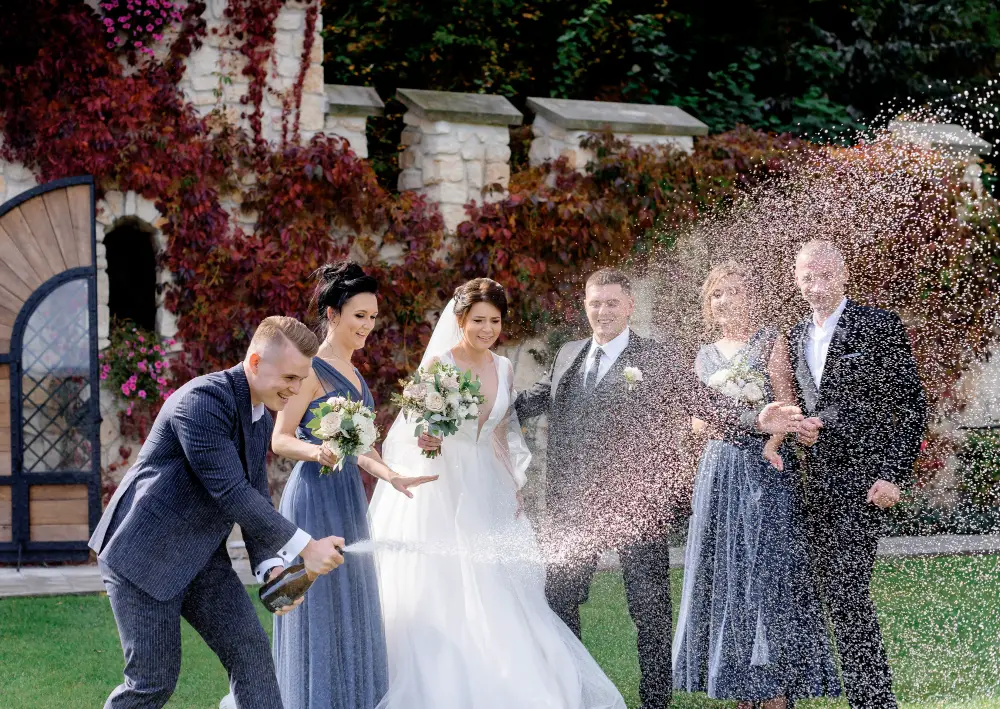
By the time my mind caught up with my eyes, her old gray dress was soaked through and clinging to her slight frame, and her white hair was pressed flat against her face, and Vanessa was still holding the trigger down with the easy, careless pressure of someone who has never once been told that what they are doing is wrong.
The guests laughed. Not all of them, but enough. The ones who laughed did so because Charles was laughing, and laughing alongside Charles Whitmore was a reflex that two hundred people had spent years cultivating at private dinners and charity events and board meetings where his approval determined what happened next to their careers and their comfort and their sense of where they stood in the world.
Charles raised his champagne glass from the terrace.
“Would you look at that?” he announced, in the voice of a man delivering a toast at his own celebration. “She looks like she wandered in from a bus station.”
Vanessa smiled beneath her cathedral veil. She was radiant in it. I had thought so an hour earlier, standing at the altar watching her process across the lawn of her family’s estate, and I remember thinking that whatever imperfections I had accommodated during our two-year engagement, whatever cruelties I had told myself were pressure or inheritance or habit, perhaps they would soften. Perhaps the day would soften her.
She aimed the hose again.
The stream struck my mother’s shoulder and she stumbled backward. I was already moving. I crossed the distance between us in several long strides and stepped in front of her, and the next stream hit me across the chest, the cold water soaking through my wedding shirt, and I stood there dripping and looked at the woman I had intended to marry.
“Put the hose down, Vanessa.”
She rolled her eyes. “Don’t ruin the joke, Daniel.”
Behind me, my mother’s hand found my arm.
“Danny.” Her voice was quiet, careful. “Please. Not today.”
Those three words nearly finished me. She was the one standing soaked in front of two hundred laughing guests, and she was worried about ruining my wedding. That was the shape of my mother’s love: she would absorb any cruelty directed at herself without complaint, but let someone threaten the happiness of the people she loved and she became entirely immovable.
I reached into my pocket.
I removed the ring slowly, deliberately, and I held it where Vanessa could see it.
Her smile disappeared. The hose dropped onto the grass.
“The wedding is over,” I said. I was surprised by how steady my voice was. “And before sunrise, your family’s empire will be gone.”
Charles laughed.
It began as genuine amusement and became something performative once he realized others were watching for his reaction. “Your empire?” He descended a step from the terrace, champagne glass still raised. “You are a salaried consultant who still drives a six-year-old car.”
Vanessa stepped toward me. The veil shifted around her shoulders, luminous and absurd. “Put the ring back on. You’re embarrassing yourself.”
“No,” I said. “You did that for me.”
I took off my jacket and placed it around my mother’s shoulders. She was shivering. The cold of it, or the humiliation, or both. I guided her toward the car while Charles followed several steps behind, his voice losing its warmth and becoming something harder and more precise.
“If you leave now, you lose everything,” he said. “The apartment, your position, your entire professional network. I built all of it for you.”
I stopped near the terrace steps and turned. I looked at him.
That was what he truly believed. In two years of watching me attend his dinners, review his contracts, and sit quietly while he boasted about acquisitions he had financed with money he did not actually control, Charles Whitmore had constructed a complete and entirely fictional version of me. He had never once asked how three major banks approved emergency credit for his failing company within forty-eight hours. He had never wondered who truly controlled Northbridge Capital, the private investment firm that existed behind six separate holding companies. And he had never thought to ask why my mother arrived in an old gray dress when she had the means to purchase the entire estate he was standing on.
I helped her into the passenger seat and closed the door gently.
Then I called Rebecca.
“Release the files,” I said.
She did not ask for clarification. Eleven years of working together had made that unnecessary.
We drove without speaking for several minutes. The estate gates shrank in the mirror, and through them I could see Vanessa standing on the lawn, screaming into her phone, the veil finally torn away, the beauty of the morning completely dismantled.
My mother looked down at her hands, folded in her lap over my jacket. Her hair was still damp against her neck.
“Danny,” she said. “Take me home.”
“You need to see a doctor.”
“I need dry clothes and a proper cup of tea.”
“You almost fell.”
She turned to look at me with the particular patience she had always reserved for my most anxious moments. “I have been knocked down by worse people than Vanessa Whitmore,” she said. “The difference is they were intelligent enough not to record themselves doing it.”
I laughed. It came out raw and brief and painful, but it was real, and hearing that steel beneath the gentleness of her voice reminded me of something I had been in danger of forgetting: she had never needed me to rescue her. She had needed me to make the right choice.
I looked at the dress. The gray fabric, old and neatly pressed, a small repair visible at the hem if you knew to look.
“That was Grandma’s, wasn’t it,” I said. It was not a question.
She smoothed it across her knees. “She wore it the morning your father and I opened our first office. We had twenty-seven dollars between us. She said honest work could turn twenty-seven dollars into a future.” She was quiet for a moment. “She was right.”
Vanessa had not merely soaked an inexpensive dress. She had aimed a hose at the memory of the woman whose twenty-seven dollars had built everything the Whitmore family spent two years trying to absorb through marriage.
“I should have told her who you were,” I said.
My mother shook her head. “You should never have to present a financial statement before another person decides whether you deserve dignity.”
That sentence carried more weight than she intended, or perhaps exactly as much as she intended. During our engagement I had forgiven Vanessa many times for things I should not have forgiven. I told myself the cruelty was her father’s influence, that the contempt for people she considered beneath her was inherited rather than chosen, that love was a sufficient argument against character. The woman with the hose had settled that question permanently.
My phone began vibrating before we reached the highway. Charles called three times. Vanessa called six. Her mother, Lorraine, sent a message demanding I return and apologize publicly before anyone else left the ceremony.
Then Rebecca’s notifications began.
Northbridge had suspended every unused Whitmore credit facility. Three banks had received evidence that Charles violated his debt covenants. Two outside directors had requested an emergency board convening. The company’s chief financial officer had resigned by text.
I read each message and felt no satisfaction. The architecture of a dishonest empire is impressive until it falls, and when it falls it does not fall only on the people who built it. Underneath Whitmore Global’s towers were housekeepers and cooks and maintenance workers and thousands of families who had nothing to do with what Charles had done.
“Promise me,” my mother said, watching my face.
“Payroll is protected. Operating accounts for properties with guests are untouched. Only executive authority is frozen.”
She relaxed by a degree.
“Justice removes the person holding the matches,” she said quietly. “Revenge burns the whole house.”
Her brick house looked exactly as it always had when we arrived: modest, surrounded by maple trees, the same uneven sidewalk where I had learned to ride a bicycle. She could have lived anywhere. She had refused penthouses, gated communities, private islands, every luxury property Northbridge had acquired across three decades of operation. She stayed in the house where my father had lived because, she said, the house remembered him. That was enough.
I helped her inside, turned up the heat, found clean towels. While she changed I stood in the kitchen and looked at the framed photograph above the table. My parents, young and exhausted and genuinely hopeful, holding a handmade sign outside their first office. My father in an inexpensive brown suit. My mother in the gray dress.
They had no idea, standing there, what they were beginning.
Rebecca arrived with Marcus Lee, Northbridge’s forensic accounting director, both of them carrying leather cases and neither of them mentioning my wet shirt or the fact that I had just walked out of my own wedding. My mother returned in dark trousers and a cream cardigan. A red mark showed along her shoulder where the water struck her, and when Rebecca saw it her expression changed in a way she did not bother to conceal.
“Mrs. Hale. I’m deeply sorry.”
“My pride is bruised more than my shoulder,” Mom said. “Show Daniel what you found.”
The contracts came first. The emergency financing agreement at the top of the stack told the story efficiently: Whitmore Global had been collapsing for years before I became engaged. Charles had concealed the losses through inflated property valuations, circular loans between his own subsidiaries, and revenue projections from hotels that had not yet opened. Northbridge had supplied nearly eight hundred million dollars in emergency credit, and in return had received conversion rights, voting proxies, and personal guarantees from every senior Whitmore.
Charles had been too desperate and too arrogant to investigate who actually controlled the money he was accepting.
Then Marcus set down a second stack.
Unauthorized transfers. Four offshore accounts. The beneficial owners: Charles, Lorraine, and Vanessa.
“Vanessa owns one?”
“Two,” Marcus said. “Nearly fourteen million dollars over three years. Several transfers occurred after the engagement.”
Rebecca slid a document toward me. My electronic signature was on it, authorizing what appeared to be a routine expense approval.
“I never signed this.”
“We know. The signature was extracted from a scanned employment agreement. The file was created on Vanessa’s personal laptop.”
The silence in the kitchen was total for several seconds.
Vanessa had used my name and my identity to launder stolen money, confident that my ordinary title made me too insignificant to be examined closely. She had done this while accepting my ring. While planning a wedding. While telling me, with apparent sincerity, that she loved me.
“Did she know I controlled Northbridge?”
“No,” Rebecca said. “But she intended to gain access.”
She removed the prenuptial agreement from the second case. I had refused Vanessa’s final draft after noticing language I could not reconcile with anything legitimate. What Rebecca showed me now was a version of that document containing a hidden attachment, added after my attorney’s review, which would have granted Vanessa temporary voting authority over any asset held through a company where I served as trustee, officer, or undisclosed beneficiary.
My father had built Northbridge. My mother had protected it for thirty years behind a wall of anonymity. And Vanessa had designed a legal instrument, using a forged version of my signature, to reach through that wall and take what was inside.
“They selected me,” I said. “Not because I mattered. Because they thought I was close enough to open the door.”
A car stopped hard outside. Fists hammered the front door.
Charles.
My mother walked toward the entryway before I could move. I followed closely, and when she opened the inner door she left the locked glass storm door between us and him, which I noted was a deliberate choice. She was going to face him, but on her own terms.
He no longer looked like the commanding presence who had raised a champagne glass above a crowd. His face was dark with blood and effort, his white wedding tie hanging loose, the authority he wore so naturally all afternoon entirely absent.
“Tell your son to reverse what he’s done,” he said.
“My son does not require my permission to protect his company.”
Charles went completely still.
“His company,” he repeated.
My mother looked at him with something that was almost patience, the expression of a person delivering news they have been carrying for a long time.
“You accepted eight hundred million dollars without identifying who stood behind the holding companies,” she said. “That carelessness alone proves you were never qualified to manage what you had.”
Recognition moved across his face in stages. Then came disbelief. Then something that looked, briefly, like fear.
“Eleanor Hale,” he said.
He gripped the storm door handle. It did not move.
“After Thomas died, everyone said you sold and disappeared.”
“I allowed everyone to say what protected Daniel.”
“You cannot do this.”
“My family has done nothing to you that you did not do to yourself,” she said. “You falsified valuations, stole from investors, forged my son’s signature, and used your daughter’s marriage as a financial acquisition.”
His eyes cut to me, calculating how much I knew, whether there was anything left to negotiate.
“This is a misunderstanding,” he said. “Vanessa handles her own documents. Young people make errors. We can resolve this privately, without destroying thirty years of work.”
“You sprayed my mother with a garden hose,” I said.
“That was Vanessa’s idea.”
“You laughed.”
His face hardened. “Do not destroy an empire because an old woman’s feelings were hurt.”
My mother’s expression changed then. The warmth left it completely, and what remained was the face of the woman who had spent three decades building something specifically designed to end this conversation.
“You believe this began today,” she said.
Charles said nothing.
“It began when you falsified the Brookhaven reports. It continued through every bribed inspector, every drained pension, every family you promised security and then quietly robbed.”
“None of that is proven.”
“It will be.”
He leaned toward the glass. “If I fall, Northbridge suffers too. You financed those projects.”
“Every valuable property is protected in a separate subsidiary,” I said. “The only asset being removed is your personal authority over other people’s money.”
The certainty left his face. What replaced it was something I had not seen from him before. The look of a man who had structured his entire life around never arriving at this particular moment, and who had arrived at it anyway.
“You planned this.”
“I planned for your dishonesty,” I said. “I did not plan for your daughter to assault my mother at our wedding. That only accelerated the schedule.”
Security arrived. Charles threatened prosecutions, political retribution, personal ruin, everything left in his inventory, before finally returning to his limousine.
Vanessa came minutes later, still in the wedding gown, the veil gone, the train stained, mascara beneath her eyes. She stood on the street calling my name.
I remained behind the locked door.
She said her father had told her the hose was harmless. That my mother had dressed that way to attract attention. That everyone would laugh and it would pass.
“She wanted to honor my grandmother,” I said.
Vanessa’s face went through something complicated.
Behind me, Rebecca held the forged authorization document up to the glass. Vanessa looked at it and stopped moving.
“The file was created on your laptop,” Rebecca said. “The metadata includes your account name, your password certificate, and edits made at three seventeen in the morning, the night before the wedding.”
Vanessa looked at the street. Then back at me.
“Daniel. I can explain.”
“Explain why you were marrying me.”
A pause. “I loved you.”
“Then explain the attachment in the prenuptial agreement.”
“My father said it was protection.”
“From whom?”
“From your partners.”
“You mean the partners you intended to steal from using my name.”
The pleading left her face and anger replaced it, the way it does when a person stops pretending and lets you see the thing underneath. “You hid everything from me for two years. You let me believe you were an employee while you secretly controlled a billion-dollar institution. You watched my father treat you like nothing and said nothing.”
“I watched to learn whether his respect for people came naturally or required an audience.”
“That is manipulation.”
“So is marrying someone to obtain voting rights over his assets.”
She flinched.
Then she reached into the neckline of the wedding gown and removed a diamond pendant, which she twisted open. Inside it was a tiny encrypted drive.
“Everything my father moved offshore,” she said. “Every payment, every false invoice, every inspector and banker and politician he purchased.”
She held it out.
My mother studied her.
“You knew he was destroying people,” she said, “and you stayed silent until you needed protection from him yourself.”
“I was raised inside that family.”
“That explains your fear,” Mom said. “It doesn’t excuse your choices.”
Rebecca accepted the drive in an evidence envelope.
Vanessa stared at the ring still in my pocket. “Are we truly over?”
“You ended us when you pointed the hose.”
She sat down on the porch step. The wedding gown spread around her in the evening air, white and wrecked, and for the first time that day there was no audience to perform for. Just the consequences, which had arrived exactly on schedule.
I closed the door.
By midnight, Rebecca’s forensic team had decrypted the files. The evidence was worse than any of us had prepared for. Bribed safety inspectors, after structural cracks appeared beneath three Whitmore properties. Employee retirement contributions diverted and concealed behind falsified statements. Payments to private investigators assigned to follow journalists and judges and business rivals. Recordings of Charles threatening former executives with language that left no room for alternate interpretation.
Then Marcus opened a folder.
My father’s name appeared on the screen.
Inside were surveillance photographs taken during the final six months of his life. Copies of confidential investigations he had been conducting. And payment records for a mechanic who had worked near our family office.
My father had died when the brakes failed on a mountain road during a rainstorm. Everyone had called it an accident. The mechanic had received two hundred thousand dollars from a Whitmore-controlled account three days before.
My mother sat absolutely still.
“Mom,” I said.
She closed her eyes.
She told me quietly, in the voice she used when she was managing herself very carefully, that she had always believed Thomas’s death was not an accident. But suspicion without evidence would have placed me in danger. So she had carried the possibility alone for thirty years, building something powerful enough to make the truth safe.
Rebecca found an audio recording dated two nights before the crash. My father’s voice came through the kitchen speakers, older and warmer than my memories of it.
“If anything happens to me,” he said, “Charles Whitmore ordered it. Eleanor must protect Daniel and finish what we started.”
My mother’s cup slipped from her hand.
I knelt beside her, but she held up one hand, forcing herself to remain steady while Rebecca contacted federal investigators. She had survived thirty years of not knowing. She would survive knowing. That was who she was.
We drove to Whitmore Global headquarters at four-thirty in the morning. My mother wore a navy suit. The repaired gray dress was folded carefully in a garment bag beside her.
News vans surrounded the building. The wedding video had covered every platform overnight. Charles encouraging the crowd to laugh. Vanessa with the hose. My mother stumbling backward. The public had reached its verdict hours before any court convened.
The emergency board meeting began at five-fifteen. Charles still occupied the chairman’s seat, still projecting the particular authority of a man who believes position is the same as power.
He smiled when I entered.
Rebecca placed the financing agreement in front of him.
“Northbridge Capital has converted its outstanding debt,” she announced. “Effective four fifty-eight this morning, it controls sixty-eight percent of Whitmore Global’s voting shares.”
The directors turned.
I walked past Charles and stood behind the chairman’s seat.
“My name is Daniel Hale,” I said. “I am the controlling beneficiary of Northbridge Capital, and my first motion is the immediate removal of Charles Whitmore from this board.”
Three hands rose. Then five. Then every hand in the room except his.
The empire did not survive until sunrise.
When federal agents entered with an arrest warrant connected to my father’s death, Charles looked past them at my mother.
“You still haven’t told him the final truth,” he said. “Ask Eleanor who really built Northbridge, and what Thomas planned to do with it before I stopped him.”
The agents closed the cuffs around his wrists. He was still laughing as they walked him out.
My mother met me in the executive conference room as dawn appeared above the city.
She told me the truth she had been carrying alongside everything else.
My father and Charles had been partners, briefly, at the very beginning. They had met in college. Thomas understood finance, Charles had wealthy connections and the kind of ambition that fills every room it enters. They purchased neglected buildings and repaired them, offering tenants paths toward ownership. My mother managed the accounts and insisted on protections for the people inside each property.
Charles considered those protections a waste of money.
The partnership ended when he forged inspection certificates. My father had intended to report it but Charles threatened the employees and families who would lose everything in the resulting collapse. Thomas agreed to a quiet separation and spent years compensating the people Charles had cheated, using the company they built together as the foundation for something new.
That company became Northbridge.
“Charles believed your father stole his future,” she said. “In reality, Thomas spent years paying the debts Charles created.”
She removed an old sealed envelope from her handbag.
My father had planned to divide Northbridge among its employees. He believed no family, including ours, should exercise permanent control over an institution that affected so many lives. He had drafted the transition documents shortly before his death. He was driving that night to collect files before Charles could destroy them.
“You built the whole thing to stop him,” I said.
“I built a shield,” she said. “But your father never intended it to become a throne.”
Our first public announcement was not about the arrests, or the wedding video, or the collapse of the Whitmore empire. We guaranteed every employee’s salary, health coverage, and pension while independent auditors worked. The second announcement restored the retirement contributions Charles had stolen. Northbridge deposited the missing funds before investigators finished calculating the total.
It cost our family hundreds of millions of dollars.
My mother approved it before I finished explaining the numbers.
“That money was never ours,” she said. “It belonged to the people who earned it.”
The employee who approached me at a hotel forum weeks later was a maintenance supervisor named Miguel. He carried a folder full of safety reports that had been submitted and ignored. Structural concerns beneath one of the main properties, suppressed because repairs would reduce quarterly margins.
We evacuated the affected sections that afternoon. Engineers confirmed that one support structure could have failed within months, while guests were inside.
That discovery closed the final argument among the board. Every director who had once raised a glass with Charles voted unanimously to remove his name from every property in the portfolio. The company was renamed through an employee ballot. Havencrest Hospitality. A name that belonged to no family.
I appointed Miguel to the independent safety council, with authority to halt operations when serious hazards were documented and ignored.
Some executives called it expensive.
I called it the price of allowing people to go home alive at the end of their shift.
The transition of ownership took months of legal architecture, but we announced it before it was complete. Forty percent of Northbridge would move into an employee ownership trust. Another twenty percent would fund community housing, vocational education, grief support, and retirement protections. Our family would retain a minority stake and strict ethical veto rights for a defined period, sufficient to prevent hostile acquisition of the mission without constituting permanent control.
Financial commentators called the decision reckless.
Employees said it was the first time anyone had asked them to share the future they had spent their careers building.
My father had written me a letter, drafted when I was eight years old, recovered from a warehouse owned by one of Charles’s shell companies.
I read it at the kitchen table beside my mother.
“One day people may tell you that wealth proves intelligence, goodness, or importance,” he wrote. “Do not believe them. Money reveals character more often than it creates character.”
At the bottom he had added one line.
“Your mother will know when it is safe to finish this.”
Months later, the estate where my wedding had collapsed was seized during the criminal forfeiture process. My mother proposed a use for it.
The mansion became the Thomas Hale Center for Grief, Legal Assistance, and Financial Recovery.
The ballroom where guests had laughed at her became a free dining hall for elderly residents and families in crisis. The terrace where Charles raised his champagne glass became an outdoor counseling space surrounded by gardens. The lawn where Vanessa held the hose hosted vocational graduations, adoption celebrations, and weddings for couples who needed a beautiful place and could not afford one.
Beside the fountain stood a small plaque.
My father’s words, in plain type: “Money reveals character more often than it creates character.”
At the opening ceremony, my mother wore the repaired gray dress. Every seam had been strengthened. My grandmother’s silver brooch rested near the collar. When reporters asked why she had chosen it, she looked at them with the patience of someone who has spent a long time waiting for the obvious question.
“Because something does not lose its value merely because a cruel person failed to recognize it,” she said.
Three thousand people stood and applauded.
She walked onto the terrace where Charles had mocked her and stood looking out at the grounds, and she looked exactly like what she was: the woman who had done all of this. Who had carried a thirty-year secret and a thirty-year plan without letting either one distort her into something harder or smaller than she began.
She looked like my mother. That was greater than anything else she could have looked like.
Charles was convicted on every major count. The jury deliberated less than four hours. He received a sentence ensuring he would spend the remainder of his life in prison.
Before the center’s first anniversary, Vanessa sent a handwritten letter. She had served her reduced sentence. She was working with a nonprofit assisting families affected by financial crimes. She did not ask to see me. She wrote that the first honest paycheck she earned was smaller than what she once spent on a single dinner, and that it allowed her to sleep without medication for the first time in years.
I wished her healing and sent no further reply.
Some apologies deserve acknowledgment without renewed access.
Some people can only begin changing after losing the privilege of standing beside those they harmed.
On the anniversary of my father’s death, my mother and I drove the mountain road and placed flowers at the marker and read his letter aloud in the car with the engine off and the windows down and the trees moving around us the way they always had, indifferent and patient.
“I hope he knows we finished it,” I said.
“He knew we would,” she said.
Before we left, she handed me the ring. She had found it in my jacket pocket the night of the wedding and kept it without mentioning it.
“What should I do with this?”
I held it in my palm and looked at it for a while, the cold weight of a life I had very nearly chosen.
Then I placed it at the base of the marker.
“It belongs to a version of my future I don’t live in anymore,” I said. “I don’t need to carry it.”
My mother smiled.
We drove home through the afternoon light, through the maple trees and the uneven sidewalks of the street where I had grown up, to the table where her parents’ photograph still hung above the door.
Twenty-seven dollars and a gray dress and honest work and the long patience required to finish what you start.
That was the whole story.
That was everything.

Specialty: Legal & Financial Drama
Michael Carter covers stories where money, power, and personal history collide. His writing often explores courtroom battles, business conflicts, and the subtle strategies people use when pushed into a corner. He focuses on grounded, realistic storytelling with attention to detail and believable motivations.