The Easier Person to Hurt
The morning we brought the crossover home, I sat in the driver’s seat for a while before I did anything else.
I just sat there with my hands on the wheel, not going anywhere, feeling the particular quality of something that has taken a long time to arrive. Three years is a long time to want something and hold the wanting carefully and not let it become impatience or bitterness. We had kept our sagging living room chairs and our phones with cracked screens. We had declined weekend trips while our friends posted photographs from lake houses and beaches and the kinds of places that exist primarily to be photographed. Every small refusal had been a deposit toward this, and now it was here, and I was sitting in it, and the dashboard was clean and the seats were white and it smelled like the future.
Timothy leaned against the door frame, watching me with the half-smile he uses when he finds me charming and doesn’t want to say so directly.
“You know it’s allowed to have fingerprints,” he said.
“Not today.”
He laughed. It was a good morning. The kind that stays with you not because anything remarkable happened in it but because the ordinary things inside it felt, briefly, like enough.
“We earned this, Elle.”
“We did,” I said.
I looked at the white seats. “No food or drinks in here.”
“Am I ever going to drive it?”
“I’ll check the paperwork,” I said, and he laughed again, and for a few minutes everything was light in the uncomplicated way that things are light when you have been working toward something for a long time and you have finally arrived.
Then gravel crunched behind us.
Jake’s sedan rolled into the driveway. He climbed out and circled the crossover with the proprietorial ease of someone assessing a new acquisition, running his eyes along the body lines, touching the hood briefly with the flat of his hand.
“Finally,” he said. “My brother bought something with personality.”
“We bought it,” I said.
Jake looked at Timothy as if I had not spoken.
“This is exactly what I need tonight. Can I borrow it?”
I understood, in the moment that followed, that this was a question directed at my husband about my car, in front of me, with full awareness that I was present. It was not carelessness. It was a long-established protocol, the kind that develops between people who have been doing a thing for so long that it stops feeling like a choice and becomes simply how things are.
“No,” I said. “Tim, it’s brand new. We brought it home an hour ago.”
Jake’s hand stopped on the hood.
“There’s a party,” he said, as if the party explained and resolved everything.
“We haven’t even driven it yet,” I said. “I wanted us to take it out tonight, just the two of us. It was supposed to be something we did together first.”
Jake opened his arms in the gesture of a man who considers himself reasonable. “I’ll be careful. You can have your date tomorrow.”
“You don’t take care of your own car,” I said.
“That’s different.”
“How?”
“It’s mine.”
I looked at him. “That’s exactly my point.”
What I wanted, in that moment, was for Timothy to turn to his brother and say simply: not this one, Jake. She said no. We just got home. But Timothy was shifting his weight beside me in the particular way he shifts his weight when Jake has created a situation and Timothy wants someone to resolve it without anyone having to say anything difficult.
“It’s one night,” Timothy said. “It’ll be okay, Elle.”
I felt the morning change shape.
The thing about being the easier person to hurt is that it happens gradually and then completely. It happens in small moments where someone chooses the path of least resistance, and the path of least resistance runs directly through you, and because you love them and because you understand that they are not doing it with malice, you absorb the cost and move on. And then you absorb it again. And again. Until the absorbing has become so practiced and so automatic that the person doing the choosing stops noticing they are making a choice at all.
“It’s our first night with it,” I said. “I wanted it to be special.”
“You can have special tomorrow,” Jake said, easy as anything.
Timothy gave me the look. The one that said Jake would escalate if I held the line, and the escalation would reach his parents eventually, and somehow by the time it got there it would have become a story about me being difficult. I knew this look because I had been responding to it for years, adjusting my position to accommodate it, swallowing my own legitimate objections because the cost of maintaining them was always somehow higher than the cost of letting go.
“Please,” Timothy said. “Do this for me.”
I stared at my husband.
He had framed my own boundary as a favor he was asking me to abandon. He had taken my no and held it up to the light of Jake’s wanting and found my no to be the problem requiring a solution.
“Fine,” I said, because I was tired and because the morning had been good until five minutes ago and because I loved Timothy and because I could not see, from inside the moment, the full shape of what I was teaching everyone by agreeing.
I pulled back the keys when Jake reached for them.
“Look at me,” I said.
He rolled his eyes and obeyed, the way a teenager obeys a rule he considers beneath him.
“No food. No drinks. Nobody else drives it. You bring it back by nine tomorrow morning.”
“Scout’s honor,” he said.
“You were never a scout.”
He took the keys and was gone, and I stood in my own driveway watching our new car disappear down the street, and it did not feel like generosity. It felt like something had been taken, and I had been asked to hand it over myself so that no one would have to feel bad about the taking.
Nine o’clock the next morning came and went without the crossover.
Jake did not answer when I called. Eventually a text arrived: Relax. Leaving soon.
Timothy suggested traffic, and I did not say what I thought about that explanation.
At ten thirty, the crossover turned into the driveway. I was at the door before Jake switched off the engine.
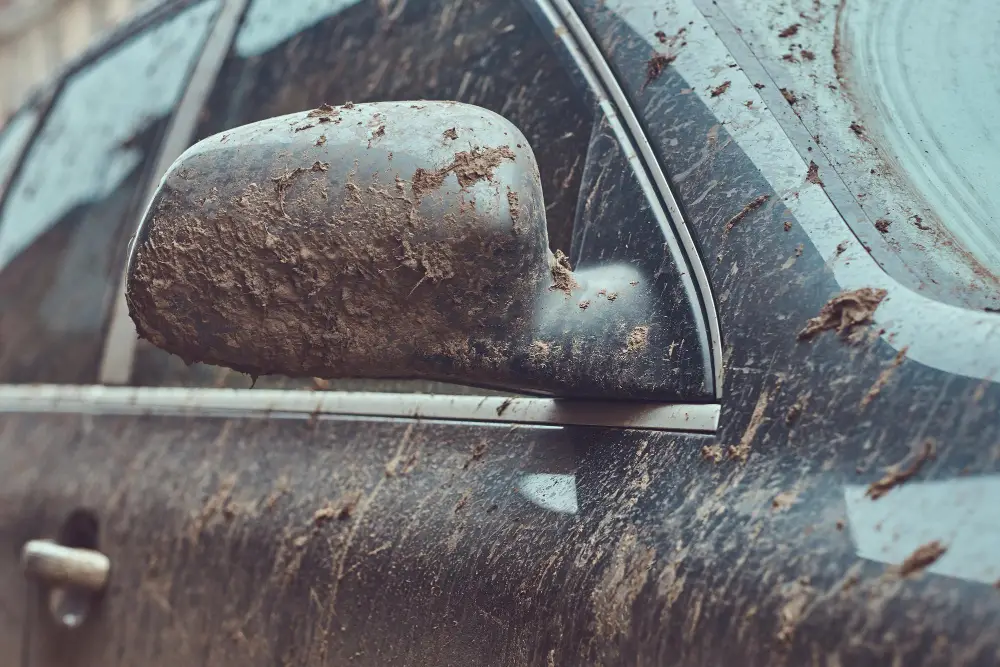
The smell hit me when I opened the driver’s door: alcohol and old food and something underneath both of those things, something sour and organic that belonged to a very different kind of evening than the one Jake had described. The back seat held a red stain that was still damp when I pressed two fingers to it. Mud covered the mats. Crushed food was ground into the upholstery. A sticky cup had left a ring on the floor beneath the passenger seat.
Jake leaned against the hood. “We cleaned most of it.”
“Most of it,” I said.
“Someone spilled a drink.”
“You promised no drinks.”
“I promised nobody else would drive.”
I looked at him. “You promised both.”
“Plans changed. We were having fun.”
I pressed my fingers to the wet stain again and held them up so he could see. “Sit in it.”
“What?”
“Sit down in the seat.”
He looked at the seat. “It’s soaked.”
“Exactly,” I said.
He folded his arms. “It’s just a car, Elle.”
I took out my phone and began photographing everything, methodically, the stain and its precise dimensions, the lifted edge of the rear mat, the residue on the upholstery, the cup beneath the seat. Jake watched me with the expression of someone who finds careful documentation personally offensive.
“What are you doing?”
“Documenting your mess.”
“I’ll take it to a cheap place,” he said.
“No. You’ll pay for proper repair.”
“Use your insurance. That’s what it’s for.”
“You borrowed it. You pay for what you damaged.”
Timothy came down the porch steps then, still half-asleep, rubbing his eye with the back of his hand. He looked through the open door and his face changed.
“Jake. This is bad.”
“It can be cleaned,” Jake said. “Nobody wrecked it.”
“You promised no food or drinks,” Timothy said, and I felt something release slightly in my chest, a tension I had been holding since the previous afternoon.
“I wanted one night,” Jake said, in the tone of someone who has never accepted that wanting something does not entitle you to it.
“Then you should have used your own car,” Timothy said.
The detailer arrived before noon. He was a careful, thorough man who moved through the crossover with professional attention, lifting mats, pressing the seat, checking beneath the rear floor piece.
“This needs more than cleaning,” he said. “The padding has absorbed the liquid and will require odor treatment. This section of the flooring has warped and needs replacement.”
The estimate came through an hour later: $1,860.
I called Jake and put him on speaker.
I read him the line items. Deep stain treatment, odor removal, replacement of the damaged floor piece.
“That’s ridiculous,” he said. “I’m not paying it.”
“You can pay the detailer directly or reimburse us. Either way, this is your bill.”
“No, Elle. Get over yourself.”
Timothy started to speak. I looked at him before the words formed.
“Don’t ask me to use our savings to cover this,” I said. “We spent three years putting that money away. Respect me more than that.”
“I was going to say Jake should pay,” Timothy said.
“Yes. He should.”
Jake laughed through the phone, the specific laugh of a person who has never had to face a consequence he couldn’t outrun. “You two can afford it.”
“That was never the question,” I said.
“You’re acting like I crashed it.”
“You returned it soaked in alcohol, refused to pay the bill, and expect everyone to shrug. That’s the problem.”
“Nothing serious happened,” Jake said, and hung up.
Timothy sighed. “You know how he is.”
I looked at my husband. “That’s what everyone says instead of stopping him.”
I called Nathan.
Nathan had been part of Timothy’s circle since before we married, a good-natured, honest person who I trusted to tell me what had actually happened. He answered on the second ring. His fiancée Sasha was with him.
“I need to know what happened in the car,” I said.
There was a brief silence.
Then Sasha said, near the phone, “Jake told us drinks were allowed.”
“I told him specifically no drinks.”
“We didn’t know that,” Nathan said.
“When things started spilling,” Sasha continued, “I asked him to pull over and deal with it. He said it would be fine.”
“What did he say when it got worse?”
Nathan exhaled. “He said Timothy would smooth it over. He said the car would get cleaned up and the whole thing would disappear.”
I looked at my husband.
“He said you’d forgive Timothy,” Sasha added, “and that would be the end of it.”
Timothy’s face shifted through several things in the space of a few seconds. I watched him understand what he was being told: that Jake had not made a careless mistake and hoped for the best. Jake had planned the evening around the expectation of my silence. He had built his night on the reliable foundation of my willingness to absorb and move on, had told his friends in advance that this was how it would go, had treated my boundaries as a theoretical obstacle that Timothy would dissolve on his behalf.
Nathan offered to contribute to the repair cost.
“No,” I said. “You can apologize. Jake can pay.”
I thought about it for a long time after I hung up. About the shape of it. About how long it had been this shape, and how I had participated in making it this shape, and what it would cost to change it.
I printed the clearest photograph of the ruined seat and wrote Jake’s words beneath it: IT’S JUST A CAR. I attached the estimate and the damage photographs and a note quoting his refusal. I put it all in a frame.
Then I arranged for it to be delivered to Jake’s apartment that evening, where Donna and Craig were spending time with their son before their anniversary dinner.
I want to be honest about this: I knew what I was doing. I was not being careless. I was making a deliberate choice, and I had thought it through, and I had decided that the thing I had been participating in for years, the comfortable family arrangement in which Jake did what he wanted and I smoothed it over and Timothy looked relieved and Donna and Craig never had to see the cost, had gone on long enough.
Jake called within the hour.
“HOW DARE YOU?” He said it so loudly I had to pull the phone away from my ear.
“Did you read the estimate?” I asked.
“You embarrassed me in front of Mom and Dad.”
“You did that when you refused to pay.”
“Take it back.”
“Pay the bill.”
“You knew they were there.”
“Yes,” I said. “I wanted them to see what they’ve been protecting.”
Timothy was on the porch behind me. His face told me that Donna had already called him. He came down the steps and stood beside me while I was still on the phone, and when Jake hung up Timothy looked at me with the expression of someone who is not sure whether to be angry or ashamed and is sitting with both.
“You should have warned me,” he said.
“I warned you yesterday,” I said. “I said no. That was the warning.”
“This is their anniversary.”
“I know.”
“This isn’t about a dirty car anymore, Elle.”
“You’re right,” I said. “It isn’t.”
He blinked. “What does that mean?”
“It means Jake ruined our car and you made me feel guilty for caring about it. It means you pressured me until I gave him the keys, and then when he came back late with a car full of damage and refused to pay for any of it, your first instinct was still to ask me to manage my reaction. That’s what this is about.”
“I was trying to keep the peace.”
“No. You were trying to keep Jake from being upset. Those are different things. Keeping the peace is something you do for everyone. What you were doing was keeping Jake comfortable at my expense.”
Timothy was quiet for a long time.
“If you had just told him no yourself,” I said, “you would have had to own the decision. But if you could get me to agree, then the choice was mine, and if it went wrong, it was my fault for not holding the line. You needed me to agree so you’d have somewhere to put the blame.”
He looked at the driveway. “That isn’t how I thought about it.”
“I know,” I said. “That’s what makes it hard to explain.”
We went to the anniversary dinner because I loved Donna and Craig and I was not going to let Jake turn my absence into evidence of my unreasonableness. Donna hugged me when I arrived. Craig pulled out my chair. Jake did not look up from his plate, and the framed photograph was gone from wherever it had been set, and there was a particular tension in the room of people who have had a conversation before you arrived and are not sure what to do with you now that you’re there.
Donna set down her fork after several strained minutes.
“Where’s the estimate, Jake?” she asked.
“Not tonight, Mom.” His voice had the practiced weariness of someone who has been using this tone to buy time for decades. “I just want one night without all this. It’s just a car.”
“You said the damage wasn’t serious,” Donna said. “So show us.”
Craig cleared his throat. “We can look at it later. Let’s eat.”
Jake relaxed. I watched him relax and I understood exactly what I was seeing: the old routine running exactly as it always ran. Someone would suggest a delay, someone else would agree, and by the time later arrived the problem would have been absorbed by time and everyone’s exhaustion and the general willingness of people who love Jake to let things go rather than watch him be held accountable.
I put my napkin beside my plate.
“Happy anniversary,” I told Donna and Craig, and I meant it completely. “You two deserve so much joy.”
Donna frowned. “You’re leaving, honey?”
“Yes.” I looked at Jake. “You damaged my car, refused to pay for it, and spent the evening expecting everyone at this table to make me feel guilty for mentioning it. I’m not going to sit through that part. It’s disrespectful, and it genuinely hurts.”
I walked out.
Timothy followed me into the parking lot.
“Elle, wait.”
I turned. He stopped a few feet away, and in the light from the restaurant windows he looked younger than usual, the way people look when they are telling the truth about something they have been carrying for a long time.
“When I was nineteen,” he said, “Jake borrowed my first car. He scraped the entire passenger side against a concrete post.”
“What happened?”
“My parents paid for it. They told me not to hold a grudge. It was a whole thing about family and forgiveness and the importance of not letting money come between brothers.”
“You remember every detail.”
“Every detail,” he said. “Disappointing Jake always became a family crisis. Everyone mobilized to prevent it.”
“And disappointing me?”
He looked at the ground. “You usually forgave me.”
“That wasn’t permission, Tim.”
“I know.” He met my eyes. “I chose the easier person to hurt. That’s what I did. I’m not going to pretend it was something else.”
Jake appeared in the doorway behind us. “You’re taking her side?”
Timothy did not hesitate. “She’s my wife and you’re wrong.”
Craig appeared beside Jake and offered to cover the bill himself, let Jake repay him over time.
“No,” I called from the driveway.
Donna touched Craig’s arm. “Elle’s right. We’ve done this before. We pay, we tell him not to worry, and then we wonder why nothing changes.”
Craig looked at his younger son. “Every time we fixed it for you, we taught you that someone else would carry your consequences.”
Jake said he didn’t have the money.
I offered a payment plan. Reasonable amounts, reasonable timeline.
He refused.
Nobody rescued him.
Three days later he sold the custom wheels from his own car. That evening he came to our house with an envelope and stood in the doorway with the expression of someone who is not accustomed to arriving without an exit prepared.
“I’m sorry this got out of hand,” he said.
I left the envelope in his hand. “What are you sorry for?”
He looked at Timothy. Timothy looked at him steadily and said nothing.
Jake looked at the envelope. Then at me.
“I’m sorry I took the crossover after you said no. I’m sorry I let people bring food and drinks inside when I promised I wouldn’t. I’m sorry I expected Timothy to make you drop it.” He paused. “And I’m sorry I told people beforehand that he would.”
“Why won’t this happen again?”
He looked toward the driveway, where the crossover sat, clean now, repaired. “Because your things aren’t mine.”
I took the envelope.
“Now that’s an apology,” I said.
The detailer had done excellent work. The stains were gone. The smell was gone. The warped floor piece had been replaced and the new one fit perfectly, indistinguishable from the original.
Timothy and I drove it out that evening, finally, the long drive I had wanted on the first night, out past the edge of town where the road opens up and the sky gets wider. We got ice cream and ate it in the parking lot of a closed hardware store because it was the first place we found that had somewhere to sit outside, and we did not talk about Jake or the estimate or the anniversary dinner. We talked about other things, small things, the kind of conversation that fills the space between two people who have said the important things and are resting in the aftermath.
It was not a perfect evening. Something had shifted between us in the past week, something that would take longer than one drive to fully settle into its new position. But the car was clean, and the night was mild, and Timothy drove on the way home without asking whether he was allowed to.
The frame came down too, once the bill was paid. It had done what it needed to do.
Jake paid what he owed. Donna and Craig let him. Timothy stopped treating my limits as problems requiring management.
For the first time in as long as I could clearly remember, keeping the peace did not mean making myself smaller to fit inside someone else’s comfort.
It meant simply telling the truth, and holding it, and waiting to see who would eventually stand beside it.
Timothy did.
That mattered more to me than the car.
Though I was also very glad about the car.

Laura Bennett writes about complicated family dynamics, difficult conversations, and the quiet moments that change everything. Her stories focus on real-life tensions — inheritance disputes, strained marriages, loyalty tests — and the strength people find when they finally speak up. She believes the smallest decisions often carry the biggest consequences.