Forty-One Thousand Gallons
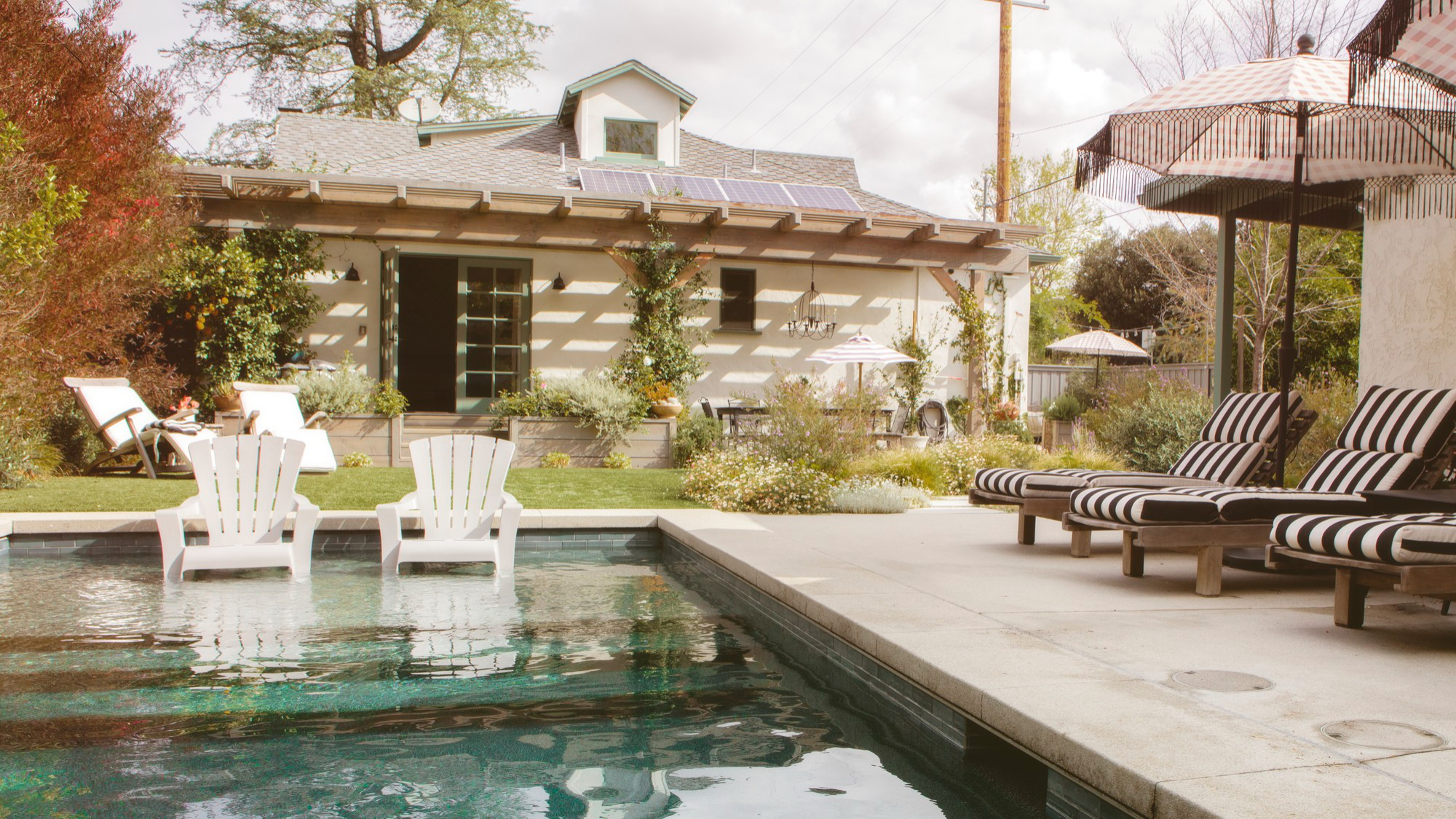
The backyard lights came on when I flipped the switch by the sliding door, and they revealed an empty blue shell where forty-one thousand gallons of water had been just five days earlier. I stood there on the threshold with my keys still in my hand and the smell of the long drive still in my clothes, and for a moment my mind simply refused to make sense of what my eyes were showing me. A pool is a thing that is supposed to be full. That is its entire nature. An empty pool is like an empty grave, a wrongness that the eye registers before the brain can catch up, and I stood there in the doorway to my own backyard and felt the ground tilt slightly under me.
The vinyl liner had pulled away from the walls where the weight of the water was no longer holding it in place, hanging in loose wrinkled sheets like shed skin. Mud, thick and dark, coated the deep end where the drain sat exposed. The pool equipment, the pump and the filter housing that I had maintained meticulously for four summers, was cracked and broken, one component knocked clean off its mounting. And across the patio, someone had overturned the large planters that Sarah and I had spent a weekend arranging, spilling black soil and broken ceramic across the flagstones, so that the whole yard looked less like the site of a party and more like the site of something deliberate, something that had wanted to leave a mark.
Sarah came up behind me, dragging the last of the camping bags, and she stopped, and I heard the breath go out of her.
Oh my God, she said.
We had just driven back from a week of camping near Yellowstone, seven hundred miles of highway, both of us tired in the specific bone-deep way that a long trip leaves you, looking forward to nothing more than our own bed. And instead we had come home to this.
On the patio table, weighted down against the wind by a smooth river stone that had come from one of our own flower beds, sat a note. I recognized the handwriting before I was close enough to read the words, because I had seen it on birthday cards and Christmas tags for years. It was my brother-in-law Carter’s handwriting, cramped and aggressive, pressed hard enough into the paper to leave grooves.
Pool parties are over, it read. Maybe now you’ll understand how it feels when someone takes something you care about. Don’t call me.
And then, underneath, added in a slightly different ink as though it had been a later thought, a small cowardly hedge:
The pump may have been left off. Accidents happen.
I read it twice. I read the two parts of it, the confession and the retraction, the way a man will admit something and then, catching himself, try to build in deniability, and I understood exactly what I was looking at. It was the note of a person who wanted me to know he had done it, wanted the satisfaction of my knowing, but had gotten just nervous enough at the end to leave himself an out. Accidents happen. He had drained forty-one thousand gallons of water out of my pool, cracked the equipment, overturned the planters, and then written accidents happen.
Sarah was reading it over my shoulder. She turned to me, and her face was doing several things at once, horror and guilt and a kind of pleading.
Call him, she said. Matthew, call him right now.
I looked at the note for a long moment. And then I did something that surprised her, and honestly surprised me a little too, because for four years I had been a man who argued, who objected, who got drawn into every fight and lost every one of them. I did not reach for my phone. Instead I went inside, and I came back out with a gallon freezer bag from the kitchen drawer, and I carefully, without touching the writing, slid the note inside it and sealed it.
I’m not calling him, I said.
What are you going to do? Sarah asked.
I looked at the ruined pool, the wrinkled liner, the mud, the broken equipment, the spilled soil, the note in its plastic sleeve in my hand.
Document it, I said.
I need to go back four summers to explain how forty-one thousand gallons of water ended up drained onto my patio by a man who was, at least on paper, my family. Because it did not happen all at once. It happened the way these things always happen, the way a person ends up eaten alive by something that started small. It happened one boundary at a time, each one crossed so casually that objecting to it felt petty, until I looked up one day and discovered that I had no boundaries left at all.
I built the pool the first summer Sarah and I lived in the house. It was a real expense, a stretch even for us, but I had wanted it for years, since I was a kid who swam at other people’s houses and dreamed of having my own, and I did the math and decided it was worth it. It was mine in a way few things in my life had ever been mine, a thing I had wanted and worked for and finally gotten, and I took care of it the way you take care of something you love. I tested the chemistry every few days. I vacuumed it. I ran the pump on a careful schedule. It was, I will admit, a small point of pride, maybe even vanity. It was my pool.
The first time Carter used it, he did not ask. He simply showed up on a hot Saturday with his two boys and a cooler of beer and a bag of pool toys, walked around the side of the house through the gate, and installed himself on my patio as though he owned it. I came outside to find my brother-in-law’s children already cannonballing into the deep end and Carter cracking open a beer in my lounge chair, and when I stood there, startled, he grinned at me and said, family doesn’t need an invitation, Matthew. Lighten up.
I let it go. Of course I let it go. It was one Saturday, and they were family, and the boys were having fun, and I did not want to be the uptight brother-in-law who couldn’t share his pool with his nephews. That is how it starts. It starts with a reasonable person deciding, correctly, that one instance is not worth a fight.
But it did not stay one instance. Carter came back the next weekend, and the one after, and soon he stopped even the pretense of showing up unannounced and simply began to inform me of his plans. He would text me. Party Saturday at one, one message read. Make sure the filter’s running. Not a question. Not a request. An instruction, from a man treating my pool like an amenity he had rented. He used my grill, burning through my propane. He invited people I had never met, coworkers and neighbors and friends of friends, so that I would come home to a backyard full of strangers eating food I had not bought, and then he and his crowd would leave in the early evening and I would spend the rest of my Saturday night cleaning up their mess, fishing beer cans out of my pool, scrubbing my grill, bagging their garbage.
Whenever I objected, and I did object, at first, Sarah defended him. This is the part that I have had to think about the most, in the aftermath, because it was Sarah’s defense of Carter, more than Carter’s behavior itself, that made the whole thing possible. The boys don’t have a pool, she would say, as though that settled it, as though the absence of a pool at Carter’s house created an obligation at mine. He can still ask permission, I would say. He’s family, Matthew. Family shares. And around and around we would go, and I would eventually give up, because I could see that fighting Sarah about her brother cost me more than the pool did, and I made the calculation that many people in a marriage make, that peace was worth more than being right.
Her father, Joseph, was worse than Carter, in his way, because Joseph provided the philosophical framework that justified all of it. Joseph was the patriarch of Sarah’s family, a heavy, certain man who had opinions about everything and doubts about nothing, and he had decided, early on, that I was a resource to be managed. You have a big house and no children, he told me once, at a family dinner, in front of everyone. Sharing a pool shouldn’t be difficult for a man in your position. And there it was, the whole worldview in a sentence. I had things. I did not have children. Therefore my things belonged, by some natural law Joseph had invented, to the people who did have children, which was to say his family. My ownership was conditional. Theirs was absolute. And when Joseph said this, at the dinner table, and everyone looked at me, waiting to see if I would be gracious about it, I looked at Sarah, and Sarah said nothing. She looked at her plate.
That silence. I have thought about that silence more than almost anything else. Because Sarah’s silence, repeated across four years and a hundred small moments, was the thing that taught Carter and Joseph that the family would always, always protect them, and that I would always, in the end, be alone. Every time Sarah looked at her plate instead of at me, she was casting a vote, and the vote was for them. She would tell me later, when everything came apart, that she had been trying to keep the peace, and I believe that she believed it. But there is no such thing as keeping the peace by only ever asking one person to sacrifice. That is not peace. That is just a slow, quiet, one-sided surrender, and I had been the one surrendering for four years, and I had let myself not notice how much I had already given up.
Then came the tent.
Sarah and I had been planning the Yellowstone trip for months. It was going to be our trip, just the two of us, a week away from her family and the endless obligations, and I had been looking forward to it with an intensity that told me, in retrospect, how much I needed to get away. We needed a tent, a good one, and Carter owned exactly the tent we needed, a large high-quality model that he had bought and, as far as I knew, used exactly once before losing interest, the way Carter lost interest in most things after the novelty wore off.
After everything he’s gotten from us, Sarah said, he won’t mind lending you the tent. Just call him.
So I called him. And I want you to understand that after four summers of Carter using my pool, my grill, my propane, my Saturdays, borrowing his tent for one week felt like the most reasonable request a person could make. It felt, if anything, like a chance for the ledger to balance, just slightly, for the first time.
You want my tent? Carter said, and I could hear the laugh forming in his voice before he even finished the question.
I’ll return it clean, I said. Even then, I was apologizing, softening, making myself small.
Buy your own, Matthew, he said. We’re not helping you.
I was quiet for a second. And then, because something in me had finally reached a limit it did not know it had, I reminded him. Carter, I said, you’ve used my pool every weekend for four years. My grill. My yard. You’ve never once asked, and I’ve never charged you a dime.
And Carter, my brother-in-law, said the sentence that I think about now as the moment the whole thing became inevitable. A pool just sits there, he said. My tent is valuable property.
Then he hung up.
I stood there in my kitchen holding the phone, and something had shifted, some tectonic plate deep under the surface of four years of accommodation. A pool just sits there. My tent is valuable property. In one sentence, Carter had laid bare the entire arithmetic that had governed my marriage into this family. My things were nothing, background, scenery, they just sat there, free for the taking. Their things were valuable, private, protected, not to be lent even for a week even after years of my generosity. The double standard was not hidden or subtle. It was stated, out loud, proudly, as though it were simply the obvious truth.
I told Sarah what he’d said. And Sarah, my wife, sighed, the sigh of a woman tired of being caught in the middle, and she said, you can afford another tent, Matthew. Just move on.
So I bought one. I drove to the outdoor store and I bought a tent, four hundred and something dollars, and I told myself that Sarah was right, that it was easier to just spend the money than to fight, that this was the same calculation I had been making for four years and that it had kept my marriage functional if not exactly happy.
But something bothered me, and it would not let go, a small splinter working its way deeper the more I tried to ignore it. Because I remembered when Carter had bought his tent. It had been about two years earlier, and I remembered it specifically because at the time Carter had been going through one of his periodic financial crises, out of work, complaining constantly about money, and I remembered thinking it was strange that a man who claimed to be broke had suddenly acquired an expensive camping tent. At the time I had assumed he’d put it on a credit card, or that his fortunes had turned, and I had not thought about it since.
That night, after Sarah went to bed, I sat at the kitchen table with my laptop and I pulled up our old credit card records, going back two years, searching. I told myself I was being paranoid. I told myself I would find nothing, that Carter had bought his own tent like a normal adult, and that I would close the laptop and go to bed and let the whole thing go.
I found it on the second page. A charge from the same outdoor store, dated two summers ago. Four hundred and thirty-five dollars and fifty cents. On Sarah’s card. Paid, like everything on that card, out of our joint account.
I sat there in the dark kitchen and stared at the number for a long time.
The next morning I put my laptop on the table in front of Sarah, the record still on the screen, and I said, we bought Carter’s tent.
Sarah froze. She looked at the screen, and then at me, and I watched her try to find her way out of it and fail.
Dad asked me to put it on my card, she said quietly. Carter needed it and he didn’t have the money and Dad said I should just cover it and Carter would pay it back.
Did he pay it back? I asked.
A long pause. No, she said.
So let me make sure I understand, I said, and I kept my voice level, because I had finally learned that the level voice was more powerful than the shouting one. Two years ago, we paid four hundred and thirty-five dollars for Carter’s tent. This week, I asked to borrow that tent, the tent we paid for, for one week, and Carter laughed at me and told me to buy my own, and called it his valuable property. Your father laughed. And you, my wife, told me to just buy another one and move on. Is that the situation?
I was trying to keep the peace, Sarah said, and she was crying now.
You kept their peace, I said. You have never once, in four years, kept mine.
We left for Yellowstone the next morning anyway, because the reservations were made and the money was spent, and we drove seven hundred miles in a silence that was different from any silence we had shared before. Not the comfortable silence of a long marriage, and not even the angry silence of a fight, but a new silence, the silence of a man who has finally, after four years, seen something clearly and cannot unsee it. Somewhere on the second day, watching the mountains come up on the horizon, I made a decision, quietly, without announcing it. When we got home, Carter’s access to our property was going to end. All of it. The pool, the grill, the yard, the unannounced parties, the whole arrangement. And more than that, I was going to end the hidden flow of my money into their lives, the payments I had discovered were larger and more numerous than just one tent, because once I had started looking through those records I had found other things, and I will come to those. I decided all of it under the big Wyoming sky, calmly, the way you decide something you should have decided years ago.
And then we came home, and I flipped the switch by the sliding door, and the lights came up on an empty blue shell, and I understood that Carter had made his own decision while we were gone.
I photographed everything before I touched a single thing. I want to be clear about the order of operations, because the order mattered, and it is the thing I am most glad I got right. I did not react. I did not rage. I did not call anyone. I got my phone and I documented the scene with the methodical care of a man who has decided that his feelings are going to have to wait, because there is work to be done first, and the work is more important than the feelings. I photographed the liner pulled away from the walls. I photographed the mud in the deep end. I photographed the broken pump and the cracked filter housing from multiple angles. I photographed the overturned planters and the spilled soil and the broken ceramic. I photographed the drainage control valve, which had been deliberately opened, because forty-one thousand gallons of water do not drain themselves, and an accident does not open a valve. And I photographed the note, in its plastic sleeve, front and back, in good light.
Sarah watched me do all of this without a word. I think she had expected me to explode, to call Carter and scream, to do the thing I had done a hundred times before, and my refusal to do it, my cold methodical documentation, frightened her more than any explosion would have. She kept saying, Matthew, talk to me, what are you thinking, and I kept saying, in a minute, let me finish this first. Because I had learned something in four years of losing every argument, which is that in that family, feelings were a weakness they knew how to exploit. Documentation was not. Facts, photographs, contractor estimates, credit card records, those were things Joseph could not laugh away and Carter could not talk his way out of and Sarah could not sigh at. I had spent four years fighting them on their terms, emotional terms, family terms, and losing. I was done fighting on their terms. I was going to fight on mine.
The next morning I called Elijah, the contractor who had installed the pool four years earlier, a serious, careful man who knew the pool better than anyone. He came out and he walked the site slowly, crouching at the equipment, examining the drainage valve, running his hand along the pulled-away liner, and when he finally stood up his face was grim.
This wasn’t normal equipment failure, Matthew, he said. Equipment fails, sure, but this valve was opened manually, and this liner damage is from the pool being drained fast and left empty in the sun for days, which is the worst thing you can do to a vinyl liner. Somebody drained this on purpose and let it sit.
How much? I asked.
He did the mental math, walking the perimeter one more time. Between twenty-four and twenty-eight thousand dollars, he said. To do it right. New liner, the equipment, the patio damage, refilling it, the whole job.
Put everything in writing, I said. Every detail. The manual valve, the deliberate draining, all of it. A formal estimate and a formal assessment of cause.
Elijah looked at me for a long moment, and then he said, quietly, you know who did it.
He signed the note, I said.
By noon that day I had done four things, in a specific and deliberate order. I had filed an insurance claim, submitting all my photographs and Elijah’s preliminary assessment. I had changed the gate code, the physical code on the keypad that controlled access to the backyard, so that the old code Carter had used for years no longer worked. I had removed Carter from every shared household account he had somehow gotten himself attached to over the years, streaming services, a warehouse membership, a couple of other things I had been paying for without quite realizing his name was on them. And I had canceled the recurring payments that Sarah, I had discovered in my forensic tour through our finances, had been making for years toward her parents’ phone plan and toward Carter’s children’s activities, hundreds of dollars a month flowing quietly out of our joint account into the lives of people who considered a tent too valuable to lend me for a week.
I want to be honest about that last part, because it is the part that some people, hearing this story, think was going too far. The phone plan and the children’s activities did not cause the pool damage. Canceling them was not, strictly, about the pool. But they were part of the same pattern, the exact same pattern, and I had finally seen the pattern whole. My money was considered family property, available to anyone who wanted it, whenever they wanted it, no permission required and no repayment expected. Their belongings, their tents, became private, valuable, protected property the instant I asked for anything in return. It was a one-way valve, exactly like the one Carter had opened to drain my pool, and I had been on the wrong side of it for four years, and I was closing it. All of it. Not out of revenge, though I understand why it might look like revenge. Out of a simple, overdue correction. I was no longer going to fund the lives of people who had just destroyed something I loved and left a note about it.
I emailed Carter the contractor’s estimate. I attached the formal document, twenty-six thousand dollars in the middle of the range, and I wrote one sentence in the body of the email:
All future communication will be handled in writing.
His response arrived seven minutes later. Three words.
You can afford it.
I looked at that for a while. You can afford it. It was, I realized, the same logic Joseph had used about the pool. You have a big house and no children. You can afford it. My ability to absorb the cost was, in their minds, the same thing as my obligation to absorb it. Because I could pay, I should pay, and the question of whether I should have to, whether it was just, whether a man should have to pay for the destruction of his own property by the person who destroyed it, never entered their calculation at all. I did not reply to Carter. I forwarded his three-word email, you can afford it, along with the note he had signed and the contractor’s estimate, to my insurance company and to the attorney I had retained that morning, because a written admission of the attacker’s attitude is a useful thing to have, and Carter, in his arrogance, kept handing me useful things.
The next email came from Joseph, and it was very different in tone, and that difference told me that the family had begun, dimly, to understand that something had changed.
Joseph’s email was long, and it was a masterpiece of the genre, the genre being the patriarch’s attempt to reassert control through a combination of wounded feeling and veiled threat. He wrote that he was disappointed in me. He wrote that I was tearing the family apart over a pool, a pool, as though the twenty-six thousand dollars and the deliberate destruction were a trivial thing I was blowing out of proportion. He wrote that Sarah’s mother was heartbroken. He wrote that family did not sue family, that we handled things among ourselves, that involving lawyers and insurance companies was a betrayal of everything family stood for. And then, at the end, he made his mistake, the mistake that men like Joseph always eventually make, because they cannot help themselves. He wrote that I should remember that Sarah was his daughter, and that families that fought could lose more than money, and that I should think very carefully about the choice I was making, because it might cost me my marriage.
He was threatening me with Sarah. He was, in the crudest possible terms, telling me that if I did not drop this, if I did not eat the twenty-six thousand dollars and restore Carter’s access and reinstate the payments and let the whole thing go, that he would use his influence over his daughter to end my marriage. And the terrible thing, the thing that made my stomach turn, was that for four years this threat would have worked. For four years, the implicit version of this threat, that pushing back against the family would cost me Sarah, had been the invisible force that made me look at my own plate at dinner, that made me buy a second tent, that made me clean beer cans out of my pool every Saturday night. Joseph had never had to say it out loud before because he had never had to. The threat had done its work silently. Now he was saying it out loud, which meant it had stopped working, and he could feel it stopping, and he was reaching for the biggest weapon he had.
I did not reply to Joseph either. Instead I printed his email, and I sat down at the kitchen table, and I asked Sarah to sit down across from me, and I put it in front of her.
Your father just threatened to end our marriage if I don’t pay for the pool your brother destroyed and reinstate everything, I said. I need you to read it. And then I need you to decide something, and I’m not going to decide it for you, and I’m not going to keep the peace for you, and I’m not going to look at my plate. I need you to tell me, right now, whose family this is.
Sarah read it. I watched her read it, watched her face change, and I understood that she was seeing something she had spent her whole life not letting herself see, which was her father, in plain text, using her as a weapon against her own husband. She had grown up inside that family, inside its logic, inside its silences, and she had absorbed the rule that you kept the peace by never crossing Joseph and never crossing Carter and always, always finding a way to make the outsider bend. And now the outsider was her husband, and the demand was that she help her father and brother extract twenty-six thousand dollars from him for a crime they had committed, under threat of losing him, and for the first time in her life she was being made to see the machine she had always been a part of from the inside.
She put the email down, and she was crying, but it was a different kind of crying than I had seen from her before. Not the crying of a woman caught in the middle wishing everyone would just get along. The crying of a woman who has just understood something about her own family that she can never un-understand.
I’ve been protecting them my whole life, she said. Haven’t I. Since I was a kid. It was always my job to smooth it over, to keep Dad happy, to make excuses for Carter. And I just kept doing it after we got married. I made it your problem too, and I never even noticed I was doing it.
I didn’t say anything. I had learned the power of not filling silences.
The pool, she said. Carter drained the pool because you asked to borrow a tent. Because you finally asked for one thing. And my response was to tell you to buy your own and move on. She looked up at me. Matthew, my brother destroyed twenty-six thousand dollars of our property because you asked him for a favor after four years of favors, and my instinct, my very first instinct, was still to protect him. What is wrong with me.
Nothing’s wrong with you, I said. You were raised in it. But you’re forty years old, and now you can see it, and now it’s a choice.
It took a while. I am not going to pretend that Sarah flipped a switch in that one conversation and became a different person, because that is not how people work and it would be a lie. But that conversation was the beginning. Over the following weeks, as the insurance claim proceeded and my attorney sent Carter a formal demand and the family’s emails grew more frantic and then more threatening and then, finally, desperate, Sarah stayed on my side. That was the thing that changed everything. Not that she raged at her family, though eventually she did have some very hard conversations with them, but that when Joseph called her, as he did constantly, trying to activate the old machinery, trying to make her the instrument of pressure against me, she stopped letting him. She told her father that Carter had committed a crime, that the note was an admission, that the demand for me to simply pay for it was insane, and that she would not be used against her own husband anymore. She kept my peace, finally, for the first time in four years.
The desperate calls started the morning after my attorney’s letter arrived at Carter’s house. Because Carter, it turned out, had not thought any of it through. He had drained the pool in a fit of wounded ego over a tent, he had written a stupid gloating note, he had sent a three-word email admitting his attitude, and he had done all of it under the assumption that operated in that family as a law of physics, which was that Matthew would absorb it, Matthew would eat it, Matthew would pay, because Matthew always paid, because Matthew’s things just sat there. And now Matthew was not paying. Matthew had documented everything, filed an insurance claim, retained an attorney, and sent a formal demand for twenty-six thousand dollars, and the insurance company, armed with Elijah’s assessment of deliberate manual draining and Carter’s own signed note, was pursuing Carter directly for the damages, which is what insurance companies do when the cause of loss is a deliberate act by an identifiable person. Carter was not looking at a family squabble anymore. He was looking at a real financial and possibly legal catastrophe of his own making, and his confident laughter, the laughter of a man who called a tent valuable property, had curdled overnight into panic.
He called me, and I did not answer, because all future communication would be handled in writing, as I had told him. He called Sarah, and Sarah told him the same thing, and told him he had done this to himself, and hung up. He emailed, and the emails moved through the stages of grief in real time, from anger to bargaining to something almost like begging, and I forwarded all of them to my attorney and answered none of them. Joseph called, and Joseph’s calls, too, moved from threat to negotiation to, finally, an offer, because Joseph was smart enough to see, before Carter was, exactly how badly this was going to go for his son if it proceeded through the insurance company and potentially into court, where a signed note reading maybe now you’ll understand how it feels when someone takes something you care about is not the kind of evidence that helps a defendant.
In the end, it was settled, but it was settled on my terms, in writing, with everything documented, which is a sentence that would have been unimaginable in that family six weeks earlier. Carter paid. Not all twenty-six thousand at once, because he did not have it, but through a structured arrangement, formalized by attorneys, secured properly, that he will be paying for a long time. The insurance covered part of it and pursued Carter for the rest, and my premiums are what they are, and the pool got rebuilt, better than before, and I paid nothing for the crime committed against me, which was the entire point. Not the money, in the end. The point was that for the first time, the one-way valve got closed, and the cost of what Carter did landed on Carter instead of on me.
The family fractured, of course. There is no version of this where the family stays whole, where we all gather around the rebuilt pool the next summer and laugh about the misunderstanding, because it was not a misunderstanding, it was the surfacing of a truth that had always been there, which was that Sarah’s family had regarded me for four years not as a person but as a resource, and you cannot un-see that once you have seen it, and I did not want to. Joseph and I do not speak. Carter and I communicate, when we must, in writing, through attorneys, about the payment schedule, and not otherwise. Sarah’s mother, who I always believed was decent underneath it all, exists now in an awkward middle space, and there has been some tentative, careful contact, and maybe in time something can be rebuilt there, but I am not holding my breath and I am not chasing it.
What matters, what actually matters, is Sarah. Because I want to be honest that for a while, in the middle of all of it, I did not know if my marriage would survive. Joseph had threatened me with exactly that, and it was not an empty threat, because a woman raised the way Sarah was raised does not easily choose her husband over her father and her brother and her whole family system, and I had prepared myself, quietly, for the possibility that in forcing this to a head I might lose her. It would have been worth it even then. That is the thing I understood under the Wyoming sky and never stopped understanding. I would rather lose the marriage honestly than keep it by continuing to disappear, one boundary at a time, one silence at a time, until there was nothing of me left.
But I did not lose her. Sarah chose. She did the hard, wrenching, disloyal-feeling thing that was in fact the most loyal thing, which was to choose the family she had made over the family she came from, to stand next to her husband against her father’s threat, to stop being the instrument of a machine that had been running since she was a child. It cost her enormously. She lost, for now, a relationship with her father, and that is a real grief, and I do not pretend otherwise, and I have held her while she cried about it more than once. But she chose, and in choosing she became, at forty, a person she had never quite been allowed to be, which is a person with a spine of her own, a person who keeps the peace that is worth keeping and refuses to keep the peace that is only surrender.
We swim in the pool now, the two of us, in the evenings, in the rebuilt pool that no one uses without asking, because the gate code is ours alone now, and the water is ours, and the yard is ours, and there is a cleanness to it that has nothing to do with chlorine. Forty-one thousand gallons, full again, blue and still in the evening light. Sometimes I think about the note, which I still have, in its plastic sleeve, in a file with all the other documentation, and I think about how Carter meant it as the ultimate power move, the grand gesture that would put me in my place, and how it turned out to be the single most self-destructive thing he ever did, because it was the thing that finally, after four years, made me stop arguing and start documenting, made me stop fighting on their terms and start fighting on mine.
Maybe now you’ll understand how it feels when someone takes something you care about, Carter wrote. And the strange thing, the thing I would never say to him because we communicate only in writing now and only about the payment schedule, is that he was right, in a way he could never have intended. I do understand how it feels when someone takes something you care about. I understood it perfectly, because he and Joseph and, for four years, Sarah, had been taking something I cared about the entire time. Not the pool. My standing. My voice. My place as a full person in my own marriage and my own home. They had been draining that slowly for four years, one weekend and one silence and one hidden payment at a time, and I had let them, because I kept deciding that each individual instance was not worth the fight.
Carter draining the pool was the first time they took something all at once, in a single visible act, something I could photograph and document and hold up to the light. And in doing it, he did me the enormous accidental favor of showing me, in forty-one thousand gallons of drained water and a signed note on my patio table, exactly what had been happening in slow motion the whole time. He made the invisible visible. He gave me the evidence. And I did not argue, and I did not seek revenge, whatever it may look like from the outside. I documented the damage, revoked their access, closed the one-way valve, and sent them the bill for what they had actually done, which was the truest and most useful thing I have ever done, and by the next morning their confident laughter had been replaced by desperate calls, and I let those calls go to voicemail, and I went out to the backyard, and I started, at last, to plan how I would fill my pool back up.

Adrian Hawthorne is a celebrated author and dedicated archivist who finds inspiration in the hidden stories of the past. Educated at Oxford, he now works at the National Archives, where preserving history fuels his evocative writing. Balancing archival precision with creative storytelling, Adrian founded the Hawthorne Institute of Literary Arts to mentor emerging writers and honor the timeless art of narrative.