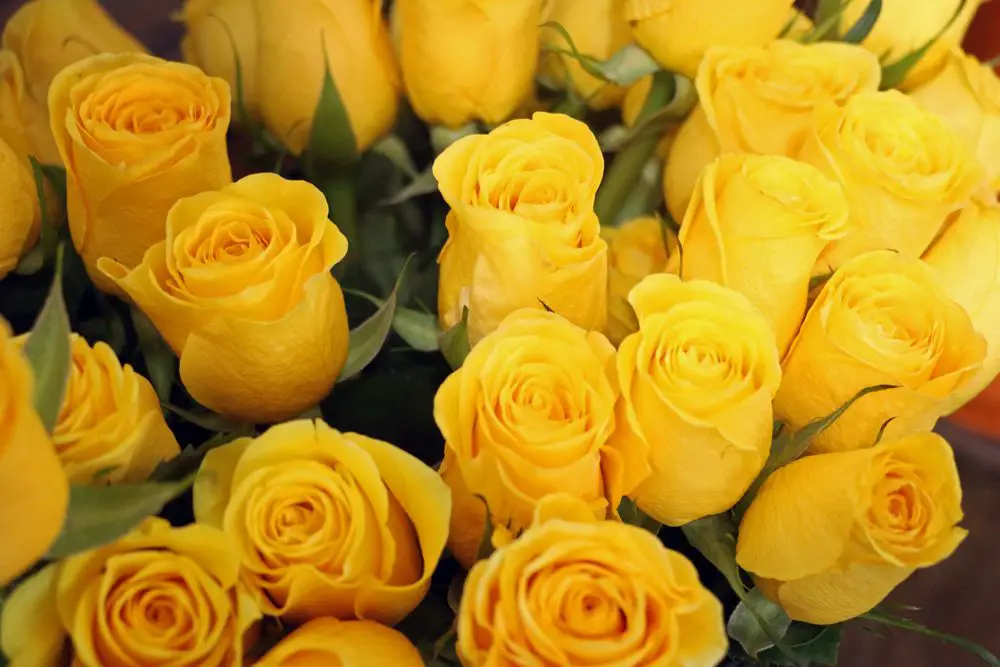
The bouquet arrived just after noon, and I remember the exact moment because I had only just stepped away from the kitchen sink, where I had been rinsing out my coffee mug, when the doorbell rang. The sound went through the house sharp and sudden, the way it always did, and I glanced toward the front hall with a small frown, drying my hands on the dish towel that hung from the oven handle. One hundred yellow roses. That was what waited for me on the other side of the door, though I did not know it yet, and I have thought since about how strange it is that a person can walk toward a thing that will change her whole life with nothing in her chest but mild curiosity and a little irritation at being interrupted.
Marcus was away on a business trip, a full week this time, and that part was ordinary. After nineteen years of marriage I had grown used to the sight of his suitcase standing by the bedroom door the night before he left, used to the last-minute calls from the gate at the airport, used to the particular way his side of the bed felt too smooth and too undisturbed in the mornings while he was gone, the blanket lying flat where his weight should have been. His work carried him out of town often, sometimes for a single night, sometimes for the better part of a week, and I had never loved it, but I had understood it, the way you come to understand the weather in the place where you live. We had built a stable life around the rhythm of his leaving and returning, and the rhythm had held for a long time.
There were no obvious problems between us. That is the thing I keep coming back to, the thing I have turned over a thousand times since. No cold silences at dinner, no arguments that started over nothing and were really about something else, no phone that he turned face-down on the table or carried into the other room to answer. We were steady. At forty-five I had long since stopped believing that marriage was supposed to be fireworks every single day, and I had made my peace, a real peace and not a resigned one, with the quieter thing it became instead. Sometimes love was a text that said only landed safely, three words that meant more to me by then than any paragraph could have. Sometimes it was Marcus remembering to order the almond creamer before a trip because he knew I would forget to buy it and would stand at the refrigerator on the third morning resenting my coffee. Sometimes it was the two of us sharing a dinner in comfortable quiet, neither of us feeling the need to fill every silence with talk, the plates scraping and the tap running and the ordinary music of a shared life going on around us.
I had come to think of that ease as its own kind of wealth, the kind you do not notice until it is gone. We had met young, the two of us, and grown up alongside each other, and there had been hard years in the middle the way there are in any long marriage, the year money was tight, the year we could not seem to be in the same room without friction, the long bad stretch after my mother died when I was not much of a wife to anyone. We had come through all of it. And on the far side of all of it we had arrived at this, at nineteen years, at a marriage that had stopped needing to prove anything to itself. I trusted Marcus the way I trusted the floor under my feet, which is to say completely and without ever thinking about it, which is to say I did not know I was trusting it at all until the afternoon it opened up beneath me.
So when I opened the door and found a delivery driver standing on the porch with an enormous bouquet gathered up in both arms, my very first reaction, before anything else, was to smile.
“Amber?” he asked, tipping his head to peer around the mass of blooms.
“That’s me.”
“These are for you.”
He shifted the whole heavy weight of it into my arms, and I nearly laughed at how much it weighed, the sheer size of the thing, the stems thick as a bundle of kindling wrapped in brown paper. The roses were a bright and startling yellow, almost golden where the light off the porch caught them, the petals full and flawless and packed so densely together that I could barely see over the top of them to say goodbye to the man who had brought them.
“My goodness,” I said, gripping the wrapped stems against my chest. “Somebody went all out.”
The driver gave me the polite, practiced smile of a man who has handed a great many flowers to a great many people. “Enjoy them,” he said, and turned to go.
I looked down into the bouquet, already searching for the little envelope that usually rode somewhere among the blooms, tucked on its plastic pick, the card that would tell me who had done this and why. There was nothing.
“There’s no card?” I said, before he could reach the steps.
He paused and checked the small printed tag stapled to the paper near the base. “No card,” he said. “No signature on the order. Just your name and the address.”
Just my name.
At first that did not trouble me at all. Marcus could be private about that kind of gesture, oddly shy about it, the way some men are. He had never once written me a long or flowery note in all our years together. On one anniversary, years back, he had sent me a thin gold necklace in a velvet box with no message inside it at all, and then telephoned me that evening while I was still turning the box over looking for the card, and said, when I asked, that he had thought the gift itself said everything that needed saying. I used to tease him for that, for being a man who could feel a great deal and write down none of it. So now, standing in the open doorway with a hundred yellow roses pressed to my chest and the afternoon warm at my back, I simply assumed he had arranged a surprise from wherever he was that week, that he had picked up the phone in some hotel room and read a florist my address in that low easy voice of his.
I carried the flowers inside and set them on the dining table, and I had to move the fruit bowl to make room, they were so large.
They were beautiful. There is no honest way to say otherwise. They lit the whole room the moment I set them down, spilling their color across the polished dark wood of the table, and the house that had felt a little dim and empty a minute before now felt suddenly warmer and brighter and somehow more alive, as though something had been switched on. I turned the vase a few degrees to face the window and watched the petals catch the afternoon sun and hold it. For about a minute I stood there and let myself be touched by it, let myself feel loved from a distance, and it was a good feeling, the kind that makes an empty house feel less empty.
Then something in me shifted, and the good feeling went thin.
It was small at first. A little pinch somewhere behind my ribs, a quiet tug I could not have explained to anyone, the feeling you get when you have walked out of a room and gotten halfway down the hall before some part of you insists that you left the stove on. I stood very still and tried to find the source of it.
The first thing that surfaced was this. My husband knew I preferred white roses. He knew it, and it was not a small or forgettable fact between us, not the kind of thing a devoted man of nineteen years gets wrong by accident. I had told him a dozen times over the course of our marriage, in a dozen small ways. White roses were what I had carried down the aisle on our wedding day, a simple bunch of them wrapped in ribbon. White roses were what he had brought to the house, without my asking, in the terrible gray week after my mother died, and had put in a vase by my side of the bed where I would see them first thing. White roses had stood on the table at the restaurant on our fifteenth anniversary, because he had called ahead and arranged it. Yellow roses were lovely, I would never say they were not, but they were not mine, and Marcus of all people knew the difference.
I folded my arms and looked at the bouquet the way you look at a word you have written down and suddenly cannot be sure you have spelled right.
“Marcus,” I murmured to the empty room, half amused and half something else. “What were you thinking?”
Then there was the number. Exactly one hundred. Not ninety-nine, not a hundred and one. One hundred, precisely, and I knew it was precise because the florist’s tag stapled to the paper listed the count in small print, the way an invoice would. I picked the tag up between two fingers and read it again, as though the number on it might rearrange itself if I stared long enough. One hundred yellow roses. A round number ought to have felt romantic, I told myself. Grand. Deliberate in the sweet way that people plan things for anniversaries and milestone birthdays, the way they order a hundred of something to mark a hundred of something else. But my birthday was months off. Our anniversary had come and gone in the spring. There was no hundred of anything to mark, no reason for the roundness of it, and Marcus, for all his many good qualities, was simply not a man who ordered a hundred roses for no reason at all. He was thoughtful, yes. He was extravagant, no. The two were not the same, and I had been married to the difference for nineteen years.
I stood there and looked at them, and the unease grew a little.
Yellow roses have never carried a single settled meaning, the way red ones do. Some people give them for friendship, plain and warm. Some old books say they once stood for jealousy, for a love gone suspicious. And in some traditions, I had read somewhere long ago, they stand for parting. For goodbye. For a leave-taking that will not be undone.
The thought arrived so clearly and so coldly that I actually took a step back from the table, as if the flowers had moved.
“Stop it,” I whispered to myself, out loud, in the empty house. “Stop.”
But it was too late. The unease had already come into the room and made itself comfortable, and I could not talk it back out the door. I reached for my phone on the counter and called my husband.
It rang. And it rang. And then it went to his voicemail, his recorded voice telling me cheerfully to leave a message, the same recording I had heard a thousand times.
I frowned at the phone. Marcus was often busy on his trips, in meetings or in transit, and he did not always answer on the first try. But he answered when he could, and when he could not, he called back within the hour, without fail, because he knew I worried and he was kind about it. That was our arrangement, unspoken and reliable.
I sent a text instead. Did you send me flowers?
And I stood there in the kitchen with the sun coming across the counter and watched the screen, waiting for the three little dots that meant he was typing.
Nothing. A minute went by. Then five. Then ten, and I had not moved from the spot, and the screen had not changed. I called again. It rang and rang and went to voicemail again.
By then the roses on the dining table did not look beautiful to me anymore. They looked too bright, too yellow, too carefully arranged, too present in my house, taking up too much of the air. I walked slowly around the table, studying them from one angle and then another, and I tried to talk sense to myself as I went. Maybe he was simply in a long meeting with his phone in his pocket. Maybe he had chosen yellow because the florist had run short of white and suggested them, and had thought I would not mind. Maybe the hundred was a package the shop offered, a special, a number that meant nothing but a nice round deal. I built each of these small comforting stories and offered them to myself in turn, and none of them stuck, because my fingers had gone cold, and the body knows things before the mind will agree to hear them.
Then I noticed something that stopped me where I stood.
The bouquet was not arranged at random. I had assumed, without thinking, that flowers came bundled however they came, a happy jumble of blooms. But these were not a jumble. There was an order to them, a deliberate order, once you looked. The outer roses were full and open, their heads angled outward in a neat repeating pattern, a ring, and then another ring inside it, and the whole thing built inward with a care that no careless bundle would have. And near the very center, a few of the stems sat lower than the rest, their heads tilted just slightly inward toward one another, not enough for most people to ever notice, but enough for me, because I had stopped now and I was looking at every single flower.
Something about that arrangement made my mouth go dry, and I did the thing that my hands wanted to do before my mind had decided to do it. I began to count.
Ten across. And ten deep. I counted the outer ring and worked my way in, touching each bloom lightly with the tip of one finger as I moved through them, the way you count money or count sleeping children, needing to be sure. Ten rows of ten. I counted it once, and then, not trusting myself, I counted it again. Ten rows of ten. One hundred exactly, arranged in a grid so careful it could only have been done by hand and on purpose, and the deliberateness of it was worse than the number, because a package deal does not come arranged in a grid.
And one of the rows was not entirely yellow.
Near the middle of the bouquet, tucked in among all that gold, one rose carried a small red mark hidden beneath the curl of an outer petal. At first I took it for a flaw, a bruise in the flesh of the flower, or a smear of dye bled over from some other bloom in the cooler at the shop. I lifted the petal gently with the edge of my fingernail to see it better.
The red mark was small, but it was not a flaw. It was too neat for that, too round, too centered under the petal where it would not be seen unless a person went looking. It looked applied. It looked placed there, carefully, by a steady hand with a steady purpose, and the wrongness of it traveled up my arm from the fingertip that had lifted the petal, a cold that had nothing to do with temperature.
My breath caught in my throat.
And then, because I could not help it, because some part of me already knew there would be more before my mind would say so, I looked for another. And I found it, three flowers over and one row down, the same small red mark hidden the same way, tucked under the curl of a petal where the eye would slide right past it. My hands had gone strange and clumsy but I kept going, lifting petal after petal now, working my way across the grid, and my heart was going harder and harder in my chest, a heavy slow banging I could feel in my throat. And then I found the third, off to the far side, in its own quiet hiding place. I searched the rest of the bouquet after that, all one hundred of them, every petal I could lift, and I found no more. There were exactly three. Three marked roses, spaced apart across the grid, no two of them touching, placed with the same care as everything else about the terrible flawless thing sitting on my dining table. Deliberate. As deliberate as anything I have ever seen in my life.
My stomach dropped through the floor.
I forgot about the calls Marcus had not answered. I forgot about the sunlight lying warm across the table and the coffee mug still sitting clean in the drying rack by the sink. For one long moment the only sound in the whole world was my own breathing, too fast and too shallow, loud in my ears.
Three marked roses.
I had seen that before. Not the flowers themselves, but the idea of them, the shape of the thing, three marks hidden in a careful pattern. It came up out of somewhere old and deep and unwelcome, a memory I did not know I still carried, the way something buried under the floorboards of an old house will begin, one quiet night, to scratch to be let out.
My hands had started to shake.
“No,” I said out loud, but the word had no strength in it, no air behind it. It came out of me like a breath.
I picked up my phone again, and this time I did not call Marcus.
I called the police.
The dispatcher who answered had a calm, even voice, and she asked me for my name and my address and then for what had happened, and I tried to tell her without sounding like a woman who had come unhinged over a delivery of flowers. It is a hard thing to do, to make fear sound reasonable when the object of it is a bouquet.
“A florist delivered flowers to my house a little while ago,” I said, and I was holding onto the edge of the dining table now with my free hand, gripping it. “One hundred yellow roses. There’s no card with them. No signature on the order. Just my name.”
There was a small pause on the line. “Ma’am, are you in any immediate danger?”
“I don’t know,” I said, and it was the truth, and saying it frightened me more than a yes would have. “But three of the roses are marked. Exactly three.”
Just saying it out loud, giving the thing words, made my throat close.
“Marked how?” she asked.
“With red,” I said. “Little red marks, hidden underneath the petals. You wouldn’t see them unless you were looking. I only found them because I counted.”
Another pause, longer this time. “And you believe this is threatening to you.”
I looked at the bouquet again, at the three small red marks that I now knew where to find, tucked away in the gold like three eyes looking back at me.
“Yes,” I said. “I do.”
The dispatcher’s voice changed just slightly, tightened into something more attentive, and she told me to stay inside the house, to lock my doors, and not to touch anything else until an officer arrived. I did exactly what she said. I locked the front door and slid the deadbolt across, and then I went through the kitchen and locked the back door too and checked the handle twice, the way you do when a single check will not satisfy the animal part of your brain. And then I stood in the middle of my own dining room in my own house, a house I had lived in for eleven years and had never once been afraid inside of, and I did not know what to do with my hands or my body or the minutes that had to be crossed before someone came.
I became aware, in a way I never had been before, of how many windows my house had. Of how the afternoon light through them, which I had always loved, now meant that anyone standing in the yard could see in as easily as I could see out. I went around and I closed the blinds, one room after another, and the house went dim and strange around me, striped with the little bars of light that came through the slats, and that was worse in its own way, the dimness, so that I did not know which was the mistake, the seeing or the not seeing. I kept the flowers in the corner of my eye the whole time, as though they might do something if I looked away from them, as though they were not flowers at all but something wearing the shape of flowers.
I stared at the bouquet that had come while my husband was away, and I waited for the police, and I waited for Marcus to call me back. I told myself that at any second the phone would ring and it would be him, easy and warm and a little puzzled, asking me what was wrong, and that he would explain the yellow and the hundred and the marks in three sentences and I would feel like a fool and we would laugh about it later, and I held onto that, and I watched the phone in my hand, and I willed it to light up with his name.
He did not call.
Two officers arrived within twenty minutes, a man and a younger man, and they came into my dining room and looked at the bouquet with the careful, gentle politeness that people use when they suspect that you are frightened over nothing and they do not want to say so to your face. I knew that politeness. My father had worn it home from work often enough for me to know exactly what it meant.
The older of the two, a solid man named Officer Vane with gray coming in at his temples, took out a small notebook. “You said your husband usually sends white roses,” he said, reading back what I had told the dispatcher.
“Always white,” I said. “Never yellow. In nineteen years, never once yellow.”
“And he’s away for work right now.”
“That’s what he told me. A trip. A week.”
The younger officer, who could not have been thirty, glanced at the flowers and then back at me with a kindness that was almost worse than rudeness would have been. “Ma’am,” he said, “I understand this has you shaken, and I don’t want to make light of it. But sometimes florists just make mistakes. Wrong color, wrong order, orders get crossed. It happens more than you’d think.”
I wanted to believe him. I wanted it more than I can say, wanted to be a foolish anxious woman who had frightened herself over a clerical error, wanted the three red marks to be nothing but dye and my own overheated imagination. I opened my mouth to agree with him, to apologize for wasting their afternoon.
Then a dark sedan pulled up to the curb outside the front window.
A few minutes later a man came in through my open front door, a man in his late sixties, with silver hair combed back from a lined forehead and the tired, patient eyes of a person who has spent a working life looking at things other people are not made to look at. He had the kind of face that seemed to be carrying a great deal that it would never set down, a heaviness in it that had nothing to do with the moment.
“I’m Detective Hollis,” he said, to the room in general, and then to me.
The name did something to me, sent a small strange current through me, though I could not immediately say why.
“My father knew a Hollis,” I said, almost to myself, before I had decided to speak.
His eyes came to mine and held them, and something in his face sharpened. “Your father,” he said slowly, “was Detective Ray.”
I nodded, and I was surprised, even after all these years, by the ache that came with hearing my father’s name said out loud by a stranger who had known him. Ray. My father had been a homicide detective for the better part of thirty years, a quiet man who came home late and did not talk much about his work, though now and then, when I was grown and could be trusted with a little of it, he would share a story from some old case. Never the worst of it. Never the details that would have kept a daughter up at night. But enough that I understood there were cases that had stayed with him, that rode home in the car with him and sat down at our table and never entirely left, that stood at the foot of his bed some nights, I think, when the rest of the house was asleep.
He had been a good detective, everyone said so, a patient one, the kind who worked a case the way water works stone, slowly and without ever quite stopping. He kept everything. That was the thing people always said about him, the thing that was half a compliment and half a complaint. He kept his notes and his files and his own private records long after a case had gone cold and everyone else had moved on, because he could not make himself let a thing go unfinished, and because he believed, he told me once, that the answer to almost anything was already written down somewhere if you were only willing to read carefully enough and long enough to find it. He died when I was thirty-one, of the ordinary thing, of a heart that simply stopped one gray winter morning, and I had grieved him as a daughter grieves a father, without ever imagining that he was not finished with the world, or that the world was not finished with him.
Detective Hollis moved toward the roses on the table, unhurried. His expression, at first, stayed calm and professional, the expression of a man doing a routine thing.
Then he saw the three marked flowers.
I watched the color go out of his face. I have never seen it happen to a grown man so fast, the blood simply leaving, so that in the space of a breath he went gray. He did not touch the bouquet. He stood very still and looked at it, and when he spoke, his voice had dropped low and gone rough at the edges.
“Where did these come from,” he said. It was not quite a question.
“I told the officers,” I said. “A florist delivered them, a little after noon. There’s no card. No sender. Just my name on the order.”
He turned to the two officers, and everything about him had changed, the tiredness burned off him and replaced by something urgent and hard. “Secure the house,” he said. “All of it. And call it in. Now.”
Officer Vane straightened, caught off guard. “Sir? Call in what, exactly?”
“Now,” Hollis said, and there was no arguing with the way he said it.
My legs had gone weak under me and I put my hand on the back of a dining chair to hold myself up. “You recognize this,” I said. “You know what this is.”
Detective Hollis turned and looked at me, and for the first time since the bouquet had crossed my threshold, someone in that house believed me completely. I could see it in his face. It was almost a relief, and it was the most frightening thing that had happened yet, because if he believed me, then it was real.
“Twenty-three years ago,” he said, and his voice was quiet and level, the way you keep your voice level over something that is anything but, “three women went missing. Over the course of about a year. Different neighborhoods, different lives, no connection anyone could ever find between them. And every one of them received a delivery of one hundred yellow roses before she disappeared.”
My throat had closed so tight I could barely get the words out. “One hundred,” I said.
He nodded, once. “Not ninety-nine. Not a hundred and one. One hundred exactly, every time. Your father worked that case. He was the one who noticed it first, the count, the exactness of it. He believed the number was a message. He believed it meant an ending. A cycle finished. A goodbye that couldn’t be taken back.”
I gripped the back of the chair until my knuckles ached. “And the red marks,” I said. “The three of them.”
“Three marked flowers,” he said. “Hidden the same way. Under the petals, spaced across the arrangement, always exactly three. It never once made the papers. We kept it back deliberately, the way you always keep the true signature of a thing back, the one detail only the killer could know, so that when the false confessions come in, and they always come in, you can tell the real one from all the lonely people who want to have done something. In twenty-three years, only a handful of us ever knew about the marks. Your father. Me. A couple of others, most of them gone now.” He looked at the bouquet again, and something moved behind his eyes, some old grief that had never healed over. “There has not been a bouquet like this one,” he said, “in twenty-three years. Not one. And now there is one, on your table, while your husband is missing. So you’ll forgive me if I don’t think a florist made a mistake.”
The room seemed to tilt very slowly under me, and I had to sit down in the chair I had been holding.
And then a memory came up out of me, whole, the way they do when the ground has shifted. I was young, still living at home, and it was a warm night, and my father and I were sitting out on the old porch of the house I grew up in, the two of us in the dark, the porch light off because he preferred it that way. He was rolling a mug of coffee slowly between his two hands, coffee that had long since gone cold, staring out past the yard into the trees, and he had been quiet for a long time, and then he said, without any warning, in a low voice that was almost not meant for me, “Some monsters don’t leave fingerprints, sweetheart. They leave symbols.”
I had thought, at the time, that he was only tired, that it was the kind of thing a weary man says into the dark at the end of a hard week. I had reached over and squeezed his arm and told him to come inside and get some sleep. I had not understood, and I could not have understood, that he had been telling me something. That he had been, in his roundabout and careful way, trying to warn me.
The police tried Marcus’s phone again, and I tried it too, and each time it rang out and went to his voicemail. And then Detective Hollis stepped away into the corner of my living room and called Marcus’s company, and I stood a little way off and watched his face while he listened, and I saw it change, and I felt the floor of my life begin to give way beneath me before he had said a single word.
“What is it,” I said, when he lowered the phone. “Please. Tell me.”
He did not answer right away, which was its own answer.
“Please,” I said again.
“Amber,” he said, “your husband was not on a business trip.”
My mouth went dry, so dry I could hardly form the words. “That’s not possible. He packed his bag. He kissed me goodbye. I watched him drive away Monday morning.”
“The hotel reservation he gave you doesn’t exist,” Hollis said gently. “There was no flight taken under his name. And no one at his company has seen him or heard from him in four days. As far as they knew, he was here. At home. With you.”
Four days.
My husband had leaned over the bed on Monday morning and kissed my forehead and told me he would call me when he landed in the city, and had picked up his suitcase and walked out to the car, and I had stood at the window and watched him back down the driveway and lift two fingers off the wheel to me the way he always did.
And now I did not know where he was. And, worse than that, standing in my own front hall with a detective’s careful eyes on me, I was beginning to understand that I did not know who he was either. Four days. He had been gone four days, not since Monday morning as I had thought, or he had been gone since Monday but not to anywhere he had told me, and the reservation was invented and the flight was a fiction, and every ordinary detail I had built my calm week around had turned out to be a wall painted to look like a door. I thought of every phone call we had not had that week, every unanswered ring I had explained away, and I felt the ground I had been standing on all my married life simply cease to be there.
They searched the house that evening. I sat in the living room with a blanket someone had draped around my shoulders, though I was not cold, or not cold in any way a blanket could reach, and I listened to the sounds of them working through the floor above me, drawers sliding open and shut, the click of closet doors, the low murmurs between them, the particular careful quality of strangers moving through the private rooms of your home, touching your things, learning you. I sat and I turned my phone over and over in my hands, checking it and checking it though I knew it would not ring, and I did not cry. I was too far past crying by then. I had gone out somewhere beyond it, into a flat numb country where nothing had any feeling in it at all, and I sat in that country and waited to find out what my life had actually been.
Then Detective Hollis came down the stairs holding something, a small gray metal lockbox, the kind you keep documents in, and I recognized it at once. It came from the shelf in Marcus’s home office, up on the high shelf behind his desk, and I had seen it a hundred times and never once thought about it, because it was Marcus’s and married people are allowed their small private boxes.
“Amber,” Hollis said, and his voice was very careful now, the way you are careful carrying something that might go off. “Do you know what this is? Do you know what’s in it?”
I shook my head. My voice would not come.
He set it on the coffee table in front of me and opened the lid, and inside were newspaper clippings.
Dozens of them. More than dozens. Some of them old and gone yellow and soft at the folds from being handled, some of them newer, the paper still white. And every one of them, I saw as he lifted them out one by one and laid them on the table, was about the disappearances. The three women. The roses. Twenty-three years ago.
My hand flew up to cover my mouth.
“No,” I breathed, through my fingers. “No, no.”
There were photographs of the three women, their faces looking up at me from the newsprint, young and ordinary and smiling in the way people smile in the pictures their families give the papers, none of them with any idea, in the moment the shutter clicked, of what was coming for them. There were articles about the flowers, and about the search parties, and about the fear that had gripped the whole city for that long year, the fear I had been just old enough to feel around the edges of my childhood without understanding, the reason, I realized now, that my mother had walked me to school later than the other children, the reason there had been a stretch when my father hardly slept at all.
And along the white margins of many of the clippings there were notes. Written in pen, in a small neat hand, cramped into the available space. Dates. Question marks. Arrows drawn from one line of a printed article to a scribbled word beside it. A name circled twice. Little marginal arguments a man had been having with himself on paper. And I knew the handwriting. I knew it the way you know a voice in the dark. I had read it on grocery lists stuck to the refrigerator and on birthday cards and on the small folded notes he still sometimes left for me on the kitchen counter before an early flight, love you, back Friday, don’t forget the creamer. I had been reading that handwriting for nineteen years.
It was Marcus’s handwriting. My husband had sat somewhere in this house, in the evenings while I thought he was answering work email, and had bent over these clippings and written in the margins of them in his own hand, and I had never known.
Officer Vane, standing behind the detective, looked grim. “We’re going to need a warrant,” he said quietly. “For all of it.”
I sat and stared at the clippings until the words swam and blurred and stopped being words at all, just gray marks on paper, and I thought about my husband. My Marcus. The man who made genuinely terrible pancakes every Sunday morning and served them to me anyway with a straight face, who insisted that mine came out too pretty to eat and his were the honest kind. The man who had held me upright at my mother’s graveside when my knees would not hold me. The man who had slept beside me, breathing his slow familiar breath, for nineteen years of nights.
Had he been keeping this the whole time? In a gray box on a high shelf in the next room?
Had I spent nineteen years loving a stranger?
By midnight, Marcus had been named a suspect. The word they used, to my face, was person of interest, but I had been a detective’s daughter my whole life and I could hear perfectly well what lived underneath it. They thought my husband had done these things. They thought the box in his office and the notes in his hand and the fake trip and the flowers all pointed one direction, and I could not entirely blame them, because sitting there in the small hours with all of it spread out on my coffee table, part of me had started to think it too, and that was the worst hour of the whole ordeal, worse than the flowers, worse than not knowing where he was. The hour I began to believe it.
By the small hours of the morning I had stopped feeling anything at all. I was scraped out, hollow, a shell of a woman sitting in a chair in a house full of quiet moving strangers, married, it seemed, to a man I had never actually known, going back over nineteen years of ordinary happy memories and turning each one over looking for the rot I must have missed. I found none, which somehow frightened me more, because it meant either that he was innocent or that he was better at hiding than any person should be. I waited for a sunrise I did not want, because I did not know what the daylight was going to make true.
But the sun came up anyway, the way it always does whether you want it or not, and with the daylight came the single thing that turned all of it over again.
Detective Hollis arrived at the house just after I had failed to eat any breakfast, and his jaw was set tight, and I braced myself for the worst, because I had learned by then that his face carried the news before his mouth did.
“The prints came back,” he said. “Off the florist’s order form. The physical copy the shop kept.”
I held onto the edge of the counter.
“They’re not your husband’s,” he said.
I blinked at him. For a second I could not make the sentence mean anything. “Then whose,” I said. “Whose are they.”
And his face changed. Something came into it that had not been there before, something that made him look suddenly older than his years, older even than the tiredness had made him look the day before. He seemed, for a moment, like a man looking down a long hallway into the past.
“They belong to a man named Gareth Pruitt,” he said.
The name meant nothing to me at all. I searched it and found nothing. “I don’t know that name,” I said.
Hollis swallowed. “He was a detective. Retired now, a long time. He worked the original case, twenty-three years ago.” He paused, and I watched him make himself say the rest of it. “He worked it alongside your father. They were partners.”
My father’s partner.
The room went completely silent. I could hear the refrigerator humming in the kitchen, and a bird somewhere outside, and nothing else.
Hollis pulled out a chair and sat down across the table from me, and when he spoke again his voice had gone quieter and gentler, the voice you use for the part that is going to hurt. “Your father suspected him,” he said. “Near the end. Before he passed. He never had the proof, not enough to move on, and it ate at him, I think. He suspected the man he worked beside every day. Do you understand what I’m telling you? He went to his grave carrying it.”
A shiver went through the whole length of me. “Why,” I said. “Why would this man, this Pruitt, send those flowers to me? After all this time? What did I ever do to him? I was a child when all of this happened.”
“He didn’t send them to you,” Hollis said. “Not really. We think the flowers were bait. We think you were meant to be found with them. We think the whole thing was a trap, and you were the thing in the jaws of it.”
“I don’t understand,” I said. “A trap for who?”
Hollis looked at me steadily. “We found evidence upstairs that your husband had your father’s old case notes. The real ones, the private ones, the things your father never turned in. Somewhere recently, your husband got hold of them, and he started reading. And I think he found something in them. Something your father saw and wrote down and never got to act on. I think Marcus started pulling the thread.” He nodded toward the gray lockbox, still sitting on the coffee table with its clippings. “That box isn’t the box of a killer, Amber. I’ve seen those, and that isn’t one. That’s the box of a man doing an investigation. A man trying to finish something. And I think Pruitt realized your husband was getting close to the truth. Closer than your father ever got.”
My heart stumbled in my chest, missed, caught again. “Marcus knew,” I said. “He knew all of this and he never told me. He let me think he was going to Chicago.”
“He may have been trying to keep it away from you,” Hollis said. “To keep you clear of it. To protect you, right up until he couldn’t anymore.”
And that, of everything, was the thing that broke me. That was the thing that finally cracked the numb country I had been sitting in all night and let the grief come pouring through, because I had spent the whole of that long dark night with my husband cast as a monster in my mind, turning over nineteen years of memories and looking for the horror hidden inside each one, teaching myself to see a killer in the man who made bad pancakes. And now I was being told that all that time he might have been the one fighting the monster. That he had walked out my door on Monday morning not to do a terrible thing but to try to stop one, and had walked into something that had swallowed him whole, and that the last normal thing between us, the kiss on my forehead, had been a lie he told to keep me safe.
I put my face in my hands and I wept.
They tracked Gareth Pruitt over the course of that day, and it was slow, agonizing work that I only understood the shape of afterward. A retired detective knows how to disappear. He knows what the searchers will do because he has been the searcher. He had no phone they could follow, no cards he had used, no trail through the ordinary machinery of a modern life, because he had spent a career learning where that machinery kept its records and had simply stepped outside all of it. What they found him with, in the end, was the old thing, the human thing, a property record buried in a county archive, a scrap of land that had come down through his family and that he had never sold and never lived on and never quite let go of, an old hunting cabin off a forestry road better than an hour outside the city, at the end of a track that did not appear on most maps.
I was not allowed to go. I understood why, and I hated it anyway. They put me in a small quiet room at the station, a room with a table and three chairs and a window too high to see out of, and someone brought me a paper cup of coffee that I held and did not drink until it went cold, and then held some more. And I sat there, and time came apart. Every second stretched into something unbearable, every minute a year long, and the not knowing was a physical thing, a pressure behind my eyes and a sickness low in my stomach. I could not stop imagining. I imagined the worst and then I made myself stop and then I imagined it again.
I held Marcus’s wedding ring the whole time, turning it over and over between my thumb and forefinger until the metal went warm from my hand. He had left it behind on the dresser before his trip, the way he sometimes did when he traveled, because he said it caught on things and he was afraid of losing it in some hotel, and I had not thought anything at all of it at the time, had glanced at it lying there on the wood and thought nothing. Now it seemed to mean everything in the world, that plain worn band sitting cold on the dresser while somewhere out past the edge of the city I did not know whether the hand that had worn it for nineteen years was still alive to wear it again. I pressed it into my palm until it left a red circle in the skin, and I made bargains with a God I was not sure I believed in, the way you do, and I waited.
When Detective Hollis finally came back to the station, hours later, and stood in the doorway of that little room, his eyes were wet.
“He’s alive,” he said.
I stood up so fast the chair went over behind me. “Marcus? You mean Marcus?”
“Yes.”
A sound came out of me that was not quite a word, half a sob and half a prayer, and my legs gave and I sat back down without the chair being there and did not care.
Marcus came home two days later. There were things that had to happen first, a hospital and questions and paperwork, but on the second day he came home, and he came through our front door with bruises blooming purple and yellow along one side of his face, and a bandage wrapped around one wrist, and a limp he tried to hide, and something in his eyes that was worse than any of the injuries, a guilt so heavy it bent him.
The moment he was through the door I crossed the room and ran into him, and I did not care about the bruises or the bandage, I just needed to feel that he was solid and warm and breathing and real.
“I thought you were dead,” I said into his shoulder, and I was crying again, the ugly kind, the kind you cannot stop. “I thought you were dead and I thought you were, I thought”
He held me so tightly that I could barely draw a breath, and I felt him shaking, felt it come up through his whole body, this man I had thought of for nineteen years as the steady one, the calm one. “I’m sorry,” he said, over and over into my hair, like something he could not stop saying. “I’m so sorry, Amber. I found your dad’s notes months ago, in an old box in the garage, behind the Christmas things. I was only looking for the extension cords. And I opened the box, and I saw his handwriting, and I started to read, and then I couldn’t stop. It got into me. I thought if I was careful, if I was quiet about it and didn’t tell anyone, I could work it out and finish the thing he never got to finish. Before anyone else ever got hurt. I thought I could keep all of it away from you.”
I pulled back far enough to look up into his battered face, at the bruises and the guilt and the exhaustion in it. “You should have told me,” I said, and I was not angry, or not only angry, it came out of me more like grief. “Whatever it was, you should have told me. We could have carried it together. That’s what I’m here for. That’s the whole point of me.”
“I know.” His voice broke on the word. “I know that now. I was afraid. I thought if I told you, then you’d be part of it, you’d be inside it with me, and I could not stand the thought of you anywhere near it, not after what it did to your father. So I lied to you instead. I told you Chicago, and I kissed you goodbye, and I drove off like it was any Monday. I have never lied to you before in my life and I hope I never do again, and I will be sorry for it for the rest of it.”
“Afraid of what?” I said. “Tell me what you were afraid of.”
“For you,” he said simply. “The whole time. From the first night I opened that box. Every single thing I did, I did because I was afraid for you. He knew who your father was. I was afraid that if he ever understood that Ray’s daughter was still right here, still findable, still living in this town with his notes in her garage, then he would.” He stopped, and his jaw worked, and he could not finish it. He did not have to.
Gareth Pruitt was arrested at the cabin, taken alive, which I understand was not a certain thing and cost the people who went in there more than they will ever say. What they found in that place, in the end, was more than enough. There were things kept there, kept carefully for twenty-three years, the way a certain kind of man keeps trophies of the worst thing he has ever done because it is also, in his own ruined mind, the most important thing he has ever done. Those things tied him beyond any argument, beyond any doubt a jury could entertain, to the three women who had vanished all those years before. I will not set down here what those things were. They were shown to me later, some of them, because I asked, and I have wished since that I had not asked, and in any case they belong to the three families and not to me, and I will leave them with the families.
But this I will say. After twenty-three years, three families who had long ago made the terrible daily peace of not knowing, who had taught themselves to stop hoping because hope had become the thing that hurt the most, finally received an answer. It was not the answer any of them would have chosen. There is no good answer to a question like theirs. But it was an answer, a true one, with a name attached to it and a place and an end, and after twenty-three years of the not knowing, whatever an answer is worth to people who have waited that long in the dark, they had it at last. My father had wanted that for them more than he had wanted almost anything, and he had not lived to give it to them, and in the end, through my husband, he had.
The bouquet stayed in police custody, logged and tagged as evidence, sealed in a box with a number on it, and I was glad, more glad than I can say, to have it out of my house and out of my sight. For a long while after, I could not so much as look at a yellow rose in a shop window without something going cold and tight in my chest, and I think some part of me will always feel that way, the way you flinch at a certain song for the rest of your life because of where you were the first time you heard it.
Weeks passed, and slowly the house became a house again and not a crime scene, and one evening Marcus and I sat out together on the back porch in the blue quiet after sunset, close, his hand over mine on the arm of the chair, neither of us saying much, the way we had always been good at.
“The flowers were never meant for me,” I said finally, into the dark. “Not really.”
Marcus laced his fingers through mine. “No,” he said.
“They were meant for you. A message to you. He knew you were close. He wanted you to walk in and find them and understand exactly who they were from and exactly what he was promising. He wanted you afraid.”
He nodded slowly, and his eyes in the last of the light were full of an old regret. “He wanted me to know he knew who I was,” he said. “And that he could reach into my house any time he wanted. That he could reach you.”
We sat with that for a while, the two of us, listening to the small night sounds coming up out of the yard, the crickets starting, a dog somewhere far off.
And I understood, finally, sitting there in the dark holding my husband’s hand, the whole shape of the thing. The bouquet had not been a romantic surprise from a loving husband, and it had not been, in the end, a threat sent to break a frightened woman alone in her house. It had been a message to the one person the killer had come, after twenty-three careful years, to fear. My husband. The man who had picked up a dead detective’s unfinished work and carried it far enough that a monster finally felt the floor move under him.
And somewhere underneath all of it, running through all of it like a thread you only see once the light hits it right, was my father. He had seen the shape of this evil half a lifetime ago and had not been able to prove it, and it had followed him quietly to the end of his days, and he had written down what he knew and put it in a box and left it, without ever saying so, for whoever might one day be brave enough and stubborn enough to pick it up. He had left it, though he could not have known it, for the man his daughter would marry. And in the end, from a long way off, from the far side of the grave, my father had reached forward through all those years and all those pages, and he had led us, the two people he had loved and the two people he most wanted to protect, all the way back home to each other.
I looked out at the dark yard, at the place where our own porch light did not quite reach the tree line, and I thought about a warm night long ago and a man rolling a cold cup of coffee between his two hands, staring out into a dark just like this one, telling his daughter something she was not ready to hear and could not have been.
Some monsters don’t leave fingerprints. They leave symbols.
He had been right about that, the way he had been right about most things, quietly and years too early for anyone to thank him for it. And I understood now that he had been watching over me the entire time, across all the years he had been gone, in the only way that was left to a dead man, which was the truth he had written down when he was alive and had not been able, or had not been willing, to say out loud to the people he loved. He had kept his notes because he could not let a thing go unfinished. And because he kept them, my husband had found them. And because my husband had found them, a man who had walked free for twenty-three years was going to walk free no longer. My father had reached out of the past and set it all in motion, every piece, and had brought his daughter and the man his daughter married back through the worst of it and out the other side, together, alive, sitting on a porch in the dark holding hands.
I leaned my head against my husband’s shoulder. We stayed out there a long time, the two of us, not needing to talk, the way we had always been good at. We stayed until the last of the light was gone from the sky and the stars came out one by one over the yard, and the crickets filled up the dark with their small steady sound, and for the first time in weeks, sitting close to the person I had almost lost, I found that the dark did not frighten me at all.

Lila Hart is a dedicated Digital Archivist and Research Specialist with a keen eye for preserving and curating meaningful content. At TheArchivists, she specializes in organizing and managing digital archives, ensuring that valuable stories and historical moments are accessible for generations to come.
Lila earned her degree in History and Archival Studies from the University of Edinburgh, where she cultivated her passion for documenting the past and preserving cultural heritage. Her expertise lies in combining traditional archival techniques with modern digital tools, allowing her to create comprehensive and engaging collections that resonate with audiences worldwide.
At TheArchivists, Lila is known for her meticulous attention to detail and her ability to uncover hidden gems within extensive archives. Her work is praised for its depth, authenticity, and contribution to the preservation of knowledge in the digital age.
Driven by a commitment to preserving stories that matter, Lila is passionate about exploring the intersection of history and technology. Her goal is to ensure that every piece of content she handles reflects the richness of human experiences and remains a source of inspiration for years to come.