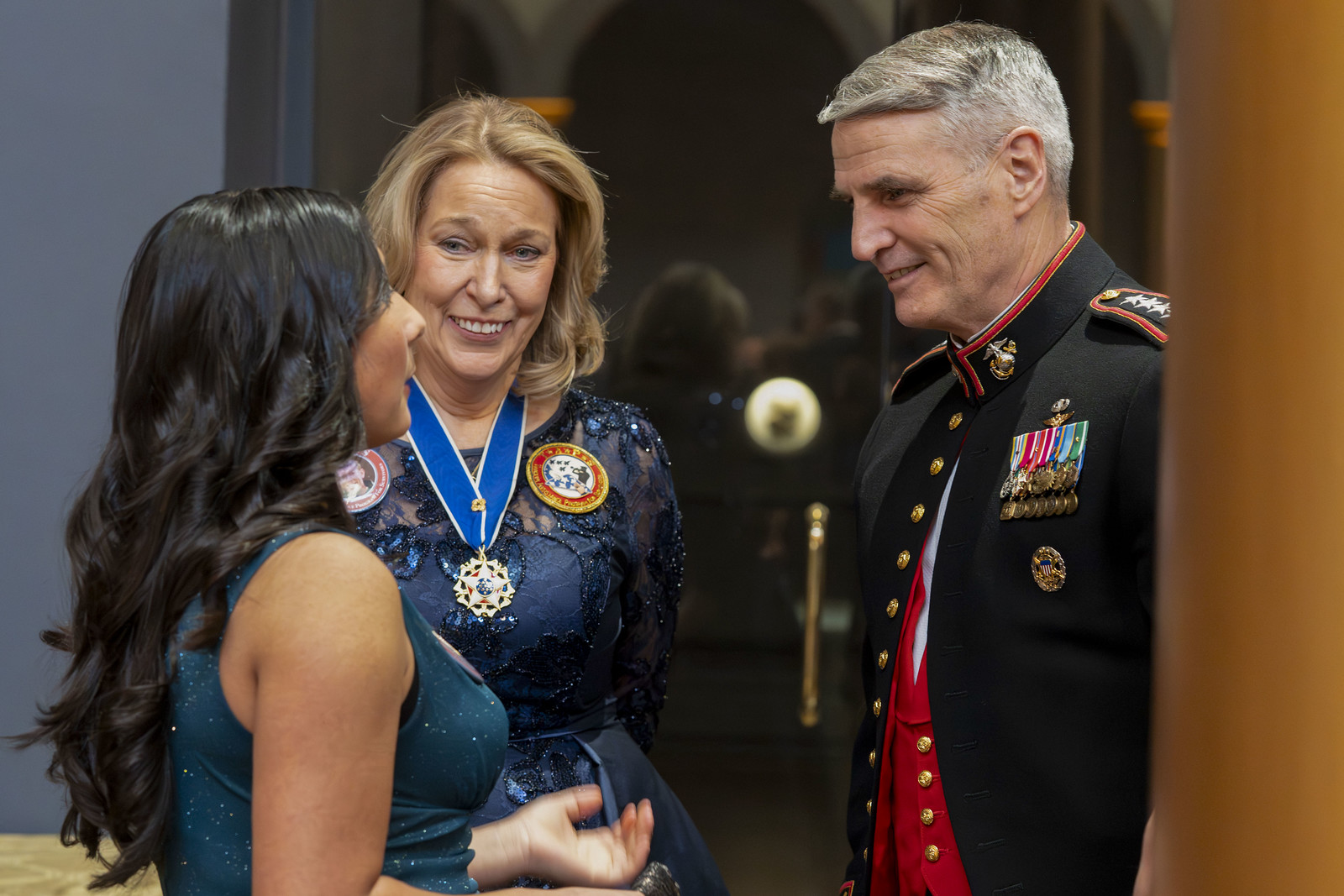
The day my family told me not to attend my grandfather’s military honor ceremony, I almost listened.
They said my Army uniform would embarrass them.
My brother mocked my medals.
My father openly declared that real success happened in boardrooms, not battlefields.
For years, I had been the family disappointment—the daughter who chose service over status.
But what none of them knew was that I wasn’t just attending the event.
Hidden behind the carefully planned ceremony was a surprise known only to the Department of Defense.
And before the day ended, the same family who looked down on me would be forced to hear the truth from a four-star general standing before hundreds of witnesses.
My name is Staff Sergeant Maya Parker.
And everything changed the moment I stepped out of my Army SUV.
“You actually came?”
That was the first thing my older brother, Daniel, said when he saw me. Not hello. Not good to see you. Not even a polite smile for the sister he rarely saw. Just disbelief that I had ignored the family’s very clear preference that I stay away.
I closed the SUV door behind me and looked at him. Daniel stood near the entrance in an expensive designer suit, perfectly fitted, his cufflinks catching the light as he adjusted one sleeve. I gave him a small smile.
“Nice to see you too.”
His eyes moved slowly over my uniform. There was nothing subtle about the inspection. He looked at the ribbons, the medals, the pressed fabric, and finally my boots as though I had arrived wearing something inappropriate for the occasion.
The irony was almost funny. Almost.
The ceremony was being held at a military heritage center overlooking the Potomac River outside Washington, D.C. My grandfather, a decorated Korean War veteran, was turning ninety and receiving a lifetime service tribute. For him, I would have shown up regardless of what anyone else thought. He had never treated service like a consolation prize. He understood what it meant to put on a uniform and accept that your time, comfort, and sometimes your safety no longer belonged entirely to you.
My family, however, had turned the ceremony into something else. They treated it like one of the biggest social events of the year. The guest list included corporate executives, doctors, attorneys, politicians, and senior military leaders. Every detail had been carefully considered. Every introduction mattered. Every conversation seemed to carry the possibility of a useful connection.
And then there was me. The soldier my family had spent years treating like the person who never quite measured up.
Daniel adjusted his cufflinks again. “You know this is a major event, right?”
“I know.”
“Several members of Congress are here. Military leadership too.”
I looked toward the entrance. “Sounds like the perfect place for a soldier.”
His wife, Ashley, laughed softly beside him. It was not the kind of laugh that came from genuine amusement. It was the little sound people make when they believe someone has missed the point.
“Honestly, Maya,” she said, “we thought you’d wear something else.”
I looked at her. “Something else?”
Ashley gestured toward the medals and ribbons on my chest. “Those seem a little dramatic.”
For a second, I simply looked down at them. To Ashley, they were decorations. Something shiny pinned to fabric. Something that might pull attention away from the carefully planned event. To me, every piece carried weight she could not see. They carried names. Faces. Memories. Long days that had blurred into longer nights. They reminded me of people I had served beside and moments when courage had looked nothing like the speeches people gave afterward. Sometimes courage had been someone doing the necessary thing while exhausted and afraid. Sometimes it had been keeping another person moving when stopping would have been easier. Sometimes it had been staying steady because other people needed you to be steady.
Those were the things I thought about when I looked at what Ashley had just called dramatic.
But I did not explain any of it. I had learned a long time ago that there are some things you should not have to translate for people determined not to understand them.
So I walked past them and entered the building.
The ballroom was already filling when I stepped inside. Guests gathered in small groups, greeting one another, exchanging handshakes, and moving toward their tables. The room had the polished feel my family loved. Everything appeared organized, important, and controlled.
I had barely made it toward my seat when my father intercepted me.
“Maya.”
His tone told me immediately that this was not going to be a welcome.
“We need to be realistic today.”
I stopped. “About what?”
He glanced around before answering, as if even having the conversation with me required discretion. “Today is your grandfather’s day. We don’t want unnecessary attention.”
There it was. The real problem had never been that I might cause a scene. I had spent my adult life in an environment where discipline mattered and where losing control could carry consequences far more serious than an uncomfortable family conversation. My father knew that. What worried him was different. My presence reminded his polished friends that one of his children had chosen a life he considered less impressive.
Daniel had followed the path my father understood. Business. Status. The kind of success that could be described with titles, offices, financial milestones, and the names of important people you knew. My achievements did not fit as neatly into that language. I had chosen service. Years earlier, that decision had become a dividing line in our family. At first, everyone acted as though I would change my mind. Then they treated the Army as a temporary detour. When it became clear that I had built a career instead of abandoning one, their disappointment hardened into something more permanent.
Daniel became the example of what success supposedly looked like. I became the comparison.
My father lowered his voice. Then he said the sentence that stayed with me.
“Compared to what Daniel has accomplished, being a career soldier isn’t particularly impressive anymore.”
I looked at him for a moment without answering. Then I looked toward my mother. She looked away. My younger sister said nothing. No one defended me.
That hurt more than I wanted it to. I had been through difficult assignments, long separations, and situations where fear had to be acknowledged and then put aside because there was still work to do. Yet one sentence from my father could still drag me backward through time. For a moment, I felt sixteen again. I was standing in a room full of people who had already decided what success was, knowing that no matter how hard I worked, I would never fit the definition they had chosen for me.
I could feel my hands tightening at my sides. That was when I knew I needed to leave the room before anger made a decision for me.
I did not argue. I did not defend my career. I did not list assignments, sacrifices, or accomplishments. I simply turned and walked outside.
The cool air coming off the river hit my face as soon as I stepped through the doors. I moved far enough away from the entrance to be alone and stood there breathing slowly. The building behind me was full of voices, greetings, and carefully managed appearances. Outside, I could finally hear myself think.
I stared beyond the property toward the river and waited for the tension in my hands to ease.
Part of me wondered why I had come. Not because of my grandfather. For him, there had never been a question. But I wondered why I kept expecting something different from the rest of them. Every milestone in my career had been met with some version of the same response. Daniel’s accomplishments were announced. Mine were acknowledged briefly and moved past. His work was considered ambitious. Mine was treated like stubbornness. He had built the kind of life my father could explain to his friends. I had built one that required no explanation to the people who had served beside me.
That difference should have been enough. Most days, it was. Standing outside my grandfather’s ceremony, though, I could still feel the old need to be seen by the people who had known me first.
My phone rang. The sound cut cleanly through my thoughts. I looked at the screen and answered immediately.
“Staff Sergeant Parker.”
A professional voice came through the line. “Ma’am, the Pentagon delegation has arrived.”
The tension inside me shifted. Not disappeared. Shifted. A small smile touched my lips.
“Understood.”
I ended the call and stood there for another second. That was the part my family knew nothing about. Months earlier, I had been selected for one of the military’s highest peacetime commendations, recognizing extraordinary leadership during an international rescue mission overseas. The announcement had remained classified. The presentation had quietly been added to my grandfather’s ceremony, allowing the recognition to happen in the presence of a man whose own lifetime of service had shaped so much of what wearing the uniform meant to me.
Only military leadership knew what had been planned. My family had no idea. Daniel did not know. Ashley did not know. My father—the man who had just told me that my career was not particularly impressive—had no idea that senior military leadership had arrived partly because of me.
I could have gone back inside and told them. For one brief moment, the temptation was there. I could have watched Daniel’s expression change. I could have repeated my father’s sentence back to him and then given him the information that would make him regret saying it. But that would have turned the moment into exactly what they feared—a contest for attention. My grandfather deserved better than that. And I had not earned the commendation so I could win an argument with my family.
So I put my phone away and returned to the ballroom without mentioning the call.
Daniel was still talking with guests. Ashley barely looked at me when I passed. My father acted as though our conversation had never happened. That was another family habit I knew well. A cruel sentence could be delivered with complete confidence, and five minutes later everyone was expected to behave as though nothing unusual had happened.
I did not challenge him. I simply took my seat.
From where I sat, I could see my grandfather surrounded by people who had come to honor him. Whatever else happened that day, that mattered to me most. He had lived long enough to see ninety. He had lived long enough for people to gather and recognize decades of service. And I wanted to remember that part of the day without letting my family’s opinions consume it.
So I listened. I watched. I stayed quiet.
Around me, conversation continued as guests settled in. My father moved easily through the room, speaking with people he clearly wanted to impress. Daniel did the same. He looked completely at home there. For years, that had been the contrast my family seemed to prefer. Daniel belonged in rooms with executives and influential people. Maya belonged somewhere else. Somewhere less visible. Somewhere they did not have to explain the difference between a ribbon and a medal or understand why certain memories could never be reduced to a line on a résumé.
But that afternoon, both worlds were sitting in the same ballroom. My family just did not realize it yet.
An hour later, the ballroom lights dimmed. The conversations gradually stopped. People turned toward the stage as a four-star general walked out in front of the assembled guests. The room’s attention shifted immediately. Even Daniel stopped talking.
I sat with my hands folded in my lap.
The general began by speaking about service and duty. He spoke about the sacrifices made by my grandfather’s generation and about what it meant for a country to remember people whose service had demanded years of their lives. I listened quietly. This part belonged to my grandfather. I watched him as the general spoke, aware that the man being honored had once been young too, wearing a uniform and making choices whose consequences would follow him for decades.
For all the ways my family misunderstood my career, my grandfather never had. He knew service was not impressive because of how it looked from the outside. He knew it mattered because of what it required when no one was watching.
The general continued. Then something in his tone changed. It was subtle enough that most people probably would not have noticed immediately. I did. My heartbeat picked up.
The general paused and looked across the ballroom. Hundreds of faces turned toward him. My family was watching too. Daniel sat with the confidence of someone expecting the ceremony to continue exactly as planned. My father’s attention remained fixed on the stage. Ashley sat nearby, composed and polished. None of them knew about the call I had received outside. None of them knew why the Pentagon delegation had arrived. None of them knew that the program they thought they understood contained something they had not been told.
The general looked out over the room. Then he spoke.
“Today, we honor not one hero—but two.”
My heartbeat slammed against my ribs.
Beside me, my father slowly turned his head in my direction.
“Six months ago,” the general said, “a joint task force was deployed to extract a group of American aid workers and their families trapped in a collapsed building following a natural disaster overseas. The structure was unstable. The window for a safe extraction was measured in hours, not days. The operation required a small team to enter conditions that most of us in this room can only imagine, and to make decisions under pressure that most of us will never be asked to make.”
He paused, letting the room sit with that.
“The mission succeeded. Eleven civilians were brought out alive, including three children. That success was due, in significant part, to the leadership of the noncommissioned officer who coordinated the extraction under conditions where communication with command was intermittent at best, and who made the call, more than once, to hold her position rather than withdraw when withdrawal would have been the easier choice.”
My father’s face had gone very still.
“For extraordinary leadership, courage under fire, and a refusal to leave anyone behind, the Department of Defense is presenting the Distinguished Service Medal to Staff Sergeant Maya Parker.”
For a moment, the ballroom did not move. I felt every eye in the room shift toward me, that particular weight of attention I had felt before, in briefings and after-action reviews, but never quite like this—never surrounded by people who thought they already knew exactly who I was.
Daniel’s mouth had opened slightly, the practiced ease gone from his face entirely. Ashley had gone pale, her hand frozen halfway to her water glass. My mother had both hands pressed to her chest. My younger sister was staring at me like she was seeing a stranger.
And my father. My father, who ten minutes earlier had told me that being a career soldier wasn’t particularly impressive anymore, sat with an expression I had never once seen on him in thirty years. It wasn’t pride, not yet. It was something closer to disorientation, the look of a man watching the ground shift under a house he thought he understood the foundation of.
The general’s eyes found mine across the room. “Staff Sergeant Parker, would you join me?”
I stood. My legs felt steadier than I expected them to. I walked down the center aisle between the tables, past faces I recognized and faces I didn’t, past executives and politicians who had spent the last hour treating the uniform I wore as background scenery for their own conversations. I did not look at Daniel as I passed him. I did not look at Ashley. I kept my eyes on the stage, on the general, on my grandfather sitting in the front row with his hand pressed over his mouth.
When I reached the stage, the general shook my hand and turned me gently toward the audience. He began to read the official citation, the language formal and precise in the way military citations always are, describing coordinates and conditions and decisions in clipped, exact sentences that could never fully capture what those hours had actually felt like. I stood there and let the words wash past me, because I already knew what had happened in that building. I didn’t need the citation to remember it. I remembered the dust in my throat. I remembered the sound the structure made when it shifted, a low groan that none of us ever wanted to hear again. I remembered a woman named Nadia handing me her daughter through a gap in the rubble no wider than my shoulders, and the way the little girl had gripped my collar the entire way out, refusing to let go even after we were clear.
I remembered deciding to stay when the order came through to pull back, because pulling back meant leaving four people still inside, and I had made a judgment call that I would have made again in a heartbeat, consequences or not.
The general finished reading. He pinned the medal to my uniform himself, his hands steady, his expression solemn in a way that told me he understood exactly what the moment meant, not just for me, but for everyone in that room who had spent years deciding what my life was worth compared to someone else’s.
Then he did something that wasn’t in any program, wasn’t part of any script.
He turned to face the ballroom fully; and instead of moving on to the next part of the ceremony, he addressed the guests directly.
“I want to say something, if I may, that isn’t in the printed program,” he said. “I’ve stood on a lot of stages presenting a lot of honors, and I’ve learned that the people receiving them rarely talk about themselves the way they deserve to be talked about. Staff Sergeant Parker has spent twelve years in service to this country, three of them in conditions I’m not able to discuss in detail in this setting. She has led soldiers through situations that would break most people, and she has done it with a level of composure and judgment that I have personally recommended for further advancement. I say this because I suspect there are people in this room who have never had the chance to hear it stated plainly. So let me state it plainly. This is one of the finest noncommissioned officers I have had the privilege of serving alongside in thirty-four years.”
I felt my face flush, standing there under the lights, hundreds of eyes on me, my grandfather’s face turned upward, tears openly running down his cheeks now, unashamed of them the way only a man his age and his history could be. Somewhere in the crowd, I heard someone start to clap, and then it spread, the whole ballroom rising to its feet in a way I hadn’t expected and wasn’t remotely prepared for.
I looked out at the crowd and found my family’s table.
Daniel was standing, clapping mechanically, his expression somewhere between shock and something that looked almost like shame. Ashley stood beside him, her hands barely coming together, her eyes fixed somewhere on the floor rather than on me. My mother was crying openly, one hand covering her mouth. My younger sister looked stricken, the way you look when you realize you’ve been complicit in something without ever quite deciding to be.
And my father stood very still, clapping slowly, his eyes locked on mine across the distance of the ballroom. I couldn’t read his expression. I wasn’t sure, in that moment, that he could either.
The applause eventually settled, and the general guided me back toward my seat, the ceremony continuing on to the portion actually meant for my grandfather. I sat down, the weight of the medal unfamiliar against my chest, and tried to steady my breathing while my grandfather’s tribute began. I wanted to be present for it. I wanted this day to still belong to him, the way it was always supposed to.
But I could feel my father’s eyes on me from three seats away for the rest of the ceremony, and I understood, without needing to look at him, that something had shifted that would not simply shift back once the lights came up and the guests went home.
The reception afterward was different from the one before the ceremony. That was the first thing I noticed. People who had walked past me an hour earlier without a second glance now approached with a kind of careful deference, congratulating me, asking questions about my service that they clearly hadn’t cared to ask before. A senator’s aide introduced himself. A retired colonel shook my hand and told me he’d read the operation summary and called it one of the cleanest extractions he’d seen documented in years. I answered politely, gave the short version of things, and kept scanning the room for my grandfather, who was, as always, the only person whose opinion of the day actually mattered to me.
I found him near the windows overlooking the river, sitting in a chair someone had brought over for him, still dabbing at his eyes with a folded handkerchief.
“Granddad.”
He looked up at me and reached for my hand, pulling me down toward him with more strength than I expected from a man turning ninety.
“I always knew,” he said quietly, just for me. “I want you to know that. I always knew what you were made of.”
“I know you did.”
“They didn’t.” His eyes flicked, briefly, toward the other side of the room, where my father stood in a small cluster of guests, nodding along to a conversation but clearly not listening to a word of it. “That’s their failure, Maya. Not yours. Never yours.”
I felt something in my chest loosen, hearing him say it. I had spent so many years absorbing my family’s version of my worth that I sometimes forgot there was another version entirely, one that had existed the whole time in the eyes of the one person whose service had shaped my own understanding of what it meant to give yourself to something larger.
“I’m proud of you,” he said. “I’ve been proud of you since the day you told us you’d enlisted, and I’ve been proud of you every single day since, whether anybody bothered to say so or not.”
I stayed with him for a long while after that, letting the reception continue around us, until eventually Daniel approached, alone, his cufflinks no longer quite so perfectly adjusted.
“Can we talk?” he asked.
My grandfather patted my hand and released it, giving me a small nod that told me he understood, and I followed Daniel toward a quieter corner of the room, near a bank of windows that looked out over the darkening river.
For a moment, neither of us said anything. Daniel looked, for the first time in longer than I could remember, uncertain of himself.
“I didn’t know,” he finally said.
“I know you didn’t.”
“You could have told me. Before the ceremony. You could have—” He stopped himself, seeming to hear how the sentence was about to land. “That’s not what I mean. I don’t mean you owed me an explanation.”
“Then what do you mean?”
He was quiet for a moment, looking out at the water instead of at me. “I mean I’ve spent years assuming I understood what your life looked like. I never actually asked. I just decided, because it was easier than finding out I might be wrong about something.”
It was the closest thing to self-awareness I had ever heard from my brother, and I wasn’t entirely sure what to do with it.
“The medals,” he said. “Earlier. When I looked at your uniform like that. I was thinking about how it would look next to me in photos. That’s — God, saying it out loud, that’s an awful thing to admit.”
“It is,” I said. I wasn’t going to soften it for him.
“I’m not going to pretend I have some big speech ready,” he said. “I don’t. I just — I watched that general talk about you up there, and I realized I’ve never once asked you what any of it actually cost you. Any of the deployments. Any of it. I just assumed it was smaller than what I was building, because it didn’t come with a title I recognized.”
“It cost plenty,” I said, quietly. “It still does.”
He nodded slowly, and for once, he didn’t try to fill the silence with something clever or deflecting.
“I’m sorry,” he said. “For today. For a lot of days before today, if I’m honest.”
I studied his face for a long moment, trying to decide how much of it I believed. Some of it, I decided. Not all of it. Apologies delivered in the afterglow of public embarrassment have a way of curdling once the embarrassment fades, and I had learned not to mistake a good moment for a permanent change.
“I appreciate you saying that,” I said. “We’ll see.”
It wasn’t forgiveness, not fully, not yet. But it was honest, and honest felt like the only currency worth trading in with my family after a day like that one.
My father found me last, after most of the guests had begun filtering out toward the valet stand, after my grandfather had been wheeled toward the car by an aide, tired but glowing in a way I hadn’t seen on him in years. My father approached slowly, his hands in his pockets, none of the polish from earlier in the day quite intact anymore.
“Maya.”
“Dad.”
He looked at the medal still pinned to my chest, and then at my face, and I watched him search for whatever he intended to say.
“I said something today I shouldn’t have said.”
“You did.”
“I’ve said a lot of things over the years I shouldn’t have said.” He exhaled slowly, looking out toward the river the way Daniel had. “I don’t have a good excuse for it. I could tell you I didn’t understand what your career meant, but the truth is I didn’t try to understand it. It was easier to measure you against your brother’s world because that’s the world I know how to talk about at dinner parties.”
“You could have asked me,” I said. “Any time in the last twelve years, you could have asked me what any of it meant.”
“I know.”
“You didn’t.”
“I know that too.” He looked down for a moment, and when he looked back up, there was something in his expression I hadn’t seen directed at me in a very long time — something that looked almost like humility, an emotion I don’t think I’d ever actually witnessed on my father before that evening. “I’m not going to stand here and tell you I understand now, because one ceremony doesn’t undo twelve years of getting it wrong. But I heard that general tonight, and I heard what he said about you, and I realized I’ve never once said anything close to that to you myself. So I’m saying it now, even though it’s late, even though I don’t deserve much credit for saying it only after somebody else said it first. I’m proud of you, Maya. I should have told you that a long time ago, and not because a four-star general told me I should.”
I didn’t answer right away. Twelve years of accumulated distance doesn’t dissolve in the space of one sentence, however sincerely it’s delivered, and I wasn’t going to pretend otherwise, not even to make the moment easier for him.
“Thank you for saying that,” I finally said. “It matters. It doesn’t fix everything. But it matters.”
“I know it doesn’t fix everything,” he said. “I’d like the chance to try, though. If you’ll let me.”
I looked at him for a long moment, this man who had spent my whole adult life measuring my worth against a yardstick that never once accounted for what I’d actually chosen to give my life to. I thought about all the years of silence at family dinners, all the times my achievements had been acknowledged and moved past in the same breath, all the times I had told myself it didn’t matter what they thought, even when some small, stubborn part of me had never fully believed that.
“We can try,” I said. “Slowly.”
It wasn’t everything. It wasn’t the kind of clean, cinematic reconciliation that makes a tidy ending. But it was honest, and it was a start, and after twelve years, a start was more than I had ever really expected to get.
My grandfather turned ninety that day surrounded by more recognition than most men receive in a lifetime, and somewhere in the middle of his tribute, I received one of my own that I never saw coming and never asked for. But if I’m honest, the part of that day that stayed with me longest wasn’t the medal, and it wasn’t the applause, and it wasn’t even the general’s words ringing out across that ballroom.
It was watching my father’s face change, slowly, painfully, in real time, as he was forced to reckon with a version of his daughter he had spent twelve years refusing to see.
I drove home that night with the medal still in its case on the passenger seat beside me, the Potomac disappearing behind me in the rearview mirror, and I thought about all the ceremonies and ribbons and quiet, unglamorous moments that had led to that one loud, public one. I thought about Nadia’s daughter gripping my collar in the dark. I thought about the years of family dinners where my accomplishments had been treated as footnotes. I thought about how strange it was that it had taken a stranger standing on a stage to say the things my own family should have been saying to me for over a decade.
I didn’t need my father’s approval to know what my service meant. I had known that for years, long before that ceremony, in the quiet certainty that comes from doing hard things for the right reasons regardless of who’s watching. But there was something undeniably healing about finally hearing it acknowledged out loud, in front of the very people who had spent so long deciding I didn’t measure up.
My grandfather called me the next morning, his voice still a little rough with emotion.
“You know,” he said, “your father called me last night after he got home. Wanted to talk about you for almost an hour.”
“What did he say?”
“He said he didn’t know how to be proud of something he never understood. I told him that was the most honest thing I’ve heard him say in twenty years, and that understanding starts with asking questions instead of making assumptions.” He paused. “I think he heard me, Maya. I really do.”
I wasn’t sure I believed it yet, not entirely. Old patterns don’t dissolve overnight, and I had learned, the hard way, not to build my sense of worth around whether my family finally decided to see me clearly. But something had cracked open that day in that ballroom, something that had been sealed shut for over a decade, and for the first time in a long time, I let myself believe that crack might actually let some light through.
Whatever happened next between me and my father, between me and Daniel, between me and the family that had spent years treating my service like an inconvenience to be managed rather than a life to be honored — that part would take time, and it would take more than one good conversation on the night of a ceremony to prove itself real.
But I had spent twelve years learning that the most important battles are rarely won in a single moment. They’re won slowly, decision by decision, day by day, by people who choose to keep showing up even when showing up is hard.
I decided that night that I would do the same thing with my family that I had always done with everything else that mattered to me.
I would show up. I would hold the line. And I would wait to see who else was willing to do the same.

Laura Bennett writes about complicated family dynamics, difficult conversations, and the quiet moments that change everything. Her stories focus on real-life tensions — inheritance disputes, strained marriages, loyalty tests — and the strength people find when they finally speak up. She believes the smallest decisions often carry the biggest consequences.