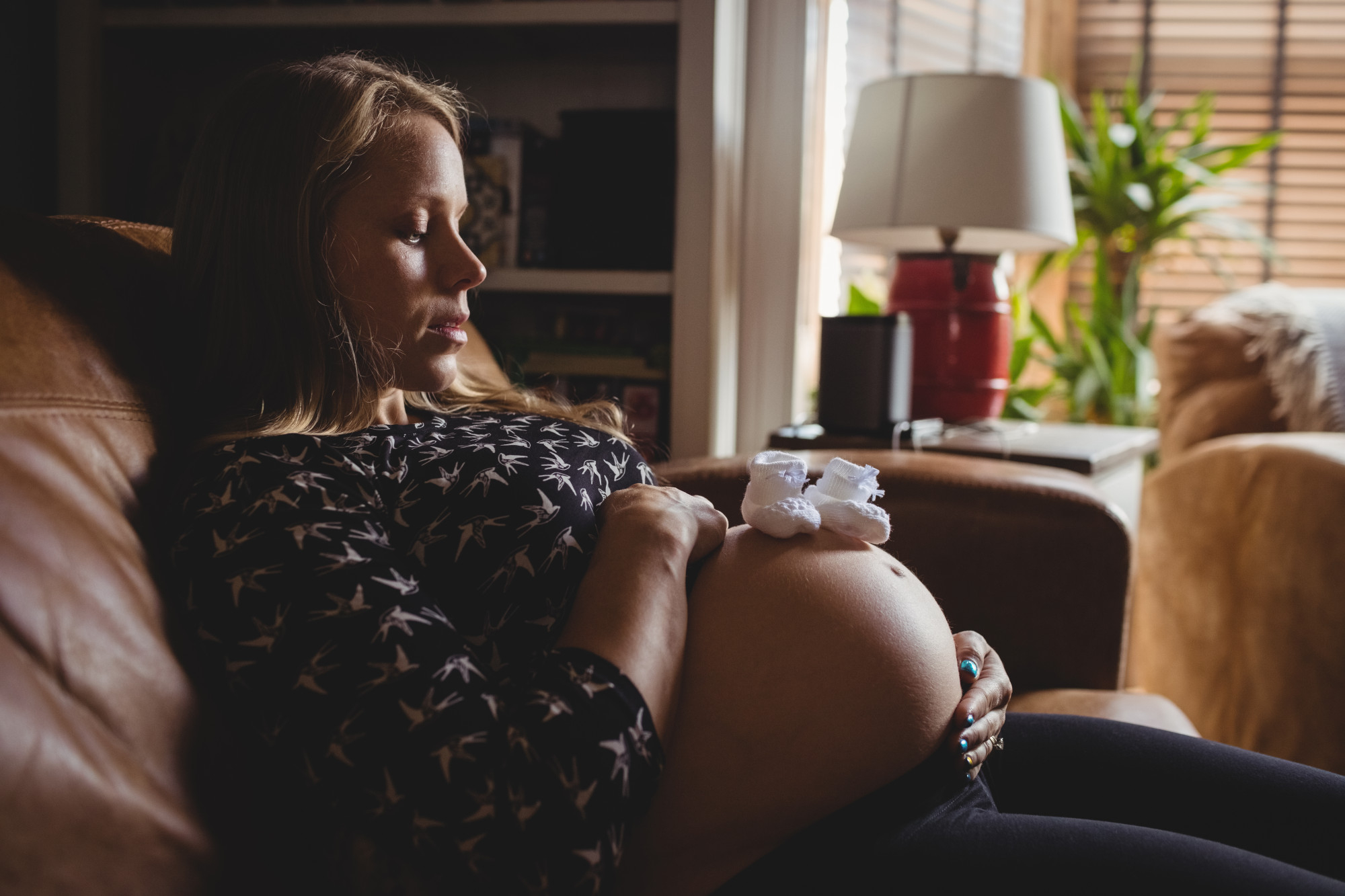
I became a widow while pregnant. After I gave birth, the police officer handed me a suspicious looking envelope.
I was seven months pregnant when my husband died.
One moment, we were arguing over baby names. The next, a state trooper was standing at my front door telling me there had been an accident.
I barely remember the funeral. Or the weeks that followed. I just kept telling myself one thing. I had to stay strong for our baby.
When my daughter was finally born, she became the only reason I got out of bed each morning. The hospital discharged us three days later. I couldn’t wait to bring her home. But as I turned onto my street, something felt wrong.
My neighbors were standing outside. Nobody waved. Nobody smiled. They were all staring at my house. I looked up, and my heart stopped. The entire front of my home had been painted black. The porch. The front door. Even the white columns my husband had spent an entire summer restoring. Someone had covered everything in thick black paint overnight.
I held my newborn tighter as tears blurred my vision. There wasn’t a note. No broken windows. No sign explaining why anyone would do something so cruel.
The police came within minutes. One officer quietly walked around the property while another took my statement. Then he stopped beside the mailbox.
“Ma’am.” His voice suddenly changed.
I walked over. Inside the mailbox was a small white envelope. No stamp. No address. Only my daughter’s name written neatly across the front.
The officer looked at me. “I think you should open it.”
My hands were shaking so badly that I could barely work my finger under the flap, and my daughter, whose name I had chosen alone in a hospital bed three days earlier, whose name I had chosen without her father, stirred against my chest and made the small snuffling sound newborns make, and I stood on the sidewalk in front of my ruined house with my neighbors watching and I looked at her name written in careful handwriting on the front of an envelope that no stamp and no mail carrier had brought, and I did not recognize the handwriting, and that was the thing that frightened me most, because who writes your three day old daughter’s name in handwriting you have never seen.
I got the envelope open. Inside was a single sheet of paper, folded once, and I unfolded it with one hand while the officer stood close, close enough that I understood he was ready to take it from me if it was something a new mother should not read, and I have thought since about how kind that was, that readiness, and how much of the kindness of strangers I was about to depend on.
The note said this. I am so sorry about the house. I did not know how else to reach you and make you stop before it was too late. Your husband did not die in an accident. Do not sign anything. Do not trust the man who is going to come to your door with papers. I painted the house black so that everyone on this street would be watching it, and watching you, when he comes, because he will not do in front of witnesses what he was going to do in private. I am watching too. You are not alone. Trust the neighbors. Trust the officer reading this over your shoulder. Do not trust family.
There was no signature.
I read it twice, standing on the sidewalk, and then I looked up at the officer, who had, as the note said, read it over my shoulder, and I watched his face change from the professional concern of a man taking a vandalism report into something sharper and more alert, and he said, quietly, “Ma’am, I’m going to ask you to come sit in my car for a few minutes, out of the sun, with the baby, and I’m going to make some calls, and I want you to know that from this moment you are not going to be by yourself with any of this. Do you understand me? Not with any of it.”
I did not understand any of it. But I understood that. And I let him lead me to the car.
Let me tell you what I knew, sitting in the back of that patrol car with my newborn daughter, before the note, so you understand how completely the ground moved. I knew that my husband, Daniel, had died two months earlier in a single car accident on a rural road late at night, that he had gone off the road and into a tree, that the state trooper who came to my door had said the words I’m so sorry, there’s been an accident, and that I had been seven months pregnant and had folded in half in my own doorway and had not fully stood up straight, emotionally, since. I knew that Daniel’s family had swept in during those two months, his older brother Marcus especially, who I had never liked and never trusted but who had been, I told myself, generous in his grief, handling things, taking care of paperwork, telling me not to worry about anything in my condition, telling me to rest, to focus on the baby, that he would take care of the estate, that Daniel would have wanted him to. I had let him. I had been too broken and too pregnant to do otherwise, and Marcus had been so insistent, so smoothly capable, so ready to handle every hard thing, and I had been grateful, and I had signed a few things he put in front of me, small things, he said, just formalities, just to make the transition easier, and I had not read them carefully because who reads carefully when their husband is dead and their baby is coming and a capable man is telling them to rest.
Do not sign anything. Do not trust the man who is going to come to your door with papers. Do not trust family.
I sat in that patrol car and I felt the two months rearrange themselves, the way the woman in another story felt her year rearrange when a letter arrived, the way you feel your whole recent past turn to glass and show you a shape underneath it that was there the whole time.
The officer’s name was Officer Reyes. He came back to the car after fifteen minutes and got into the front seat and turned around to face me, and he said, “I need to tell you some things, and I need you to stay as calm as you can, because you have a three day old baby and I don’t want to frighten you, but I also am not going to lie to you, because somebody’s already tried to keep the truth from you and I’m not going to be another one.” He took a breath. “I pulled your husband’s accident report. I just read it. And there are things in it that don’t sit right, and they didn’t sit right with the responding officer at the time either, but the case was closed fast, faster than it should have been, and I want to understand why. Ma’am, was there a life insurance policy on your husband?”
“Yes,” I said. “A big one. We took it out when I got pregnant. Both of us did, on each other. Daniel said with a baby coming we had to be responsible, that if anything ever happened to either of us the other one and the baby had to be taken care of.” My voice caught. “He was so careful about us. He was the most careful person I ever knew. That’s why the accident never made sense to me. He didn’t drive fast. He didn’t drink and drive. He wore his seatbelt to the end of the driveway. And they told me he went off a straight road into a tree at eleven at night on a road he had no reason to be on, and I asked why he was even there, and Marcus said he’d probably been running an errand, and I let it go, because I was seven months pregnant and I couldn’t, I couldn’t hold any of it.”
Officer Reyes was very still. “Who’s the beneficiary on the policy?”
“Me,” I said. “I’m the beneficiary. And the baby, after me.”
“And if something happened to you,” Officer Reyes said, slowly, watching my face, “before the estate was settled, before the baby was legally provided for, who would control everything then? The policy, the house, all of it, on behalf of the child?”
And I understood. Sitting in that car, holding my daughter, I understood what the note meant, and what Marcus had been doing for two months, and what the papers were that he was going to bring to my door, and why the note said he will not do in front of witnesses what he was going to do in private, and I understood why someone had painted my entire house black in the night so that every neighbor on the street would be standing outside staring at it when Marcus came.
“Marcus,” I whispered. “Daniel’s brother. He’s been handling everything. He made himself, he had me sign things, he said they were formalities. Officer, I signed things I didn’t read. I let him take over the estate. And if I signed what I think I might have signed, then if something happens to me, he controls all of it. The policy. The house. Everything meant for my daughter. He’d control it as her, as her guardian or her, oh God.”
“I need you to breathe,” Officer Reyes said gently. “You and the baby are safe right now. I’m right here and I’m not going anywhere. But I need you to help me understand the timeline, because someone who wrote you that note knows something, and they took an enormous risk to warn you, and I want to make sure we honor that risk by being careful and being right.”
We sat in that car for a long time, and I told him everything, the whole two months, every paper I could remember signing, every smooth reassurance Marcus had given me, every moment that had felt slightly wrong and that I had swallowed because I had no capacity left to question anything. And as I talked, I watched Officer Reyes’s understanding of the situation deepen and darken, and at a certain point he made another call, and this time he stepped out of the car to make it, and when he came back he told me that a detective was coming, and that the accident file was being pulled for review, and that I was not, under any circumstances, to sign anything else, or to be alone with Marcus, or to let Marcus into my house or near my daughter, and that if Marcus contacted me I was to tell him only that I was resting and would talk to him in a few days, and nothing more.
And then Marcus came. Of course Marcus came. He came that very afternoon, exactly as the note had promised, and this is the part that I still, even now, find almost impossible to believe, the sheer timing of it, that whoever wrote the note had known so precisely when he would arrive that they had painted my house black the night before to make sure the street would be full of witnesses when he did.
He pulled up in his car and got out with a leather folder under his arm, the folder I would come to think of as the folder, and he saw the black house and he saw the neighbors standing outside and he saw the patrol car in my driveway and I watched him hesitate, I watched Marcus, from the window of the house where I now sat with Officer Reyes and the detective who had arrived, I watched him take in a scene that was the exact opposite of what he had been counting on, which was a broken grieving new mother alone in a quiet house, and instead he found a black painted house and a street full of watching neighbors and police in the driveway, and I watched him recalculate, and I understood that the note had been right about everything, that whatever Marcus had come to do, he could not do it in front of all of this.
He came to the door anyway, because to turn around and leave would have looked strange, and Officer Reyes answered it, not me, and I heard Marcus’s smooth voice go up half an octave in surprise, heard him ask what had happened, was everything all right, he’d come to check on his sister in law and the baby, terrible thing about the house, some vandal, this neighborhood was going downhill. And I heard Officer Reyes say, calmly, that there was an active investigation, that I was resting, that it wasn’t a good time, and I heard Marcus press, gently, insistently, the way he pressed everything, saying he really did need just a few minutes, there were some time sensitive documents, the estate had deadlines, it was really in my interest and the baby’s interest to get these signed today, he didn’t want me to lose out on anything because of a technicality, he was only trying to protect us.
Time sensitive documents. In my interest. Get these signed today. I sat in the back room and listened to my brother in law try to talk his way past a police officer to get papers in front of a woman three days out of the hospital, and I felt the last of my grief for the man I had thought Marcus was burn away, and what was left was clear and cold and steady.
The detective, whose name was Detective Alvarez, went out and spoke with Marcus. I did not hear all of it. But she came back inside afterward, and she sat down across from me, and she said, “He left. He wasn’t happy about it, but he left. I asked him to leave the documents so we could review them, said it would speed things up, and he wouldn’t, he took the folder with him, which is interesting, because a man with nothing to hide usually wants his paperwork looked at. And I got a good look at the top document while he was fumbling. It was a designation of guardianship and financial control, naming him, that needed your signature. Today. Before the estate finished processing.” She paused. “Ma’am, I’ve been doing this a long time. I want to be careful and I don’t want to frighten you past what’s warranted. But I think somebody may have saved your life with a bucket of black paint, and I think we need to take the question of how your husband died very seriously, and I think you and your daughter should not spend tonight in this house.”
I did not spend that night in the house. I spent it at a hotel that Detective Alvarez arranged, quietly, under a name that was not mine, and I lay awake most of the night with my daughter in a bassinet the hotel provided, and I stared at the ceiling and I turned the note over and over in my mind. Trust the neighbors. I am watching too. You are not alone. Who had written it? Who had known enough to warn me, known the timeline down to the day, known about Marcus and the papers and the danger, and had chosen to reach me not with a phone call or a knock on the door but with a bucket of black paint and a note in a mailbox? Whoever it was had known things they could only know from very close, and had been unwilling or unable to come forward openly, and had risked a great deal to make sure I would be surrounded by witnesses at the crucial moment. I fell asleep near dawn without an answer, holding my daughter’s small hand.
The investigation took months, and I will not walk you through every stage, because these things are slow and I was learning, in the middle of them, how to be a mother, which is its own kind of investigation, its own kind of not sleeping. But I will tell you the shape of what they found, because the shape is the whole story.
Daniel’s accident was reopened, and it did not survive a second look. The first look had been fast, too fast, and Detective Alvarez came to believe it had been fast because someone had wanted it fast, and there were questions about the responding officer’s original handling that became, eventually, their own separate matter. But the physical evidence, looked at properly, told a different story than a tired man drifting off a straight road. There were indications, the accident reconstruction specialist found, that Daniel’s vehicle had been struck from behind before it left the road, paint transfer that had been overlooked or ignored, damage patterns that did not fit a simple single car accident. And there was the question of why Daniel was on that road at all, which Marcus had waved away as an errand, and which turned out, when they pulled Daniel’s phone records, records nobody had looked at before, to be because Marcus had asked him to meet him there. A text, two hours before the accident. Marcus asking Daniel to meet him on that rural road, late, to talk about something private, something to do with money.
Because it was always about money, of course it was. It came out slowly, the financial picture, the way these pictures always come out slowly, through subpoenas and forensic accountants and the patient unglamorous work of following numbers. Marcus was in debt. Deep, dangerous, the kind of debt that comes to men who make bad bets and then make worse ones to cover the first. And Daniel, careful, responsible Daniel, my Daniel who wore his seatbelt to the end of the driveway, had recently taken out a large life insurance policy, and had recently, in his careful responsible way, been made aware by Marcus of just how much money existed in the family, and had, the records suggested, refused to give Marcus what Marcus needed, had refused to bail his brother out one more time, had drawn a line. And Marcus had asked Daniel to meet him on a rural road at eleven at night to talk about it. And Daniel had gone, because he was a good brother even to a bad one, and Daniel had died, and Marcus had appeared at my door not long after to handle everything, to take over the estate, to become the capable generous grieving brother who would protect the pregnant widow, and had spent two months maneuvering himself into control of every dollar, and had needed only one more signature, a guardianship designation, and after that, I understood now, after that a pregnant widow and then a new mother would have become the single remaining obstacle between Marcus and everything, and men who arrange for their own brothers to die on rural roads do not, as a rule, leave the last obstacle standing.
The note had been right. He would not do in front of witnesses what he was going to do in private. And so someone had made sure there would be witnesses.
Marcus was arrested. The case against him was built patiently and it was strong, the phone records and the paint transfer and the accident reconstruction and the financial motive and the pattern of a man methodically seizing control of an estate that was not his, and there was, in the end, more, because once the police were looking hard, more surfaced, as it always does, the way a single loose thread pulled steadily unravels a whole garment. He did not confess, men like Marcus rarely confess, but the evidence did not need his confession. He was charged with my husband’s murder, and with fraud, and with a number of other things, and the guardianship papers he had tried to get me to sign in the hours after I brought my daughter home became, at trial, one of the most damning exhibits, because a jury understood, without much explanation needed, what it meant that a man had come to a three day postpartum widow with a black painted house and police in the driveway and pressed her to sign away control of everything to him that very afternoon, time sensitive, in her interest, today.
But I have not told you the most important part, and it is the part I promised myself I would find out no matter how long it took, which is who wrote the note.
It was my neighbor. An old woman named Eleanor who lived directly across the street, who I had known for years in the distant way you know a neighbor, waves and occasional small talk about the weather and her garden, and who I had never once suspected of knowing anything about my life beyond what anyone could see from across a street. Eleanor came to me herself, finally, months into the investigation, after Marcus was already arrested, and she sat in my kitchen, in my house that I had by then had repainted white, and she told me the truth, and it was not the truth I had imagined.
Eleanor had insomnia. She was old, she said, and old people don’t sleep, and she spent her nights in a chair by her front window with a cup of tea watching the street, because there was nothing else to do at three in the morning and because she had watched that street for forty years and it was, in a way, her television. And she had seen things, over the two months since Daniel died, that had troubled her more and more. She had seen Marcus come and go at odd hours. She had seen him, once, late at night, when I was in the hospital in false labor that turned out to be nothing, she had seen him let himself into my house with a key and stay for two hours and leave carrying a box, and she had thought that was strange, a brother in law letting himself in at midnight while the widow was in the hospital, but she had told herself it was grief, that people did strange things in grief, the way I had told myself. And then, three days before I came home, she had been sitting in her window at two in the morning and she had seen Marcus’s car pull up, and she had seen him sit in it for a long time in the dark, just sitting, watching my house, and something about the way he watched it had frightened her so badly that she had not been able to shake it, an old woman’s instinct, she said, the kind you learn to trust when you have watched the world for eighty years, and she had known, with a certainty she could not explain and could not prove, that the man across the street meant harm to the pregnant girl who was about to come home with a baby.
And Eleanor had not known what to do. She was old, and she had no proof, only a feeling, and she knew that a feeling from an insomniac old woman would not be enough to make anyone act, would not stop a smooth capable man with papers, and she had lain awake, she said, agonizing, because she believed something terrible was going to happen in that house and she did not know how to stop it, and then she had thought of the one thing that might. She could not make the police act on a feeling. But she could make the whole street watch. If she made a spectacle of my house, if she did something so strange and so visible that every neighbor would be outside staring and the police would come and there would be witnesses everywhere for days, then whatever Marcus was planning to do quietly, he would not be able to do, because he would arrive to a stage full of eyes instead of an empty house. So she had gone out in the dark, an eighty year old woman, and she had painted my house black, all of it, the porch and the door and the columns Daniel had restored, working through the night, terrified the whole time that she was insane, that she was destroying a grieving girl’s home over nothing, over an old woman’s paranoia, and she had put the note in the mailbox addressed to my daughter because she wanted me to open it, wanted a mother to open anything addressed to her newborn, and she had signed nothing because she was ashamed, she said, ashamed of the crazy thing she had done, and afraid I would hate her for the paint, and she had decided that if she was wrong, if it was nothing, at least I would never know who had ruined my house, and if she was right, well, then the paint would not matter at all next to what it prevented.
She had been right. An old woman’s sleepless instinct and a bucket of black paint had put a street full of witnesses in front of my house at the exact moment a murderer arrived to make me sign away my life, and had turned his careful private plan into an impossibility, and had, Detective Alvarez told me plainly, very probably saved my life and my daughter’s, because everything they later learned about Marcus’s intentions suggested that the guardianship signature was to be followed, before long, by a second tragic accident, another careful person meeting a careless end.
I sat in my kitchen and listened to Eleanor tell me this, this frightened brave ashamed old woman who had committed vandalism in the dark out of love for a girl she barely knew, and I got up and I crossed my kitchen and I put my arms around her, and I held her while she cried and apologized for the paint, apologized over and over for the columns, for Daniel’s columns, and I told her, I told her the thing that was the truest thing I have ever said to anyone, I told her that Daniel had spent a summer making those columns white and that I would spend the rest of my life grateful that she had painted them black, because the white columns were a thing my husband had built and the black paint was a thing that saved his daughter, and if I had to choose, and Eleanor had chosen for me, I would choose my living daughter over any paint in the world, over any house, over anything.
My daughter is four now. Her name, the name I chose alone in a hospital bed, the name written in careful handwriting on an envelope in a mailbox, is Nora, which was Eleanor’s mother’s name, though I did not know that when I chose it, I only found out later, and Eleanor wept when she learned it, and said it was a sign, though I do not believe in signs, I believe in sleepless old women who watch the street and trust their instincts and act. Eleanor is Nora’s godmother now, and she lives across the street still, and Nora runs across to her house most afternoons, looking both ways the way I have drilled into her, and Eleanor, who is eighty four now, keeps cookies for her, and they sit together in the chair by the front window where Eleanor once watched a murderer watch my house, and they look out at the street together, the very old woman and the very young girl, and I do not think there is a safer place in the world for my daughter to be than in that chair, watched over by the person whose watching saved her.
Marcus is in prison. He will be there for the rest of his life. I went to the trial every day, and I looked at him every day, and I felt, by the end, something I did not expect, which was not hatred but a kind of vast cold pity, pity that a man could love money so much more than his own brother, could sit in a car in the dark and watch the house of a pregnant girl and calculate, and I understood that whatever Marcus was, he had been that way long before any of us saw it, that Daniel had probably spent his whole life bailing out a brother whose emptiness had no bottom, and that in the end the emptiness had eaten Daniel too. I do not forgive Marcus. Some things are not mine to forgive, and my husband’s murder is one of them, that forgiveness, if it exists at all, belongs to Daniel and to a justice larger than mine. But I have let go of the hatred, because hatred is a house you have to keep painting, and I have a daughter to raise, and I would rather spend my paint on her.
I think a great deal, still, about that afternoon, about turning onto my street with my three day old daughter and seeing my house painted black and my neighbors standing outside not waving, not smiling, and how it looked, in that moment, like the cruelest thing anyone had ever done to me, a grieving widow’s home defaced the very day she brought her baby home. It looked like malice. It looked like the world kicking a woman who was already down. And it was the exact opposite. It was the single most loving thing anyone had ever done for me, and it was disguised as cruelty, because love, when it is desperate enough and has no other tools, will sometimes wear the mask of the thing it is fighting, will paint your house black to keep you in the light.
Look again. That is the thing I took from all of it, the same thing I have tried to teach Nora as she has grown old enough to hear pieces of the story. Before you decide what a thing is, before you decide the black paint is cruelty and the strange old woman across the street is nothing to you, look again, because you almost never know the whole story, and the worst looking thing in your life may turn out to be the hand that saved it. My house was painted black by an angel with insomnia and a guilty conscience and a bucket of paint, and I came home hating it, and it was the reason I came home at all, the reason I am here to write this, the reason a four year old named Nora is across the street right now, eating cookies in a chair by a window, watched over and safe, in a world where her mother is alive to come and call her home for dinner.

Laura Bennett writes about complicated family dynamics, difficult conversations, and the quiet moments that change everything. Her stories focus on real-life tensions — inheritance disputes, strained marriages, loyalty tests — and the strength people find when they finally speak up. She believes the smallest decisions often carry the biggest consequences.