The second I stepped into my parents’ dining room that evening, I knew something was wrong. It was not one of those things a person can point to and prove, not right away. It was the way the conversation stopped a full beat before I even reached the table, the way five voices went quiet all at once, like a radio switched off in another room. It was the way my mother set down her fork too carefully, with a small deliberate click, as if she had rehearsed the exact sound of silver against china and had been waiting all evening to produce it. It was the smell of pot roast and onions and gravy hanging thick and warm in the air, so ordinary and so homey that it made what came next feel even colder by comparison, the way a knife looks colder on a kitchen towel than it does on steel.
Outside the front window, the little flag on my parents’ porch lifted once and dropped in the October wind, a single lazy motion in the gray evening light. Inside, the air was different. Inside, my whole family looked up at me, all together, the way you look at someone who has arrived late to a meeting where her fate has already been decided and written down and voted on, where the only thing left on the agenda is to inform her of the outcome and watch her face while she takes it in. Five pairs of eyes turned to me at once. Nobody said hello. Nobody stood up. My mother did not tell me the food was getting cold. And in the particular quality of that silence, I felt the whole shape of the evening waiting for me like a trap already sprung, though I did not yet know its teeth.
I should have turned around. Some animal part of me, standing in that doorway with my coat still on, knew to turn around and walk back out to my car. I did not listen to it. I had spent thirty-two years not listening to it. I told myself I was tired and imagining things, and I made myself walk toward the table.
My name is Renna. At that time, I was thirty-two weeks pregnant with my first child. I had just come off a twelve-hour shift at the hospital, my navy scrubs wrinkled at the knees, my lower back a solid bar of ache, my ankles swollen so badly that the elastic marks from my socks looked carved into my skin, little valleys pressed into the flesh. I was exhausted down to the marrow of my bones, the specific deep exhaustion of a twelve-hour hospital shift stacked on top of a third trimester, the kind of tired where your body feels like it belongs to someone else. And still, despite all of it, all I had wanted, the only thing I had wanted as I drove the long slow way over to my parents’ house with the heater running and my swollen feet aching against the pedals, was to tell them the news in person. To give it to them face to face, out loud, watching their eyes. A girl. It was going to be a girl. That is what you do, or what you dream of doing, with good news. You carry it home to the people who are supposed to love you, and you set it down in front of them, and you watch them light up. That was the whole of my foolish plan for the evening. I never got to say the words at all.
Because that afternoon, my husband Adrian and I had finally learned that we were having a girl. We had sat together in the dim ultrasound room and watched the small gray shape of her move on the screen, and the technician had turned to us and smiled and told us, and Adrian had gripped my hand so hard it almost hurt, and neither of us had been able to speak for a moment. A girl. Our girl.
After three years of trying, it did not feel quite real. Three years of appointments and blood draws and insurance forms, of ovulation charts and disappointment arriving each month like clockwork, of one specialist and then another, of quiet crying in the car in cold parking garages after the bad news, both of us pretending to be strong for the other. Three years of hope worn down almost to nothing, sanded thin. And yet, driving to my parents’ house that night, I found I still had one foolish, stubborn little scrap of hope left, and it was not about the baby at all. It was about them.
I wanted my parents to be happy for me. That was the whole of it. I wanted my mother to reach out across all the years of distance and touch my stomach and smile like she actually meant it, all the way up into her eyes. I wanted my father to lower his newspaper and look at me, really look at me, and say that he was proud, that he was glad, that his first grandchild was coming and it was a girl. That is all I wanted. That should not have been too much to ask of anyone in the entire world. It is the most ordinary tenderness there is, the kind strangers manage for each other in grocery store lines. I had been asking my family for it, in one form or another, for thirty-two years.
But in my family, ordinary tenderness always seemed to arrive with a bill attached, a cost written in small print that you did not see until you had already accepted the gift and it was too late to give it back. A hug came with an expectation. A compliment came with a favor you would be reminded of later. Love, in my parents’ house, was never simply given. It was extended, like credit, and the interest compounded, and sooner or later the account came due, always at the worst possible moment, always when you had the least ability to pay. I had spent my whole childhood learning the terms without ever being shown the contract.
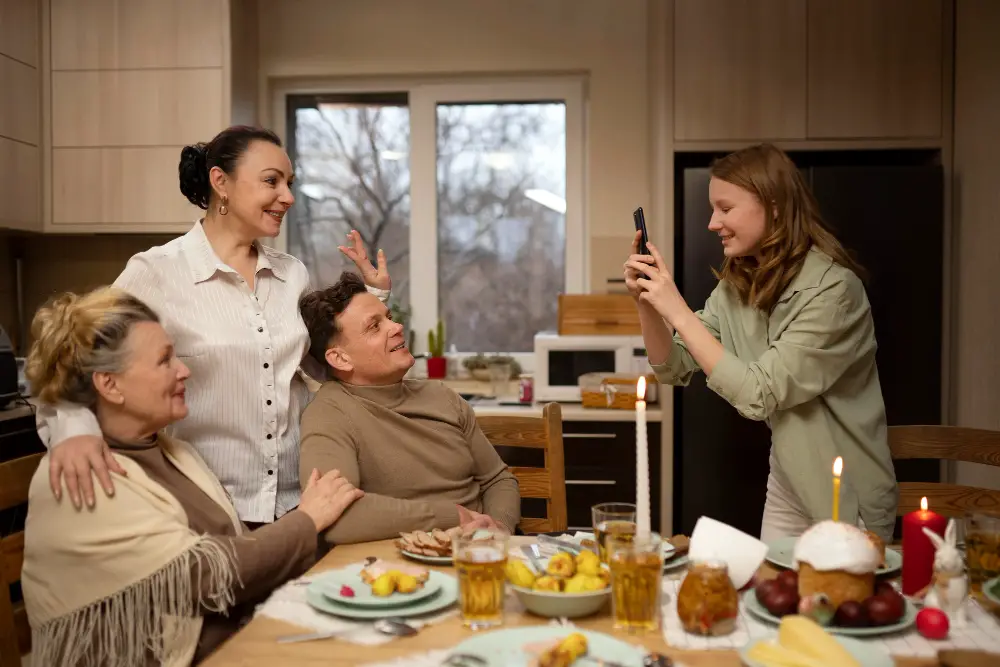
My mother, Glenda, sat at the head of the table with her cloth napkin folded into a precise rectangle beside her plate. My father, Grady, sat to her right, heavy through the shoulders, already scowling before I had said a word, his face set in the expression he wore when he had made a decision and was daring the world to argue with it. My younger sister, Danielle, sat beside my mother with one hand resting flat on her stomach in a way I did not yet understand. And my uncle Hal was there too, which should have been my warning, if I had been less tired and more alert. Hal almost never came to weeknight dinners. He came when there was business to be discussed. Family business, they called it, which in our house had always been code for the moments when somebody wanted something from me and had gathered reinforcements to get it.
My mother lifted her eyes to mine. And without so much as a hello, without a single word about the scrubs or the swollen ankles or the obvious plain fact that I was heavily pregnant and visibly exhausted and had just driven across town to see her, she spoke.
“Come here and sit down,” she said. “Since your sister is expecting now too, you’re going to hand over everything you’ve bought for your baby, and you’re going to sign over that house your in-laws gave you.”
For a moment, I truly did not understand the sentence. It was the strangest sensation. I heard every single word of it clearly, each one landing distinct in the warm gravy-scented air. And yet I simply could not make my brain accept that my mother had arranged those particular words in that particular order and aimed them across the table at me, in that flat, announcing, almost bored tone, the exact tone she might have used to tell me the dinner was almost ready or that it looked like rain. My mind kept trying to rearrange the words into some other, more survivable meaning, some sentence a mother might actually say to her pregnant daughter, and it could not do it. The words just sat there, exactly as she had said them, refusing to become anything kinder.
Danielle leaned back in her chair, and a slow smile spread across her face, the smile of someone who has been waiting a long time for a curtain to go up.
“Wow,” she said, drawing the word out, savoring it. “So I get the nursery, and the gifts, and the house, and you don’t even get a congratulations. I guess that tells you exactly who deserves it more around here, doesn’t it.”
I put one hand on my belly. My daughter moved under my palm, a small rolling pressure, a slow turn, and that tiny private motion grounded me for half a second in the middle of the tilting room, reminded me who I actually was and what I was actually there to protect.
“Danielle,” I said carefully. “You’re pregnant?”
She widened her eyes and lifted her chin, the way a person does when she is accepting applause she believes is overdue. “Surprise,” she said.
I swallowed. My mouth had gone dry. “That’s big news,” I said, and I meant to sound warm, I truly did, some old reflex still reaching for peace. “Congratulations. But I don’t understand what that has to do with my baby’s things, or with my house.”
My father folded his arms across his chest. “It has everything to do with it,” he said, in the voice he always used when he wanted plain bullying to sound like plain common sense, the voice that framed obedience as maturity. “Your sister needs those things more than you do. It’s simple. You’ve got Adrian. You’ve got his parents, who apparently have money to burn. You’ve got that big house. You can replace whatever you give up. Danielle can’t.”
Replace. He said it so easily, as if a nursery built one double shift at a time were a sweater I had ordered in the wrong size and could simply send back for another.
I thought of the crib standing upstairs in my own house, still smelling faintly of fresh raw wood, the crib Adrian had spent a whole Sunday sitting cross-legged on the floor to assemble, the instructions spread out in a ring around him, the little bags of screws lined up, swearing cheerfully every time a piece went in backward and laughing when I brought him lemonade. I thought of the soft butter-yellow paint the two of us had chosen together, standing in the aisle of the hardware store holding paint chips up to the fluorescent light and then carrying them to the window to see them in daylight, because we had wanted the room to feel warm and full of sun no matter what gray season our daughter finally came home in.
I thought of the car seat I had researched for three solid weeks, reading every crash rating and every safety review and every parenting forum until my eyes blurred and Adrian gently took the laptop away and told me to sleep. I thought of the stroller I had finally bought, after months of saving from extra shifts, standing at the register almost giddy. I thought of the little stack of storybooks I had lined up on the nursery shelf in the exact order I had loved them as a child, one after another, saved from my own childhood and bought new, all of them waiting patiently for a girl who did not yet even have a name.
Every receipt was saved in a folder on my laptop. Every warranty card was filled out and filed away. Every single choice had been made slowly, and carefully, and with more love than I had ever put into anything in my life. None of it was replaceable. That was the entire point of all of it, the thing my father with his talk of replacing could not begin to understand. It was not stuff. It was not a pile of goods to be redistributed to whoever the family decided was most deserving. It was the physical, touchable shape of three years of hoping, three years of grief and prayer and waiting made solid, assembled one careful piece at a time in a warm yellow room. You cannot hand that to someone else. You cannot sign it over. It was already, in every way that mattered, hers, the girl turning slowly under my hand.
My mother looked at me as though my silence were a small rudeness she was choosing to overlook. “Renna,” she said. “Don’t make this difficult.”
I almost laughed out loud, right there. The sentence was so perfectly, precisely her. My mother could walk into the middle of your life carrying a crowbar and still, somehow, find a way to accuse you of making all the noise.
Because this was not new. This was only the clearest, ugliest version of a thing that had been true my whole life. Six months earlier, when Adrian and I had first announced the pregnancy at this same table, I had let myself imagine, foolishly, that there might be hugs. I had imagined happy tears, my mother’s arms around me. Instead my mother had said, “Well. It’s about time,” in a tone you would use about a late tax refund. My father had barely glanced up from his plate. And Danielle had muttered, just loud enough, “Fantastic. Another baby for everyone to obsess over.”
Danielle had always been the center of gravity in my parents’ house, the bright hot sun the rest of us were expected to arrange our orbits around. She was twenty-six, two years younger than me, and she had spent nearly the whole of her adult life being caught, cushioned, and rescued from the consequences of her own choices, every single time, without fail. Rent she did not pay, covered. Car payments that lapsed, made good. Phone bills, credit card overdrafts, security deposits, jobs she quit in a huff or was quietly let go from, friendships she burned to the ground, boyfriends, apologies she offered smoothly and never meant for one second. Whenever the ground rushed up toward Danielle, my parents were there underneath her with a net, and they never once let her feel the fall.
They called all of it helping. Family helping family. I had come, over many years of watching, to understand it as something else entirely, something with a crueler long-term shape. They were training her. Year after year, rescue after rescue, they were teaching my sister to believe, all the way down in the deepest part of her, that the world owed her a soft landing as a matter of course, and that whenever a landing turned out to be hard, it could only mean that someone else, somewhere, had failed in their duty to catch her. She had never once in her life had to sit in the wreckage of her own decisions and feel the full weight of them. And a person who never feels that weight never learns that other people are real. That, more than anything, was what sat across the table from me smiling that night.
I had been raised differently, or really I had raised myself differently, because I had needed to. There was no net under me. I understood that very young. Danielle was the one who got caught, and I was the one who was expected to be fine, to need nothing, to cause no trouble, to be grateful for a roof and ask for nothing more. So I learned early and thoroughly not to fall, because I knew with total certainty that no one would catch me if I did.
I worked my way through nursing school, every semester of it, on my own. I packed my lunches into the same three scratched plastic containers, year after year, while classmates ordered takeout without a second thought. I slept in four-hour pieces for years, between shifts and classes and studying. I said no to things other people said yes to. I built, slowly and stubbornly, brick by brick, a whole life that did not require my parents’ approval to keep standing upright, a life with its own foundation poured by my own hands.
And that, I came to understand only much later, was the truly unforgivable thing I had done in their eyes. Not a failure. A success they had no claim on. Families like mine do not always resent your failures. Sometimes, what they truly cannot forgive is the living, breathing, thriving proof that you survived without their permission. That you got out. That you built something they did not give you and could not take away, and that you did not need them, in the end, the way they had always needed you to need them. My independence was not a source of pride to them. It was an accusation. Every time I paid my own way, I was, without saying a word, pointing at what Danielle could not do, and they hated me a little for it, and I had spent years pretending not to know that.
Adrian’s parents had made all of it worse, in my family’s eyes, simply by loving us openly and generously. When Adrian and I got married, his mother and father had transferred to the two of us the ownership of a four-bedroom house on a quiet street, a solid older place with a real front porch and a fenced backyard and a dented blue mailbox that Adrian repainted one bright Saturday morning while I sat on the front steps in my robe drinking coffee and laughing at him. The house was paid off, free and clear, and worth a good deal of money. Adrian’s parents called it a foundation, a place for us to build a family on. My parents called it showing off.
From the very first day, my mother had spoken about that house the way you might speak about an insult somebody had deliberately left sitting out on a front lawn for the whole neighborhood to walk past and see. It offended her. It was not that she wanted a house like it, exactly. It was that its existence, its very solidity, said something about my life and Adrian’s parents’ generosity that she could not stand to have said. My father declared, flatly and often, that Adrian’s family had only done it to make him look poor by comparison, as though a gift to their son and his wife had secretly been an attack on him. And Danielle said, more than once, in that light poisonous way of hers, that some people just got lucky in life, and she always looked right at me when she said it, meaning me, meaning that nothing I had was earned, that it had all simply fallen into my lap while she struggled.
And still, God help me, for years, I kept trying to keep the peace. I do not fully know why. Some mixture of hope and habit and the deep old need of a child to be loved by the people who are supposed to love her, a need that does not switch off just because you become an adult and know better. I invited them all over. I let my mother walk through the nursery and inspect it and find small things wrong with it. I let Danielle pull open the dresser drawers and finger the tiny folded clothes and say “must be nice” in that particular voice, and I let her pretend she was only joking. I even kept the old key to my parents’ house on my ring, all those years, because some stubborn childish part of me still wanted, against all the evidence, to belong there.
Standing in their dining room that Tuesday night, with the pot roast cooling and my family watching me like a jury, I finally understood how dangerous that particular hope had always been.
My mother went on, ticking the items off on her fingers as if reading a shopping list. “The crib, the stroller, the car seat, the clothes, the blankets, and all the gifts from Adrian’s parents. All of it goes to Danielle. She needs it.”
“No,” I said, quietly.
She continued exactly as though I had not spoken at all, as though the word had made no sound. “And you and Adrian are going to sign the house over. His parents clearly have money. They can simply buy the two of you another one.”
Uncle Hal cleared his throat then, shifting his weight in his chair. “Renna,” he said, not quite looking at me. “Come on now. Family helps family.”
That one hurt more than I had braced myself for. Hal was not like the rest of them, or he had not always been. Hal had taught me how to change a flat tire on the gravel shoulder of a county road when I was sixteen, crouching down in his good work pants to show me how to set the jack and where to brace it, patient, never once making me feel stupid for not knowing. He had shown up at my nursing school graduation, one of the only members of my family who bothered to come, and afterward, out in the parking lot, he had put his heavy hand on my shoulder and told me that I looked like a woman who had earned her way into that room, and I had held onto those words for years.
And now here he sat, at my mother’s table, on my mother’s side, unable or unwilling to lift his eyes from the tablecloth to meet mine. Whatever had been said before I arrived, whatever pressure or logic or family loyalty had been applied to him in that kitchen, it had been enough. He had chosen. And his choosing hurt worse than my father’s shouting, because I had not expected anything better from my father, and I had, foolishly, still expected something better from Hal.
“Danielle’s in a difficult position,” he said to the tablecloth.
I looked from my uncle to my sister. And Danielle was not frightened. She was not ashamed. She was not uncomfortable in the slightest. She was enjoying herself, openly, the way she used to enjoy it when we were girls and I got blamed for something she had done.
“My daughter’s car seat,” I said slowly, “is not your difficult position.”
Danielle’s smile thinned into something meaner, something with teeth in it. “You always act like everything you have is because you’re just better than the rest of us,” she said. “You’ve always been like that. Little miss perfect. Little miss works so hard.”
“I worked for what I have,” I said. “Every bit of it.”
“You married well. That’s all it is. You got lucky and you married a man with rich parents, and now you look down on all of us.”
“I married someone who loves me,” I said, and my voice was quieter than hers but it did not shake. “That’s the difference. That’s the whole difference between us, Danielle, and it has nothing to do with money. You should try it sometime. Marrying someone who loves you. Loving someone back.”
Her eyes flashed, hot, and the whole table went utterly, breathlessly still, the kind of still that comes right before something breaks. Forks hovered in the air, halfway to mouths. A spoonful of gravy slipped off the serving spoon and spread slowly across the white tablecloth in a dark stain that nobody moved to blot. My father was staring at me with the exact expression he had used when I was a child and had spoken too truthfully for his comfort, a look that promised consequences. My mother’s fingers pressed flat and white against her folded napkin. The chandelier hummed faintly overhead. For a long moment, nobody in that room moved at all.
Then my father brought his open palm down on the table with a crash. The plates jumped. A water glass tipped over and rolled and clinked against Danielle’s plate, spilling a thin sheet of water across the cloth.
“Don’t you dare talk back to us,” he barked, and his voice filled the whole room.
My whole body went cold, a cold that started in my chest and spread outward down my arms. He pushed his chair back and stood up to his full height, using his size the way he always had, as an argument that did not require words.
“You belong to this family,” he said, low and hard, leaning over the table toward me, “and you will do exactly what I tell you to do.”
For one ugly, vivid heartbeat, I imagined it all. I imagined seizing the gravy boat off the table and hurling it against the wall just to hear it shatter. I imagined screaming until the neighbors down the quiet street heard me through their storm windows. I imagined finally, finally saying aloud every cruel and buried truth I had swallowed down since I was small enough to sit in a booster seat at this same table. I imagined all of it in the space of a single breath.
I did none of it. Instead I slid my hand into the pocket of my scrubs and closed my fingers around my phone.
My father saw the movement. His eyes dropped to my pocket. “Who are you calling?”
“My husband,” I said.
“No,” he said. “You’re not.”
And he came around the end of the table toward me.
That was when the pain hit.
It tore low across my body, sudden and sharp and deep, a cramping wrenching pull unlike anything I had felt in the whole pregnancy, so sharp and so wrong that I grabbed the back of the nearest chair with both hands to keep from going straight down onto the floor. My knees bent under me on their own. The breath went out of my lungs all at once and would not come back in. For a second the whole dining room tilted and swam sickeningly around me, the chandelier above smearing into a long streak of light, the faces at the table blurring, and a cold clammy sweat broke out along my hairline and down my back.
Every piece of my training as a nurse went off at once inside me, all the alarms at the same time. I knew what sudden pain at thirty-two weeks could mean. I knew the words for it. And the knowing made it worse, not better, because I knew exactly how much there was to be afraid of.
“Something’s wrong,” I said, and my own voice sounded very far away, as though it were coming from the next room, from underwater. “Something is really wrong. Call an ambulance. Please. Somebody call an ambulance right now.”
My mother stood up from her chair. For one half of one second, some part of me still expected her to become, at last, in this emergency, a mother, to rush to me, to catch me, to call for help. That is how deep the old hope went. It survived even that night, even that long.
But she did not move toward me to help me. She reached out and took hold of my arm, and her fingers closed around my wrist, not to steady me, but to hold me in place, and she looked into my face with an expression of perfect calm.
“Promise first,” she said.
I stared at her. The pain rolled through me and gripped again, harder, and I heard myself make a small sound. “What?” I managed. “Mom. What?”
“Promise me you’ll do the right thing for your sister,” she said, and her voice was perfectly level, perfectly reasonable, almost gentle, her grip on my wrist not loosening by the smallest degree. “Promise me that, right now, and then we’ll deal with the hospital. First things first.”
I have gone over that moment many times since. The plain arithmetic of it. My daughter was in distress inside my body, and my mother had decided that this, precisely this, was her moment of maximum leverage, the instant when I would agree to anything at all, and she had chosen to use it. She was not panicking. She was negotiating. She had looked at her pregnant daughter doubled over in pain in front of her and seen, before anything else, before her own child, an opportunity.
There are moments when betrayal stops feeling like a wound and starts feeling, instead, like information. Clean, cold, clarifying information, the kind that reorganizes everything that came before it. A wound makes you cry out. Information makes you go quiet and still and finally see. For thirty-two years I had experienced every cruelty from these people as a wound, a fresh hurt to be absorbed and survived and, somehow, forgiven, always with the wound still bleeding underneath. But at twenty-six minutes past six, on an ordinary Tuesday, in my parents’ dining room, with my daughter in real distress inside my body and my mother’s hand clamped hard around my wrist demanding a promise before she would allow me care, the wound finally, at long last, converted into information. Cold, complete, and undeniable. I understood these people fully, perhaps for the first time in my life. Every last hope I had carried into that house for thirty-two years quietly finished dying, all at once, and did not hurt nearly as much in the dying as I would have expected, and something much simpler and much harder and much stronger moved in to take its place.
Danielle tilted her head to one side and looked at me with mock concern. “Careful, Renna,” she said sweetly. “Stress isn’t good for the baby, you know.”
I pulled out my phone with shaking fingers, and I pressed Adrian’s name, and I put it on speaker.
The call connected almost instantly. “Renna?” Adrian’s voice came out of the phone into that silent hostile room. “Hey. Are you okay?”
My mother’s grip tightened hard on my wrist. My father took another step toward me. And another wave of pain rolled through my body, and I gasped aloud, unable to stop it.
Adrian’s voice changed on the instant. It did not rise into panic. It sharpened into focus, into total attention. It was the voice of the man who had sat beside me through every single appointment of those three long years, who had learned by heart the difference between ordinary discomfort and real danger, who had spent three years memorizing every small tremor and shift in my face.
“Renna. Put me on speaker if I’m not already,” he said, fast and calm. “Tell me exactly where you are. Right now.”
“I’m at my parents’ house,” I said. “I’m at my parents’.”
My mother leaned in close and hissed into my ear, “Stop this. Stop it right now.”
I kept going anyway. “I’m in the dining room. Adrian, they won’t call an ambulance. They said they won’t call an ambulance unless I promise first to give Danielle all the baby things and sign over our house.”
There was one beat of dead silence over the phone, one held breath. And then Adrian said, very calmly, very clearly, in a low steady voice I had never quite heard from him before, a voice with iron all the way through it, “Okay. Listen to me. I’m calling 911 right now from my other phone. Stay on this line with me, Renna. Do not hang up, no matter what anyone says. Keep talking to me. I’m already in the car. I’m already moving. I’m three minutes out.”
I heard, through the phone, the sound of his keys, the slam of a car door, the engine. He had not wasted a single second deciding whether to believe me. That, I would think about later too. In a family that had spent my whole life teaching me to doubt my own perceptions, Adrian had heard one sentence in my voice and moved.
Danielle’s mock smile faltered and slid slowly off her face as she understood that this was no longer a scene playing out entirely under my parents’ control.
“This is family business,” my father said loudly, for the phone to hear.
Adrian heard him through the phone. “No,” my husband said, and his voice came through the little speaker flat and hard and absolutely certain. “That’s not what this is. This is my pregnant wife, in pain, being physically prevented from getting medical care by the people in that room. That is not family business. That is something else entirely, and it has a name, and the police are going to use that name when they get there.”
My mother let go of my wrist all at once, snatching her hand back as though my skin had suddenly gone hot enough to burn her fingers. The word police, spoken aloud into her dining room by a calm man on a phone, had done what nothing else had. She stepped back from me. And in her face, for the first time all evening, I saw not anger, not calculation, but the beginning of fear, the dawning understanding that this was not going to go the way they had planned it around the table before I arrived.
And a text preview slid down across the top of my phone screen, from Adrian, sent from the other phone even as he spoke. Recording started when you picked up. Stay with me. I’ve got you.
Two weeks before that dinner, my mother had left three long voicemails on my phone about what she called fair distribution, and about what Danielle deserved, and about family taking care of family. Adrian had listened to all three of them standing in our kitchen. He had not yelled. He had not threatened anyone. He had simply looked at me and said, quietly, “We need to start documenting this.”
I had not fully understood then what he meant, or why he was so serious about it. It had seemed like a lot, if I am honest, for what were just my mother’s ugly voicemails, the kind of thing I had been absorbing my whole life. But over those two weeks, quietly, without making any fuss about it, Adrian had done the work. He had saved all three voicemails and backed them up in two places. He had driven downtown to the county clerk’s office and pulled an official copy of the deed to our house from the public record, so that there could never be any question about whose names were on it. He had photographed every nursery receipt and every warranty registration and every price tag and organized them in a folder.
At the time, watching him do it, I had thought he was just being cautious, a little overprotective, the way he sometimes was about me, the way a person becomes when he has watched someone he loves get hurt over and over. I had even teased him about it gently. I did not understand, until the night in that dining room, that he was not being paranoid at all. He was quietly building a lifeline, coil by coil, and laying it down within my reach, for a night that neither of us yet knew was coming but that he, apparently, had felt in his bones was on its way. He had believed my family capable of something I still, even then, did not want to believe them capable of. And he had been right.
My father saw my face change as I read the text. “What did he do?” he demanded. “What did that text say?”
Danielle’s eyes went to the phone in my hand. “Recording?” she whispered. “Is it recording?”
Uncle Hal dropped his fork. It hit his plate with a hard small clatter. And that, I realized, was the first fully honest thing anyone at that table had done all night.
Then headlights swept bright across the front window, and Adrian’s SUV pulled into the driveway so fast that the tires bit the gravel and the beams swung and flashed across the dining room walls and ceiling like the lights of an emergency, which was exactly what it was. And at the same moment, the 911 dispatcher’s voice came onto the open line, calm and clear.
“Ma’am, I need you to tell me who is preventing you from receiving medical care.”
My mother’s hand flew up to cover her mouth. My father took one full step backward, away from me, away from the phone, as though physical distance could undo what had already been recorded. Danielle’s hand left her own stomach and gripped the edge of the table until her knuckles went white. In the space of a few seconds, the whole balance of the room had inverted. They were no longer the tribunal and I the accused. Now there was a calm official voice coming out of my phone asking who was hurting me, and they were the ones who had to answer for it.
“Ma’am, are you still there?” the dispatcher said. “Can you tell me who is preventing you from getting care?”
And I said their names. All of them. Clearly, evenly, into the phone, for the record, into whatever recording was being made on the other end. My mother’s name. My father’s name. My sister’s name. My uncle’s name. One by one, out loud, in that dining room, with all of them standing right there listening to me do it. It was the first time in my life I had ever named exactly what they were doing while they were doing it, instead of swallowing it and explaining it away later, and something came loose in my chest as I did, some knot that had been tied since childhood.
By the time Adrian came through the front door, not bothering to knock, pushing straight in, I was bent over the back of the chair and crying without having decided to cry, the tears just coming on their own with the pain and the fear and the sheer overwhelming relief of hearing his car in the drive. And he crossed that entire room without looking at a single other person in it first. He did not glance at my father, who had drawn himself up. He did not look at my mother with her hand at her mouth. He did not acknowledge Danielle or Hal at all. To him, in that moment, they simply did not exist. He came straight across the room to me, to his wife and his daughter, and nothing else in that house registered to him as worth a single second of his attention. One of his warm hands went firmly to the small of my back, steadying me. The other reached up and gently took the phone out of my shaking grip so that I did not have to hold it, so that I could just breathe and let him carry it.
“What did they do?” he asked me, low, only for me.
My father tried to square up his shoulders and reclaim the room. “Don’t you come into my house giving orders, boy.”
Adrian turned and looked at him then. And in all the years I had known my husband, I had never once seen his face go so still, so completely without heat. It was not anger. It was past anger.
“This house,” Adrian said quietly, “almost cost my wife and my daughter their lives tonight, because you wanted property. Don’t talk to me about your house.”
The sirens came about three minutes later. Three minutes can feel like an entire lifetime when every second of it is moving through pain and fear. But they came. A paramedic knelt down beside me on my parents’ dining room floor and began asking questions in a quick, practiced, steadying voice. How far along was I. How frequent was the pain. Any bleeding. Any fall. Any recent stress event.
My mother kept trying to interrupt the paramedic as he worked, hovering at the edge of the little pool of activity on her dining room floor, trying to narrate, trying to reframe. “She gets like this,” she said, to the paramedic, over his shoulder. “She’s always been dramatic, ever since she was a girl. It’s probably nothing. She works herself up.”
The paramedic did not even glance up at her. He kept his eyes on me, his fingers on my pulse. “Ma’am,” he said, flat and final and without a shred of deference, “I need you to step back.”
And that was the first order anyone had given my mother all night that she actually obeyed. She stepped back. A stranger in a uniform, kneeling on her floor, had done in four words what I had never once managed to do in thirty-two years. He had simply refused to grant her the authority she assumed, and she had folded. I filed that away, even then, even through the pain. It could be done. You could just decline to hand her the power. She only had it because we kept giving it to her.
They loaded me carefully onto the gurney and out through the front door into the cold October dark, past the little flag on the porch, and Adrian was right there the whole time, at my side, then following in the SUV. At the hospital intake desk he handed over my ID and my insurance card and, without being asked, a clear timeline of the evening, like a man who had been born ready for exactly this disaster. Arrival at my parents’ house. The emergency call. The dispatch. The paramedics on scene. He had the times. The intake nurse wrote quickly as he spoke.
When she asked me, gently, what had triggered the pain, what had happened right before it started, I looked at Adrian. He squeezed my hand once. So I told her the truth. All of it. The demand for the nursery. The demand for the house. The hand on my wrist. The refusal to call for help until I promised. And the recording, running the whole time.
The hospital kept me overnight for monitoring. The pain, it turned out, had been triggered by the acute stress, my body’s alarm response to a threat, and with rest and fluids and calm it settled, and the danger passed. But they kept me, to be sure, to watch. And our daughter’s heartbeat stayed strong through all of it, steady and quick, a fast little galloping rhythm, and that sound, coming through the monitor in the dim hospital room hour after hour through the night, became the only thing in the whole world that I trusted for a while. Every time it filled the room I breathed again.
Adrian sat beside my bed in the hard vinyl chair the entire night, still in his rumpled work shirt, one hand wrapped around mine on the blanket, and he did not let go even when he finally dozed off near dawn with his head tipped back against the wall. He did not once, in all those hours, tell me to calm down. He did not tell me that family is complicated, that they had probably meant well, that I should try to understand their side of it, that blood is blood. He did not do a single one of the things I had been braced my whole life to hear people do, the minimizing, the both-sidesing, the quiet pressure to forgive and smooth it over. He said only, at one point, into the dim quiet, his thumb moving over my knuckles, “They do not get near you again unless you choose it. Not you, and not her. Not ever again unless it’s your choice. I promise you that.”
I believed him. Lying there in the dark listening to my daughter’s steady heartbeat with my husband’s hand around mine, I believed him completely, and I slept.
The next morning, before I was even discharged, we filed a police report. Not because I wanted drama, and I want to be clear about that, and not out of any hunger for revenge. I did not want any of it. We filed it because the truth needed a place to live outside of my own memory, somewhere solid and official, somewhere it could not be argued away or quietly reshaped later into my fault, the way absolutely everything in that family had always, eventually, become my fault. I knew how the story would be told if I let it stay only in memory. I would become the ungrateful daughter who overreacted, who abandoned her family, who made a scene over nothing. So we wrote it down, where they could not touch it.
Adrian sent the call recording, the three voicemails, and the copies of the deed to an attorney that same day. He changed every lock on our house before I ever walked back through the door, so that the old key on my mother’s ring, if she had one, would open nothing. His father came over that same afternoon and installed a security camera above the front porch, working quietly and steadily with a screwdriver, saying very little, just doing the thing that needed doing. His mother arrived and filled our freezer with soup and casseroles and breakfast sandwiches, each one carefully labeled in black marker in her small handwriting, so that I would not have to think about cooking for weeks. Neither of them made a single speech. Neither of them said one word against my family, or asked me to explain myself, or made me relive it. They just showed up and took care of us, quietly, with their sleeves rolled up. That, it turned out, was what family was actually supposed to look like. I had simply never had it shown to me until I married into it.
My parents called me thirty-seven times over the next two days. I did not answer a single one. Danielle sent exactly one text message. You ruined everything.
I read it sitting on my own couch, in my own living room, in my own safe house with the new locks and the camera at the door, with my feet propped up on a pillow and my daughter rolling slowly beneath my ribs. You ruined everything. And for the first time in my entire life, in a situation like this one, faced with my family’s judgment, I did not feel one single flicker of guilt. Not one. I waited for it, almost out of habit, braced for the familiar flood of it, and it simply did not come. Instead I felt clear. Clear as glass, clear as still water. The low current of guilt that had run underneath my whole life like a buried live wire, humming, always there, always ready to shock me into compliance, had finally, simply, gone quiet. She was right, in a way she had not intended. I had ruined everything. I had ruined the machine that ran on my guilt, and I was never going to repair it.
A week later, a formal letter from our attorney was delivered to my parents’ house. It stated that they were not to contact me directly. It stated that any further attempt to enter our property, to demand ownership of anything, or to harass us about the house would be documented and acted upon. It stated, plainly, that the deed was held jointly by Adrian and me and was not subject to their wishes, their feelings, or their opinions about family.
I wish I could tell you that the letter ended it, that a formal document on an attorney’s letterhead was enough to make it stop. But it was not, because people who have decided somewhere deep down that they are entitled to you, that you belong to them, that your life and your things and your body are theirs to allocate, rarely stop simply because a piece of paper tells them no. A piece of paper means nothing to a person like that. They had never respected any boundary I tried to set with words. There was no reason to think they would respect one set in ink.
My mother showed up at our house anyway, about a week after the letter. She stood on our porch in the clear thin light of a fall afternoon, looking somehow smaller than I remembered her and at the same time twice as hard. Adrian opened the door with me standing behind him, one hand on his back.
She tried to peer past his shoulder into the house. “I want to speak to my daughter.”
“She heard you very clearly,” Adrian said, “the night you refused to let her get medical care.”
My mother’s mouth trembled, and for one second I thought, against all my better judgment, that an apology might actually come out of it. It did not. Instead she said, “Your sister is devastated, Renna. Danielle is absolutely devastated.”
That was when I stepped into view, into the doorway beside my husband, my daughter safe upstairs. Not close to my mother. Not within her reach. Just close enough that she could see my face clearly, and read it, and understand that I was not the same daughter who had walked into her dining room that Tuesday night still hoping for something.
“I was devastated too,” I said. “That night. On the floor of your dining room, thirty-two weeks pregnant, in pain, terrified I was losing my baby. I was devastated. But you didn’t care about that, did you. You looked at me down on that floor and the only thing you saw was your chance to make me sign. There was nothing in it for you to care, so you didn’t. That’s the whole thing, Mom. That’s who you are. I just finally believe it now.”
Her eyes filled with tears. Maybe they were real. Maybe they were one more tool, pulled out because the others had stopped working. The remarkable thing was that, standing there, I found I no longer needed to decide which. It truly did not matter to me anymore.
“You’re really going to cut off your own family,” she said, her voice breaking, “over things? Over furniture and a house?”
I put my hand on my belly, on my daughter. “No,” I said. “I’m not cutting off my family over things. I’m cutting off people who treated my daughter’s safety like a bargaining chip. Those aren’t the same, and I think you know it.”
Adrian closed the door, gently, all the way. And through the feed from the new porch camera, on the little screen inside, we watched my mother stand out there alone on the boards for another full minute after the door had closed, not knocking again, not speaking, just standing, staring at the shut door as though she could not quite believe it had shut on her, as though a door had never once in her life failed to open for her. And then, finally, she turned, and she walked back down the porch steps, and down the walk, and away to her car, and out of the frame, and out of my life, for good.
She did not get the nursery. Danielle did not get the gifts, not the crib or the stroller or the car seat or the little books lined up in their careful order. Nobody signed over anything. Nobody got the house. Every single thing they had gathered around that table to take from me, they walked away from that night with none of it, and less than none, because they had traded whatever access to me they still had for a chance at furniture, and they had lost both. In the end the only thing that changed hands that night was the truth, and it came to me.
Two months later, our daughter was born, healthy and howling and perfect, after a long hard labor that left me shaking and wrung out and emptied of everything and happier than I had ever known a single human being could be. We named her for Adrian’s grandmother, a woman who had, by every account, loved fiercely and without conditions and without a bill attached, and it felt right to give our girl that name to carry.
Adrian cried the moment he heard her first thin furious cry fill the room, tears just running down his face while he laughed. His mother, out in the waiting room, cried harder than either of us when they told her, harder than I have ever seen a person cry from pure joy. His father stood in the corner of the recovery room pretending very hard to examine the label on the bassinet, turning it over and studying it with tremendous concentration, while he wiped his eyes over and over with the back of his hand and pretended he was not. There was so much love in that small room that it felt like it might not fit. Not one drop of it came with a cost. Not one.
I held my daughter against my chest, and I looked down into her small furious brand-new face, her tiny fists, her eyes squeezed shut against a world she had only just arrived in, and I thought, for just a moment, about that dining room table. The forks frozen in the air. The water glass rolling. The gravy spreading dark and slow across the white cloth while nobody moved to blot it. The people I was related to by blood, who had looked at me thirty-two weeks pregnant and doubled over in pain and had decided, coolly, that the right move, the smart move, was to trade my child’s safety for their own convenience and my sister’s comfort. And then I looked back down at my daughter, and I made her a silent promise, the first of many. She would never once in her life sit at a table like that one. She would never learn that love comes with a bill. Whatever else I managed or failed to do as her mother, I would give her that. She would grow up certain, all the way down, that she was loved for free.
For years, so many years, more years than I want to count, I had tried and tried to love my family correctly, as though love were a skill I simply had not mastered yet, a test I kept failing and could pass if I only studied hard enough. I had contorted myself into smaller and smaller shapes, folded myself down, gone quiet, asked for less, given more, forgiven faster, all of it trying to find the one version of me that would finally be enough for them, the version that would at last earn the plain tenderness I never stopped believing had to be in there somewhere, hidden, waiting, if I could just be good enough to unlock it.
That night at the table, holding my new daughter, I understood at last that there had never been anything to unlock. They taught me the truth of it, once and for all, and it was a hard clean truth and it set me free. Love that requires you to hand over your peace, your home, and your own child’s physical safety as the price of approval is not love at all. It never was. It is ownership, wearing the warm and familiar face of family, using the word family as a key to your locks. And the very moment I finally saw that clearly, all the way through, without flinching from it, something in me that had been clenched tight as a fist my entire life was at last, quietly, able to let go and open.
The morning we brought our daughter home, I took the key to my parents’ house off my ring. I had carried it there for years, that small brass key, through every apartment and every job and every version of my adult life, because some part of me had never stopped hoping I might one day be welcome to use it.
Adrian was standing at our own front door, working the new key into the new lock, the security camera keeping its quiet watch above us, the freshly painted blue mailbox down at the curb catching the morning light, the nursery waiting upstairs in its soft yellow glow for the little girl now asleep and warm against my chest. This was my house. This was my family, the one I had chosen and the one that had chosen me. And I stood there on the walk for a moment and took my parents’ key between my fingers.
I had carried that small brass key for years, through every apartment and every hard season and every version of my life, because some part of me had never been willing to admit that the door it opened would never really open for me, not in the way I wanted. I had kept it the way you keep a hope you are ashamed to say out loud. And I did not need it anymore. I did not want it anymore. The hope it stood for was gone, and I found I did not miss it, because I had something real now in its place.
I held our daughter close against me with one arm, and with my free hand I worked my parents’ key the rest of the way off the ring, and I dropped it into the trash can that stood beside the garage.
It made almost no sound at all when it landed. A small dull tap against the plastic, and that was all. Nothing. But to me, standing there in the cold bright morning air with my whole real family finally gathered together under one roof, my husband at the door and my daughter at my heart, that tiny sound was the loudest and best and most final ending in the entire world. It was the sound of a door I had been standing outside of my whole life, at last, closing. And I turned my back on it, and I walked inside my own home, where the light was warm, and I did not look back.

Laura Bennett writes about complicated family dynamics, difficult conversations, and the quiet moments that change everything. Her stories focus on real-life tensions — inheritance disputes, strained marriages, loyalty tests — and the strength people find when they finally speak up. She believes the smallest decisions often carry the biggest consequences.
A fantastic story with a great ending! Thanks for writing it.