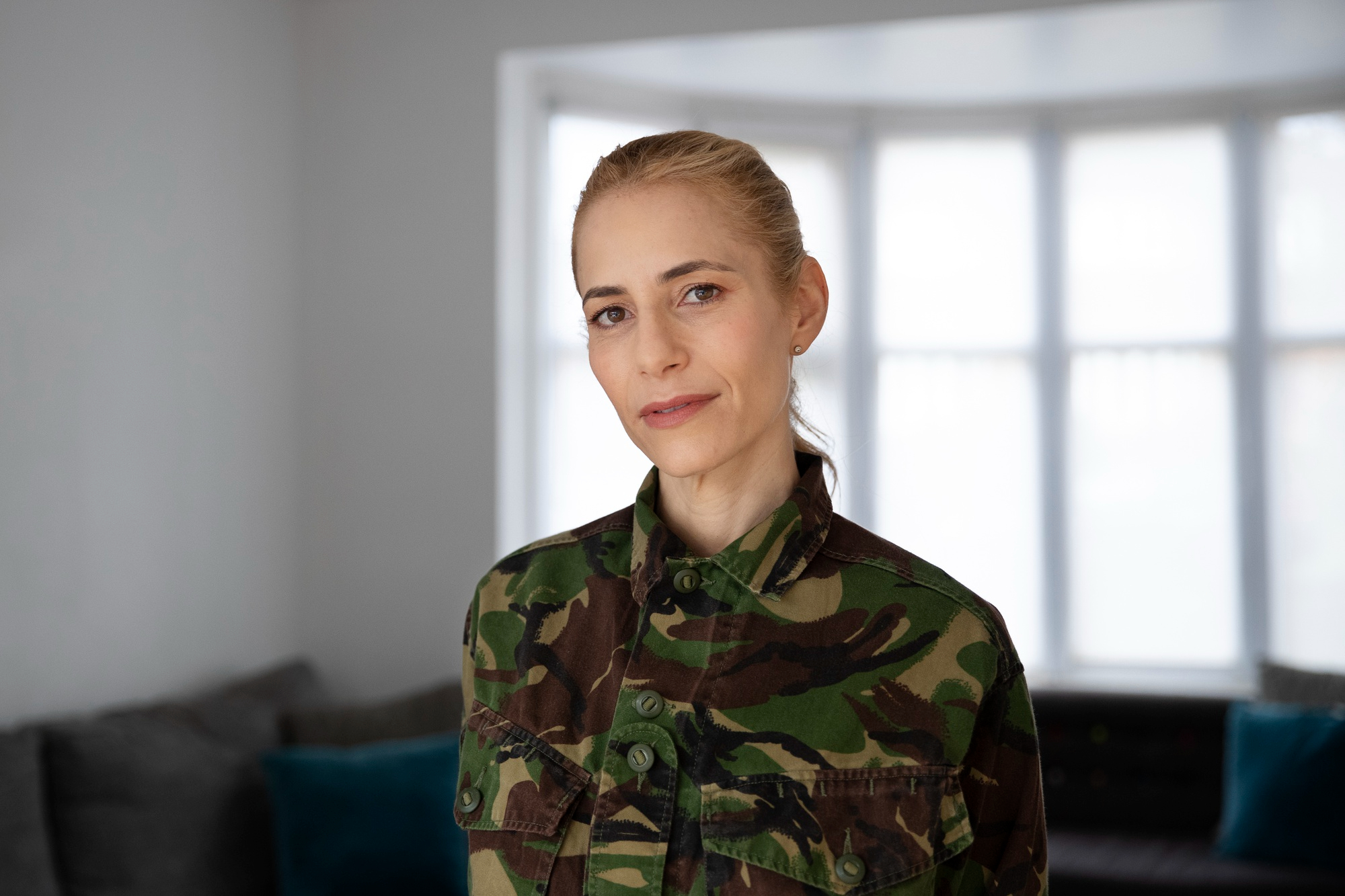
I pulled into my parents’ driveway just outside Denver at 8:17 p.m. and shut off the engine, but my hand stayed locked around the steering wheel.
The porch light glowed against the fading spring sky. Cold wind moved through the hedges, and through the windows came music, roasted garlic, and the sharp lemon polish my mother always used when she wanted the house to look more expensive than it was.
Five years away, and somehow this place could still make me feel seventeen.
Tiffany opened the door with her phone already raised.
“Oh my God. You really came.”
Behind her, Mom wore the smile she saved for other people.
“Five years,” she announced. “No photos. No updates. We barely even knew where she was.”
That wasn’t true.
Tiffany had my emergency contact number, a secure mailing address, and the information I’d given her when Grandma got sick. Those were some of the few safe pieces of my life I had trusted her with.
Then she noticed the patch on my shoulder.
“So… that’s your rank?”
Laughter moved through the room.
Brad, Tiffany’s almost husband, stepped beside her.
“You’re actually in the military? You really don’t look like the type.”
Tiffany angled herself toward her livestream.
“Brad is the real deal. Leadership. Visibility. My sister just does some small job on a base.”
Dad wouldn’t look at me.
“Just try not to make us look bad tonight.”
I said nothing.
The party kept moving around me.
Ice knocked against glasses.
Brad talked about promotions while Mom rested a hand on his sleeve like his future already belonged to the family.
At 8:43 p.m., I heard Dad speaking down the hallway.
“Sign this and we can finalize the transfer,” an unfamiliar voice said.
The office door was open barely two inches.
I stepped inside.
Papers covered the desk: a property transfer packet, a notary acknowledgment, a county recorder cover sheet, and an inventory of assets with Grandma’s name still visible along the margin.
One page carried a county recorder watermark.
Another had a blank signature line where my name had absolutely no reason to be.
Across the thickest stack was one word.
TRANSFER.
Mom crossed her arms.
“It’s for Tiffany. You were gone. We needed to be practical.”
Practical.
That was what they were calling trying to transfer property Grandma had left to me without my approval.
Then I noticed something else.
The silver framed picture of Grandma standing beside me on the day I shipped out was gone from the wall behind Dad’s desk.
A pale rectangle marked the spot where it had been.
For one moment, anger hit hard enough that I wanted to sweep every page onto the floor and give Tiffany’s livestream the scene she clearly wanted.
Instead, I took pictures of the documents sitting openly on the desk.
The transfer packet.
The notary seal.
The signature lines.
The county watermark.
The stranger’s business card.
The empty place where Grandma’s picture had been.
Then I walked back into the party.
Three firm knocks hit the front door.
The music faded.
Two police officers came inside.
One held a folded complaint summary.
Both remained calm while reviewing the situation.
Tiffany pointed at me immediately.
“Yes. That’s her.”
My parents didn’t ask what I had supposedly done.
They didn’t ask whether the complaint was accurate.
What I saw on their faces looked disturbingly close to relief, as if the arrival of police would somehow prove everything they had decided about me years ago.
One officer glanced at the paperwork.
“Ma’am, we need to speak with you about a complaint that was filed.”
I didn’t argue.
I didn’t explain.
“Of course,” I said.
Then his radio crackled.
Outside, headlights swept across the curtains.
A black SUV stopped at the curb.
Then another.
Then a third.
Tiffany lowered her phone slightly.
Dad moved toward the window.
“What is this?”
I stayed where I was.
The front passenger door of the first vehicle opened.
A senior military officer stepped onto the sidewalk accompanied by two staff members.
There was no dramatic rush toward the house.
No shouted orders.
No display of authority directed at the local officers.
He simply walked toward the front door with the controlled posture of someone who had spent decades entering rooms where facts mattered more than noise.
The officer beside me glanced outside.
Then back at me.
“You know him?”
Before I could answer, the front door opened.
The senior officer stepped inside.
His eyes moved across the room.
Tiffany.
Brad.
My parents.
The paperwork on the desk down the hall.
The two local officers.
Then he saw me.
His expression changed immediately.
He stopped.
“Major?”
The room went silent.
Tiffany stared at me.
Dad’s mouth opened slightly.
Brad looked from the officer to the patch on my shoulder as though he had suddenly realized he had misunderstood something important.
I remained still.
The senior officer walked closer.
“I wasn’t expecting to find you here tonight.”
“I could say the same.”
One of the local officers stepped forward.
“Sir, we’re currently reviewing a complaint involving her.”
The senior officer nodded.
He did not tell them what to do.
He did not ask them to ignore the complaint.
He simply reached into the folder one of his staff members was carrying.
“I may have information relevant to confirming her identity and whereabouts during the period referenced in that complaint,” he said. “I’m happy to provide it through the appropriate process.”
That was all.
No special treatment.
No orders.
Just information.
The officer holding the complaint looked down at the document again.
Then at me.
Tiffany’s phone slowly lowered.
For the first time all evening, nobody was laughing.
And whatever my family thought was about to happen, it was clear the facts were finally going to be reviewed by people they could not interrupt, embarrass, or talk over.
The officer with the folder unfolded it fully and read from it, his voice steady and procedural in the way officers train themselves to sound no matter what a room is doing around them.
“The complaint alleges that an unauthorized individual entered a private residence this evening, removed confidential financial documents without consent, and made threatening statements toward the residents. The complainant is listed as Tiffany Marsh.”
Tiffany’s face went through several expressions in rapid succession, defiance first, then something closer to alarm as she seemed to hear, out loud, in front of a room that now included a colonel and two federal looking staff members, how thin the story actually sounded once it left her mouth and entered an official document.
“That’s not what happened,” I said, keeping my voice level. “I didn’t remove anything. I photographed documents that were sitting on an open desk, in a room I was invited to walk past, in a house I grew up in. I made no threats. I said almost nothing to anyone in this house tonight before your officers arrived.”
“She’s lying,” Tiffany said, though her voice had lost some of its earlier certainty. “She went into Dad’s office without permission and started going through his things.”
“The door was open two inches,” I said. “I could hear a stranger telling my father to sign a transfer packet with my name on a blank signature line. I think most people would have looked.”
The colonel, whose name tag read Ashcroft, glanced toward the hallway where the office door still stood ajar, the desk visible from where we stood, papers fanned out under the lamp exactly as I’d left them.
“Would it be possible to see the documents in question,” he asked the officers, his tone entirely deferential, a man who understood precisely where the boundary of his own authority sat in a civilian home and had no intention of stepping past it uninvited.The senior of the two local officers, a broad shouldered man named Officer Delgado according to the name plate on his chest, considered that for a moment before nodding. “We were going to need to look at that room anyway, given what’s being alleged. Ma’am,” he said, turning to me, “would you walk us through what you saw.”
I led them down the hallway, aware of the whole party trailing loosely behind us, Tiffany’s phone still recording though she’d lowered it to her side, Brad hovering near my parents with the particular useless energy of a man who had walked into something far bigger than the evening he’d planned for. My mother’s hand found my father’s sleeve, gripping it the way she’d been gripping Brad’s earlier in the night, though this time it looked less like pride and more like fear.
The desk lamp was still on. The papers were exactly where I’d left them, and Officer Delgado stepped forward to examine them without touching anything, his partner already photographing the scene with a small department camera.
“This is a property transfer packet,” Delgado said slowly, reading through the top pages. “County recorder cover sheet. Notary acknowledgment. This line here,” he tapped the page without touching it, “has a name printed already. Reyna Marsh. But the signature line is blank.”
“That’s me,” I said. “I never signed anything. I never agreed to anything. I’ve been overseas for most of the last two years and stateside for the rest of it, and nobody in this house told me any of this was happening.”
“Where did the notary acknowledgment come from,” Delgado asked, looking up at my father.
My father’s mouth opened and closed once before he found words. “A family friend helped us with the paperwork. He said it was standard, that we just needed her signature to finalize things since she was the one named on the deed.”
“Who is the family friend,” Delgado asked.
Nobody answered immediately. Then my mother, in a voice that had lost every trace of the performance she’d been wearing all evening, said quietly, “Gary. Gary Holbrook. He does real estate closings. He’s a friend of your father’s from the club.”
“Is he a licensed notary in this state,” Delgado asked.
“I don’t know,” my mother said. “I assumed so.”
Delgado exchanged a glance with his partner. “We’re going to need his information, and we’re going to need to hold onto these documents as part of an active review. Given what I’m seeing here, this isn’t really about the complaint that was filed against her anymore. This looks like it might be a document fraud situation, possibly involving forgery of a signature line and an improperly executed transfer of inherited property. That’s a significantly bigger problem than the complaint you filed, ma’am,” he said, looking at Tiffany, “and I’d strongly encourage you to think carefully about what you say next, because right now the person with something to explain in this room isn’t her.”
Tiffany’s face crumpled, the confident, camera ready version of her from earlier in the evening entirely gone, replaced by something younger and more frightened than I had seen on her in years.
Colonel Ashcroft remained near the doorway throughout this exchange, saying nothing further, his staff members equally silent, present but deliberately unobtrusive, and I understood, watching him, that he had chosen his moment to speak earlier with the same precision he brought to everything, offering exactly the information needed to keep an unjust complaint from swallowing me whole, and nothing more than that, leaving the actual unraveling of the situation to the people whose job it was to unravel it.
It was almost an hour before the officers finished documenting the desk, collecting Gary Holbrook’s business card and contact information, and explaining to my parents that a detective from the county’s financial crimes unit would likely be in touch given the apparent forgery of a signature line on an official transfer document. My father sat through most of it at the kitchen table, his face gray, saying very little. My mother alternated between explaining and apologizing in ways that never quite landed as either.
Tiffany disappeared upstairs at some point during the questioning, and I didn’t see her again until the officers were preparing to leave, when she came back down, her makeup smudged, and stood at the bottom of the stairs watching the last of the activity with an expression I couldn’t fully read.
Colonel Ashcroft waited until the local officers had gone before he approached me again, his staff members giving us a small, deliberate distance near the front door.
“I owe you an explanation for showing up the way I did,” he said. “Your security clearance renewal flagged an active law enforcement contact tonight, standard automated notification, goes to your reporting chain whenever something like that happens. I happened to be in Denver for an unrelated review and pulled the notification myself before it went through the usual channels, because I recognized the name the moment it came across.”
“I appreciate it,” I said. “Though I imagine most majors don’t get a full escort over something like this.”
“Most majors didn’t pull three of my soldiers out of a burning vehicle outside Kandahar while under active fire,” he said, quietly enough that it didn’t carry past the two of us. “I don’t forget that kind of thing, Reyna. I never have, and I never will. When I saw your name attached to a police contact, I wanted to be here myself, not because I doubted you’d handled yourself well, but because I know what it looks like when good people get run over by bureaucracy or bad luck, and I wasn’t going to let that happen to you if I could help it.”
I hadn’t expected the sound of my own first name to affect me the way it did, standing in my parents’ front hallway after five years of being called almost nothing but Major, or worse, the vague, dismissive phrasing my sister had used earlier that night, some small job on a base. I felt something loosen in my chest, something that had been wound tight since the moment I’d pulled into the driveway.
“Thank you for coming,” I said. “Truly.”
“You don’t need to thank me,” he said. “You’ve spent your entire career doing the harder, less visible work that keeps people like me alive long enough to make the decisions that get remembered. I’m glad I could return even a small piece of that tonight.” He glanced past me, toward the kitchen where my parents still sat, subdued and shaken. “For what it’s worth, whatever’s actually going on in this family, that’s not something I have any business weighing in on. But I’ll say this much. You handled tonight the way I’ve watched you handle far worse. Calmly. Precisely. Without giving anyone the chaos they were hoping for. That’s not nothing.”
He left a few minutes later, the black SUVs pulling away from the curb as quietly as they’d arrived, and the house settled into a silence that felt different from any silence I’d experienced there before, heavier, and somehow also clearer, as though something that had been hovering unspoken over that house for years had finally been dragged into a light bright enough that nobody could pretend not to see it anymore.
My mother found me still standing near the front door a few minutes after the SUVs pulled away, her arms wrapped around herself in a way that looked less like composure and more like a woman trying to hold herself together by force.
“Who was that man,” she asked, her voice smaller than I’d heard it all evening. “The colonel.”
“My commanding officer’s commanding officer,” I said. “Someone I served under years ago.”
“He called you Major like he actually knew what that meant.”
“He does know what it means,” I said. “That’s the difference between him and most of this family.”
She flinched at that, and for a moment I thought she might snap back with the old defensiveness, the reflexive redirect she always used whenever a conversation threatened to land somewhere she didn’t want it to. Instead, she just stood there, looking smaller than I ever remembered her looking, and said, quietly, “I told people you did a small job on a base because I didn’t understand the real job, Reyna. I never let myself learn it, because learning it would have meant admitting I didn’t understand my own daughter at all. It was easier to make up a version I could explain to people at the club.”
“You could have just asked me,” I said. “I would have told you. I always would have told you, if you’d ever once seemed like you actually wanted to know.”
She didn’t have an answer for that, and I didn’t wait around for her to find one. I told her I needed some air, and I walked out to my car and sat there for almost twenty minutes before I trusted myself to drive anywhere, the porch light still glowing behind me, the party inside finally, mercifully, over.
I want to explain, now, what that house had actually been hiding, because I don’t think the events of that evening make full sense without understanding the five years, and really the two decades, that led up to them.
My grandmother, Vivian Calloway, was the only person in my family who ever seemed to understand who I actually was rather than who they needed me to be. She lived in a small lake house about ninety minutes outside Denver, a modest place with a dock that leaned slightly to one side and a garden she tended with a devotion that bordered on the religious, and from the time I was seven years old, she was the person I called whenever something in the rest of my family’s dynamic became too much to carry alone.
Tiffany was born eleven months after me, close enough in age that my mother used to joke we were practically twins, though the joke never accounted for how differently the two of us were actually treated. Tiffany was the daughter my mother understood instinctively, interested in the things my mother was interested in, comfortable in the world my mother had built for us, appearances, status, the careful curation of how a family looked from the outside. I was the daughter who asked too many questions, who wanted to take things apart to see how they worked, who joined the ROTC program in high school against my mother’s explicit wishes and never looked back.
My father wasn’t cruel, not in any dramatic sense, but he had a talent for absence that functioned almost as effectively as cruelty over time. He worked long hours at an insurance brokerage that never seemed to make him happy, and he came home most nights with just enough energy left for Tiffany’s stories about her day, and almost none for mine. I don’t think he disliked me. I think, more honestly, he simply never learned how to engage with a daughter whose interests and instincts diverged so completely from the version of family life he and my mother had built.
Grandma Vivian filled that gap for as long as she could. She used to pick me up on Sunday afternoons and take me out to the lake house, just the two of us, and we’d sit on that leaning dock with our feet in the water while she told me stories about her own life, about growing up on a farm in eastern Colorado, about the years she’d spent as one of the only women working in a county surveyor’s office in the nineteen sixties, about the particular satisfaction of building a life on your own competence rather than on anyone else’s approval.
“Your sister’s always going to have an easier time of it in this family,” she told me once, when I was maybe fifteen, sitting on that dock after a particularly brutal week of watching my mother praise Tiffany for a school project while barely glancing at the science fair award I’d brought home the same week. “Not because she’s better than you. Because she wants the things this family already knows how to give. You want something different, and it scares your mother a little, if I’m honest, because she doesn’t know how to help you get it. That’s not your fault, Reyna. It’s just going to mean you’ll have to build some of it yourself, without waiting for her to catch up.”
I joined the Army the summer after I graduated high school, and my mother cried, though not, I came to understand over the years, out of pride.
My mother cried because my choice embarrassed her in front of the other mothers at the club, because it didn’t fit the story she wanted to tell about her family, two beautiful, accomplished daughters who would marry well and settle nearby and fill her calendar with the kind of visible, photographable milestones she valued above almost everything else. A daughter in uniform, deployed somewhere she couldn’t picture clearly, doing work she couldn’t describe at dinner parties in the flattering shorthand she preferred, simply didn’t serve the narrative, and over the years, I watched her quietly edit me out of most conversations where I might have come up, replacing detailed answers about my life with vague, dismissive phrases that made it easier for her to keep talking about Tiffany instead.
The years that followed took me further from that house than distance alone could explain. Basic training, then officer candidate school, then a first deployment that landed me in a logistics unit responsible for keeping fuel and ammunition moving across terrain that made every convoy feel like a negotiation with fate. I learned, in those early years, how to make decisions under conditions that left no room for the kind of careful, deliberative process my mother preferred to associate with competence, learned instead to trust my training, trust the people beside me, and move.
The incident Colonel Ashcroft referenced outside Kandahar happened during my second deployment, on a resupply run that went sideways when our lead vehicle struck an improvised device and the convoy came under fire almost immediately afterward. I don’t like to describe it in detail, even now, not because the memory is too painful exactly, but because the version people want to hear when they learn about it always sounds more cinematic than what it actually felt like in the moment, which was mostly just narrow, focused necessity, three soldiers who needed to get out of a burning vehicle and very little time in which to make that happen. I received a Bronze Star for it eventually, a piece of ribbon and a citation that sat in a drawer in my quarters for years because I never saw much point in explaining it to people who’d already decided, long before I earned it, that my job was something small and unremarkable.
Grandma Vivian was different. She wrote me letters every few weeks throughout my entire career, actual letters, on the same cream colored stationery she’d used my whole childhood, filled with updates about the garden and the lake and whichever book she was working through that month, and she always, without fail, asked real questions about my life, the kind that showed she’d been paying attention to my last letter rather than simply filling space until it was her turn to talk again.
She was diagnosed with pancreatic cancer a little over two years ago, during a deployment that made it functionally impossible for me to get home in time to see her before she passed. I found out about her death through a two line email from Tiffany, sent nearly a week after the funeral had already happened, informing me that Grandma was gone and that they’d handled everything, as though handling everything were an act of consideration rather than a quiet, deliberate exclusion.
I didn’t find out the details of her will until almost a year later, when Mr. Osei, no relation to anyone I’d know through other channels, but a meticulous, careful estate attorney nonetheless, tracked me down through my unit’s family readiness office after months of trying to reach me through addresses my family had apparently either forgotten or declined to update. Grandma had left the lake house to me specifically, along with a modest trust to cover its taxes and upkeep, with an explicit note in the will stating that she wanted it to remain in my name for as long as I chose to keep it, unless I decided otherwise myself, in writing, once I’d had time to properly grieve and consider what I wanted.
She had left Tiffany a smaller cash inheritance, along with an explanation, according to Mr. Osei, that she’d written into a private letter rather than the will itself, one Mr. Osei had been instructed to deliver only if I ever asked about the reasoning behind the division. I asked, the day I learned about the will, sitting in a rental car outside the county courthouse with my hands shaking in a way that had nothing to do with weather.
The letter, in Grandma’s familiar, looping handwriting, explained that she loved both her granddaughters equally but had watched, over decades, as our family consistently treated my accomplishments as an inconvenience and Tiffany’s as the natural order of things, and that she wanted, in the one meaningful way still available to her, to make sure at least one piece of what she’d built over a long, hardworking life went to the granddaughter who had never once been given credit for building anything of her own. She wrote that she trusted me to decide, eventually, what to do with the lake house, whether to keep it, sell it, share it, or simply let it sit empty for a while until I was ready to figure that out, but that the decision needed to be entirely mine, made without pressure from anyone else in the family, because I had spent enough of my life making room for other people’s decisions already.
I didn’t know, standing in that hallway the night I came home, that my family had spent the better part of the last year attempting to override that explicit instruction, working with a family friend who apparently either wasn’t a licensed notary or had agreed to falsify an acknowledgment anyway, drafting a transfer packet designed to move the lake house into Tiffany’s name using a signature line that had simply been left blank, presumably with the intention of forging it, or perhaps with the vague, self justifying hope that I might sign it myself once I finally came home, worn down enough by five years of distance and a lifetime of being the family’s afterthought to simply go along with whatever they’d already decided.
I think about the last time I actually saw Grandma Vivian in person often, a visit home eighteen months before her diagnosis, back when I’d managed to get two weeks of leave and spent almost the entire stretch at the lake house rather than at my parents’, a choice that had caused its own quiet friction at the time, though I never regretted it. We spent those two weeks the way we always had, mornings on the dock with coffee, afternoons in her garden where she taught me, patiently, the particular rhythm of deadheading roses and staking tomatoes, evenings on the porch listening to her tell stories I’d heard a dozen times before but never tired of hearing again.
Near the end of that visit, she took me into the small study off the living room, a room I’d always associated with the smell of old paper and the particular orderliness she brought to everything, and she showed me a filing cabinet where she kept copies of every important document related to the house, the deed, the tax records, the insurance paperwork, explaining each one to me with the careful, deliberate thoroughness of a woman who had spent her career ensuring that surveys and property lines never left room for ambiguity.
“I’m not showing you this because I think something’s going to happen soon,” she said, though something in her tone made me wonder, even then, whether she already suspected otherwise. “I’m showing you because I want you to know exactly what you’d be dealing with, if anything ever did happen, and because I don’t trust anyone else in this family to explain it to you honestly if I’m not the one doing it.” She closed the cabinet drawer with a soft, definitive click. “Your mother’s going to tell you, someday, that I should have split everything evenly, that fairness means identical outcomes for both of you. I don’t believe that, and I never have. Fairness means giving people what they actually need, and what you’ve needed, your whole life, is one place in this family that’s entirely yours, that nobody can talk you out of or laugh you out of or make you feel small inside of. This house is going to be that place, once I’m gone. I need you to hold onto it, even if holding onto it makes some people in this family uncomfortable. Especially if it does.”
I didn’t know, at the time, how literally I would eventually have to honor that request.
The days that followed the party were quiet in a way that felt entirely unfamiliar for that house. A detective from the county’s financial crimes unit, a careful, unhurried woman named Detective Ferris, came by twice to interview each of us separately, and it became clear, over the course of those interviews, that Gary Holbrook had indeed allowed his notary commission to lapse eighteen months earlier and had continued notarizing documents anyway, a fact that turned what my parents had likely intended as a private family workaround into something with genuine legal exposure for everyone involved.
Detective Ferris interviewed me first, in a small conference room at the county building that smelled faintly of burnt coffee, and she was thorough in a way that surprised me, given how quickly Officer Delgado had already moved the situation from an accusation against me toward an investigation of the family. She walked me through the photographs on my phone one by one, asking me to describe exactly when each had been taken, cross referencing the timestamps against my own account of the evening with a precision that reminded me, oddly, of my own training, the way you learn to build a case out of small, verifiable facts rather than impressions.
“I want to be straightforward with you,” she told me, near the end of that first interview. “Cases like this usually come down to intent, and intent is always the hardest thing to prove. Your father and mother are going to claim, probably honestly in their own minds, that they believed this was some kind of gray area, family business rather than fraud. Whether a prosecutor decides to pursue anything against them personally is going to depend a lot on what Gary Holbrook says once we bring him in, and on how cooperative everyone stays going forward. I can tell you the notary fraud itself is much more straightforward. That part isn’t going anywhere.”
I asked her, near the end of our second meeting a week later, what typically happened in situations like this, where an elderly relative’s clearly stated wishes had been quietly circumvented by the family members left behind.
“Depends heavily on the family,” she said. “Some of these cases end in real prosecution, restitution, sometimes jail time if the amounts are large enough or the intent is clear enough. Others end the way I suspect this one might, with a forged document voided, a notary losing his license and facing his own separate charges, and a family left to sort out the wreckage of what they tried to do to each other without much additional legal consequence beyond that. I’ve learned not to predict how families come out the other side of something like this. Some get closer. Some never speak again. Most land somewhere in between, carrying it quietly for years.” She looked at me for a moment, something almost gentle in her expression. “For what it’s worth, the paperwork you photographed that night probably saved this from becoming a much longer, messier legal fight. You gave us a clean timeline instead of a he said, she said. That matters more than people usually realize.”
I stayed in a hotel rather than in my old bedroom during that stretch, needing distance more than I needed the appearance of reconciliation, and I met with Mr. Osei again during those same days, going over the will in full detail for the first time since Grandma’s death, understanding fully, for the first time, exactly what she had tried to protect and why.
My mother called twice during that week. I let both calls go to voicemail, not out of anger exactly, though there was plenty of that too, but because I understood, from years of watching this family operate, that a phone call from her right then would likely be another attempt to manage the situation rather than actually reckon with it, and I wasn’t interested in being managed again.
My father showed up at my hotel unannounced on the fourth day, standing awkwardly in the lobby when I came down to meet him, looking older than he had at the party, as though the intervening days had physically worn something out of him.
“I owe you an apology,” he said, before I’d even fully sat down across from him. “Not the kind your mother gives, where it’s really just an explanation dressed up as regret. An actual apology.”
I waited, saying nothing, because I’d learned, over the years, that giving my father room to talk without interruption was usually the only way to get him to say anything real.
“I told you not to embarrass us,” he said. “The night you came home, after five years. That’s what I led with. I’ve been sitting with that for four days now, and I can’t find a version of it that doesn’t make me feel sick. You came home in one piece after doing things I don’t fully understand and probably couldn’t survive myself, and my first instinct was to worry about how it would look.” He rubbed a hand over his face. “Your grandmother used to tell me I was going to regret how I treated your differences from Tiffany, if I kept letting your mother set the tone for how this family valued things. I always told her she was overreacting. I don’t think she was.”
“Did you know about the transfer packet before that night,” I asked, because I needed to know, more than I needed the apology to feel complete on its own.
He hesitated, and the hesitation told me most of what I needed to know before he even answered. “I knew we were working on paperwork,” he said. “I told myself it was administrative, that Gary knew what he was doing, that eventually you’d understand it made more practical sense for Tiffany to have the house, since she’s local and you’re rarely here. I didn’t let myself think too hard about the blank signature line, if I’m honest. I think some part of me knew exactly what that meant and chose not to look at it directly.”
“That’s the part I need you to sit with,” I said. “Not the apology for what you said at the party. The part where you were willing to let a signature with my name on it get forged, or hoped I’d be tired enough to sign it myself, rather than just asking me directly what I wanted to do with something my grandmother left me.”
He nodded slowly, and for the first time in longer than I could remember, I watched my father actually absorb something difficult rather than deflect it. “I don’t have a good answer for that,” he said. “I think I’ve spent so many years letting your mother decide what mattered in this family that I stopped noticing when it started costing other people something real. I’m sorry, Reyna. I know that doesn’t undo it. I don’t know what would, at this point, except trying to actually be different, going forward, if you’re even willing to let me try.”
I didn’t have a clean answer for him that day, and I told him so honestly, that I needed time, that an apology in a hotel lobby four days after police showed up at a party wasn’t going to erase two decades of feeling like an afterthought in my own family, but that I appreciated him saying it plainly, without the usual layer of self protection I’d come to expect. He accepted that without pushing for more, which itself felt like a small, meaningful change.
Tiffany reached out exactly once during that stretch, a long, rambling text message that oscillated between blaming Brad’s financial pressure for pushing her toward the idea, blaming our mother for encouraging it, and, near the very end, admitting, in a single unguarded line, that she’d spent years watching me build a life that impressed people in ways she couldn’t fully explain to her friends, a Bronze Star citation she’d found once while searching my name online out of curiosity, a promotion list with my name on it that she’d never mentioned to anyone because she didn’t know how to reconcile it with the story she’d always told herself about which of us was actually succeeding at life. She wrote that some ugly, small part of her had wanted the lake house not just for the money, but because it felt like the one thing Grandma had left that could finally even the score, and that she understood now, reading that sentence back to herself, exactly how badly she’d misunderstood what winning was actually supposed to look like.
I didn’t respond right away. I sat with her message for several days, turning it over the way I’d learned to turn over difficult intelligence during my career, looking for what was true underneath the parts that were clearly self serving, and I found, underneath the excuses, something that read as genuine, if incomplete. I wrote back, eventually, telling her that I appreciated the honesty, that I wasn’t ready to pretend everything was fine, but that I wasn’t interested in permanently cutting her out of my life either, and that whatever came next between us would have to be built slowly, on actual honesty rather than the old performance we’d both grown up inside of.
Brad, notably, was not mentioned in any conversation I had with my family after that night, and I learned, secondhand, from my father, that the engagement had quietly stalled sometime that summer, not from any single dramatic rupture, but from what my father described only as things not seeming as solid as they once had, a phrase vague enough that I didn’t press for more, though I suspected, privately, that watching his fiancée’s family unravel in front of a colonel and two police officers had given Brad a clearer picture of what he was marrying into than either of them had bargained for. I didn’t take any particular satisfaction in that. I mostly just hoped, for Tiffany’s sake, that whatever came next for her would be built on steadier ground than what I’d watched her stand on for most of her adult life.
The forgery charge against Gary Holbrook moved forward over the following months, a slow, unglamorous legal process that Detective Ferris kept me updated on periodically, and my parents, though never formally charged, given the county’s determination that they’d been more negligent and self deceiving than criminally intentional, were required to submit to a full accounting of the estate paperwork and formally acknowledge, in writing, that the property belonged to me outright, with no further claims from any other family member.
I kept the lake house. I want to be honest that there was a period, in the weeks after that party, where I strongly considered selling it, distancing myself entirely from a piece of property that had become tangled up in so much ugliness so quickly. But the more I thought about it, the more I understood that selling it would have meant letting my family’s attempted theft define what that place meant to me, rather than the two decades of Sunday afternoons that had actually happened there, my grandmother’s voice, the leaning dock, the particular quality of light on the water in late afternoon that I still dream about sometimes, wherever I’m stationed.
I talked through that decision, at length, with a fellow major I’d served alongside for years, a steady, plainspoken woman named Odessa Vance who had become one of the few people outside my unit I trusted enough to think out loud in front of. She listened to the whole story over a long phone call one night, uninterrupted, and when I finished, she asked me a single question that ended up settling the matter more decisively than anything else I’d turned over on my own.
“If your grandmother could see you right now, deciding whether to sell the one thing she specifically protected for you, what do you think she’d want you to remember about why she protected it in the first place?”
I didn’t have to think long about the answer. I called Mr. Osei the next morning and told him I wasn’t selling.
I had the dock repaired that summer, the same lean my grandmother used to joke gave the whole property its character finally straightened by a contractor I found through a recommendation from one of Grandma’s old neighbors, a quiet, careful man who understood, without my having to explain it fully, that I wanted the repair done in a way that respected what the dock had been rather than simply replacing it with something new and characterless. He kept the original posts where they could still bear weight safely, and matched the new boards to the weathered gray of the old ones as closely as he could, so that from a distance the dock looked almost exactly as it always had, only steadier now, able to hold whatever weight was placed on it without giving way.
Colonel Ashcroft and I have stayed in touch since that night, an easy, occasional correspondence that has little to do with rank and everything to do with the particular kind of trust that gets built under fire and doesn’t fully dissolve once the fire is out. He asked me once, in an email a few months after everything settled, whether I’d made peace with my family, and I told him honestly that peace felt like too strong a word for where things actually stood, something closer to a cautious, ongoing negotiation, my father trying harder than I expected, my mother still struggling to fully account for the years of quiet erasure, Tiffany somewhere in between, genuinely trying in fits and starts that didn’t always land cleanly.
He wrote back something I’ve kept saved on my phone since, a short reply that read, in its entirety, that sounds about right for real families, the good ones included. Peace usually isn’t a single door you walk through. It’s a hallway you keep choosing to stay in, one day at a time, even when it would be easier to turn back. I’ve thought about that line often in the months since, particularly on the harder days, the ones where my mother says something that lands wrong or Tiffany goes quiet in a way that makes me wonder how much of her apology was ever fully real. It has helped, more than I expected, to think of it as a hallway rather than a door, something ongoing rather than something either finished or failed. I’ve come to think it’s probably the truest thing anyone said to me during the whole ordeal, and it came, fittingly enough, from a man who had spent his career learning exactly how long real recovery actually takes.
I found Grandma’s photograph eventually, the one that had gone missing from my father’s office wall the night of the party, tucked into a drawer in his desk rather than thrown away, which felt, in its own small way, like evidence that some part of him had never fully been able to erase what it represented even while trying to accommodate the version of the story that made him more comfortable. He gave it to me without my having to ask, the week after our conversation in the hotel lobby, and I drove it out to the lake house myself and hung it in the front room, in the exact spot where Grandma used to keep a similar photograph of the two of us from years earlier, the two images now sitting side by side on the same wall, my entire relationship with her contained in that small, quiet gallery.
I think, more than anything, that photograph has become the clearest marker of how much actually changed that year, not because a single image on a wall carries some enormous symbolic weight on its own, but because of what it took to get there, an honest, difficult conversation in a hotel lobby, a father willing to hand over something he could have just as easily let quietly disappear, a daughter willing to accept it without pretending the years before it had never happened. Neither of us has said much more about it since. Some things, I’ve found, don’t need to be discussed at length in order to matter. They just need to be handled carefully, the way you’d handle anything fragile enough to still be worth keeping.
On a warm evening in early autumn, home on leave for the first time since everything had happened, I sat on the newly repaired dock with my boots off and my feet in the water, the way Grandma and I used to sit together on Sunday afternoons, and I thought about the particular, unglamorous kind of victory that evening at my parents’ house had actually turned out to be.
There had been no dramatic confrontation, no speech that changed anyone’s mind in an instant, no clean, satisfying ending where every wrong was made immediately right. There had only been the truth, laid out plainly on a desk under a lamp, photographed and documented and handed carefully to people whose job it was to sort out what it actually meant, and a family slowly, unevenly, beginning to reckon with what they’d nearly done rather than being allowed to simply talk their way past it the way they always had before.
My father had called the week before, tentative but persistent, asking whether he could come out to see the lake house sometime that fall, not to stay, just to see it, to understand, finally, what it was that Grandma had wanted to protect. I told him yes, surprising myself a little with how easily the answer came, and we’d tentatively planned a visit for the following month, a small, uncertain step that felt more meaningful to me than any grand reconciliation speech could have.
The light moved slowly across the water as the sun dropped toward the tree line, gold and orange scattering across the surface in the particular pattern I remembered from childhood, and somewhere behind me, in the house Grandma had left specifically to make sure I’d always have one place in this world that was entirely mine, a kettle began to whistle on the stove, and I sat there a while longer before I finally got up to answer it, unhurried, steady, exactly the way I’d learned, over twenty years and two continents, that the truest victories usually arrive.

Specialty: Quiet Comebacks & Personal Justice
David Reynolds focuses on stories where underestimated individuals regain control of their lives. His writing centers on measured decisions rather than dramatic outbursts — emphasizing preparation, patience, and the long game. His characters don’t shout; they act.