What the Bags Held
Barbara seemed like the kind of woman who had everything under control.
She lived in the pale blue colonial at the end of our street, the one with the white shutters and the boxwood hedges that were trimmed so precisely they looked architectural rather than botanical. Her flower beds were maintained in the particular way of someone who does not merely garden but curates, cycling through blooms according to the season with an attentiveness that my wife Maya had once described as almost aggressive. The chrysanthemums arrived in September exactly when the summer annuals finished. The tulips came in April like a scheduled delivery. The lawn was edged along the driveway with a crispness that made our own yard look apologetic.
Her car sat in the driveway most mornings, a dark green luxury SUV that she kept immaculate in the way that some people keep cars immaculate because they understand the car says something about them and they have decided to control what it says. I had never seen a dent, a water spot, a film of road dust that was not addressed immediately.
We were not friends with Barbara. We were neighbors in the particular suburban sense of that word, which means we recognized each other, waved from driveways, nodded when the mail arrived simultaneously, and had exchanged perhaps four minutes of genuine conversation across two years of living forty feet from each other. I knew her name and her car and the general contours of her daily schedule. I did not know her last name.
I did not know very much about her at all, which turned out to be the point.
The trash started the previous fall, though looking back I think it may have been happening longer than that, and I had simply not calibrated my attention to notice. My wife Maya noticed first, because Maya notices everything. It is one of the qualities I love about her and one of the qualities that makes her genuinely difficult to live with in certain moments, because she notices things I have chosen not to notice and will not allow the polite fiction of not-noticing to continue once she has made her own observation.
She brought it up on a Thursday morning in October, looking out the kitchen window while I read the back pages of the newspaper.
“Have you ever wondered what’s in those bags?”
I looked up. “What bags?”
She tilted her head toward the window. “Barbara’s. Three of them this morning. Big ones. The contractor kind.”
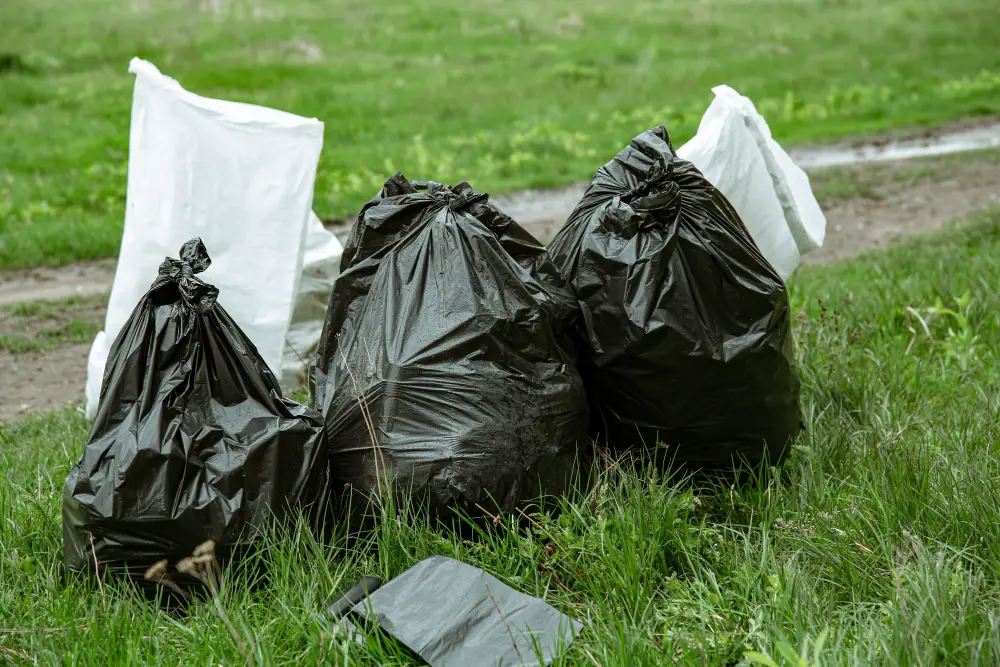
I looked. Barbara was at the end of her driveway in a pink robe and slippers, hauling a black bag of the kind you buy for construction debris, thick-walled and heavy. She set it down halfway, pressed one hand to her lower back, breathed for a moment, and continued.
“It’s trash,” I said.
“We have one bag, sometimes two, per week.” Maya set her coffee down. “She has three or four every day.”
I looked at the bags and then at Barbara, who had reached the curb and was walking back up the driveway toward the house with her arms empty and her pace different from the careful walk of the descent, lighter somehow, like someone who has set something down and is relieved not to be carrying it.
“Maybe she’s clearing out.”
“She’s been clearing out since we moved here.”
I went back to the newspaper. But Maya had done the thing she does, which is plant a question in my mind and walk away from it, leaving me to tend it alone until it grows into something I cannot ignore.
After that Thursday, I could not stop noticing.
Three bags on Monday. Four on Wednesday. Sometimes five on Fridays, arranged along the curb by seven in the morning, often before I had finished my first coffee. They were always the same: contractor-grade black bags, tied at the top with the careful double knot of someone who does not want them coming open, packed so thoroughly that the plastic showed the shapes of whatever was inside without revealing anything specific.
She never threw out cardboard boxes, which would have suggested deliveries or purchases. She never had furniture by the curb, or bags of clothing with visible fabric shapes pressing against the plastic. No obvious renovation, no sign of construction materials or paint cans or the debris of a project in progress. No smell of food waste beyond the ordinary. The bags were full of something solid and compact, but their contents remained invisible and their existence remained unexplained.
I told myself I was not actually curious. This lasted about ten days.
On a Tuesday morning in November, a cold gray morning that had not yet decided whether it intended to rain, Barbara left for work at her usual time, backing down the driveway and turning with the confident precision of someone who has performed a maneuver so many times it requires no thought. I was getting into my own car. I watched her go.
I watched five bags sitting at her curb.
I looked up and down the street. My neighbor to the left was not visible. The house to the right had its blinds down. The street was quiet in the specific way of a Tuesday morning when everyone has somewhere to be and has already gone there.
I crossed the street.
I am not going to dress this up as anything other than what it was: I was being nosy. I told myself I was concerned about something, a neighbor in distress, an unexplained pattern, a possible explanation that needed ruling out. These were stories I was telling myself to make the next action feel acceptable. In reality, the question had been growing for weeks and the opportunity had presented itself and I was a person who had made the mistake of becoming interested.
I crouched beside the largest bag and untied the double knot.
The moment I pulled the plastic open, every hair on my arms stood up.
The smell hit me first. Not garbage, not rotting food, not the chemical smell of cleaning products or the sawdust smell of construction waste. Something else. Something sweet and wrong in a way that took me a second to place, and then another second to decide I had not placed it correctly, and then a long suspended moment during which I stood on a public sidewalk in November holding open a trash bag and understanding that I had been right the first time.
The smell of dried flowers. But not pleasant, not the potpourri smell of a decorative bowl. Something older and more concentrated, as though a large quantity of flowers had been pressed and sealed and left for a long time, until the sweetness had fermented into something with an edge to it.
Inside the bag: clothing.
Not discarded clothing in the way people throw things out, not the tangled pile of a wardrobe purge or the jumbled donation-pile quality of things being sent away. These clothes had been folded. Precisely, carefully, with the deliberate attention of someone who folds laundry the way other people iron it, creating clean edges and flat planes, stacking the items in layers.
A man’s suit jacket. Charcoal gray, pressed, folded along the lapels.
Two white dress shirts, still on their cardboard collar inserts from the dry cleaner.
A pair of dark trousers, creased along their original lines.
I stared at the folded suit jacket for a long moment.
Beneath the clothing, wrapped in a separate plastic grocery bag, was a collection of objects. A wristwatch with a leather strap, the face scratched. A leather wallet, thin and worn at the corners. A set of keys with a small metal tag attached to the ring.
I did not touch any of it.
I retied the bag. I stood. I walked back across the street with the specific quality of someone trying very hard to look as though they have been doing nothing of note.
Inside, Maya looked at my face and said, “What happened?”
“Men’s clothing,” I said. “Folded. And personal things. A watch. Keys.”
She was quiet for a moment.
“No one has seen a man at that house in months,” she said.
We looked at each other.
“We should check if she’s all right,” Maya said.
“We don’t know her,” I said.
“That’s the problem,” Maya said.
I thought about the bags every day for the next week. I thought about the folded suit jacket with its clean lapels, folded by someone who had handled it carefully, who had not simply crammed it into a bag with the thoughtless efficiency of a person throwing things away. I thought about the watch and the wallet and the keys on their ring with the small metal tag, which had been wrapped in a separate bag as though they were distinct from the clothing, as though whoever had placed them there had understood the difference between the things a person wears and the things a person carries.
On Sunday morning, I saw Barbara in the driveway.
She was watering the winter pansies she had planted along the front walk, moving the hose in the slow, methodical way of someone who is doing a thing that requires only a portion of their attention, leaving the rest available for whatever is actually occupying their mind. She was dressed and composed in the way she was always dressed and composed, and the SUV was freshly washed, and the boxwoods were exactly as they always were.
I walked over.
“Good morning,” I said.
“Good morning.” She smiled the pleasant, neighborly smile.
“I wanted to ask,” I said, and then stopped, because there is no graceful way to say what I wanted to say, and I stood on her driveway trying to find one.
She waited.
“Are you all right?” I asked.
Something moved across her face. Not the surprise of someone who has been asked an unexpected question. The different expression of someone who has been anticipating a question and has arrived at the moment of it.
“Why do you ask?” she said.
“I’ve noticed the bags,” I said. I held her gaze. “I’m sorry. I shouldn’t have, but I looked inside one of them.”
She looked at the hose in her hand. The water continued running, spreading across the brick path in a slow dark stain.
She did not look angry.
“My husband died,” she said. “Seven months ago.”
“I’m so sorry.”
“Thank you.” She reached forward and turned the nozzle on the hose, and the water stopped. “He died in February. At the hospital. He had been sick for about two years.”
“I didn’t know,” I said. “We didn’t know.”
“We moved here three months after his diagnosis,” she said. “I suppose we never really introduced ourselves properly. We were…” She paused, looking at the pansies. “We were managing.”
I waited.
“The bags,” she said. “I can’t explain it very well.” She looked at me directly, with the expression of someone who has decided to try explaining something they have not explained before. “After he died, I couldn’t bear having his things in the house. But I also couldn’t bear throwing them away. Does that make any sense?”
“Yes,” I said.
“So I started putting things in bags. Just getting them out of the rooms where I had to see them. And then the bags were in the garage, and the garage was full of bags, and I still couldn’t open them because opening them would mean deciding, and deciding would mean accepting what I was deciding about, and I wasn’t ready.” She paused. “So I started putting them at the curb.”
“Without opening them.”
“Without opening them. Just taking them out of the garage where I didn’t have to see them, and letting the truck take them, and not having to decide anything about them.”
I thought about the folded suit jacket. About the pressed white shirts still on their cardboard collar inserts.
“But you fold them,” I said.
She looked at me for a moment.
“I fold them,” she said. “Because he was neat. He was very particular about his clothes. He would have wanted them folded.”
She said it without self-consciousness, without any apparent awareness of the heartbreak contained in that single sentence. She was folding her dead husband’s clothes before discarding them because he would have wanted them folded. She was honoring his preferences in the act of letting him go.
I stood on her driveway not knowing what to say, which is the honest position.
“I’m sorry I looked,” I said again.
“It’s all right,” she said. “I’m surprised it took longer.”
That evening, I told Maya everything.
She listened at the kitchen table, turning her coffee mug in both hands, and when I finished she was quiet for a long time.
“She’s grieving alone,” Maya said.
“Yes.”
“Has anyone been helping her?”
I thought about the seven months of daily bags, the pink robe and slippers in the early morning, the hands pressed to the lower back on the long walk to the curb. The SUV washed and the hedges trimmed and the flower beds cycling through their seasons on schedule.
“I don’t think so,” I said.
Maya looked at her coffee. “We should do something.”
“What do we do?”
“I don’t know yet. But something.”
Maya went to Barbara’s door the following afternoon. I watched from our living room window, which I acknowledged was not my finest moment, and I saw Barbara answer and the surprise on her face and Maya saying something and Barbara nodding and stepping back to let her in.
Maya was inside for an hour and forty minutes.
When she came home she was quiet, the specific quiet that means she has received something she is still absorbing.
“Her husband’s name was Edward,” she said. “He was an engineer. He liked old movies and terrible puns. He had a garden before he got sick, behind the house, mostly tomatoes.”
“What did you talk about?”
“Everything.” She sat down. “She has no one local. Her children are grown and in different cities and she has been handling everything herself.” She looked at the window. “She told me she started clearing the house because she thought it would help. She thought that if his things weren’t everywhere she was looking at, she would feel less of it.” She paused. “It didn’t work. She said every morning she takes the bags out and she still feels exactly the same.”
“Of course she does.”
“She knows that. She keeps doing it anyway. She said it’s the only thing that feels like doing something.”
I thought about that for a long time. The activity of grief, the need to be in motion when the alternative is being still with something too large to be still with. The bags were not solving anything. She knew they were not solving anything. But the act of carrying them, of making the long walk in the early morning, of the double knot and the return walk with empty arms: these were the form her grieving had taken, the specific physical language her body had found for what it was carrying.
The truck arrived every day and took the bags and she came inside and the house was still full of his absence.
We started bringing food.
It began the following Saturday, when Maya made too much soup in the deliberate way she makes too much of things when she has decided someone needs feeding. We carried it across the street in a pot and knocked on the door and Barbara answered in her Saturday clothes with paint on her fingers because she had apparently been repainting the hall bathroom, which she said she had been meaning to do for years and had suddenly found it impossible not to do.
She invited us in.
The house was extraordinary. That was the word I kept returning to as Barbara showed us through, the quality of it: extraordinary. Not in the way of expensive things displayed to communicate wealth, but in the way of a home that has been made by someone who finds making things beautiful as natural as breathing. Every room had something handmade in it, something that revealed skill and patience. Ceramic vessels she had thrown and glazed. Textile wall hangings she had woven. A small watercolor collection arranged along the staircase wall, signed with her initials in the lower right corner.
“You made all of this?” Maya said.
“It’s how I keep my hands busy,” Barbara said. “Always has been.”
Along the mantelpiece in the living room: a row of photographs. A younger Barbara with a man who must have been Edward, outdoors somewhere, both of them laughing at something outside the frame. Their children at various ages. A wedding photograph, the two of them under the kind of tree that suggests a summer afternoon, her in a simple dress and him in a light suit with a flower in the lapel.
And beside the photographs, a collection of small objects. A watch with a leather strap, the face scratched. A leather wallet, thin and worn at the corners. A set of keys with a small metal tag attached to the ring.
I looked at them.
These were not the same objects. These were the ones she had kept.
“I thought you were giving everything away,” Maya said quietly.
Barbara looked at the mantelpiece. “I thought I was too,” she said. “But then I looked at these and I couldn’t.” She picked up the watch and held it for a moment and set it down. “He wore this every day for thirty-one years. I don’t know what happens to me if I put it in a bag.”
We had soup in the kitchen, the three of us, at a table that still had two regular places and a third that Barbara had added for us. The afternoon came through the kitchen window and fell across the table, and Barbara talked about Edward, and then she talked about the garden he had kept before the diagnosis, how she had taken it over when he could not manage it anymore, how she still grew the tomatoes because growing them felt like continuing something that was his, like a conversation that could be resumed in the spring.
“He had opinions about tomatoes,” she said. “Very strong opinions. He believed most people under-water and over-fertilize.”
“Was he right?” I asked.
“He was always right about the tomatoes,” she said. “I never told him that.”
The telling of it produced a brief, private smile, the smile of someone recalling something that exists only inside their own memory now and which they are protecting by receiving it carefully.
Maya asked if she could come back on Thursday.
Barbara looked at her as though she had offered something unexpected. “I’d like that very much,” she said.
Over the weeks that followed, we established a routine that none of us had planned or formally agreed to, that simply grew in the way that things grow when they are finding their own shape. Maya went on Thursdays. Both of us went on Saturdays. We stopped knocking and started calling ahead, which felt like a different kind of arrival. Barbara began appearing at our door occasionally in the evenings with something she had made, a jar of preserved tomatoes from the plants she had grown that fall, a ceramic bowl she said she had thrown on impulse and it had come out in a color she thought Maya would like.
The morning bags continued for a while.
Not every day. Then three times a week. Then once a week. Then there was a Tuesday when Maya pointed out that she had not seen any bags in over a week, and I looked up and realized she was right, and neither of us said anything about it directly because saying something about it directly would have required examining what it meant, and some things are better understood sideways.
One evening in early spring, Barbara came over for dinner. She brought the preserved tomatoes and we put them on pasta, and she told us that her daughter was coming to visit for the first time since the funeral, and that she had finally opened the boxes she had been unable to open for months, and that it had been terrible and necessary and that her daughter had sat beside her on the floor of the bedroom for four hours going through everything, crying and laughing in equal measure.
“She knew his things better than I thought she did,” Barbara said. “She recognized things I had forgotten about. She said the watch was on the list of things she had asked him for and he always said someday.”
“Did she take it?”
“No.” Barbara turned her wine glass. “She said she’d rather know it was on the mantelpiece.”
She looked at me across the table.
“I’m sorry you looked in that bag,” she said. “I mean that sincerely. Those were private things.”
“I know,” I said. “I’m sorry.”
“But I’m also glad you came over. Because I wasn’t going to knock on anyone’s door.” She looked at her glass. “I thought I was managing.”
“You were managing,” Maya said.
“I was carrying it all in bags and taking it to the curb every morning,” Barbara said. “That’s not managing. That’s just finding the nearest available metaphor.”
We all looked at her.
“Well,” I said. “It’s still one of the better metaphors I’ve encountered.”
She laughed. A real laugh, unguarded and brief, surprised out of her by the ridiculousness of the thing we were all agreeing to find honest and true.
The spring came, and she planted the tomatoes in the garden behind her house, in the beds Edward had maintained. She planted more than she needed and shared the surplus, and the sharing of them became its own kind of continuity, the thing that had been his passing forward through the growing season into other people’s kitchens.
One morning in May, I came out to get the newspaper and Barbara was in her driveway. Not in slippers and a robe. Dressed and standing at the back of her car, loading a box into the rear hatch.
One box.
Sealed with tape, addressed in her handwriting, destined for somewhere she had decided it should go.
“Donation?” I asked.
“His suits,” she said. “Good ones. Going to a program that helps men going to job interviews.”
She looked at the box.
“He would have liked that,” she said. “He was very particular about suits. He would have had opinions about whether the men were wearing them correctly.”
“Strong opinions,” I said.
“Very strong opinions.” She closed the rear hatch. “But he also would have wanted someone else to have the use of them.” She patted the hatch once. “It took me a while to hold both of those things at once.”
I looked at the empty curb.
It had been two months since the last bag.
She had not fixed anything. Edward was still gone. The house was still the house of someone who had lost the person around whom it had organized itself for many years. The mornings were still mornings without him. None of that had changed.
But she had figured out, through the trial and error of grief, which is the only way anyone figures anything out about grief, what she actually needed. Not to discard. Not to preserve everything unchanged, the frozen museum of a life shared. Something in between, something that required looking at each thing and deciding: does this stay, does this go, does this find a new purpose, does this belong on the mantelpiece.
The watch and the wallet and the keys with the small metal tag were still there.
The suits were in a box in the back of her car.
Both things were true and both things were right and she had found her way to the truth of both of them without any roadmap and on a schedule that belonged only to her.
That evening, Maya made soup again. Not because Barbara needed feeding the way she had needed feeding in the early months, but because soup had become part of what we were to each other, a language that started as concern and had become, without anyone deciding that it should, something more like ordinary affection.
I carried it across the street and knocked, and Barbara opened the door and stepped back to let me in, and the house smelled of something she had been cooking and of the clay she used for her ceramics and faintly, still, of the light floral perfume she had worn every morning for decades.
“Come in,” she said. “I was just starting the tomatoes.”

Laura Bennett writes about complicated family dynamics, difficult conversations, and the quiet moments that change everything. Her stories focus on real-life tensions — inheritance disputes, strained marriages, loyalty tests — and the strength people find when they finally speak up. She believes the smallest decisions often carry the biggest consequences.