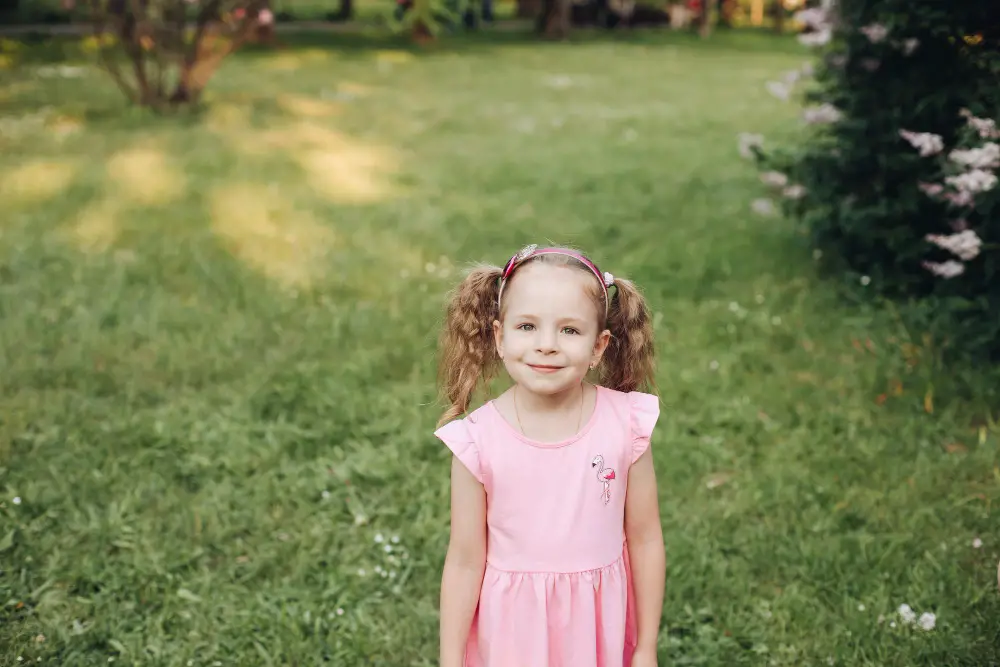
My three-year-old pointed at my husband’s best friend’s boots during the birthday party and chirped, “Daddy cries there.” Everyone laughed. And then she cheerfully repeated the rest of what she’d overheard on one of their Sunday outings, and the silence that came after it changed our marriage forever.
Liam’s thirtieth birthday should have been one of those family afternoons we’d tell and retell for years, the story getting a little funnier each time, the kind of memory that becomes a private language between people who love each other. Everyone we cared about was in our backyard. The grill was going, the good weather had held, and our daughter was on her knees in the grass conducting some elaborate ceremony with her plastic dinosaurs. I remember standing at the edge of the patio with a glass of lemonade sweating in my hand and looking around at all of it, the streamers I’d hung too early that were already drooping in the heat, the folding tables borrowed from three different neighbors, the people. I remember thinking, with the particular fullness that comes so rarely you almost don’t recognize it, this is everything. This is the whole of what I wanted, and it is right here in front of me.
By sunset, I would understand how little of it I had actually known.
I have gone back over that afternoon so many times, hunting for the moment I should have caught, the thread I should have pulled. There is a particular cruelty in learning that your happiest hour was sitting directly on top of the thing that would end it, that while I was congratulating myself on the beautiful life I had made, the life itself was already coming apart underneath me in a place I had never thought to look. People say hindsight is clear, but that isn’t quite true. Hindsight is not clear so much as merciless. It shows you every small warning you waved away, every softened interpretation you chose because the harder one was inconvenient, and it makes you responsible for a blindness that felt, at the time, exactly like peace.
Liam moved through the crowd with the quiet confidence I had fallen for eight years earlier, back when I was twenty-two and certain I could read every person who walked into a room, and he was the one who proved me wrong by being calmer and deeper than I’d assumed anyone that handsome could be. He shook hands and clapped shoulders and accepted birthday wishes with that half-smile of his, the one that always looked like he was in on a joke he was too polite to tell. He passed close to me on his way to the cooler and let his hand rest a moment on the small of my back.
“You did too much, babe,” he murmured, and pressed a kiss to my temple.
“You only turn thirty once,” I said. “Let me spoil you.”
“You always spoil me.”
“Someone has to.”
I watched him go, and I felt the ordinary, unremarkable happiness of a woman who believes she is looking at her whole life and finding it good. I had no reason not to believe it. That is the thing I keep returning to. There had been no signs I could name, no lipstick on collars, no phone turned face down, no late nights I couldn’t account for. Whatever had been eating my husband from the inside had left no marks I knew how to read, and so I had gone on setting out the potato salad and refilling the ice, entirely at peace, while the ground under the party quietly gave way.
Across the lawn, Chloe was crouched in the grass, arranging her dinosaurs into a solemn little parade. Her dark curls bounced as she muttered instructions to each one, telling the stegosaurus where to stand, scolding the T. rex for some infraction I couldn’t hear. She had been like that since she could sit up on her own, a small serious presence who watched everything and missed nothing. Other children her age narrated their play in bursts of noise. Chloe observed. She catalogued. She filed things away in that busy little head and produced them later, at the worst possible moments, with the innocent precision of a child who does not yet know that some true things are supposed to stay unsaid.
“She’s her mother’s daughter,” my sister said, appearing at my elbow with a plate stacked high with ribs. “That kid notices when I change my earrings. Swear to God. Last time I saw her she looked at my ears for a full ten seconds and told me the old ones were nicer.”
I laughed. “She told me last week that Grandpa smells like the medicine drawer. Right to his face. I nearly died.”
“Was she wrong, though?”
“No,” I admitted. “That’s the problem. She’s never wrong. That’s the whole terror of her. Other kids make things up. Chloe reports. If she says a thing happened, it happened, and usually it happened exactly the way she says, right down to who was standing where. Liam thinks it’s funny. I’ve told him it’s going to catch up with us one of these days, a kid who remembers everything and edits nothing.”
My sister laughed and said something about how at least we’d never need a witness, and drifted off toward the drinks, and I stood there a moment longer watching my daughter boss her dinosaurs into formation, feeling nothing but a mild, amused pride. It never once occurred to me that the same eyes that clocked my sister’s earrings and my father’s cologne had been watching my husband, too. That she had been in the room for something none of us were meant to see, and had tucked it away with all the rest, waiting, the way she waited with everything, for the moment it would be useful. I had joked that it would catch up with us one day. I did not imagine that day would be this one, in front of everyone we knew, before the candles had even been lit.
Marcus arrived just as the burgers came off the grill, sweeping in the way he always did, loud and grinning, his arms full of a wrapped gift and a bottle of something expensive with a French name I couldn’t pronounce. He had been part of our lives since Liam’s freshman year of college, which meant he had been part of my life almost as long as Liam had. Marcus was eternally single, restless, the kind of man who changed apartments and jobs and hobbies the way other people changed their minds, but who was, in the one area that counted, absolutely constant. He was devoted to my little family in a way I had long since stopped finding strange. He remembered Chloe’s favorite color. He showed up when the water heater died. He was simply there, a fixed star in our sky, and I had accepted his presence the way you accept weather, without examining it.
Looking back, I wonder if I should have examined it more. Not for the reason my panicked mind would briefly seize on later that afternoon, but for a quieter reason. A single man does not spend eight years orbiting another man’s marriage without a gravity holding him there, and I had never asked myself what that gravity was made of. I had assumed it was friendship, and I had been right, but I had never understood how much friendship, how much loyalty, how much love of a plain and unromantic kind Marcus had been carrying on our behalf. I would find that out before the cake was cut.
There is a version of this story, I know, that a suspicious wife would have been telling herself for years. The devoted single friend. The Sundays. The way he knew our house better than some of our relatives did. I had never told myself that story, and I want to be honest about why. It was not because I was above suspicion or unusually secure. It was because Marcus had never given me a single reason, and because the friendship between the two men was so obviously the real and rooted thing that any other reading would have felt like an insult to it. What I had failed to imagine was not something sinister between them. It was something tender. That my husband had a person in his life he could kneel in front of and weep, a person he could hand the truth to, and that this person was not me. I had never been jealous of Marcus in the way wives are warned to be. It would turn out I should have been jealous of him in a way no one warns you about at all. He had my husband’s trust, the whole of it, the part I thought was mine.
“There’s the birthday boy!” Marcus boomed, pulling Liam into a rough, backslapping hug.
“You’re late,” Liam grumbled, though his whole face had already softened the way it only ever did around Marcus.
“I’m fashionable. There’s a difference.”
“There isn’t.”
Chloe abandoned her dinosaurs mid-parade and barreled across the lawn toward Marcus’s knees, clinging to his leg the way she always did, as though he were a tree she intended to climb.
“Uncle Marcus!”
“There’s my favorite person,” he said, scooping her up onto his hip with the ease of long practice. “Did you save me any cake?”
“Not yet. Mama says wait.”
“Mama is very wise.”
I watched the two of them and felt that familiar warmth spread through my chest, the contentment of seeing the people you love be gentle with the person you love most. Marcus bent down, Chloe still balanced on his arm, to fish one of her dinosaurs out from under a patio chair where it had rolled. And as he straightened up, he caught Liam’s eye.
It lasted only a second. One of those silent exchanges people have when they are trying not to say something out loud, a whole sentence passed between two faces in the space of a blink. Liam gave the slightest shake of his head, so small it was almost nothing, and Marcus looked away, and the moment closed over itself like water.
“Everything okay?” I asked.
Liam blinked, as though I’d startled him out of somewhere. “Yeah. Why?”
“You looked serious.”
He smiled, too fast. “Just thinking about how old and decrepit I am now. Thirty. It’s over. Wheel me out to pasture.”
I laughed and swatted his arm and told myself I’d imagined the whole thing, that little wordless exchange, the head shake, the way Marcus’s smile had gone stiff for half a beat. I was good at that, I would later realize. Good at explaining away the small wrongnesses, at choosing the comfortable interpretation, at not looking too hard at the edges of my own happiness for fear of what I might find fraying there. I used to tell my mother that Marcus was the brother Liam never had, and I said it with real affection, and it was true. I just didn’t yet understand what it meant that my husband had a brother he could confess to, and a wife he could not.
The afternoon rolled on the way good afternoons do, gathering its own slow momentum. There was too much food and then somehow not enough. The kids got sticky and wild. Somebody’s phone played music no one had chosen and no one turned off. Liam blew out his candles with Chloe perched on his hip, both of them puffing at the little flames, and I snapped a picture at exactly the right second, and I knew even as the shutter clicked that it would live on our refrigerator for years, that I would pass it a thousand times pouring coffee and feel the same small tug of love. I did not know it would become a photograph I could barely look at, a picture of the last hour of a marriage I thought I had.
Then Marcus settled into one of the patio chairs and stretched out his legs, and his boots caught the late sun. Deep brown leather, hand-stitched, obviously and unapologetically expensive.
“Those are ridiculous,” my brother-in-law said, in the admiring way men say ridiculous about things they secretly want.
“Custom,” Marcus replied, wiggling one foot so the light ran along the stitching. “Every man deserves a great pair of boots.”
Everyone chuckled, the loose easy laughter of people who are full and warm and among friends. And Chloe, who had wandered back to her dinosaurs a few feet away and was humming to them under her breath, suddenly went still.
I noticed it because I was her mother and I noticed those things, the way her humming stopped and her small head tilted, the way something clicked into place behind her eyes. She got to her feet. She crossed the patio with the grave, deliberate walk of a very small person on a very important errand, and she stopped directly in front of Marcus, and she raised one finger and pointed it at his boot.
“Daddy cries there!” she announced, brightly, delighted, the way she announced everything she was proud to know.
The entire patio erupted into laughter. Of course it did. It was the funniest thing in the world, this tiny solemn child pointing at a grown man’s expensive boots and declaring that her father wept upon them. My mother-in-law laughed until she had to dab her eyes. Someone said something about kids saying the darnedest things. The bottle of expensive French something got passed around again. It was, for exactly four more seconds, still a wonderful party.
Chloe’s finger stayed pointed at the boot. Steady as a compass needle. She was not laughing with us. She was waiting to be understood.
I set down my glass and knelt beside her on the warm patio stones, still smiling, still expecting whatever adorable nonsense was coming.
“What do you mean, sweetie? Daddy cries there? On Uncle Marcus’s boots?”
She nodded, her curls bouncing with certainty.
A few of our friends chuckled behind me, still in on the joke, still waiting for the punchline that would send everyone into fresh laughter. I glanced up at Liam, expecting to share the moment with him, to catch his eye and grin at the strange wonderful machinery of our daughter’s mind.
And my laughter died in my throat.
Liam had locked gazes with Marcus. The blood had drained out of my husband’s face so completely that his skin had gone the color of the paper plates. His eyes were not amused. They were not confused. They were filled with something I had never seen on him in eight years, not when his father died, not when Chloe was born three weeks early and spent her first days in a plastic box with tubes in her tiny arms. His eyes were filled with terror.
“On the shoes,” Chloe said helpfully into the thinning laughter. “Daddy was on the floor. He was crying loud.”
The chuckling faded, one voice at a time, like candles being pinched out. I felt Marcus shift in his seat beside me, but I did not look up at him. I kept my eyes on my daughter.
“When was this, baby?” I asked. My voice came out very quiet and very steady, the way it does when the rest of you has already understood that something is wrong.
“Before Sunday park time.” She tilted her head, working to be precise, wanting to get it right for me. “Daddy said, ‘Please don’t tell.’ He said, ‘I make it right.’ And he said, ‘More time, please.'”
Somewhere near the grill, someone made a small sound and swallowed it immediately.
I felt the whole shape of the afternoon tilt under me, the tables and the streamers and the sticky happy children all sliding toward some edge I couldn’t see.
“He said that to Uncle Marcus?” I asked.
“Yes, Mama.” She brightened, pleased to be so well understood, glad to be helpful. “On his knees. Like when I say sorry.”
I looked up.
Marcus opened his mouth. And Liam, across the patio, gave the smallest shake of his head, so quick I almost missed it, the same gesture from earlier, the one I’d told myself I’d imagined. And Marcus obeyed. He closed his mouth. Neither man spoke.
Not one denial. Not one laugh. Not one of them saying, oh, that, and launching into some easy explanation that would let the party breathe again. Just two grown men looking terrified while my three-year-old calmly and cheerfully described a moment they both clearly recognized, a moment they had believed no one would ever be able to describe.
A suffocating silence rolled over the patio in a single wave. I have been in quiet rooms before, but I had never felt a silence with a texture to it, a weight, a temperature. The party did not so much go quiet as hold its breath. Forty people found something to look at that was not the three of us.
I want to describe what those seconds were like from the inside, because they were the strangest seconds of my life. Time did not stop, exactly. It thickened. I was aware of everything at once and none of it seemed to be arriving in the right order. I could hear my own pulse. I could feel the warmth of the patio stone still coming up through the soles of my sandals. I could see, with a clarity that felt almost cruel, the exact shade of green of the grass and the way the ice was melting in the abandoned drinks and the precise expression on my mother-in-law’s face, which was the expression of a woman who has just realized she is about to learn something and would give anything not to. And underneath all of it, running like a current, was a single question with no words attached to it, just a rising pressure. What is it. What is it. What is it. My mind had understood, before I had a shape for it, that whatever was coming would divide my life into a before and an after, and it was bracing, the way the body braces in the half second before an impact it cannot avoid.
I stayed crouched, one hand on my daughter’s shoulder, and I made my voice light because she was watching my face and I would not let her see what was happening to it.
“Okay, sweetheart,” I heard myself say. “Go find your cousin, alright? Go on, go play.”
Chloe skipped off, humming, entirely satisfied with herself, having no idea in the world that she had just walked into the center of her parents’ life and set off something that could not be un-set. That is the mercy and the cruelty of a child that age. She could see the thing clearly enough to report it and could not see it at all clearly enough to know what it meant. She would remember this day, if she remembered it, as the day of the dinosaurs and the cake. She would not remember it as the day everything cracked. I have been grateful for that, in the time since. It was the one small kindness in the whole afternoon.
I rose slowly, my knees stiff from the stones.
Liam was looking at the ground. Marcus was looking at Liam. The rest of our guests had discovered a sudden, intense fascination with their own hands, their drinks, the middle distance.
“Liam,” I said.
He lifted his head. His face was working to arrange itself into something normal and failing.
“Kids say the weirdest things, right?” he tried. His laugh came out wrong, high and thin, a sound I did not recognize coming from my own husband.
“They do,” I said. “But this isn’t one of those times, is it?”
He gulped. I watched his throat move. Then he glanced at Marcus, and that glance was so naked, so full of pleading and fear, that it sent an icy chill straight down into my heart. It was the look of a man reaching for a rope. It was the look of a man who did not know how to survive the next thirty seconds and was silently begging the only other person who knew the truth to save him from it.
“Liam,” I said. “Explain what Chloe saw.”
He exhaled, long and unsteady.
“It’s nothing,” he said. “I tripped. Last Sunday. Landed on the floor in front of Marcus, made a whole thing of it, you know how I am. The rest was just me being dramatic. Joking around.”
I stared at him for a moment. I looked at the man I had married, the calm one, the steady one, the one who fixed things and carried heavy furniture and never once in eight years had raised his voice, and I watched him lie to my face at his own birthday party in front of forty people, and something in me went very cold and very clear.
“You’re lying,” I said.
His mouth opened. Closed. Nothing came out.
And in the silence, an ugly, ridiculous thought crawled up out of some dark place I had not known I kept inside me. I looked at Marcus. My husband’s best friend. The man who spent every Sunday morning with my husband and my daughter. The man who lived alone. Who never seemed to date. Who was always, always there. And the thought arrived fully formed and monstrous, and I could not stop it.
Were Liam and Marcus having an affair?
It was ludicrous. Some rational part of me knew instantly it was ludicrous, that Marcus dated women he never got serious about and that Liam looked at me across rooms in a way that had never dimmed. But panic does not consult the rational part. Panic reaches for the biggest, most terrible shape it can find, and this was the biggest shape available. On his knees. Crying. Please don’t tell. More time. My mind assembled the pieces into the worst possible picture, and I could feel my face doing something I could not control, something crumpling and horrified.
Marcus saw it. Whatever was happening on my face, he read it exactly, and his eyes widened a fraction, and then, God help me, they softened. And he shook his head at me. Once, small, almost tender. No. Not that. Not what you’re thinking.
He stood up out of the patio chair and moved to Liam’s side and set a hand on my husband’s shoulder, and Liam flinched under it as though the hand weighed a thousand pounds.
“Man,” Marcus said, low, meant only for Liam but close enough that I caught every word. “You have to tell her.”
“Marcus,” Liam breathed.
“No. Look at her face. Look at what she’s thinking right now. You do not get to let her stand there and think that.”
“Please.” Liam’s eyes had filled. My husband, who I had seen cry exactly twice in eight years, was standing in our backyard with tears standing in his eyes. “I can’t.”
Marcus’s voice dropped even lower, but it did not waver.
“I love you, man. You know I love you. I’ll stand right here through whatever comes next, I’m not going anywhere. But if you don’t tell her the truth in the next thirty seconds, I’m going to do it for you. And I really, really do not want to be the man who does that to your marriage.”
Liam’s shoulders caved inward, like something structural had finally given way.
“What is he talking about?” I said, and I could hear my own voice climbing. “Liam. What is he talking about?”
Around us, the guests had stopped pretending to be busy and had simply become furniture, still and silent, unwilling witnesses to something that was clearly no longer any kind of party. My mother-in-law stood with one hand pressed flat against her mouth. Somebody’s teenager was staring straight up at the sky as though hoping to be lifted out of the yard entirely.
“Whatever it is,” I said, and I heard the crack forming right in the middle of the words, “I need to hear it from you. Not from Chloe. Not from Marcus. From you.”
He closed his eyes. He drew in a breath that seemed to catch on every single rib on the way up.
“It isn’t what you think,” he whispered.
“Then tell me what it is.”
“It’s about money,” he said, and his voice came apart on the last word like wet paper.
And I watched my stoic, unshakable husband, the rock I had leaned my whole adult life against, prepare to set something enormous and heavy down in the middle of his own thirtieth birthday.
Marcus stepped forward just enough to catch my eye. “Sarah,” he said quietly. “Before he tells you, you need to know one thing.”
“Marcus,” Liam said, a warning and a plea at once.
“No.” Marcus did not look away from me. His voice was steady in a way that told me he had been waiting a long time to be allowed to say this. “He didn’t spend that money on himself. Or for himself.”
My heartbeat slowed, for one strange beat, at the relief of that. And then sped up all over again, because what on earth was that supposed to mean? Not for himself. Not another woman, then, and not Marcus, and not any of the shapes my panic had been building. But money that was not spent on himself, hidden so deeply that my three-year-old finding him on his knees was the only crack in it, was its own kind of terror, a different animal entirely, and I did not yet know its face.
Liam finally straightened his shoulders. It cost him something visible to do it. His eyes met mine, hollow and red-rimmed, and he drew one last ragged breath.
“Dad wasn’t the man everyone thought he was,” he said.
A murmur went through the family clustered around us. His father had been dead eight months. His father had been, by every account, a good man, a churchgoing man, the kind of father-in-law who fixed your car and remembered your birthday and told the same three jokes at every holiday. I had loved him. Chloe had adored him. And Liam had just spoken his name in the past tense in a way that made the whole yard go tighter.
“After he died,” Liam went on, “I found out he’d been gambling. For years. Not once in a while, not a friendly card game. Constantly. Credit cards. Personal loans. He took out a second mortgage none of us knew about. He hid it from everyone. He hid it from Mom.”
His mother rose slowly from her chair, and her face had gone hard and disbelieving.
“That’s a lie,” she said. “Your father never gambled. Not once in thirty-two years. I would have known.”
Liam looked at her, and the tenderness in his ruined face nearly broke me all over again.
“That’s because he spent years making sure you never saw it, Mom. That was the whole thing he was good at. Not the gambling. The hiding.”
Nobody moved. The music had long since stopped or been stopped. A bird was singing somewhere, absurdly cheerful, in one of the yard’s two trees.
“He paid one loan off with another,” Liam said. “Then paid that one with a third. Every time he got in deep, he convinced himself that one lucky night would set it all right, and he’d win it back, and no one would ever have to know. He kept the whole thing spinning for years. And it might have kept spinning if he hadn’t died before he could catch it.”
His mother’s hand flew to her mouth. “No,” she whispered. “No.”
“He died before any of us knew how bad it was,” Liam said. “And then the notices started coming. Then the phone calls. Then the lawyers. Then the creditors, one after another, coming for what he owed. His estate wasn’t anywhere close to enough to cover it. Not even in the same universe as enough.”
He looked at me then, and everything in his face was asking me to understand, and I did not yet understand, and he knew I didn’t.
“I couldn’t stand the thought of everyone finding out who he really was,” he said. “Of you finding out. Of Mom finding out. Of Chloe growing up hearing that her grandfather bankrupted the family from beyond the grave. So I took out a loan. I paid off Dad’s debts myself. After he passed. Quietly.”
The air left my lungs all at once.
“I borrowed against everything I could,” Liam continued, and now the words were coming faster, as though the dam had finally given and he could not have stopped them if he’d wanted to.
My stomach dropped through the patio stones. “Everything?”
He nodded.
“The house. Our savings. Every reserve we had. All of it.” His voice cracked straight down the center. “If I can’t keep up with the payments, Sarah, we lose this house.”
Nobody spoke. Even the children playing at the far end of the yard, oblivious, sounded impossibly loud against the silence, their shrieks of laughter drifting across the lawn like sounds from another world where nothing had happened.
“I won’t sugarcoat it anymore,” Liam said, and he hung his head so I could see the crown of it, the place where his hair was just starting to thin, a small ordinary human detail that pierced me. “I risked our family’s future trying to erase my father’s mistakes. I did that. I made that choice.”
I stared at him. And the strangest thing happened inside me, something I have thought about many times since.
The affair I had spent the last five terrible minutes bracing myself to survive simply vanished. It evaporated. It had never existed, and now I knew it had never existed, and the relief of that should have been enormous. But in the space where it had been, something else was standing, something I had not braced for at all, and it turned out to be heavier.
This was not another woman. This was not Marcus. This was our mortgage. This was our savings, the ones I had watched grow over years of us being careful, of us saying no to things, of me clipping coupons and Liam bringing his lunch to work. This was Chloe’s future, the college fund we had started when she was six months old, the security we had built brick by careful brick. This was every plan we had ever made together, made on ground that had, for eight months, already been quietly crumbling beneath us without my knowing.
And somehow that hurt differently. In some ways it hurt worse. An affair is a betrayal of the heart, and hearts, God knows, are complicated. But this was a betrayal of the partnership itself, of the fundamental agreement that we were two people facing the world together, that there was no version of us in which one of us made a decision this size alone. He had not stopped loving me. He had done something that in a strange way came from loving too much, loving his father’s memory, loving the idea of protecting me. But he had, in the doing of it, decided that I was not strong enough to be told, not partner enough to be consulted, not adult enough to help carry a weight that was crushing him. He had looked at our marriage and decided he could hold it up alone. And he had nearly brought it down doing it.
I kept thinking, in those first raw minutes, about all the ordinary evenings of the last eight months. The dinners where I had asked him how his day was and he had said fine and I had believed him. The nights I had felt him lying awake beside me and had assumed it was grief for his father, and had held him, and had thought I was comforting him, when in fact I had been lying next to a man drowning in a secret and mistaking the sound of his drowning for the sound of ordinary sadness. I had been so close to him the whole time. I had been right there. All he would have had to do was turn his head on the pillow and say it, and I would have caught it, I would have caught him, and he had chosen instead to hold his breath under the water every single night rather than let me see that he was going under. That was the image I couldn’t shake. Not the money. The nearness. How near I had been, and how alone he had insisted on being anyway.
“The weight of it got so heavy,” Liam said, “that I finally told Marcus. Months ago. He’s the only one who knew. And he’s been telling me every single week that I had to tell you, and I kept saying I would, and I didn’t. I didn’t know how. There was never a right time. There was never a way to say it that didn’t feel like the end.”
Marcus patted his shoulder, once, encouragingly, the loyal steady friend who had been carrying this alongside him and had begged him, week after week, to do the right thing.
“Chloe saw me begging Marcus for more time,” Liam said, staring down at the patio stones as though he could read the rest of the confession in them. “One Sunday, before we took her to the park. It got bad. A payment I couldn’t make. I went to Marcus and I just, I broke. I got down on the floor. I wasn’t even asking him for money, I was asking him for time, for help, for anything. I didn’t know she was watching. I didn’t want you to ever know your husband wasn’t the rock he pretended to be.”
I stared at this man I had been so sure I knew all the way down to the bottom. How, I thought, how could I have been so completely wrong about the inside of a person I slept beside every night. Not wrong about his character. He was, it turned out, exactly as decent and exactly as loyal as I had always believed. I had been wrong about something harder to name. I had been wrong about whether he trusted me. I had spent eight years believing we told each other everything, and the whole time he had been capable of carrying the single largest crisis of our lives entirely alone rather than let me see him falter. That was the thing I had not known. That was the wrongness at the bottom.
His mother crossed the patio then, slow and unsteady, her earlier disbelief collapsed into something rawer. She reached her son and cupped his face in both of her hands, and her own face crumpled completely.
“I didn’t know,” she said, barely above a whisper. “Sweetheart. I didn’t know.”
“I know you didn’t, Mom.”
My brother-in-law, who had been standing silent through all of it, finally spoke, and his voice was not unkind but it was hard.
“You risked your daughter’s home,” he said, “without telling your wife?”
Nobody answered. There was no answer. The question was its own verdict.
My sister shook her head slowly, and when she spoke it was gentler than her husband but no less clear. “Liam. That’s not protecting your family. I know it felt like it was. But that’s not what that is.”
His mother, still holding his face, whispered, “You should have come to us. All of us. Your father made those choices, sweetheart. Those were his. You were never supposed to carry them. That was never yours to pick up.”
And Marcus finally spoke the thing he must have been holding for months.
“I told him that every week,” he said. “Every single week. I sat in my apartment and told him, man, you have to tell Sarah, you have to tell your family, this isn’t yours to hold by yourself.” He looked at me then, directly, and his eyes were wet too. “I told him that secrets like this destroy families faster than any amount of debt ever could. I told him the debt was survivable. It was the hiding that would kill you.”
I looked at Marcus, this man I had briefly, insanely, suspected of the worst, this man who had in fact spent months being the only person in the world trying to hold my marriage together from the outside, pushing my husband every week toward the truth, refusing to let the lie become permanent, and finally, today, forcing it into the light because a three-year-old had cracked it open and he would not let me stand there believing the wrong thing for one more second. I gave him a small nod. It was all I could manage, but he understood it. Thank you. I understand now. Thank you for not letting him leave me in the dark.
Then I turned back to my husband.
“You should have trusted me,” I said, and my voice had gone soft, all the fury draining out of it into something quieter and sadder and more permanent.
“I know,” he said.
“No. You don’t.” I wiped at the tears that had spilled over and were running down my face now, unstoppable. “You think this is about the money. It isn’t about the money, Liam. You didn’t just borrow money. You made a decision about our entire future, about our daughter’s home, about everything we’ve ever built, and you made it alone. You looked at me across the dinner table every night for eight months and you decided I couldn’t handle knowing. You decided that for me.”
“I was afraid,” he began.
“Of what?” I asked. “That I’d say no?”
He couldn’t answer. He looked at me, and there was no answer in him, because we both knew the truth. He hadn’t been afraid I’d say no. He’d been afraid I’d say yes, and then he’d have had to let me see him need help, let me watch him be less than the man he’d built himself into, the one who never faltered, the one who fixed everything. His father had spent thirty-two years hiding his weakness from the people who loved him, and it had nearly destroyed all of them, and Liam, without ever seeing the pattern, had reached for the exact same tool. Hide it. Carry it alone. Protect them from the truth of you. He had inherited his father’s silence more completely than any of his father’s debts, and it had almost cost him the one thing his father, for all his flaws, had managed to keep. A wife who loved him. A family still standing.
There wasn’t an excuse in the world big enough for what he’d done, and I think he finally knew it, standing there with his mother’s hands on his face and his best friend at his shoulder and his wife weeping four feet away.
His mother stepped back from him then and looked around the yard, at all of us, at the ruined party and the silent guests.
“I blame myself for all of this,” she said quietly.
We all turned to look at her.
“I was married to his father for thirty-two years,” she said, and the tears were coming down her cheeks now, steady and unashamed. “Thirty-two years. And I never saw it. Not once. I thought we didn’t have money because we were careful, because he was frugal, because that was just how we lived. I never asked. I never looked. I should have seen what was happening in my own house, in my own marriage, and I didn’t, because it was easier not to.”
She looked directly at me, one wife to another across a generation.
“And when Liam called me after the funeral, he never once asked me for money. Do you know what he asked me? He asked me how to protect his father’s reputation. That was the only thing he wanted. And I told him, I told him how to keep it quiet, how to manage the story, and it never once occurred to me to ask him why his father’s reputation needed protecting in the first place. I helped him build the very silence that nearly took his marriage. God forgive me. I taught him how to do it.”
She was quiet for a moment, and when she spoke again her voice had dropped so low we all leaned in to catch it.
“I spent my whole marriage keeping the peace by not asking questions. That was the job, I thought. A good wife doesn’t pry. A good wife trusts. I told myself I was being loyal. But there’s a kind of not-knowing that’s really just not-wanting-to-know, and I let it become the shape of my whole life. And then my son watched me do it for thirty-two years, and when his own crisis came, of course he reached for the only thing I’d ever taught him. Handle it alone. Protect the people you love from the truth of things. Keep the surface smooth no matter what’s rotting underneath.” She shook her head slowly. “I thought I was passing down decency. I was passing down a lie about what strength is.”
Marcus nodded slowly. “He thought carrying it alone made him a good son,” he said.
“It made him a lonely one,” his mother replied, and the plainness of it landed on all of us like a stone into still water.
Then she straightened, and she looked around the whole yard again, at the family, at the friends, at the two neighbors’ folding tables and the sagging streamers and the cake with the candle smoke still hanging faintly in the warm air.
“But you were never alone in this,” she said to her son. “That’s the part your father never understood, and it’s the part I need you to understand right now, today. You were never alone. You just decided you were.”
My brother-in-law, the one who had asked the hard question, was the first to move. He uncrossed his arms and stepped forward.
“We’ll figure out the debt,” he said. Simple as that. “We’ll sit down and look at all of it and we’ll figure it out.”
My sister nodded. “We’re family. That’s what this is for.”
And then, one by one, quietly, the others agreed. A cousin. An old friend of Liam’s from work who had no reason in the world to involve himself and involved himself anyway. My mother-in-law, of course. The circle closed in, not with drama, not with speeches, but with the low practical murmur of people deciding together to hold something up.
And I understood, watching it happen, that they were not doing it because Liam deserved rescuing. In that moment, honestly, I wasn’t sure he did. He had done a foolish, prideful, dangerous thing, and rescue was not what he had earned. They were doing it for Chloe, who deserved to grow up in this house with the crooked mailbox and the tree she liked to climb, who deserved stability she would never even know she’d been given. And they were doing it because they were the kind of family that had just learned, in the most painful way possible, what secrets cost, and had decided in real time that they would rather survive a hard truth together than let another quiet lie do to Liam what it had done to his father. Families survive hard truths better than they survive hidden ones. I have never believed anything more completely than I believed it standing in that yard.
I reached for Liam’s hand. He looked down at my fingers closing around his as if he could not quite believe I was touching him at all.
“We’ll fight the debt together,” I said. I squeezed his hand once, firmly, so he would know I meant it. “All of us. We’ll fight it. But Liam, I need you to hear the other part, and I need you to really hear it. You’re going to spend a long time earning back my trust. A long time. This isn’t fixed by the debt being paid. The debt was never the thing that broke.”
“I know,” he said immediately. “I know.”
Marcus looked at his friend. “First thing Monday,” he said, and there was relief in his voice now, the relief of a man finally allowed to set down a weight he’d carried alone for months. “We meet with a financial adviser. A real one. We put the whole thing on the table in the daylight and we look at it.”
My brother-in-law folded his arms again, but this time it was the posture of a man rolling up his sleeves. “And a lawyer.”
Liam looked up. “A lawyer?”
“If those creditors crossed any legal lines going after your father’s estate,” my brother-in-law said, “if they came after you for things they had no right to come after you for, if any of that paper isn’t clean, then we’re going to find out. You’ve been so busy hiding from this thing that you never once stopped to ask whether all of it was even legitimate. That stops now. We look at everything.”
His mother reached over and took her son’s other hand, so that he stood there between his wife and his mother, held on both sides, exactly the thing he had spent eight months making sure would never happen.
“Your father left us enough pain,” she said, and her voice was steadier now, resolved, a woman who had lost her illusions in the last twenty minutes and found something harder and more useful underneath them. “He left us enough. He doesn’t get to take your marriage too. I won’t let him. Not from where he is now. Not through you.”
The party did not resume. Of course it didn’t. There was no putting the afternoon back together, no returning to the burgers and the music and the easy laughter, and no one tried to. People began to gather their things quietly, hugging us on their way out, saying the small true things people say. It was not the birthday any of us would have chosen. But as the yard slowly emptied and the long light went gold and then amber over the fence, I found myself standing beside my husband, still holding his hand, and I understood that something had ended and something else had, just barely, begun.
Chloe came running back across the lawn as the last guests were leaving, one dinosaur clutched in each fist, her curls wild, entirely restored to her happy oblivious self. She had already forgotten the boots and the crying and the strange grown-up quiet. She held up the stegosaurus to me.
“Mama, this one’s the daddy,” she informed me solemnly. “And this one’s the baby. And they’re going home now.”
“Are they,” I said, and my voice only shook a little.
“Yes. Because it’s bedtime for dinosaurs.” She considered this. “Is Daddy sad?”
I looked at Liam. He crouched down to her level, the way Marcus had earlier, and he did not lie to her, and I loved him a little for it even in the middle of everything.
“Daddy was sad,” he told her. “But Daddy told the truth today. And telling the truth made it better.”
Chloe absorbed this with the total seriousness she brought to everything. Then she pressed the baby dinosaur into his hand, apparently deciding he needed it more than she did, and skipped off toward the house calling for her cousin, leaving her father kneeling on the grass holding a small plastic dinosaur and looking up at me with an expression I had not seen on him in a long time, or maybe ever, because it was the face of a man with nothing left to hide.
That night, after Chloe was asleep and the folding tables were stacked by the door to be returned and the ruined cake was wrapped in foil in the fridge, we sat at the kitchen table, the same table we had sat at a thousand times, and Liam laid it all out. Every account. Every loan. Every payment and shortfall and creditor and due date. He had it all in a folder he had been hiding in the bottom of his desk, and he opened it in front of me at last, page by page, and it was worse than I had feared and it was also, somehow, survivable, because it was finally in the light where we could look at it together.
I remember the way his hands shook as he turned the pages. I remember that at some point, without deciding to, I put my hand over his to steady it, and we both looked at that, at my hand on his hand on the terrible paper, and neither of us said anything, because there was nothing to say that the gesture wasn’t already saying. He had spent eight months believing that the moment I saw these numbers would be the moment I stopped loving him. And here I was, seeing them, and I had not stopped. I was furious and I was wounded and I was more tired than I had ever been in my life, and underneath all of it the love was still there, stubborn and inconvenient and refusing to leave, and I think that was the moment he actually understood what he had thrown away eight months of peace to avoid finding out. Not that I would forgive him easily. I wouldn’t, and I didn’t. But that I was strong enough to be told. That I had always been strong enough. That the whole premise of his silence, the idea that the truth would break me, had never been true, and he had ruined so much protecting me from a fragility I did not have.
It was a long night. It was the first of many long nights. The road out was not short and it was not easy, and there were months when the numbers frightened me and months when I looked at my husband and felt the old hurt rise up fresh, unannounced, over nothing, over a stray thought at a red light. Trust does not come back the way it leaves. It leaves all at once, in an afternoon, on a patio, from the mouth of a child. It returns slowly, in a thousand small ordinary proofs, a hard conversation had instead of avoided, a bill shown instead of hidden, a moment of weakness admitted instead of buried. He gave me those proofs, one after another, for a long time. He is still giving them to me. I have watched him become, slowly and with effort, a man who says the hard thing at the beginning instead of at the end, who comes to me when the ground shifts instead of trying to hold it still alone. It did not happen because he promised it. It happened because he practiced it, badly at first, and then better, a thousand ordinary times, until the new way was more natural than the old one. That is the only way I have ever seen anyone actually change.
The lawyer, as it turned out, found that my brother-in-law had been right. Some of what the creditors had come after Liam for was never legally his to pay. His father’s debts had died, in part, with his father, and Liam in his panic and his grief had simply paid what he was asked, had picked up burdens that were never his, because no one had told him he was allowed to put them down. Getting that money back, unwinding what could be unwound, took the better part of a year. But it made the difference. It was the difference between losing the house and keeping it. Chloe still climbs the tree. The mailbox is still crooked. We never fixed it. Somewhere along the way it stopped being an oversight and started being a joke between us, and then it stopped being a joke and just became ours, the crooked thing we kept because straightening it would have meant admitting how close we’d come to losing the whole yard it stood in.
I have thought many times about that photograph, the one I took of Liam blowing out his candles with Chloe on his hip, the one I knew would live on our refrigerator for years. It does live there. I pass it every morning pouring my coffee, the way I imagined I would, and it does tug at something in me, the way I imagined it would. But not the way I expected. I look at it and I see the last hour of a marriage built on a silence I didn’t know was there, two people smiling in the sun with a secret sitting invisible between them. And I am not sad when I see it. Because I know what came after. I know that our daughter, with her compass-needle finger and her fearless little voice, pointed at a pair of expensive boots and told the truth none of us could tell, and cracked our whole careful world open, and let the light in. She thought she was reporting where Daddy cried. She had no idea she was saving us. Someday, when she is old enough, I am going to tell her. And I am going to tell her that the best thing she ever did for this family, she did before she could tie her own shoes, simply by refusing to keep a secret she was never asked to keep, and by loving the truth more than she feared the quiet. It is the thing I most want her to carry out of childhood and into whatever life she builds. That the people who love you can survive almost anything, except the things you decide, alone and in silence, to carry without them.

Adrian Hawthorne is a celebrated author and dedicated archivist who finds inspiration in the hidden stories of the past. Educated at Oxford, he now works at the National Archives, where preserving history fuels his evocative writing. Balancing archival precision with creative storytelling, Adrian founded the Hawthorne Institute of Literary Arts to mentor emerging writers and honor the timeless art of narrative.