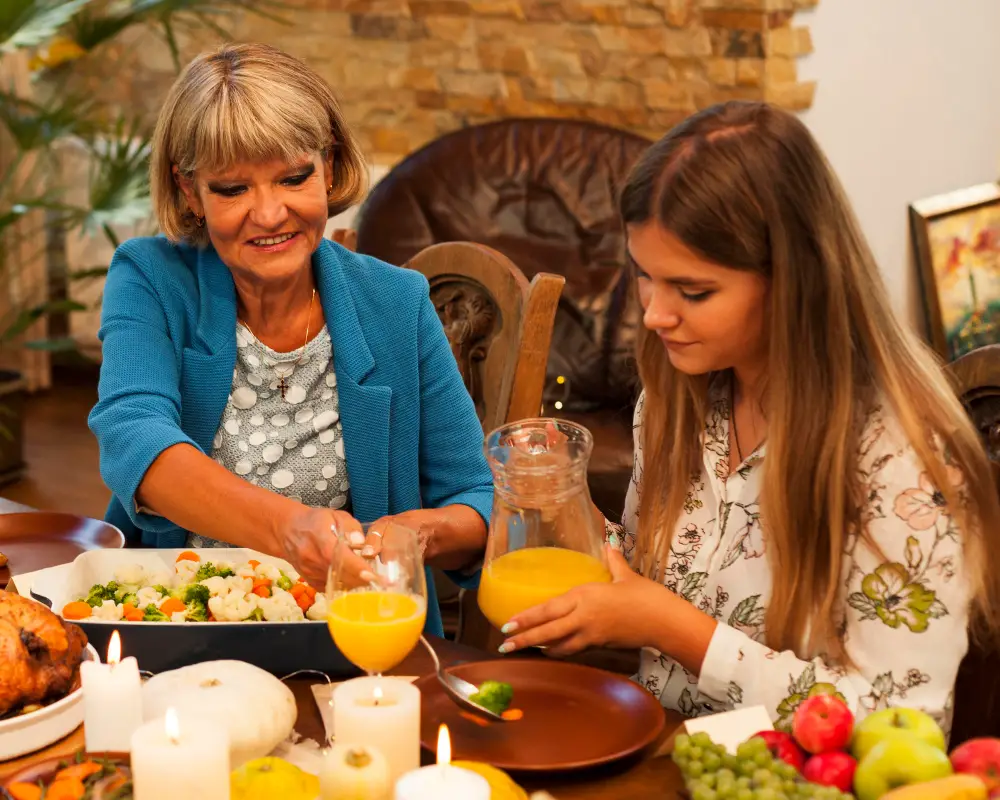
The dining room still smelled of rosemary and beef stew and warm bread and candle wax when Linda made her announcement, and for one more second before she opened her mouth, I let myself believe the evening could still be saved.
I had been telling myself that for hours, the way you tell yourself a headache will pass if you just keep working through it. The stew was warm. The bread was fresh from the oven, the crust crackling when I sliced it. The table looked almost exactly the way it had on the holidays back when Anthony was still alive, the good china out, two candles burning, everything in its place, except for his chair at the head of the table, which had stayed empty for years because I had never once been able to bring myself to let anyone else sit in it.
I had spent the whole day in a state I recognized from a long time ago, from the early years of my marriage when money was tight and company was coming and I wanted so badly for everything to be nice. It is a particular kind of hope, the hope of a woman standing over a stove, the belief that if the food is good enough and the table is pretty enough and the candles are lit, then the people who gather around it will become, for one evening, the best versions of themselves. I had believed it that morning. I had believed it while the stew simmered and the house filled with the smell of it. I went on believing it right up until Linda pointed at my back door, and even then, for one more second, some stubborn part of me was still reaching for it.
Dylan’s spoon stopped halfway to his mouth. He was nine, my great-grandson, and he had the particular stillness children get when they sense a storm in a room full of adults who are all pretending the sky is clear. Sarah’s nervous little laugh died before it fully escaped her. My son, Edward, stared down at the plate I had filled for him, studying the gravy as if the answer to everything might be hiding under a piece of potato.
And Linda pointed at the back door. She pointed the way you would dismiss a waiter who had lingered too long beside your table.
Take your plate outside, she said, and eat with your friend.
She did not sound embarrassed. She did not sound uncertain. She spoke with the flat, easy confidence of a woman who believed that every single person in that room had already accepted her authority, that the matter had been settled somewhere she couldn’t see and she was simply informing me of the outcome.
I was sixty-eight years old, and I was standing inside the red brick house on the South Side of Chicago that my late husband and I had bought on two teacher salaries, and I want you to understand what that house was, because Linda never understood it, not once in all the years I knew her.
That house was never handed to us. Anthony and I clipped coupons at the kitchen counter on Sunday afternoons and planned the week’s grocery list around whatever the store had marked down. We skipped vacations the year the furnace died in January and again the year it needed replacing for good. We drove the same rattling used sedan through four Chicago winters longer than we ever should have, because a car payment would have meant falling behind on the mortgage, and falling behind on the mortgage was the one thing we had promised each other we would never do. Some months, after Edward was asleep, we sat at that very dining table with a spiral notebook between us and moved numbers from one column to another, again and again, as if we could make a teacher’s paycheck stretch further by rearranging it enough times. Sometimes we could. Sometimes we just went without and didn’t say so.
People who inherit things, or who buy them with money that arrived easily, never quite understand what a house like ours meant. To us it was not an investment or an address. It was a decision we remade every month for thirty years, a thousand small refusals of everything easier we could have done with the money instead. When Anthony’s tooth cracked one winter, he waited two months to see the dentist because the bill would have eaten the cushion we kept against the property taxes, and I was furious with him and also I understood, because I would have done the same. When I wanted a new winter coat, I turned my old one inside out and had the lining redone for a fraction of the price, and I wore that coat another six years. This was not martyrdom. It was simply the arithmetic of two teachers raising a son in a city that did not care whether we made it. We chose the house, over and over, and the house became the proof of every choice.
We never complained where our son could hear us. We simply made it work, the way people of our generation were raised to, quietly, without expecting anyone to be impressed by it.
When the mortgage was finally paid off, after nearly thirty years, Anthony brought home a small grocery store cake, the kind with the too-sweet frosting and a plastic film over the top. There was no party. There was no speech. He set the final statement down next to my plate, the one stamped paid in full, and he tapped it once with his finger and smiled at me across the table.
We did it, he said.
That was how we celebrated most things in our marriage. Quietly, gratefully, and together. I have thought about that little cake more times than I can count in the years since he passed, that cake and the way he tapped the paper, because it was the closest thing to a victory lap that a man like Anthony ever allowed himself. He had grown up with even less than I had. His own father had rented the same apartment for thirty years and died still renting it, still at the mercy of a landlord who raised the rent whenever he pleased, and Anthony had carried that his whole life, the determination that he would own the ground he stood on, that no one would ever again be able to tell his family to pack up and get out. When he tapped that paper and said we did it, that was what he meant. He meant that the thing his own father never had, we had, at last, together. He meant we were safe. He meant no one could ever put us out.
I do not think, on that night, either of us could have imagined that the person who would someday try was our own son’s wife, standing in our dining room, pointing at our back door.
The property tax bills still came addressed to me. The homeowners insurance policy was in my name and had been renewed under my name every single year since the year we moved in. The deed had never belonged to Edward. It had certainly never belonged to Linda. There was not a single document in any drawer in that house that gave her the right to point at my back door and tell me where to eat my supper.
But I had opened that door to them anyway, because my son called me at 10:42 on a Tuesday morning and told me he had lost his job.
I remember the exact time because the kitchen clock was ticking behind me while he struggled to get the words out, and I found myself staring at it, at the second hand going around, while my child tried to tell his mother he was afraid. Edward had always hated admitting when he was frightened. Even as a little boy he would insist he was fine while I picked gravel out of his scraped knees, his chin trembling, telling me it didn’t hurt. That Tuesday, his voice sounded smaller than it had in years. It sounded like the boy with the scraped knee.
He told me the job was gone. It had been a good job, a management position at a logistics company, the kind of job that had let him and Linda live in a way Anthony and I never had. He told me they needed somewhere to stay. He told me it would only be temporary, just until he got back on his feet, and I heard in that word, temporary, all the times over the years I had watched my son try to solve a money problem by calling it a temporary inconvenience and waiting for it to disappear on its own.
I knew, without being told, roughly how the rest of it looked, because I had watched it take shape over a decade. There had been the bigger house in the suburbs with the mortgage that stretched them thin from the first day. There had been the two newer cars in the driveway, the leases rolling one into the next so there was never a year without a payment. There had been the vacations Linda posted about, the resorts and the flights, the version of a life that looked, from the outside, like success and was, from the inside, a tightrope with no net beneath it. Anthony and I had spent our whole lives building a net first and only then deciding how high to climb. Edward and Linda had done the opposite, and now the rope had snapped, the way it always eventually does, and my son was on the phone at 10:42 on a Tuesday with a nine-year-old and a wife and no ground beneath any of them.
I did not ask him how much they had saved. I did not ask whether Linda had agreed to give up anything at all, the newer car, the vacations, the things Anthony and I had done without our whole lives. I did not remind him of the gentle warnings I had offered over the years, the times I had suggested, carefully, that a family should keep a cushion for exactly this kind of morning, that they might look at what they were spending, that a financial planner or even just an honest afternoon with a notebook might spare them later. None of that would have helped him, and none of it was what he needed to hear from his mother at 10:42 on the worst Tuesday of his life.
He was my son, and he was frightened, and he needed help.
So I gave him the code to the front door. I cleared out the guest room, carried boxes up to the attic, and folded a stack of clean towels at the foot of the bed. I went to the store and stocked up on the snacks Dylan liked, the cheese crackers and the applesauce pouches, because a nine-year-old should not have to feel like he is being marched into a disaster he had no hand in creating. I told Edward not to think about paying me anything until he could breathe again. I meant it, completely. I even lay awake that first night doing the math on my own accounts, working out quietly how far my pension and my savings would stretch to cover three more people, deciding without any drama that they would stretch far enough, because that is what you do for family and you do not make them watch you count.
I did not expect to be thanked every morning. I did not expect anyone to treat me like a hero for taking in my own child. I expected one thing, and one thing only, and it was the same thing I would have expected from any adult sharing my roof, which was basic respect inside the home I was opening to them.
That first evening, I made the beef stew Edward used to beg for after soccer practice. When he was a teenager he would come banging through the front door with wet hair and muddy socks and a hunger that seemed physically impossible to satisfy. Anthony would holler at him to leave his cleats on the mat. I would pretend to be put out about it while I was already reaching into the cabinet for a second bowl. All those years later, long after Anthony was gone and Edward had a family of his own, my hands still knew how much rosemary to use and exactly how thick he liked the broth. Some things the body remembers on its own.
I had stood at that stove all afternoon thinking it might reach him. That is the truth I am a little embarrassed by now. I thought that if I could just set that particular bowl in front of my son, the one from the muddy soccer years, the one from before Linda, before the suburban house and the leased cars and the long slow drift, then something in him might remember who he was and whose son he was. Food carries memory the way almost nothing else does. I thought the stew might do the work that all my careful words over the years had failed to do. I was wrong about the stew, as it turned out, but I was not entirely wrong about the reaching, because in the end something did reach him that night, just not the thing I had planned and not in the way I had hoped.
I sliced the warm bread. I lit two candles. I brought out the good china, the wedding china with the thin gold rims and the tiny blue flowers that had faded just slightly over the decades of careful washing. I brought it out on purpose. I wanted the first night to feel less like a family in crisis and more like a family coming home. That was the whole idea behind the whole evening. I wanted them to walk in and feel safe.
By the middle of the afternoon, though, Linda had already begun measuring my generosity the way an appraiser measures square footage.
The guest room was too small. The lighting in the upstairs bathroom was terrible. The closet space, she informed me, was simply unacceptable. She walked through my house with her arms folded across her chest, pointing out problems in rooms I had lived in comfortably and gratefully for the better part of forty years. She did not ask where she might put their things. She told me where she intended to put them. She stood in the middle of my living room and talked about what she would do with it, how she would move the couch, how the drapes would have to go, how the whole place felt dated and closed in and could be opened up so easily if a person just had some vision. She said it in front of me as though I were not standing there, as though the house were already an empty thing she had been handed to renovate, and I understood in that moment that in her mind the transfer had already happened. She was not asking to stay in my home. She was taking inventory of hers.
And then she stood in the hallway and announced, as though she were doing me a favor by explaining her reasoning, that she and Edward really ought to take my bedroom, because it was the largest and it just made the most sense.
My bedroom is the largest, that much is true. It is also the room that still holds the last pieces of the life Anthony and I built. His book is still on the nightstand, the one he was in the middle of reading, a bookmark stuck a little past the halfway point where he left off and never got to finish. His side of the closet is mostly empty now, but I still keep one of his sweaters folded on the shelf, the gray wool one, because on the hardest nights I can hold it and it still, faintly, after all this time, smells like him. There are mornings when the early sun comes across that floor in the same narrow strip it always crossed when he was alive, and for just a moment the room does not feel so empty, and I lie there and let it not feel empty for as long as the light allows.
That room was where he died, in the end, at home, the way he wanted, after the doctors had told us there was nothing left to try and we had brought him home to be somewhere he loved. I had sat in that narrow strip of morning light and held his hand through the last of it. There is no amount of square footage on earth that would make me hand that room to someone who had never once asked me a single question about the man whose whole leaving still lived in its walls. Linda knew none of that, because Linda had never once asked. She simply decided that the biggest room in the house should be hers, and that the woman who owned the house should be relocated like a piece of furniture.
I said no.
I did not shout it. I did not offer her an explanation she could argue with or pick apart or wear down. I said the one word, and I went right on folding the towels.
I had learned, over the years, that explanations were oxygen to Linda. Give her a reason and she would find the flaw in it, worry at that flaw until the whole thing came apart, and somehow, three sentences later, I would find myself apologizing for having had the reason at all. So I stopped giving her reasons. I had figured that much out even before I understood the rest of it. No is a complete sentence, Gabriella had said to me once, in her office, and I had laughed at the time because it sounded like something off a poster, and then I had gone home and found that it was simply true.
Linda smiled at me as if she had heard the words not yet. That smile stayed with me the rest of the afternoon. It was not a cruel smile, exactly, and that was the unsettling thing about it. It was patient. It was the smile of a woman who was completely certain that my resistance was nothing more than the opening move in a negotiation she had already won, that if she simply held her position and applied a little more pressure, I would come around the way I always had.
Because I always had. That was the thing I had to sit with, later, in the dark.
At dinner, Linda waited until every one of us was seated before she rested both her hands flat on the table beside her plate. Edward had taken the chair nearest the window. Dylan sat across from him, small and quiet. Sarah, Edward’s daughter from his first marriage, sat down near the end of the table already watching Linda the way you watch a dog you don’t quite trust, bracing for something before it happens. I had barely lowered myself into my own chair when Linda looked slowly around the room, gathering us all up in her gaze, and spoke.
I’m the one in charge of this house now, she said.
She said it calmly, and the calm was what made it monstrous. A cruel thing shouted in the heat of an argument can be forgiven later as temper, as a bad moment, as words that got away from someone. Linda did not want that escape. She wanted every person at that table to understand that she had thought about this, weighed it, and chosen it, and that she meant it exactly as she said it.
Edward shifted in his chair. He did not look at me.
That small motion, that little shift of his weight away from the moment, hurt me more than anything his wife had said or would say. Because Edward knew. He knew the whole history of that house. He knew about the notebook and the coupons and the four extra winters in the rattling car. He knew I had cleared the guest room and stocked the cabinets and told him to forget about rent. He knew his wife had no right, none at all, to speak to me that way at my own table. And he kept his eyes down on his plate.
I looked at the top of my son’s bowed head, at the gray coming in at his temples now, and I thought about all the versions of him that head had held. The baby I had walked the floor with at three in the morning. The boy who came home muddy from soccer. The young man in the rented gown at his college graduation, the first in our family to finish, Anthony weeping openly in the folding chair beside me. The groom, twice over. And now this, a grown man of forty-two lowering his eyes at his mother’s table because it was easier than the alternative, and I felt something I had never quite let myself feel about my own child, which was disappointment so sharp it had a taste.
Then Linda lifted her hand and pointed at the back door.
Take your plate outside, she said, and eat with your friend.
The insult landed in the middle of the table, right there beside the bread basket and the serving spoon, and nobody moved. Nobody reached for anything. Dylan’s eyes went from Linda to me and back, his face tight and confused, trying to work out whether this was a grown-up joke he didn’t understand. Sarah pressed her lips into a hard line. Edward said nothing at all.
The insult hurt. My son’s silence hurt worse.
I sat there very still, and in that stillness I finally saw something clearly that I had spent years refusing to look at directly. For a long time I had told myself that keeping the peace was the same thing as protecting my family. I had swallowed rude comments at holiday dinners because I did not want to force Edward to choose sides between his wife and his mother. I had changed my plans a hundred times when Linda complained, because giving in seemed so much easier than turning every gathering into a war. When she criticized my cooking or my timing or the gifts I chose for Dylan or the way I said things, I told myself she was under stress. When she cut me off in the middle of a sentence, I let her finish. When she made decisions that landed on all of us, I told myself that objecting would only make my son uncomfortable, and so I stayed quiet. I even apologized first, most of the time, because saying sorry was easier than watching Edward stand trapped in the space between us, not knowing which way to turn.
Every one of those compromises felt small at the moment I made it. One rearranged dinner didn’t matter. One swallowed insult wasn’t worth a family blowup. One holiday spent tiptoeing around Linda’s moods was survivable, and so I survived it, and then I survived the next one, and the one after that.
I thought about a particular Christmas, two years back, the one that had finally sent me to Gabriella’s office in the first place though I didn’t know it yet that night. I had spent three days cooking. I had bought Dylan the science kit he had circled in a catalog, and Linda had looked at it and said, in front of the boy, that they were trying not to fill the house with plastic junk, and I had apologized. I had actually apologized, in my own kitchen, for buying my great-grandson a gift, and then I had gone into the bathroom and run the water so no one would hear me, and I had stood there and thought, this is not right, something in this is not right, and I had come back out and refilled everyone’s glasses and said nothing. That was the shape of it. That was the shape of years.
But small surrenders do not always stay small. Sometimes they are lessons. Sometimes, without meaning to, you are patiently teaching another person the exact distance they are allowed to push you, and they are patiently learning it, and the day comes when they push all the way to your own back door and tell you to go eat outside.
Sitting there, I finally understood the difference between peace and surrender, and I understood that I had been confusing the two for years. Peace requires respect flowing in both directions. Surrender only requires one person to keep quiet. I had called my silence peace for a very long time. It had never been peace. It had only ever been surrender wearing a nicer name.
And I understood something else, too, sitting in that quiet with the insult still hanging in the air. I had told myself, all those years, that I was swallowing my pride for Edward’s sake, to spare him from having to choose. But I saw now that I had not spared him anything. I had taught him. Every time I apologized first, every time I let Linda run over me and then smoothed it back down, I had shown my son that this was how his mother could be treated, that there would be no cost, that the woman who raised him would always, always fold. I had not protected him from having to choose. I had quietly raised the price of ever choosing me until it felt, to him, too high to pay. My silence had not kept him out of the middle. My silence had built the middle, and then it had built the walls around it.
I looked at my son, and I waited. I will admit that. Some part of me was still waiting, still hoping, even then. I hoped he would lift his head. I hoped he would tell his wife that she had gone too far. I hoped he would remember that less than twenty-four hours earlier he had needed my home and my groceries and my guest room and my voice on the phone telling him it would be all right.
He said nothing. He kept his eyes on his plate.
And so I made my decision, though it did not feel like deciding so much as finally stopping the long, slow work of talking myself out of it.
I did not raise my voice. I did not stand up and recite the list of everything I had done for that boy over forty-two years. I did not remind him who packed his lunches, who signed the permission slips he forgot until the morning they were due, who turned the car around and drove back to the school when he left his project sitting on the kitchen counter. I did not bring up the soccer games I sat through in the rain under an umbrella that kept blowing inside out while Anthony worked late to cover the overtime. I did not tell him about the nights I sat up with him when he was sick, or the mornings I went to work hollow with exhaustion because he had needed me more than I had needed sleep. All of that was simply what it meant to be his mother. None of it was a debt. I never kept a ledger, and I was not about to open one now.
There is a kind of mother who keeps score, who reminds her children of every sacrifice, who spends the second half of her life presenting the bill for the first half. I had known women like that and sworn I would never be one. Love that keeps a ledger is not love, it is a loan, and I had never once thought of a single thing I did for Edward as a loan. But being his mother did not mean I had to make myself disappear inside my own home. Those were two entirely different things, and it had taken me sixty-eight years and a woman pointing at my back door to finally see the daylight between them.
So I smiled.
Linda mistook the smile for defeat. I watched it happen. Her shoulders came down from around her ears. She leaned back in her chair, satisfied, certain that the scene had played out precisely the way she had scripted it in her head, certain that any second now I would pick up my plate and carry it out the back door and prove to every witness at that table that she was the authority in this house.
At exactly 6:48 on the kitchen clock, I pushed back my chair. The legs scraped softly across the hardwood floor that Anthony had refinished by hand one long-ago summer. I left my plate exactly where it was.
Then I walked to the phone on the kitchen wall.
Anthony had wanted to get rid of that phone for years, always after me to replace it with something cordless, something modern. I had kept it because it worked, because my fingers knew every button in the dark, and because there was a comfort in the way its ring carried through the whole house, the same ring that had called us to a thousand ordinary evenings. I kept a short list of numbers taped to the wall beside it, in my own handwriting, the way people my age still do.
Linda watched me cross the room, and she was still leaning back, still looking pleased with herself. I could see exactly what she thought was happening. She thought I was calling a neighbor to ask if I could come finish my dinner in someone else’s kitchen. Maybe she pictured me apologizing on my way out the door. Maybe she expected me to explain her behavior in the soft forgiving language I had used for years, the language I was ashamed to realize I had trained her to expect. Linda is under a lot of pressure. Linda didn’t mean it that way. Linda is only trying to hold the family together. I had made those excuses for her so many times that she had every reason to believe I always would.
There is a strange freedom in the moment you stop performing the role someone has cast you in. I felt it crossing that kitchen floor, the old linoleum I had mopped ten thousand times, past the counter where Anthony and I had clipped our coupons, toward the phone that had rung through every important day of my adult life. I was not angry anymore, exactly. Anger is hot and this was cool, clear, almost calm, the feeling of a decision that has already been made somewhere deeper than thought and is only now catching up to the surface. My hands were steady. My breathing was even. I have wondered since whether that calm was the most frightening thing of all to the people watching me, more frightening than any amount of shouting could have been, because a person who shouts still wants something from you, and a person who has gone quiet and steady has stopped asking.
Edward finally lifted his head.
Mom, he said. Who are you calling?
It was the first thing he had said since his wife declared herself the head of my house. There was worry in his voice now, real worry. Not enough courage in it yet to defend me, but enough awareness, at last, to understand that the ground had shifted under his feet and he could not tell which way it was going to tip.
I lifted the receiver. I dialed the number from memory, because I had dialed it enough times over the past two years to know it by heart. My fingers did not shake. Behind me, no one had gone back to eating. The stew was cooling in the good china bowls. The candles burned straight and steady between the plates. The wedding china that Anthony and I had unwrapped together as newlyweds, dreaming out loud about the family we would someday feed on it, sat under the hands of people who had somehow forgotten they were guests in my home.
I remember thinking, in the strange stretched-out way the mind works in a moment like that, about all the calls that phone had carried over the decades. The call telling us my mother had passed. The call from the hospital the night Edward was born, Anthony shouting the news into it to everyone we knew. The call, years later, that I had made from that very spot to tell those same people that Anthony was gone. That phone had been the instrument of every large thing in my life, joy and grief both, and now here it was in my hand again, carrying one more. I do not think Linda understood what she was watching. To her it was just an old woman at an old phone. To me it was the whole weight of a life, gathered up and pressed into a single quiet call.
She answered on the second ring, and she said my name right away, warm and awake, the way she always did.
Gabriella Ruiz had been my attorney for a little over two years. I had gone to her not long after a different holiday dinner, a Thanksgiving where Linda had reduced me to apologizing in my own kitchen for something I had not done, and I had driven home that night and sat in the dark and understood that I needed to put my affairs in order while I was still the one deciding what those affairs would be. Gabriella had drawn up my will. She had helped me set up a living trust, so that the house and everything in it would pass exactly the way I intended and not one inch otherwise. She had walked me, line by line, through my rights as the sole owner of my property, a homeowner, a woman with a deed in her name and taxes she paid herself every year. She had told me, in that first meeting, something I had written down and kept: that no one lives in your home except by your permission, and permission is a thing you are always free to withdraw.
I had gone to her expecting to feel like a bitter old woman scheming against her own family, and instead I had walked out of her office feeling, for the first time in years, like a person with ground under her feet. She had not told me to cut anyone off. She had simply shown me, in plain language and signed documents, that my life was still mine to direct, that the decades of sacrifice had bought me something no one could take from me by force of personality alone. We had met perhaps four times since then, to update this or clarify that, and every time I left her office I felt that same steadiness. She had become, without either of us quite naming it, the person who reminded me who I was. I had never had to use any of it. I had hoped I never would. But I had kept her number taped to the wall by the phone all the same, in my own handwriting, because some part of me had always known that the day might come.
I kept my eyes on Linda while I held the phone to my ear. Her pleased expression had not vanished, but it had begun to tighten around the edges, the corners of it pulling in, because whatever she had imagined this phone call was, the ease of me, the steadiness of me, was not fitting the picture.
Gabriella, I said quietly. It’s time.
The words did not need to be dramatic, so they weren’t. Linda’s fingers curled slowly against the back of her chair. And Edward, my Edward, stared at the phone in my hand, and I watched his whole posture change before another word was spoken, because Edward knew the name. He had heard it before. Months earlier I had mentioned, in passing, that I had an attorney named Gabriella who was helping me get my estate in order, and he had nodded the way you nod at something you assume you will never have to think about, and now he was thinking about it, hard, and the color was going out of his face the same way it had gone out of Linda’s.
On the other end of the line, Gabriella asked me a question. She asked it plainly and without any relish, because she is a serious woman who does not enjoy this part of her work. She asked me whether I wanted her to begin the formal process of removing them from the property, the notice, the paperwork, the whole slow lawful machinery that ends with people who will not leave a house being made to leave it.
I did not answer right away. I let the question sit, and I looked around the room I had spent all afternoon preparing as a welcome. I looked at the candles I had lit for them. I looked at the warm bread and the stew that Edward had loved since he was a boy with grass stains on his knees. I looked at the empty chair at the head of the table, Anthony’s chair, and I thought about the man who had tapped a piece of paper with his finger and said we did it, and I wondered what he would make of this, of his wife being told to eat outside in the house the two of us had bled for.
Then I looked at my son. He had called me because he needed a safe place to land, and I had given him that place with no conditions and no lecture and no ledger. And within a single day he had sat at my table with his eyes on his plate while his wife tried to drive me out of my own home.
Gabriella, patient, asked the question again.
And I looked at Edward’s face, at the fear in it that was, at last, the right kind of fear, and I made a different choice than the one Linda thought I was making, and a different one, too, than the clean and total revenge some part of me wanted.
Not yet, I told Gabriella. I need you to do something else first. I need you to hold the line for me while I say something in my own house, and I need to know you’re on it while I say it.
I’m right here, she said. Take your time. I’m not going anywhere.
I kept the receiver in my hand, the line open, Gabriella listening, and I turned around to face the table. I did not need her to fight this battle for me. I had spent two years quietly making sure I could never be pushed out of my own life, and now I only needed to stand inside that certainty and speak from it. The phone was not a threat. It was a spine. It was the knowledge, made solid and held in my hand, that behind every word I was about to say there stood a deed and a will and a trust and a woman who knew the law, and that I was not, as I had felt for so long, alone and outnumbered in my own dining room. I had never needed to win Linda over. I had only needed to stop needing to.
Linda, I said, and my voice was level and clear and it carried through the whole room. This is my house. The deed is in my name. The taxes are paid in my name. Every light that’s on in here, every bit of heat coming out of those vents, is paid for by me. You are a guest here, and you have been a guest here for exactly one day.
She started to speak and I raised my hand, just slightly, the way I used to when Edward was small and had run out of good reasons.
I’m not finished, I said. You told me to take my plate outside. So here is how this is going to go. Nobody is eating outside tonight. But there are going to be new terms for living under this roof, and they are not going to be negotiated, because I’ve learned my lesson about negotiating with you. You will speak to me with respect, in my home, or you will not stay in it. That is the whole rule. It is not complicated. My attorney is on the phone right now, and she has everything she needs to make me the last word on who lives here and who doesn’t. I would very much rather never have to ask her to use it. But I will. I want you to believe that I will, because for the first time in all the years I’ve known you, I mean it all the way down.
I let that sit for a moment, and then I said the last of it, more quietly, because the quiet part was the true part.
I took you in, I said. I did it gladly. I cooked your husband the supper he’s loved since he was a boy, and I lit candles, and I put out the china my husband and I unwrapped the year we married, because I wanted this house to feel like home to you. That was my welcome. What you did with it was tell an old woman to go eat in the yard. I am not going to spend whatever years I have left being made small in the only home I’ve ever owned. Not by you. Not by anyone. Those are the terms.
The room was so quiet I could hear the candles.
Linda’s face had gone through several things by then, the confidence, the confusion, and finally a kind of stunned recalculation, a woman discovering that the ground she had been so sure of was not ground at all. She opened her mouth once more and then closed it, because there was, for once, nothing in her whole arsenal that fit the moment.
And then Edward pushed back from the table so fast that his chair scraped hard across the hardwood, and he stood up.
For one terrible second I did not know which way he was going to go. I have replayed that second many times since. He looked at his wife, and he looked at me standing there with the old phone in my hand and Gabriella waiting on the line, and I watched something in my son’s face finally break open, some wall he had been hiding behind for years, maybe for his whole marriage. In that second I saw both futures at once, the one where he sided with her out of habit and fear and the wish to keep his own small peace, and the one where he did not, and I understood that whatever he chose in the next breath would tell me the truth about my son that I had spent years not letting myself learn. I did not reach for him. I did not say a word to tip him one way or the other. I had done far too much of that already, all those years of nudging and smoothing and making it easy. This one he had to do standing on his own two feet, or it would not count.
Enough, he said. He said it to Linda, not to me. Enough. That’s my mother. This is her house. She took us in when I had nothing, she had the stew on the table the same day I called her, and you told her to eat outside like a dog.
Edward, Linda started.
No, he said. His voice was shaking but he did not stop. I sat here and let you do it. I sat here with my eyes on my plate and let you do it, and I will be ashamed of that for the rest of my life. He turned to me, and there were tears standing in his eyes, and he was forty-two years old and he looked exactly like the boy with the scraped knee insisting it didn’t hurt. Mom, he said. I’m so sorry. God, I’m so sorry. Put the phone down. Please. I’ll fix this. I promise you I’ll fix this.
I looked at him for a long moment. I did not put the phone down right away, and I think he understood why. I had put phones down before. I had accepted apologies before, accepted them too quickly and too cheaply, and every easy forgiveness had been another brick in the middle room. I was not going to buy this one on credit.
Gabriella, I said into the receiver, my eyes never leaving my son. I think we’re all right here for tonight. I’ll call you in the morning.
Good, she said gently, and I could hear that she understood everything that had just happened without my explaining any of it. Call me anytime. I mean that.
I hung up the old phone on the wall. And in the quiet that followed, Linda stood, and without a word she went up the stairs, and we heard the guest room door close, not slammed, just closed. Dylan let out a breath he had been holding. Sarah reached over and squeezed his shoulder, and murmured something to him that made his face relax a little, and I was grateful to her for that, for tending to the child while the adults sorted out the wreckage.
Edward and I stood there in the candlelight on either side of the table we had eaten a thousand meals at, and neither of us knew quite what to say, so we didn’t say anything for a while. Then he came around the table and he put his arms around me the way he hadn’t since he was a boy, and I held on to my son, and over his shoulder I could see Anthony’s empty chair, and the little blue flowers on the plates, and the stew going cold, and I understood that the evening had not, in the end, gone the way anyone at that table had planned. Not Linda’s way. Not even my own.
Nothing was fixed that night. I want to be honest about that. A closed door upstairs is not the same as a healed family, and one true sentence from Edward, however long I had waited to hear it, did not undo the year of small surrenders that had led us to that table. Linda and I would have hard conversations in the weeks to come, some of them at that same table, some of them with Gabriella’s careful language written down between us. I did not throw them out. I want to be clear about that, because it would have been the easier story to tell, the satisfying one, the one where the wicked daughter-in-law is marched to the curb with her suitcases. Real life is slower and stranger than that. I let them stay, on the new terms, because Dylan needed a roof and Edward needed a chance and because I have never in my life found much use for cruelty, even when it is deserved.
But the terms were real, and everyone in the house came to understand that they were real. Edward found work within a couple of months, not as grand as the job he had lost, a step down in title and pay, but honest and steady, and he started handing me a small amount toward the groceries and the utilities every two weeks, and I took it, not because I needed it but because he needed to give it. He and Linda began seeing someone about their money, finally, a counselor at a nonprofit who helped them look at the whole frightening picture and make a plan, the kind of plain honest afternoon with the numbers that Anthony and I had lived by our whole lives. Linda and I never became close. I don’t think we were ever going to be. But she never again told me where to eat in my own house, and there came a day, months later, when she thanked me, stiffly and briefly, for taking them in, and I could tell what it cost her to say it, and I accepted it the same way Anthony would have, quietly and without making her pay twice.
Edward had a great deal to reckon with, about the job and the money and the marriage and the man he wanted to be, and none of it would be quick. But something had changed in that house, and it had changed for good, and I knew it as I stood there in my son’s arms. I had stopped calling my silence peace. I had picked up the phone, and the person on the other end of it had reminded me of something I had let myself forget for far too long, which was that I was still the owner of my own life. Not a guest in it. The owner.
Anthony and I had built this house out of coupons and cold winters and numbers moved back and forth in a notebook after our boy was asleep. We did it, he had told me, tapping that piece of paper. We did. And I was not about to let anyone tell me to take my plate and eat outside of it. Not for one more day.
I told Edward to sit down. I told him the stew was cold but that was what the microwave was for, and he laughed, wet and surprised, the same laugh he’d had at sixteen. I warmed up his bowl, and I set it back in front of him at his mother’s table, and I sat down in my own chair, the one I had always sat in, and I picked up my fork, and for the first time in longer than I could remember, I ate my dinner in my own house exactly where I pleased, in the light of two candles, across from the empty chair where the best man I ever knew used to sit and tell me, quietly and gratefully and together, that we had done it.

Lila Hart is a dedicated Digital Archivist and Research Specialist with a keen eye for preserving and curating meaningful content. At TheArchivists, she specializes in organizing and managing digital archives, ensuring that valuable stories and historical moments are accessible for generations to come.
Lila earned her degree in History and Archival Studies from the University of Edinburgh, where she cultivated her passion for documenting the past and preserving cultural heritage. Her expertise lies in combining traditional archival techniques with modern digital tools, allowing her to create comprehensive and engaging collections that resonate with audiences worldwide.
At TheArchivists, Lila is known for her meticulous attention to detail and her ability to uncover hidden gems within extensive archives. Her work is praised for its depth, authenticity, and contribution to the preservation of knowledge in the digital age.
Driven by a commitment to preserving stories that matter, Lila is passionate about exploring the intersection of history and technology. Her goal is to ensure that every piece of content she handles reflects the richness of human experiences and remains a source of inspiration for years to come.