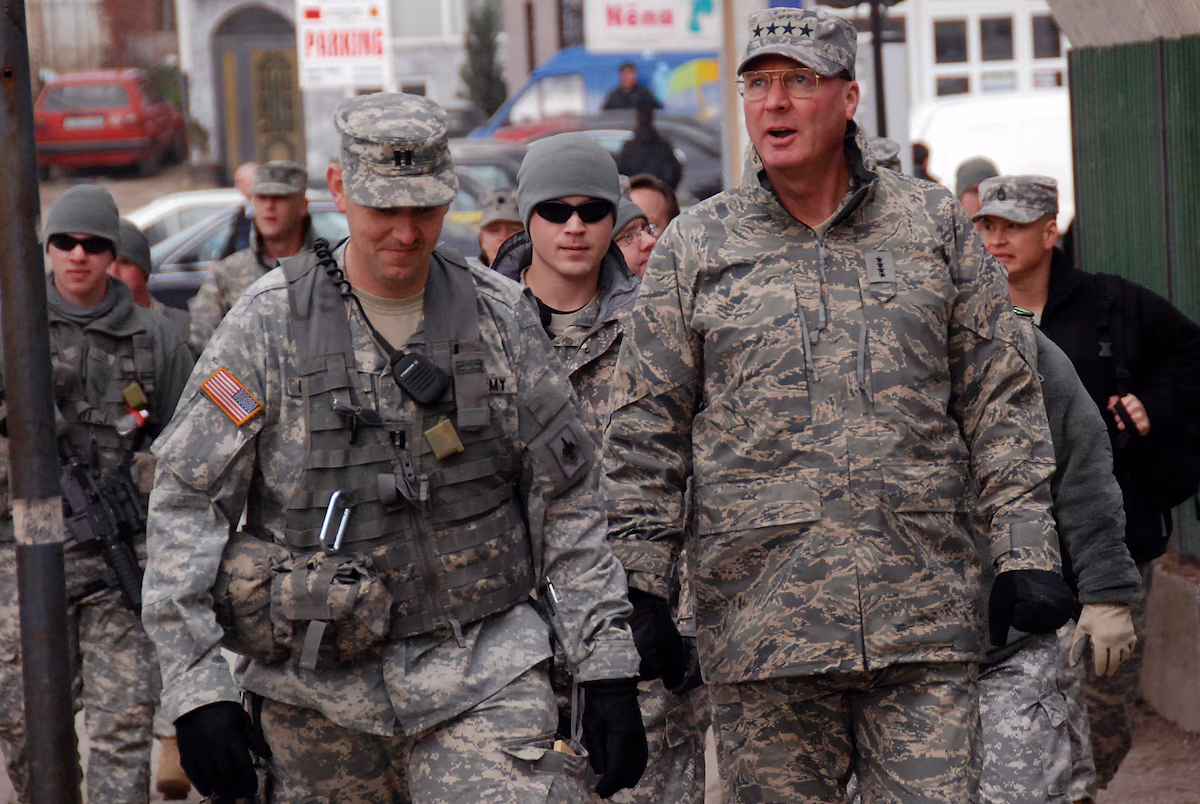
Richard Hayes clamped both hands around the chair arms as the general finally spoke. His voice carried easily across the grass even without a microphone.
“Victoria Hayes,” he said, “I have waited a long time to salute you where people could actually see it.”
I felt something tighten behind my ribs. Not pride. Not yet. Mostly dread. Because I knew my father. I knew Michael. And I knew that whatever the general said next could open a door I had spent eighteen years forcing myself not to touch.
Behind him, nearly two hundred soldiers stood near the convoy in disciplined rows, their boots planted in the grass while families and guests stared from the other side of the chain-link fence. Michael still had the microphone in his hand. My niece stood beside the podium. Dad had not moved.
The general glanced toward the stage, then back at me. “May I?” he asked.
It took me a second to understand what he meant. He wasn’t asking permission to enter the park. He was asking permission to tell the story. That mattered more than anyone there could have known.
I gave him one small nod.
The general turned toward the crowd. “Eighteen years ago,” he said, “Victoria Hayes was involved in an operation that most of the people standing here were never cleared to know about.”
Michael’s face changed first. His mouth tightened around a response he clearly wanted to make. The general continued before he could. “What became public afterward was incomplete. What reached families was worse than incomplete. It was misleading.”
I looked at my father. For once, he wasn’t looking through me. He was looking directly at me.
In 2008, I had been assigned to a joint operation overseas that deteriorated faster than anyone had planned. The details that still mattered to national security were not mine to repeat, and the general was careful not to repeat them either. But the part that had destroyed my place in the Hayes family was simple enough.
An order came down directing my element to withdraw. Then new information reached us. People were still trapped beyond the route we had been told to abandon. The safest decision for my career was clear. Follow the order exactly. Come home. Let somebody higher in the chain explain the losses later. I couldn’t do it. I delayed my withdrawal long enough to redirect people and equipment toward the stranded group.
It was not clean. It was not heroic in the way movies make those decisions look heroic. People were yelling over radios. Plans changed by the minute. I knew I was violating the narrow instruction I had been given, and I knew there would be consequences even if we succeeded. We did succeed. People came home who otherwise might not have.
Then the questions started. Why had I delayed? Who had authorized the change? What intelligence had I acted on? Why had I refused to identify certain sources during the first review? Those questions were tied to information I was legally forbidden to discuss outside classified channels. So the version that escaped into ordinary conversation was much easier to understand. Victoria Hayes had disobeyed an order. That was the version my father heard. That was the version Michael repeated. That was the version that cost me my photograph on the family wall.
The general looked toward the stage. “The classified review did not conclude that she acted recklessly,” he said. “It concluded that she made a command decision under conditions the public record could not explain.”
A murmur ran through the crowd. Michael lifted the microphone. “General, with respect, this is a family event.”
The general looked at him. “Commander Hayes, that is precisely why I am here.”
Michael lowered the microphone a few inches. Nobody had shouted. Nobody needed to.
The general gestured toward the soldiers behind him. “Some of these men and women served under Victoria later in her career. Some were trained by people she trained. Some benefited from decisions she made when nobody outside a secure room would ever know her name.” He paused. “And some are here because people Victoria refused to abandon in 2008 were able to keep serving, keep leading, and keep bringing others home.”
That hit me harder than the salute. For years I had trained myself not to count the ripples. You couldn’t. If you tried to carry every person affected by every decision, command would crush you. You made the best call you could, accepted the cost, and moved forward. But now those ripples were standing in front of me. Rows of them.
My niece stepped away from the podium. “Aunt Victoria?” Her voice was small enough that I almost didn’t hear it. I looked at her. She looked younger than she had five minutes earlier. Not like the polished speaker who had talked about an unbroken family legacy. Like my brother’s daughter trying to understand what part of her childhood had been built around a lie.
“Why didn’t you tell us?” she asked.
Michael turned toward her sharply. “This isn’t the place.”
She didn’t look at him. She kept looking at me. I answered her because she had done something nobody in my immediate family had bothered to do eighteen years earlier. She asked.
“At first, I couldn’t tell you,” I said. My voice came out steadier than I felt. “Later, I stopped wanting to defend myself to people who had already decided what I was.”
Dad’s hands loosened from the chair arms. He stood slowly. At eighty-one, he still had the posture of the colonel who used to inspect my shoes before school ceremonies. But something about him looked smaller now. “Victoria,” he said.
I waited.
He looked at the general. “Was she cleared?”
The question almost made me laugh. Even now, he needed the answer from another officer. Not from me. The general must have understood that too, because he did not rush to rescue either of us. “The review found that the circumstances justified her decision,” he said. “She continued serving because the Army knew what she had done and why.”
Dad looked back at me. Thirty years of service. Eighteen years of silence between us. And suddenly he understood the arithmetic. If I had truly been the disgrace he imagined, the Army would not have trusted me with greater responsibility afterward. He had simply never asked how those two facts fit together.
Michael stepped down from the stage. “You could have told me there was more to it.”
That finally brought the anger up. Not explosive anger. The old kind. The kind worn smooth from carrying it too long. “I did,” I said.
He frowned. “When?”
“Every time I told you there were things I couldn’t discuss. Every time I said the story wasn’t what you thought. Every time I kept serving while you called me an embarrassment.”
Michael’s jaw flexed. “That isn’t the same as explaining it.”
“No,” I said. “It isn’t. Because I wasn’t allowed to explain it.”
My niece closed her eyes briefly. Dad looked down at the grass. The general remained beside me, but he said nothing. I appreciated him for that. He had brought truth into the park. He wasn’t going to tell me what to do with it.
Then my niece walked toward the gate. Michael saw her moving and said her name. She kept going. The event organizer had left the side entrance latched but not locked. My niece lifted the latch. The metal gate scraped across the ground. Then she stepped back and held it open for me.
It was such an ordinary movement. That was why it nearly broke me. A gate. A hand on a piece of metal. Room made where there had been none.
“You don’t have to come in,” she said. “But you shouldn’t have been kept out.”
I looked at Michael. Then at Dad. Then at the rows of chairs where my family had planned to celebrate generations of service while pretending one entire life did not belong in the story. I walked through the gate.
The soldiers did not cheer. I was grateful. Applause would have turned the moment into a performance, and I had spent enough of my life being judged by performances. Instead, the general fell into step beside me. My niece closed the gate behind us.
Michael moved toward the podium again. “We should probably take a few minutes,” he said.
“No,” I told him.
He stared at me. “Victoria—”
“Finish the ceremony.”
He looked genuinely confused. “After this?”
“Especially after this. There are families here who came to honor people they love. This doesn’t need to become another Hayes family spectacle.”
The general’s mouth shifted slightly, not quite a smile. Michael looked toward Dad. For the first time I could remember, Dad didn’t give him an answer. So Michael had to make his own decision. He returned to the microphone. The program resumed. But it was not the same program anymore.
When my niece spoke again, she did not repeat the line about an unbroken legacy. She folded her prepared page in half and set it on the podium. “I need to correct something I said earlier,” she began.
Michael turned toward her. She continued anyway. “I said our family’s history of service had been passed cleanly from one generation to the next. I didn’t know enough to say that.” Then she looked at me. “Some of that history was missing.”
That was all. No dramatic apology. No speech about forgiveness. Just a correction. It was the most honest thing anyone in my family had said publicly that day.
When the ceremony ended, people approached me carefully. Some knew my name from assignments years earlier. Others only knew what the general had just told them. I shook hands until my fingers hurt. One soldier told me his first team leader had served under me and still quoted something I used to say before difficult operations. Another told me that a man extracted during the 2008 mission later became the officer who convinced him not to leave the service after a terrible year.
Those stories were difficult to hear. Not because they made me proud. Because they reminded me that decisions keep moving long after the person who made them stops looking.
Eventually the crowd thinned. The Humvees remained lined along the road while soldiers gathered in small groups. Dad approached me alone. Michael stayed near the stage. My niece was helping stack programs that nobody seemed interested in saving anymore.
Dad stopped a few feet away. “I heard you had disobeyed a direct order,” he said.
“You did.”
“An old friend told me there had been an investigation.”
“There was.”
“He said you wouldn’t explain yourself.”
“I couldn’t.”
Dad nodded once. He seemed to be assembling the past piece by piece and discovering that none of the pieces excused him. “I thought silence meant guilt.”
“You wanted it to mean guilt.”
His eyes lifted to mine. That hurt him. I could see it. I did not take it back.
“Why would I want that?”
“Because disappointment was easier for you than uncertainty. You knew how to punish disappointment. You didn’t know how to sit with not knowing.”
He looked toward the emptying chairs. “Maybe.”
It was not an apology. But it was the first time my father had ever answered one of my hardest truths without immediately defending himself.
Michael joined us a minute later. He had left the microphone behind. That helped. “I was wrong to keep you out,” he said.
I looked at him. “Yes.”
He blinked, almost surprised that I wasn’t going to make his apology easier. “I thought I was protecting Dad. Protecting the event.”
“From me.”
“From what I thought this would become.”
I glanced around the park. Soldiers were talking with families. Kids were back on the grass. Someone was carrying folding chairs toward a trailer. The world had survived the truth.
“You made me the disruption before I arrived,” I said. “That part belongs to you.”
Michael nodded. He did not ask me to forgive him. I was relieved. Forgiveness demanded on schedule is just another form of control.
The general found me before leaving. We stood near the road while the convoy prepared to move out. “Was that necessary?” I asked him. I meant the soldiers. The vehicles. The salute. All of it.
He considered the question. “No,” he said.
I raised an eyebrow. He added, “But it was earned.”
I looked toward the park. “You could have called.”
“You would have told me not to come.”
He was right. “Probably.”
“That’s why I didn’t call.”
For the first time that morning, I laughed. Then his expression grew serious again. “There is one thing I wanted you to understand.”
I waited.
“Those people didn’t come because you needed rescuing from your family.” He nodded toward the soldiers. “They came because people should know when their lives were changed by someone who never demanded credit for it.”
I looked down at my shoes. “Credit was never the point.”
“I know. That’s usually why the right people deserve some.”
Then he shook my hand and left. The convoy rolled out slowly, one vehicle after another, until the engine noise faded beyond the hill where it had first appeared.
I thought that would be the end of it. It wasn’t.
Three evenings later, Dad came to my house. No blazer. No medals. Just khakis, an old windbreaker, and the uncomfortable expression of a man who had spent his life preparing for difficult conversations by giving orders and had finally encountered one that did not have a chain of command. He carried a flat cardboard box under one arm.
I let him inside. He put the box on my kitchen table. “I found this years ago,” he said.
I opened it. My commissioning photograph lay inside the same dark wooden frame that had once hung on the Hayes family wall. The glass was dusty at the corners. For a moment I was twenty-something again, standing beside Dad while he studied that picture and told me I still had plenty to prove.
“You kept it,” I said.
“I took it down,” he answered. “I never threw it away.”
I ran my thumb along the frame. That distinction mattered to him. It did not matter as much to me. “Why bring it now?”
Dad pulled out a kitchen chair but waited before sitting. “Because it belongs to you.” He exhaled slowly. “And because I owe you an answer I should have given eighteen years ago.”
I remembered standing in his living room asking where my picture had gone while he hid behind a newspaper.
“Okay,” I said.
He sat. “I was ashamed,” he said. “Not of what you had done. I didn’t actually know what you had done. I was ashamed that people might think one of my children had failed.” He rubbed a hand across his forehead. “So I decided you had failed before anyone could accuse me of defending you.”
There it was. Not a classified conspiracy. Not a grand misunderstanding. Something smaller and uglier. Pride.
“You protected the Hayes name,” I said.
“I protected my idea of it.”
I looked at the photograph again. “And Michael learned from you.”
Dad nodded. “Yes.”
That answer cost him something. I could tell. Good. Some truths should cost something.
He did not ask to put the photograph back on his wall. He did not invite me to another ceremony. He did not tell me our family could start over. Instead he asked, “What happens now?”
For most of my life, Richard Hayes had supplied the answer to that question for everyone around him. Now he was asking me.
“Now you call before you come over,” I said.
He almost smiled. “Fair.”
“You don’t use Michael to deliver messages to me.”
“All right.”
“And if you want a relationship with me, you build one with me. Not with my record. Not with the general’s opinion. Me.”
Dad looked at the photograph between us. Then he pushed it gently across the table until it rested in front of me. “All right,” he said again. This time I believed he understood what he was agreeing to.
Michael took longer. For several weeks, he sent short messages that sounded like briefing notes because that was apparently the only emotional language he knew. I answered some. Ignored others.
My niece was different. She called one Sunday afternoon and asked whether she could visit. She brought two paper coffee cups and no questions about classified missions. Instead she asked what I had been like at twenty-two. I told her I had been arrogant, terrified, ambitious, and absolutely certain that buying one decent pair of boots would solve most of adulthood. She laughed.
Then she asked about the photograph. I pointed toward the small shelf near my front door. I had placed the old frame there beside my keys. Not in the center of a military wall. Not beneath medals. Not as evidence for anyone. Just a picture of a younger woman who had believed belonging was something her father could grant or remove.
My niece studied it for a few seconds. “Grandpa looks at that picture every time he comes here, doesn’t he?”
“Every time.”
“Does he say anything?”
“No.”
She smiled faintly. “Probably good for him.”
I smiled too. When she left, I carried the empty coffee cups into the kitchen and came back for my keys. The photograph caught my eye. Eighteen years earlier, its disappearance had felt like a verdict. Now it was just a frame on a shelf in my own house. I picked up my keys, locked the door behind me, and went on with my day.
The months that followed settled into a rhythm none of us could have predicted the morning the general first raised his hand in salute. Dad called before visiting, exactly as I’d asked, and though the calls themselves were often brief and awkward, filled with the particular stiffness of a man unaccustomed to asking rather than announcing, I found myself looking forward to them in ways I hadn’t expected.
He started asking questions about my career that he’d never asked before, not the vague, dutiful inquiries of a father performing interest, but specific, informed questions that suggested he’d actually been reading about the units I’d served with, the deployments I’d led, piecing together on his own time a version of my history he’d spent eighteen years refusing to investigate.
“I looked up the operation,” he told me one evening, sitting at my kitchen table with a cup of coffee he’d learned to make exactly the way I liked it, black, no sugar, a small detail he’d apparently committed to memory somewhere in those first awkward months. “As much as I could find, anyway. Most of it’s still redacted.”
“Most of it will stay that way.”
“I know.” He turned his own mug slowly between his hands. “I found enough to understand you made the harder call. Not the safer one.”
“I made the only call I could live with.”
“That’s the harder one,” Dad said. “In my experience, it usually is.”
I didn’t ask him to elaborate, and he didn’t offer to, but I understood, sitting there, that he was talking about more than my career. Somewhere in those months of careful, deliberate rebuilding, my father had begun reckoning with his own pattern of choosing the safer call, the more defensible one, the version of fatherhood that protected his own comfort over his children’s actual needs. He never said as much directly. He didn’t need to. The coffee made exactly the way I liked it said enough.
Michael’s repair took considerably longer, and honestly, I’m not certain it was ever complete in the way Dad’s eventually became. He apologized again, more fully, about four months after the ceremony, showing up at my door on a Saturday morning without calling first, a lapse I might have called him out on in the earlier weeks but let pass by then, understanding that some habits take longer to unlearn than others.
“I’ve been thinking about what you said,” he told me, standing on my porch, uncharacteristically without a prepared script. “About making you the disruption before you even arrived.”
“And?”
“You were right. I built the whole ceremony around a story that made our family look uncomplicated. I think I needed that story more than I needed the truth.”
“Why?”
He considered the question longer than I expected. “Because if the story was uncomplicated, then I never had to examine why I went along with cutting you out. If it was just insubordination, just a straightforward disgrace, then keeping you at a distance was reasonable. Understanding what actually happened meant admitting I chose the easy version because it let me avoid feeling complicit.”
That was, I thought, the most honest thing my brother had ever said to me, delivered with none of the polish of his usual public speaking, all the awkward, unrehearsed weight of someone actually reckoning with himself rather than performing reckoning for an audience.
We didn’t become close quickly after that. Some of what Michael had absorbed from Dad’s example ran deeper than a single honest conversation could undo. But he started including me in ordinary things, family dinners, his daughter’s school events, the small unglamorous fabric of a life he’d spent eighteen years assembling without me in it. I attended when I could. I declined when the invitations still felt more obligatory than genuine. Slowly, the difference between the two became easier to tell.
My niece, Sarah, remained the steadiest bridge between all of us, the one who’d had the courage to lift a gate latch when nobody else in that family had thought to question why it was closed in the first place. She visited often, asked good questions, and eventually, when she commissioned into the Army herself two years later, asked if I would pin her second lieutenant’s bars.
I stood on a different parade ground that day, watching a young woman who shared my last name take the same oath I’d taken decades earlier, understanding, with a clarity that still occasionally caught me off guard, how much closer we’d come to losing this entirely: the relationship, the recognition, the simple, ordinary privilege of being present for a family milestone rather than erased from it.
“Are you proud of me?” Sarah asked afterward, still adjusting to the weight of the new insignia on her shoulders.
“I’m proud of the questions you ask,” I told her. “The rest, you’re going to earn on your own, the same way everyone does. But yes. I’m proud.”
She smiled, and for a moment I saw, in her face, the same defiant hope I imagined I must have carried at her age, before eighteen years of silence taught me to guard it more carefully. I hoped, watching her walk toward her waiting friends, that she would never need to learn that particular lesson the hard way, that whatever family she built around herself, military or otherwise, would never require her to prove her worth through a framed photograph on somebody else’s wall.
The commissioning photograph still sits on the shelf by my front door, exactly where I placed it that afternoon Dad brought it to my kitchen table. I don’t display it as evidence anymore, and I don’t hide it as shame either. It’s simply a picture of who I was before the world tried to decide, without asking me, who I’d become. Some mornings, reaching for my keys, I catch my own eye in the old, dusty glass, and I think about how close that photograph came to disappearing entirely, filed away in some box in my father’s garage, a life folded up and forgotten because acknowledging it honestly would have cost someone else more comfort than they were willing to spend.
It didn’t disappear. I made sure of that, the same stubborn way I’ve made sure of most things worth keeping. And these days, when people ask about my family, I no longer have to decide how much of the truth is safe to share. The truth, finally, is simply the truth, sitting in plain view on a shelf by my door, exactly where it always deserved to be.
I retired from active service three years after that parade ground ceremony, a decision that came more easily than I expected, given how much of my identity had once been tangled up in proving, to an audience that had spent nearly two decades refusing to look, that my career had never been the disgrace they’d assumed it was. Once Dad and Michael and Sarah had all, in their own separate and imperfect ways, finally looked, I found the proving itself began to matter less. I could simply be a soldier who had served well, without needing that service to also function as an argument.
The general and I stayed in occasional contact after his retirement too, exchanging holiday cards and the kind of brief, warm check-ins that develop between people who’ve shared one genuinely consequential afternoon together. He came to my own retirement ceremony, smaller and quieter than the parade ground gathering that had first brought Dad face to face with everything he’d refused to understand, and afterward, standing near the refreshment table with a cup of unremarkable coffee, he asked me the same question he’d asked years earlier outside that park.
“Was it worth it? Coming back through that gate?”
I thought about the question honestly, the way I’d learned to think about most things since that day. “I used to believe the answer would be about my family,” I told him. “Whether they finally understood, finally apologized, finally treated me the way I deserved. I don’t think that’s the real answer anymore.”
“What is?”
“It was worth it because I stopped carrying the silence alone. Whatever they do with the truth now is their responsibility. I just had to stop protecting them from it.”
He nodded slowly, the same unhurried nod I remembered from the day he’d asked permission to tell my story to two hundred soldiers and a park full of strangers. “That’s usually the part that actually matters,” he said. “The rest tends to sort itself out, given enough time.”
It had, mostly. Not perfectly, not without scar tissue that would likely never fully smooth over. But enough. Enough that I could stand in my own kitchen, coffee in hand, and look at a framed photograph of a younger version of myself without flinching, without needing anyone else’s permission to claim every complicated year of the life that photograph represented.
That, in the end, was the entire inheritance worth keeping: not vindication, though I’d certainly received plenty of it, but the simple, hard-won ability to hold my own history without apology, in a house that was, finally and completely, entirely my own.
Sarah still visits when her deployments allow, usually with two paper coffee cups and a fresh batch of questions I’ve come to look forward to more than I ever expected to. Last spring, she asked whether I’d ever thought about writing any of it down, the operation, the silence, the parade ground, the slow work of rebuilding what her family had once so carelessly discarded.
“I don’t know that it needs writing down,” I told her. “It needs remembering. There’s a difference.”
“What’s the difference?”
“Writing it down turns it into a story other people consume. Remembering it means I carry it forward myself, into how I treat the people I love.” I looked toward the shelf by the door, the old frame catching the afternoon light. “I’d rather do the second one.”
She seemed to turn that over for a while, the way she turns most things over, carefully, without rushing toward the easy answer. Eventually she just nodded, finished her coffee, and asked whether I still had the recipe for the pot roast I used to make when she was small. I did. We spent the rest of the afternoon in the kitchen instead, which felt, in the end, like exactly the right way to carry a hard history forward: not as testimony, but as an ordinary, unremarkable Tuesday, built carefully, on purpose, out of everything that almost didn’t survive to become it.

Laura Bennett writes about complicated family dynamics, difficult conversations, and the quiet moments that change everything. Her stories focus on real-life tensions — inheritance disputes, strained marriages, loyalty tests — and the strength people find when they finally speak up. She believes the smallest decisions often carry the biggest consequences.