My name is Eleanor Whitmore, and for thirty-two years I believed that blood was the only thing that could truly bind a family together. I was wrong about that, and it took losing nearly everything to teach me how wrong.
Let me take you back to a Sunday dinner two years ago, at my parents’ house in the suburbs, the kind of house that announces a certain kind of success before you even reach the front door. Manicured lawn. A porch with white columns my mother had insisted on. Inside, the good china came out, because in our family Sunday dinner was less a meal than a performance, a weekly staging of how well the Whitmores were doing.
I sat at that long dining table across from my younger sister, Vanessa, and beside my parents, Richard and Diane, and it should have been an ordinary evening. It was not. Vanessa had an announcement, and she made it the way she made everything, as though a spotlight followed her from room to room.
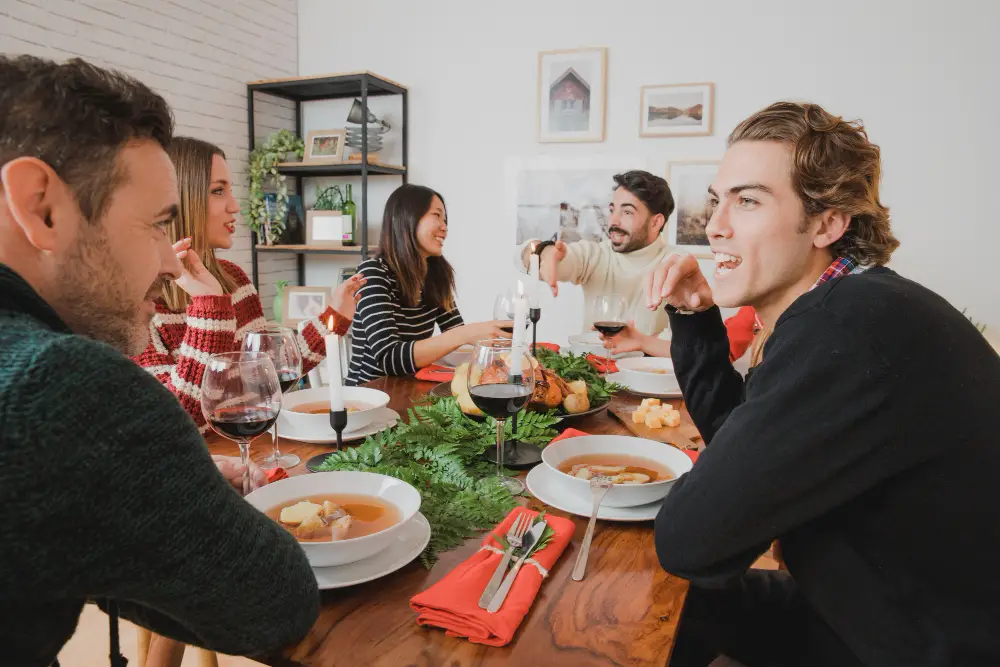
The table that night held everything my mother believed a table should hold. The good china, cream with a thin gold rim, brought out of the cabinet where it lived behind glass three hundred and sixty days a year. Cloth napkins folded into little peaks. A roast that had been in the oven since two in the afternoon, and my mother’s rolls, and the green beans done the way only she could do them. It was, in every visible way, a picture of a happy family, and I had learned long ago that the picture was the point. What mattered in our house was how things looked from the outside, and from the outside, the Whitmores looked wonderful.
She and her husband, Marcus, were expecting their first child.
The table erupted. My mother actually cried, pressing a napkin to the corners of her eyes so as not to smudge her makeup. My father stood and shook Marcus’s hand and clapped him on the shoulder and called for the good wine, the bottle he saved for occasions he considered worthy of it, the one that lived on its side in the rack and came down maybe twice a year. And I was happy. I want to be clear about that, because of what came later. I was genuinely, wholeheartedly happy for my sister. I got up and walked around the table and hugged her, and I meant it, and I told her she was going to be a wonderful mother, and I felt the small hard knot of my own childlessness, which I carried always, and I set it aside, because this was her moment and she deserved to have it be entirely hers.
Then my father raised his glass, and the whole table quieted to hear him, because when Richard Whitmore had something to say, the room made room for it. He was that kind of man. He filled a space. People leaned in when he spoke, and he had spent a lifetime enjoying that they did.
To the future of the Whitmore family, he said. To my grandchild, who will carry on our name and everything we’ve built.
We all raised our glasses. And then he looked at me, and he added, almost as an afterthought, almost lightly, You know, Eleanor, this is what family is really about. Real family. Blood.
The words landed in my chest like a stone dropped into still water. Real family. Blood. I set my glass down slowly. Across the table, my mother’s eyes flicked away from mine. Vanessa suddenly found her plate fascinating. And I understood, in that quiet, that this was not a slip of the tongue. It was a line being drawn, out loud, in front of everyone, with a raised glass.
You see, I am adopted. My parents adopted me when I was three years old, after years of trying and failing to have a child of their own. And then, as these things sometimes go, two years after they brought me home, my mother became pregnant with Vanessa. The miracle baby. The natural child. And from that point on, though it took me most of my childhood to find words for it, I had always been the daughter who was chosen, in a family that clearly preferred the daughter who simply arrived.
I do not want to paint my childhood as some gothic horror, because it was not. There were no locked doors, no cruelty you could point to and name. My parents fed me and clothed me and sent me to good schools and told me they loved me, and I believe, in their limited way, they did. But children are seismographs for the things adults do not say. I knew, long before I could have explained it, that when relatives visited they cooed over Vanessa in a slightly different register than the one they used for me. I knew that when my mother told the story of Vanessa’s birth, her voice filled with a wonder that was simply absent when she told the story of my adoption, which she told less as a miracle and more as a piece of family history, the way you might explain how a particular painting came to hang in the hall. I knew that the word blood, in that house, was always spoken warmly, and that I was always, very slightly, outside the circle it drew.
I had spent thirty years pretending I did not notice. Pretending I did not hear the difference in how they spoke about the two of us. Pretending the word blood, which came up more often than you might imagine in that house, did not have a barb in it aimed directly at me. I had become, out of long practice, a person who absorbed these small wounds without flinching, who smiled and passed the dish and told herself she was imagining things, because the alternative, admitting she saw it clearly, was unbearable.
Dad, I said, keeping my voice as steady as I could manage. I’m family too.
He smiled at me, and it was not an unkind smile, which somehow made it worse. Of course you are, sweetheart, he said. We love you. But you understand what I mean. It’s different. It’s not the same thing.
And that was it. That was the whole conversation. My mother changed the subject to nursery colors, and Vanessa laughed at something Marcus said, and the dinner rolled on as though a wall had not just been built down the center of the table with me on the wrong side of it. I sat there and I smiled and I passed the potatoes, and inside me something very old and very tired finally, quietly, broke.
I need you to understand what I had given to that family, because it matters to everything that came after. My father owned a restaurant. Not just any restaurant. Whitmore’s was a landmark, a white-tablecloth institution that had been serving the city for thirty-five years, the place people came for anniversaries and engagements and the dinners after funerals, the place with a name that meant something. My father had built it, yes. But for the last twelve years, I was the one who had kept it alive.
I had a degree in business and a second one, hard-won at night, in culinary management, and after college I had come straight home to work at the restaurant, and I had never left. I started at the host stand and I learned every single job in that building, one after another. I bused tables. I worked the line until my forearms were a map of burn scars, small pale marks I can still read like a diary. I learned the books, the vendors, the payroll, the impossible arithmetic of a business that operates on margins thin as a knife blade. And somewhere in those twelve years, without anyone quite deciding it out loud, I became the person who actually ran Whitmore’s.
I did not take a salary that reflected any of it. That is a thing I need to say plainly, because it matters to what came later. My father paid me a manager’s wage, a fair one for a manager, and I did the work of a manager and an executive chef and a general manager and a chief financial officer and an owner, all at once, and I never once asked to be paid for the difference. I told myself it was a family business, that the money was all in the family anyway, that it would come to me in the end. I believed that. I actually believed that. I deferred my own worth for twelve years on the strength of a promise no one had ever actually made me out loud, a promise I had simply assumed was there because I was, I thought, a daughter.
I was the one who came in at six in the morning to receive the fish delivery and stayed past midnight to reconcile the register. I was the one who negotiated with the linen service and the wine distributors and the man who serviced the walk-in cooler. When the head chef quit without notice on a Friday in December, it was me who ran the kitchen through the entire holiday rush, sleeping four hours a night, my hands cramping, my feet swollen, my whole body one long ache, and I did it without complaint because I loved the place and because the alternative was to watch it fail. When the pandemic nearly killed us, it was me who reinvented the whole operation, built the takeout program from nothing, applied for every relief loan and grant I could find, cut deals with suppliers who were themselves going under, and kept every single one of our employees on payroll when other restaurants up and down the street were going dark for good, their chairs stacked in the windows, their names peeled off their doors. I saved my father’s life’s work. I did it with my own two hands, and I did it because I loved it, and because on some level I could not name at the time, I believed that if I just gave enough, I would finally be enough.
My father took the credit publicly, of course. He was the face, the name over the door, the man who worked the dining room shaking hands and accepting compliments about a kitchen he had not cooked in for a decade. And I let him have it, because I told myself it did not matter who got the applause as long as the place I loved survived. I told myself that a lot. I told myself a great many things in those years, and most of them were versions of the same thing, which was that my worth would be recognized eventually, if I was only patient enough, and gave enough, and asked for little enough in return.
Vanessa, meanwhile, had nothing to do with the restaurant. She had gone into interior design, married Marcus, an accountant, and built a comfortable life across town. She would come to Whitmore’s for free dinners and post photographs of herself at the best table, tagging the restaurant, calling it the family business, my family’s restaurant, and I never once corrected her, because I did not want to be petty, because she was my sister and I loved her.
So when my father raised that glass and told me, in front of everyone, that real family meant blood, he was not just wounding a daughter. He was saying it to the woman who had given twelve years of her life to keep his name alive. That is the part that I could not get past, lying awake that night. Not the words alone, but everything the words ignored.
Two weeks after that dinner, my father called me into the restaurant office on a Monday, our closed day, when the place was empty and quiet. He was sitting behind the desk that I, in truth, used far more than he did. My mother was there too, standing by the filing cabinet, which I found strange. My mother rarely came to the restaurant. She did not like the smell of the kitchen in her clothes, she said. Her being there told me, before a word was spoken, that this was not an ordinary conversation.
Eleanor, my father said. Sit down. We need to talk about the future.
I sat. And I listened as my father explained, in the reasonable, measured tone he used for delivering things he had already decided, that he and my mother had been thinking about their estate. About legacy. About what would happen to Whitmore’s when he was gone. He talked for a while about mortality, about getting older, about wanting to have things settled so there would be no confusion, no fighting, when the time came. He said it all gently, the way you might lead up to bad medical news, and some animal part of me knew what was coming before he said it.
We’ve decided, he said, that the restaurant should stay in the bloodline. It’s important to us. So we’re going to be leaving Whitmore’s to Vanessa. And to the baby, when it comes.
I did not say anything at first. I could not. The room seemed to tilt, and I was aware of my own heartbeat, and of the hum of the walk-in cooler through the wall, a sound I had heard ten thousand times and never once, until that moment, heard as the sound of something that was being taken from me.
Now, my father went on, filling the silence because I would not, we’d love for you to stay on. You do good work here, Eleanor, we all know that. Nobody’s saying otherwise. You could keep managing the place, keep everything running the way you have. Vanessa doesn’t know anything about restaurants, obviously, so she’ll need someone reliable at the helm. You’d be taken care of. A good salary. Job security. It would all keep going just the way it has. Nothing really changes for you day to day.
Nothing really changes for you. As though the day to day were the point. As though I had given twelve years to the day to day and not to the belief that I was building something that was, in some real way, partly mine.
I looked at my mother. She was studying the filing cabinet as though it held the secrets of the universe. She would not look at me. That was its own answer.
You want me, I said slowly, to keep running the restaurant. For Vanessa. Who will own it. Because she was born and I was adopted.
My father’s face tightened. Don’t make it ugly, Eleanor, he said. It’s not about that. It’s about keeping the family legacy intact. There’s a right way for these things to pass down. It’s about blood, yes, I won’t apologize for that, it’s how it’s always been done. You have to understand how these things work.
I understood perfectly. I understood that I was to spend the rest of my working life as the reliable manager, the loyal retainer, keeping the family business running so that it could be handed down through a bloodline that had made very clear I was not part of. I understood that twelve years of my life had been quietly reclassified, in that office, from love into labor. I understood that I had been, all along, an employee they happened to have raised, and that the raising had been, in their private accounting, a kind of charity that did not come with the rights of the real thing.
Can I think about it, I said.
Of course, my father said, magnanimous now that the hard part was done, now that I had not made a scene. Take all the time you need, sweetheart. And when I stood to go, he smiled at me with what I think he genuinely believed was warmth, and he said, We’re glad you’re taking it so well. We knew you would. You’ve always been the sensible one.
The sensible one. I drove home with those words rattling in me. That was the role I had been assigned at birth, or at three years old, whenever the assigning happened. Vanessa was the treasured one and I was the sensible one, the useful one, the one who could be counted on to take it well. And I had played that part so faithfully, for so long, that they had come to believe it was simply my nature, that I would absorb any wound if you delivered it in a reasonable enough tone.
I drove home and I sat in my apartment in the dark for a long time, and I did the thing I always did when my world came apart, which was to stop feeling and start thinking. Because here is what my father, in all his talk of bloodlines and legacy, had never once bothered to understand.
He did not actually own Whitmore’s outright. Not anymore. Not for a long time.
During the pandemic, when the restaurant was drowning, I had been the one to restructure everything to save it. The banks were not lending to restaurants, not then, not to a thirty-five-year-old white-tablecloth place hemorrhaging money with its dining room shut by order of the state. To secure the relief financing and renegotiate the lease and bring in the operating capital we desperately needed, I had formed a management company, a proper legal entity, on the advice of an accountant who told me it was the only structure that would work. And I had put my own money into it. Not a little. All of it. The entire inheritance my grandmother, my adoptive grandmother, the one person in that family who had ever loved me without conditions or asterisks, had left me when she died. Ninety thousand dollars, which was every dollar I had in the world.
I had poured all of it into Whitmore’s when Whitmore’s was going under, and in exchange, in the documents my father signed without reading closely, because reading closely was never his strength and trusting me to handle it was a habit of twelve years, that management company had taken a significant ownership stake in the business. A stake proportional to the money and the risk I had brought when no one else would bring any. And I owned that management company. Entirely. It was mine, formed in my name, funded with my grandmother’s money, carrying loans I had personally guaranteed with my own signature and my own credit.
My father thought he was giving Vanessa the restaurant. But you cannot give away what is not entirely yours.
I remember the exact moment I understood the full shape of it, sitting on my couch in the dark with my laptop open to the operating agreement I had drafted two years earlier and never once thought of as a weapon. It had been an act of desperation and love, that agreement, a way to save a sinking thing. It had never occurred to me, signing it, that I was also, without meaning to, making myself impossible to erase. My father could write me out of his will. He could hand Vanessa every share he personally held. And at the end of all of it, I would still own forty-one percent of Whitmore’s, and there was not a single thing he could do about it, because it was not his to take.
I want to be honest that my first feeling, sitting in the dark that night, was not triumph. It was grief. Deep, disorienting grief, the kind that has no clean edges. Because I did not want to own Whitmore’s out from under my family. I had never wanted that. I had wanted to be loved. I had wanted, just once, for my father to raise a glass and say to the future of this family, and mean me, mean me first, mean me without a qualifier. The ownership stake had never been a scheme. It had been the only way to save a thing I loved, executed at a moment when I was not thinking about inheritance or leverage or self-protection, only about keeping the lights on and the staff paid. That it had now become the thing that could save me was an accident, a bitter one, and I sat with the bitterness of it for a long time before I did anything at all.
But my father had drawn a line, out loud, in front of everyone. He had told me exactly who he thought I was and exactly what he thought I was worth. And I remembered my grandmother, near the end of her life, when I sat by her bed and she held my hand in her papery one and said, Eleanor, you are worth more than they will ever let you believe. Don’t wait for them to tell you. Know it yourself. She had seen it, even then. She had seen the whole shape of my family clearly, the way the very old sometimes see things, and she had tried to arm me against it with the only weapon she had, which was the truth, and ninety thousand dollars, which I had promptly poured into the very people she was warning me about. There was a terrible symmetry in that. Her money, given to protect me, had ended up saving them, and now, at last, it was going to protect me after all, just as she had intended, only by the longest and strangest possible road.
I called a lawyer the next morning.
Her name was Patricia Cho, and she specialized in business and estate matters, and she was, I would learn, exactly the kind of person you want in your corner when a family goes to war over a legacy. She reviewed the documents, all of them, the management company formation, the ownership stake, the operating agreements, the loans I had personally guaranteed, and when she finished she took off her glasses and looked at me for a long moment.
Ms. Whitmore, she said, do your parents understand the ownership structure of this business?
No, I said. I don’t think they do.
She nodded slowly. Then I think, she said, you have a great deal more power here than they realize. May I ask you something personal?
I nodded.
Do you want the restaurant, she said. Or do you want out. Because those are two very different strategies, and I can help you with either one, but you have to tell me which one you actually want, not which one you think you should want.
It was a good question, and I did not have an answer for it, not that morning. I told her I did not know. I told her that a week ago the answer would have been simple, that of course I wanted the restaurant, that I had given it my whole adult life. But that a week ago I had also believed I was a member of the family that owned it, and now I did not know what I was, or what I wanted, or who I would be if I stopped pouring myself into that building at six in the morning and past midnight. She listened, and she did not rush me, and at the end she said something I have never forgotten.
Then let’s protect your options, she said. Let’s make sure that when you do know what you want, no one can take the choice away from you. Right now they think they hold all the cards. Let’s quietly make sure that isn’t true, and then you can decide from a position of strength instead of fear. Nobody makes good decisions from fear.
Over the following weeks, quietly, I put my affairs in order. I did not announce anything. I did not confront anyone. I went to work every day and ran the restaurant exactly as I always had, received the fish delivery, reconciled the register, smiled at the regulars, and all the while, in the evenings, in Patricia’s office, I built my foundation. I understood, for the first time truly, exactly where I stood. My grandmother’s money, documented. The loans in my name, documented. The personal guarantees, the ownership percentage, the twelve years of unpaid overtime and deferred salary that I had never once claimed and that Patricia said, with quiet professional interest, might be worth a great deal on their own. I built the record, piece by piece, and with every piece I felt something in me shift, some old cowering thing beginning, cautiously, to stand up straight.
And then I told my father I had made my decision about his generous offer.
We met again in the restaurant office. My father, my mother, and this time Vanessa too, glowing already with early pregnancy, sitting in the chair that I had bought for that office with my own money. They had the look of people who believed they were about to receive good news, the easy relaxed posture of a family that has already decided how a conversation is going to go. My father was even a little jovial. He offered me coffee. I declined.
Well, my father said, smiling. Have you thought it over?
I have, I said. And I’ve decided that I’m not going to stay on as manager.
His smile faltered. Eleanor.
Let me finish, I said. I’m not going to manage Whitmore’s for Vanessa. Because Whitmore’s is not entirely yours to leave to her.
The room went very still. I watched the jovial ease drain out of my father’s face and something more careful take its place.
What are you talking about, my father said.
I slid a folder across the desk. Patricia had prepared it, clean and clear and impossible to argue with, tabbed and organized the way she organized everything. During the pandemic, I said, when the restaurant was three months from closing for good, when the banks wouldn’t touch us and you were talking about just letting it go, I formed a management company and I invested my grandmother’s entire inheritance, ninety thousand dollars, every cent I had, to keep it alive. In exchange, that company holds a forty-one percent ownership stake in the business. You signed the agreement, Dad. That’s your signature on the last page. I didn’t hide it from you. You just didn’t read it, because you never read anything, because you trusted me to handle the parts you found boring. I own that company. Which means I own forty-one percent of Whitmore’s.
My father opened the folder with hands that were not quite steady, and I watched him read, and I watched the color leave his face the way water leaves a sink, all at once, from the top down.
This isn’t, he started. This can’t be right. This isn’t what I signed.
It’s exactly what you signed, I said. Patricia Cho, my attorney, can walk you through every line of it, and so can the accountant who set it up, and so can the bank that holds the loans I personally guaranteed to save your restaurant. It’s right, Dad. It’s been right for two years. You just never knew, because you never had to know, because I was handling it.
Vanessa looked between us, her brow furrowed, one hand resting on the small curve of her belly. What does that mean, she said. Forty-one percent. So Dad still owns most of it. He still owns more than you.
Fifty-nine percent, I said. Yes. But here’s the thing, Vanessa. That fifty-nine percent is worth a great deal less than it sounds, because the restaurant only works if someone runs it, and none of you knows how. You don’t know the vendors, or which of them will extend us credit in a bad month and which will cut us off at the first late payment. You don’t know the books. You don’t know how to make the payroll come out when the numbers don’t want to, or how to keep the health inspector happy, or what to do when the walk-in cooler dies on a Saturday night in July with a full dining room and eighty covers still on the books. I do. I’m the only one who does. Twelve years, and I’m the only one who does. And I’m leaving.
My mother spoke for the first time. Eleanor, she said, you wouldn’t. You love this place. You’ve always loved this place.
I do, I said, and my voice broke a little on it, because it was true and it was the truest thing in the room. I love it more than any of you ever understood. I gave it twelve years. I gave it my grandmother’s money and my health and every relationship I didn’t have time to build because I was here at midnight reconciling the register while other people my age were falling in love and having children and building lives. I love it. And you looked at all of that, at everything I gave, and you decided it counted for nothing, because I wasn’t born into the right blood.
My father slammed the folder shut. This is blackmail, he said. This is you holding my own restaurant hostage.
No, I said. Blackmail is when you threaten to take something that isn’t yours to force someone’s hand. I’m not taking anything. I’m not threatening anything. I’m telling you the plain truth about what I own and what I’ve decided to do with my own life. I’m resigning. Effective in thirty days, which is more notice than you’d give any other employee, and we’ve established that’s what I am. What you and Vanessa choose to do with your fifty-nine percent of a restaurant that none of you can operate is entirely up to you. It’s your legacy. It’s your blood. Run it yourselves.
I stood up.
You’d destroy the family business, my father said, and there was something new in his voice now, something that had never been there when he spoke to me, something close to panic. Out of spite. Out of hurt feelings.
I turned in the doorway and looked at him, and I felt, for the first time in my life, entirely unafraid of him. No, Dad, I said. I saved the family business. Twice. Once from bad management over twenty years and once from a plague. And you thanked me, both times, by standing up at a dinner table and telling me I wasn’t really family. So I’m not destroying anything. I’m just declining to keep giving my one and only life to people who’ve made it as clear as it can possibly be made that they don’t want me. They only want what I can do for them. And I’ve finally decided that isn’t the same as being loved, and I’m not going to accept it as a substitute anymore.
And I walked out.
The thirty days that followed were the strangest of my life. My phone rang constantly. My father, alternating between fury and pleading, sometimes within the same call. My mother, guilt and reproach in equal measure, telling me I was breaking my father’s heart, that I was being cruel, that after everything they had done for me, taking me in, raising me, giving me a home, this was how I repaid them. That word again, underneath everything. Given. Taken in. As though thirty-two years of being their daughter had been a favor with an invoice attached, coming due at last. And Vanessa, who had never in her life had a serious conversation with me about the restaurant, suddenly calling to ask my thoughts on vendors and staffing and the wine list, as though she might absorb twelve years of hard-won knowledge in a month by asking the right questions in the right order.
I answered honestly when they asked practical questions, because I was not cruel and I did not want the place to fail, not really, not in my heart, whatever I had said in that office. But I did not bend. I trained no successor, because there was no one to train and thirty days was not enough time even if there had been. I documented my processes as thoroughly as I could and left the binders stacked on the office desk, labeled and organized, a gesture of more generosity than they had earned, a small act of love for the building itself if not for the people who thought they owned it. And on my last day, I walked through the dining room one final time before service, past the tables I had set ten thousand times, past the host stand where I had started, past the kitchen where my forearms had earned their scars, and I let myself cry, just for a moment, alone in the empty dining room with the afternoon light coming through the front windows, and then I dried my face and I left my keys on the desk beside the binders and I drove away without looking back.
The silence after was enormous. I had structured my entire adult life around that restaurant, every waking hour bent toward it, and now the hours were simply mine, empty and echoing, and I did not know what to do with them. I slept, at first, more than I had slept in years. I took long walks. I sat in coffee shops in the middle of the day like a person on permanent vacation, and I watched other people go about their lives, and I tried to remember who I had been before I was the woman who ran Whitmore’s, and found that I could barely remember her at all, because I had become the restaurant so completely that without it I was not sure what was left.
Within two months, Whitmore’s was in serious trouble. My father hired a manager from outside, a man with an impressive resume and a confident manner and no understanding whatsoever of the particular machine that Whitmore’s was, of its rhythms and its regulars and its thousand small unwritten rules, and the man lasted six weeks before he and my father parted ways in a shouting match that half the staff witnessed. The vendors, used to dealing with me, used to my reliability and my relationships, grew frustrated with the chaos and the late payments and the calls that went unreturned. Two of the longtime cooks, men who had stayed all those years partly out of loyalty to me and the culture I had built in that kitchen, quit within the same month. The reviews began to slip, first a little, then a lot. The food went out inconsistent. The service faltered. The regulars noticed the difference, the way regulars always do, the way you notice when an old friend starts to look unwell, and one by one, quietly, some of them stopped coming.
I heard all of this secondhand, from former coworkers who still texted me, from the grapevine of a small city’s restaurant world, from the visible and public fact of the restaurant’s fading reputation. And I will not pretend there was no part of me that felt vindicated, because there was, a small hard knot of it, the part of me that had been told I did not matter and was now watching exactly how much I had mattered become undeniable. But mostly, and this surprised me, I felt sad. Deeply, genuinely sad, because I had loved that place, had poured my life into it, and watching it decline was like watching an old friend get sick and being unable to do anything but hear the reports.
Then, about four months after I left, my father called, and his voice was different. The fury was gone. The pleading was gone. What was left was something I had never once heard from Richard Whitmore in my entire life. It was fear.
Eleanor, he said. We’re going to lose it. The restaurant. We’re going to lose everything.
I said nothing.
I need your help, he said. I don’t, he stopped, and started again. I don’t know how to do this without you. I never did. I know that now.
There it was. Twelve years, and it had taken the near destruction of everything for him to say a version of the truth out loud. I don’t know how to do this without you. I never did. I sat with the phone against my ear and I did not answer right away, and in the silence I could hear him breathing, this man who had never once, in my whole life, admitted he needed anything from me.
I could have said no. I want you to understand that I could have, and that I sat with that option for a long time in the days that followed, because they had earned a no. Every reasonable person I told the story to, and there were a few by then, Patricia among them, said the same thing, that I owed them nothing, that I could let it all collapse and walk away with my forty-one percent of the wreckage and never look back, and no one would blame me. That is the ending the angry knot in my chest wanted. To watch the place go dark. To let them sell the tables and the chairs and peel the name off the door, and to feel, at last, the clean cold satisfaction of a debt repaid in kind.
But I found, when I truly sat with it, that I did not want to be the person that ending would make me. My grandmother had not raised me, in the small and important ways she managed before she died, to burn things down. She had raised me to know my own worth, which is a different thing entirely, and I had come to understand, in the four quiet months since I left, that these were not the same. Knowing your worth does not require you to destroy the people who failed to see it. It does not even require them to admit they were wrong, though it is sweeter when they do. It only requires you to stop letting them be the ones who decide what you are worth. I had spent thirty-two years letting them hold that pen. I did not need to snap the pen in half. I only needed to take it back.
So I did not say no, and I did not say yes. I told my father I would think about it, and I called Patricia, and over the next two weeks we built an offer, and it was not the offer of the daughter begging to be let back in, grateful for scraps. It was the offer of a woman negotiating from strength, which is what I had finally, at great cost, become.
I would come back, I told him when we met, in that same office, though this time it was only the two of us. I would save Whitmore’s again, because I loved it and because I was the only one who could, and we both knew both of those things were true. But not as the manager. Not as the reliable retainer keeping the seat warm for the bloodline, not as an employee they happened to have raised. I would come back as what I already legally was, a co-owner, an equal partner, my name on the documents and eventually on the door beside his. I would buy an additional stake at a fair valuation, an independent appraiser’s number, not a discount and not a premium, enough to make me a true and unmistakable partner, and I would fund it not with cash I did not have but with the deferred salary and the unclaimed overtime that Patricia had documented across twelve years, money I was genuinely owed and had simply never taken, because I had believed, foolishly, that I was building something that was already mine.
And, I said, the talk about blood ends. Forever. Not because I’m demanding you love me. You can’t demand love, I’ve learned that much, and I’ve stopped trying to earn it, which is a kind of freedom I never expected. But if I am going to give this place my life a second time, I will not do it while being told I’m not really part of the family that owns it. Those are my terms. All of them, together, not a menu to choose from. Take them, or lose the restaurant. It’s genuinely up to you, Dad. I’ll be all right either way now. That’s the part that’s changed. I’ll be all right either way.
My father was quiet for a long time. He looked older than he had four months earlier, smaller somehow, the bluster all gone out of him. And then, in a voice thick with something I had waited my entire life to hear, he said, You were always more of a Whitmore than any of us, Eleanor. You worked harder, you loved it more, you gave it more than I ever did. I was too much of a fool and too much of a coward to say it, and I told myself a story about blood because it let me off the hook for how much I’d taken from you. I’m ashamed of that dinner. I’m ashamed of what I said in this office. I accept your terms. All of them. And I’m sorry. I know that word doesn’t buy back twelve years. But I’m sorry.
We did not fall into each other’s arms. It was not that kind of story, and I did not want it to be, because I no longer trusted easy reconciliations, the kind that let everyone off the hook without anything actually changing. But it was a beginning, an honest one, built on paper and plain words and an independent appraiser’s valuation instead of the performance of family we had staged at that long table every Sunday for thirty years. The estate plan was redrawn too, as part of it, to reflect what was actually true, which was that I had built and saved this business and had every right to inherit my full share of it alongside Vanessa, not as a favor, not as charity, but as what I had earned. My father signed all of it, every page, and this time, I made certain, he read every line before he did.
Vanessa was harder. Much harder. When she learned that the estate plan was being redrawn, that Whitmore’s would not simply be handed down to her child the way she had been promised, she was furious, and we had a terrible fight, the worst of our lives, in the very office where all of this had started. Years of things neither of us had ever said came pouring out of both of us at once. She accused me of stealing her inheritance, of manipulating our grieving, aging father, of always having secretly resented her. I told her she could not steal what had never been hers, that she had spent her entire life posting photographs of a restaurant she had never once worked a single shift in, calling it her family’s business, my family’s restaurant, while I bled for it in the back with burns on my arms and the books in my head. I told her I had covered for her my whole life, had smiled while our parents treated her like the treasure and me like the help, and had never once said a word. She cried. I cried. It was ugly and loud and long, and it was, I understood even in the middle of it, absolutely necessary, the kind of fight that either ends a relationship for good or finally clears the poisoned ground so that something real might grow.
In the end, slowly, over more than a year, we found our way to something new, something neither of us had ever actually had, which was an honest relationship between equals instead of the rivalry two parents had quietly engineered between us and then pretended not to see. It helped that her daughter was born, a bright, fierce little girl named Grace, with a laugh that could fill a room. And it helped enormously that I discovered I could love that child without any of the old poison in it, could be her aunt Eleanor completely and without reservation, chosen family loving a child into the world with my whole heart. It helped that Vanessa, watching me pull the restaurant she had assumed anyone could run back from the edge of ruin, finally understood, in a way she never had before, what I had actually been doing all those years, the sheer scale and difficulty of it. She apologized to me one evening, unprompted, sitting in the restaurant office after close with a glass of wine, and it was halting and imperfect and completely real, and I accepted it, and something between us that had been broken since before either of us could remember quietly began to knit.
Whitmore’s recovered. Of course it did, because I came back and I ran it the way it needed to be run, and this time I ran it as an owner whose name would be on the door, not as a servant keeping someone else’s seat warm. The vendors returned, relieved to be dealing with me again, to have their calls answered and their invoices paid on time. The old cooks came back when I called them personally and told them things were different now, and I explained how they were different, and they believed me because I showed them the paperwork. The regulars drifted in again, cautiously at first and then in force, the way people return to a restaurant when word gets around that it has found itself again. The reviews recovered and then climbed higher than they had ever been, because now the whole staff could feel that the person running the place was running it out of ownership and love rather than obligation and quiet resentment, and you can taste that difference in the food, you can feel it in the warmth of the room, even if you could never quite name it.
Within a year the place was not just surviving but thriving, better than it had been in its entire thirty-five-year history, and I want to be clear that this was not luck. It was the direct result of a person doing, freely and as an equal, the work she had once done in silent hope of being loved. The work was the same. Everything around the work was different.
My father worked the dining room for another year, shaking hands, greeting the regulars by name, and then he retired for real, and he did it gracefully, which surprised me, because grace had never been his strong suit. At the small party we threw for him, staff and family and a few of the oldest regulars crowded into the private room, he stood up with a glass in his hand, the way he had at that terrible Sunday dinner two years before, and the room went quiet to hear him the way rooms had always gone quiet to hear Richard Whitmore. But he was not the same man who had raised that first glass. And what he said was not the same.
To my daughter Eleanor, he said, and his voice was not steady, this man who had spent a lifetime being steady in front of a crowd. Who saved this place twice, when I could not, and who is more this family than I ever had the sense to know, or the courage to say. I spent too many years measuring family by the wrong thing entirely. I know better now. She taught me better, at considerable cost, most of it to her. To the future of Whitmore’s, which is safe, at long last, in the right hands.
I cried that time too. But it was an entirely different kind of crying than I had done at that first dinner, smiling and passing the potatoes while something inside me broke. This was the other kind, the kind that comes when a thing you had given up ever hearing is finally, unmistakably said out loud, in front of everyone, with a glass raised.
My name is on the door now, beside his. Whitmore and Whitmore. When I hired the sign painter to add it, I stood on the sidewalk in the cold and watched him work, watched my own name take shape in gold letters on the glass beside my father’s, and I thought about my grandmother, who had given me ninety thousand dollars and a single true sentence and who would have loved to see this, and I thought about the girl I had been at that long dining table, smiling and passing the potatoes while something inside her quietly came apart. I wished I could reach back through the years and put a hand on that girl’s shoulder and tell her what I know now, that the wound she was pretending not to feel was real, that she was right to feel it, and that it would not, in the end, be the thing that defined her.
Because here is what I finally learned, at thirty-two, after nearly losing all of it. Blood is not the only thing that binds a family. Sometimes it is not even the strongest thing. What binds a family is who shows up, and who stays, and who bleeds for the thing you all claim to love, and who tells you the truth when a comfortable lie would be so much easier. I was chosen once, at three years old, by two people who did not fully understand what they were choosing, who thought they were getting one kind of child and got another, and who spent thirty years quietly wishing I had come to them the ordinary way. And in the end I chose them right back, but on my own terms this time, as an equal, worth exactly as much as anyone who had ever sat at that table, and finally, at long last, unwilling to accept a single ounce less than that.
I was wrong, all those years, to believe that blood was the only real bond. I had built my whole sense of myself around that belief, around being the one who fell outside the circle it drew, and it had nearly cost me my life, or at least the only life I had, given away an hour at a time to people who let me. But I was also right about one thing, without ever knowing I was right, all through those years of smiling and giving and waiting to be enough. I was always family. I had always been family. It simply took me thirty-two years, and a raised glass that cut me to the bone, and the near ruin of the thing I loved most, to stop waiting for someone else to say the words, and to say them, at last, in my own voice, to myself, and to mean them.
And that, it turned out, was the only permission I had ever actually needed.

Specialty: Legal & Financial Drama
Michael Carter covers stories where money, power, and personal history collide. His writing often explores courtroom battles, business conflicts, and the subtle strategies people use when pushed into a corner. He focuses on grounded, realistic storytelling with attention to detail and believable motivations.