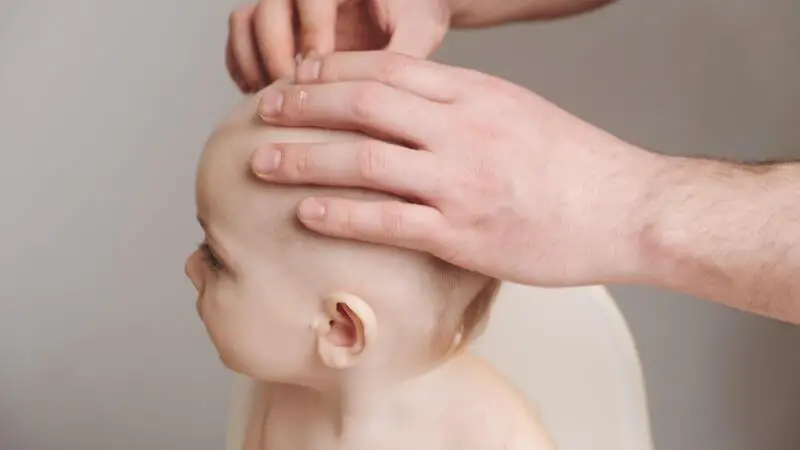
“They shave little thieves so they’ll learn what shame feels like!”
My mother-in-law’s voice carried through the apartment while I held my three-year-old daughter against my chest.
Emma was completely bald. Her whole body was trembling, and her tiny hands shook so badly she couldn’t hold on to my blouse.
I had just gotten back to Chicago after a week in Dallas for work. Every night while I was gone, Emma had asked me the same thing over FaceTime, her small face crowding the whole screen.
“Mommy… are you bringing my chocolate teddy bears?”
Every night, I promised I was. I’d bought them at the airport gift shop the very first evening, a whole bag of them, because I knew she’d ask again the next night and the night after that, and I wanted to be able to say yes and mean it.
During the flight home, I kept picturing her racing toward the door with that crooked little smile she got whenever she was excited, the one where her whole face seemed to tilt to one side.
Instead, I walked into the apartment and found my daughter barefoot on the enclosed balcony, facing a brick wall.
She was wearing thin pajamas. January wind rattled the windows, and her freshly shaved scalp was red from the cold, little nicks along one side where whoever had done it hadn’t been careful.
Then she heard me.
“Mommy…”
She turned, and tears immediately rolled down her face.
“I didn’t take anything.”
The shopping bags slipped out of my hands and hit the floor. The bag of chocolate teddy bears split open, little foil-wrapped shapes scattering across the tile, and I stepped right over them without a second thought.
I ran to her. Emma was freezing, her skin cold to the touch in a way that made something in my chest lurch sideways. The second I picked her up, she buried her face against my shoulder and started sobbing so hard I could barely understand her.
“What happened?” I asked, my voice already shaking.
She kept saying the same thing.
“I didn’t steal. Mommy, I didn’t steal.”
Before she could tell me more, Margaret Dawson walked out of the kitchen, drying her hands on a dish towel like this was an ordinary evening, like she’d just finished the dishes after a nice family dinner.
My mother-in-law looked completely calm.
Lauren, my sister-in-law, was sitting on the couch scrolling through social media, thumb moving lazily across her screen, not even glancing up when I came in. Richard, my father-in-law, leaned against the dining room wall smoking a cigarette, the smell of it thick and stale in a room that was supposed to hold a toddler.
Three adults were standing in that apartment, and not one of them seemed disturbed that a three-year-old had been shaved and left shivering as punishment.
Margaret folded her arms.
“My gold bracelet disappeared. The one my mother left me.”
Then she pointed directly at Emma.
“She was the only one who went into my bedroom.”
I stared at her, feeling something cold and precise settle over the shock, the way ice settles over a pond, thin and hard.
“Emma can’t even reach the dresser where you keep it.”
Lauren gave a quiet laugh, not looking up from her phone.
“You’d be surprised what kids do when no one’s watching. Maybe she saw something shiny. Maybe she put it in her backpack.”
Emma’s arms tightened around my neck, her small fingers digging into the fabric of my coat.
Margaret stepped closer, and I could smell her perfume, the same expensive, cloying scent she’d worn to our wedding four years earlier, the one that had made me sneeze all through the reception.
“She’s just like you,” she said. “You came into this family with nothing. And now your daughter steals from us.”
I could feel Emma’s tears soaking through my blouse, warm against my collarbone even as the rest of her stayed cold.
Every answer I wanted to give Margaret crowded into my throat. Every accusation. Every insult. Every reason a grown woman should have known better than to humiliate a terrified child over something she couldn’t prove. I wanted to ask her how she’d decided a three-year-old, who still needed help buttoning her own coat, had somehow located a bracelet hidden in a dresser drawer, figured out how to open it, and then disposed of it cleanly enough that nobody could find it. I wanted to ask what kind of woman shaves a toddler’s head as a lesson.
But Emma was listening. Emma was cold. Emma needed me more than Margaret needed an argument.
So I didn’t give her one.
I gathered only what Emma and I needed — her favorite blanket from the back of the couch, the diaper bag still sitting by the door where I’d left it a week ago, her small sneakers that I didn’t even bother putting on her feet — and wrapped my coat around my daughter’s shaking body, and carried her toward the door.
Margaret followed behind us, still talking, still insisting humiliation was the only way “a child like Emma” would learn.
“You’re being dramatic, Claire,” she called down the hallway after us. “This is exactly the soft parenting that raises little thieves. David would agree with me if he were here.”
I never turned around.
I drove straight to a hotel near my office, not trusting myself to go to David’s parents’ guest room or anywhere connected to that apartment, not that night. I got Emma into a warm bath first, checking every inch of her small body for anything beyond the shaved head and the cold — bruises, marks, anything — my hands shaking almost as badly as hers had been. There was nothing else, physically. But she flinched every time I moved too quickly near her, and that told me something the absence of bruises couldn’t undo.
I called David from the bathroom while Emma soaked in the warm water, humming quietly to herself now that the worst of the shaking had passed, more interested in a rubber duck than in the disaster that had just happened to her.
“Where are you?” David asked, his voice tight. “Mom just called me. She’s saying you took Emma and left without explanation.”
“Without explanation.” I had to sit down on the edge of the tub, my legs suddenly unreliable. “David, your mother shaved our daughter’s head and left her outside on the balcony in January because she thinks Emma stole a bracelet.”
Silence on the line.
“David.”
“That doesn’t sound like something my mother would do.”
I closed my eyes. David was in Denver for a conference, three states away, and I understood, in some distant, reasonable part of my brain, that he hadn’t seen what I’d seen, that hearing it secondhand over the phone was different from walking into that apartment and finding your child trembling on a balcony. But the reasonable part of my brain was very small and very far away right then.
“I watched our daughter cry that she didn’t steal anything while your mother stood there drying dishes like nothing happened. Lauren laughed. Your father smoked a cigarette three feet from a crying toddler. I’m not making this up, David.”
“I’m not saying you’re making it up. I’m saying—” He stopped himself. I could hear him breathing, could picture him pacing some hotel hallway with his free hand pressed against his forehead, the gesture he made whenever he didn’t know what to do with a feeling. “I’ll fly back tonight. I’ll figure out a flight.”
“Do that.”
“Claire—”
“I have to get Emma out of the bath,” I said, and hung up before he could say anything else, because I didn’t trust what would come out of my mouth if he tried to explain his mother to me one more time.
That night, after Emma finally fell asleep beside me in the hotel bed, curled small and still with one hand fisted in the sleeve of my shirt like she was afraid I might disappear if she let go, I lay awake thinking about Margaret’s missing bracelet.
About how certain everyone had sounded. About how quickly three adults had decided an accusation was enough to justify punishing a three-year-old, without one of them stopping to ask how, physically, a child that size could have pulled off what they were describing.
Then I remembered something everyone in that apartment seemed to have forgotten.
The hidden camera in the living room.
David and I had installed it eight months earlier, after a string of package thefts in the building lobby, a small discreet unit tucked into the bookshelf, angled to catch the front door and most of the living room. We’d told his parents about it once, in passing, during a conversation about building security, and I don’t think either of them had thought about it since. It ran on a cloud storage subscription that kept two weeks of footage before it cycled over, and I’d honestly forgotten about it myself over the past busy week, between packing for Dallas and prepping for a client presentation and calling Emma every night to promise chocolate teddy bears.
I got up as quietly as I could, careful not to jostle the bed, crossed the small hotel room to where my laptop sat charging on the desk, and opened the app.
The camera feed loaded, and I went straight to the footage from before I came home, scrolling back through the timeline to that afternoon, my heart beating so hard I could feel it in my throat.
At first, I saw nothing unusual. Emma wandered through the living room around two in the afternoon, carrying one of her stuffed rabbits, the pink one with the chewed ear that she refused to sleep without. She disappeared down the hallway for a moment, out of frame, then came back a minute later, still carrying the rabbit, both hands full and empty of anything else.
I watched again, slower this time, pausing every few seconds to study the frame.
Then I moved farther ahead in the recording, past a stretch where nothing happened except Margaret vacuuming and Richard reading the newspaper in an armchair, past Lauren wandering in and out of frame with a mug of coffee.
At 3:47 in the afternoon, one of the adults crossed the living room and headed toward Margaret’s bedroom, moving with a particular kind of quickness, a checked-over-the-shoulder quality that made the hair on my arms stand up before I’d even understood what I was watching. A short time later, the same person came back into view with one hand closed around something small, fingers curled tight around it the way you hold something you don’t want anyone else to see.
When that hand opened, just for a second, angled toward the light from the window, a flash of gold caught the camera.
I stopped breathing.
I replayed the clip once. Then again. I needed to be absolutely certain before I let myself believe what I was seeing, needed to rule out every innocent explanation my mind kept trying to supply — maybe they were just going to get something of their own, maybe the gold flash was a phone case, a set of keys, anything.
But there was no ambiguity by the third viewing. Emma hadn’t taken Margaret’s bracelet.
The person on that recording had been inside the apartment while my daughter was accused, shaved, and punished for it.
I froze the video on the clearest frame, my hand hovering over the trackpad, because the face on my screen belonged to someone who was still sleeping under the same roof.
It was Lauren.
I sat there in the dark hotel room for a long time, the laptop’s glow the only light, staring at my sister-in-law’s face frozen mid-stride, her hand curled around her own mother’s stolen bracelet, and I felt something shift inside me that I can only describe as the sound of a door closing very quietly and very finally.
I thought back over the past year, piecing together small things I’d noticed and dismissed because they hadn’t seemed important at the time. Lauren asking David for a loan six months earlier, something about a car repair, though David had mentioned once, off-hand, that she’d never actually gotten the car fixed. Lauren’s job at the boutique downtown that she’d apparently lost sometime in the fall, a fact she’d never mentioned to me directly and that I’d only learned because Margaret complained about it during a Sunday dinner, saying Lauren was “between opportunities.” Lauren’s phone, once, lighting up on the kitchen counter with a text from a number saved only as “Tony — DO NOT ANSWER AROUND MOM,” which I’d glanced at and thought nothing of, assuming it was some ex-boyfriend drama that wasn’t my business.
I hadn’t put any of it together before. Why would I have? Nobody hands you a reason to suspect someone until the moment arrives that makes all the smaller moments make sense in retrospect.
I exported the clip to a separate file, then a second copy to a cloud folder David and I never used for anything else, then a third copy onto a flash drive I kept in my laptop bag for exactly this kind of situation, though I’d certainly never imagined I would need it for something like this. Then I closed the laptop and sat in the dark, listening to Emma’s slow, even breathing beside me, and let myself feel, for the first time since I’d walked into that apartment, something other than fear.
It was fury. Clean, focused, patient fury.
David landed at eleven that night. He came straight to the hotel instead of going home, and when I opened the door he looked at Emma sleeping in the bed, her bald head visible above the blanket, and something in his face cracked open.
“Oh God,” he whispered, crossing the room to kneel beside the bed, one hand hovering over her scalp like he was afraid to actually touch it and make it more real. “Claire, I’m so sorry. I should have believed you the second you called.”
“You believe me now.”
“I believe you now.” He stood, running both hands through his hair, the same gesture Emma made when she was overwhelmed, and I realized, not for the first time, how much of him lived inside her without either of them knowing it. “I called my mother on the way from the airport. She’s still saying Emma took the bracelet. She’s not backing down.”
“She’s not going to back down,” I said. “Because Emma didn’t take it.”
“I know that now, but—”
“David.” I went to the desk and opened the laptop, turning it to face him, the frozen frame of Lauren’s hand still glowing on the screen. “I know who did.”
I watched his face change as he understood what he was looking at, watched confusion give way to disbelief, and disbelief give way, slowly, to something like grief.
“That’s Lauren.”
“That’s Lauren.”
He sat down hard on the edge of the desk chair, staring at the screen. “She stole from her own mother. And let Emma take the blame. And watched her get—” He couldn’t finish the sentence, his jaw working, and for a moment I thought he might actually be sick.
“I need you to understand something,” I said, sitting down across from him, keeping my voice low so I wouldn’t wake Emma. “I’m not showing you this so we can have a family meeting where everyone apologizes and we move past it. I’m showing you this because I need to know, right now, tonight, whether you’re going to stand beside me when I use it, or whether you’re going to try to protect your sister the way you tried to protect your mother on the phone this afternoon.”
David looked at me for a long moment, and I watched him actually think about the question instead of answering reflexively, which told me more than any quick response could have.
“I’m going to stand beside you,” he said finally. “I should have said that the second you called me. I’m sorry it took seeing this.”
“Okay.”
“What do you want to do?”
I thought about it, watching Emma’s small chest rise and fall under the blanket, thought about the shape her life would take if this went unaddressed, if she grew up hearing, in some form, forever, that she was the girl who stole from Grandma once. Children remember things like that in their bodies even when the details fade, and I was not going to let that happen to my daughter because her aunt had gambling debts and her grandmother preferred a story where the newest, least powerful person in the family was the villain.
“Tomorrow,” I said, “we’re going to go back to that apartment. Together. And we’re going to show them exactly what happened.”
We didn’t sleep much that night. David spent an hour on the phone with his cousin, a family law attorney in Milwaukee, walking through what our options were if Margaret refused to acknowledge the truth, if this escalated into something that touched custody or guardianship questions down the road. I sat beside him making notes on a legal pad from the hotel desk drawer, writing down every detail I could remember from the moment I’d walked into that apartment — the exact wording Margaret had used, the time I’d arrived, the state Emma had been in, small physical details like the redness on her scalp and the cold of her skin that I wanted preserved somewhere more permanent than memory.
Around one in the morning, Emma woke up crying, disoriented in the unfamiliar hotel room, and I held her for a long time while she settled, humming the same lullaby I’d been singing to her since she was an infant, feeling the strange, smooth unfamiliarity of her bare scalp under my palm where soft dark curls used to be. She fell back asleep eventually, but I didn’t, not really. I lay there running through everything I planned to say the next day, revising it in my head like a legal brief, because I understood, somewhere underneath the fury, that I would only get one real chance to do this the right way, and I didn’t want emotion to blur the facts when the facts were already so damning on their own.
We arrived at the apartment just after ten the next morning. Emma stayed with a sitter David trusted, a retired teacher who lived two floors below us and had known Emma since she was born, because there was no version of that morning I wanted my daughter present for.
Margaret opened the door already talking, the way she often did, launching into her grievance before either of us had crossed the threshold.
“David, thank God, finally someone with sense. I’ve been trying to explain to your wife—”
“Mom.” David’s voice was quiet, but it stopped her cold. He rarely used that tone with her, and I think the unfamiliarity of it did more to silence her than the actual words could have. “We need to talk. All of us. Is Lauren here?”
Lauren was in fact curled up on the couch in the same spot she’d occupied the day before, scrolling her phone, and she looked up with an expression of mild, put-upon annoyance, as though we were interrupting something important.
“What’s this about?”
“Sit down,” David said. “Everyone.”
Richard emerged from the back bedroom in his robe, looking irritated at being summoned on a weekend morning, and settled into his usual armchair with a heavy sigh, like the whole exercise was beneath him.
I opened my laptop on the dining room table and set it up so the screen faced the couch, my hands steadier than I expected them to be.
“Before we say anything else,” I said, “I want everyone to watch something.”
Margaret crossed her arms, the exact posture from the day before, unmoved. “Is this about the camera? David mentioned you had one installed. I don’t see what footage of Emma wandering around proves anything except that she had access to my room.”
“It’s not footage of Emma,” I said. “Watch.”
I hit play.
The room went very quiet as the clip ran — Lauren crossing toward Margaret’s bedroom, the checked-over-the-shoulder glance, the return with her hand curled tight, the flash of gold when her fingers opened.
Nobody said anything for a long moment. Richard leaned forward in his chair, squinting at the screen as though better focus might change what he was seeing. Margaret’s face had gone very still, an expression I’d never seen on her before, something between disbelief and dawning horror.
Lauren was the first to speak.
“That’s — you can’t even see what’s in my hand clearly, that could be anything—”
“I can enhance the frame,” I said, and I did, zooming in on the paused image, the gold bracelet unmistakable even magnified and slightly blurred, the distinctive twisted rope pattern that Margaret had described to us a dozen times over the years, the one that had belonged to her mother, the one she’d promised, more than once, would go to Lauren someday, not realizing Lauren apparently hadn’t wanted to wait.
“Lauren,” Margaret said, and her voice had lost every ounce of its certainty from the day before. “Tell me that isn’t what it looks like.”
Lauren’s face had gone pale and blotchy, the particular color of someone who has run out of ways to argue with the truth. She looked down at her phone in her lap instead of at any of us.
“I needed money,” she said finally, so quietly I almost missed it. “I was going to put it back. I was going to pawn it just for a few weeks and then buy it back once I got paid, I swear, Mom, I never meant for—”
“You let a three-year-old take the blame,” David said, and his voice had gone somewhere I’d rarely heard it go, flat and cold in a way that made even Richard sit up straighter. “You watched Mom shave her head. You laughed on the couch while Claire held our shaking, freezing daughter. You knew the whole time.”
“I didn’t think it would go that far,” Lauren said, tears starting now, though I found I had very little sympathy left to spare for them. “I thought Mom would just yell at her, or take away a toy, I didn’t think—”
“You didn’t think,” Margaret repeated, and turned to look at her daughter with an expression I hadn’t expected from her, something that looked almost like the beginning of shame. “Lauren, how could you let me do that to her? To Emma?”
“You did it,” Lauren said, some old, ugly family reflex kicking in even now, deflecting outward instead of inward. “I didn’t shave her head, Mom, you did that.”
“Because you let me believe she stole from me!”
The two of them were shouting now, some argument that clearly had roots going back decades, long before any of us in this room, and I let it run for a moment because I needed them to exhaust the first wave of denial before I said what I’d actually come there to say.
“Stop,” I said finally, and something in my voice cut through the noise enough that both of them turned. “This isn’t about the two of you working out your family patterns right now. This is about what happened to my daughter, and what’s going to happen next.”
Margaret’s composure, what was left of it, seemed to crumble further. “Claire, I am so sorry. I don’t know what to say. I was wrong. I was completely wrong, and I hurt an innocent child, and I don’t — I don’t know how to undo that.”
“You can’t undo it,” I said. “That’s the thing you need to understand. You can’t undo the fact that my daughter spent an entire evening believing her own grandmother thought she was a thief worth punishing with humiliation. You can’t undo the fact that she’s three years old and now flinches when I move too fast near her head. There is no version of an apology that puts her hair back, or takes back what she felt standing on that balcony.”
Margaret was crying now, real tears, not the performance of the day before but something that looked like genuine horror at what she’d done.
“What do you want from me?” she asked. “Tell me what to do.”
“I want you to understand that this isn’t a negotiation,” I said. “David and I are not interested in discussing how Emma gets ‘un-punished,’ because there’s no undoing this. What we are interested in is making sure it never happens again, to Emma or to anyone else’s child. That means, going forward, you do not discipline my daughter. Ever. Not a time-out, not a stern word, nothing. If you have a concern about her behavior, you bring it to me or to David, and we handle it. You do not touch her hair, her body, or her belongings without our explicit permission in the room.”
“That’s fair,” Margaret said quickly. “That’s more than fair.”
“It also means,” I continued, “that you owe her an apology. A real one, when she’s old enough and ready to hear it, not today, not forced, but eventually, in a way she can understand. And it means you’re going to have a very different relationship with accusations in this family going forward. If something goes missing, if something breaks, if anything happens that looks like wrongdoing, you do not assume it was the three-year-old just because she’s the newest, smallest person in the room. You ask questions. You gather facts. You do not jump to punishment as a first resort, especially punishment designed to humiliate rather than teach.”
Richard, who had said almost nothing this entire time, finally spoke, his voice rougher than I remembered it. “She’s right, Margaret. This whole family jumps to blame too fast. Always has.”
Margaret didn’t argue with him, which told me something about how deep this particular family pattern actually ran, deeper than just this one incident, deeper than Lauren’s theft, some old inherited habit of looking for someone smaller to hold responsible.
Lauren, for her part, had gone quiet, staring at her hands, and when she finally spoke again her voice was small in a way I’d never heard from her.
“Am I going to be arrested?”
“That’s not up to me,” I said. “That’s between you and your mother, since it’s her property that was stolen. But I want to be very clear about something. If you ever come near my daughter again with anything less than complete honesty and kindness, I will use every piece of evidence I have, and I will not hesitate. Right now, this stays inside this family, because Emma doesn’t need to grow up knowing her aunt is a convicted thief, and I’m not interested in destroying your life for the sake of punishment. But that generosity has exactly one condition attached to it, and the condition is that this never, ever happens again.”
Margaret reached over and gripped Lauren’s arm, not gently, and looked at her daughter with an expression that mixed fury and heartbreak in equal measure. “You’re going to pay me back for that bracelet, and you’re going to get help for whatever it is that made you think stealing from your own family was an option. And you are going to apologize to that little girl someday, properly, whether it’s comfortable for you or not.”
We left an hour later, the conversation having wound down into logistics — David’s cousin drafting a written agreement about boundaries and expectations going forward, Margaret agreeing to family counseling sessions that David had insisted on as a condition of any continued relationship between his mother and his daughter, Lauren agreeing, tearfully, to enter a debt counseling program and to pay back the pawned bracelet, which we later learned she’d sold for less than a third of its actual worth to a shop two neighborhoods over, a detail that told its own story about how desperate she’d been and how little she’d actually thought this through.
Emma’s hair grew back slowly over the following months, first as a soft dark fuzz and then, by summer, into loose curls that framed her face the way they had before. But something else took longer to heal, something I noticed in small ways for a long time afterward — the way she still occasionally reached up to touch her own head when she felt nervous, checking, I think, that it was still there, still hers, still safe.
We didn’t cut Margaret out of Emma’s life entirely, though there were nights in those first weeks when I wanted to. David and I talked about it at length, weighing what was best for Emma against what felt satisfying for us in the moment, and we landed, eventually, on supervised visits only, always in our home or in public, never alone, a boundary Margaret accepted without argument, which surprised me at first and then didn’t, once I understood how thoroughly that morning had shaken something loose in her that she’d apparently needed shaken loose for a long time.
Lauren didn’t come to Sunday dinners for the better part of a year. When she finally did return, quiet and visibly changed, thinner in a way that spoke of stress rather than health, she brought Emma a small stuffed rabbit to replace the one with the chewed ear, which had finally, after years of love, fallen apart beyond repair. She didn’t say much to me directly that first dinner back, but she knelt down at Emma’s level, carefully, and said, “I’m really sorry I let something bad happen to you. It wasn’t your fault. Not any of it.” Emma, three and a half by then and already forgetting most of the specifics, simply hugged the new rabbit and said “thank you” the way she’d been taught to say thank you for any gift, without any of the weight the moment carried for the rest of us.
I kept the footage. I never deleted it, never will, filed away on a drive in a locked box in our closet alongside the passports and the deed to our apartment, not because I ever plan to use it again, but because some part of me needs to know it exists, needs the proof to remain real and findable in case anyone in that family ever tries to rewrite what happened into something softer, something more forgivable, something that centers their embarrassment over my daughter’s fear.
Margaret never fully explained why she’d been so quick to believe the worst of Emma, so quick to reach for humiliation as a teaching tool, but one afternoon, months later, during one of our supervised visits, she said something that stayed with me.
“When David was young,” she said, watching Emma stack blocks on the living room rug, “my own mother did something similar to me. Not the shaving, but the assuming. The punishing before asking. I told myself I’d never do that to my own children, and then somehow I did it anyway, to my grandchild, without even noticing I was repeating it.” She looked at me, something old and tired in her face. “I’m not telling you that to excuse it. I’m telling you because I think you deserve to understand that some of what happened wasn’t really about Emma at all. It was about me, and my mother, and the habits I never actually broke, no matter how much I told myself I had.”
I didn’t forgive her that day, not fully, not in the way that erases what happened. But I understood, a little better, the shape of the thing that had produced that terrible evening, and understanding it made it slightly easier to hold the boundary firmly without needing to hold the anger quite so tightly alongside it.
David and I talked, in the months that followed, about what we wanted Emma to eventually understand about all of it, once she was old enough to ask questions, because we both knew that someday she would ask why she didn’t remember much hair from her toddler years in the family photos, or why Aunt Lauren always seemed a little careful and quiet around her compared to how she was with other kids. We agreed, eventually, on something close to the truth, softened only by age-appropriateness rather than dishonesty — that someone made a very big mistake, that the person responsible admitted it and worked hard to fix what they could, and that Emma had never, not for one single second, done anything wrong.
That last part mattered most to me. Because in the weeks right after it happened, in the quiet moments at two in the morning when Emma would wake up crying for no reason she could name, I understood that the real danger of that night hadn’t only been the cold, or the fear, or even the humiliation itself. It had been the risk that some small, buried part of her might grow up carrying an unearned guilt, some quiet unexamined belief that she’d done something to deserve it, the kind of belief that settles into a person’s foundation before they’re even old enough to argue with it.
I made sure, over and over, in the months and years that followed, that she never had to carry that. Every time the subject came up, however obliquely, I told her the same thing, plainly, without hedging: you didn’t do anything wrong, someone made a mistake, and it was never, ever your fault.
By the time Emma turned five, her hair had grown long enough for the crooked little smile I remembered from the airport to reappear underneath a full head of dark curls again, and watching her run through the apartment some Saturday mornings, chasing the cat, laughing at nothing in particular, I found that the sharp edges of that January evening had softened, not disappeared, but softened into something manageable, something I could hold without it holding me back.
The camera stayed in the bookshelf, still running, still recording two weeks of footage on a loop, and I never told anyone in David’s family it was still there. Not out of malice. Just because some lessons, once learned as painfully as that one, don’t need repeating, but the reminder that the truth is always recoverable, if you’re patient enough and careful enough to look for it, felt like something worth keeping close.

Specialty: Quiet Comebacks & Personal Justice
David Reynolds focuses on stories where underestimated individuals regain control of their lives. His writing centers on measured decisions rather than dramatic outbursts — emphasizing preparation, patience, and the long game. His characters don’t shout; they act.