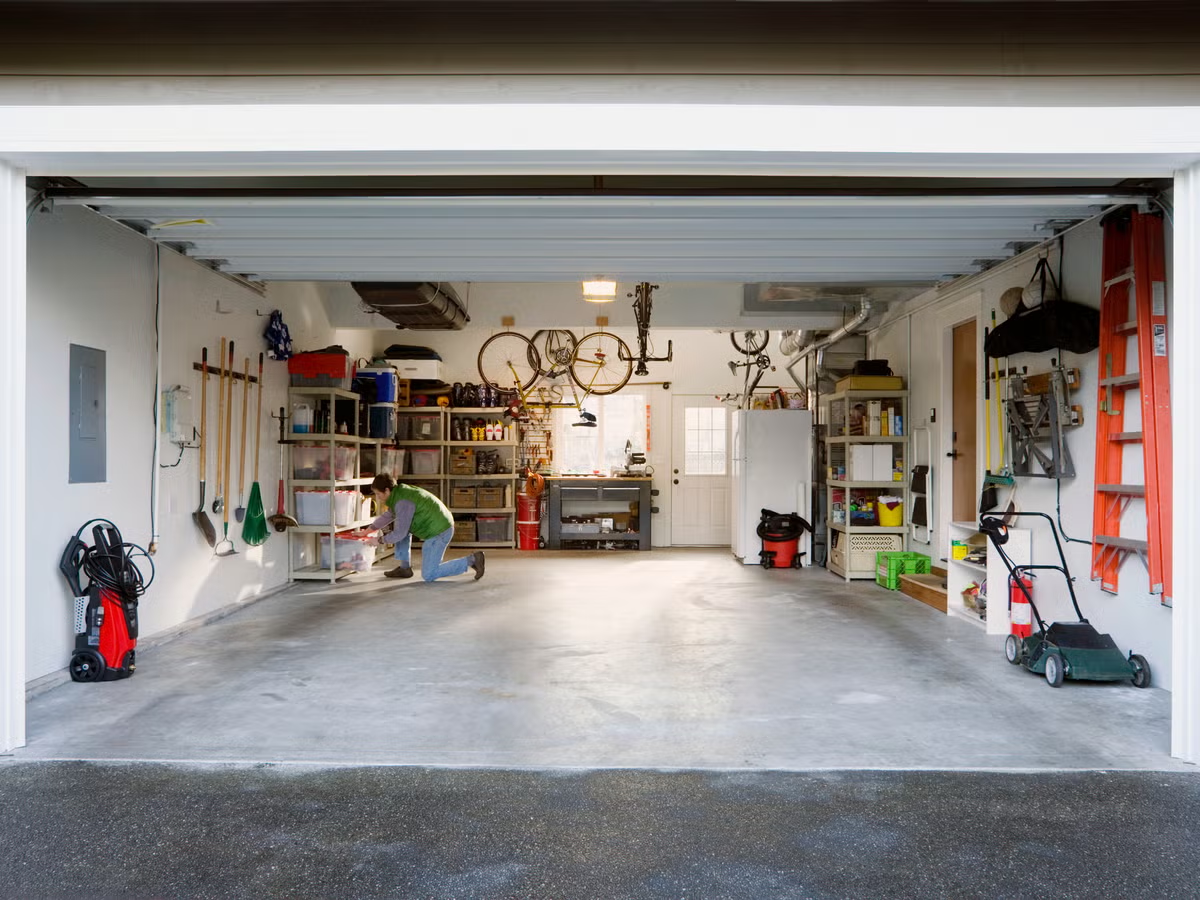
The garage door opener groaned along its chain track above my head while I knelt on the cold concrete floor, pressing strips of blue painter’s tape into careful straight lines. Four feet by eight feet for the cutting table. Two sewing machines along the far wall. Shelving here, a garment rack there, a packing station tucked near the interior door that led into the kitchen. For the first time since I’d lost my corporate job back in March, I could actually see my little sewing business becoming something real, something with edges and dimensions instead of just a fantasy I kept in a spreadsheet.
The bungalow had cost me a hundred and nineteen thousand dollars, every penny of it scraped together from savings and a small inheritance from my grandmother. Between the down payment, the closing costs, and an emergency plumbing repair that had eaten into my cushion within the first month, I had barely four thousand dollars left sitting in my account. My kitchen still had curling laminate countertops that peeled up at the corners no matter how many times I pressed them back down, and a refrigerator so plain and boxy it looked like it belonged in a rental apartment rather than a home I actually owned.
But the garage was mine. Or so I thought, kneeling there with the tape between my fingers, already picturing bolts of fabric stacked neatly on the shelving I planned to install.
My phone buzzed against the concrete beside me. My older brother Griff.
Can I stash a few things in your garage for a week? he’d texted.
I looked around at the blue tape outlining my future workspace, at the empty concrete just waiting to become something. “Sure,” I typed back, the word escaping my thumbs before some more careful part of my brain could stop it.
An hour later, Griff’s SUV pulled into my driveway, and he climbed out grinning, already hauling three cartons of college textbooks from a decade earlier, a giant hockey bag that smelled faintly of old sweat and rubber, and the disassembled pieces of a secondhand table and chairs he swore he’d pick up again soon.
“You always make everything so easy, Bell,” he said, patting my shoulder on his way past me into the garage, setting boxes down right on top of the blue tape lines I’d just finished pressing into place.
I watched his SUV back out of the driveway and disappear around the corner, and something in my chest tightened without my fully understanding why yet.
Easy. For years, I had mistaken that particular word for love. I would come to understand, much later, just how expensive that mistake was going to be.
That same afternoon, I drove out to our parents’ place in North Olmsted, where they were finally moving after thirty-five years in the same house, and the whole property looked like an archaeological dig running straight through our shared childhood. Wedding china wrapped in yellowed newspaper. School papers with gold stars still stapled to the corners. Christmas decorations spilling out of boxes that had clearly been packed and unpacked a dozen times without ever actually being sorted. Old photographs, curling at the edges, of people I only half recognized.
My mother, Blythe, could not let go of a single thing. When the donation crew arrived with their clipboard and their efficient, businesslike energy, I watched her actually reach back into an already-loaded holiday carton because she’d spotted one small handmade ornament buried near the bottom, something one of us had glued together in elementary school decades earlier.
“Where does this go?” my father asked, gesturing at a stack of boxes nobody had claimed.
Griff answered before I could even open my mouth. “Bell has the garage.”
My sister Laurel, standing nearby with her toddler balanced on one hip, immediately added three more cartons to the pile, this batch full of baby clothes, disassembled crib rails, and a double stroller she claimed she’d need again “eventually, probably.” My brother Nolan, the youngest of us, took only his own boxes of books, loading them into his own car without comment.
Nobody asked me. Not one person in that entire house, moving room to room, sorting through thirty-five years of accumulated life, thought to turn to me and ask whether my garage, my new garage, in my new house that I had bought with my own money and my own risk, actually had room for any of it.
By evening, twelve cartons sat lined along my garage walls, surrounded by Griff’s disassembled furniture, Laurel’s stroller and crib pieces, and that hockey bag that had already started to make the whole space smell faintly stale.
“It’s just temporary,” Laurel said through my father’s speakerphone, her toddler audibly fussing in the background.
“We’ll sort everything soon,” my mother promised, her voice bright and certain in the particular way that meant she herself didn’t quite believe it.
I stood alone in my garage after they’d all left, staring at the boxes stacked against walls that were supposed to hold shelving, not storage. There was still visible concrete in the middle of the room, which somehow made everything worse rather than better, because anyone glancing in from the driveway would say, reasonably enough, “You have plenty of room in there.” But my cutting table, the actual centerpiece of the business I was trying to build, no longer fit where I’d taped it out that morning. I folded it flat and leaned it against the one remaining clear stretch of wall.
By April, I was sewing at my dining room table instead. Whenever I wanted to eat an actual meal there, I had to clear away customer garments, straight pins, spools of thread, shipping labels, and pieces of tailor’s chalk, stacking them carefully on a nearby chair so I wouldn’t lose track of a project mid-alteration.
Griff’s promised “week” came and went without a single word of acknowledgment from him. When I finally worked up the nerve to message the whole family, I chose every single word with the kind of care I usually reserved for a difficult client conversation.
My production is picking up, I typed. I really need the garage for work. I’ll be home all day the first Saturday in May. Can everyone please come collect their things?
Griff replied with a thumbs up and the words We’ll try. Laurel wrote back, May is crazy for us. Can’t promise anything. My mother reacted to the whole message with a small red heart emoji and nothing else. My father said absolutely nothing at all.
Still, I convinced myself they were coming. I spent the days leading up to that Saturday actually looking forward to it, imagining the relief of an empty garage, of my cutting table unfolded and permanent again.
That Saturday morning, I borrowed my neighbor Corliss’s old rusty hand truck from her shed. I cleared the driveway of my own car so there’d be room to maneuver. I made a full pot of coffee in case anyone wanted some while they loaded up. I grouped every single item by owner, boxes stacked in neat clusters labeled in thick marker, and I even sorted loose hardware, screws and bolts and crib fittings, into individually labeled bags so nobody would have any excuse to complain about missing pieces.
Then I waited.
Nine o’clock came and went. No one.
Noon arrived, the sun climbing high over my quiet street. No one.
By five-thirty that evening, my driveway was still completely empty, the coffee gone cold in the pot, and I stood there staring at twelve carefully staged, meticulously labeled boxes and finally, fully understood something that had been circling the edges of my awareness for weeks. My entire family had just watched me sacrifice another full workday, another Saturday I could have spent actually sewing, without even bothering to send a single text canceling on me.
That night, sitting alone at my kitchen table with my laptop open, I signed a six-month lease on a tiny commercial sewing room I’d found listed online. Four hundred seventy-five dollars a month. Twenty-eight hundred fifty dollars total, money I genuinely could not spare from a business that hadn’t even turned a real profit yet. I signed the lease because I still, even after everything, couldn’t make myself say the one sentence I should have said from the very beginning, back when Griff first texted me about stashing a few things for a week.
Get your things out of my garage.
I had no idea, sitting there in the dim light of my kitchen with the lease agreement glowing on my screen, that my silence was about to cost me far more than just the rent.
The commercial studio on Brook Park Road sat only fifteen minutes from my house, but every single drive over there reminded me, in a small, grinding way, exactly why I needed it in the first place. The room itself was tight, cramped even, but functional. My four-by-eight cutting table fit against one wall. Both sewing machines fit along another. The garment rack squeezed into the remaining corner. For four hundred seventy-five dollars every single month, I was essentially renting something I already owned, sitting empty, at home. Enough space to work.
I told nobody in my family about the studio. Some part of me, I think, wasn’t ready to hear whatever reaction that news might get.
Then June arrived, humid and heavy, and one Tuesday afternoon Laurel’s husband pulled into my driveway with a borrowed cargo van, its back doors already swinging open before he’d even fully parked. Inside sat a damaged digital console piano hauled up from their basement, several of its keys visibly cracked or missing entirely.
“Laurel said you agreed to this,” he told me, already unloading a dolly from the van’s back seat.
I stared at him for a long moment. I had agreed to absolutely nothing. Not one word had passed between Laurel and me about any piano.
He glanced past me into the garage, taking in the boxes and furniture already crowding every wall. “Can that sewing stuff go somewhere else, maybe? Just to make room.”
There was a small window, a genuine pause, where I could have simply said no. I felt it open up in front of me, that one clean opportunity. Instead, I found myself moving my fabric bins into the living room, stacking them against the couch. My packing supplies went against the kitchen wall, crowding the small breakfast nook. A garment rack got squeezed into my nine-by-ten home office, wedged between the desk and the window. Then, together, we carried that broken piano inside and settled it into the space my own supplies had just vacated.
That evening, sitting alone with the piano’s dark shape looming in my garage, I finally wrote in the family group chat: No more boxes in the garage. I need the space for work.
My mother called me privately within minutes. “I didn’t know a few boxes were causing so much trouble,” she said, her voice carrying that particular note of wounded confusion she used whenever she felt accused of something.
I started explaining. The shelving I’d never installed. The cutting table that no longer had a home. The studio I was now paying for out of pocket. The rent. The workflow disruptions, the dining table meals interrupted by pins and thread, the whole cascading mess of it.
When I finally finished, she was quiet for a long moment. Then she said, softly, almost sadly, “I thought I could count on you until we got settled.”
Shame burned straight up the back of my neck, hot and immediate. For one full second, I actually almost apologized to her, the words already forming.
Instead, I said, “I have to get back to work,” and hung up before I could talk myself into something else entirely.
By July, my weakness had a very specific, very concrete price tag attached to it. A boutique downtown offered me a wholesale contract for twenty-four jackets, two colors, four sizes each, roughly thirty-two hundred dollars in gross revenue. It was, without question, the biggest production opportunity anyone had ever handed me.
But fulfilling it meant I needed real space, room for rolls of fabric, lining material, interfacing, cut panels waiting to be assembled, half-finished garments hanging in various stages, completed jackets ready for delivery, all while still keeping up with my normal alteration clients who paid my bills week to week.
My rented studio could handle ordinary business just fine. It could not handle everything at once, not with the cramped square footage I was working with. If my own garage had still been available, the order would have been entirely possible. Without it, I’d need to rent additional space on top of what I was already paying, or sacrifice roughly five weeks of dependable alteration income to clear enough time and room for the boutique jackets.
I sat under the studio’s flickering fluorescent lights one evening, calculating costs on a legal pad. Materials alone would run somewhere between thirteen hundred and fourteen hundred fifty dollars. After more than a hundred hours of my own labor, factored against what I could actually charge, my remaining margin was already razor thin. Any additional rent would wipe it out entirely, maybe push me into the red.
I opened my laptop. I typed a polite, carefully worded email to the boutique owner. And I declined the order.
No screaming. No dramatic confrontation with anyone. Just the quiet, almost anticlimactic click of Send, and then I sat there in the empty studio for a long time afterward, listening to the hum of the lights.
By that point I had already paid fourteen hundred twenty-five dollars in studio rent, money that existed entirely because my own garage, sitting empty of my equipment and full of everyone else’s forgotten belongings, couldn’t be used for the purpose I’d bought the house to enable.
That same week, my neighbor Corliss brought me six shirts that had belonged to her late husband, carefully folded in a paper grocery bag. She wanted a memory quilt made from them.
“Which parts matter most to you?” I asked her, spreading the shirts across my worktable.
She reached out and touched a faded cuff, gentle as anything. Then a breast pocket, worn soft from years of use. A tiny embroidered company logo near the collar. “These,” she said quietly.
While I cut into those shirts later that afternoon, carefully preserving the pieces she’d pointed to, I realized something that settled into my chest like a stone dropping into still water. Every single cut I made was a decision about what deserved to remain and what had to be released entirely. I looked toward my own house, sitting there with its garage full of other people’s undecided belongings, and understood that I was finally approaching that same kind of decision myself.
Then a summer storm made the choice for me, whether I was ready or not.
After a hard rain in August, one of those storms that turns the street gutters into small rivers, I opened my garage door and immediately smelled something sour and damp. Water had pushed up beneath the worn bottom seal along the frame. One of Laurel’s baby-clothes cartons sat directly in the path of the seepage, its cardboard bottom visibly darkened.
I opened it carefully. Tiny outfits near the bottom of the box were soaked through, gray-green mold spots already beginning to bloom along several of the folded seams.
I photographed everything, every damp fold and every spreading spot, and sent the pictures straight to our family group chat without any commentary attached.
Griff replied first, characteristically brief. If it’s ruined, toss it.
Laurel wrote back almost immediately after, her message sharp with alarm. Please don’t throw any of that out.
Then my mother added her own line. Can you wash the clothes for her, Bell?
I stared at my phone screen for a long moment. I could feel my brain already beginning to plan the laundry cycle, the gentle detergent I’d need, the drying rack I’d have to clear space for. Wash them. Dry them. Buy a plastic tote to keep them safe going forward. Save everyone, again, the way I always had.
I put the phone down on the counter instead.
I spread the damp clothes out across a drying rack in my spare bathroom, just enough to keep the mold from spreading further. But I washed nothing.
Then I picked the phone back up and typed: They need to leave the garage by Sunday.
Laurel complained that the weekend was already difficult for her, between the kids’ schedules and a family obligation on her husband’s side. I simply repeated myself: They need to leave by Sunday.
Sunday afternoon, her husband showed up in his crossover, already stuffed to the ceiling with car seats, soccer equipment, and grocery bags from some earlier errand. There was room for exactly one thing, the damaged carton, which I’d already transferred into a plastic tote to keep it from falling apart further.
He took that single tote and drove away. The stroller remained. The crib rails remained. The piano remained, dark and silent in the corner.
But something important had happened, even in that small, incomplete gesture. One thing had actually left my garage because I had attached a real deadline to it and refused, for the first time, to solve the underlying problem myself.
Two days later, I sent another message, longer and more detailed than anything I’d written before. Please pick up everything belonging to you by September fifteenth. Anything left afterward will be moved to climate-controlled storage for October. Nothing will be discarded. Everyone must retrieve their property by October thirty-first. The garage becomes my workroom in October.
This time, finally, they actually answered.
Griff wrote back: Fine. If I can’t get there, move mine. Laurel followed with: If we don’t make the 15th, move ours. My father, uncharacteristically direct, wrote: Move everything marked Mom and Dad. I’ll handle pickup. And my mother, after a longer pause than the others, simply wrote: Alright.
I took screenshots of every single reply and saved them to a folder on my phone.
September fifteenth arrived. I stayed home from nine in the morning until six that evening, watching the driveway through the front window between sewing projects.
Nobody came.
The next day, while I was going through the boxes and reinforcing a weak carton marked “Mom’s Papers” with fresh packing tape, a folded sheet of paper slipped partly out through an untaped flap I hadn’t noticed. I recognized my mother’s handwriting immediately, the particular loop of her cursive Y’s.
It was an old, unsent letter addressed to her own mother, my grandmother, dated years before I was even born. One visible sentence, sitting right at the top of the visible fold, stopped me completely.
The boxes have been taking up the basement for two years now and we really need a decision.
I slid the letter carefully back into the box without reading any further. I didn’t need to. Suddenly, standing there in my own garage, I could see my mother decades earlier, a much younger woman trapped in exactly the situation I was living through right now, surrounded by somebody else’s belongings that nobody would come collect.
The realization softened something in my chest, some old resentment I’d been carrying without fully naming it. But it did not change my decision. Understanding where a pattern came from, I told myself, did not require me to keep living inside it.
Then, one bright Saturday morning near the end of September, I turned onto my own street coming back from the grocery store and saw a rented box truck parked squarely in my driveway. My garage door stood wide open. My mother, it turned out, still remembered the keypad code from months earlier.
Inside the truck sat seven more cartons, several black garbage bags stuffed full of who knew what, and an old particle-board bookcase clearly pulled from my parents’ new, much smaller condo.
Laurel’s husband was already lifting the first box out of the truck bed. He started walking toward my open garage door with it braced against his belt.
Before his boot could cross the threshold, I stepped directly into his path, planting myself in the doorway.
“No,” I said.
He froze mid-step, the carton still pressed against him.
My mother came around the side of the truck, her expression already shifting into something pleading. “Bell, your dad wants our garage cleared before winter really sets in.”
I said nothing.
“We already rented the truck,” she added, as though the logistics alone should settle the matter.
Nothing.
“The condo is only nine hundred square feet, Bell. There’s nowhere else.”
I looked directly at her, meeting her eyes in a way I don’t think I ever fully had before, not about something like this. “Nothing else goes in my garage.”
Her face tightened, the pleading giving way to something harder. “Then what are we supposed to do with the truck?”
Every old instinct I had screamed at me in that moment. Find them storage. Give directions. Help unload it somewhere else. Fix this, the way I always fixed things. Instead, I said the most terrifying words I had spoken all year.
“I don’t know.”
Silence stretched out across my driveway, broken only by a neighbor’s dog barking somewhere down the street.
My mother finally turned toward Laurel’s husband, her shoulders dropping. “Put it back.”
He returned the carton to the truck bed. They climbed back in, and the truck pulled away, my mother’s face turned toward the passenger window, not looking back at me.
I stood alone in my driveway afterward, my hands actually shaking. Then I went inside and changed the garage’s keypad code before I could lose my nerve.
That same afternoon, I booked a climate-controlled ten-by-fifteen storage unit, available starting October first, roughly a hundred ninety dollars for the promotional first month. Then I hired a two-person moving crew, about seven hundred fifty dollars, to help me clear everything out properly and without further arguments.
Between the studio rent I’d already sunk into this, and now the movers and storage fees stacking on top of it, my major direct costs had climbed to roughly thirty-seven hundred ninety dollars. The lost boutique order added another thirty-two hundred dollars in revenue I had never earned and never would. But I wasn’t going to spend any more energy arguing about the money. Everyone in the family had already given me written permission, right there in the group chat, to move their property myself.
So I documented everything with the same careful precision I’d have used for a client order. Photographs of every box, every piece of furniture. Exterior condition notes. Owner labels on each item. Fragile markings where needed. I opened no private boxes beyond what I’d already accidentally glimpsed. I sold nothing. I donated nothing without asking. I discarded absolutely nothing.
Forty-eight hours before the moving crew was scheduled to arrive, I sent one final reminder to the group chat. The movers are booked for Saturday. If you want anything before then, contact me by Friday evening.
Nobody came, and nobody wrote back.
Saturday morning, the moving truck pulled up right on schedule. Griff’s textbooks left first, carried out in careful stacks. Then his hockey bag, still faintly smelling of old rubber. Then the disassembled table and chairs he’d never once come back to collect properly. Laurel’s crib rails followed, then the stroller, then the baby clothes in their now-labeled tote, then the damaged piano itself, broken down into its body, its legs, its pedal unit, each piece wrapped and carried out separately. Finally, my parents’ six archive cartons, the ones full of decades of accumulated papers and photographs and unresolved decisions.
When the movers reached the box marked “Fragile, Wedding China,” I stepped closer myself, watching them handle it. “Please keep that one upright,” I said, and they nodded, adjusting their grip.
The last carton rolled out on the dolly, and then something happened that almost brought me to tears standing right there in my own driveway. I could see the entire concrete floor of my garage for the first time in months. All ten by twenty feet of it, bare and open and completely mine.
The original blue tape residue was still visible in faint ghostly lines against the concrete, exactly where I’d pressed it down back in March. My workspace hadn’t disappeared after all. It had only been buried under everyone else’s undecided lives.
I swept months of dust and stray cardboard fibers out toward the open door, the broom strokes long and satisfying. Then I walked in a single straight line from my back door all the way out to the driveway. Nothing forced me sideways around a stack of boxes. Nothing blocked my path at all.
At the storage facility that afternoon, I separated everything carefully by owner, photographing each labeled section one final time before locking the unit. Then I drove home and sent one last message to the family chat.
Everything remaining in my garage has been moved safely. Nothing was thrown away. Pickup times are Saturday nine to eleven and Wednesday six to eight. All items must leave storage by October thirty-first. The garage is my workspace now.
Hours later, Laurel left an angry voicemail on my phone, her voice tight with frustration about the inconvenience of the scheduled pickup windows. I didn’t call her back.
My mother waited three full days before finally sending her own message. I thought I could count on you.
This time, I knew exactly what to say back to her.
I can count on me, I typed. You just can’t use my garage for storage.
Then I set my phone down on the kitchen counter and went back to work.
The following Saturday, Laurel’s husband arrived at the storage unit with the very same cargo van he’d once used to deliver that broken piano. This time, the van pulled up completely empty. Together, without much conversation between us, we loaded the stroller, the crib rails, the baby-clothes cartons, and the piano’s various disassembled pieces, body, legs, and pedal unit, back into the van. Laurel’s entire section of the unit stood empty by the time he drove away.
Wednesday evening, Griff came by during the second scheduled pickup window. He folded down his SUV’s back seats and loaded up the old textbooks and his hockey bag without complaint. Then he stood for a long moment staring at that dismantled table and chairs he’d never once returned to collect during all those earlier months.
I said nothing, just watched him from a few feet away.
Eventually, he dragged the pieces one by one into the back of his SUV. The inconvenience, finally, was entirely his to carry.
My father came during the final scheduled weekend appointment, arriving alone in his own car. He loaded the archive cartons one at a time, working methodically, saving the wedding china for last, carrying it with both hands like it might shatter from a hard look alone.
Standing beside the now-empty section of the storage unit, he rubbed the back of his neck in a gesture I recognized from my own childhood, the same tic he made whenever he was working up to saying something difficult.
“We should have taken care of this sooner,” he finally said.
I looked at him, waiting.
He stared down at the bare concrete floor of the empty unit instead of meeting my eyes. “You warned us,” he added quietly.
That was all he said. But somehow, standing there in that half-empty storage facility with the autumn light coming in slanted through the roll-up door, it was enough.
Before October thirty-first arrived, the entire unit stood empty. I closed the account. My six-month commercial studio lease ended that same week, and I brought my machines home for good. The second bedroom, which had briefly become an overflow office during the worst of the chaos, turned back into an actual office again. The cutting table unfolded exactly where I had first marked it out with blue tape back in March, as though the whole intervening ordeal had simply been a long detour back to where I’d started.
There was no sudden miracle waiting for me at the end of it. No boutique magically appearing to replace the order I’d lost. No tearful family apology ceremony gathered around my kitchen table. No check arriving in the mail to reimburse the thirty-seven hundred ninety dollars I’d spent protecting a boundary that should have cost me nothing at all. Some costs, I was learning, simply stay paid. Some lessons do too, settling into you the same permanent way.
In November, Laurel called, her voice carefully neutral. “Mom thinks everyone needs some space this year. We’re keeping Thanksgiving small.”
I understood immediately what that meant. I wasn’t invited. And for the first time in longer than I could remember, I didn’t ask to be included anyway.
My brother Nolan, the youngest of us, had volunteered for a half-day shift at his job that Thanksgiving, so he came over to my place afterward, still in his work clothes. Corliss joined us not long after, carrying an apple pie she’d baked that morning, still faintly warm through the foil covering it. I’d picked up a turkey breast, mashed potatoes, and a bag of dinner rolls from the grocery store earlier that week, nothing elaborate, just enough for three people around one small table.
Three people. One small table. No tension hanging in the air. No negotiations disguised as favors, no boxes waiting in the corner, no piano taking up space that belonged to something else.
Over coffee afterward, Corliss mentioned the memory quilt I’d made from her late husband’s shirts. “I use it almost every night now,” she said, wrapping both hands around her mug. “You got it exactly right, every piece of it.”
I smiled at her, meaning it fully. “I’m glad.”
After they both left that evening, I washed the few dishes we’d used and set them in the rack to dry. My phone sat quiet beside the sink the whole time. No message from my mother. For once, that particular silence didn’t feel like punishment settling over me. It just felt like an ordinary, peaceful evening, nothing more and nothing less.
Before bed, I opened the door to the garage one last time that night. The small electric heater I’d installed hummed softly in the corner, keeping the space just warm enough. My fabric shelves stood neatly along the wall, finally holding what they were always meant to hold. Both sewing machines waited beneath their task lights, ready for tomorrow’s work. My packing supplies sat organized near the door. And right in the center of it all stood my four-by-eight cutting table, exactly where the original blue tape had first said it belonged, all those months ago.
I stood there smiling for a long moment before I noticed something small and faded beneath the table’s edge. A tiny strip of leftover painter’s tape I’d missed while cleaning, still stuck stubbornly to the concrete. I bent down and touched it gently with two fingers.
For months, I had believed my problem was the boxes. Then, for a while, I believed the problem was my family itself, their carelessness, their assumptions, the easy way they’d all decided my space belonged to whatever they couldn’t bear to deal with themselves. But standing there in that quiet, finally organized garage, I understood the real truth of it at last.
The actual problem, the whole time, had been the word yes. A yes spoken automatically, without a single moment of real thought behind it. A yes spoken purely out of guilt, out of some old inherited fear of being called selfish by the people who were supposed to love me best. My own mother had lived through that exact same pattern long before I ever did, her old unsent letter proved as much, sitting there in that box with its own quiet, decades-old plea for somebody to finally make a decision.
But patterns, I had come to understand, are not inheritances anyone is required to keep passing down. Sometimes love genuinely does mean helping. Sometimes it means simply showing up when someone needs you. And sometimes, just as truly, the most loving and honest thing a person can say is no, this space is mine.
I straightened back up, turned off the light, and closed the garage door quietly behind me. For the first time since I’d bought that little bungalow, I understood that I wasn’t merely living inside a house I happened to own on paper. I was finally, fully, allowing myself to own my own life.

Specialty: Quiet Comebacks & Personal Justice
David Reynolds focuses on stories where underestimated individuals regain control of their lives. His writing centers on measured decisions rather than dramatic outbursts — emphasizing preparation, patience, and the long game. His characters don’t shout; they act.