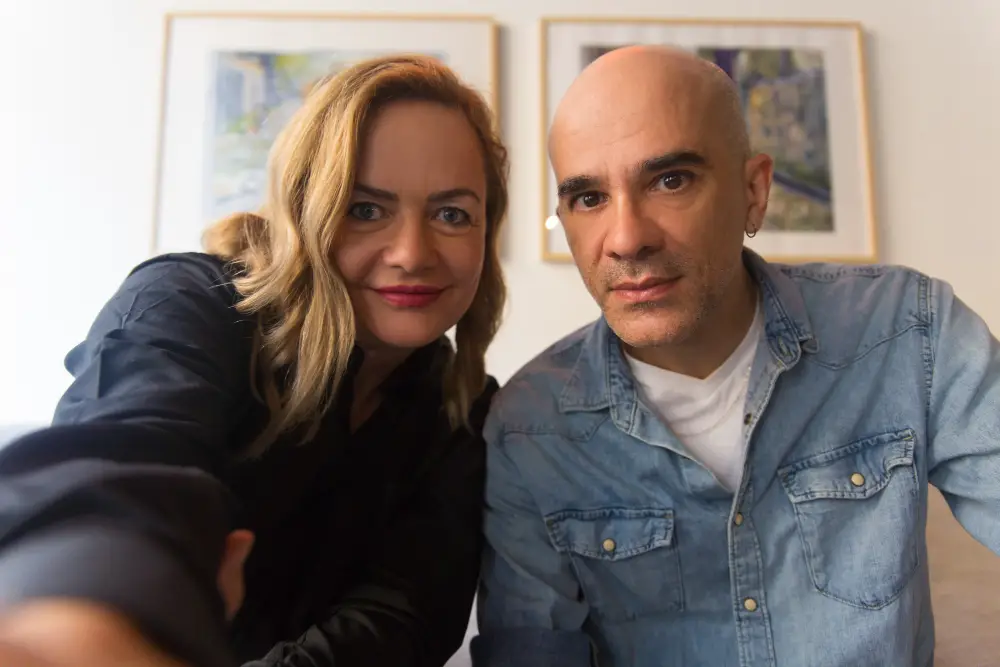
Ten years of marriage, and Dave chose to announce that he wanted to blow it up at a restaurant where the bread basket alone cost fourteen dollars.
I want to be clear about the setting because it matters. He had made the reservation himself, which almost never happened. He had told me to wear something nice, which he said approximately twice a year and usually only when his company was hosting something client-facing. He had arranged for his mother to watch the kids for the evening. He had even, and this should have been my first warning, put on the jacket I liked.
I sat across from him at a candlelit table in the kind of restaurant where the servers introduce themselves and describe the menu with the focused intensity of people who love what they do, and I thought, for approximately twenty minutes, that my husband had planned a romantic anniversary dinner.
Then Dave said he’d been thinking.
This is where I should explain something about Dave and thinking. Dave is not a man who operates in half-measures when an idea takes hold. He committed to Christmas lights in July with the full conviction of someone who has discovered an efficiency the rest of the world has simply overlooked. He once decided, mid-renovation, that we should take down a wall between the kitchen and the living room because he had read somewhere that open floor plans increased property values, without mentioning this to me or to anyone with a contractor’s license until there was already a significant hole in the drywall. He is a man of enthusiasms, and when an enthusiasm arrives, it arrives with flags.
I set down my wine.
“What have you been thinking?”
“I know you’re tired,” he said. “The kids, the house, everything. You’re always exhausted.”
This was true. I was tired. I worked full-time in marketing, I managed most of what happened inside our home, I had two children under ten, and I had not slept an uninterrupted eight hours since sometime around the second Obama administration. My tiredness was a documented and ongoing condition.
I was not prepared for where he was about to take it.
“So I thought,” he said, and there was something in his voice, a brightness, the brightness of a man presenting a solution he is proud of, “that maybe we should open up the relationship.”
I stared at him.
The candle between us flickered.
“Come again?”
He leaned forward with the energy of someone who has been storing this up and is relieved to finally release it. “If I’m getting some of my needs met elsewhere, you won’t feel as pressured. You can focus on the kids. It takes the weight off you.”
“My needs,” I said slowly.
“Yeah, I mean.” He gestured vaguely. “Real women. Women who aren’t so tired all the time. It would be like doing you a favor.”
Real women.
I want to sit with that phrase for a moment, because I sat with it at the table for what felt like a very long time. Real women. As opposed to what I was, apparently. The tired woman across from him with the uneaten bread and the good dress and ten years of her actual real life given to this person and his children and his household and his wall that he decided to knock down on a Tuesday without consulting her.
I felt something move through me. It started as hurt and moved through anger and arrived somewhere else entirely, somewhere colder and clearer and, frankly, more useful.
I leaned back in my chair.
“You know what, Dave? You’re right.”
He looked like a child who has just been told he can have ice cream for breakfast.
“Really?”
“Completely. As long as it goes both ways.”
Something crossed his face. A flicker. A brief moment of recalibration.
Then he laughed and said, “Sure, why not?”
I smiled at him.
Dave, I thought. You have no idea what you’ve just agreed to.
The week that followed was genuinely instructive.
Dave approached the modern dating scene with the confidence of a man who believes he is more appealing than the market will confirm. He downloaded three apps in one afternoon. He spent an evening crafting what he described as a “solid profile,” which I saw briefly over his shoulder and which featured a photo from a company event two years ago that I had always thought was one of his better ones.
Then the rejections began.
I was folding laundry in the living room when he flopped onto the couch beside me with the expression of a man who has been personally wronged by the universe.
“Another one canceled.”
“Mm.”
“She said she was taking a break from men.”
“That happens,” I said.
“Why would someone be taking a break from men?”
I looked at him.
He was looking at me with genuine bewilderment, as though I were a reference librarian who might have insight into this specific phenomenon.
“Maybe she sensed something,” I said.
“Like what?”
“Desperation, possibly.”
He did not take this well.
The week produced several more variations on the same theme. A woman who asked several probing questions about his living situation and then stopped responding. A date that he described as promising until she mentioned, in passing, that her ex-husband was her business partner and they had lunch together daily. A third who sent an enthusiastic first message and then, upon learning he had children, sent a much less enthusiastic second one.
Meanwhile, my week had a completely different character.
Shawn worked two floors above me in the same building, in the tech division, and we had been friendly in the particular way of coworkers who share an elevator bank and occasionally end up at the same departmental events and discover, over several years of small conversations, that they like each other’s company.
He was funny. He was easy to talk to. He was also, and this is relevant context, genuinely attractive in the straightforward way of someone who doesn’t appear to be working at it.
I mentioned the situation to him at the coffee station on a Tuesday, because I needed to tell someone and he was there and I trusted him not to make it weird.
He raised his eyebrows.
“Your husband suggested this.”
“He did.”
“On your anniversary.”
“In a restaurant.”
He shook his head slowly, then looked at me with an expression that was partly amused and partly something else.
“Well,” he said, “his loss. I’d be happy to take advantage of his extremely questionable decision, if you’re open to it.”
I laughed. He smiled. We made plans for coffee.
The coffee became dinner.
I spent more time getting ready than I had in years, which itself was a data point worth examining. I put on a dress I had bought impulsively six months ago and worn nowhere. I did my makeup with care. I felt, in the process of all this, the specific and slightly surprising sensation of someone remembering something about themselves they had put away.
Just before Shawn arrived, I sent Dave a text.
Don’t come home tonight. My date might go to the next level.
I set my phone on the counter and heard it buzz with his response, which I did not read immediately because Shawn was at the door.
He was punctual, which I liked. He brought wine, which I also liked. He sat at my kitchen table with the easy comfort of someone who is genuinely happy to be where he is, and we talked through dinner and into dessert about work and families and the particular challenges of building a career while also being a person with a life outside of the career.
He asked questions and listened to the answers.
He laughed at the right places.
He said, at one point, that I seemed like someone who had been managing a lot by herself for a while, and I said yes, and he nodded and said that was something he could see and that it seemed exhausting, and I said it was, and something about being accurately seen by someone who had no particular investment in not seeing me clearly made me feel a thing I had not felt in a long time.
I was in the middle of telling him about a campaign I was particularly proud of when the front door opened.
Dave’s voice preceded him into the living room.
“Twenty-five cats, Felicity. Twenty-five. She had photos of all of them individually labeled, and she expected me to remember their names—”
He stopped.
He took in the table. The wine. Shawn and me in mid-conversation, mid-laugh, the easy comfortable picture of two people who are enjoying each other’s company.
His face went through several things in rapid succession.
“Am I interrupting something?”
“You got my text,” I said.
He reached into his pocket and looked at his phone.
I watched his face while he read it.
“Could you maybe give us a few more hours?” I asked. “We were just getting to the good part.”
Dave’s jaw did something I had never seen it do before, which was drop without any of the usual preamble.
“You’re not serious.”
“You wanted this,” I said. “These were your terms.”
His face went through approximately eight more expressions in about four seconds.
Then: “We need to talk. Now.”
I looked at Shawn.
“I’m sorry about this,” I said. “Rain check?”
He smiled with the settled grace of someone who is not going to make a tense situation worse.
“Of course,” he said. He stood, shook my hand, and paused. “For what it’s worth,” he said, quietly enough that Dave probably didn’t hear, “you’re someone worth making time for.”
Then he was gone.
Dave and I stood in the kitchen.
“Where did you find him?” Dave said. “A modeling agency?”
“He’s a colleague. We’ve worked in the same building for three years.”
“Three years.”
“Three years.”
Dave sat down heavily at the kitchen table, the same table where Shawn and I had just been having dinner, and looked at the remnants of the evening with an expression I had not seen on him in a long time.
Genuine distress.
Not the performance of distress. Not the slightly-put-out look he sometimes produced when something hadn’t gone the way he planned. Real, unmanaged, human distress.
“How did this feel?” he asked. “When I said what I said at the restaurant.”
I sat down across from him.
“Like you looked at me and saw someone who had become inconvenient.”
He flinched.
“Like you had spent ten years with me and arrived at the conclusion that the most efficient solution to our problems was to outsource the parts of the marriage that required your actual attention.” I paused. “Like when you said real women, you meant women who were still interesting to you, and you had stopped finding me interesting, and you hadn’t thought to mention this before proposing a solution.”
He was very quiet.
“I was an idiot,” he said finally.
“You were.”
“I knew things were off between us. I knew you were tired and I wasn’t doing enough, and instead of trying to fix that I decided to just.” He stopped. “Find a workaround.”
“That’s accurate.”
“I thought if the pressure was less you’d be happier. I thought it was a practical solution.” He looked at his hands. “I didn’t think about what I was telling you when I suggested it.”
“What were you telling me?”
He looked up.
“That I didn’t want to do the work. That it was easier to look elsewhere than to look at what I’d stopped giving you.” He rubbed his face. “And then I came home and you had someone here who was looking at you the way I should have been looking at you for the past couple of years, and I felt.” He stopped again.
“Jealous,” I said.
“Sick,” he said. “I felt sick.”
I looked at him across the table.
This man had been my person for a decade. I had married him knowing his particular set of obliviousnesses and enthusiasms and his tendency to arrive at solutions without fully examining the problems. I had chosen him. He had chosen me. We had built something together that was real and complicated and worth something.
He had also, ten days ago, sat across from me at a restaurant and told me I was a tired woman who would benefit from being freed from his attentions.
Both of those things were true at the same time.
“I don’t want an open relationship,” I said. “I never did. I agreed to your terms because I wanted you to understand what you were actually suggesting.”
“I understand now.”
“Do you? Because what I need isn’t for you to feel jealous when you see me with someone else. Jealousy is easy. What I need is for you to actually look at what’s been happening in this marriage and figure out what you’re going to do about it.”
“I know.”
“I’ve been carrying most of what holds this family together for years. Not because you’re cruel. Because it was easier for both of us to let me do it and not examine why. And somewhere in the process of that, you stopped seeing me as a person who had needs that weren’t related to the children’s school schedules and the household logistics.”
“Felicity.”
“I’m telling you what happened. I need you to hear it.”
He nodded.
“I hear it.”
“I don’t want a workaround,” I said. “I want a partner. I want the person I married to show up for our actual life instead of outsourcing the parts that require him to be present.”
He was quiet for a long moment.
“I don’t know when I stopped,” he said. “Showing up. I didn’t notice it happening. And I think that’s the problem. I let myself not notice.”
“Yes.”
“I want to fix it.”
“Wanting to isn’t the same as doing it.”
“I know. I know that.” He reached across the table. “Will you give me the chance to do it?”
I looked at his hand on the table.
I thought about ten years. About the coffee he spilled on my dress on our first date and the way he looked at me when he tried to clean it up, mortified and earnest and so clearly hoping I would stay. About the night our first daughter was born and how he held her like something both precious and overwhelming, and looked at me over her head with an expression I had never seen from him before or since. About the small accumulated evidence of a life shared: inside jokes and shared references and the specific shorthand of people who know each other well enough to communicate in partial sentences.
About the restaurant, and the candles, and the phrase real women landing in the middle of a table where I had expected something entirely different.
“I want to see a counselor,” I said. “Both of us, together. Not as a last resort. As the first actual step.”
“Okay.”
“And I want you to stop treating the household as something that runs itself and start looking at what actually keeps it running.”
“Okay.”
“And I need you to understand that what you did wasn’t just a bad idea. It was a communication from you about how you saw me, and that communication is going to take longer to address than one conversation.”
“I understand.”
I believed him, mostly.
Not completely. You don’t arrive at complete belief in a single kitchen conversation at eleven o’clock at night after ten days that had included an open relationship proposal and a dinner that ended with your husband walking in on your date. But mostly.
We sat there for a while. The house was quiet the way it only got when the kids were at his mother’s, a different quality of silence from normal, the silence of the house itself rather than the silence between two people ignoring each other.
“Do you remember the drive home from the hospital?” I asked. “After Elena was born.”
He almost smiled. “You kept making me drive five miles under the speed limit because she was in the car.”
“She was three days old and you were doing forty in a residential zone.”
“I was doing thirty-eight.”
“You were doing forty and you know it.”
He laughed, actually laughed, the sound coming out of him like something he’d been holding.
“You cried when we pulled into the driveway,” he said. “I always thought it was because you were relieved to be home.”
“I was relieved,” I said. “But I was also just.” I paused. “The whole thing had happened so fast. She existed, and then we were taking her home, and I thought: this is my life now. This is what I’m building. And I was so glad it was with you.”
He looked at me.
“When did I stop making you glad?”
“You didn’t stop. You just started being someone I had to manage instead of someone I could lean on. There’s a difference.”
He nodded slowly.
“I want to be someone you can lean on,” he said. “I know that’s not a promise that fixes anything tonight. But I want you to know it’s what I want.”
“Then show me,” I said. “Not tonight. Over time. In the regular ordinary days, which is when it actually counts.”
He agreed.
We went to bed that night without the conversation being resolved, because conversations like that one don’t resolve. They open something that then has to be addressed across many days in many ordinary moments. I knew that. I think he was beginning to know it.
The counselor’s name was Dr. Patricia Osei, and she had an office with good natural light and the particular quality of calm that certain professionals develop from spending years in rooms with people in difficult circumstances.
The first session, she asked us each to describe the marriage as we experienced it.
Dave went first.
He described a marriage that had become logistical. Two people running a household and a family and separate careers, efficient and organized and deeply unpracticed at actually talking to each other about anything that wasn’t on a shared calendar.
I described the same marriage from the inside.
Dr. Osei listened to both of us without interrupting. Then she said, “It sounds like you’ve built something very functional and haven’t been maintaining the connection underneath it.”
Dave looked at me.
“That’s accurate,” I said.
“What would maintaining it look like?” she asked.
We didn’t know immediately. We had to figure it out, which turned out to be part of the point.
The weeks that followed were not a montage.
There was no transformation scene, no moment where everything clicked into place and the marriage emerged from its crisis suddenly and obviously repaired. Dave made efforts that were genuine and sometimes clumsy. He started coming home from work before the kids’ bedtime, which required rearranging things he had previously treated as immovable. He asked, one evening, what I needed that I wasn’t getting, and then sat with the answer in a way that looked uncomfortable but didn’t become defensive.
I made efforts too.
I told him about the things I had been carrying silently instead of continuing to carry them silently. I stopped assuming his unawareness was indifference. It wasn’t always. Sometimes it was simply unawareness, and unawareness can be addressed in ways that indifference cannot.
I saw Shawn at work on the following Monday.
We had coffee, the same as usual.
He asked how things were going.
“Complicated,” I said. “But possibly better than they were.”
He nodded with the equanimity of a man who has understood from the beginning where this situation was most likely to land.
“That sounds worth pursuing,” he said.
“I think so.”
We talked about work for the rest of the break. We have continued to be friendly colleagues in the easy, uncomplicated way we always were. Nothing about that evening changed what we were to each other. If anything, it clarified it.
What it also clarified was something about me.
The process of getting ready for that dinner, of feeling interesting and visible and like someone whose company was worth seeking out, was not manufactured by Shawn’s attention. It was something I had let go dormant. Something that had been mine and had gotten buried under years of being useful to everyone in every direction until I had become more of a function than a person in my own life.
The recovery of that was not Dave’s project.
It was mine.
I started taking a Tuesday evening for myself. Every week, reliably, regardless of logistics. Sometimes I went to a class. Sometimes I met a friend I had been canceling on for two years. Sometimes I just drove somewhere and sat with my coffee and existed outside the context of my responsibilities.
It sounds like a small thing. It wasn’t a small thing.
On the night of our eleventh anniversary, Dave made the reservation.
He asked me where I wanted to go and then made the reservation at the place I named and did not negotiate toward something more convenient or suggest that we could just as easily order in.
It was not the expensive place from the year before. It was a restaurant I had always liked, with good food and no pretension, the kind of place where a real conversation was possible without performing having a real conversation.
We sat across from each other.
He looked, I thought, like someone who had been paying attention for a year and it had changed something in his face.
“Do you want to know what I’ve been thinking?” he asked.
I looked at him.
“Last year when you said that,” I said, “it didn’t go particularly well.”
“I know.” He looked slightly sheepish. “This is different. I’ve been thinking that this year has been harder than the previous nine put together, and also better. And I wanted to say that out loud.”
“Harder and better.”
“It’s possible to be both.”
“I know,” I said.
“I know you know.” He reached across the table. “I’m still figuring out how to be the person you needed. I’m not there yet. But I’m actually trying to get there, which I wasn’t doing before.”
“I know that too.”
“Are you glad you gave it the chance?”
I thought about the question honestly. About the year of counseling sessions and difficult conversations and the slow, unglamorous work of two people who had drifted apart trying to find their way back to each other across the specific and ordinary terrain of daily life.
About the Tuesday evenings. About the things I had stopped swallowing silently. About the version of myself I had begun to recover, which turned out to be someone I wanted to continue being.
“Yes,” I said. “I’m glad.”
The bread basket arrived.
We ate it before the main course, which we had always done and had always considered a minor act of rebellion against the way things were supposed to go.
Some things about a marriage you keep exactly as they are.
Some things you take apart entirely and rebuild from the ground up.
The difficulty is knowing which is which, and having the honesty to look clearly enough to tell the difference.
We were still learning.
We ordered more wine.
We talked until the restaurant was half-empty and the candles had burned down.
We drove home under a sky that was doing something remarkable in the west, orange going to deep blue, the kind of sky that asks you to notice it, and we did.
Neither of us said anything for a while.
We were just two people in a car going home, which is an ordinary thing, and also, if you’re paying attention, one of the better things.

Lila Hart is a dedicated Digital Archivist and Research Specialist with a keen eye for preserving and curating meaningful content. At TheArchivists, she specializes in organizing and managing digital archives, ensuring that valuable stories and historical moments are accessible for generations to come.
Lila earned her degree in History and Archival Studies from the University of Edinburgh, where she cultivated her passion for documenting the past and preserving cultural heritage. Her expertise lies in combining traditional archival techniques with modern digital tools, allowing her to create comprehensive and engaging collections that resonate with audiences worldwide.
At TheArchivists, Lila is known for her meticulous attention to detail and her ability to uncover hidden gems within extensive archives. Her work is praised for its depth, authenticity, and contribution to the preservation of knowledge in the digital age.
Driven by a commitment to preserving stories that matter, Lila is passionate about exploring the intersection of history and technology. Her goal is to ensure that every piece of content she handles reflects the richness of human experiences and remains a source of inspiration for years to come.