The first thing they did after Margaret Hale bought the tiny house for one dollar was laugh in her face. The second thing they did was tell her that her dead husband would have been embarrassed. The third thing happened after midnight, when someone slipped a white envelope under her motel-room door with five words printed inside: DO NOT OPEN THE FIREPLACE WALL.
Margaret read the sentence twice, then folded the paper along its existing crease, slid it into a plastic sandwich bag, and placed it beside the motel Bible on the nightstand. She did not scream. She did not call everyone she knew. She did not try to convince herself it was a prank. At fifty-four, after twenty-nine years of marriage, eleven months of widowhood, a contested life-insurance claim, and one spectacularly ugly fight with her late husband’s business partner, Margaret had learned something useful: fear became much easier to manage once you gave it a job.
So she gave hers several. Photograph the note. Check the hallway camera. Call the motel manager. Write down the time. Do not touch the fireplace wall until daylight. Then she sat on the edge of the faded floral bedspread, looked through the window at the blinking VACANCY sign, and smiled for the first time that day, because until that envelope appeared, she had genuinely wondered whether the house was truly worthless. Now she knew somebody desperately needed her to believe it was.
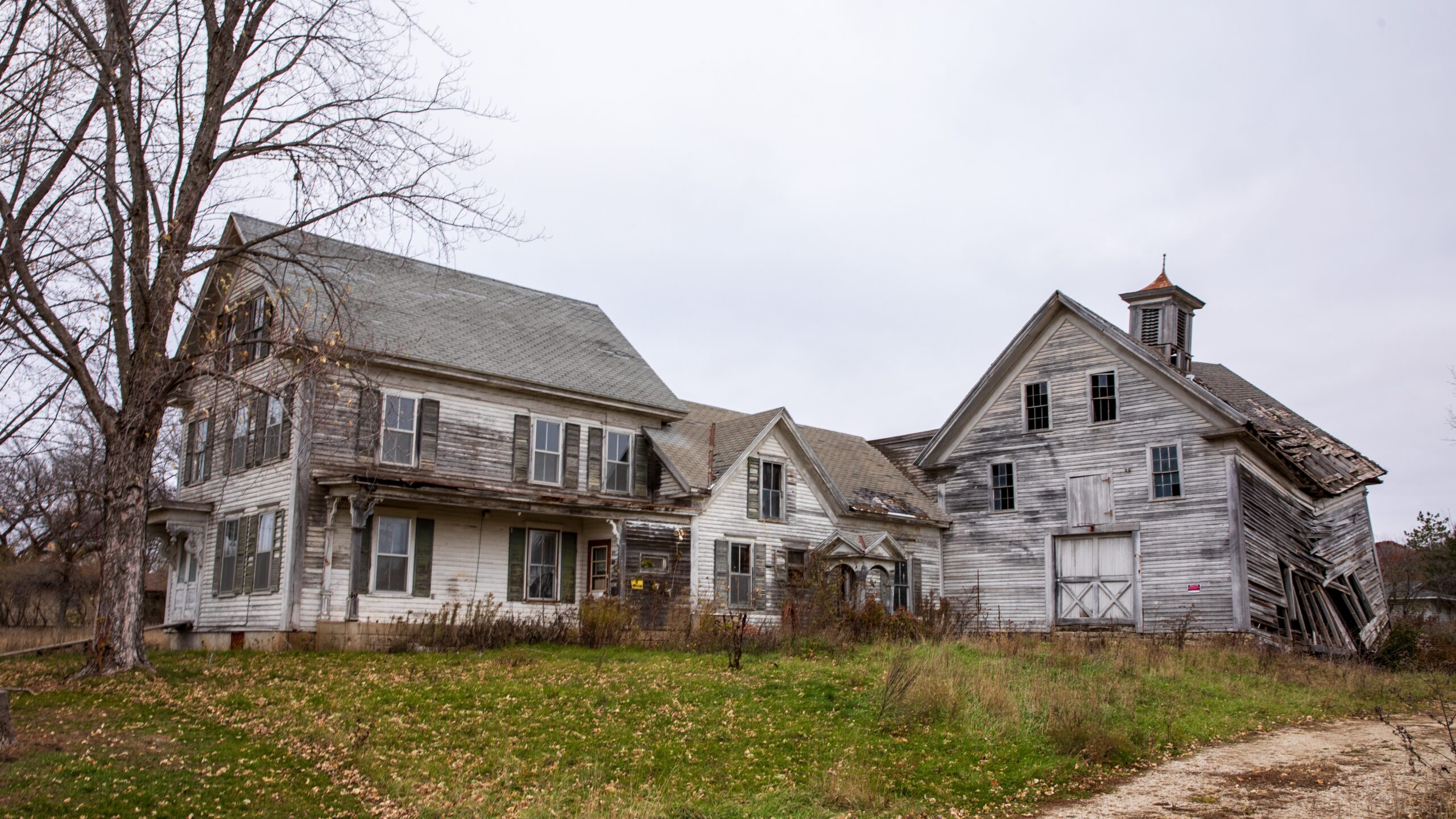
Three hours earlier, half the town of Bellweather, Pennsylvania, had watched Margaret Hale become the owner of a house nobody wanted. It stood at the end of Juniper Street, squeezed between a boarded furniture repair shop and an overgrown municipal lot where goldenrod grew through the cracks of an old basketball court. The structure was barely eight hundred square feet. The white clapboard had gone gray. The roof sagged above the kitchen. One front shutter hung by a single hinge. The porch leaned hard enough that the county inspector had tied orange tape across the steps, and someone had spray-painted a crooked red X on the plywood covering the front window.
The county called it Parcel 17-B. Everyone else called it the Wren House. It had been built in 1924 by a watchmaker named Silas Wren, occupied by his family for almost sixty years, then passed through three owners, two foreclosures, and finally a county tax seizure. By the time Bellweather put it into its annual abandoned-property auction, nobody had bid on it for six straight years, and the starting price had eventually fallen all the way to one dollar.
Margaret had raised her paddle. “One dollar,” the auctioneer said, and then he stopped. The room went silent. Margaret could hear someone unwrapping a peppermint behind her. “Do I hear two?” A chuckle came from the third row. “Let her have it,” a man called, and more laughter followed. The auctioneer frowned toward the sound. “Sir.” “What? I’m saving everybody time.”
Margaret did not turn around. She already knew the voice. Dean Mercer, fifty-eight, owner of Mercer Development Group, former college football booster, current town-council donor, a man who wore navy blazers over expensive jeans and liked to slap people on the shoulder while explaining how much money they didn’t understand. He had tried to buy three adjoining parcels on Juniper Street the previous year. The Wren House sat directly in the middle of them. That alone had interested Margaret. The fact that Dean Mercer publicly claimed not to want the property interested her even more.
“Going once,” the auctioneer said. Margaret kept her paddle raised. “Going twice.” Dean leaned toward the woman beside him and whispered loudly enough to be heard across three rows. “Some people lose a spouse and start collecting cats. Some buy condemned houses.” The woman laughed. Margaret felt the comment land, not because it was clever, but because twelve months earlier, her husband, Thomas, would have been sitting beside her. He would have squeezed her hand under the folding table. He would have whispered something dry enough to make her bite the inside of her cheek to keep from laughing out loud. Thomas had been good at that, good at taking humiliation and shrinking it down to its proper size.
Cancer had taken him in eleven weeks. By week eight, he could barely climb the stairs. By week ten, he had made Margaret promise something she still heard in her dreams: don’t become smaller just because I’m gone.
The auctioneer’s gavel came down. “Sold. Parcel 17-B. One dollar.” People clapped sarcastically. Dean Mercer clapped loudest of all. Margaret stood, picked up her brown leather purse, and walked toward the registration table. As she passed him, Dean leaned back in his folding chair. “Mrs. Hale.” Margaret stopped. He gave her a sympathetic smile with no sympathy actually behind it. “You understand the demolition lien stays with the property, right?” “I read the packet.” “Roof stabilization. Mold remediation. Municipal compliance. You’ll spend forty grand before you can legally sleep there.” “Probably.” His smile twitched at the edges. “And the land’s not worth half that.” “Maybe.”
The woman beside him looked Margaret up and down, and Margaret recognized her a second later. Cynthia Vale, the real-estate attorney who handled Mercer’s acquisitions, wore a cream pantsuit, pearl earrings, and the patient expression of someone watching a child make a financial mistake. Cynthia tilted her head. “Are you planning to restore it?” Margaret looked at her. “I haven’t decided what I’m planning.” That answer removed Cynthia’s smile, only for a second, but Margaret saw it happen.
Then Dean stood. “Tell you what. When reality hits, call me. I’ll give you five thousand for the lot.” “You just said it wasn’t worth twenty.” “I like helping people.” Margaret nodded. “That must be exhausting.” She walked away before the laughter started.
Outside, October wind pushed dead leaves across the courthouse parking lot. Margaret unlocked her twelve-year-old Subaru and sat behind the wheel without starting it. Her hands were steady. She had expected the house to sell for more, not much more, maybe fifty dollars, maybe five hundred. She had placed a private limit of three thousand dollars in her own mind, because three thousand dollars was what remained of the savings account Thomas had privately called the Don’t-Tell-Maggie’s-Brother fund. Her older brother, Eric, believed cash should never sit idle. Thomas believed Eric should never know how much cash they actually had. Both men had been stubborn about it for years. Only one of them had ever made her laugh.
She opened her auction folder and looked again at the county map. The Wren property was narrow but deep, forty-eight feet wide and one hundred eighty-nine feet long. Behind it ran an abandoned service alley, and beyond that, Mercer Development already owned most of the former textile block. Dean wanted to build what the local paper had described as a mixed-use luxury residential corridor, forty-six apartments, street-level boutiques, a rooftop restaurant, underground parking. The project map had a peculiar notch cut into it right at the Wren House. Margaret had noticed that three weeks earlier. That was the actual reason she had attended the auction, not because she wanted a house, but because Thomas had once taught her that when wealthy people become emotional about ugly pieces of land, the dirt usually knows something they don’t want you to know.
Thomas had worked thirty-four years as a structural engineer. Margaret had been a high-school librarian. Their version of date night had often involved coffee, courthouse records, and Thomas pointing at old buildings while explaining exactly why somebody had made an expensive mistake. Ten months after his death, Margaret still found herself turning toward the passenger seat whenever she spotted a bad foundation, as if he might lean over and tell her what to look for.
That afternoon, she drove to Juniper Street. The Wren House looked even worse in person than it had in the auction photos. The orange tape snapped in the wind. A rusted mailbox leaned toward the curb. The front yard held one dead hydrangea bush and a maple tree growing dangerously close to the foundation. Margaret parked across the street. A man in paint-stained work pants was loading ladders into a pickup beside the old repair shop, and he watched her get out of her car.
“You the dollar lady?” he asked. Margaret smiled. “Apparently that’s my legal name now.” He laughed. “Ray Dorsey.” “Margaret Hale.” They shook hands. Ray nodded toward the house. “You really bought that thing?” “I did.” “Why?” “I’m still deciding.” He studied her face, trying to figure out whether she was joking, then pointed at the rear roofline. “Back corner’s bad. Water’s been getting in for years.” “I saw the report.” “Report’s polite.” “Reports usually are.” Ray grinned. “You married to an engineer or something?” “Was.” The grin faded. “Sorry.” “Thank you.”
He looked toward the house again. “My grandfather knew the old woman who lived there. Beatrice Wren. Mean as January.” “Silas Wren’s daughter?” “Granddaughter, I think.” Margaret glanced at him. “You know much about the family?” Ray shrugged. “Only town stories. Watchmaker built it. Supposedly did repair work for railroad men, bankers, whoever passed through. Had some kind of falling-out with his son. Then everybody died or moved.” “And the fireplace?” Ray’s expression changed. It was small, but it was there. “What about it?” “I’ve been told not to touch it.” “By who?” “That’s what I’m trying to learn.”
Ray stared at the boarded house for a long moment, then lowered his voice. “There used to be a rumor.” Margaret waited. Ray glanced toward the street before continuing. “Kids broke in there when I was young. One swore the fireplace wasn’t original. Said there was another room behind it.” “What kind of room?” “Nobody knew.” “Did anyone check?” “My dad would’ve killed me if I went inside.” “That isn’t an answer.” Ray smiled reluctantly. “No. I didn’t check.”
Margaret walked to the porch. The county had given her a key attached to a yellow plastic tag. She stepped over the orange tape and tested each board before placing her weight on it. The porch groaned. The front door opened inward with a dry scrape, and cold, damp air breathed out to meet her. Margaret switched on her flashlight. The living room held no furniture except a broken wooden chair and a rolled carpet darkened by mold. Plaster had fallen from the ceiling in fist-sized chunks. Old wallpaper peeled in long strips down one wall. Dust thickened every surface, and against the far wall stood the fireplace.
It was brick, too much brick. Margaret stopped. Thomas had taught her to read rooms by proportions, back when they used to walk through open houses for fun on Sunday afternoons, and the habit had never left her. The chimney breast projected nearly forty-two inches into the living room, but from the exterior, the chimney was much shallower than that. She crossed the floor carefully. The fireplace opening had been sealed with black-painted steel, not modern steel, but heavy plate, held by four bolts with no visible handle. Margaret crouched down in front of it. Dust covered most of the surface, except near the bottom right corner, where the dust had clearly been disturbed. Recently.
She touched nothing. Instead she took photographs, a wide shot, then close-ups of the floor, the bolt heads, the brickwork, and a thin line near the right edge where the plaster had cracked. Then she stood, her pulse quickened by a small but unmistakable jolt of adrenaline. Someone had been here. Someone with access before today’s auction.
Outside, tires crunched against gravel. A black SUV stopped at the curb, and Dean Mercer stepped out. He did not look surprised to see her. “Couldn’t resist?” Margaret remained in the doorway. “You follow all your competitors?” “Competitors?” He laughed. “Margaret, you bought a shack for a dollar.” “You drove here.” That wiped some of the amusement from his face. He climbed one porch step. “Look, I came because I didn’t want us getting off on the wrong foot.” “We aren’t on any foot.” “I’m serious.” “So am I.”
Dean put his hands in his pockets. “Juniper Street’s going to change. That’s inevitable. I don’t want you sinking your savings into this because you’re grieving.” Margaret’s face stayed perfectly still. “Do you know what my husband would find insulting about that sentence?” Dean paused. “Probably several things.” “He would have started with your assumption that you know my finances.” A muscle moved in Dean’s jaw before he recovered quickly. “Fair enough.” “What do you want?” “I told you. Five thousand.” “For something you say is worthless.” “For convenience.” “Yours?” “Everyone’s.”
Margaret looked past him at the SUV. Cynthia Vale sat in the passenger seat, watching. Dean followed Margaret’s gaze. “I can make it ten.” “No.” “Fifteen.” “No.” His expression hardened around the edges. “You’re making this complicated.” Margaret almost laughed. “For whom?” Dean stepped closer, not threateningly, not quite. “There are timelines on the redevelopment. Environmental reviews. Utility corridors. Financing commitments. One holdout property creates expensive delays.” “So now it’s a holdout property.” His eyes narrowed. “Twenty thousand.” “You should stop increasing the offer.” “Why?” “Because you’re teaching me.”
For the first time, Dean Mercer had no immediate response. Margaret closed the front door. “I’ll be in touch if I decide to sell.” She walked past him, and Cynthia lowered the SUV window. “Mrs. Hale.” Margaret stopped. Cynthia smiled politely. “Just be careful inside. Old houses conceal things.” Margaret met her eyes evenly. “So do new people.”
That night, the envelope arrived.
By eight the next morning, Margaret had hired Ray Dorsey, not to renovate the house, not yet, but first to help stabilize the porch, secure the windows, and install two battery-powered cameras where anyone entering would be recorded. Ray also recommended Lena Ortiz, a local contractor who specialized in historic properties, and Lena arrived at nine-thirty wearing work boots, black jeans, and an orange knit cap. She walked through the house without touching anything, then stood in front of the fireplace.
“That’s weird,” she said. Margaret folded her arms. “How weird?” “Enough that I want coffee before I answer.” Twenty minutes later, the three of them stood around the hood of Lena’s truck holding paper cups. Lena had sketched the living-room dimensions on the back of a receipt. “Exterior wall to wall, twenty-six feet four inches,” she said, drawing another line. “Interior usable depth, twenty-one feet eight.” Ray whistled. Margaret stared at the numbers. “Almost five feet missing.” “Accounting for studs, siding, plaster? You still have a cavity that’s too large.” “Behind the fireplace.” “Most likely.” Ray leaned closer. “Hidden room?” Lena shook her head. “More like a chase or enclosed service space. But this wall was altered.” “When?” “Hard to say without opening it.”
Margaret took out the anonymous note. Lena read it, then Ray. Ray looked toward the house. “That makes me less excited.” “It makes me more careful,” Margaret said. Lena handed the note back. “You call police?” “About an unsigned sentence? I made a report.” “And?” “They documented it.” “Dean Mercer know about the fireplace?” “I haven’t asked.” Ray snorted. “His face yesterday answered plenty.” Margaret looked at him. “Faces are evidence of emotion. Not guilt.” Ray raised both hands. “Okay, librarian.” “Retired librarian.” “Somehow worse.” Lena laughed, and Margaret almost did too.
They entered the house again. Lena knelt beside the fireplace. “These bricks aren’t from 1924.” “How can you tell?” “Mortar. Tooling. Maybe late seventies, early eighties.” Margaret remembered Ray’s story. Beatrice Wren had still lived there then. “Can we open it without damaging whatever is behind it?” “Yes.” “When?” Lena looked at the steel plate. “Today.” Margaret shook her head. “Not yet.” Both contractors looked at her. She explained the disturbed dust, the note, Dean’s offer jumping from five thousand to twenty thousand in under five minutes. Then she pointed toward the camera above the front doorway. “If somebody believes I’m about to open this wall, I want to know what they do first.” Lena smiled slowly. “You’re baiting them.” “I’m waiting.”
That night, Margaret did not return to the motel immediately. She parked two blocks away in the dark and watched the camera feed on her phone. At 11:42 p.m., movement triggered an alert. A person in a hooded jacket entered the backyard through the alley. They did not approach the front door. They walked directly to the kitchen window, wearing gloves, dark shoes, medium height, carrying a small pry bar. Margaret called 911, then stayed exactly where she was.
The intruder forced the kitchen window and climbed inside. Margaret watched from the camera feed. For twelve seconds, nothing happened. Then another camera caught the figure crossing the hallway, straight to the living room, straight to the fireplace. The intruder knelt. Margaret zoomed in. He, or she, wasn’t trying to break the wall. They reached behind a loose baseboard beside it and pulled. Something came free, a small rectangular object, and the intruder shoved it into a jacket pocket. Sirens sounded in the distance. The figure froze, then ran, out the kitchen, across the backyard, over the alley fence. The police arrived thirty-eight seconds too late.
But Margaret had what she wanted. Not a face, not yet, but a target. Someone had entered the house to remove something hidden beside the fireplace, which meant the secret wasn’t merely behind the wall. Somebody had been maintaining it.
Officer Kyle Benson watched the footage twice. “You recognize the person?” “No.” “Any enemies?” Margaret looked at him. “I was a librarian for twenty-seven years.” He almost smiled. “That a no?” “It’s a surprisingly complicated answer.”
By morning, the Wren House had a new lock, plywood over the kitchen window, and Bellweather’s newest rumor: someone had broken into the dollar house. By noon, Dean Mercer called. Margaret let it ring four times. “Hello?” “I heard what happened.” “News travels.” “You okay?” “Fine.” “This is what I was worried about. That neighborhood attracts problems.” “The intruder ignored everything except the fireplace.” Silence. Very brief, very useful. Dean said, “What?” Margaret waited. His breathing changed. “Why would somebody care about a fireplace?” “I was hoping you could tell me.” “Why would I know?” “You’ve wanted the property for years.” “I wanted the lot.” “Twenty thousand dollars yesterday.” “That’s a business decision.” “Then this should make the business simpler. I’m not selling.” Dean exhaled sharply. “Margaret.” “Have a good afternoon.” She hung up.
For the next three days, she did what people in Bellweather did not expect grieving widows to do. She researched. She sat in the county archives under fluorescent lights. She requested fire-insurance maps. She read property transfers. She found old tax photographs. She searched newspaper microfilm. And because she had spent decades helping teenagers who waited until the night before a research paper was due, Margaret knew exactly how to follow a trail most people abandoned after the first dead end.
Silas Wren had not been merely a watchmaker. He had owned the building that became Bellweather Savings & Trust, for six years, then, in 1931, during the Depression, he sold it for one dollar. Margaret stared at the microfilm. One dollar, the exact symbolic price she had paid for his house ninety-five years later. She printed the article.
Silas had later worked as a private bookkeeper for several local companies. One name appeared repeatedly: Bellweather Textile Consolidated, the same company whose abandoned factory property Dean Mercer was now redeveloping. Margaret kept reading. In 1978, the textile company had been sued by employees over missing pension contributions. Records vanished. The lawsuit collapsed. In 1981, fire destroyed part of the company archives. In 1982, Beatrice Wren installed a masonry heat-retention improvement inside her house. Margaret leaned back. The fireplace. She wrote the date in her notebook.
Then she found something else, a photograph, Bellweather Gazette, June 11, 1984. Beatrice Wren, then seventy-three, stood outside the tiny house beside a younger man in a gray suit. The caption identified him: Arthur Mercer, local attorney and newly elected councilman. Dean Mercer’s father. Margaret’s skin prickled. The article was harmless on its face, a neighborhood preservation committee, historic homes, community pride. But Arthur Mercer’s hand rested on Beatrice Wren’s shoulder, and Beatrice was not smiling. Margaret copied the page.
When she reached the motel that evening, another envelope waited under her door. This one held no note, only a photograph. Thomas. Her husband. Taken outside the Wren House. Margaret sat very still. The photograph was recent enough to hurt. Thomas wore the brown field jacket she had donated after his funeral. His hair was thinner than it had been five years earlier. He stood beside the maple tree in front of the house, looking toward the chimney. A date stamp ran along the bottom: March 14. Four months before his cancer diagnosis.
Margaret turned the photograph over. Three handwritten words: HE FOUND IT FIRST.
For the first time since the auction, Margaret’s composure cracked, not loudly, but her thumb trembled against the edge of the photograph. Thomas had never mentioned the Wren House, not once. She could remember almost every conversation from his final months because grief had preserved them like insects in amber. The hospital. The insurance. Eric’s visit. What to do with the car. Which tools to give Ray’s nephew. Whether she should sell their house. Where Thomas wanted his ashes. Nothing about Juniper Street. Nothing about Silas Wren. Nothing about Dean Mercer. Nothing about a fireplace.
Margaret looked at Thomas’s face again. He was not posing. The picture had been taken from across the street. Someone had watched him. Someone had saved the photograph. Someone had waited until Margaret bought the house to send it. She did not sleep.
At six-fifteen the next morning, she drove home. Their old house stood twenty minutes outside Bellweather, on two acres bordered by red maple and pine. Margaret had barely entered Thomas’s workshop since his death. The room still smelled faintly of sawdust and machine oil. His pegboard remained exactly as he’d left it: levels, clamps, measuring tapes, a blue hard hat, a mug with WORLD’S OKAYEST ENGINEER printed across the front. Margaret stood in the doorway, then began searching. Not randomly. Thomas was organized, painfully so. He labeled tax records by year, receipts by project, photographs by address. If he had investigated the Wren House, he would have documented it, unless he’d deliberately hidden the documentation from her.
Margaret opened filing cabinets. Nothing. Desk drawers. Nothing. The old laptop, password protected. She knew the password: Maggie1972! It failed. That alone frightened her more than the anonymous notes. Thomas had used variations of the same password for years despite Margaret telling him the internet had moved beyond 2004. She tried their anniversary. Failed. His engineering license number. Failed. Then she stopped.
On the wall above his drafting desk hung a framed photograph of the two of them in Maine, their twenty-fifth anniversary. Thomas had written something on the back once. Margaret removed the frame. A yellow sticky note dropped out, not from the photograph, but from behind it. Four numbers: 0417. Margaret typed them. The laptop opened.
The desktop showed ordinary folders. Taxes. Clients. Photos. Medical. But one folder sat in the lower-right corner: WREN. Margaret clicked. Inside were thirty-seven photographs of the tiny house, exterior shots, roof, chimney, foundation, old property maps, scans of newspaper clippings. And one PDF labeled: IF MARGARET OPENS THIS.
She stared at it for ten full seconds, then clicked. The document contained only one page. Thomas’s words appeared in black type. Maggie, if you’re reading this, then one of two things has happened. Either I finally decided to tell you what I found on Juniper Street. Or I ran out of time. I’m sorry if it’s the second one.
Margaret covered her mouth and continued reading. I need you to understand something before you do anything else. The house itself is not the valuable part. What matters is what Silas Wren hid there. I don’t know exactly what it is. But I know three people believed it was important enough to erase records, manipulate property transfers, and quietly purchase every lot surrounding it. One of those people was Arthur Mercer. Another was his son. The third person is the reason I’m writing this instead of confronting them. Do not trust anyone who claims they were helping me investigate.
Margaret’s stomach tightened. Thomas continued. I found evidence the fireplace wall contains a sealed steel compartment built in 1982. I never opened it. I intended to. Then someone entered my workshop while we were at Eric’s anniversary dinner. Nothing was stolen. But my Wren files had been moved. Two weeks later, Dean Mercer called me and offered consulting work on the Juniper redevelopment. I had never told him I was studying the site.
Margaret closed her eyes. She remembered that dinner. Thomas had been quiet on the drive home. He’d blamed indigestion. She had believed him.
The document continued. I backed away. That may have been a mistake. If the Wren property ever comes up at auction and you decide to follow this, because I know you, and you probably will, promise me one thing. Don’t open the wall alone. And don’t assume what’s hidden there is money. Sometimes records are more dangerous than cash. I love you. T.
Margaret read the letter again, then once more. On the fourth reading, she noticed the phrasing. One of those people was Arthur Mercer. Another was his son. The third person is the reason I’m writing this instead of confronting them. The third person. Not organization, not company. Person. Someone Thomas knew. Someone dangerous enough to make him stop.
Margaret printed the document and copied the entire Wren folder onto two flash drives, one into her purse, the second into the glove compartment of her Subaru. Then she called Eric. Her brother answered on the fifth ring. “You know it’s seven in the morning?” “Did Thomas ever talk to you about Juniper Street?” Silence. Margaret’s hand tightened around the phone. “Eric.” “A little.” The room seemed to narrow. “What does a little mean?” “He asked me about a property title.” “When?” “Last winter.” “You never told me.” “He asked me not to.”
Margaret stared at Thomas’s empty chair. “What title?” “The Wren place, I think.” “Why did he ask you?” Eric worked in commercial insurance, and property records crossed his desk often. “He wanted to know whether an old easement could survive multiple transfers.” “What easement?” “I don’t remember.” “Try.” Eric sighed. “Maggie, what’s happening?” “I bought the house.” “What?” “For a dollar.” “You bought, Jesus Christ.” “What easement?” Another silence. Then Eric said, “Underground access.” Margaret stopped breathing for a second. “To what?” “I don’t know. He showed me a reference from a 1926 survey. Something called Service Corridor C.” “Was it under the house?” “Maybe. The map was incomplete.” “Why didn’t he tell me?” “He was trying to protect you.” Margaret’s voice turned cold. “Do not say that to me.” Eric went quiet. “He was sick,” Eric said finally. “He didn’t know it yet, but he was exhausted. He was getting paranoid about the whole thing.” “Was he paranoid?” “I don’t know.” “You just told me someone broke into his workshop.” “What?”
Margaret realized Thomas had not told Eric everything either. That mattered. “I’ll call you later.” “Maggie, don’t go into that house.” “Why?” “Because Thomas asked me to keep you away from it.” Margaret looked at the laptop. “He also wrote instructions for what to do when I found it.” Eric said nothing. She hung up.
By ten that morning, Margaret had made her decision. They would open the wall, but not secretly. Lena would do the work. Ray would witness. Officer Benson would be notified because of the break-in. A structural camera would record the entire process. Margaret would also livestream the camera feed privately to Eric, despite being angry with him. Fear became easier when you gave it a job. So did betrayal.
At eleven-thirty, Margaret stood in the Wren House while Lena removed the fireplace’s steel plate. The bolts resisted. Two snapped. One stripped. The fourth came free with a metallic pop. Dust drifted through Margaret’s flashlight beam. Behind the plate was not a fireplace opening. It was brick. A second layer. Lena tapped it. “Hollow.” Ray leaned against the wall. “You sure you want to do this?” Margaret held Thomas’s printed letter inside a clear document sleeve. “Yes.”
Lena began removing brick, one, two, three. The work was slow. Mortar crumbled onto the plastic sheeting. After twenty minutes, the opening was large enough for Lena’s flashlight. She leaned close, then stopped. “What?” Lena did not answer immediately. Margaret stepped beside her. Behind the bricks stood a steel door. Not a box. A door, approximately thirty inches wide and five feet high, with a circular locking mechanism at waist level. Ray let out a breath. “That’s not normal.” Officer Benson moved closer. “Can it be opened?” Lena examined the hinges. “Not without damaging it. Unless we have the combination.”
Margaret thought of Thomas’s sticky note. She entered it. Nothing. Four digits. Maybe not a password. A date. April seventeenth. But what happened April seventeenth? Margaret looked around the room. Silas Wren. Watchmaker. Bank. Textile company. She remembered something from the newspaper archive. Bellweather Savings & Trust had failed during the Depression. What date? She pulled out her phone, her research notes. April 17, 1931. The day the bank closed. She entered 041731. The mechanism clicked.
Nobody spoke. Margaret grasped the handle. Officer Benson stopped her. “Let the contractor.” Margaret almost objected, then nodded. Lena pulled. The steel door resisted for decades, then it opened three inches with a long groan. Cold air came through the gap, not musty air, cold, moving. Ray’s face changed. “There’s ventilation.” Lena opened the door wider. Behind it was a narrow concrete passage descending beneath the house, six steps, then darkness. Officer Benson swore softly. Margaret stared. Thomas had been right. The fireplace hid something. But not a compartment. A passage.
They descended carefully, Lena first, Officer Benson second, Margaret behind them, Ray following. The stairs ended in a concrete chamber no larger than a walk-in closet. Steel shelving lined one wall, most shelves empty. At the far side stood an old metal desk, and on that desk sat a wooden box.
Margaret walked toward it. She could hear her own breathing. The box was dark walnut, roughly eighteen inches long, no lock. She opened it. Inside were ledger books, seven of them, wrapped in oilcloth. A brass key. A bundle of letters tied with faded blue ribbon. And a photograph. Margaret lifted the photograph first. Four men stood outside Bellweather Textile Consolidated. The image had yellowed at the edges. One man was Silas Wren, whom Margaret recognized from the archives. Another was younger, Arthur Mercer, Dean’s father. The third man was unknown. The fourth man made Ray swear. “That’s Mayor Vale’s grandfather.” Margaret turned. “Vale?” “Cynthia Vale.” The room became very quiet.
Lena picked up one ledger carefully. “What are these?” Margaret opened it. Rows of names, dates, dollar amounts, property numbers, initials. Some entries were nearly a century old. Others were more recent, much more recent. Margaret’s heart pounded. Someone had continued updating Silas Wren’s hidden archive long after he died.
Officer Benson leaned over her shoulder. “What does M.G.D. mean?” Margaret didn’t know. Then she turned the page. At the top, written in blue ballpoint pen: MERCER GROUP DISBURSEMENTS. Dean’s company. Her pulse spiked. The entries included parcel numbers, campaign donations, consulting payments, settlement amounts. One line from the previous year showed: Parcel 17-B, recovery pending. Below it: T.H. inquiry confirmed. Thomas Hale. Margaret touched the initials. Officer Benson saw them too. “Your husband?” “Yes.”
Then the floor above them creaked. Everyone froze. Ray whispered, “Someone’s in the house.” Officer Benson drew his sidearm. “Stay here.” He moved toward the stairs. Another sound, a door closing, then fast footsteps. Officer Benson climbed, Ray followed halfway. Margaret remained beside Lena. Ten seconds, twenty, thirty. Then Officer Benson shouted, “Police! Stop!” A crash came from above. Margaret didn’t move. Another shout, then silence.
Her phone rang. Unknown number. She stared at it. Lena said, “Don’t answer.” Margaret answered. No voice, only breathing. Then a man spoke. “You should have taken the twenty thousand.” Click. Margaret lowered the phone. Lena looked pale. “Dean?” “I don’t know.”
Officer Benson returned two minutes later. “No one.” “You heard them.” “Back window was open.” “We boarded it.” “Board’s been removed.” Margaret looked at the ledgers. Someone had been watching. The discovery should have felt like victory. Instead Margaret felt the shape of something larger assembling around her, because this room had not been abandoned. Someone knew the code. Someone had accessed it. Someone had added records through 2023. The little house wasn’t hiding an old secret. It was hiding a living one.
Officer Benson called his supervisor. The chamber became a potential evidence scene. Margaret was ordered not to remove anything. She agreed. What she did not mention was the brass key she had already photographed. The key bore one tiny stamped number.
By evening, Bellweather knew. Nobody knew exactly what had been found, but seven police vehicles outside the dollar house were enough to turn rumor into wildfire. Local reporters arrived. Dean Mercer arrived fifteen minutes later, pushing past a camera crew toward the police tape. Margaret stood on the sidewalk speaking with Lena. Dean pointed at her. “You had no right.” Margaret turned. A reporter immediately lifted her microphone. “No right to what?” Margaret asked. Dean stopped. Cynthia Vale appeared behind him. “Dean.” One word, sharp. He heard himself too late.
Margaret stepped closer to the tape. “No right to enter my own house?” Dean’s nostrils flared. “You’re interfering with a major redevelopment based on some theatrical treasure hunt.” Margaret watched Cynthia, not Dean. Cynthia’s eyes were on the house, specifically the chimney. “Interesting,” Margaret said. “What?” “I never said we found treasure.” Dean’s face tightened. Cynthia intervened. “Mrs. Hale, everyone is emotional. Let’s not make allegations.” “I haven’t made one.” “Then don’t.” Margaret smiled. “You seem worried I might.” Cynthia stared at her. The reporters caught every second.
The first mini-payoff came the next morning. Mercer Development’s bank temporarily suspended a financing draw after learning that police were reviewing property records tied to the Juniper redevelopment. The second came four hours later. Bellweather’s mayor announced an independent records review. The third came at lunch when the county issued a preservation order preventing demolition or structural alteration of the Wren House. Dean could no longer force the building condemned and cleared. For the first time in years, the tiny house was safer standing than falling.
Margaret should have felt relief. Instead, she returned to Thomas’s laptop. There had to be more. She searched every folder, then the recycle bin, then browser history. A deleted email archive contained one message sent by Thomas to himself. Subject line: If April 17 opens the door, 314 opens the truth. Margaret stared at it. The brass key. She knew immediately it wasn’t for anything inside the Wren House. The hidden room had no additional locks. So where did 314 belong?
She searched Thomas’s notes. Nothing. She called Eric. He answered quickly this time. “I was about to call you.” “Why?” “News says police found records.” “Eric. Do the numbers three-one-four mean anything to you?” Silence again. Margaret hated his silences now. “They might.” “Stop protecting dead people’s decisions.” “Thomas made me promise.” “Thomas is dead.” Her voice did not break. The words hurt anyway. “I am the one standing in the consequences.” Eric exhaled. “Bellweather Central Station.” “What about it?” “Old luggage lockers.” Margaret stood. “Thomas rented one?” “I don’t know.” “You just said—” “He asked me whether the station still had lockers. I told him most were removed after renovation.” “Most?” “There are historical display lockers in the old east concourse.” “Number 314?” “I don’t know.”
Margaret grabbed her coat. “Maggie.” “What?” “Someone followed Thomas home from that station.” She stopped. “When?” “About a month before the diagnosis.” “Who?” “He didn’t know.” “Why didn’t you tell me this yesterday?” “Because yesterday I still thought Thomas had walked away.” Margaret closed her eyes. “And now?” “Now I’m looking at the news and realizing he didn’t.”
Margaret drove to Bellweather Central at three-twenty. The station had once served four passenger lines. Now only regional commuter trains passed through. The east concourse had been restored with terrazzo floors, brass railings, and a small historical exhibit featuring old ticket booths and luggage lockers, most sealed behind plexiglass. But Locker 314 wasn’t in the display. A maintenance worker checked the old map. “Three-fourteen would have been downstairs.” “Downstairs where?” “Mail platform.” “Can I see it?” “No public access.” Margaret showed him the brass key. His eyebrows rose. “Where did you get that?” “My husband.” The worker looked toward a security desk. “I should get my supervisor.” “You should.”
Twenty minutes later, Margaret stood with station supervisor Paul Denning and a transit police officer at the bottom of a concrete staircase. The old mail platform smelled like dust and wet stone. Rows of metal lockers lined one wall, numbers running from 280 to 329. Locker 314 remained intact. Margaret inserted the brass key. It turned. Inside was a canvas document bag. Nothing else. The transit officer removed it. On the bag, in Thomas’s handwriting, were three words: FOR MARGARET ONLY.
Her knees weakened, but she remained standing. They took the bag upstairs before opening it. Inside were copies, not originals, property plats, financial ledgers, photographs, and an audio recorder. Margaret pressed play. Thomas’s voice filled the little station office. “Maggie, if you’re listening to this, I owe you an apology.” Margaret stared at the recorder. She had not heard his healthy voice in almost a year. The sound struck harder than she expected.
“I told myself I kept you out of this because I was protecting you. The truth is, I was also afraid you’d talk me into doing the right thing before I was ready.” A breath, then: “What Silas Wren found was not stolen money. Not exactly. He found a mechanism.” Margaret leaned closer. “For nearly a century, several families in Bellweather used abandoned easements, tax liens, shell companies, and municipal acquisitions to quietly control land around major infrastructure projects. They didn’t have to steal property outright. They only had to make ownership messy enough that normal people couldn’t afford to fight.”
Margaret thought of Juniper Street, the condemned parcels, the one-dollar transfers, Dean buying everything around the Wren House. Thomas continued. “Silas documented the system. Someone else continued his records. I don’t know who.” Margaret stopped breathing. “I thought Arthur Mercer was the keeper. He wasn’t. Neither is Dean.” The station supervisor looked at Margaret. Thomas’s voice continued. “The Mercers benefited from it. So did the Vales. But somebody else manages the archive.”
Margaret’s fingers tightened around the chair. “Who?” she whispered. The recording answered almost as if Thomas heard her. “I have a name. I won’t put it on this recording because if I’m wrong, I could destroy an innocent person. If I’m right, the proof is in the red ledger.” The audio clicked off. Margaret stared. “What red ledger?” the transit officer asked. Margaret already knew. There hadn’t been one in the hidden room. Seven ledgers, black, brown, green, blue. Not red. Someone had removed it. The intruder, the first night, the rectangular object taken from behind the baseboard. Not a ledger, too small. Unless it had been a key. Or instructions.
Margaret searched the station bag. At the bottom was a photograph of Thomas standing beside another person. The image had been taken at a coffee shop. Margaret recognized the other person immediately. Ray Dorsey. The neighbor. The man who had told her about the hidden-room rumor. The man she had hired.
Her phone rang. Ray. She stared at his name, then answered. “Where are you?” His voice sounded wrong, breathless. “Margaret, don’t go back to the house.” She stood. “Why?” “I need you to listen.” “Where are you?” “No time.” “Ray.” “I lied to you.” Margaret’s blood went cold. “About what?” “The Wren family.” Behind his voice, she heard an engine. A truck. “I knew Beatrice.” “How?” “She was my mother’s aunt.” Margaret said nothing. Ray continued. “I didn’t tell you because Thomas asked me not to.” “You knew Thomas was investigating.” “Yes.” “Did you break into the house?” “No.” “Did you send the notes?” A pause. “The first one.” Margaret closed her eyes. “Why?” “Because I hoped you’d walk away.” “And the photograph?” “Not me.” “Who, Ray?” “I don’t know.” “Then tell me what you do know.”
His breathing grew heavier. “Beatrice didn’t create that room. Silas did. She sealed it after Arthur Mercer tried to buy the house in 1982.” “The brick is from then.” “Yes.” “Who continued the ledgers?” “I don’t know.” “You’re lying.” “I’m not.” Margaret heard a horn blast. Ray shouted something away from the phone, then returned. “I found something at my grandfather’s place this morning. Thomas must’ve known it was there.” “What?” “A letter from Beatrice.” “Bring it to the police.” “I tried.” “What do you mean, tried?” “The desk officer called someone before he’d even read it.” Margaret’s mind raced. “Where are you?” “County Road Nine.” “Go to the state police.” “I’m heading there.” “Ray—”
A violent sound erupted through the phone. Metal. Glass. Tires. Then nothing. “Ray?” Static. “Ray!” The call disconnected.
Margaret immediately dialed 911. By the time she reached County Road Nine, police had blocked both lanes. Ray’s pickup had left the road near a stone culvert. The driver’s side was crushed against a sycamore tree. An ambulance sat nearby. Margaret parked behind the barrier and ran. Officer Benson intercepted her. “You can’t go down there.” “Is he alive?” “Yes.” She stopped. “How bad?” “They’re taking him to Allegheny Regional.” “What happened?” Benson looked toward the road. “Appears somebody clipped the rear quarter panel.” “Somebody hit him.” “Looks that way.” “Was another vehicle found?” “No.” Margaret held up her phone. “He called me before the crash.” Benson’s expression sharpened. “What did he say?” “He had a letter.” Benson looked toward Ray’s truck. Police searched it. No letter. Margaret already knew what they wouldn’t find.
That evening, Dean Mercer held a press conference. He stood in front of the Bellweather Commerce Building with Cynthia Vale at his side. Margaret watched from her motel room. Dean described himself as the victim of reckless speculation. He denied knowledge of hidden ledgers. He denied threatening Margaret. He denied that his company had engaged in improper property acquisition. Then he did something Margaret did not expect. He admitted his father had known the Wren family. “Arthur Mercer served this community for forty years,” Dean said. “Attempts to smear a dead man’s reputation based on documents nobody has authenticated are disgusting.”
Margaret switched off the television. His anger wasn’t entirely performance. She could see that now. Dean did not know everything. He knew enough to be dangerous. But he was afraid too, and that changed the board.
She opened Thomas’s files again. At midnight, she found the pattern. Parcel numbers in the hidden ledgers repeated beside three-letter codes. M.G.D. V.H.C. B.C.T. At first she had assumed they were corporate initials. Then she overlaid them with old city maps. They weren’t companies. They were locations. Municipal Gas Depot. Vale Heating Company. Bellweather Central Terminal. The ledger wasn’t only recording payments. It was indexing storage sites.
Margaret searched for any entry corresponding to Wren House. J.S. 17-B. Juniper Street. Below it appeared another line. R.L., transferred 2023. R.L. Red ledger. Transferred. Not removed by the intruder. Transferred three years earlier. The red ledger was somewhere else.
Margaret looked through Thomas’s station documents again. One property map contained a penciled circle. Old Bellweather Cemetery. She stared at it. No. Too obvious. Thomas disliked obvious. She turned the map over. There was a receipt taped to the back. Bellweather Public Storage. Unit 314. Margaret laughed once, not because it was funny, but because Thomas had made the same joke twice. Locker 314. Storage 314. He wanted her to find the pattern.
The next morning, she drove there with Officer Benson. The manager confirmed Thomas Hale had rented Unit 314 seventeen months earlier, paid annually in cash, no listed contents. They opened the unit. Inside stood one object. A wooden clock, six feet tall, grandfather style, dark walnut. Margaret recognized the craftsmanship immediately from photographs in the Wren archive. A brass plate read: S. WREN, 1936.
Officer Benson looked disappointed. “A clock?” Margaret stepped closer. “Silas Wren was a watchmaker.” She opened the cabinet. No red ledger. The pendulum hung motionless. Margaret crouched. Thomas had taught her something about antique clocks during an estate sale years earlier. Weights were heavy. Bodies were hollow. And good craftsmen loved false backs. She ran her fingertips along the interior panel. One section moved. Behind it was a narrow compartment, empty except for one envelope.
Margaret opened it. Inside was a Polaroid photograph. The red ledger. It lay on a desk beside a newspaper dated November 4, 2023. Proof it still existed. On the back, Thomas had written: I moved it. R.D. knows where. Ray Dorsey. Margaret closed her eyes. Ray wasn’t merely a witness. Thomas had trusted him with the most important piece.
At Allegheny Regional, Ray was awake but medicated. His left arm was broken, three ribs fractured, a cut crossed his forehead. Margaret waited until the nurse left, then placed the Polaroid on his blanket. Ray stared at it. “Thomas left that?” “Where is the red ledger?” Ray’s eyes moved toward the door. Margaret noticed. “Police are outside.” “Local?” “Officer Benson.” “That’s not what I asked.” Margaret leaned closer. “Where is it?” Ray swallowed. “My grandfather gave it to Beatrice. Beatrice gave it to my mother. My mother hid it after someone broke into our house in 1991.” “Where?” “You’ll think I’m crazy.” “Try me.” “The dollar house.” Margaret stared. “We opened the room.” “Not there.” “Where?” Ray whispered. “Under it.”
Margaret remembered Eric’s words. Underground access. Service Corridor C. “The passage continues?” Ray nodded carefully. “Hidden under the concrete room. Beatrice sealed it.” “Where does it go?” “Originally?” “Yes.” “Bellweather Savings.” Margaret felt cold. Silas Wren’s former bank. The building sold for one dollar in 1931. Now demolished. What stood there today? She already knew. Bellweather City Hall annex.
Ray continued. “The tunnel was supposed to be closed decades ago. It wasn’t.” “The ledger is in the tunnel?” “Maybe.” “Maybe?” “My mother moved it in 1991. She never told me exactly where. She left me instructions after she died.” “The letter in your truck?” “Yes.” “It’s gone.” Ray stared at her. “Then whoever hit me has it.”
Margaret stood. “Can you reconstruct the instructions?” “Partly.” “Do it.” He looked at her. “You don’t understand.” “Then make me.” Ray’s face tightened with pain. “The ledger doesn’t just name property deals.” “What does it name?” “People.” “Which people?” “Judges. Council members. Bank officers. Lawyers.” “Mercer?” “Yes.” “Vale?” “Yes.” “Who else?” Ray looked toward the window. “Your husband.” Margaret went perfectly still. “No.” “Not as part of them.” “Be precise.” “Thomas’s name is in the red ledger.” “For what?” “I don’t know.” “You’ve seen it.” “Once. Years ago.” “Then you know.” Ray shut his eyes. “Thomas’s father worked for Bellweather Textile.” Margaret knew that. Harold Hale had been an accountant. He died before Margaret and Thomas married. Ray opened his eyes. “There was a notation beside Harold’s name.” “What notation?” “Custodian.” Margaret said nothing. Then: “And Thomas?” “Successor contacted.”
The room seemed to tilt. Margaret gripped the bed rail. Thomas had not stumbled onto the Wren secret by accident. His family was already connected to it. Maybe that was why he had investigated. Maybe that was why he had hidden it from her. “Why did he tell me he didn’t know who maintained the archive?” “I don’t know.” “He lied.” “Maybe he learned after making the recording.” “Or maybe he lied.” Ray did not answer. Margaret hated the uncertainty more than she hated Dean Mercer. Dean was easy. Greed was easy. People understood greed. Love wrapped around secrets was harder.
She left the hospital with a copy of Ray’s reconstructed directions. That afternoon, state investigators arrived in Bellweather. Local police jurisdiction was no longer the only layer. Margaret felt slightly safer. Slightly.
At four-ten, Officer Benson called. “We identified the vehicle that hit Dorsey.” “Whose?” “Stolen.” “Of course.” “But traffic cameras caught another vehicle following it.” Margaret waited. “A black Cadillac.” “Dean?” “No.” “Cynthia?” “No registration connection to either.” “Who?” Benson hesitated. “Registered to Eric Hale.” Margaret’s brother. She sat in silence. “Where is he?” “We’re trying to locate him.” Margaret hung up, then immediately called Eric. No answer. Again. No answer. She drove to his house. Empty. His wife, Dana, was supposed to be visiting their daughter in Florida. Eric’s Cadillac was gone. The garage door stood open. On the workbench lay Thomas’s old red toolbox. Margaret recognized it instantly. Thomas had given it to Eric two years before he died.
She opened it. Inside, beneath a set of sockets, was a folded map of the Wren tunnel, and a fresh receipt. Bellweather Hardware. Two flashlights. Bolt cutters. Respirator masks. Purchased that morning. Margaret called Officer Benson. Then she noticed something written on the receipt, not printed, handwritten. Maggie, if they show you my car, don’t believe it. Below that: Meet me where Thomas proposed. Come alone.
Margaret’s breath left her. Thomas had proposed at Bellweather Public Library, third floor, genealogy room. She did not go alone, not exactly. She texted Benson the location, left live tracking active on her phone, then drove there. The old library closed at six. Margaret arrived at five-forty-three. The genealogy room was empty. Rows of city directories lined the shelves. Microfilm cabinets stood against the far wall. Eric emerged from behind a stack. His jacket was dirty. A bruise darkened his cheek.
Margaret did not hug him. “Your car hit Ray.” “My car was stolen last night.” “Why didn’t you report it?” “I did.” “Benson says there’s no report.” Eric laughed bitterly. “Exactly.” Margaret’s anger cooled into calculation. “Who did you call?” “Bellweather police.” “Name?” “Desk sergeant. Hollis.” Margaret remembered the ledger codes. One surname from Thomas’s research flickered in her memory. Hollis. A family linked to textile security in the seventies. “What happened?” Eric looked toward the door. “Someone came to my house at two this morning. They knew about Thomas. They knew about the storage locker.” “How?” “I don’t know.” “You bought tunnel equipment.” “Because I found Thomas’s map.” “Where?” “In the toolbox.”
Margaret crossed her arms. “Why now?” “Because I finally opened the false bottom.” Of course Thomas had used a false bottom. He really had been insufferable. Margaret nearly laughed from exhaustion. Instead she said, “Show me.” Eric unfolded the map. It showed the Wren House basement chamber. Below it, dotted lines extended west beneath Juniper Street. The tunnel split twice. One branch led toward the old bank. Another toward the textile factory. The third ended beneath a building marked BPD, Bellweather Police Department. Margaret stared.
Eric tapped the map. “This is why Thomas stopped.” “You don’t know that.” “I found another note.” He handed her a piece of paper. Thomas’s handwriting. If the red ledger is recovered, do not take it to Bellweather Police. One active custodian remains inside. Margaret read the sentence twice. “Custodian.” The same word beside Harold Hale’s name. Eric nodded. “Our father wasn’t necessarily part of the scheme.” “Then what was a custodian?” “Maybe someone who protected the records.” “Or protected the people in them.” “Maybe.”
Margaret folded the note. “Where is the ledger?” “I think Thomas moved it from the storage unit back into the tunnel.” “Ray thinks the same.” Eric looked surprised. “You talked to Ray?” “He’s alive.” “Good.” “Did you hit him?” Eric’s face changed. “No.” “I had to ask.” “I know.” Margaret studied her brother. He looked older than he had yesterday, frightened, but not dishonest, at least not about this.
“Why tell me to come alone?” “Because I didn’t know whether Benson was safe.” “I told him where I was coming.” Eric closed his eyes. “Great.” “He’s the only officer who hasn’t lied to me.” “That you know of.”
A sound came from the hallway. Both turned. The door opened. Officer Benson stepped inside. His hands were visible. “Mrs. Hale.” Eric backed away. “You followed her.” “She sent me her location.” Benson looked at the map. “What is that?” Margaret didn’t answer. “Show me your phone,” she said. Benson blinked. “What?” “Your phone.” “Why?” “If you want me to trust you, unlock it and hand it over.” Benson stared at her, then removed his phone, unlocked it, handed it to her. Margaret opened recent calls. No Hollis. No Mercer. No Vale. She checked messages, then stopped. One unread message from an unknown number. She found Eric. Do not enter genealogy room until 5:50. Current time: 5:48.
Margaret looked up. Benson saw her face. “What?” She turned the screen toward him. His color drained. “I didn’t see that.” Eric swore. “Someone’s using your number as a marker.” Margaret moved toward the window. “Or tracking whether he obeys.” 5:49. Benson reached for his radio. No signal. The genealogy room’s thick stone walls blocked it. Margaret looked at the ceiling. Old building, few exits. “Stairwell,” she said. They moved.
At 5:50 exactly, the fire alarm erupted. A mechanical bell hammered through the library. Sprinklers did not activate. Emergency lights flashed. Margaret smelled smoke, not heavy, controlled, a distraction. They reached the stairs. A gray haze climbed from below. Benson said, “Roof access.” They turned upward. Someone had planned to trap them. But old librarians knew old buildings. Margaret stopped at the fourth-floor landing. “This way.” “There is no fourth floor.” “There is if you worked here before renovation.” She pushed through a maintenance door hidden behind a display panel. A narrow metal staircase led down through the old book lift shaft. They reached the loading dock two minutes later. Fire crews were arriving. The smoke had come from a trash can in the basement. No serious fire. No suspect. But the message on Benson’s phone changed everything. Someone had known Margaret would find Eric. Someone had expected Benson to follow. Someone was watching them closely enough to schedule the next move by the minute.
That night, they did not go to the Wren House. They went to state police headquarters forty miles away. Margaret turned over copies of everything. Thomas’s recordings. The map. The ledgers already recovered. The photograph. Ray’s testimony. The anonymous notes. The suspicious message sent to Benson. State investigators took Bellweather police out of the evidence chain.
At 1:20 a.m., one investigator returned to the interview room. His name was Special Agent Daniel Reese, gray hair, square glasses, calm voice. He placed a file on the table. “We found something you need to see.” Margaret sat straighter. Reese opened the folder. Inside was Thomas’s death certificate. She stared. “I know what that is.” “We pulled the hospital records because your husband’s initials appear in the ledgers.” Margaret felt her stomach tighten. “Why?” “Mrs. Hale, did your husband receive treatment at Bellweather Regional before he was transferred to Allegheny Oncology?” “Two emergency visits.” “When?” “May and June.” “Before his diagnosis?” “Yes.”
Reese slid a lab result toward her. “I’m not a physician. A medical examiner will review this formally.” Margaret looked at the page. Most values meant nothing to her. One handwritten notation had been circled. Heavy metal screening recommended. Margaret looked up. “What are you suggesting?” “I’m not suggesting anything yet.” “What did Thomas die from?” “Officially? Pancreatic cancer.” “I know.” “These results don’t change that diagnosis.” “Then why am I looking at them?” Reese hesitated. “Because someone removed the follow-up screening order from the electronic chart three hours after it was entered.” Margaret went completely still. “Who?” “We’re tracing access.” “Who.” “The login credentials belonged to a hospital administrator.” “What name?” Reese turned the page. Margaret stared at it. Cynthia Vale.
She felt no explosion of emotion, only a terrible clarity. Cynthia had not been merely Dean Mercer’s attorney. Before joining private practice, she had worked in hospital administration. Thomas had passed through a hospital system she could access. That did not mean Cynthia poisoned him. It did not mean his cancer was false. It meant Thomas’s death had edges Margaret had never examined. And somebody might have expected her never to examine them.
Reese closed the file. “You need protection.” Margaret looked at him. “What I need is the red ledger.” “Those aren’t mutually exclusive.” “If the ledger identifies the current custodian, it may explain everything.” “Or it may get you killed.” Margaret leaned forward. “Agent Reese, my husband spent his last months knowing something dangerous enough that he hid evidence from me. My brother’s car was stolen. Ray was run off the road. Someone used a police officer’s phone as a timing device. If I stop now, the danger doesn’t disappear.” Reese studied her. “You’ve thought about this.” “I was married to an engineer.” That almost made him smile.
By dawn, they had a plan, not Margaret’s first choice, a safer one. State police would search the Wren tunnel under warrant. Margaret would remain outside. She objected, then accepted. Control did not mean doing everything yourself. Sometimes control meant knowing when expertise mattered.
At nine-thirty, investigators entered the hidden chamber. They found the concealed floor hatch exactly where Ray predicted. Beneath three inches of poured concrete lay an older iron access plate. The tunnel below was narrow, brick-lined, dry. Power cables had been added within the last twenty years, which meant someone still used it. At 11:06, agents found the first branch, empty. At 11:43, they found a locked steel cabinet, empty. At 12:20, they found fresh footprints. At 12:37, the tunnel alarm activated. Nobody knew it had an alarm. A warning bell sounded somewhere beneath Juniper Street. Then every light went out.
Margaret stood behind the perimeter tape when Reese came running from the house. “Everybody out!” Investigators emerged one by one. Then smoke rose from a storm drain two blocks away. Someone had ignited materials inside another tunnel branch. Fire crews flooded the access points. The red ledger, if it had been there, was now at risk.
Margaret watched black smoke climb over Bellweather. Dean Mercer arrived again. This time he did not approach her. He stood across the street beside Cynthia. Cynthia wore a gray coat, her face revealing almost nothing. Then Margaret noticed something. Cynthia wasn’t looking at the smoke. She was looking at the maple tree. The tree beside the Wren House. Margaret followed her gaze. The old maple, roots crowding the foundation. Thomas had photographed it repeatedly, not the whole tree, the base, the trunk, one peculiar scar in the bark. Margaret’s pulse quickened.
She opened Thomas’s photo archive on her phone. Image 12. Maple trunk. Image 19. Same trunk. Image 24. Close-up. A small metal disk embedded in the bark. Survey marker? No. Thomas had zoomed into it. Numbers barely visible. 314. Margaret nearly laughed. Thomas. Again.
She walked toward Reese. “I know where it is.” “Where what is?” “The ledger.” She pointed. “Not under the house.” Reese followed her hand. “The tree?” “The tree.”
They waited until fire officials cleared the yard. An arborist was brought in. The maple had a large hollow core where an old limb had been removed decades earlier. A metal sleeve had been inserted deep inside and concealed beneath a fitted bark panel. Inside the sleeve sat an oilcloth bundle. Red leather. Margaret watched Agent Reese remove it. The red ledger.
Dean Mercer saw it from across the street. His face collapsed, not guilt, recognition. Cynthia did not move. For the first time, Margaret understood. Dean had known the ledger existed. Cynthia had known where it was. Neither had expected Thomas to move it into the tree.
The ledger went directly to state custody. Margaret was allowed to view several pages under supervision because her husband’s name appeared inside. Harold Hale. Custodian. Thomas Hale. Successor contacted. Then a later entry. Successor refused. Margaret exhaled. Thomas had been offered his father’s role, whatever that role meant. He had refused. Below it: Containment required. Margaret’s hands went cold.
Reese noticed. “That could mean several things.” “It means somebody considered my husband a problem.” “Possibly.” Margaret turned the page. Dean Mercer appeared dozens of times. Payments. Property transfers. Political contributions. But one notation beside his name read: Beneficiary only. No archive access. Dean wasn’t the keeper. He was a customer. Cynthia Vale’s name appeared too. Legal containment. Medical access. Margaret felt the room shrink.
Then she found the section labeled Active Custodians. Three names had been crossed out. Arthur Mercer. Harold Hale. Raymond Dorsey Sr. A fourth name remained. The paper had been cut, not torn, cut cleanly from the ledger. Someone had removed the current custodian’s identity. But beneath the missing piece was a handwritten instruction. If succession fails, contact secondary keeper. See ledger H-2. “H-2?” Reese said. Margaret stared. Another ledger. Another archive. A second keeper. Another twist of the knife Thomas had only partially uncovered. They had found the red ledger. They had not found the system behind it.
That evening, state police arrested no one. Not Dean. Not Cynthia. Not Hollis. The evidence was complicated, old, layered. Investigators needed time. Margaret hated that sentence. But she understood it. Dean’s redevelopment was frozen. Cynthia resigned as his attorney before sunset. Bellweather’s mayor announced a leave of absence. The police department placed Sergeant Hollis on administrative duty. Ray remained hospitalized. Eric stayed with state investigators. The tiny house on Juniper Street, bought for one dollar, now sat under twenty-four-hour guard. People no longer laughed when Margaret drove past. They stared. Some waved. Most didn’t. Margaret did not care.
At eleven-thirty that night, she returned to her motel room with two state officers stationed downstairs. She locked the door, checked the window, set Thomas’s photograph on the dresser. Then she made tea. For the first time in days, the room was silent. Margaret sat beside the bed. She thought about Thomas, his lies, his fear, his stubborn belief that secrecy could protect her. She was angry with him. She loved him. Both things could live in the same room.
She picked up the photograph. “You should have told me.”
The motel phone rang. Margaret stared at it. Nobody had that room number except Eric, state police, and the motel staff. She answered. “Hello?” No breathing this time. A woman’s voice. Old. Steady. “Margaret Hale?” “Who is this?” “You found the red ledger.” Margaret’s grip tightened. “How do you know?” “Because I helped your husband hide it.” Margaret stood. “Name.” A pause. Then: “Eleanor Wren.” Margaret’s heart slammed once. Silas Wren’s family had no living descendants listed in any public record. “That’s impossible.” “That’s what your husband thought too.”
“Where are you?” “Far enough away to still be alive.” Margaret reached for her cell phone with her free hand and began recording. “What do you want?” “To correct a mistake.” “What mistake?” “Thomas believed the red ledger contained the most dangerous names.” “It doesn’t?” “No.” Margaret looked at the motel door. “What does?” “The black ledger.” “We found black ledgers.” “Not those.” The woman’s voice lowered. “The original.” Margaret’s mouth went dry. “Where is it?” “Your husband had it.” “No. He would’ve documented it.” “He did.” “I’ve searched everything.” “No, Margaret.” The woman almost sounded sad. “You searched what he left for you.”
A cold sensation moved along Margaret’s spine. “What does that mean?” “It means Thomas didn’t die before finishing his investigation.” Margaret stopped breathing. The woman continued. “He finished it.” “Then where is the ledger?” “Ask yourself why a dying man who labeled every screwdriver in his workshop left one thing in your house completely unmarked.” Margaret’s eyes moved slowly around the motel room as if she could somehow see through twenty miles of darkness to her home. “What thing?” The woman whispered two words. “His ashes.”
Margaret’s hand went numb. Thomas’s urn sat on the living-room mantel, a heavy bronze cylinder, sealed by the funeral home. Margaret had never opened it, never considered opening it. Her voice dropped. “What did he put inside?” But Eleanor Wren did not answer. Instead Margaret heard a distant sound on the line. A door. Then Eleanor gasped. Someone spoke behind her. A man’s voice. Margaret could not make out the words. “Eleanor?” The woman returned to the phone, breathing fast now. “Margaret, listen to me.” “I’m listening.” “Do not open the urn inside your house.” “Why?” A crash sounded. Eleanor whispered, “Because Thomas wasn’t the last person who touched it.” The line went dead.
Margaret stood frozen. Then her cell phone buzzed. A motion alert. Home security camera. Her house. Twenty miles away. Front door. 2:13 a.m. Margaret opened the feed. The porch appeared in grainy night vision. Empty. Then the image glitched. Once. Twice. A figure stepped into view. Tall. Dark coat. Face hidden. The person did not approach the door. They raised one hand toward the camera. In that hand was something Margaret recognized immediately. Thomas’s bronze urn. Her breath stopped. The camera feed died.
Then a text message appeared from Thomas’s old phone number, a number disconnected eleven months ago. Only seven words.
YOU FOUND THE WRONG SECRET, MAGGIE.

Ethan Blake is a skilled Creative Content Specialist with a talent for crafting engaging and thought-provoking narratives. With a strong background in storytelling and digital content creation, Ethan brings a unique perspective to his role at TheArchivists, where he curates and produces captivating content for a global audience.
Ethan holds a degree in Communications from Zurich University, where he developed his expertise in storytelling, media strategy, and audience engagement. Known for his ability to blend creativity with analytical precision, he excels at creating content that not only entertains but also connects deeply with readers.
At TheArchivists, Ethan specializes in uncovering compelling stories that reflect a wide range of human experiences. His work is celebrated for its authenticity, creativity, and ability to spark meaningful conversations, earning him recognition among peers and readers alike.
Passionate about the art of storytelling, Ethan enjoys exploring themes of culture, history, and personal growth, aiming to inspire and inform with every piece he creates. Dedicated to making a lasting impact, Ethan continues to push boundaries in the ever-evolving world of digital content.