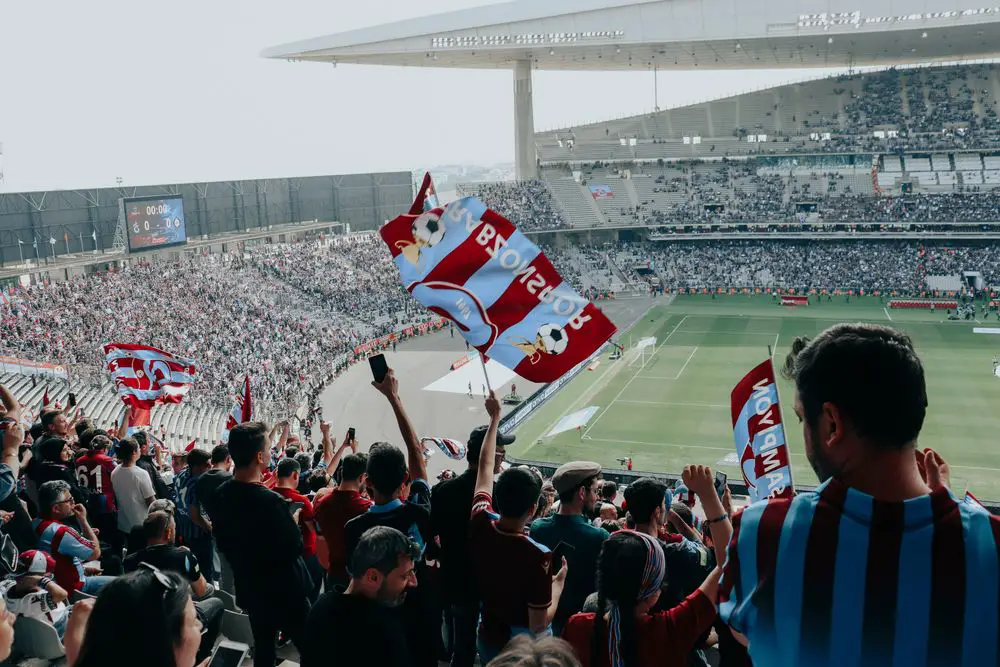
Our ten-year-old son’s final wish was simple. One real football game with Mom and Dad. We thought the whole trip was for Ethan, start to finish. Then our faces appeared on the stadium’s giant screen, the announcer told us to turn around, and I watched our son hide a smile while my husband went completely, utterly still beside me.
“Mom! Look!”
Ethan nearly spilled his drink trying to point up at the enormous screen suspended above the field.
I looked up, and there we were. All three of us, forty feet tall, filling the giant screen that hung over the center of the field. Chris on one side of Ethan, me on the other, and our boy in the middle in his blue team jersey, the one we’d ordered a size too big back when we still assumed he’d grow into it. He was grinning so hard that for one glorious second he looked like every other ten-year-old in that stadium. Not a patient. Not a chart at the foot of a bed. Not a countdown. Just a kid at a football game with his mom and dad, mugging for the camera.
I waved up at the screen. Chris threw both hands over his head like he’d personally scored. Ethan shouted, “We’re famous!” at a volume that turned heads three rows over, and the people around us laughed and waved toward the camera too, that easy stadium generosity, folding a stranger’s kid into their good time without a second thought. Somebody behind us ruffled his hair. Ethan loved it. He was lit up like the screen itself.
I’d already taken more pictures that afternoon than I could count, my phone hot in my hand from hours of overuse, the battery already down past half. But I reached for it again out of pure reflex, the way I reached for it a hundred times a day now, and lifted it toward the screen to photograph the photograph of us, as if I needed proof of the proof.
Then the stadium announcer’s voice rolled out over the whole crowd, unhurried, amplified, impossible to ignore.
“Ethan, we’re very happy you’re here with us today.”
My son stopped bouncing. His face swelled even larger on the screen, that gap-toothed grin frozen in forty-foot glory.
“But there’s something you don’t know about this trip,” the announcer went on.
I looked at Chris. He looked back at me, and I could see he was just as lost as I was. This wasn’t on the itinerary the wish organization had walked us through. There had been a schedule, accessible seating, a coordinator’s phone number, a plan for everything down to the parking. Nothing about the announcer knowing our son’s name.
“All three of you,” the voice continued, warm and unhurried, “please turn around and look behind you.”
Around us, people twisted in their seats to see what was happening. Ethan grabbed my hand, his fingers cold the way they always were now.
“What is it, Mom?”
“I don’t know, Captain.”
We turned.
A man was coming down the concrete stadium steps toward us, moving carefully against the flow of the crowd, and Chris went rigid beside me. Every trace of color drained out of his face in an instant, the way it does when you see someone your body recognizes before your mind has caught up.
“Leo?”
Behind Leo came Ray from the hospital, a big man made bigger by a team cap and jersey, carrying Ethan’s battered plastic tabletop football game tucked under one arm like it was a championship trophy he’d fought hard to win. A nurse from Ethan’s floor followed close behind, and I almost didn’t recognize her out of her scrubs, in jeans and a jersey of her own, looking younger and freer than I’d ever seen her at the nurses’ station. After her came a lanky teenager named Cody and his mother, all of them picking their way down the steps toward our row, waving.
Ethan’s mouth fell open. “No way.”
I looked at my son’s face, trying to read it, and what I saw there stopped me. Whatever he’d been bracing for when the announcer told us to turn around, this clearly wasn’t it. For a moment he just stared, genuinely stunned, and I realized that even the boy who had secretly set some of this in motion hadn’t known the whole shape of what was coming for him. His wish had been taken further than even he had dared to imagine.
Then Ray lifted that beat-up plastic game up over his head, high, like a man hoisting a trophy for a stadium to see, and Ethan started to laugh, this pure helpless delighted laugh, and I understood that some part of this, at least, our boy had quietly built himself.
To understand why a cheap tabletop football game reduced my son to helpless laughter in the middle of a professional stadium, and why my husband couldn’t look Leo in the eye, I have to go back three months, to when football was still just an ordinary thing in our house.
Back then, Sunday afternoons meant Chris yelling at the television, Ethan correcting every single thing he yelled, and me pretending I wasn’t invested while somehow complaining louder than either of them the instant I decided the referees had missed a call.
“Mom,” Ethan told me once, laughing so hard he had to set down his plate, “you don’t even know the rules.”
“I know cheating when I see it,” I said, with total confidence.
Chris nearly choked on a mouthful of chips.
That was the shape of us. An ordinary family in an ordinary living room, arguing about a game none of us could have explained to a stranger with any real authority. We had a mortgage on a three-bedroom house with a swing set out back that Chris had spent a whole Saturday assembling while swearing under his breath. We had a minivan with a permanent archaeology of crumbs in the back seats and a calendar on the refrigerator covered in Ethan’s soccer practices and dentist appointments and half-days at school. Chris commuted forty minutes each way to an engineering job he mostly liked. I did the books for two small businesses from a desk in the corner of our bedroom so I could be home when Ethan got off the bus.
We argued about ordinary things. Whether we could afford to redo the kitchen or should wait another year. Whether Ethan was old enough for his own phone. Whose turn it was to take him to Saturday practice in the cold. We were gloriously, boringly normal, the kind of normal that feels like it will last forever precisely because you never think to notice it. I had no idea, none at all, how much I would come to miss boring. How I would lie awake later and give anything, everything, to argue about a kitchen renovation again.
Then Ethan’s cancer stopped responding to treatment.
The doctor asked Chris and me to step outside Ethan’s hospital room one afternoon, and I knew before he said a word, the way you always know. There’s a particular gentleness doctors put on like a coat when they’re about to take everything from you. I remember staring at the tiny cartoon football Ethan had taped to his door, the one he’d drawn himself in the craft room with a marker that was running dry, so the brown came out streaky. I stared at that streaky little football while the doctor’s mouth moved and the fluorescent light hummed overhead and a cart rattled past somewhere down the hall.
“I’m truly sorry,” he said. “The treatment isn’t working the way we’d hoped.”
Chris asked all the questions. He’s an engineer. When something breaks, he needs the schematic, the failure point, the fix, the workaround. What else could they try? Was there another trial somewhere, another medication, another hospital, another specialist, a second opinion, a third? He wrote things down on the back of a parking receipt because it was the only paper in his pocket, his handwriting getting smaller and more cramped as the receipt ran out of room, as though if he just gathered enough information the conclusion might rearrange itself into something survivable.
He would spend the following weeks the same way. On the phone with our insurance company during his lunch breaks, fighting over prior authorizations and what counted as experimental and what they’d cover, keeping a binder now, an actual binder with tabs. Reading medical journals at two in the morning with the laptop glow on his face. Emailing programs in other states, in other countries. Refusing, in the way that only love refuses, to accept that the schematic had finally, truly run out of pages. I loved him so much in those weeks, and I couldn’t reach him at all, because he’d gone somewhere I couldn’t follow, a place made entirely of maybe.
I couldn’t get past a single sentence. Everything the doctor said after it turned to underwater noise, that muffled roar you hear with your head below the surface of a pool.
“We may be looking at much less time than we’d hoped.”
When we finally went back into Ethan’s room, a game was playing on the television bolted to the wall. Chris sat down heavily in the chair beside the bed. Their team scored, and for one automatic second, before he could think, before he could remember where we were and what we’d just been told in the hallway, Chris shot up out of the chair with his fists in the air.
“Yes!”
Ethan burst out laughing at his dad’s reaction, this bright surprised sound in that sterile little room. But then Chris caught himself, remembered, and leaned over the bed rail, his whole body suddenly careful and quiet, the joy switched off like a lamp.
“You okay, Captain?”
Ethan’s smile faded a little at the edges. “Dad. I laughed.”
“I know.”
“I’m allowed to laugh. It doesn’t hurt anything.”
Chris sat back down slowly. “Of course you are, buddy. Of course you are.”
I lifted my phone and took a picture of the two of them. The shutter sound clicked in the quiet room.
Ethan looked over at me. “What?”
“Nothing,” I said.
But it wasn’t nothing, and from that afternoon on, almost everything became something I needed to save. Ethan eating cereal in the morning light that came through the hospital blinds in slats. Ethan asleep with one sock on, the way he’d done since he was a baby, the other sock always lost somewhere in the sheets. The face he made at the hospital’s rubbery gelatin, a betrayed sort of grimace. The hours he and Chris spent arguing over which player had the better season, both of them citing statistics I was fairly certain at least one of them was inventing on the spot.
Photos. Short videos. Voice recordings I’d start secretly and let run for whole minutes just to catch the sound of him talking, laughing, complaining about the food, so that the exact pitch of his voice would exist somewhere outside my own failing memory. My phone filled up. I bought more cloud storage, upgrading the plan late one night in the hospital parking garage, sitting in the cold car because I didn’t want him to see me doing it. Nine ninety-nine a month to keep more of my son. It seemed like the easiest money I’d ever spent, and also the saddest.
I told myself I was collecting our life, gathering it up carefully so that later, when the house was too quiet, I would have something to hold in my hands. I was building an ark against a flood I could see coming and couldn’t stop.
What I didn’t understand, what I couldn’t see from behind the phone, was that I was being watched too. That every time I lifted that screen between us, my son saw it go up. He noticed every single click. He was keeping his own record, and what he was recording was his mother slowly disappearing behind a camera.
A few days later, a woman from a wish organization came by Ethan’s room. She had kind eyes and a lanyard full of badges, and she pulled a chair right up to the side of his bed like she had all the time in the world, like there was nowhere else on earth she needed to be. I imagine that’s a skill you have to learn, in that job. How to sit down slowly in a room full of people running out of time.
“If you could do one really special thing, Ethan,” she said, “anything at all in the whole world, what would you pick?”
I braced myself. I had, embarrassingly, already imagined this moment. I’d pictured him asking to meet a famous quarterback, someone whose poster hung on his wall at home, whose jersey number he’d made me sew onto a backpack. Or a trip somewhere warm and bright, a beach, a theme park, one of those enormous shining wishes that end up photographed in the local paper with a caption about bravery. I’d braced myself to watch my child ask for something huge, because that felt like the least the universe owed him.
Ethan answered instantly, like he’d been holding the answer ready in his hand the whole time.
“A football game!” He named his favorite team without a second’s hesitation. Then he added, almost as an afterthought, the part that turned out to be the entire point. “With Mom and Dad.”
Chris squeezed his shoulder. “Obviously, Captain.”
The woman laughed and wrote it down. She explained how it would all work. She coordinated closely with Ethan’s medical team, she said. She’d arrange accessible seating close to an exit, safe transportation with the right equipment, a wheelchair on standby whether or not he wanted it. She’d clear every detail with his doctors. The whole day would be engineered around keeping him comfortable and safe, around making it something he would never forget. She was warm and thorough and I was so grateful I could have wept, and did, a little, in the hallway afterward.
We thought we understood the entire plan. We nodded along and pictured the three of us in the stands.
But Ethan, it turned out, had made a second request. He’d made it quietly, on some other afternoon when Chris and I had stepped out for coffee or to take a phone call, and he’d made it the way a kid makes a wish on a birthday candle, never actually believing anyone would reach into the world and make it real. He had no way of knowing that a woman with a lanyard and a whole team of people would take a sick ten-year-old completely, gloriously at his word.
On game day, I finally understood why he’d chosen a stadium the moment we walked through the gates.
He stopped dead just inside the entrance, one hand still holding mine. Thousands of voices rolled and echoed through the concrete corridors, a sound with real physical weight to it, a sound you felt in the soles of your feet. Food vendors shouted their prices over the din. Music pounded from speakers mounted somewhere overhead. People in team jerseys streamed past us in a river of blue and white, laughing, calling to each other, carrying trays of nachos and enormous sodas, a whole city of strangers united by a game.
Ethan just stood there in the middle of it, small in his oversized jersey, taking it all in with his mouth slightly open. I watched Chris’s hand tighten on the handles of the wheelchair we’d brought just in case, watched him read the crowd for threats, for germs, for exhaustion, doing the constant math of a parent whose child’s immune system had become a full-time worry.
Chris leaned down toward him, immediately anxious. “Too much, Captain? We can find somewhere quieter. We don’t have to do the whole crowd.”
Ethan shook his head slowly, his eyes enormous, drinking it in. “It’s awesome, Dad.”
Then we came up out of the tunnel into the open bowl of the stadium, and he saw the field for the first time, that impossible expanse of it, and for a second he simply forgot to breathe.
For months I had watched my son’s entire world shrink. It had narrowed down to hospital rooms and waiting areas, to medication schedules and blood counts written on a whiteboard, to careful trips home and carefully monitored returns. His universe had become the size of a bed, a window, a taped-up cartoon football, and an IV pole he’d named Gerald and insisted on steering himself. I had watched the walls close in, week by week, on a boy who used to run everywhere he went, who couldn’t walk to the mailbox without turning it into a race.
And now, suddenly, there was green grass stretching out in every direction, more open space than he’d seen in months. Real players warming up on it, jogging and stretching and tossing the ball in easy arcs. Real helmets catching the afternoon light. Real, enormous, physical, magnificent noise that you felt in your chest as much as heard.
Ethan laughed out loud when the crowd booed the visiting team as they took the field. He yelled along with sixty thousand strangers until his voice cracked and gave out and he had to gulp from his water bottle. He announced, flatly and with great dignity, that he was not hungry, and then proceeded to eat half a soft pretzel and steal three separate bites of Chris’s hot dog when he thought no one was counting. I photographed all of it, every second, my thumb aching on the button, my eyes stinging behind the screen.
At one point Chris leaned over to him, unable to help himself. “You tired, Captain?”
“No, Dad.”
“Cold? You want my jacket? I’ve got the jacket right here.”
“Nope.”
“You need water? I can grab water, it’s no trouble, I’ll be right back.”
“Dad.”
“What?”
“Watch the game.”
Chris laughed. “I am, buddy. I’m watching.”
Ethan looked up at him, and there was something older than ten years in his face, something patient and a little sad. “No. You’re watching me watch it.”
Chris’s smile faltered for just a second, caught out. Then Ethan turned back toward the field as though he hadn’t said anything at all, as though he hadn’t just quietly and precisely named the exact thing his father had been doing for three months straight, the loving, frightened, hovering thing that had slowly turned Chris from a dad into a sentry.
I took another picture. My hands, at least, didn’t seem to know how to do anything else. It would be hours before I understood that I was the other half of the very same problem, that Chris watched with his eyes and I watched through a lens, and that between the two of us we had built a wall of worry around our son so complete that he’d had to travel to a stadium and put our faces on a giant screen just to get us to climb over it.
By halftime Ethan was visibly worn out, sinking lower in his seat, his energy finally flagging after the biggest day he’d had in months. But he flatly, absolutely refused to leave.
“Ten more minutes,” he kept bargaining, the exact voice he used to use over bedtime, over one more show, over five more minutes at the playground when he was little and whole and endless.
“You said that twenty minutes ago,” Chris pointed out.
“That was a different ten,” Ethan said, with the unshakable logic of a boy who intended to stay until they turned off the lights.
And that was when the camera found us, and our faces went up on the giant screen, and the announcer said Ethan’s name, and told us to turn around.
Which brings me back to the steps, and to Ray, and to the small crowd of people from the hospital coming down toward our row carrying a beat-up plastic football game through a stadium full of strangers.
I knew Ray well by then. Everyone on that floor did. He worked in facilities, and he had a way of appearing exactly when Ethan needed a light fixed or a stubborn television reset or, most often, simply someone willing to argue passionately about football for twenty minutes. Ethan called him “Coach Ray.” Ray insisted, with great seriousness, that his official title was “Commissioner.” They had been running that argument for months, and neither had conceded an inch.
Ethan had one ridiculous, non-negotiable rule about that tabletop game, and everyone on the floor knew it. Nobody who came into his room was allowed to just stand there and watch him play. If you lingered near the little plastic field for more than a minute, arms crossed, spectating, he assigned you a player on the spot, no discussion permitted, and suddenly you were in the game whether you’d planned to be or not, a grown adult crouched over a fifteen-dollar toy taking a fourth-down snap while a ten-year-old trash-talked you.
“Everybody plays,” he’d say, pressing a tiny plastic quarterback into your palm. “That’s the rule. You don’t get to just watch.”
He enforced it on everyone. Nurses on their break. The chaplain. The kid who delivered the meal trays. A visiting specialist once, in a suit, who ended up on his knees by the tray table for twenty minutes and left looking more human than when he’d arrived. It was, I would come to understand much later, the most important thing my son believed. That watching from the sidelines wasn’t allowed. That if you were in the room, you were in the game. That love meant you had to actually play.
But standing in that stadium, I could not for the life of me work out why Ray was carrying that cheap plastic field down forty rows of concrete steps in front of sixty thousand people.
And behind Ray came the others. The nurse from Ethan’s floor, out of her scrubs and in a team jersey, looking strange and wonderful in ordinary clothes. Cody, a teenager who’d been fighting his own battle down the hall, and who Ethan idolized in the way younger kids idolize older ones. Cody’s mother. And Leo.
Chris saw Leo, and looked away, down at his own hands.
I need to explain about Leo, because it’s the part of this story I understand least and think about most, the part that still keeps me up some nights.
Months earlier, Leo’s young son had been receiving treatment on the same floor as Ethan. The two families had passed each other in hallways for weeks, the way you do in a place like that, nodding, exchanging the tight small smiles of people who don’t need to say a word to understand each other completely. There’s a terrible unspoken solidarity among parents on an oncology floor. You never learn each other’s last names. You know exactly what the other person is carrying.
Then, one afternoon, Leo’s family got news. Good news. The best possible news, the kind everyone on that floor is praying for and almost no one lets themselves expect. Their boy was responding to treatment. The scans had come back clean. Leo had stood in the hallway and laughed, this huge, disbelieving, cracked-open laugh, and someone had thrown their arms around him, and then he’d started to cry right there against the wall, sliding down it a little, the kind of crying that comes when a weight you’ve carried for so long is suddenly, impossibly lifted off your shoulders and you don’t know what to do with your body now that it’s light.
Chris came around the corner at exactly that moment. He had just walked out of a meeting where Ethan’s doctors had told us, gently, in that coat of gentleness, that another treatment had failed. He was carrying that news in his body like a stone in his chest, and he walked directly into a father weeping with joy over the very outcome we had just been denied.
He stopped in front of Leo, and something in him broke the wrong way, and he snapped, “Could you celebrate somewhere else?”
The hallway went silent. Nurses looked up. Leo, still wet-faced, the joy draining out of him, immediately began to apologize, mortified, stammering that he was sorry, that he wasn’t thinking. Chris regretted it almost before the words had finished leaving his mouth. I saw the regret land on his face in real time, saw him understand exactly what he’d done. But he didn’t fix it. He didn’t apologize back. He didn’t go find Leo the next day, or the day after that. Shame has a way of building a wall higher and thicker than the original wound, brick by brick, until going back feels impossible. Chris let that wall stand, and he told himself it was too late, and every day it got a little more too late.
What neither of us knew at the time was that Ethan had seen the whole thing from his doorway. He’d been standing there, steadying himself on Gerald the IV pole, and he’d watched his father snap at a crying stranger in the hall. He never said anything to us about it. But he’d seen it. And Leo, glancing up, had seen Ethan see it.
The very next afternoon, Leo had knocked softly on Ethan’s door. He didn’t mention the hallway, didn’t bring up Chris at all. He didn’t ask how Ethan was feeling, didn’t use the soft, careful, tilted-head voice that every adult on that floor used on the kids. He just held up the plastic football game that lived on Ethan’s tray table and challenged him to a match. Then he sat down, played hard, lost badly, and immediately demanded a rematch on the grounds that the equipment was clearly defective and the officiating corrupt.
Ethan liked him instantly and completely and without a single reservation. Leo became a regular after that, stopping by Ethan’s room between his own son’s appointments, and their ongoing argument about whether the goalpost’s permanent lean constituted an unfair home-field advantage became one of the great running debates of Ethan’s entire hospital life, reopened fresh nearly every afternoon.
And now here was Leo, a father whose own son had made it home, walking down the stadium steps to be part of the football day of the boy whose father had snapped at him in the worst moment of both their lives.
“Dad,” Ethan whispered up at Chris, “don’t be weird.”
Chris looked down at him. “I’m not weird.”
“You are sometimes.”
Even with everything happening, even with my heart doing complicated things in my chest, I laughed.
Ray reached our row and held up the tabletop game. “Captain.”
Ethan groaned, long and theatrical, and dropped his face into his hands. “You snitched. You totally snitched on me.”
“Commissioner,” Ray corrected him, unbothered.
“You cheat, Ray.”
“Unproven,” Ray said, “and frankly slanderous,” and the whole cluster of strangers around us who’d been shamelessly eavesdropping on the exchange laughed out loud.
He set the little plastic football field down carefully on Ethan’s lap, and one player immediately toppled over onto the turf, right on cue, drawing another groan from Ethan and a satisfied nod from Ray, as if the game itself had proven his point about the equipment.
The stadium announcer spoke again, and the crowd quieted down to listen, sixty thousand people leaning in toward one ten-year-old.
“Ethan told our wish team that if this was going to be his football day, he wanted his hospital league to somehow be part of it too. What he didn’t know is that a few members of that league decided that watching from home just wasn’t good enough.”
The crowd cheered, a warm rolling wave of it. Ethan covered his whole face with both hands, mortified and delighted in equal measure.
“I’m never going back to the hospital,” he announced from behind his fingers, to no one in particular.
The nurse leaned over him, completely deadpan. “You have an appointment Tuesday.”
“Cancel it,” came the muffled reply.
More laughter rippled through the rows around us, strangers grinning at each other, caught up in a boy they’d never met.
“Ethan has one rule for his league,” the announcer said.
Ray raised his arm and pointed straight at Ethan, grinning enormously, a showman enjoying his moment.
Ethan shook his head hard, peeking out from between his fingers. “Don’t. Ray, don’t you dare say it.”
The announcer said it anyway, and it boomed out over the whole stadium.
“Everybody plays.”
The people near us broke into applause. I smiled so wide it hurt, caught up in it, and I turned to catch Ethan’s face for a picture, to save it, to bank it with all the others.
But he wasn’t smiling anymore. He was watching me. Watching my phone come up between us, watching the screen rise toward his face one more time. And there was something in his expression I couldn’t name yet, something quiet and grown and a little bit heartbroken underneath all the noise and celebration, and it made me lower the phone slowly without pressing anything. In the middle of the biggest, loudest surprise of his short life, my son was looking not at the stadium or the crowd or the hospital league that had traveled all this way for him. He was looking at his mother, and at the thing she kept holding up between them, and he wasn’t laughing about it.
I didn’t understand it fully in that moment. I would, very soon, in a quiet room just off the roaring stadium. But I lowered the phone, and I looked back at him without it, and something in his face eased, just slightly, just enough.
A stadium staff member came over a few minutes later and quietly explained that there was a family room nearby, somewhere quieter, where Ethan could rest and decide whether he wanted to come back to the seats. By then he’d started to sag against Chris’s side, the long afternoon finally catching up with him, and I welcomed the offer with my whole heart. We gathered ourselves and followed the staff member inside, the whole ragtag hospital league trailing after us.
The sudden quiet of the family room felt almost unreal after the roar of the stadium, like surfacing from deep underwater into still air. It was a plain, kind room, a couch and some chairs and soft lighting, clearly designed for exactly these kinds of families and these kinds of moments. Someone had thoughtfully set out water bottles and a plate of cookies on the low table. Ethan settled onto the small couch with a sigh, the long day sitting heavy on him now, and Ray placed the tabletop game on the table in front of him with great ceremony. One plastic player fell over instantly, the way it always did, the way it had been doing since February.
“Cheap equipment,” Ray muttered, righting it.
“Bad coaching,” Ethan shot back without missing a beat.
Cody laughed from across the room, and his mother smiled, and for a moment it was just a bunch of people from a hospital being easy with each other in a quiet room.
The adults lingered, shifting their weight, unsure, the way people do when they don’t want to leave a child but sense the moment isn’t theirs. And Ray, who I was quickly learning understood a great deal more than he ever let on behind all the football arguing, figured it out before I did. He glanced toward the door, then toward Ethan, then clapped his big hands together once.
“All right, come on, people. Captain’s got a family meeting.”
Ethan’s head snapped up. “I do?”
“You do now.”
Ray started herding everyone toward the door with the gentle authority of a man used to moving people out of rooms. Cody and his mom, the nurse, all of them filing out with a wave and a word for Ethan. Leo was last to go. He paused in the doorway, and he and Chris looked at each other across the little room. For a long moment neither of them said anything at all. Then Leo gave a small nod, just a slight dip of his head, and followed the others out.
The door clicked shut. And then it was just the three of us.
Ethan sat on the couch with the tabletop game beside him. Chris pulled a chair up close. I sat down on Ethan’s other side, and I could feel that something was coming.
“Captain,” I said carefully. “What exactly did you tell Ray?”
“Nothing, Mom.”
Chris pointed at the door the others had just gone through. “Nothing? Ray traveled all the way to this stadium carrying a dozen plastic football players and one goalpost that hasn’t stood up straight since February, and you told him nothing?”
“They’re players, Dad. Not football players. Players.”
“Fine. Athletes.”
Ethan fought down a smile. I waited, saying nothing, the way you learn to wait when you want a child to fill the silence. He picked at a loose thread on the hem of his jersey.
“Ethan,” I finally said, softly. “Why was it so important to you that they be part of today?”
He shrugged, eyes down. “Because.”
“Ethan.”
His eyes came up and met mine. Then they slid down to the phone still sitting in my hand, where it always was, and stayed there.
“They’re people from the hospital,” he said gently, “who still act normal around me.”
Chris blinked. “Normal? What do you mean, normal? Are we not, are we being weird?”
Ethan immediately looked like he wished he could take it back. “I didn’t mean bad weird, Dad.”
“What kind of weird, Captain?” I asked. I kept my voice level, though my heart was pounding.
He stared down at the little plastic field, at the fallen player.
“Dad pauses the game to check if I’m tired,” he said. “Like, every few minutes. He doesn’t even watch the game anymore. He just watches me.”
Chris opened his mouth.
Ethan kept going, the words coming faster now, like a dam giving way. “And you take pictures when I’m eating cereal, Mom. Just eating cereal. Nobody takes pictures of a kid eating cereal.”
I looked down at the phone in my hand as if it belonged to someone else.
“You saved my hospital bracelet,” Ethan added, quieter. “The one from the night I threw up on your shoe.”
“That was a very memorable evening, sweetie,” I said, trying for lightness.
“Mom.”
“Sorry.”
He rubbed one thumb slowly over the little plastic scoreboard. Then he looked at his father.
“Dad, you used to yell at football.”
“I still yell at football, buddy,” Chris said. “I yelled two minutes ago.”
“No, Dad.” Ethan shook his head. “Now you yell, and then you look at me. To make sure it was okay that you yelled.”
Chris said nothing. There was nothing to say, because it was true, and we both knew it was true.
Ethan turned back to me. “And Mom, you used to yell at referees.”
“Bad referees,” I said.
“All referees, Mom.”
I almost laughed, because that was true too.
Then Ethan said the thing that made the whole room go silent.
“That’s why I picked football. For my wish.”
Chris leaned forward slowly. “What do you mean, Captain? Why does football have to do with it?”
Ethan’s face crumpled with a kind of frustration, like we were forcing him to explain something that should have been obvious to any reasonable person.
“I wanted you guys to have fun with me.” He wiped his nose with the back of his hand. “Not fun about me. With me. There’s a difference. Everybody keeps acting like everything has to be special now, and careful, and important, and gentle, just because I’m going to die. And I hate it. I hate it so much.”
I set my phone down, facedown, on the couch cushion beside me.
Ethan’s eyes went straight to it. He watched me put it down. And then he said the sentence I have carried with me every single day since, the one I will hear differently for the rest of my life, the one that rearranged something permanent inside me.
“Sometimes I just want stuff to be stuff.”
For a moment none of us moved. Sixty thousand people were roaring somewhere on the other side of that wall, a whole ordinary world of people whose Sundays were just Sundays, and inside that small quiet room the three of us just sat with what our ten-year-old had understood so much more clearly than either of his parents. That in trying so hard to make every moment count, we had made every moment heavy. That we’d been so busy memorializing him that we’d half stopped just being with him. We’d turned him into an occasion. And all he’d wanted was to still be a kid whose mom yelled at referees she didn’t understand and whose dad leapt out of his chair when their team scored and forgot, for one whole second, to be afraid.
Chris stared at Ethan for a long few seconds, his jaw working. Then he reached over and covered our son’s small hand with his big one, the way he’d done in the hospital room three months earlier, the way he’d done a thousand times.
“I’m sorry, Captain.”
Ethan shrugged, but his eyes stayed down on the plastic field. “I know you’re sad. I’m sad too. I’m not mad about it. I get it.” He was quiet for a beat. “I just don’t want to spend my whole, you know. My whole rest of it. Being watched.”
The word landed in the center of my chest and stayed there.
Chris nodded. When he spoke again his voice was rough and low. “You’re still here, Captain,” he said. “You’re right here. And I’ve been acting like my whole job is to sit and watch every second tick past, like a scoreboard, instead of just being in the seconds with you. I’ve been guarding the clock instead of playing the game. That’s a bad way to coach. You’d bench me for that.”
Ethan finally looked up at him, and a little of the frustration eased out of his face. “So you’re admitting I’m right?”
Chris blinked. “Absolutely not.”
Ethan grinned, and it was the real one, the unguarded one, the one that made him look like every other kid again. “Too late. You basically already said it. There’s witnesses.”
“Your mother’s a hostile witness.”
“Mom, back me up.”
“I’m watching the game,” I said, which made no sense, and made all three of us laugh, which was the point.
A knock came at the door.
Chris looked at me, then got up and crossed the room and opened it. Leo was standing there in the hallway, hands in his pockets, uncertain, like a man who wasn’t sure he had the right to knock but had done it anyway.
For a second the two men just looked at each other, and the whole history hung in the air between them, the hallway, the failed treatment, the celebration, the cruel sentence, all the months of silence built up brick by brick.
“How’s your son?” Chris asked.
His voice was careful, almost formal. But he asked it. After all those months of not being able to, of the wall being too high, he stood in that doorway and finally made himself ask the question.
Leo seemed genuinely surprised, his eyebrows going up. “Home,” he said after a moment. “Driving his mother up the wall. Won’t stop leaving his shoes right in the middle of the hallway where everybody trips on them.” He gave a small, helpless shrug, the shrug of a father complaining about the most precious problem in the world.
Chris smiled, and this time it reached all the way to his eyes. “Good,” he said. “That’s really good, Leo. I mean that.”
That was the whole exchange. Ten seconds, maybe. Two fathers in a doorway. But I understood exactly what it had cost my husband and exactly what it meant. It was one piece of good news that Chris finally let himself hear all the way through, finally allowed himself to be simply, cleanly glad about, without it feeling like something stolen from our own son, without the arithmetic of grief turning another family’s mercy into our loss. Somewhere in that small room, with our dying boy sitting on the couch teaching us both how to live, Chris had set down the stone he’d been carrying in his chest since that afternoon in the hall.
Leo held Chris’s gaze a moment longer, and something passed between them that didn’t need words, one father forgiving another for a thing that was never really about him in the first place. Then Leo nodded once, stepped back, and the door eased shut behind him.
A few minutes later, I looked over at Ethan, who was resting now, his color a little better in the quiet.
“You ready to head home, Captain?” I asked.
He glanced through the glass wall toward the field, where the game was still going, tiny and bright in the distance.
And I caught myself. I heard the assumption underneath my own question, the careful managing of him, and I stopped.
“What do you want?” I asked instead. Simply. The way I’d have asked him six months ago.
Ethan considered it seriously, weighing it. “Ten more minutes.”
Chris nodded. “Ten.”
We went back out to our seats. And this time, no camera found us. No announcer said our names over the speakers. No players jogged over to the railing, no one handed Ethan a signed football or made a fuss or pointed a lens at the brave sick kid. The game simply went on around us, ordinary and enormous and completely indifferent to us in the best possible way, exactly the way he had wanted it all along. We were just three people in a crowd of sixty thousand, and it was perfect.
Chris groaned loudly about a terrible play call, a real groan, from the gut, forgetting to look over. Ethan informed him, with the withering authority of a ten-year-old, that he had absolutely no idea what he was talking about and never had. A few minutes later a referee threw a yellow flag out onto the grass.
“Oh, come on!” I shouted, up on my feet before I’d consciously decided to stand.
Ethan cracked up, doubling over in his seat, the plastic game rattling on his lap. “Mom, you don’t even know what happened!”
“I know injustice when I see it,” I said with total conviction, and sat back down to a smattering of applause from the strangers around us who’d apparently taken my side.
My hand went automatically toward my phone. Muscle memory. Three months of muscle memory, my whole body trained to reach for it whenever he laughed, to preserve him, to bank the moment against the coming quiet.
I stopped. I made my hand stop.
Ethan noticed, because Ethan noticed everything, always had.
“You’re not taking one?”
“No.”
“Why not?”
I looked at him. Not at the screen, not at the frame, not at the shot. At my son’s actual face, the flush in his cheeks from yelling, the light in his eyes, the here-ness of him.
“Because I’m watching,” I said. “I’m right here, and I’m watching you. Not through anything. Just watching.”
He studied me for a moment, weighing whether I meant it. And then he nodded, slowly, as though that answer made perfect and complete sense, and turned back to the field, satisfied, and let me back into the game with him.
Late in the fourth quarter, our team scored, and the whole stadium detonated around us. Sixty thousand people came up out of their seats at once, a wall of sound you could lean against. Chris leapt to his feet, roaring, both fists in the air. Ethan grabbed his father’s arm with one hand and my arm with the other, hauling himself up between us, laughing so hard he could barely make a sound, just this breathless silent shaking, his whole small body caught up in it.
The tabletop game slid sideways off his lap. One tiny plastic player popped loose and tumbled down between the seats, landing somewhere underneath mine.
I saw exactly where it went. I registered it, the small orange figure lying on the concrete by my shoe.
And for once, I didn’t move. I didn’t immediately bend down to rescue it. I didn’t reach for my phone to capture the moment, and I didn’t lunge to fix the small thing that had gone wrong, to smooth it over, to make it perfect. Because Ethan was laughing, really laughing, and Chris was yelling himself hoarse, and I was yelling too, all of us on our feet and tangled together, and the game was still happening all around us, huge and loud and gloriously unfinished, and I was in it. All the way in it, for the first time in three months. Present in my own life instead of standing outside it, guarding it, preserving it behind glass. I let the little player lie there. I let the moment be imperfect and unrecorded and completely, achingly alive.
Only when the cheering finally began to soften, when people were dropping back into their seats and the noise was ebbing, did Ethan glance down at his lap and notice.
“Mom! My player!”
I reached under the seat, found the little plastic figure with my fingers, and handed it back to him. He took it, inspected it for damage, and snapped it firmly back into place on the field. He nudged it once with his thumb to make sure it stood, and gave a small, satisfied nod, order restored to his tiny league.
“Everybody plays.” The rule. The whole rule, and the whole heart of him, folded into two small words.
Then my Captain turned back toward the field, toward the green grass and the noise and the ordinary, glorious, gorgeously unremarkable rest of the game.
And this time, so did we. All three of us, watching the same thing at the same time, together, the way he’d wanted from the very beginning.
I still have the photographs, thousands of them. I’m grateful for every single one now, in a way I couldn’t have understood behind the camera. But the moment I hold onto hardest, the one I return to on the hard nights, is the one I never captured at all. The one where I put the phone down and let a plastic football player lie on the concrete under my seat, and just watched my son laugh, and was simply, wholly there with him while there was still a there to be.
That was Ethan’s real wish, in the end. Not a stadium or a famous team or a giant screen with our faces lit up on it forty feet tall. He wanted, for one ordinary afternoon, to give his frightened parents their boy back, and to have us back too, unafraid, fully present, in the handful of seconds we still had left together. He was ten years old, and he understood something it takes most people an entire long lifetime to learn, if they ever manage to learn it at all. That love isn’t in the watching, and it isn’t in the saving. It’s in the being there, all the way, while there is still a there to be.
Everybody plays. Nobody just watches. That was the rule, and it was the truest thing he ever taught us.
We’re still learning to live by it.

Specialty: Legal & Financial Drama
Michael Carter covers stories where money, power, and personal history collide. His writing often explores courtroom battles, business conflicts, and the subtle strategies people use when pushed into a corner. He focuses on grounded, realistic storytelling with attention to detail and believable motivations.