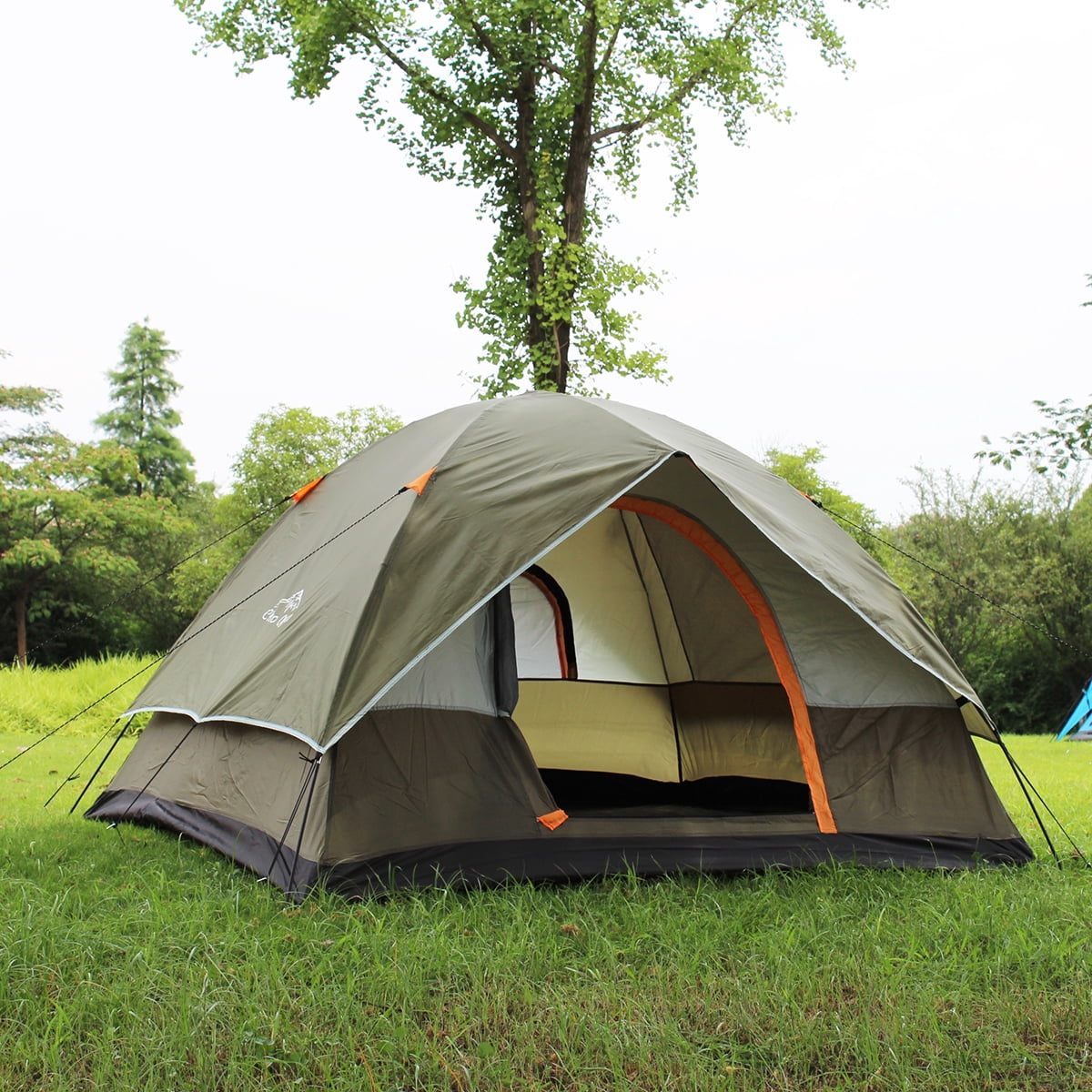
A squirrel sat on a branch above me and stared like I owed it rent for encroaching on its territory. My back throbbed in that particular way that felt less like pain and more like a formal grievance being filed against me by my own spine. My hip was doing the thing where it felt bolted on wrong, like some overworked handyman had installed it in a hurry and never come back to tighten the screws. And I was, at sixty-eight years old, lying flat on my back inside a lopsided tent in my son’s backyard, blinking up at a pink dawn sky through a mesh window that had seen better decades.
“Well,” I muttered to nobody in particular, “guess I’ll be leaving a very honest review on Amazon.”
The sleeping bag zipper caught on the hem of my nightgown, because of course it did, because nothing about this situation was going to be easy or dignified. I wrestled with it for a good minute before giving up and simply lying back down, staring at the tent ceiling. The squirrel kept judging me through the mesh, tilting its little head like it couldn’t quite believe what it was witnessing either.
I live alone in Ohio, two states away from my son Luke, his wife Gabrielle, and my two grandbabies, Poppy and Jonah. I’ve got arthritis settled comfortably into both knees, a back that files formal complaints every single morning before I’ve even had my coffee, and a water heater older than my marriage was, which is saying something, because my marriage lasted thirty-one good years before my husband Walter passed.
Luke comes when he can. He drives out from wherever life has planted him, fixes whatever’s broken on the gutters, hauls groceries up my porch steps two bags at a time, and pretends he doesn’t notice me tearing up a little when it’s time for him to leave again.
“Ma, I’ll be back next month,” he’d always say, standing in my doorway with his keys already in hand.
“Don’t rush, honey,” I’d tell him, because that’s what mothers say.
“I’ll always rush,” he’d answer, and mean it. That’s my Luke. Always has been, since he was a boy who used to run the whole length of our street just to beat the mail truck home.
His wife, though. She’s another story entirely.
I’ve never actually caught my daughter-in-law being rude to my face, not once, not directly. It’s all background noise, like a bad radio station you can’t quite turn off no matter how many times you fiddle with the dial. But every time I call Luke, I hear it anyway, leaking through the receiver whether she means for me to or not.
“Is she calling again?” A big sigh, unmistakable even through the phone line. A cabinet door slamming somewhere in their kitchen with just a little too much enthusiasm.
“Luke, the kids need dinner,” she’d say, loud enough that I knew she wanted me to hear it too.
She hates me, and honestly, she’s never worked particularly hard to hide it. It really bothers her, I think, how much time Luke still spends thinking about his old mother two states away. Gabrielle loves being the center of attention, and she genuinely cannot stand it when she isn’t standing dead center of every single conversation.
I always pretend I don’t hear any of it. My best friend Doreen says I’ve earned myself an honorary PhD in Pretending I Don’t Hear.
“Marlene,” she told me once, stirring cream into her coffee at our regular Tuesday diner booth, “one of these days you’re going to have to say something.”
“Oh, I couldn’t,” I said.
“That’s exactly your problem,” she said, and pointed her spoon at me like a schoolteacher.
My mother raised me never to be a bother to anybody. Bless her memory, she also raised me never to wear white after Labor Day, so I suppose her wisdom came with certain expiration dates I’ve had to learn to navigate on my own.
Anyway. A few weeks back, Luke called with the sweetest news I’d heard in months.
“Ma, come and stay for a week. The kids miss you something awful. Poppy’s been drawing you pictures, taping them up on her wall.”
I nearly cried straight into my morning oatmeal.
“Are you sure Gabrielle won’t mind?” I asked, because old habits die slower than old husbands.
“Ma, come,” he said, in that tone that meant the conversation was already decided.
So I packed my best cardigan, the soft blue one with the little pearl buttons Walter always said made me look like I belonged in a magazine advertisement for good manners. I packed a tin of homemade chocolate chip cookies, the recipe my own mother handed down to me on a index card so worn the ink had gone soft. I even bought a little stuffed dinosaur for Jonah, because Luke had mentioned, with real fondness in his voice, that his boy had entered a very committed dinosaur phase, the kind that involved correcting adults on pronunciation.
I hadn’t hugged those babies in almost a year. A year is a genuinely long time when you’re pushing seventy and your knees crack like kindling every time you stand up from a chair.
But right before I was supposed to fly out to their city, Luke called again, and I could hear right away, before he even said a word, that something had shifted.
“Ma, I’m so sorry. Work is sending me out of town for two, maybe three days. Gabrielle’s picking you up from the airport instead. I’ll be back before you know it, I promise you that.”
“Okay, honey,” I told him, because that’s what I always say. “Don’t worry about me.”
Because that’s the thing I’ve said my whole life, whether I meant it or not. Don’t worry about me. Don’t fuss over me. I’ll manage.
I got to the airport at noon, wearing my sensible walking shoes and what I hoped was a hopeful expression, though at sixty-eight, hopeful and nervous can sometimes look identical on a person’s face. The flight was smooth as glass. I even got the window seat, which felt like a small kindness from the universe, a little apology in advance for whatever was coming.
I stepped off that plane into a jetway that smelled like jet fuel and stale pretzels, and I felt something small and cold settle down into the bottom of my stomach, right where good instincts like to sit and wait to be ignored.
Looking back now, sitting here in my own kitchen typing all this out on my old laptop with the sticky spacebar, I want to reach clean through time and grab that woman, that earlier version of me standing in the jetway, by the cardigan sleeve and shake her a little. I should have turned right back around and flown home that very afternoon. Instead, I went to find Gabrielle.
My daughter-in-law showed up at the arrivals curb wearing sunglasses the size of dinner plates, even though the sun had already started its slow slide toward evening.
“Marlene. Hi,” she said, and popped the trunk of her car without ever once getting out to greet me properly.
I wrestled my own suitcase into that trunk, cardigan sleeves flapping like I was fighting off a determined seagull, and slid into the passenger seat wearing what I hoped passed for a warm, grateful smile.
“It’s so good to see you, honey,” I said. “How are the kids?”
“They’re fine,” she said, and that was the whole answer.
I blinked, waited a beat for more, and got nothing.
We drove in a silence so thick I could have buttered toast with it. The only sound for the better part of twenty-five minutes was Gabrielle updating me, entirely unprompted, on her yoga instructor’s ongoing divorce proceedings.
“He kept the dog. Can you believe that? The dog!” she said, gripping the wheel like the injustice of it had personally wounded her.
“Terrible,” I said, because at that particular moment I would have agreed the moon was made of provolone cheese if it kept the peace for another twenty minutes.
By the time we pulled into the driveway, my back had settled into that particular low hum it gets when it’s quietly plotting revenge against me for the day’s indignities. I just wanted a pillow. Any pillow at all. A folded bath towel, even, because it was already getting late and my whole body was announcing, in no uncertain terms, that it wanted to lie down somewhere flat.
“Could you show me my room, sweetheart? I’m about to fall right over.”
“Sure. This way,” she said, and led me through the kitchen, past a bowl of very sad-looking bananas going soft and brown at the tips, and slid the back door open into the darkening yard.
I followed her across the lawn in my traveling flats, the grass damp against the thin soles, thinking maybe she wanted to show me the garden, or maybe some new patio furniture Luke had mentioned on the phone. Then I saw it.
A small blue tent, glowing faintly under the porch light like some sad little lantern nobody had asked for.
I actually laughed at first. “Oh, that’s cute. Did the kids set that up? Are they hiding in there?”
Then Gabrielle pointed at it and said, plain as anything, “No, that’s your room.”
I waited for her to laugh too, to let me in on the joke. She didn’t.
“The thing is,” she went on, “all the rooms were painted just this morning. There’s only one that isn’t painted yet, and I’ll be sleeping there with the kids. There’s nowhere to sleep inside the house. But you like camping, if I remember correctly, right?”
Well, I wouldn’t exactly say I like it. I haven’t liked camping in ten solid years, not since a raccoon stole my hot dog clean off my paper plate and, along with it, a fair amount of my confidence in the natural world. I’ve mentioned that particular incident at several family get-togethers over the years, told it as a funny little story, never once imagining it might be filed away and used against me later.
“It’s just paint fumes, Marlene,” she said. “You’d be sick all night if you tried to sleep inside.”
I stood there in the near-dark, holding a tin of homemade cookies I’d baked with my own two arthritic hands, staring at a tent, and I thought about Luke, about the grandkids sleeping somewhere warm inside that house, and about how one wrong word from me right now could turn a peaceful week into an all-out family war.
But what could I really do? Obviously I didn’t want to breathe in paint fumes all night at my age, not with my lungs the way they are.
So I said, “All right. Just for tonight,” and I crawled into that sleeping bag, and my hip cracked loud enough that I half expected the neighbors to come check on the noise.
Someone two yards over decided that eleven o’clock at night was the perfect hour to use a leaf blower, which, honestly, felt like a deeply personal message being delivered straight from the universe to my tent flap.
I fumbled around for my phone in the dark and texted Doreen.
I am sleeping in a tent. Send wine.
Three little dots appeared almost instantly. Doreen hardly ever sleeps, not since her own husband passed, and I’ve come to rely on that particular insomnia of hers more than I probably should.
WHAT?! Marlene!
Long story. Paint fumes inside, allegedly.
Allegedly, my foot! Get up and go to a hotel!
I can’t. The grandkids are inside.
Marlene, honey. You are too old and too classy for a tent.
I put the phone down on my chest and stared up at the tent ceiling, which was decorated with what looked like the ghostly stains of dried apple juice from some long-ago backyard sleepover, years old by the look of it. An old camping tent, I realized, the kind that had clearly been shoved into the back corner of the garage for a decade, waiting patiently for exactly this indignity to come along and give it purpose again.
I struggled against sleep for a good long while, my mind turning over the whole strange evening, before travel exhaustion finally won out and pulled me under.
Morning came the way punishment usually does, slowly and with absolute certainty. I unzipped the tent flap and found the squirrel back on his fence post, staring at me like I’d personally wronged him in some past life he still remembered vividly.
I sat up, and every single vertebra in my back filed its own individual formal complaint, one after another, like a very slow-moving morning meeting nobody wanted to attend.
I waited out on a lawn chair for what felt like a solid hour, my robe pulled tight against the morning chill, hoping against hope that Gabrielle might appear with coffee, breakfast, and an apology, delivered in that particular order.
Instead, my daughter-in-law appeared with a granola bar and a bottle of water balanced on a little decorative tray, like she was serving afternoon tea to visiting royalty rather than breakfast to a sixty-eight-year-old woman who’d just spent the night on the ground.
“The paint still isn’t dry,” she said.
“Ah,” I said, because what else was there to say.
“I’ll bring you a real breakfast in a bit.”
“Take your time, sweetheart,” I told her, and she retreated back into the house without another word.
I chewed on that granola bar, which had roughly the moisture content of a paperback bookmark, and watched a bird on the fence line watch me right back with what I can only describe as open judgment. I was busy composing, in my head, exactly how I’d describe this whole scene to Doreen later, when I heard tires crunching on the gravel of the driveway.
A familiar silver sedan rolled in, a full day earlier than expected, and Luke stepped out with his overnight bag slung over one shoulder, looking like a man who’d driven straight through without stopping.
My son’s car door slammed shut, and I watched his face run through a whole slideshow of expressions in about three seconds flat. Confusion first. Then concern. Then something I hadn’t seen cross his face since he was twelve years old and caught his little sister eating his Halloween candy straight out of the bag.
He crossed the yard in about four long strides, and we hugged right there on the grass, and he told me his business trip had wrapped up early, so he’d just driven straight home instead of waiting for his original flight.
Then he noticed the tent, and he asked what exactly it was doing set up in the middle of his backyard.
“Mom? Why are you sitting out here in the yard? In a robe?”
I gave him my sweetest smile, the one I usually reserve for particularly unpleasant trips to the DMV.
“Well, honey, Gabrielle told me you’re having the rooms renovated. She said the fumes were just terrible and there was nowhere for me to sleep inside, so she set me up out here for the night.”
Luke turned red. Not embarrassed red, not the color a man goes when his mother says something mildly awkward in public. This was the kind of red that has its own weather system attached to it, thunderclouds gathering somewhere just behind his eyes.
“Painted?” he said. “Mom, there is no renovation. There’s no paint anywhere in this house. Nothing has been painted. I personally made up the guest room myself before I left for my trip. Fresh sheets. I even put a lavender candle on the nightstand because I know how much you like that smell.”
I was shocked, truly. Gabrielle had really gone too far this time, further than I’d even let myself imagine while I was lying awake listening to that leaf blower.
Just then, my daughter-in-law appeared in the doorway with her arms crossed tight over her chest, her hair perfectly in place, her expression very much not.
“Luke, it, it wasn’t like that. I can explain.”
“Gabrielle.” His voice stayed calm, and that was the truly frightening part, calmer than I’d ever heard him. He even smiled a little, which somehow made it worse. “I’m going to run to the store. Twenty, thirty minutes. Mom, go inside. Please.”
He kissed my forehead like I was made of something fragile and precious, then walked back to his car without another word to his wife.
I don’t think I’ve ever moved so fast in my entire life. Bad back and all, I was up off that lawn chair and settled onto the living room couch with a fresh cup of coffee in about sixty seconds flat.
Gabrielle paced the living room floor, folding a hand towel that was already perfectly folded, then unfolding it just to fold it right back up again, her hands clearly needing something to do besides sit still.
“He’s overreacting,” she muttered, mostly to herself. “You know how he gets.”
“Mmm,” I said, and took a slow sip of coffee.
She glanced anxiously toward the hallway. The guest room door had drifted partway open, and from where I sat on the couch I could plainly see crisp white sheets, tucked in hospital-corner neat. The lavender candle sat there on the nightstand like a small, silent witness to the whole affair.
Not a single whiff of paint anywhere in that house. The whole place smelled of fresh coffee and, very faintly, whatever expensive candle Gabrielle liked to keep burning in the kitchen.
Little feet came thumping down the stairs then, fast and uneven the way children run when they’re excited about something. Poppy first, all messy braids and a nightgown covered in cartoon avocados wearing tiny sunglasses. Jonah trailed right behind her, clutching his stuffed dinosaur by the tail, dragging it along the carpet.
“Grandma!”
They flew straight into me, and I did not care one bit what my back had to say about the impact. I hugged those babies until my arms genuinely ached from the effort, and it was the best kind of ache I’d felt in months.
Poppy pulled back after a moment and gave me a very serious look. Seven-year-olds have a particular way of asking questions, like tiny courtroom lawyers who already suspect they know the answer and are simply waiting to catch you in something.
“Grandma, why did you sleep outside?”
I opened my mouth, and nothing useful came out.
“Mommy said you wanted to,” Poppy went on, undeterred. “She said you love camping. But you don’t love camping. You told me on the phone your back hurts when you sit on the floor too long.”
From across the room, Gabrielle made some sort of strangled little noise.
I patted Poppy’s cheek gently. “Grandma had a little misunderstanding, sweetheart. It’s all sorted now.”
Jonah tugged at my sleeve, dinosaur still dangling from his other hand. “Are you going to sleep in my room? I have a bunk bed.”
“That’s very generous, buddy,” I told him. “Grandma might take the guest room, though.”
Gabrielle turned sharply toward the kitchen, and I saw her jaw tense in a way that told me the morning was far from over.
My phone buzzed in my robe pocket. Doreen, of course.
Are you alive? Do I need to fly out there? I have a suitcase and rage packed and ready to go.
I typed back: Luke’s home. I think there’s about to be a reckoning. Also, please send an ice pack, my hip is never forgiving me for last night.
Half an hour passed the way it does when you’re waiting for a shoe to finally drop, both slowly and, somehow, at the same time, very loudly in your own head. I didn’t really know what exactly I was waiting for in that moment. I didn’t know about the box yet, sitting somewhere in the trunk of Luke’s car, waiting for its own dramatic entrance.
All I knew was that Luke had gone quiet in that particular way. The one my late husband, God rest him, used to call his slow burn. The one that meant somebody, somewhere in this house, was about to receive a very educational moment they wouldn’t soon forget.
Gabrielle came back into the living room carrying a plate of grapes she clearly wasn’t offering to anyone in particular. She just stood there holding it, like a prop she’d forgotten she was still holding.
“Marlene,” she started, “you understand it was chaotic, with Luke gone, and.”
Tires crunched on the gravel outside once more.
Her mouth closed mid-sentence. Her face went the color of skim milk left out too long.
Luke was back, and through the front window I could see him lifting something heavy out of the trunk. A plain brown cardboard box, big enough to hold a large dog, or, as it turned out, something else entirely.
My son carried that box straight into the living room and handed it directly to Gabrielle.
“Open it,” he said.
“Luke, whatever this is, please don’t.”
He opened it himself instead, without waiting for her. Out came a bright pink four-person tent, folded neatly, along with a fancy new sleeping bag, a little battery-powered lantern, and a folding camp chair complete with its own built-in cup holder.
I nearly choked on my coffee right there on the couch.
“Since you think the backyard is a perfectly fine place for family to sleep,” Luke said, setting the box down on the coffee table with a deliberate thud, “you can try it yourself for the next two nights, while my mom actually uses the guest room to recover from all that supposed paint you say is drying in there.”
Gabrielle screamed then, loud enough that I genuinely felt the walls of that living room tremble a little around us.
“You are humiliating me? In front of your mother and children?”
“Mom flew clear across the country with a bad back, and you stuck her in a tent,” Luke said, his voice staying level even as hers climbed. “Do you want to be queen of this house, Gabrielle? Then start acting like guests in it are actual people, not inconveniences to be managed.”
My daughter-in-law burst into tears at that, which honestly startled me far more than her screaming had. I’ve seen plenty of tempers in my sixty-eight years, but real tears from Gabrielle, tears that seemed to come from somewhere genuine, were something new entirely.
“You can sleep out there tonight,” Luke went on, quieter now, some of the heat gone out of his voice, “or you can sit down right now, apologize to my mother properly, and agree to go with her to family counseling next month. Your choice.”
Gabrielle wiped her face roughly with the back of one hand and sat down hard on the arm of the sofa. The grandkids stood frozen in the doorway, just staring at the whole scene unfolding in front of them, wide-eyed and silent for once.
“I’m sorry, Marlene,” Gabrielle said finally, her voice small in a way I’d never once heard from her. “Truly. That was awful of me.”
It was a clumsy apology, delivered without any real polish or preparation, but it felt real underneath all that clumsiness. And I saw something in her face I hadn’t expected to find there, buried under all the sunglasses and the sighing and the slamming cabinet doors. Fear, plain and simple.
Over the dinner Luke cooked that evening, moving quietly around the kitchen while the rest of us sat at the table in a kind of careful truce, Gabrielle explained herself in pieces, the words coming slow and reluctant, like she was pulling them up from somewhere deep.
“I grew up in a house with six kids,” she said, not quite looking at anyone. “Nobody ever really noticed whether I’d left the room or not. There were just too many of us, too much noise, too much need to go around. When Luke goes to you, spends time worrying over you, calling you, driving out to see you, I just, I panic. It feels like being invisible again.”
I reached across the table and patted her hand, because that’s simply the kind of person I am, whatever else has happened between us.
“Honey, there’s plenty of him to go around,” I told her. “Let’s share.”
I spent the rest of that week in the actual guest room, sleeping on those crisp white sheets under the smell of lavender candle wax. I read stories to Poppy every night before bed, her small body tucked against my side. I taught Gabrielle my mother’s cookie recipe, badly, with flour somehow ending up dusted across the kitchen ceiling by the time we finished, both of us laughing harder than either of us expected to.
I flew home at the end of that week, still a little sore in the hip, still creaking some in the mornings, but softer somehow too, in a way I hadn’t expected a lopsided tent and a very embarrassed squirrel to teach me.
Sometimes meanness is just fear wearing lipstick, dressed up and sent out into the world because it doesn’t know any other way to walk. And a good son with a pink tent and a bright pink cup holder can fix a great deal more than you’d ever think possible.

Specialty: Quiet Comebacks & Personal Justice
David Reynolds focuses on stories where underestimated individuals regain control of their lives. His writing centers on measured decisions rather than dramatic outbursts — emphasizing preparation, patience, and the long game. His characters don’t shout; they act.