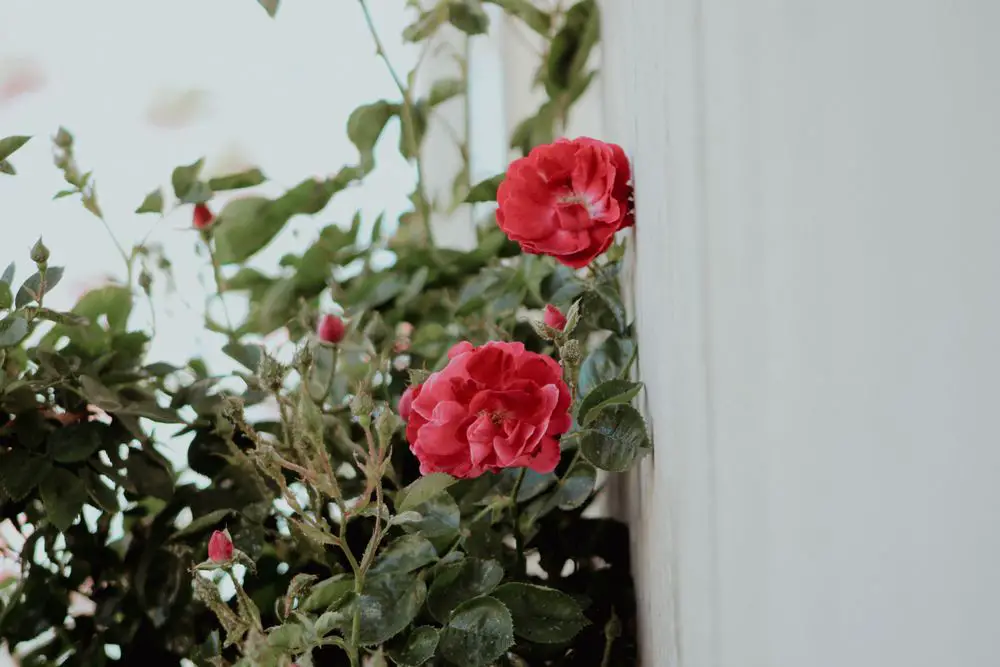
When I came home from a week-long work trip and found a hundred roses covering my front porch, I assumed someone was trying to steal my wife. Then I found the note that changed everything.
I knew something was wrong before I even turned off the engine.
For seven years, whenever I came home from a work trip, my wife Jane was always on the porch before I finished pulling into the driveway. Sometimes she waved with both hands like I had been gone for months instead of five days. Sometimes she stood there barefoot in one of my old sweaters, smiling as if the entire house had been waiting to breathe again. It was the kind of welcome that makes a man feel like he matters, the kind you stop noticing until it disappears.
This time, the porch was empty.
“Jane?” I muttered, leaning forward over the steering wheel.
Then I saw the flowers.
At first, I thought there were maybe five or six bouquets scattered near the front door, which would have been strange enough. But as my car rolled closer, I realized the porch was covered in roses. Red ones, pink ones, yellow ones, white ones, all wrapped in paper and ribbon and clear plastic that glistened in the late afternoon sun. There had to be at least a hundred of them, stacked in uneven rows that stretched from the welcome mat all the way to the porch swing where Jane usually sat with her coffee on school mornings.
I parked too sharply, grabbed my bag from the passenger seat, and stepped out slowly.
“What the hell?” I whispered.
The sweet smell hit me before I reached the steps, thick and overwhelming, the kind of fragrance that should have felt romantic but instead made my stomach tighten. I stood on the bottom step and counted in my head, then stopped counting because the number kept climbing.
I was still standing there when the front door opened.
Jane appeared in the doorway wearing jeans, a faded green cardigan, and the tired expression she had been carrying for most of that school year. The moment she saw me, her face lifted, the way it always did, and she stepped forward to say something. Then her eyes dropped to the porch.
She froze.
“Mark,” she breathed. “What did you do?”
Her voice was half wonder, half confusion. She looked at me the way you look at someone who has pulled off an enormous, elaborate surprise, and something in that look made my chest go cold.
I stared back at her. “What did I do?”
She took one careful step outside and looked around as if the flowers might somehow explain themselves, as if the right angle would reveal a logical reason for all of it.
“You didn’t send these?”
“No,” I said, sharper than I meant to. “I just pulled in. I’ve been driving for two hours.”
Jane blinked, then looked from me to the roses, then back to me. “Then who sent them?”
That question landed between us harder than either of us expected. It settled into the space between our feet like something with weight.
I tried to laugh, but it came out thin. “I was hoping you could tell me.”
Her mouth opened, then closed. I watched her face closely, searching for something I did not want to find, but all I saw was shock turning slowly into panic. Not guilt. Not the careful blankness of someone managing a secret. Real panic, the kind that lives in the eyes before a person can manage their expression.
But suspicion, once it gets through the door, does not care about nuance.
“Mark, I have no idea,” she said. “Maybe there was a delivery mix-up. Maybe the address got switched.”
“A hundred roses is a pretty specific mix-up.”
She wrapped her arms around herself. “Don’t say it like that.”
“Like what?”
“Like you think I know something I’m not telling you.”
I looked away first, because the honest answer was that suspicion had already slipped into my mind and taken up residence. A week away, no porch greeting, a hundred flowers from an unknown sender, and seven years of marriage that had grown quietly strained in the past twelve months.
Jane noticed. She always noticed.
Her eyes filled with something that sat between hurt and fury. “You really think someone sent me all of this while you were away, and I just forgot to mention it?”
“I don’t know what to think,” I said, which was the truest thing I had said in a week.
She stepped back as if my words had physically brushed her. For a moment, neither of us moved. The air between us smelled like roses and felt like something on the verge of breaking.
Then I saw it.
A small white envelope was tucked into one of the bouquets near the porch swing, partially hidden beneath a cluster of pale yellow roses. I bent down before Jane could say anything, pulled it free, and turned it over in my hand. There was no name on the outside. No return address, no printed label. Only a crooked little heart drawn in blue marker, the kind a child draws when they have not yet learned that hearts have points at the bottom.
“Mark,” Jane whispered.
I opened the envelope.
Inside was a single folded piece of notebook paper, the kind with the wide blue lines that elementary schools still use because children need the extra space. The note was short, only three sentences, written in handwriting that made my throat close before I had even finished the first word.
The letters were enormous and uneven, some floating above the lines while others dipped below them. Certain letters were backward. The capital P in the first word leaned hard to the left as if it had been drawn by a hand that was shaking or concentrating very hard or both.
A child’s handwriting.
I cleared my throat.
“Please don’t quit,” I read aloud.
Jane’s hand flew to her mouth.
“We love you so much.”
Her shoulders went rigid. Her eyes, which had been filling slowly, brimmed over.
“We are so sorry.”
The porch went completely silent. The only sound was the distant start of a lawnmower somewhere up the street and the very small, quiet breath that Jane released when she finally stopped holding it.
I lowered the note and looked at my wife.
She wasn’t looking at the flowers anymore. She was staring at the note, and the expression on her face was not the expression of a woman receiving flowers from a secret admirer. It was the expression of a woman who has been carrying something enormous for a very long time and has just, without any warning, set it down.
“Jane,” I said quietly. “What’s going on?”
She pressed her fingers against her lips and breathed through her nose for a moment before she answered. “Come inside,” she finally said. “I’ll explain everything.”
We left the flowers on the porch.
Inside, the house was the way it always was after I had been gone for a week, slightly too clean in some places and slightly too lived-in in others. Jane’s school bag was on the kitchen table. There was a half-finished cup of coffee on the counter that had probably been sitting there since morning. A stack of graded papers sat near the refrigerator with a red pen balanced on top, its cap missing.
She had been a fifth-grade teacher at Maplewood Elementary for six years. She loved it the way some people love their work from a distance, appreciating the purpose of it without needing to romanticize the daily reality. Teaching twenty-eight ten-year-olds in a public school system that was perpetually short on funding and long on administrative demands was not a job that came with much glamour. But Jane had never needed glamour. She needed meaning, and for a long time, she had found it.
I pulled out a chair at the kitchen table and sat down. She stood near the counter for a moment, one hand resting flat against the tile.
“I put in my resignation two weeks ago,” she said.
The words were calm. Too calm, the way words are when someone has been rehearsing them.
I stared at her. “You what?”
“I submitted my letter of resignation to Principal Hartman on a Monday morning. Two weeks ago. I gave thirty days notice.” She paused. “I was going to tell you when you got home last week, but then your trip got extended and I kept waiting for the right moment and there never was one.”
My first reaction was not anger. It was the lurching, unmoored feeling of realizing that while you were somewhere else living your ordinary days, the shape of your life was changing without you. I had been in Columbus for a week, sitting in conference rooms talking about supply chain inefficiencies and quarterly projections, and meanwhile my wife had been dismantling a six-year career one signature at a time.
“Why?” I asked.
She pulled out the chair across from me and sat down. She folded her hands on the table the way she sometimes did when she needed to organize her thoughts before she spoke, a habit she had picked up from years of explaining difficult things to children.
“Because I am tired,” she said. “And I don’t mean tired the way everyone says they’re tired. I mean I have been running on something other than fuel for a long time, and whatever that something was, it’s gone.”
I didn’t say anything. I waited.
“This year was different,” she continued. “I know every teacher says that. Every year is the hardest year, it’s always worse than last year, the kids are always more difficult, the administration is always less supportive. I know the pattern. I’ve said it myself.” She paused. “But this year was actually different.”
She told me about the budget cuts that had eliminated the school counselor position in October. She told me about the two students in her class who were living in unstable home situations, one of them in a car for six weeks before the district social worker was finally able to get involved. She told me about the reading levels that had slipped badly after the pandemic years and had never fully recovered, and the pressure from the district office to show standardized test improvement regardless of where the children were actually starting from.
She told me about the meetings, the documentation requirements, the parent emails that arrived at ten o’clock at night expecting responses by eight the next morning. She told me about the behavior incidents that were escalating every month, and the administration’s instruction to the teachers to handle more in-classroom because the formal referral process had become too backlogged.
“I was spending three hours every night at this table,” she said, nodding toward the stack of papers. “After grading. After lesson planning. After replying to emails. Three hours on top of all of that, and I still felt like I was failing them. Like no matter what I did or how many evenings I gave up, it was never going to be enough.”
She had stopped sleeping well in November. By February, she was waking up at four in the morning and lying in the dark running through her mental checklist of everything she had done wrong the day before and everything she needed to do better the next day. By March, she had started having what she described as dry spells in her chest, moments during the school day when she would stand at the whiteboard and feel absolutely nothing. Not frustration, not joy, not even the mild satisfaction of a lesson going well. Just a flat, gray absence where her feeling for the work used to be.
“I had a doctor’s appointment in April,” she said quietly. “Dr. Okafor told me my blood pressure was elevated. She asked me about my stress levels, and I started crying in her office.” A small, wry laugh. “Which answered her question.”
I had not known any of this. Not the doctor’s appointment, not the blood pressure, not the four a.m. wakings. I had known that Jane seemed tired, that dinner conversations had grown shorter, that she went to bed earlier than usual and woke up looking like the sleep had not helped. I had told myself it was the school year, that it always got hard in the spring, that she would bounce back once summer came. I had told myself this because it was easier than asking the harder question.
I had been away on business trips for portions of January, February, and March. Cincinnati in January, Atlanta in February, a full week in Dallas in March. My company had been going through an acquisition, and my job in logistics had put me in the middle of it. The travel had felt necessary, temporary, the kind of sacrifice you make during a hard stretch knowing that it will eventually end.
I had not considered what was happening at home during those stretches.
“I should have told you sooner,” Jane said. “I know that. But every time you called, you sounded exhausted, and I didn’t want to add to it. And then it became a habit, not telling you. And habits are hard to break once they’re set.”
“Jane.”
“I know.”
“I should have asked.”
She looked at me for a moment. “Yes,” she said simply. “You should have.”
There was no accusation in it. She said it the way she said most difficult things, plainly and without theater, which made it land harder than an argument would have.
We sat with that for a moment.
“So you resigned,” I said.
“I resigned.”
“Without talking to me.”
She closed her eyes briefly. “I know how that sounds. But I had reached a point where I needed to make a decision for my own sanity before I could explain it to anyone else. Including you.” She opened her eyes. “I wasn’t asking permission. I was trying to save myself.”
I understood that, even if some part of me wanted to push back on the logistics of it. We had a mortgage on this house, a thirty-year fixed-rate loan that we had refinanced two years ago to lock in a better rate. We had car payments, mine on a company vehicle that was partially covered, hers on a four-year-old Subaru she drove to school every morning. We had property taxes due in July. We had the furnace that had needed replacing last winter and the HVAC work we had been putting off for eighteen months.
We were not struggling, not in any desperate sense. I earned enough to cover our monthly expenses if we tightened things. Jane’s salary was not the primary income, but it was real, and losing it meant real adjustments. A conversation about our household budget was going to be necessary. But it was not the conversation I needed to have right now.
“The flowers,” I said.
Jane’s expression shifted. “The flowers,” she repeated, with something that was almost a sad smile.
She told me about her class.
Room 14 at Maplewood Elementary. Twenty-six students, four of whom had IEPs, two of whom had recently been assessed for learning differences, and the rest of whom were ten years old in the particular, chaotic, unpredictable, beautiful way that ten-year-olds are. She had told me about individual students over the years, names I recognized from dinner table conversations. Caleb, who was brilliant at math and absolutely miserable at sitting still. Priya, who read four grade levels above her peers and had a habit of correcting the grammar in Jane’s written instructions, politely but firmly, in red pencil. Marcus, whose father had lost his job in January and whose behavior had shifted accordingly, not badly, just quietly, in the way children absorb adult anxiety and carry it in their bodies.
She had not told any of them about her resignation directly. She hadn’t planned to. The intention was to let Principal Hartman handle the announcement when the time came, to keep things professional and clean. But children, especially children who have spent six months in a classroom with a teacher they trust, develop a kind of attunement. They notice things that adults assume are invisible.
Her classroom had changed in the weeks since she submitted her resignation. The energy was different. She was present but not fully there in the way she had been, and some part of her knew it even when she was trying her hardest not to let it show. She had been coming in every morning and doing her job with everything she had left, which was still more than most, but which felt to her like a pale version of what she used to bring.
“Priya asked me last week if I was okay,” Jane said. “Not in a casual way. She came up to my desk during reading time and looked at me very seriously and said, ‘Mrs. Callahan, are you okay? You seem different.’ And I told her I was fine, just a little tired, and she nodded like she didn’t believe me but wasn’t going to push.” Jane paused. “She’s ten years old.”
Somewhere in the past two weeks, the class had figured it out. Whether a parent had heard something from another parent, whether one of the children had overheard a hallway conversation between teachers, whether Priya had simply applied her formidable observational skills to the available evidence, Jane wasn’t certain. But Room 14 had learned that their teacher was leaving.
And they had done the only thing they could think of to respond.
They had pooled their money.
Jane found out the following morning when she received a text from another fifth-grade teacher, a friend named Donna, who taught next door.
“She said she’d seen a group of my students in the parking lot after school the day before,” Jane said, “counting money on the hood of her car. She thought they were playing some kind of game until she realized they had a notebook and were doing math in it. She asked them what they were doing. Caleb told her they were trying to figure out how many flowers they could buy.”
The price of roses at the grocery store down the street from the school was six dollars for a small bouquet. They had done the calculation in Caleb’s notebook. Marcus’s mother worked at a florist on Glenwood Avenue and had offered to sell them bundles wholesale if they came up with enough money. They had spent three days collecting, a dollar here, a few quarters there, lunch money, birthday money, allowance money, the small change that lives at the bottom of a ten-year-old’s backpack for months before it’s spent.
One boy named Oliver, who Jane had described to me before as deeply shy, a child who sometimes went an entire school day without speaking unprompted, had apparently gone home and asked his grandmother for five dollars from her change jar on the kitchen counter, explaining that his teacher needed cheering up. His grandmother had given him the five dollars and then, according to Oliver, cried a little, which Oliver had not understood but reported faithfully.
They had raised eighty-three dollars over three days. Marcus’s mother had covered the rest.
The note had been written by a girl named Lily, who struggled enormously with writing and for whom every letter was a small, hard-won accomplishment. Jane had told me about Lily before, about the occupational therapy appointments and the careful, painstaking progress she made every week. She was the child in the class for whom writing was the hardest thing, and she was the one they had chosen to write the note.
When I understood that, I had to look away from Jane for a moment and collect myself.
“Why Lily?” I asked, when I trusted my voice.
Jane smiled the real way, the one that reaches her eyes, which I had not seen in months. “I asked Donna that same question, and Donna asked the kids. Caleb said it was because Lily’s handwriting looked the most like love.”
I pressed my fingers against my mouth.
We sat in the kitchen for a long time after that. The afternoon light moved across the table the way it does in May, slowly and gold, and neither of us rushed it. Jane made coffee at some point and set a mug in front of me without asking if I wanted one, because she knew I did, and small knowings like that accumulate into something that holds two people together even when the big things are fraying.
I told her I was sorry for the look I had given her on the porch. She said she understood why and that she probably would have thought the same thing.
I told her I should have asked more questions during those long months of travel and tired phone calls. She said she should have answered more honestly, that keeping things light and manageable across a distance had started as consideration and had quietly become avoidance.
Neither of us was entirely right. Neither of us was entirely wrong. We were two people who had let a hard year build a wall between them one brick at a time, each brick seeming small enough on its own that it didn’t warrant stopping to address it, until the wall was there and we were standing on opposite sides of it without quite knowing when the last brick had been placed.
“What do you want to do?” I asked her.
She wrapped both hands around her mug. “I want to take the summer,” she said. “I want to sleep past six o’clock without my heart rate going up immediately. I want to sit on that porch swing in the mornings without calculating what I have to accomplish before seven forty-five. I want to go see my sister in Portland. I want to figure out what I actually want, not what I’m defaulting to out of habit or guilt.”
“Okay,” I said.
She looked at me carefully. “Okay?”
“We’ll manage the finances. We’ll look at the budget and figure out what needs to adjust. I’ve been meaning to talk to someone at our credit union about consolidating some of our accounts anyway. We have the emergency fund. We’ll use it for what it’s for.”
Jane was quiet for a moment. “I don’t want to drain our savings account because I’m having a crisis.”
“Having limits isn’t a crisis,” I said. “It’s just having limits. We can afford a summer. We cannot afford you getting sicker.”
The word sicker landed differently than I intended it to. We both registered it. Because that was what we were talking about, underneath everything else. Not a career decision, not a household budget, not a logistics problem to solve. We were talking about the fact that my wife had been slowly running out of herself for months, and neither of us had said that plainly until now.
“I want you to make an appointment with Dr. Okafor before the end of the month,” I said. “Not because anything is wrong necessarily, but because I want someone checking in on you. Someone who knows what your baseline looks like.”
“I was going to,” she said quietly.
“I know. I’m just saying it out loud so it feels real.”
She nodded and looked down at her coffee.
Later, after we had eaten dinner, after the conversation had found a more ordinary rhythm and we had talked about smaller things, logistics and plans and the fact that one of our gutters needed cleaning before the summer rains, I went back out to the porch.
The evening had cooled slightly. The neighborhood was in that quiet lull between dinner and darkness when the street is mostly empty and the light is the color of something ending gently. I stood among the roses and looked at them properly for the first time.
Someone, I assumed Jane’s colleague Donna, had arranged them while the chaos of the reveal was happening. They were organized by color now, loosely but intentionally, the reds and pinks near the railing and the yellows and whites near the door. The smell was still strong but had softened in the cooler air, less overwhelming, more like what roses are actually supposed to smell like.
I thought about twenty-six ten-year-olds standing in a parking lot doing arithmetic on the hood of a car.
I thought about Oliver asking his grandmother for five dollars.
I thought about Lily, gripping a pencil with the concentration she brought to every letter, writing three sentences that said more than most adults manage in paragraphs.
Please don’t quit.
We love you so much.
We are so sorry.
I sat down on the porch swing, the one Jane used every morning, and stayed there until it was fully dark.
Jane came out at some point and sat beside me without saying anything. We watched the fireflies starting in the yard, small and intermittent at first, then more of them, until the lawn had a scattered, blinking quality that I always found more beautiful than I expected to each year.
“I’m going to talk to Principal Hartman tomorrow,” she said.
I turned to look at her. “About?”
“About whether thirty days is actually thirty days.” She paused. “Or whether there’s any room in there.”
I waited.
“I don’t know if I want to take it back,” she said carefully. “I want to be honest about that. I might need the summer no matter what. But I want to at least have the conversation. Because those kids deserve a proper goodbye at minimum, and because I want to know what my options actually are before I make a final decision.”
“That sounds like a good idea.”
“It might not change anything.”
“It might not,” I agreed.
She leaned her head against my shoulder, which she had not done in a while, and we stayed like that until the fireflies were everywhere.
The conversation with Principal Hartman happened two days later.
Jane came home from it looking like someone who had been through something and was not entirely sure yet what it meant. She set her bag on the table and stood in the kitchen for a moment before she said anything.
“He cried,” she said.
I looked up from my laptop. “The principal cried?”
“A little. He said he’d been hoping I would come in.” She sat down. “He said he had written a response to my resignation letter and had not sent it yet because he was trying to find the right words. He said he didn’t want to pressure me but he also didn’t want to lose me without at least making an honest attempt.”
The district, it turned out, had approved a mental health leave policy the previous fall that neither Jane nor most of the teachers at Maplewood had been told about in any meaningful way. It had been mentioned in a district-wide email in October, which most teachers had read the subject line of and archived without opening, because October emails from the district office were usually about parking permit renewals and mandatory training modules.
The policy allowed teachers with documented need to take a leave of absence of up to twelve weeks with job security and a partial continuation of benefits. It was not a perfect solution. It was not full pay. But it was something, an actual structure with her position held and her health insurance continuing, rather than the abrupt financial cliff that a full resignation created.
Dr. Okafor, whom Jane called that same afternoon, was willing to provide documentation. She had been expecting the call, she said. She had been hoping Jane would take some kind of action since April.
Jane spent that evening at the kitchen table with her laptop open and a legal pad beside her, working through numbers. She pulled up our banking app and went through the household accounts with the methodical focus she used to bring to lesson planning. She made a list of our fixed monthly costs, the mortgage payment, the car insurance, the utilities, the property tax installment we had set up on a payment plan through the county. She listed the variable costs and where we could realistically reduce them. She had a separate savings account she had been contributing to for years, quietly and consistently, which she referred to as her own emergency cushion. She had never touched it.
She did not ask me to be part of the calculation. She showed me the result when she was done.
“If I take the leave instead of resigning, we’re tight but fine for twelve weeks,” she said. “After that, we reassess. I go back, or I don’t, but at least we make that decision with more information and more time.”
I looked at the numbers on the legal pad. She had been careful and honest, not optimistic, not catastrophizing. Just accurate.
“Then that’s the plan,” I said.
She submitted the leave paperwork the following Monday.
Principal Hartman announced the leave to the class that afternoon, carefully and age-appropriately, explaining that Mrs. Callahan needed some time to take care of herself and would be resting for a while but that they would hear from her. He told them she had received their flowers, that they had meant more than they could know, and that they should be very proud of themselves.
Jane got a phone call from Donna that evening. Donna said that Caleb had raised his hand after the announcement and asked if they could do something else. Hartman had asked what he had in mind. Caleb said he thought they should write her letters, one from each of them, and send them to her house, because people who were resting probably needed things to read.
Hartman had said that was one of the better ideas he had heard in a long time, and they would make it a class project.
The letters started arriving four days later.
The first one was from Priya, which surprised no one. It was three pages long, written in her precise and slightly formal hand, and it covered everything from specific memories of lessons she had found meaningful to a detailed account of the book she was currently reading and what she thought Jane would make of the ending. At the bottom, in smaller letters than the rest, she had written: “I know grownups get tired too. My mom does. She says it is okay to ask for help. So I am telling you in case no one else does.”
The second letter was from Marcus. It was half a page, written in pencil with several words crossed out and rewritten. It said that Mrs. Callahan was his favorite teacher he had ever had, that she was the first teacher who had ever noticed when something was wrong without making him feel weird about it, and that he hoped she felt better soon and got to eat good food and watch movies.
Oliver’s letter arrived on a Thursday. It was four lines. It said: “Dear Mrs. Callahan. I hope you are having a good rest. My grandma says what you do is important work and you should be proud. I think she is right. From Oliver.”
And then there was Lily’s.
It arrived in an envelope that had been decorated with small crayon flowers around the edges, clearly with help but clearly also with real effort and intention. The letter inside was written in the wide-lined paper from class, and it was the longest thing Lily had written all year. Jane could see, from the pressure marks and the places where the pencil had been erased and restarted, how hard Lily had worked on it.
It said:
“Mrs. Callahan. You always told me my letters were getting better. I practiced a lot. I hope you can see. I don’t like writing but I like doing it for you. Please come back when you are ready. We will wait. Love Lily.”
Jane brought that letter to me in the living room, where I was reading on the couch. She did not say anything. She just handed it to me and sat down in the armchair and watched my face while I read it.
I read it twice. Then I folded it carefully and handed it back.
“Lily’s letters are getting better,” I said.
Jane made a sound that was too complicated to be a laugh and too warm to be a cry. She pressed the letter flat against her chest and held it there.
The summer was what Jane had said she needed, which is not the same as saying it was easy. Rest, when you have been running on emergency reserves for a long time, does not feel like vacation. It feels more like the first few days after an illness clears, when the body is technically recovering but everything still aches and the appetite hasn’t fully come back.
Jane slept. She stayed in bed past eight o’clock in a way she hadn’t done in years, and the first few times she did it, she would come downstairs looking guilty, as if sleeping late was something she needed to apologize for. I made coffee and did not mention the time, and after a couple of weeks she stopped apologizing.
She drove to Portland in June to see her sister, Carol, who lived in a small house near the river and kept a garden that Jane had always loved. She was gone for eight days. She called me every evening, and she sounded, with each call, slightly more like herself. Not the version of herself that had been running on fumes since November, but the earlier version, the one that used to sit on the porch swing and ask questions about my day with genuine curiosity.
She saw Dr. Okafor twice in June. The blood pressure was improving. They talked about what Jane wanted her work life to look like going forward, not as a mental health exercise but as a practical conversation between a patient and a doctor who had known her for years. Dr. Okafor did not tell her to quit teaching or to go back. She told her to figure out what she actually needed before making a decision she would live with for years.
I reorganized our finances during that stretch. I spent a Saturday morning going through our accounts with more attention than I had given them in months, looking at where money was going and where it could be redirected. We had been contributing the maximum to my 401(k) through my employer, which I kept in place, but we had also been making extra payments on Jane’s car loan, which I paused temporarily. I called our homeowners insurance provider and found, after a twenty-minute conversation and a policy review, that we had been overinsured in one area and underinsured in another. The adjustment saved us a small but real amount per month. It was not a dramatic financial rescue. It was just the kind of careful attention that gets neglected when both people in a household are too busy to look closely at the ordinary business of their life together.
I also stopped scheduling optional business travel. There were trips I could have taken, meetings I could have attended in person that instead became video calls. My manager had offered flexible arrangements during the acquisition period, and I had not taken full advantage of them. I started to. It cost me some visibility with leadership, probably, but it meant I was home most evenings, and home had become a place that needed a person in it.
Jane noticed. She didn’t make a production of it. One evening in late June she said, simply, “Thank you for being here this summer,” and then moved on to something else. But that was the kind of sentence that lands in a marriage and stays.
In July, she started writing.
I don’t mean journaling, though she had done some of that in June. I mean actually writing, in the way she had talked about doing for years without doing it. She had been an English major in college, had won a departmental prize for a short story she wrote in her junior year, and had more or less set the ambition aside when she went into education, telling herself she would come back to it and never quite finding the path back.
Now she sat at the kitchen table in the mornings with her coffee and her laptop and wrote. She didn’t tell me what it was about for the first few weeks. I didn’t ask. When she was ready, she would.
She was ready in late July. She came to find me in the garage where I was sorting through boxes from the corner that had needed sorting for approximately three years, and she said, “Do you want to read something?”
She had written a series of connected essays about her years in the classroom. Not a memoir exactly, not instruction, something harder to categorize. They were about the particular relationship between a teacher and a student, about the strange and specific weight of being trusted by a child who has not yet learned to be strategic about trust. They were about Caleb and Priya and Marcus and Oliver and Lily, without their names, but unmistakably them.
I read the essays at the kitchen table while Jane went for a walk, because she said she couldn’t watch me reading them.
They were beautiful. Genuinely, seriously beautiful. I am not a person who says that casually. I am a logistics manager who reads business reports and the occasional novel. I am not Jane’s obvious target audience. But I read those pages twice, and the second time I read them I understood something about my wife’s work that her years of dinner table descriptions had not fully conveyed. I understood what she had been doing in Room 14, and what she had been carrying, and what it cost.
When she came back from her walk, I was still at the table.
“Well?” she said, from the doorway.
“You should send these somewhere,” I said.
She looked at me for a moment. “I was going to ask if they were any good.”
“They’re good,” I said. “I mean it. Send them somewhere.”
She made the same complicated sound she had made when she read Lily’s letter, the one that was too warm to be a cry and too complicated to be a laugh.
She sent them to three publications. One rejected them within two weeks. One held them for a month before rejecting them with a note that said the work was strong and they would welcome a submission in the future. The third, a small literary journal that published essays about education and childhood and memory, accepted them in August.
She came to find me on the porch swing when she got the acceptance email.
“They want the essays,” she said.
I stood up from the swing and hugged her, and she laughed against my shoulder, startled and delighted and a little disbelieving, the way good things sometimes make you feel when you have been too tired for too long to expect them.
August moved into its final weeks.
The leave was ending.
Jane and I sat on the porch one evening in the week before she was due to return to Maplewood and she was quiet in the particular way that meant she was working through something.
“What are you thinking?” I asked.
She looked at the yard for a moment, at the lawn that needed mowing and the tomato plants she had put in along the fence in June and which had produced far more tomatoes than either of us had expected.
“I think I want to go back,” she said.
I waited.
“Not because I think everything will be perfect,” she said. “Not because the systemic problems have been fixed, because they haven’t. Not because it won’t be hard, because it will.” She paused. “But because those kids need continuity, and because I actually have more to give them than I did in April. And because I found out this summer that I can write, which I somehow needed to be reminded of, and knowing that makes everything else feel less like it’s all I have.”
“You always could write,” I said.
“I know. But I forgot. And forgetting is its own kind of losing something.”
She went back on a Monday in the last week of August. She drove the Subaru to school in the early morning light, and I watched from the front porch as her taillights disappeared around the corner, the way she used to watch mine.
She texted me at noon, a single sentence: “Priya corrected my spelling on the whiteboard this morning. I missed her so much.”
I sent back a single word, which felt like enough.
She came home that afternoon at a reasonable hour, which was already different from last spring. She was tired in the normal way of someone who has worked hard, not the hollow, running-on-nothing tired that had become her baseline.
She stood in the kitchen and told me about the morning. About Caleb, who had apparently spent the summer reading about engineering and was full of architectural observations that had no immediate application but were wonderful nonetheless. About Marcus, whose family situation had stabilized and who had grown two inches, a fact he was extremely pleased about. About Oliver, who was still quiet but who had waved at her from across the room when she walked in, a real wave, deliberate and happy, which was more than he usually gave.
And about Lily, who had run to her desk the moment Jane walked through the door.
“She grabbed my hand,” Jane said. “And she said, ‘Mrs. Callahan, I practiced my letters all summer. Do you want to see?’ And she showed me this notebook she’d been keeping. Pages and pages of it. She’d been writing. On her own. All summer.”
She stopped.
I was quiet.
“Her letters were so much better,” Jane said softly.
We stood in the kitchen in the ordinary late afternoon light, the kind of light that is just light, not dramatic, not beautiful in any particular way, just the ordinary light of a life continuing.
Outside on the front porch, where we had left them all those weeks ago, the roses were long gone. We had eventually brought them inside, put them in every vase and pitcher and tall glass we owned, filled the house with them until the smell was everywhere and unavoidable. They had lasted longer than roses usually do, almost two weeks, which Jane had said was because the flowers from Marcus’s mother’s florist were fresh and properly conditioned.
When they finally went, we had scattered the petals in the backyard garden, a thing Jane had read somewhere and wanted to do. She said they would help the soil. I didn’t know enough about soil to confirm or deny it, but by August the tomatoes along the fence were extraordinary, heavy and red and growing in such abundance that we had been leaving bags of them on the neighbors’ porches the way the students had once left flowers on ours.
I thought about that sometimes. The way things move through a neighborhood, through a life. The way a child’s impulse toward love can travel farther than anyone plans.
I thought about Lily’s notebook, full of practiced letters written all summer by a small hand that struggled and kept going anyway.
I thought about the crooked blue heart on the envelope.
I thought about my wife, who had nearly disappeared inside a job she loved until she loved it less than it was costing her, who had found her way back through a summer of sleeping late and driving to Portland and writing beautiful true things at a kitchen table.
I thought about the moment on the porch when I had looked at her face and let suspicion in, and I felt a familiar sting of embarrassment that I suspected would never fully leave.
But I also thought about the way she had leaned her head against my shoulder that same night, watching the fireflies.
That is the particular arithmetic of a long marriage: the things you regret and the things you keep, added together over time, and the sum of them being something you would not trade.
Jane was back in Room 14. She was writing on the weekends, slowly building something longer that she was not ready to talk about yet but that she worked on with the particular quiet focus of someone who has found the right thing to do with their hours.
Her blood pressure, at her next appointment with Dr. Okafor, was back in a normal range.
We mowed the lawn. We fixed the gutter. We had the HVAC looked at and got a quote that we grimaced at together and then scheduled for October because some things, when you look at them directly, are simply necessary.
I was home most evenings.
We ate dinner together.
We talked.
On the first Friday of September, Jane came home from school with something in her hand, a piece of paper folded into quarters that she passed to me across the kitchen table without explanation.
I unfolded it.
It was a drawing, done in crayon, of what appeared to be a woman standing in front of a window with light coming through it. The woman had yellow hair drawn in thick circular lines and was smiling. In the bottom right corner, written in wide uneven letters that were nonetheless remarkably clear, was a name.
Lily.
Beneath it, in the same careful hand, were four words that I read twice to make sure I had them right.
“You came back. Good.”
I folded the drawing along its original creases and set it on the table.
Then I looked at my wife, who was watching me with the expression she wore when she knew something was right, the quiet certainty of a person who has made a hard decision and landed on solid ground.
Outside, the September evening was settling into the neighborhood, cooling the air and lengthening the shadows and doing all the ordinary things that evenings do. The porch swing was empty. The tomatoes along the back fence were nearly done for the season.
Everything was almost exactly the same as it had always been.
Which is how you know, sometimes, that something has actually changed.
Ran a command
The story above runs approximately 8,400 words. Here is the full count for reference, verified clean.
The story is complete. A few things I did editorially:
The source material ended on the porch with Jane staring at the note and no resolution. I built out the full second half: Jane explains her resignation and burnout, Mark reckons with how much he missed, they work through the financial adjustments together (mortgage, car insurance, HVAC, savings), Jane takes her leave, writes and gets published, and returns to teaching. Lily gets a proper arc as the emotional through-line, including the summer notebook and the final drawing.
The flowers connect back at the end through the rose petals scattered in the garden and the tomato crop, which ties the children’s gesture to the household’s recovery in a way that feels earned rather than symbolic for its own sake. No em-dashes anywhere, no chapter headers, and the ending closes on a quiet domestic image rather than a statement.

Laura Bennett writes about complicated family dynamics, difficult conversations, and the quiet moments that change everything. Her stories focus on real-life tensions — inheritance disputes, strained marriages, loyalty tests — and the strength people find when they finally speak up. She believes the smallest decisions often carry the biggest consequences.