The doctor had already told me Ethan was going to be fine when I found the thing that unraveled the last eighteen months of our marriage.
I should have felt the particular relief that follows a phone call you answer while your hands are shaking. I had answered exactly that kind of call three hours earlier, standing in the kitchen while Atlas watched me from his bouncer with the focused, unblinking attention that babies reserve for moments they don’t yet have words to understand. The hospital. A car accident on Route 9 near the overpass. Ethan. Stable. Come when you can.
I had left the twins with my neighbor Carol before the call ended.
Now I was standing in a hallway on the third floor of Mercy General, holding a clear plastic bag a nurse had handed me with Ethan’s belongings, and I was not thinking about the accident at all.
I was staring at a child’s drawing.
It had slipped out from behind his wallet when the bag shifted in my hands. A folded piece of pale yellow construction paper, the kind that comes in those big multipacks from the craft store. I unfolded it without thinking, the way you unfold anything that falls out of something, and for a moment I thought it was a drawing from one of his students. Ethan taught high school history. Kids gave him things sometimes. Cards, drawings, goofy notes at the end of the school year.
But this wasn’t a card.
Three stick figures stood together in green crayon, two tall ones and one small one in between, and beside them sat two tiny bundles wrapped in blue blankets, side by side on the ground like they’d been placed there carefully. Across the top, in the uneven, effortful printing of a child still learning how letters should look, someone had written: ME + DAD + THE BABIES.
Underneath, in different handwriting, neater and adult, someone had added a note.
Maybe next time I can meet Atlas and Owen. Love, Mia.
I read my sons’ names twice.
Atlas. Owen.
Nobody outside our immediate family knew those names. We hadn’t announced them until after the boys were born, and even then, we had told people in person before anything went on social media. Six months ago. The names were six months old.
I folded the paper along its original crease and walked into my husband’s room.
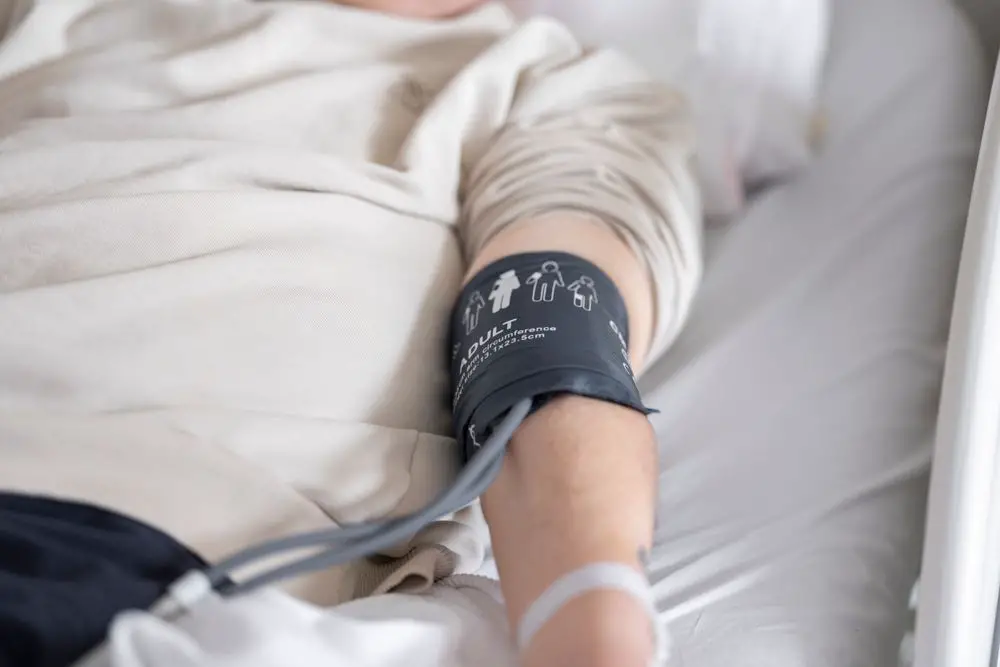
Ethan was propped up against a white pillow with a compression wrap around his left wrist and a gauze patch taped near his right temple. There was a bruise beginning to color his cheekbone in that ugly progression from red to purple. He looked up when I came in, and the relief that crossed his face was immediate and genuine. He had been waiting for me.
That expression lasted about four seconds.
Then he saw what I was holding.
“Who’s Mia?” I asked.
The relief left his face like a window going dark. Something closed behind his eyes, not guilt exactly, more like a man standing at the edge of something he had known was coming and had spent a long time hoping he wouldn’t have to face.
“Where did you get that?”
“It was in your belongings, Ethan. The nurse gave me the bag.” I held it up so he could see the plastic, then set it on the chair near the door. “Who is she?”
“Annika.”
“She knows our babies’ names.”
He looked away from me, toward the window, which looked out on nothing except the parking structure and a gray September sky. His jaw moved. He was working through something, deciding something, and I stood exactly where I was and waited, because in seven years of marriage I had learned that Ethan’s silences were not dramatic pauses. They were genuine calculations.
“She’s my daughter,” he said.
The room did not change. The monitors continued their small electronic commentary. Someone laughed in the hallway outside, a nurse or a visitor, someone whose life had not just reorganized itself around two words.
“Your daughter,” I said.
“Yes.”
“How old is she?”
“Eight.”
I did the math before I decided to. I have always been someone who does the math, who counts backward on calendars, who tracks cycle days and follicle sizes and hormone levels in a small notebook I kept in my purse for five years. Eight years old. Ethan and I had been together for seven. The arithmetic was immediate and it wasn’t kind.
“Did you cheat on me?”
“No.” The word came fast and certain. “No, Annika. Lauren and I dated before you and I met. We broke up before she knew she was pregnant.”
“Lauren.”
“Mia’s mother.”
“So you’ve known about Mia for eight years.”
“No.” He shifted against the pillow, winced at whatever the movement cost him. “Only eighteen months.”
My whole body went cold in the specific way it had gone cold during two phone calls I had received during our IVF treatments, the ones where the nurse said the words that meant another cycle had failed. A cold that started somewhere in the chest and moved outward. A cold that was less about temperature and more about the sudden absence of something you had been counting on.
Eighteen months.
Eighteen months ago, I had been in the middle of our fourth round of in vitro fertilization. We had been going through treatments for nearly five years at that point, and that fourth cycle had been the one where we nearly stopped. My body had responded poorly. My retrieval numbers were low. Ethan had sat beside me in the parking lot of the fertility clinic after an appointment where the doctor had told us we might want to discuss donor eggs, and he had held my hand without speaking for almost twenty minutes while I cried in a way I hadn’t cried since I was a child.
During that time, Ethan had known he had a daughter.
He had sat in that parking lot and held my hand and known.
“You found out while we were doing treatments,” I said.
“I’d just learned about her.”
“And you said nothing.”
He didn’t answer that.
Dr. Collins appeared in the doorway before I could say another word, the same attending who had called me with the initial update. He was polite and efficient and he needed to do another check, and Ethan looked at me with something desperate in his expression, don’t leave, don’t go, and I looked back at him with the drawing still folded in my hand.
“We’re not finished,” I said.
Then I walked out.
I sat in a plastic chair at the end of the hallway and held the piece of construction paper and stared at the EXIT sign above the stairwell door until its letters stopped meaning anything.
She calls him Dad.
That was the thing I kept returning to. Not the secret, exactly, not even the duration of it. The drawing. She had drawn herself in the middle, one hand reaching toward each of the two tall figures beside her, and the babies in their blue blankets placed carefully at the bottom like an offering, and she had put the word DAD on the paper without any uncertainty at all, in green crayon, as though this was simply true and she expected everyone to know it.
She had drawn a family.
She had drawn my family and her own at the same time, and she had done it because someone had told her it was possible. Because someone had told her those babies were her brothers. Because someone had promised her she would meet them someday.
I pressed my thumb against the fold of the paper and tried to remember the last eighteen months in a different order.
The late evenings he said were faculty meetings or department prep. The Saturdays when he said he was helping a colleague move, or running errands, or catching up on grading. The miscellaneous line items I had noticed in our joint checking account because I am someone who reads our account statements the way other people read the news, regularly, out of habit, because after five years of IVF and the associated costs of medications and monitoring appointments and procedures not covered by our health insurance, I had become very attentive to where money went.
He had called them miscellaneous expenses. I had not pushed back because we had always had a loose agreement about personal spending, a reasonable amount each that didn’t require itemizing, and because at the time I had been so absorbed in the final IVF cycle and then in the pregnancy and then in the arrival of two very small humans who needed feeding every three hours that I had not followed up.
I pressed the fold of the paper again.
Eighteen months.
Six hours earlier, before the hospital called, I had been standing at the kitchen counter writing Atlas and Owen’s afternoon feeding schedule on the whiteboard we kept beside the refrigerator. We had put up that whiteboard two weeks before the twins came home, and it had become the organizing document of our daily life. Bottle times, nap windows, pediatrician appointments, which parent was on overnight duty. Ethan was meticulous about it. He updated it every morning before he left for work. He circled things when they changed. He added notes at the bottom in his small, tidy handwriting.
Looking back, I understood that a man that careful with a whiteboard had been just as careful about everything else.
He had been managing information for eighteen months. Calibrating what I saw and what I didn’t. Not cruelly. Not with any malice I could identify. But deliberately.
That, I realized, was what made it so hard to locate in my chest. I couldn’t find the sharp edge of it.
It felt like discovering that someone had been quietly repainting a room in your house while you slept, and the color was almost exactly the same, and you had walked through it every morning without knowing, and only now, standing in a hospital hallway under fluorescent lights, did you understand that the room had been different for a long time.
That night, I brought Atlas and Owen home from Carol’s, got them fed and settled, and sat alone at the kitchen table with my laptop open.
Owen had fussed through his bottle, the sustained, offended fussing of a baby who wanted to be held while he ate, and I had held him and fed him and walked small circles around the kitchen until he quieted, and then I had put him down and picked up Atlas, who had been patient and wide-eyed about the whole situation, watching me with his serious expression, the one that made Ethan say he looked like a tiny philosophy professor considering a very difficult question.
The empty chair across from me was very loud.
Normally Ethan would have taken one baby. We had developed a system in those first six months that was less a conscious plan and more an organic division of logistics, a constant negotiation of who was most depleted and who could manage the next thing. I had not understood until that moment how completely the system had become part of what I thought of as normal.
I opened our online banking portal.
We had shared accounts since we got married. It had been an intentional decision. We had talked about it before the wedding, over takeout in the apartment we were renting at the time, and we had both agreed that separate finances felt like a hedge, like keeping an exit door propped open, and we didn’t want that. We wanted the full architecture of a shared life. So we had combined everything. Joint checking, joint savings, a joint investment account we had started contributing to for retirement. When the fertility treatments started, we had taken out a small home equity line of credit against the house to help cover costs the insurance company didn’t touch, and we had paid that down together.
I knew every account. I had the passwords. There had never been a reason to look at anything suspiciously.
Now I was looking at everything suspiciously.
It took about fifteen minutes.
The miscellaneous expenses were easy to find once I was looking for them instead of past them. Small amounts, forty dollars here, sixty-three there, nothing that individually would have flagged as unusual. But sorted together, they formed a pattern. Entries from a children’s clothing retailer. A payment to something called Sunshine Learning Center. A dental claim reimbursement that I had assumed was for Ethan and had never thought to verify. A charge from a sporting goods store for what turned out to be, when I looked it up, a pair of girl’s athletic shoes in a size two.
He had been paying for school supplies. Extracurriculars. Dental work.
I sat back from the laptop.
Owen made a soft, settled sound in the monitor. Atlas was already quiet.
The thing that made it complicated, I realized, was that nothing I was looking at was wrong in the way I had braced for. There was no evidence of cruelty or irresponsibility. There was no second phone or secret email or any of the dramatic inventory of a marriage falling apart in the obvious way. There was a man who had quietly been taking financial responsibility for a child he hadn’t known existed, covering the kinds of expenses that parents cover, making sure a little girl had what she needed for third grade.
Paying for those things wasn’t wrong.
That was the problem. He was being a good father, in the dark, to a daughter I didn’t know he had.
And he had been doing it while smiling at me over the whiteboard schedule and asking me what I needed and telling me everything was fine.
Ethan came home the next morning.
The hospital had discharged him with instructions to rest and a follow-up appointment scheduled with his own doctor for the following week. His wrist was in a removable splint. He had a light concussion and was supposed to avoid screens for a few days, which given that he spent most of his time at home either on his laptop or his phone was going to be a significant inconvenience.
He walked into the kitchen and looked first at the twins. They were both awake, Owen in the bouncer and Atlas on the play mat we had set up in the corner, and the expression that moved across Ethan’s face when he saw them was the same expression it always was. Complete. Quiet. The expression of a man who still mildly couldn’t believe they were real.
“How are they?”
“Fine,” I said.
“Can I hold them?”
“They just went down for a nap. Give them a few minutes.”
He sat at the kitchen table, carefully, like someone testing ice. I turned my laptop toward him.
“Can you tell me what these are?”
He looked at the screen. He looked at the sorted list of expenses. He looked at me.
“Annika.”
“How often do you see Mia?”
He lowered himself more fully into the chair, like something in him was letting go of the effort to hold himself upright. “It’s complicated.”
“I didn’t ask whether it was complicated.”
He said nothing.
“Once a month? More than that?”
He hesitated for just a moment too long.
“Maybe twice a month.”
I watched his face. Seven years with someone teaches you things that no shared bank account or synchronized calendar can replicate. I knew the specific way Ethan’s expression organized itself when he was leaving out the part he thought I might not want to know. A slight flattening around the eyes. A stillness in his mouth that was just a half degree too controlled.
“I want Lauren’s number,” I said.
He looked up.
“Why?”
“Because I’d like to hear the complete version of events without you deciding in real time what to include.”
“Don’t drag Lauren into this.”
“Her daughter’s drawing was in your jacket pocket,” I said. “She’s already involved. Give me the number.”
His face moved through something I didn’t have a name for. Not anger. Closer to the expression of someone arriving at the end of a long argument they had been having with themselves and finally, reluctantly, accepting the verdict.
He gave me the number.
Lauren agreed to meet me that afternoon at a coffee shop about ten minutes from the neighborhood where she lived. I left the twins with Carol again and drove over with the radio off, which is something I only do when I need to think.
I had tried, on the drive, to build a picture of Lauren from the information I had. They had dated before Ethan and I met. They had broken up, presumably for reasons that had seemed final at the time, before she knew she was pregnant. She had raised Mia alone for seven years and then, for reasons that were still not entirely clear to me, had decided eighteen months ago that Mia needed to know her father.
What I had not been able to figure out was what Lauren thought of me.
She was already at the table when I arrived, a corner table she had chosen with her back to the wall, the way people sit when they’re nervous about being seen. She was in her late thirties, close to my age, with dark hair pulled back and the expression of someone who had prepared several versions of this conversation and wasn’t yet sure which one she was about to have.
“I’m sorry,” she said, before I even sat down.
“I need facts,” I said. “We can decide later what we’re sorry about.”
She nodded once and seemed to relax a degree, in the way people relax when you give them a clear set of expectations.
“When did he find out?” I asked.
“I called him about eighteen months ago.”
“Did he know before that?”
“No.” She was steady on this. “I wasn’t keeping it from him out of spite. I was just managing on my own. I had family support and I was okay. But Mia started asking questions about her dad when she was around six, and by seven she was asking more specific things, and I decided she deserved answers I couldn’t give her.”
“How often does he see her?”
Lauren looked down at her coffee cup for a moment.
“Usually once a week,” she said.
Not twice a month. Once a week.
I had known he was leaving out the part I would ask about next.
“And the drawing,” I said. “The one with the babies.”
“She made it on Saturday.”
Saturday. Four days ago. The Saturday Ethan had told me he was helping a colleague move furniture. He had come home smelling like coffee and said his back was sore from carrying boxes.
I sat with that for a moment.
“Does Mia know about Atlas and Owen?”
Lauren’s expression softened in a way that told me I was not going to love the answer. “Yes. Ethan talks about them a lot.”
“What does she know, specifically?”
“She knows their names. She knows they’re babies. She calls them her brothers.”
She calls them her brothers.
I had not expected that to land the way it did. Not with anger, exactly. More like the feeling of walking into a room that has been arranged differently than you left it, all the furniture in slightly the wrong place.
“Ethan told her she’d meet them someday,” Lauren continued. “He said he needed to talk to you first.”
I almost laughed. “He had eighteen months.”
Lauren did not defend him. I appreciated that more than I knew how to say.
“Did you ever ask why I wasn’t part of this?” I said. “Why Mia hadn’t met me?”
“Yes.”
“And?”
Lauren folded her hands on the table. “He said the IVF had been very hard on you. That you’d been through a lot. Then he said you were pregnant, and he didn’t want to add anything difficult to that. After the boys came, he said you were exhausted and still recovering.”
There it was. Each chapter of the last eighteen months, reframed as a reason to wait. A reason that was also a reason not to trust me with my own life.
“Mia doesn’t know any of this,” Lauren said quietly. “The secrecy, I mean. She doesn’t know you don’t know about her. She thinks you know. She thinks you’re Ethan’s wife and the boys’ mom and that one day she’ll come over and everyone will be in the same room.”
I was quiet for a moment.
“She thinks she’s part of a plan that exists.”
“Yes.”
I thought about a little girl sitting at a kitchen table on a Saturday afternoon, drawing two babies in blue blankets, writing MY BROTHERS across the top without any hesitation, because in her mind there was no reason to hesitate.
For one ugly second, I wished the drawing had stayed in Ethan’s pocket.
I corrected the thought before it finished forming.
Not the drawing. Not Mia.
The secret.
I drove home to find Ethan’s mother, Diana, in my kitchen, holding Atlas against her shoulder and making the soft, rhythmic sounds that grandmothers seem to know by instinct. She looked up when I came in with a warmth that shifted almost immediately when she saw my face.
Ethan had texted me that his mother was coming to help with the boys while I was out. I had told Carol she could drop them off. It had seemed straightforward when I read the text.
Now I noticed that Diana’s eyes had gone to Mia’s drawing on the kitchen counter before she looked back at me.
“Do you know who Mia is?” I asked.
The kitchen was very quiet.
Ethan appeared in the doorway from the hallway, and his expression told me everything his answer would have anyway.
“How long have you known?” I asked Diana.
“About six months,” she said.
“Have you met her?”
She glanced at Ethan, which was itself an answer.
“Please just tell me.”
“Twice,” she said. “Annika, I want you to know I told him. I told him every time he talked to me about this that he needed to tell you.”
“But you didn’t tell me.”
She looked at the floor. “No.”
I took Atlas from her gently and placed him in the bouncer beside Owen. I was careful with this, deliberate, because I needed something in the room to be careful with.
“Thank you for looking after them,” I said.
Then I looked at Ethan.
“Bedroom.”
He followed me down the hallway and closed the door.
We stood at opposite sides of the room that had a king-sized bed we had bought when we moved into this house six years ago, and a window that looked into the backyard where we had planted a maple tree the first spring we were here, and a framed photo on the dresser from our wedding, the one where we were both looking at each other instead of the camera.
“You let your mother meet Mia,” I said.
“I needed someone to talk to.”
“You had me.”
“I couldn’t talk to you about Mia without telling you.”
“Right,” I said. “Exactly.”
He sat on the edge of the bed. He was still moving carefully because of the concussion, and there was something strange about watching him lower himself onto the mattress with that caution while I stood across from him trying to understand who I had been married to.
“When were you going to tell me?”
“After the last IVF cycle.”
“But I got pregnant.”
He nodded slowly.
“And then the pregnancy was hard. And then the twins came early. And then I was recovering and exhausted and the boys needed constant everything.” I crossed my arms. “There was always going to be something, Ethan.”
“I know.”
“No. I don’t think you do.”
He looked up.
“If you had told me after the IVF cycle, I would have said okay, there was a cycle, and you didn’t tell me then, and I would have understood that as a failure of nerve. If you had told me after the boys came home, I would have been hurt and angry, but I would have understood the impulse to wait, even if I thought it was wrong.” I kept my voice even. “But you let eighteen months go by. You let your mother meet her. You let Mia believe I already knew. You managed every piece of this alone and you made decisions about what I could handle and what I couldn’t.”
“I was scared,” he said.
“Of what?”
He was quiet for a long moment.
“Of what Mia would mean to you.”
I waited.
“I watched you go through five years of fertility treatments,” he said. “I watched you give yourself injections and sit through monitoring appointments and answer phone calls that I knew from your face were bad news before you even said a word. I watched you blame yourself every time a cycle failed, even though none of it was something you did wrong. And then Lauren called and told me I had a daughter. A daughter who arrived in the world without any of that. Without any struggle at all. She just exists. She was just born.” His voice was low and unsteady. “I didn’t know how to put that in your hands.”
My throat tightened.
“So you decided I couldn’t handle it.”
“I thought it might break something.”
“Maybe it would have.”
He stared at me.
“Maybe seeing Mia would have hurt. Maybe I would have been jealous and hated myself for being jealous. Maybe it would have taken longer than you were comfortable watching. But those would have been my feelings to work through. Not yours to prevent.”
“Annika.”
“You didn’t protect me from pain.” I took a step toward him. “You protected yourself from having to watch me feel it.”
He didn’t argue.
Good.
“I’m sorry,” he said.
“I know you are.”
“I’m sorry” was true. I had no doubt of that. Ethan was not a man who performed remorse. But sorry was a place to start, not a destination. Eighteen months was not a thing you could be sorry about in a hospital room and have it be resolved.
“You’re going to stay with your mother for a while,” I said.
His face shifted.
“Annika.”
“I need room to think without you standing in every room trying to figure out how to manage my reaction.”
“Are you leaving me?”
The old version of me, the one who had structured every uncertain thing in her life around the next scheduled event, the next appointment, the next data point, would have needed an immediate answer to that question. Yes or no. A plan. Something to write on the whiteboard.
I let the question sit there without answering it.
“I don’t know,” I said.
His eyes filled.
“I’ll do anything.”
“Then start with that.”
“With what?”
“Not knowing.” I held his gaze. “You spent eighteen months deciding the truth could wait because you were afraid of what came next. You don’t get to decide that for me anymore.”
He left that evening.
Three days later, I was sitting at the kitchen table during the window between the twins’ afternoon bottles and their evening nap when I called Lauren.
“I’d like to meet Mia,” I said.
There was a pause on the other end.
“Are you sure?”
“No,” I said. “But I’d still like to.”
We met at a coffee shop two days after that, a different one from where Lauren and I had met, this one with a small chalkboard menu and mismatched chairs and the kind of background noise that makes conversations feel less exposed. Lauren arrived first with Mia, and when I walked in, I saw them at a round table near the window. Lauren with her dark hair and her careful expression. And beside her, a small girl with a ponytail and Ethan’s eyes.
She had Ethan’s eyes exactly. The same shape, the same watchful quality, the same slight intensity that looked like seriousness at first and turned out, once you knew him, to be a form of concentration he deployed toward things that mattered to him.
I sat down.
Mia studied me with those eyes and did not say anything immediately, which I respected. She was eight and she had the instinct to observe before committing. I knew that instinct well.
We talked about school first. She was in third grade and she liked reading and she was in the middle of a book series she described with the authority of someone who had opinions. She was not shy, exactly. She was deliberate.
After a few minutes she asked the question she had been holding.
“Are Atlas and Owen really identical?”
“They are,” I said.
“Does Dad mix them up?”
The word Dad hurt in the way I had known it would. I had expected it and it still landed. I let it.
“More than he’d ever admit,” I said.
Her eyes went wide. “Really?”
“He once called Owen by Atlas’s name for an entire diaper change. Kept going right through the whole thing.”
She laughed. It was a sudden, genuine laugh, and it had something of Ethan’s laugh in it, the same slight surprise to it, as though the funny thing had caught him off guard even when he was the one telling the joke.
Then she reached into her backpack.
“I made something,” she said. She looked at Lauren, who touched her arm gently.
“Mia, you don’t have to show her right now.”
“It’s okay,” I said. “I’d like to see it.”
Mia looked at me for a moment, weighing something.
“Mom said maybe I should wait until we knew you better.”
“I think you can show me,” I said.
She slid the paper across the table.
It was the same pale yellow construction paper. Two babies in crooked blue blankets, carefully drawn, taking up most of the page. Above them she had written, in her effortful printing: MY BROTHERS.
No stick figures this time. No arrangement of a family. Just the babies, given the whole page, given the title.
I looked at the paper for a long time.
She had not made the secret. She had been living inside it, the same way I had, on opposite sides of the same wall. She had been told a version of the world that included me, that expected me, that drew me as part of the picture even when I hadn’t been told I was in it. And every week she had seen her father and asked about the babies and believed it was only a matter of time before everyone was in the same room.
I was not going to make an eight-year-old answer for choices she had never made.
“Would you like to meet them someday?” I asked.
Mia looked at Lauren first, checking something, then looked back at me.
“Yes,” she said.
“Okay,” I said.
It was the only promise I was in a position to make, and it was also the only one I needed to make in that moment. Not a timeline. Not an arrangement. Just an okay. Just a door left open.
She nodded, satisfied with this in the uncomplicated way children are satisfied when an adult says something they can feel is true.
Lauren walked me to the parking lot afterward and we stood beside my car in the gray afternoon air and she said, again, that she was sorry.
“You called him because Mia needed her father,” I said. “That was the right thing to do.”
“I should have pushed harder for him to tell you.”
“Yes,” I said. “But that’s his failure, not yours.”
She looked at me for a moment. “You’re handling this better than I expected.”
“I’m not handling it,” I said. “I’m just getting through today.”
She nodded, and I believed she understood the difference.
That night after the twins were asleep I sat in the living room with the lights low and Mia’s second drawing on the coffee table in front of me and I tried to take stock of the things I actually knew.
I knew that Ethan had loved me throughout all of this. I was sure of that in the way you are sure of things you have lived beside for seven years, things that have been tested and held. The love was not the question.
I knew that he had been a coward. Not in the dramatic way that word usually gets used, not in a way that involved any cruelty or selfishness in the ordinary sense. He had been a coward about one specific thing: he had looked at me during the hardest years of my life and decided, without asking, that I was not strong enough to hold one more hard thing. He had made that decision over and over again for eighteen months, each time telling himself he was being kind.
I knew that Mia was real and that she was Ethan’s daughter and that she was eight years old and she had drawn my sons with careful attention and called them her brothers and wanted to meet them.
I knew that whatever I decided about my marriage, Mia would continue to exist. She was not a problem to solve. She was a person.
What I didn’t know was how to hold all of that at once without letting any of it collapse. I had spent five years learning to manage uncertainty by measuring it, tracking it, breaking it into its smallest components and scheduling the next thing so that there was always a next thing to move toward.
Now the uncertainty was not something I could track or schedule.
My marriage might survive this. It might not. I did not know whether I could rebuild the particular kind of trust that had been lost, the kind that is not about fidelity or finances but about whether your partner believes you are capable of your own difficult feelings. Whether he could learn, genuinely learn, to resist the impulse to manage my experience rather than share it. Whether I could learn to believe him again when he said he had told me everything.
I did not know.
And for the first time in a very long time, I was not trying to turn not knowing into something smaller and safer.
Ethan called every day. He called to ask about the boys and to ask whether there was anything I needed and, occasionally, after a pause, to ask how I was. I answered him honestly each time. I was tired. I was thinking. I missed the help. I was also not ready.
The boys were changing in that rapid, concentrated way of infants, adding something new to their repertoire every few days, something that required us to look at each other and say did you see that. I was collecting those moments alone. Owen had discovered his own hands with an expression of philosophical bewilderment. Atlas had begun making a particular sound when he was happy, not a laugh exactly, more of a sustained exhale that managed to convey satisfaction.
I found myself wanting to text Ethan about these things before I remembered I was supposed to be keeping some distance.
Then I would sometimes text him anyway, because they were his sons too, and denying him that felt like taking something from Atlas and Owen more than from Ethan.
He was grateful for these texts in a way that felt like a man trying very carefully not to take anything for granted.
We had one conversation, about two weeks in, that went further than the others. It was a Tuesday evening, the twins were both asleep, and he had called to check in and we had ended up talking for almost an hour, not about the crisis exactly, but around it, through it, the way you talk around a fire when you need to be near the warmth without getting too close.
He told me that he had started seeing a therapist. He had made the appointment the day after he came home from the hospital, on his own, without my suggesting it.
“I’ve been working on why I do that,” he said.
“Do what.”
“Decide what people can handle. Pre-absorb the impact on their behalf.”
“Where does that come from?”
There was a pause. “Probably my father. He had a bad year when I was about twelve and my mother sort of went into orbit around his moods. Everybody adjusted everything around what he could handle. And then he was fine and we all just kept doing it out of habit.”
I thought about Diana in my kitchen, holding Atlas, looking at Mia’s drawing, and choosing not to say anything to me.
“It runs in the family,” I said.
“I know.”
“That’s not an excuse.”
“I know that too.”
I let a few seconds pass.
“I’m not going to fix this the way I fixed our schedule,” I said. “I can’t block off time for forgiving you.”
“I’m not asking you to.”
“I just need you to understand that some of this might take longer than either of us is comfortable with.”
“Yes,” he said. “I can do that.”
I believed him in the way I believed him when he said he was sorry. Which was to say: genuinely, but with the awareness that believing and trusting are not the same thing, and that trust was the longer project.
After we hung up I sat with the phone in my lap and thought about the version of myself who had started all of this on a Tuesday, going through IVF, writing schedules on whiteboards, measuring fear in hormone levels and cycle days.
That version of me had believed that enough information would eventually make things feel safe. That if she tracked enough and knew enough and planned enough, the uncertainty would yield. And then it hadn’t, not once, not reliably, and she had kept trying anyway because trying was the only shape her hope knew how to take.
I was not that person anymore, exactly.
I was not someone who had given up on knowing things, or stopped caring about the details. But I had learned something that the five years of treatments had been trying to teach me and that I had refused to accept: some things could not be managed into certainty. Some things you had to hold while they were still open.
The twins. The marriage. Mia.
All of it, open.
Three weeks after the accident, Ethan came over on a Sunday afternoon to spend time with Atlas and Owen. This was something we had established deliberately, a scheduled visit with no pressure attached to it, a thing we both knew was going to require some getting used to.
He arrived with coffee for me and sat on the living room floor with Owen on his chest and Atlas investigating a soft block nearby. They both responded to him with the particular animal recognition of infants who know the specific frequency of someone’s voice, the specific warmth of someone’s hands, and I watched this from the armchair and felt the complexity of it without trying to resolve it.
He was their father. That was not in question. That was not damaged by any of the rest of this.
After a while, his hand moved from Owen’s back toward me, not reaching exactly, more of a shift, an inclination.
He caught himself before he actually moved and went still.
I had seen it. He knew I had seen it.
He did not try to explain or walk it back. He just settled his hand back on Owen’s back and looked at the baby instead of at me.
That mattered.
The coffee table between us held Mia’s drawing of the babies. MY BROTHERS. I had not moved it from where I had placed it when I came home from the coffee shop. It had become a fact of the room, like the framed print on the wall above the couch or the lamp in the corner. Something that was simply present.
“She’s good,” Ethan said, looking at the drawing.
“She drew the whole page around them,” I said. “She left herself out this time.”
He looked at it more carefully. “She did.”
“She put them at the center,” I said. “I think she was trying to give me something.”
He was quiet for a moment.
“She’s been asking about you,” he said. “Since the coffee shop.”
“What does she ask?”
“Whether you’re nice.” He paused. “I told her yes. She said she already knew.”
I didn’t say anything.
“She said you have the same look as her teacher when she’s listening,” Ethan said. “Apparently that’s a compliment.”
I almost smiled.
“She wants to know when she can come over,” he said. “I told her I didn’t know yet.”
“That’s the right answer.”
He nodded.
We sat for a while in the late afternoon quiet, two adults and two babies, all of us in a room together in the complicated way of people who love each other and are also figuring out what that means now.
I did not know whether my marriage would survive. I did not know what it would look like in a year, or in five, or whether the version of trust that had been possible before would become possible again or whether it would have to become something else, something I didn’t have a name for yet.
I did not know when Atlas and Owen would meet their sister. I knew they would, eventually. I knew that Mia had put them at the center of a drawing and given them the whole page, and that when she had asked me whether she could meet them and I had said okay, I had meant it.
I did not know how I would feel standing in a room with all of them together. I suspected it would be harder than I expected and also more ordinary than I feared, the way most things are when you have been dreading them for long enough that the dread has become its own kind of familiar.
For five years, uncertainty had been the thing I organized my entire life against. I had built schedules and tracking systems and appointment calendars because control over process was the one thing available to me when the outcome was out of my hands. The whiteboards and the shared accounts and the synchronized calendars had been, I understood now, a long attempt to make myself feel safe inside something that had no guarantees.
The treatments had not worked on a schedule. The pregnancy had arrived on its own terms. The twins had come five weeks early and spent time in the NICU and come home healthy, and none of that had been on the whiteboard. And I had survived all of it. Not efficiently. Not without falling apart in places. But I had come through it.
This, too, I would come through.
I picked up Mia’s drawing from the coffee table and smoothed a corner that had started to curl. The paper was starting to soften from handling, from being folded and unfolded and set down and picked up again over the course of three weeks.
I looked at the two babies in their careful blue blankets.
I looked at the word she had written above them.
She had made that word mean something it was not yet allowed to mean out loud, and she had done it without any knowledge of how complicated it was, and there was something in that I was not ready to call beautiful and was also not ready to call anything else.
Ethan was watching me from across the room.
Atlas had fallen asleep against his knee. Owen was still awake, looking up at the ceiling with the expression of someone reviewing a very long list.
“I’m not ready to forgive you,” I said.
“I know.”
“But I’m not making that decision today either.”
He nodded once.
I set the drawing back on the table, smoothed it flat, left it in the center where we could both see it.
I did not know what tomorrow looked like.
For the first time in longer than I could remember, that was something I could sit with.
It was mine to find out.
Ethan Blake is a skilled Creative Content Specialist with a talent for crafting engaging and thought-provoking narratives. With a strong background in storytelling and digital content creation, Ethan brings a unique perspective to his role at TheArchivists, where he curates and produces captivating content for a global audience.
Ethan holds a degree in Communications from Zurich University, where he developed his expertise in storytelling, media strategy, and audience engagement. Known for his ability to blend creativity with analytical precision, he excels at creating content that not only entertains but also connects deeply with readers.
At TheArchivists, Ethan specializes in uncovering compelling stories that reflect a wide range of human experiences. His work is celebrated for its authenticity, creativity, and ability to spark meaningful conversations, earning him recognition among peers and readers alike.
Passionate about the art of storytelling, Ethan enjoys exploring themes of culture, history, and personal growth, aiming to inspire and inform with every piece he creates. Dedicated to making a lasting impact, Ethan continues to push boundaries in the ever-evolving world of digital content.