My name is Christine, and my neighbor Denise and I had been feuding for almost a year, ever since I complained to the HOA about her dog digging up my flower beds three separate times. Before that, we’d never been friends, but we’d been civil. We waved when we collected the mail. We made polite comments about the weather. Once, when a delivery driver left one of her packages on my porch by mistake, I carried it over myself and handed it to her with a smile.
Then her dog discovered my flower beds, and everything changed.
The first time, I assumed it was an accident. I came home from work and found several petunias ripped clean out of the soil, dirt smeared across the walkway, paw prints pressed into the mulch. I knocked on Denise’s door.
“Hey,” I said, keeping my voice friendly, “I think your dog got into my flower bed.”
She glanced toward my yard and shrugged like I’d told her it might rain later. “He’s a dog, Christine. Dogs dig.”
I expected an apology. Instead she closed the conversation like I’d complained about the wind changing direction. I went home and cleaned up the mess myself, on my hands and knees in the dirt, telling myself it was a one-time thing.
The second time, I was less patient. The third time, I found nearly an entire section of flowers destroyed, the ones I’d spent several weekends planting and fussing over, one of the few things around the house I genuinely enjoyed. So I contacted the HOA. I didn’t demand Denise be fined. I didn’t ask for anything dramatic. I only wanted someone official to remind her that her dog needed to stay in her own yard.
Apparently that was enough to turn me into her enemy for life.
A few days later, Denise caught me outside by the mailboxes.
“You complained about me?” she said, arms already crossed.
“I complained about your dog destroying my flowers.”
“You could’ve talked to me.”
“I did. Twice.”
Her mouth tightened into a thin line. “You didn’t have to involve the HOA.”
“I wouldn’t have if the problem had stopped,” I said.
She stared at me for several long seconds before turning and walking back into her house without another word.
After that, everything changed between us. She never admitted to anything directly, but small things kept happening. My trash cans “accidentally” tipped over every single collection day, like clockwork. My garden hose disappeared for an entire week and then reappeared by my outdoor faucet, cut cleanly in half. Nothing I could ever actually prove, but everything pointing in one obvious direction.
The trash cans were especially maddening. Every Thursday morning I dragged them down to the curb before leaving for work, and by the time I got home, at least one would be lying on its side in the street, garbage spilling out across the asphalt. Sometimes the lid disappeared entirely, wedged under a parked car down the block. Once I found coffee grounds scattered across my entire driveway like someone had dumped a full pot out just to watch it stain the concrete. I started securing the bags more carefully, double-tying them, weighing down the lids with bricks. It made no difference at all.
Then my garden hose vanished completely. I searched the garage twice, convinced I’d simply misplaced it somewhere. I checked behind the shed. I even wondered, briefly and absurdly, whether I’d loaned it to someone and forgotten. A week later it reappeared, coiled neatly beside my outdoor faucet like it had never left, except now it was cut clean in half, the two ends lying side by side like some kind of message. I stood there holding both pieces, staring across the fence at Denise’s house. Her blinds were shut tight. I wanted to march straight over there and pound on her door. I didn’t. I just stood in my own yard holding a ruined hose and feeling something cold settle in my stomach.
That became the pattern. Something would happen. I would suspect Denise, immediately and completely. I would have absolutely no proof. And she seemed to understand that dynamic better than anyone, because whenever we crossed paths after that, she smiled at me. Not warmly. It was the kind of smile that made me feel like we were sharing some private joke I’d never agreed to be part of, like she knew exactly what I was thinking and found it entertaining.
I considered installing cameras more than once. I kept putting it off. Part of me thought I was becoming genuinely paranoid, jumping at shadows over a feud with a neighbor about flowers and a dog. Another part of me just hated the idea of spending real money because of something this petty. I told myself it would blow over eventually. I told myself a lot of things that turned out to be wrong.
Then, two weeks ago, I woke up to find my car completely repainted.
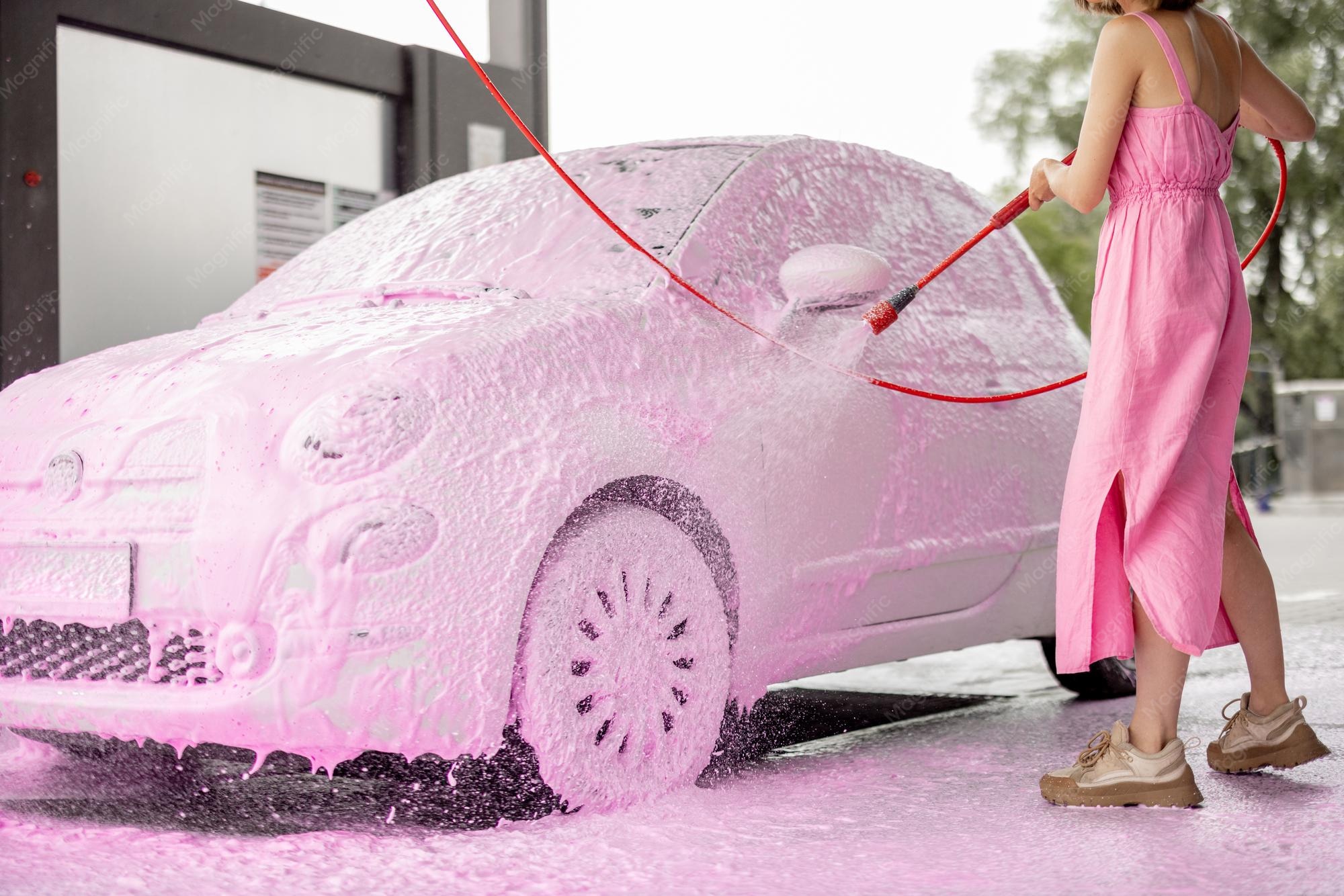
For several long seconds, my brain simply refused to process what I was looking at. I stood in my doorway with my keys still in my hand, coffee mug forgotten on the counter behind me, staring at my own driveway like it belonged to a stranger. My car was pink. Not a tasteful pink. Not some professional metallic finish you’d see on a showroom floor. Bright, garish, almost neon pink, covering practically every inch of the vehicle. Not keyed. Not egged. Fully repainted, hood to trunk, including the windows, the mirrors, even the headlights, like someone had spent hours out there in the dark with paint rollers, working methodically until every surface was covered.
I walked down the driveway in complete disbelief, my slippers slapping against the cold concrete. There were streaks where the paint had dried unevenly, thick drips that had hardened along the door panels like wax down the side of a candle. The windshield was almost entirely coated, just a few thin gaps where the wipers must have caught the paint before it fully set. I reached out and touched one corner of the hood. My finger came away tacky, faintly pink.
“What the hell,” I said quietly, because I still genuinely couldn’t process it.
Then I looked toward Denise’s house. Her curtains were shut. My stomach twisted into a hard knot. The hose had been annoying. The trash cans had been childish, petty, the kind of thing you roll your eyes about over morning coffee. This was different. Someone had deliberately, methodically ruined my car, spending real time and real effort doing it in the dark while I slept twenty feet away.
I called the police. I filed a report. I told the responding officer exactly who I suspected, without hesitation, without softening it. Without a witness or camera footage, though, there was nothing they could actually do. One of the officers walked slowly around the car, photographing the damage from every angle, his radio crackling occasionally against his shoulder.
“Any cameras nearby?” he asked, glancing up at my house.
“No,” I admitted.
“Did anyone see anything? Neighbors, maybe?”
“Not that I know of.”
“Do you have any evidence connecting your neighbor to this?” he asked, not unkindly.
I looked toward Denise’s house, its blinds still drawn tight against the morning light. “No,” I said. “That’s the problem.”
He nodded in that particular sympathetic way people do when they already know there’s nothing more they can do for you. I felt ridiculous standing there. Someone had stood in my driveway long enough to cover an entire car in paint, and I couldn’t prove a single thing about who had done it.
Later that afternoon, I saw Denise near the fence that separated our yards, pulling weeds with a pair of garden shears like it was any other ordinary day. I almost kept walking. Instead I stopped.
“Someone painted my car last night,” I said.
Her eyes widened, quick and convincing. “No.”
“Yes.”
“The whole thing?”
“The whole thing.”
She acted completely shocked, completely sympathetic, which somehow made it all so much worse. “That’s horrible,” she said, and her voice even sounded almost concerned. Almost.
“I called the police,” I told her.
“Good. You absolutely should have.”
I watched her face closely the entire time, searching for anything, a flicker, a tell, a crack in the performance. Nothing. No nervousness. No slip of the eyes. No sign I could actually use.
“Hopefully they figure out who did it,” she added, turning back to her weeds.
“Hopefully,” I said.
She smiled before heading inside, that same private, maddening smile.
For the next several days, every single time I looked at my ruined car sitting in the driveway, I felt that same exhausting combination of anger and helplessness wash over me. I finally ordered security cameras online, paying extra for expedited shipping, telling myself it was too little too late but installing them anyway. I wasn’t about to let anyone walk onto my property unseen ever again.
Yesterday morning, I was still nursing my first cup of coffee, barely awake, when I heard frantic pounding on my front door. Not knocking. Pounding, hard enough that the frame rattled. I nearly spilled coffee down the front of my shirt. I set the mug down on the counter and walked toward the entryway, my heart already picking up speed.
The pounding came again, more urgent this time.
“Christine!”
I recognized Denise’s voice immediately, though I’d never heard it sound quite like that before, raw and shrill and completely unguarded. I opened the door to find her standing there with her hair a complete mess, still in her bathrobe, practically shaking with rage. Her face was flushed red. One slipper had come half off her heel and she hadn’t even noticed. For once in almost a year, there was no smug little smile anywhere on her face.
“Did you do this?” she screamed, jabbing a finger back toward her own driveway. “I will destroy you, Christine!”
I stared at her, genuinely confused. “Do what?”
“You know exactly what!”
“I really don’t,” I said, and I meant it.
She pointed again, her whole hand trembling with fury. “Look!”
I stepped past her onto the porch to see whatever she was pointing at, and I very nearly burst out laughing right there in my slippers, coffee breath and all.
Sitting in the middle of Denise’s driveway was her car, completely covered in white paint. Not splashed. Not streaked here and there for effect. Fully covered, hood to trunk, roof, doors, windows, mirrors, headlights, every surface coated in thick white paint. Whoever had done it had been every bit as thorough as whoever had ruined mine two weeks earlier.
For a second I just stood there taking it in. Then I covered my mouth with one hand, unable to help myself.
Denise spun toward me, practically vibrating. “You think this is funny?”
“No,” I said, though my face was clearly betraying me. “I think it’s familiar.”
Her eyes narrowed to slits. “You did this.”
“I was asleep.”
“That’s exactly what you’d say.”
I looked past her at the car again, more carefully this time. There were paint trays sitting near the front tires. Two rollers had been left lying on the pavement, abandoned. A half-empty bucket sat near the passenger door, its lid nowhere in sight. Something about that detail nagged at me. Whoever had painted my car had taken absolutely everything with them when they left. No rollers. No buckets. No trace at all, beyond the paint itself. This was different. Sloppier. Angrier.
I glanced back toward my own front door, and suddenly I remembered the cameras. My amusement drained away instantly.
“Wait,” I said.
Denise crossed her arms tighter across her chest. “What?”
“I installed cameras after my car was painted.”
Her expression shifted, just slightly, but I caught it.
“Pull it up,” she demanded, following me inside without waiting for an invitation.
“I am,” I said, my hands already shaking a little as I opened the app on my phone.
For days those cameras had shown me nothing more exciting than the mail carrier, a few squirrels chasing each other across the lawn, and one particularly determined neighborhood cat that seemed to inspect my porch every single morning like it was patrolling for a living. Now I scrolled backward through the footage from the previous night, my thumb moving faster and faster across the screen.
Denise stood so close behind me I could hear her breathing, quick and shallow.
“Go faster,” she said.
“I’m trying.”
At 2:14 in the morning, movement appeared near the edge of the frame. I stopped scrolling immediately.
A pickup truck rolled slowly into view, headlights off, crawling along the street like it didn’t want to wake the neighborhood.
Denise leaned in closer. “Who is that?”
“I don’t know,” I said.
The truck came to a stop directly in front of her house. A man climbed out of the driver’s seat. Then another man got out from the passenger side. Together they opened the truck bed and began unloading buckets, moving with the kind of quiet efficiency that suggested they’d done this exact thing before, or at least had planned it out carefully.
Denise went completely still beside me.
One of the men walked straight toward her driveway. The other followed close behind, carrying two paint rollers under one arm.
I looked over at Denise. All the color had drained from her face.
“You know them,” I said.
“No.”
“You do.”
“I said I don’t.”
On the screen, the men began painting her car. They worked fast, not carefully exactly, but efficiently, like a job they wanted done and gone. One took the driver’s side, the other the passenger side. They coated the windows first, then moved to the doors, the hood, the trunk, sweeping the rollers in long, practiced strokes.
Denise stared at my phone, transfixed. “This is insane,” she whispered.
I almost agreed out loud. Then something happened on the footage that neither of us expected.
A third person stepped down out of the truck. A woman. She stood beneath the streetlight for several seconds, just watching, before finally walking toward the driveway to join the two men.
Denise made a strange, choked sound in the back of her throat. “Oh my God.”
I looked over at her. “Who is she?”
Denise didn’t answer. Her eyes stayed locked on the screen.
On camera, the woman lifted her own phone and started filming the two men painting the car, documenting it deliberately, purposefully. Then she turned and walked directly toward my house.
My stomach tightened. “Why is she coming over here?”
Denise took a step back away from me, her arms wrapping around herself like she’d suddenly gone cold.
I kept watching. On the screen, the woman stopped at the very edge of my driveway. She pointed toward my damaged car, still sitting there covered in dried pink paint. One of the men walked over and examined it closely, running a hand along the hood. The two of them spoke for a moment. There was no sound on the footage, but their body language told the whole story clearly enough. The woman looked absolutely furious. Then she turned and pointed back toward Denise’s house.
I paused the video right there.
“Denise,” I said.
She said nothing.
“Who is she?”
Denise swallowed hard, her throat visibly working. “My sister,” she finally said.
I stared at her. “Your sister?”
She sank down into one of my kitchen chairs like her legs had simply given out beneath her. All the anger was gone from her now. So was the smugness I’d grown used to seeing on her face over the last year. For the first time since I’d known her, Denise looked genuinely scared.
“Her name is Sabrina,” she muttered, staring down at her own hands.
“What does your sister have to do with my car?”
Denise rubbed both hands over her face, hard, like she was trying to physically scrub away the last few minutes. “Nothing,” she said.
“That doesn’t make sense, Denise.”
She looked toward the window instead of at me. I waited, letting the silence stretch out until it became uncomfortable enough that she had to fill it.
Finally she spoke again, her voice small. “I borrowed her truck.”
My stomach dropped straight through the floor. “When?”
She didn’t answer right away. I already knew, though. I could feel it coming before she said it.
“Two weeks ago?” I asked.
Denise shut her eyes tight.
That was answer enough.
Something inside me settled all at once, a strange, quiet click of relief mixed with something heavier. For months I had been second-guessing myself constantly. Every overturned trash can had made me wonder if I was being ridiculous, overreacting to normal neighborhood friction. Every missing item had left me questioning my own memory, my own sanity, half-convinced I was inventing a feud out of thin air. Even after the car, even with paint literally dried into every crevice of my vehicle, some small part of me had wondered whether accusing Denise so confidently made me look obsessive, unhinged, the crazy neighbor everyone whispers about.
Now she was sitting in my own kitchen, and I finally, completely knew the truth.
“You painted my car,” I said.
Denise opened her eyes. “I was angry.”
I laughed once, sharp and humorless. “You painted my entire car because I complained about your dog?”
“It wasn’t just that,” she said quickly.
“Then what was it?”
“You kept acting like you were better than me.”
My mouth actually fell open. “I asked you to keep your dog out of my flowers.”
“You embarrassed me with the HOA.”
“Your dog destroyed my yard three separate times.”
“I know.”
“No, Denise. You clearly didn’t, or none of this would have happened.”
She stood up abruptly, the chair scraping hard against my kitchen floor. “I didn’t think it would cost that much to fix,” she said.
I stared at her, genuinely stunned. “That’s your defense? The cost?”
“I’m not defending it.”
“You threatened to destroy me five minutes ago because someone did the exact same thing to you,” I said. “How does that feel now, from the other side?”
She looked away from me, out toward the window again, and something in her face seemed to genuinely crack, more than anything I’d said before. It hit harder than anything else that had come out of my mouth that morning.
“Sabrina found the pink paint on my clothes,” she admitted quietly. “In the laundry, on my sleeve. She kept asking questions about it. I told her it was nothing, just some project.”
I glanced back at the frozen security footage still open on my phone screen. “She figured it out anyway.”
Denise nodded slowly. “She saw your car yesterday afternoon when she came by to drop something off. She recognized the exact color. Then she called me last night, around midnight, screaming into the phone.”
“What did she say?”
Denise gave a small, miserable laugh, nothing like her usual smile. “She said if I wanted to behave like a child over something this petty, she’d make sure I understood exactly what it felt like to be on the other end of it.”
I looked out toward the driveway, toward the white paint drying on Denise’s car in the morning sun. Suddenly it made complete sense. This wasn’t random vandalism, some copycat prank pulled by strangers. It was a message. A very deliberate, very personal message from a sister who’d had enough.
I still called the police. Denise didn’t try to stop me this time. When the officer arrived, I showed him the security footage on my phone, and he took careful notes, asking me to send the video file directly to his department email before he left. Sabrina later admitted everything she’d done that night and accepted full responsibility for damaging Denise’s car. More importantly, standing right there in my kitchen with the officer taking her statement too, Denise finally admitted what she’d done to mine.
The whole situation became expensive and embarrassing very quickly for everyone involved. I did not enjoy that part nearly as much as I’d always imagined I would. For almost a year I had pictured, in vivid detail, how satisfying it would feel to finally prove Denise was behind everything, to have some undeniable piece of evidence I could hold up and say, I told you so. Instead, once it actually happened, I mostly just felt tired. Worn thin by a year of pettiness that had escalated into something genuinely destructive over a handful of flowers and a dog that couldn’t be bothered to stay in its own yard.
A few days later, Denise knocked on my door again. This time she was fully dressed, hair brushed, nothing like the wild-eyed woman who’d pounded on my door in her bathrobe. She was also calm, none of the fury or the fake sympathy I’d grown used to over the past year.
“I brought you something,” she said.
She handed me a plain white envelope. Inside was a check covering the first estimate for repairing my car, a number that made my eyebrows lift slightly when I saw it.
“I’ll pay anything else insurance doesn’t cover,” she said, not quite meeting my eyes. “Whatever it ends up costing.”
I studied her face for a long moment. “Why?”
“Because I owe you,” she said simply.
I nodded slowly. “Yes. You do.”
She winced at that, but she didn’t argue, didn’t try to soften it or explain it away again. Before she turned to leave, she paused near the front steps, one hand on the railing.
“For what it’s worth,” she said, not quite turning around, “I’m sorry.”
I believed that she meant it, at least in that moment, standing on my porch with nothing left to gain from pretending. That didn’t erase what she’d done, the sleepless nights, the ruined hose, the paint that took two full days of professional work to strip and repaint properly. It didn’t make us friends, not even close. But it was the first honest thing I’d heard come out of her mouth in longer than I could remember.
Her dog hasn’t been in my yard since that morning. My trash cans stay upright every single Thursday now, no exceptions. Nothing disappears from my porch anymore. And both of our houses now have security cameras mounted discreetly under the eaves, aimed at driveways instead of flower beds.
Sometimes I see Denise outside while I’m tending my garden, kneeling in the dirt the way I always have. We don’t wave anymore. We don’t smile at each other across the fence. We simply leave each other alone, moving through our own separate routines like two people who happen to share a property line and nothing else.
After everything that happened, I’ve come to consider that its own kind of progress. Peace doesn’t always look like friendship. Sometimes it just looks like two people finally deciding the fight isn’t worth continuing.
And whenever I remember her standing on my porch in that bathrobe, one slipper hanging half off her foot, screaming that she was going to destroy me over her freshly painted car, less than an hour after I’d discovered she’d done the exact same thing to mine, I still have to fight back a smile. Because for nearly a year I believed Denise could keep hurting me indefinitely as long as she was careful enough to leave no proof behind, no fingerprints, nothing I could ever point to and say, this was her.
In the end, I never actually caught her.
Her own sister did.

Specialty: Quiet Comebacks & Personal Justice
David Reynolds focuses on stories where underestimated individuals regain control of their lives. His writing centers on measured decisions rather than dramatic outbursts — emphasizing preparation, patience, and the long game. His characters don’t shout; they act.