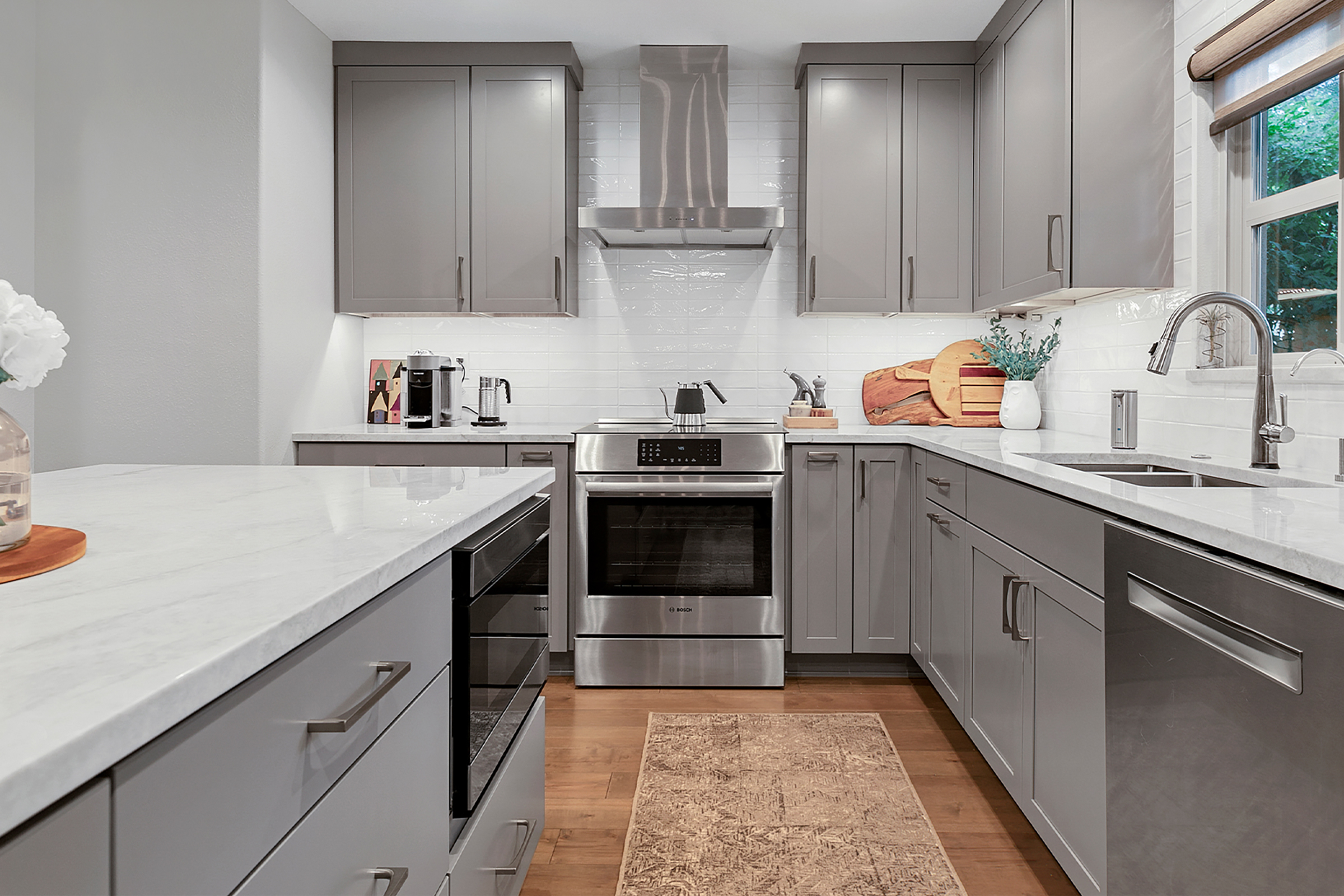
“What a stunning kitchen,” my daughter-in-law, Briana, said, running her fingers along my granite countertop like she was pricing it for sale. “My dad’s going to love waking up to this view every morning.”
She said it the way people say things they’ve already decided are true.
I didn’t answer right away. I picked up my teacup and took a slow sip, watching her walk the length of my kitchen like she was measuring it for someone else’s furniture. The countertop had a small chip near the sink where my husband Frank had dropped a cast-iron pan the week before he died. Nobody else would ever notice it. I noticed it every single day.
“I was thinking Dad could take the room down the hall,” she continued, glancing toward my son Marcus, who was very interested in his slice of pie. “It’s got the walk-in closet already. And honestly, this house has so much unused space. It doesn’t make sense for you to be rattling around in it alone.”
Her father, Gary, chuckled from across the table. “I told her I didn’t want to be a burden.”
“You wouldn’t be a burden, Dad,” Briana said quickly. “Would he, Marcus?”
Marcus looked up from his pie like a man being asked to referee a fight he hadn’t agreed to enter. “No, of course not,” he said, and then found something urgent to do with his napkin.
My name is Diane Whitfield. I’m sixty-three years old. I’ve been a widow for four years, and I have lived in this house on Larks Lane for thirty-one of them. Frank and I bought it back when the street was still half dirt and half pavement, when the bank teller told us we were young and foolish for taking on a thirty-year mortgage on a schoolteacher’s salary and a plumber’s wages. We were young. We weren’t foolish. Every plank of the back porch, every tile in the downstairs bathroom, every board of the fence, Frank and I put there ourselves on weekends with our own hands because we couldn’t afford to pay somebody else to do it.
Briana set her fork down with a decisive little click. “So here’s what I was thinking. Dad moves into the guest room next month since his lease is ending anyway. That gives us time to get the closet cleared out and maybe repaint before he settles in.”
I set my teacup down on its saucer. The sound was small, but it landed in the room like a dropped plate.
“No,” I said. Just the one word. Nothing dressed up around it.
Briana blinked the way people do when they’ve rehearsed a scene and someone skips their line. She laughed. A short, uncertain laugh. “I’m sorry?”
“I said no. Gary is welcome here for dinner anytime, but he is not moving into my home.”
The table went quiet enough that I could hear the refrigerator humming in the next room. Gary shifted in his seat and suddenly became very focused on his water glass. Briana’s smile stretched thinner, the kind of smile trying to hold a shape it doesn’t feel anymore.
“I think there’s been a misunderstanding,” she said, her voice climbing half an octave, the politeness starting to fray at the edges. “We’ve talked about this for weeks. My dad needs somewhere to go, and you have four bedrooms sitting here empty. It just makes sense.”
“It makes sense to you,” I said. “You’re not the one who decides what happens in my house.”
“Mom,” Marcus said quietly. It wasn’t quite a protest. It wasn’t quite anything.
I raised my hand slightly, not unkindly, just enough to hold the floor. “I’m speaking, Marcus.” He went quiet again, the way he always did, the way he’d been doing since he was a boy whenever two people he loved started pulling in different directions. Frank used to say our son had a good heart and a soft spine, and that one of these days life was going to ask him to stand up straight and we wouldn’t be there to hold his hand through it.
Briana’s jaw tightened. “We already told my dad he could count on this. He gave notice on his apartment.”
That landed differently than she probably intended. “You did what?”
“He’s moving out at the end of the month,” she said, like she was reading off a shopping list. “It’s already arranged.”
“Arranged by whom?”
She hesitated for just a second too long. “Well, by us. By me, mostly.”
I nodded slowly, feeling something settle into place in my chest, cold and clear. “So you made a decision that affects my home, and now you’re informing me of it instead of asking me.”
“It’s not like that.”
“It sounds exactly like that.”
Nobody spoke. Gary cleared his throat like he wanted to disappear into it. “Diane, I really don’t want to cause any trouble if this isn’t—”
“You’re not the one causing trouble, Gary,” I said gently. And I meant it. In four years of these dinners, Gary had never once measured my hallway with a tape measure or told me what my house was practically good for. He was a quiet, decent man who’d raised a daughter with a very different relationship to other people’s boundaries.
I stood and began collecting the dessert plates. “I’m sure between the two of you, you’ll find him a lovely place. There’s a very nice senior community over on Ashford Road. Grace from my book club lives there. She loves it.”
Briana’s voice sharpened behind me. “He is not going into some facility.”
“Then you’ll need a different plan,” I said, carrying the plates toward the sink. “But that plan doesn’t involve my house.”
She followed me into the kitchen, her heels clicking against the tile like punctuation. “You have all this space, and you’d really rather it sit empty than help family?”
I turned on the tap and let warm water run over the first plate. “I expect grown adults to make plans for their own lives. And I have every right to decide who lives under my roof.”
“Family helps family, Diane.”
“Families also respect each other’s boundaries, Briana. Those aren’t opposites. You’ve just decided to only hear the first half.”
She stared at me. For a moment, the mask dropped entirely. The sweetness was gone. Something harder sat underneath it. “You’d choose an empty house over your own family.”
I dried my hands slowly on the dish towel before I answered her. “This house isn’t empty. I live here.”
Neither of us said anything else. A few minutes later, I heard Marcus in the hallway murmuring something about the drive home, avoiding my eyes the way he’d been doing more and more these past months. Gary thanked me quietly for dinner, an apology folded somewhere inside his gratitude. I watched from the front window as the three of them climbed into Marcus’s truck. Briana was talking with her hands, sharp little gestures cutting through the air. Marcus kept both hands on the wheel and didn’t look back at the house once.
I closed the curtains. The quiet that settled over the kitchen afterward didn’t feel lonely. It felt like my own again.
Frank used to tell me that you never really know a person until you’ve told them no. Up until that point, everyone assumes they’re going to get a yes eventually, and they’re perfectly pleasant while they wait for it. It’s the no that shows you who somebody really is. I poured a second cup of coffee, black, the way I’ve taken it my whole life, and sat by the window in the last of the evening light. I didn’t know it yet, but that single word—no—hadn’t ended anything. It had only opened the door.
The following Thursday, my doorbell rang at a quarter to nine in the morning. When I opened it, Briana was standing on my porch holding two plastic storage bins, smiling like the dinner conversation had never happened.
“Morning, Diane,” she said brightly. “These are just some of Dad’s things. We’re a little tight on space at our place, so I figured they could sit here for a bit.”
Before I could answer, she’d already stepped past me into the front hall, setting the bins down beside the staircase like she was unloading groceries in her own kitchen. “There,” she said, dusting off her hands. “We’ll sort through everything once he’s settled.”
“Settled where, exactly?”
She waved a hand, already halfway back to the door. “Oh, you’ll come around, Diane. You always do.” Then she was gone. Back down the walkway. Into her car. Off to wherever people go when they’ve decided a conversation is finished even though the other person never agreed to end it.
I stood in my front hall for a long moment, looking at two bins that weren’t mine, holding belongings that weren’t mine, sitting inside a decision I had never made. Then I walked out to the garage, pulled out the old furniture dolly Frank used to use for moving bookshelves, and loaded both bins onto it. They were heavier than they looked. Dishes. A stack of photo albums. A folded quilt. I wheeled them out to the covered part of the front porch where they’d stay dry, and I texted Marcus.
Briana left Gary’s things here without asking. Please come get them before dark.
No anger in it. No lecture. Just the facts laid out plain.
He called within the hour. “Mom, you didn’t have to put them outside.”
“I certainly did. This isn’t a storage unit, Marcus.”
He sighed. That long, tired sigh he’d been doing more of lately. “You’re making this a lot harder than it needs to be.”
“No,” I said, keeping my voice even. “I’m making my boundaries clear. There’s a difference.”
Silence on the other end. “If someone puts their belongings in a house without being invited,” I continued, “they’re assuming a kind of ownership they were never given. It starts with boxes, Marcus. It doesn’t end there.”
“They’re just boxes, Mom.”
“They’re the beginning of something. I’ve been alive a lot longer than you have. I know what a beginning looks like.”
Another pause. Longer this time. “I’ll swing by after work,” he finally said.
He came alone that evening. Quiet. Carrying both bins back out to his truck without much conversation. He looked tired in a way that had nothing to do with his job. Like a man standing on a rope bridge between two people, trying to keep his footing steady in the middle while both sides pulled. I almost asked him in for coffee. I almost did. Instead, I told him to drive safe. He nodded and left. And I thought, foolishly, that maybe that would be the end of it.
It wasn’t.
Two mornings later, I heard my front door unlock while I was still in my robe drinking coffee at the kitchen table. My cleaning woman doesn’t come until Fridays. I stepped into the hallway just as the door swung open. Briana walked in carrying two grocery bags like she lived there.
“Morning,” she said cheerfully, heading straight for the stairs. “I thought I’d get a jump on clearing out the hall closet. We’ll need the space for Dad’s coats and things.”
I stepped directly into her path. “Stop.”
She looked genuinely startled. Like I was the one behaving strangely. “What?”
“Where did you get a key to my house?”
“Oh.” She laughed it off, breezy, like it was nothing. “Marcus gave me one years ago. In case anything ever happened to you.”
“I see.” I held out my hand. “Give it to me.”
Her face changed instantly. “Seriously?”
“Right now.”
“You’re being ridiculous, Diane.”
“I’m protecting my home. Family doesn’t let themselves into someone’s house after being told no to their face.”
She glared at me for a long moment before digging into her purse and slapping the key down onto the hallway table hard enough that it skidded. “You’re going to regret shutting everyone out.”
“I’m not shutting anyone out,” I said, picking up the key. “I’m simply refusing to be pushed around in my own home.”
She stormed past me. The front door slammed behind her hard enough to rattle the picture frames in the hall. I stood there for a moment in the ringing silence. Then I picked up my purse and drove straight to the hardware store.
By that afternoon, a locksmith had rekeyed every exterior door in the house. He handed me three new keys. I kept one. One went into the fireproof box in my bedroom closet. The third went into the locked drawer of Frank’s old desk in the study. Nobody else got a copy. Not this time.
From the hardware store, I drove straight to the bank. For six years, I’d been putting a little money away every month to help Marcus with my two grandchildren, Sophie and Ben. School clothes. Summer camp. The occasional unexpected expense. It had never been a debt. It was a gift freely given, never asked for in return. But a gift only stays a gift as long as it’s actually reaching the people it’s meant for.
I didn’t stop the money. I redirected it. I opened two separate custodial accounts. One for Sophie. One for Ben. And set up the transfers to go there instead, growing quietly until each of them turned eighteen. No one else would be able to touch a dollar of it. Signing the paperwork, I felt something I hadn’t expected. Not triumph. Just peace. I wasn’t trying to win anything. I was protecting what actually mattered. Which, I was starting to realize, were two very different things.
That evening, I sat out back with a cup of tea in the same chair Frank used to sit in while he watched the sun go down behind the sycamore tree we’d planted the year Marcus started kindergarten. Boundaries, I thought, don’t always look like raised voices and slammed doors. Sometimes they look like a locksmith and a bank appointment. Quiet decisions nobody else even notices until they do. I had a feeling, sitting there in the fading light, that this was only the beginning of something much bigger. And I was right.
The first Saturday of the new month came in warm and bright. The kind of morning that makes you forget anything is wrong right up until the phone rings. I was on the back porch with my coffee when it did. Briana’s name lit up the screen.
“Diane,” she said without so much as hello. “Where is the money?”
“What money?”
“The money for Sophie and Ben. It didn’t come through this month.”
I took a slow sip of coffee before answering. “It wasn’t going to.”
“What is that supposed to mean?”
“I opened savings accounts for both of them. Every dollar I set aside is going straight into their futures now instead of through anyone else’s hands.”
There was a silence on the line. Sharp. Full of static. “We needed that money, Diane. We already put down a deposit for Sophie’s camp.”
“I’m sure you’ll find a way to manage.”
Her voice rose. “You had no right to just change it without telling us.”
“It was always my gift to give, Briana. A gift isn’t the same thing as an entitlement.”
“So this is punishment?”
“No. This is responsibility. There’s a difference if you’re willing to look for it.”
She lowered her voice, going for wounded instead of angry. “We’re family, Diane.”
“Families don’t spend money that hasn’t been given to them yet,” I said. “They ask. They wait. They don’t assume.”
The call ended shortly after that. For the first time in weeks, I hung up the phone without a single knot of guilt sitting in my stomach. Instead, for the first time in a long while, I felt something close to free.
A few days after that, there was a knock at my door. A different knock. Softer. More hesitant than Briana’s confident rap. It was Marcus alone. He looked like he hadn’t slept properly in days. Dark circles under his eyes. Shoulders sitting lower than I’d ever seen them.
“Can I come in?” he asked.
I stepped back and let him through. We sat at the kitchen table. The same table where he used to do his algebra homework while his father grilled burgers out back and I graded spelling tests at the other end.
“So,” I said gently. “What brings you here?”
He stared down into his untouched coffee like the answer was written somewhere in it. “Briana’s upset. She says you’re trying to tear this family apart.”
“I think somebody else started that particular fire, Marcus.”
He sighed, long and heavy. “We already told my father-in-law he could live here.”
I looked at him carefully. “Did you tell him that?”
He hesitated. “No.”
“Then who did?”
“Briana.”
“And why didn’t you stop her before it went that far?”
He rubbed his forehead like it ached. “I didn’t want another fight.”
“There it is,” I said quietly.
“What?”
“The real problem, Marcus. Not Briana. Not Gary. You’ve spent years avoiding arguments instead of having the ones that actually needed to happen.”
He didn’t answer because there wasn’t really an answer that didn’t confirm what I had just said.
“This house isn’t just a piece of property,” I told him. “Your father and I bled and sweated to build this life. You took your first steps in that hallway. We celebrated every birthday you ever had in that living room.” I looked toward the backyard. “This is where I learned how to keep breathing after I lost him. It’s my whole life, Marcus. Not just square footage on a listing.”
His eyes filled, and he blinked hard against it. “I never thought about it that way.”
“I know you didn’t.”
He was quiet for a long moment. Then, barely above a whisper, he said, “Briana said if you don’t change your mind about the house, she’s going to stop bringing the kids around.”
I met his eyes steadily. “Is that a threat?”
“No, but I know how it sounds.”
“It sounds exactly like one.”
He put his head in his hands. “I don’t want to lose either of you.”
“You’re already losing one of you, Marcus, by trying so hard not to choose.” I leaned forward. “Listen to me carefully. If someone uses children as leverage to get what they want, the problem in that story was never the grandmother who said no to giving up her home.”
He didn’t answer that either. Before he left, he stood by the door for a long moment. Finally, he said, “I’m sorry, Mom.” That was all. I watched his truck pull away, hoping it was the start of something better instead of just words that would evaporate by morning.
Two quiet weeks followed. My roses kept blooming despite the early autumn chill. I played bridge on Thursdays with my oldest friend, Carol, and spent my evenings reading in Frank’s old recliner. The silence in the house stopped feeling like an absence and started feeling like something I’d actually earned.
One afternoon, I noticed a car I recognized parked across the street. Gary got out slowly and stood by my mailbox, running his hand along the top of it like he was working up the nerve to walk farther. After a few minutes, I opened the front door.
“Gary? Everything all right?”
He looked almost embarrassed to be seen. “I’m sorry to just show up like this.”
“Don’t be silly. Come have some tea.”
We sat together at my kitchen table. Steam rose off both cups for a while before he finally spoke. “Briana told me you’d invited me to stay here.”
I shook my head slowly. “No, Gary. I never said that.”
His shoulders dropped like something inside him had finally given up holding a shape. “I was afraid of that.”
“I never made that offer.”
He looked down into his tea. “I already gave notice on my apartment. I thought it was all arranged.”
“It wasn’t. I’m so sorry you were told otherwise.”
His eyes filled. “I don’t know where I’m supposed to go now.”
I reached across the table and put my hand over his. “There’s a wonderful community not far from here. My friend Grace lives there. I could introduce you if you’d like.”
He looked up, surprised. “You’d still help me after everything?”
“I won’t give up my home, Gary,” I said gently. “But I’m not going to turn my back on a decent man who got caught in the middle of somebody else’s decisions.”
He squeezed my hand. For the first time since we’d met, we weren’t standing on opposite sides of anything. We were just two people who’d both been misled by someone we loved, trying to find our footing again.
Word of that visit traveled faster than I expected. Three days later, on a Sunday afternoon, my doorbell rang again. When I opened it, Marcus and Briana stood on the porch together. My grandchildren waited quietly by the truck. Gary stood a few steps behind them near the driveway, looking like he wanted to be anywhere else. Briana was holding a thick manila folder against her chest like a shield.
“We need to settle this,” she announced.
“I’m not discussing the house today.”
“This won’t take long.”
“It already has.”
She tried to step past me into the hall. I held my ground in the doorway. “If you’ve come as family, you’re welcome to come in for coffee. If you’ve come with paperwork, this visit is already over.”
Her jaw tightened. But after a moment, she lowered the folder slightly. Against my better judgment, I let them in.
The children sat on the couch, quiet and a little confused by the tension in the room. Marcus stood near the fireplace. Not sitting. Not really present either. Briana opened the folder on the coffee table and pulled out several crisp printed pages.
“I talked to an attorney,” she said with the kind of confidence people have when they’ve never once considered they might be wrong. “If you transfer the house into Marcus’s name now, there are real tax advantages, and you’d still get to live here for the rest of your life.”
I looked at the papers without touching them. “And where exactly would I be living?”
“The basement,” she said. “It’s finished. It’s basically its own apartment down there.”
I almost laughed. “The basement?”
“It makes sense,” she said. “There are three bedrooms upstairs. We’d need those for us and the kids.”
“I see.” I turned to my son. “Did you agree to this?”
Marcus stared at the floor. “I thought it might make things simpler.”
“Simpler for whom?”
Neither of them had an answer. I gathered the papers and set them back down on the table.
“When Frank and I bought this house,” I said quietly, “we both worked two jobs. We skipped vacations for years. We fixed everything ourselves because we couldn’t afford not to. We counted every dollar for over a decade.”
No one spoke.
“We didn’t build this so that someday someone could move me into the basement of my own home while I was still alive to feel it happening.”
Briana crossed her arms. “You’re being emotional about a house.”
“It is emotional,” I said, my voice steady but firm. “It’s forty years of memory.” “My son took his first steps in that hallway.” I pointed toward it. “My husband read bedtime stories in that chair by the window.” I looked out toward the backyard. “We planted that sycamore tree together the week Marcus started kindergarten.” “This isn’t property to me.” “It’s my life.”
She sighed impatiently. “If you don’t plan ahead, everyone loses in the end.”
“I already have a plan,” I said. “My will has been finished for years.”
Marcus looked genuinely startled. “You never told me that.”
“I didn’t need to.”
Briana leaned forward, sensing an opening. “So the house goes to Marcus.”
“It will.”
Her face brightened for exactly one second. “After I’m gone.” The brightness disappeared just as fast.
“And if anyone continues trying to push me out of my own home while I’m still living in it,” I added calmly, “I’ll change every document I own by Monday morning and leave this house to a foundation that supports widows starting over.” “Every dollar of it.”
Marcus’s eyes went wide. “You wouldn’t.”
“I absolutely would.”
Briana stood up sharply. “You’d really punish your own family like that?”
“No. I’d be protecting myself from people who’ve mistaken my kindness for weakness.”
For several long seconds, nobody moved. Then something happened I genuinely did not expect. Gary stood up from where he’d been sitting quietly by the door and walked toward his daughter.
“That’s enough, Briana.”
She turned on him, stunned. “Dad—”
“You told me Diane had invited me to live here,” he said, his voice low but absolutely steady. “You let me believe that. You let me give up my lease over it.”
Briana opened her mouth. No words came out.
Gary looked at me. “I’m sorry, Diane. I had no idea.”
“You have nothing to apologize for, Gary.”
He nodded, something like gratitude in his face, then turned back to his daughter. “We’re leaving now.” Without another word, he walked toward the door. Marcus followed him, quiet and chastened. Sophie and Ben hugged me tightly on their way out, sweetly unaware of the storm that had just passed over their heads.
Briana stood alone in the middle of my living room for a moment. The folder hung limp in her hand. Something uncertain flickered across her face for the first time since I’d known her. Then she picked it up and walked out without looking back.
I closed the front door gently. The house went quiet again. And this time, the quiet felt like mine entirely.
Over the following months, life found its rhythm again. I spent mornings in the garden and afternoons volunteering at the library downtown, shelving books and reading to the little ones on Tuesday mornings. The accounts for Sophie and Ben kept growing. Untouched. Waiting. Marcus called. Sometimes short conversations, but honest ones. More honest than we’d had in years. Briana never called at all.
One cold evening in November, there was a knock at my door. It was Marcus alone. Thinner than I remembered. Older around the eyes.
“Can I come in?” he asked softly.
I stepped aside. As he walked past me into the living room, I could tell something inside him had finally settled. One way or another. He looked around like he was seeing the house for the first time in years. The photographs on the wall. The old mantel clock that had been his grandmother’s. The bookshelf Frank had built with his own hands the summer before Marcus was born.
“I’ve missed this place,” he admitted.
“Coffee?” I asked.
“I’d like that.”
We sat across from each other with two mugs between us. Quiet for a while. Then he finally spoke. “Briana and I are separating.”
I wasn’t surprised. His face had been telling me that story for weeks before his mouth caught up to it. “When did that happen?”
“About three weeks ago.” He stared into his cup. “It wasn’t just about the house anymore toward the end.” “It was about money and control and always wanting one more thing than what we had.”
I listened without saying anything.
“She wanted me to contest your will,” he said. “She even talked to a different lawyer about it behind my back.”
“And what did you tell her?”
He finally looked up and met my eyes. “I told her I would never take my mother’s home away from her.” “Not for anything.”
Something warm moved through my chest. “I’m proud of you, Marcus.”
He lowered his head. “I should have said that a long time before I did.”
“You said it. That’s what matters now.”
He nodded slowly. “Gary moved into that community you told him about. The one your friend Grace lives at.”
“Is he happy there?”
“Very. He said he’s made more friends in a few weeks than he had in the last five years combined.”
“I’m glad.”
“He wanted me to thank you.”
“There’s no need for that.”
“He insisted.”
We sat there a while longer, letting the quiet settle comfortably between us. Outside, the wind moved through the branches of the old sycamore tree Frank and I had planted together so many years before.
After a moment, Marcus spoke again. “I got a small apartment across town. Signed the lease last week.”
“That sounds like a fresh start.”
“It is.” He hesitated. “Would it be all right if I stayed here a couple of nights? They’re still painting the place.”
I smiled. “Of course you can.”
Relief spread across his face.
“Just as my guest, though,” I added.
He laughed. Really laughed. For what felt like the first time in months. “I wouldn’t dream of forgetting that.”
For the next several days, things felt almost ordinary again. Marcus helped me rake the leaves that had piled up along the fence line. He fixed the back gate that had been sticking since spring, the one Frank had meant to repair before he got sick. We cooked dinner together most nights and talked late into the evening about things we hadn’t spoken of in years. Bit by bit, the distance between us closed up like a wound finally allowed to heal.
One Saturday, Sophie and Ben came over to visit. They spent the whole afternoon in the backyard building enormous piles of fallen leaves and throwing themselves into them, shrieking with laughter every single time. Marcus watched them through the kitchen window. I saw something soft cross his face.
“I almost lost all of this,” he said quietly.
I put my hand on his shoulder. “You found your way back to it.”
“I think I confused giving in with keeping the peace,” he said.
“They’re not the same thing at all.”
“No,” I agreed. “They never were.”
“I understand that now.”
“You don’t hold a family together by asking one person to give up their whole life for it.”
“Exactly.”
A few weeks later, Gary stopped by for coffee. He looked better than I’d seen him look in years. Color in his face. A lightness in the way he carried himself. “There’s a walking club and a card night on Fridays,” he said, laughing. “And I signed up for a woodworking class, if you can believe that.” “I’ve been busier than I ever was in that apartment.”
“I’m happy for you, Gary.”
“So am I,” he said. Truly.
Our friendship hadn’t been built on years of shared history the way some are. It had been built on honesty instead. Forged fast in the middle of something hard. Sometimes I think that kind of foundation holds up even sturdier than the kind you spend decades laying down slowly.
As winter softened into spring, life settled into something gentle and steady. Marcus visited every other weekend with the kids. We baked. We played board games at the kitchen table. We planted new flowers in the beds Frank had always tended so carefully. The accounts for Sophie and Ben kept quietly growing in the background, waiting for the day each of them would need it to build something of their own.
Briana remained part of the children’s lives in her own way. But she never once came back to my house. That particular chapter had closed itself gently and completely.
One warm afternoon, little Sophie looked up at the new locks on my front door, running her small fingers over the shiny brass. “Grandma, why do you always lock the door now?”
I smiled and brushed a strand of hair away from her face. “So that the only people who come inside are the ones who are truly welcome here.”
She thought about that for a second. Then wrapped her arms around my waist. “I like coming here.”
“I like that you’re here.”
That evening, I sat alone on the bench in the backyard that Frank and I had built together with our own hands decades earlier, back when our whole life was still ahead of us instead of behind. The late sun slid through the branches of the sycamore tree, laying soft, shifting shadows across the grass. This house had witnessed every kind of season a life can hold. Birthdays. Grief. Forgiveness. Second chances. And the quiet, ordinary joy of a Tuesday afternoon with nothing wrong in it.
People sometimes think strength looks like the loudest voice in the room or the person who fights the hardest and longest. I don’t believe that anymore, if I ever did. Real strength is staying calm when everyone around you is pushing you to hand over the thing that matters most. One steady, unwavering no protected everything Frank and I spent a lifetime building. Brick by brick. Dollar by dollar. Year by year.
I still take my coffee black every morning. I still sleep on my side of the bed. The left side. The way I always have. Some evenings, the quiet in this house still reminds me how much I miss him. But it also reminds me that every photograph, every window, every worn spot on the porch steps is still exactly where it belongs.
Home was never just walls and a roof. Home is the one place where your dignity is never up for negotiation.

Adrian Hawthorne is a celebrated author and dedicated archivist who finds inspiration in the hidden stories of the past. Educated at Oxford, he now works at the National Archives, where preserving history fuels his evocative writing. Balancing archival precision with creative storytelling, Adrian founded the Hawthorne Institute of Literary Arts to mentor emerging writers and honor the timeless art of narrative.