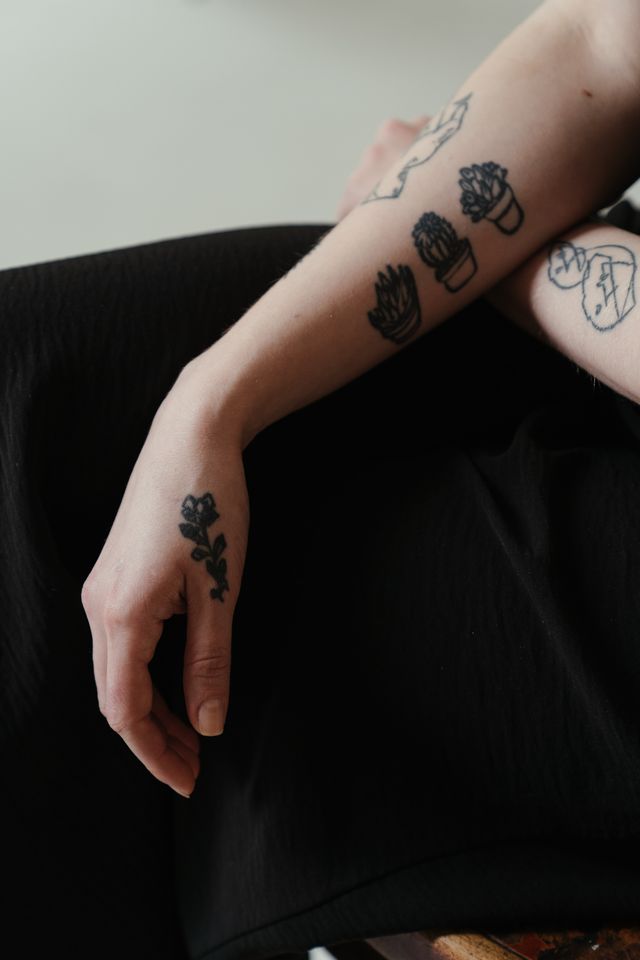
For as long as I could remember, my mother had a tiny blue flower tattooed on the inside of her left wrist, and for just as long, she refused to explain it.
The tattoo was simply part of her, the way her particular way of taking her coffee was part of her, or the specific laugh she gave when something genuinely caught her off guard, a short surprised bark that always made me smile no matter my mood. It was a small blue flower, no bigger than a coin, sitting where the skin is thin and pale and you can see the faint blue lines of the veins underneath. Five little petals. A stem. Nothing elaborate. The kind of thing you might doodle in the margin of a notebook without thinking about it.
I had traced it with my finger when I was a child, sitting in her lap on the porch on summer evenings, following the outline over and over the way children do with the small permanent features of the people they love.
“Where did you get it?” I asked her once. I must have been seven, maybe eight.
She smiled down at me, the warm easy smile that was her default expression.
“I got it when I was young,” she said.
“Does it mean something?”
“It means I was young, and I made a decision.” Then she kissed the top of my head, and that, as always, was the end of the conversation.
I asked a few more times over the years, in the way you circle back to a small mystery that never quite resolves. When I was eleven and going through a phase of thinking tattoos were the coolest thing imaginable. When I was fifteen and briefly convinced I would get one exactly like it someday, a matching flower, mother and daughter. When I was in my twenties and simply curious about the woman my mother had been before she was my mother, the version of her that existed in the years I could never reach. Every single time, I got some version of the same gentle non answer. I was young. I made a decision. A kiss on the head, or a squeeze of the hand, and then a change of subject so smooth I usually didn’t notice it happening until the conversation had already moved on to something else entirely.
There was one time, when I was around nineteen and home from college for the summer, that I pushed harder than usual. We were doing dishes together, her washing and me drying, and I asked again, and when she gave me the usual answer I said, half joking, “Come on, Mom, it’s just a tattoo, why is it such a state secret?” And she’d gone quiet for a moment, her hands still in the soapy water, and something had passed over her face that I didn’t have the maturity to recognize then. Not annoyance. Something closer to sadness. “Some things,” she’d said finally, handing me a plate, “are just for me, Emma. You’ll understand when you’re older.” I’d rolled my eyes and let it go, the way you do at nineteen. I understand now that she wasn’t being evasive to be difficult. She was standing at the edge of telling me the whole truth, and she stepped back, the way she always did.
Eventually, I stopped asking.
My mother, Helen, was a woman of full and generous presence, the kind of person who gave a great deal of herself to everyone around her and never seemed to keep score. She was the one who organized the meal train when a neighbor got sick. She remembered every birthday, sent every card, showed up with a casserole and a listening ear whenever anyone she knew was going through something hard. She had spent her whole working life as a nurse, and even in retirement she carried that quality of steady competence, the sense that if something went wrong, Helen would know what to do and would do it without any fuss.
The tattoo was the one small thing she kept entirely to herself. In a life defined by openness and generosity, it was the single locked drawer. And over the years, I had learned to respect that. Everyone is entitled to one thing that is only theirs, I figured. Even the most open person needs a corner of privacy. So I let her have her little blue flower and its unexplained history, and I stopped wondering about it, mostly.
She was sixty three now, and I was thirty two, and we had the kind of relationship I felt genuinely, uncommonly lucky to have. It was easy and warm, built over three decades out of small consistent kindnesses in both directions. We talked on the phone a few times a week about nothing in particular. She still worried about whether I was eating properly, and I still worried about whether she was overdoing it in her garden. We were, in the simplest and best sense, close. Not because we tried to be, but because we just were.
My father had passed away six years earlier, a heart attack that took him in his sleep, quick and without warning, and losing him had drawn my mother and me even closer. We were each other’s person after that. I’d helped her sort through the estate paperwork, the life insurance, the business of untangling a shared life of forty years, and in the long slow months of her grief I’d learned things about my parents’ marriage I’d never known, small tender details. She’d leaned on me, and I’d been glad to be leaned on. If you’d asked me, in the waiting room that morning, whether there was anything significant about my family I didn’t know, I would have laughed. I thought I knew all of it. I thought there were no more surprises left to find.
Which is why I took the day off work when she went in for her knee replacement.
The knee had been bothering her for years, a slow grinding decline that she’d downplayed the way she downplayed everything about herself. She’d finally admitted, after a bad fall in the driveway the previous winter, that she could barely make it up the stairs anymore, and her doctor had told her plainly that it was time. Knee replacement is routine now, one of the most common orthopedic surgeries there is, tens of thousands of them done every year. The surgeon had talked us through it with the calm confidence of a man who had done it a thousand times. She’d be up and walking with assistance the same day. Home in a couple of nights. Doing her stairs again within weeks, better than she had in years.
I still took the day off. Routine or not, she was my mother, and there was no version of that morning where I was going to be anywhere but by her side.
She had spent the weeks beforehand doing what she always did, which was worrying about the logistics and the cost far more than the surgery itself. She’d gone over her insurance coverage three separate times, calling the billing office to confirm exactly what her plan would pay and what her out of pocket maximum would be, refusing to walk into anything without understanding the full picture. She’d asked the surgeon’s office to itemize the estimated charges in advance and had actually read the whole thing, line by line, the way most people never do. She’d rearranged her downstairs den into a temporary bedroom so she wouldn’t have to manage the stairs during recovery, and she’d had a handrail installed along the hallway, and a raised seat put in the downstairs bathroom, all of it planned out weeks ahead. She’d stocked the freezer with individual portions so she wouldn’t have to cook. She’d even researched physical therapists in the area and picked one before the surgery was scheduled, because that was Helen, always three steps ahead, always prepared, always managing the practical world so competently that you forgot to wonder what she might be managing on the inside.
The hospital that morning was calm and efficient, the way good hospitals are. We checked in, and I sat with her through the paperwork, and eventually a nurse came to get her settled into the pre op area.
The nurse’s name was Patricia. She was warm and unhurried, somewhere in her late forties, with the kind of steady bedside manner that you can tell comes from decades of practice. She got my mother into a gown and settled into the bed, went through the intake questions, confirmed her medications and allergies, and chatted with her the whole time about the recovery timeline in a way that was clearly designed to keep patients relaxed and talking rather than tensing up about what was ahead.
“Now the physical therapy is really the key,” Patricia was saying, checking something on her tablet. “The surgery’s the easy part, honestly. It’s the weeks after that make the difference. You do the exercises even when you don’t feel like it, and you’ll be amazed how fast you’re back on your feet.”
“Oh, I intend to be a model patient,” my mother said. “I was a nurse for a long time. I know exactly how much you all talk about the ones who don’t do their exercises.”
Patricia laughed. “We do, we absolutely do. You’ll be our favorite, then.”
It was all so ordinary. So pleasant and unremarkable. I remember being half tuned out, scrolling through my phone, comfortable in the low hum of a morning that was going exactly as expected.
“All right, Helen,” Patricia said, setting down her tablet and reaching for my mother’s arm. “I’m going to get your IV placed now, and then we’ll be just about ready to take you back.”
She gently pushed the sleeve of the gown up above my mother’s wrist and reached for the IV supplies on the tray beside the bed.
Then her hand stopped in midair.
I was still looking at my phone when it happened, but I noticed the silence. That was the thing that made me look up. The easy chatter had simply stopped, cut off clean, and the sudden absence of it registered somewhere in the back of my mind before I even understood why.
I looked up.
Patricia was standing very still, holding my mother’s wrist in both of her hands, staring down at the little blue flower tattoo. And her face had changed completely. The friendly, professional warmth she’d worn for the past twenty minutes was simply gone, replaced by something I didn’t have a name for in the moment. Recognition, I would understand later. Recognition, and something close to shock.
For a few seconds she just looked at it, and I could see her mind working behind her eyes, processing something, arriving somewhere. It was the expression of a person who has seen something they absolutely did not expect to see, in a place they never expected to see it, and is trying very hard to make sense of what it means.
Then she recovered. Almost completely. But not quite fast enough that I missed it.
She rolled my mother’s sleeve back down over the tattoo, and she did it with a care that struck me as slightly too deliberate, too gentle, the way you might handle something you’d suddenly realized was fragile.
“I’ll just be back in a moment,” Patricia said. Her voice was steady, but there was something underneath it now, a thread of tension that hadn’t been there before. “I need to check something with the team.”
And she left the room.
My mother and I looked at each other.
“Well,” I said. “That was odd.”
“Yes,” my mother agreed.
Her voice was even. Perfectly composed. But I noticed her hands, which she had folded in her lap, and I noticed that they had gone very still. Not relaxed still. The other kind. The deliberate, holding stillness of someone concentrating on not moving at all.
“Do you have any idea what that was about?” I asked.
She looked down at her wrist, at the sleeve now covering the little flower.
“I’m sure it’s nothing,” she said.
But her tone told me, quite clearly, that she suspected it was something. And more than that, that whatever it was, she had some idea of what it might be. There was no genuine puzzlement in her face. There was only a kind of quiet, gathering dread, the look of a person who has heard a sound in the night that they were always half expecting to hear.
I told myself I was imagining it. Reading too much into a nurse stepping out of a room. Hospitals are full of small procedural interruptions, people stepping out to double check a dosage or confirm a chart or find a colleague. There was surely a mundane explanation, and in a minute Patricia would come back in with the IV supplies and apologize for the delay and we’d all forget it had happened.
The minutes stretched. My mother didn’t pick her phone back up. She didn’t make small talk. She sat with her hands folded and her eyes fixed on the middle distance, and the longer the silence went on, the more certain I became that she knew something I didn’t. I wanted to ask her again, more directly this time, but something in her stillness stopped me. She looked like a person listening for footsteps.
Then, five minutes later, two hospital security officers appeared in the hallway outside the room.
I saw them through the narrow glass panel in the door before they came in. They weren’t rushing. They were standing just outside, the two of them, talking quietly to each other and glancing toward the door, and there was something in the way they held themselves that made my stomach drop. They had the posture of people waiting to handle a situation, careful and contained. As if something strange, something that required them specifically, was inside this room. Inside this room, where there was nothing but my sixty three year old mother in a hospital gown, waiting for a routine knee surgery.
I sat up straight. “Mom.”
“I see them,” she said quietly.
Then the door opened, and a doctor came in behind the two officers. He was a man in his fifties, tall, with graying hair and the unhurried, authoritative bearing of someone senior, someone used to other people deferring to him. I had never seen him before. He was not my mother’s surgeon, and he was not any of the pre op staff we’d met that morning.
He wasn’t looking at me. And, strangely, he wasn’t looking at my mother’s face either.
He was looking at her wrist.
“Ma’am,” he said, and his voice was careful, measured, the voice of a person choosing each word deliberately. “Where did you get this symbol?”
Symbol. Not tattoo. Symbol.
And that was the moment my mother went pale.
I will never forget the speed of it, the way the color simply drained out of her face, all at once, like water running out of a basin. Her skin went gray white in the space of a single breath. I was not expecting it. Not after she had looked me in the eye and told me it was nothing. This was not the reaction of a woman confronting a misunderstanding. This was the reaction of a woman watching something she had feared for a very long time finally walk through the door.
She didn’t answer immediately.
My stomach tightened into a hard knot.
Up until that instant, I had still been telling myself there was a simple explanation. Maybe the tattoo happened to resemble something significant. Maybe there had been some kind of mix up, a case of mistaken identity, a thing that would be cleared up in five minutes and laughed about over dinner later.
But you do not send two security officers and a senior physician to close the door of a pre op room over a misunderstanding. Some quiet, rational part of my brain had already registered that, even as the rest of me scrambled to hold on to the ordinary morning that had just been taken away.
The officer nearest the door stepped fully inside and, without any drama, quietly pulled the door shut behind him.
The room felt immediately smaller. Rooms do that, I’ve since learned, when something enters them that changes the very air, when a piece of news is about to be delivered that will divide your life into a before and an after. The space seemed to contract around the four of us and my mother in her hospital bed.
“Mom,” I said, and I could hear the fear in my own voice now. “What’s happening?”
She turned to look at me. Her eyes were frightened in a way I had never seen my capable, steady mother’s eyes look frightened.
Then she looked down at her wrist, at the sleeve covering the little blue flower, and she said, very quietly, almost to herself, “I knew this day would come.”
The doctor introduced himself as Dr. Reeves. Whatever tension had brought him into the room, he clearly understood how frightening this all was, and he moved to defuse it. He pulled a chair over and sat down across from my mother, bringing himself down to her eye level, and he gestured for the security officers to wait by the door, which somehow made the whole thing feel a fraction less like an ambush.
I stayed exactly where I was, standing beside my mother’s bed with my hand gripping the cold metal rail, because there was no version of the next several minutes in which I was leaving that room.
“Helen,” Dr. Reeves said, and his voice had softened considerably from that first careful question. “I want to explain to you why this is happening, because I imagine it’s very frightening, and you both deserve to understand the context rather than just having strangers appear at your door. Is that all right with you?”
My mother nodded, a tight small motion.
“The tattoo on your wrist,” he said, “is not simply a decorative flower. It’s an identification mark. It was used, about thirty years ago, by a children’s residential facility called Maplewood House. It was a rehabilitation and transitional home for children, and this particular mark, the blue flower, was given to every child who lived in the program. With guardian consent, at the time. Patricia, the nurse who was placing your IV, volunteered at Maplewood House when she was a teenager. She recognized the mark the moment she saw it. That’s why she stepped out.”
“Oh,” my mother said. Just that. A small, deflating sound.
“Maplewood House was closed down,” Dr. Reeves continued, watching her carefully, “after the people who ran it came under investigation. There were serious financial irregularities. Fraud. Money that was supposed to go to the children’s care was diverted. And, more troublingly, there were irregularities in the adoption records that passed through the facility. In a number of cases, children’s identity documentation was altered, without the knowledge of the families who adopted them. Names were changed. Histories were obscured. Papers were falsified. Birth records, medical histories, the connections to living relatives, all of it was deliberately muddied.”
He paused, letting that settle.
“The reasons were mostly financial, as best the investigators can tell. Certain adoptions were more lucrative than others. Certain histories were inconvenient. And the people running the place found it simpler to rewrite a child’s past than to do the difficult, honest work of placing them properly. It’s one of the more disturbing cases I’ve encountered in my career, and I’ve encountered a few.”
He drew a breath.
“Federal investigators have spent the better part of a year trying to identify the former children of that program and reconnect them with their true histories. It’s been extraordinarily difficult, because so many of the records were deliberately corrupted, and because the facility has been closed for three decades. People have moved. Memories have faded. Some of the administrators have died. Until today, the investigators had not managed to find a single living, confirmed identification mark. The tattoos were the one thing the people running Maplewood couldn’t alter after the fact. A paper record can be forged. A mark on someone’s skin is much harder to change. It was, in a strange way, the most honest thing about that entire dishonest place.”
He looked at my mother steadily.
“Helen, I have to ask you directly. Were you associated with Maplewood House?”
My mother looked at me. She looked at me for a long, long moment, and I watched something shift in her face. It was not fear anymore, or not only fear. It was the look of a person standing at the edge of a decision they had been postponing for thirty years, finally understanding that the postponing was over. That there would be no better time than this one. That the moment had, at last, arrived whether she was ready or not.
“I worked there,” she said, turning back to Dr. Reeves. “As a nurse. Thirty years ago.”
I stared at her. “Mom. What are you talking about?”
She turned back to me, and her eyes were glistening now, filling with tears she was clearly fighting to hold back.
“Emma,” she said. “There’s something I should have told you a very long time ago. I wanted to tell you so many times. So many times, sweetheart. But every single time I tried, I lost my nerve.”
She drew a shaky breath, and her hands, folded in her lap, tightened around each other.
“You weren’t born to me,” she said.
The room went completely silent. Somewhere far off, down the hall, I could hear the ordinary sounds of a hospital continuing, a cart rolling, a phone ringing, a page over the intercom. All of it seemed to be happening in a different world.
I searched her face, trying to force the words to make sense, trying to fit them into the shape of the life I’d been living for thirty two years.
“I was adopted?” I whispered. It came out as barely any sound at all.
“Yes,” she said. “You were adopted. From Maplewood House.”
She reached out and took my hand, and I let her, because even in the middle of the ground shifting under me, she was still my mother and her hand was still my mother’s hand.
“There was a little girl,” she said, “who came into the program after a terrible car accident. You. You’d lost both your parents in the crash. You were two years old. You were barely more than a baby.” Her voice wavered. “The relatives who were supposed to take custody of you, they never came. There were complications, disputes, I never knew all the details. Something about your father’s family and your mother’s family and money and old grievances, the kind of ugliness that comes out when a tragedy leaves a child behind and no one can agree on who’s responsible. But months passed. And no one came for you. You sat in that program, this beautiful little girl, and month after month went by, and nobody came.”
She pressed her free hand flat against the blanket over her lap, steadying herself.
“Your father and I had been trying to have a child for years,” she went on. “We’d been through everything. The treatments, the disappointments, the hope and the loss of hope, over and over. We’d nearly given up. And then there you were. This little girl with the biggest eyes I’d ever seen, who had lost absolutely everything before she was old enough to understand what she’d lost, and no one was coming. The first day I met you, you reached up and grabbed my finger and wouldn’t let go. And that was it. That was the whole thing, right there. So we adopted you. Legally, Emma. Completely legally. Every form was filled out properly. Every court date was attended. We hired our own attorney, separate from the facility, because even then something about the place made me want my own eyes on the paperwork. We did everything by the book, exactly as it should be done. I need you to know that. Whatever else was wrong with that place, your adoption was clean. You were ours, fair and true and legal, in the eyes of the law and in every other way that has ever mattered.”
“Why didn’t you tell me?” I asked.
My voice cracked on the last word, splitting right down the middle.
And I want to be clear about something, because it matters. I was not, in that moment, questioning whether she loved me. That thought never entered my head, not for a second. I had thirty two years of evidence of her love, evidence in ten thousand small daily forms, and no revelation could touch that. What I couldn’t understand, what left me reeling, was the sheer scale of the secret. How a person could hold something this enormous, this fundamental, this close to the center of another person’s identity, and keep it locked away for three decades. How she had looked at me across the dinner table every night of my childhood and carried this and never let it show.
“The agency told us to wait until you were older,” she said. “That was the guidance back then, for a child adopted so young. Wait until she can understand. So we waited. And then when you were older, when the time came that we could have told you.” She stopped. Her chin trembled. “I was afraid. I told myself I’d find the right moment, the right words, and every year that passed made it harder to begin, not easier. The longer I kept it, the more impossible it felt to ever say. I kept promising myself there would be a better time, a gentler way to do it, and eventually.” She looked down at our joined hands. “Eventually I convinced myself it was kinder if you simply never knew. Which was wrong. I know that now. I think I always knew it. It was wrong, and it was cowardly, and I’m so sorry.”
“Were you afraid I would leave?” I asked. “That if I knew, I’d, I don’t know. Go looking for something else. Stop thinking of you as my mother.”
She looked up at me, and she didn’t flinch from the question.
“Yes,” she said simply. “God help me, yes. That was exactly what I was afraid of. You were mine, Emma. From the moment they placed you in my arms, you were mine, as much as any child has ever belonged to any mother. And I couldn’t bear, I could not bear, the thought of you ever thinking otherwise. It was the most selfish thing I’ve ever done, keeping it from you. I chose my own fear over your right to know your own story. I’ve had to live with that.”
I sat down on the edge of her bed. I took her hand, the one with the little blue flower on the wrist, the tattoo I had traced a thousand times as a child without ever knowing it was the key to all of this, and I held it in both of mine.
“I’m not going anywhere,” I said. “Do you hear me? Look at me, Mom. I’m not going anywhere.”
She closed her eyes for a moment, and a tear slipped down each cheek.
When she opened them again, the terror that had filled them was gone, and in its place was something older and more exhausted and, underneath the exhaustion, something like peace. It was the face of a person who has been carrying a tremendous weight for a very long time, alone, in secret, and has finally, without warning, been permitted to set it down.
“I love you,” she said.
“I know, Mom,” I said. “I’ve always known that. That was never the part in question.”
Dr. Reeves, to his great credit, gave us twenty minutes alone before he came back in. I thought that was generous, and I suspected it was intentional, a small mercy from a man who had clearly delivered difficult news before and understood that some moments need to be left to the people living through them.
My mother and I didn’t say a great deal during those twenty minutes. There wasn’t a great deal to say that could be said in twenty minutes. Mostly I just held her hand, and she held mine, and every so often one of us would start to say something and then stop, because the enormity of it kept outrunning the words. But it was not a bad silence. It was the silence of two people who love each other absorbing something together, which is a completely different thing from being alone with it. She had been alone with it for thirty years. Now, at least, she wasn’t.
At one point she said, quietly, “I used to rehearse it, you know. How I’d tell you. When you were little I had a whole speech worked out. I was going to sit you down when you turned ten and explain it all, gently, and then answer every question you had.” She shook her head. “And your tenth birthday came, and I looked at you blowing out your candles, so happy, and I thought, not today, I can’t spoil today. And then it was your eleventh, and your twelfth. There was always a reason it wasn’t the right day. That’s how thirty years goes by. One not today at a time.”
“I wish you’d told me,” I said. “But I understand how it happened. I do. I’m not angry, Mom. I want you to hear that. I’m shaken, but I’m not angry.”
She squeezed my hand so hard it almost hurt, and didn’t say anything, because she couldn’t.
When Dr. Reeves returned, he brought someone with him. A woman named Agent Morris, from the federal investigation unit that had been working the Maplewood House case. She was direct and efficient in her manner, but not cold, and she took a moment to acknowledge, without dwelling on it, that this was obviously an overwhelming day for both of us.
She explained that the investigation had by then identified dozens of children whose adoption records had been altered by the corrupt administrators who ran Maplewood House. In many of those cases, the paperwork had been deliberately falsified, without the adoptive families’ knowledge, to conceal the children’s original identities and make their true histories nearly impossible to trace. Some of those now grown children had spent their whole lives with names and birthdays and backstories that weren’t real, and had no idea. Others had grown up with a nagging sense that something didn’t add up, a feeling they could never quite name or prove. Untangling it all had become a massive, painstaking undertaking, one that had consumed her unit for the better part of a year.
“Most people don’t realize how much of who you are lives in a paper trail,” Agent Morris said. “Your birth certificate. Your medical history, which can be a matter of life and death when a doctor needs to know what runs in your family. Your connection to living relatives, grandparents and aunts and cousins who might have been searching for you all this time. When someone falsifies those records, they don’t just commit a fraud. They steal a person’s entire sense of where they came from. We’ve had people in our office weep just from finding out their real date of birth. That’s what we’re trying to give back.”
She turned to me then.
“I want to say something clearly, right at the start, so you’re not sitting there worrying about it,” she said. “Your adoption, Emma, was not one of the compromised cases. Helen’s records were complete and legal. The process was documented correctly from beginning to end. There is nothing about the validity of your adoption for you to fear. You are, in every legal and every real sense, exactly who you’ve always been. Helen’s daughter. Whatever else changes today, that does not.”
I felt something unclench in my chest that I hadn’t fully realized was clenched.
“Then what do you need from us?” I asked.
“Helen,” Agent Morris said, turning to my mother, “I need to ask you something important. During your time at Maplewood House, did you keep any documentation? Any records, photographs, files, anything at all from the program?”
My mother was quiet for a moment. And then something crossed her face, and she nodded slowly.
“Yes,” she said. “I kept everything. Boxes of it. When the place started to fall apart, when I began to understand that something was very wrong with how it was being run, I took copies of everything I could. All my own records. Files on the children I’d cared for. Photographs. I always thought.” She paused, gathering herself. “I always thought that someday, someone might need it. That the truth might matter someday, to someone. I couldn’t bring myself to throw any of it away. It’s been in my attic for thirty years.”
Agent Morris leaned forward, and for the first time her professional composure showed a crack of something like hope.
“Helen,” she said, “those records may be exactly what we’ve been missing. We have spent eight months trying to reconstruct the identities of the children who passed through that program, and we keep hitting walls because the official records were destroyed or falsified. If your files are complete, if they’re what you say they are, they could allow us to reconnect dozens of people with their original histories. People who’ve spent their whole lives not knowing where they came from. Do you understand what that could mean?”
“Tell me what you need,” my mother said, and there was steel in her voice now, the old capable Helen surfacing through the exhaustion. “I’ll give you everything I have. Every last page. If it’s been sitting in my attic all these years for a reason, then this is the reason. Take it all.”
They arranged the details, the logistics of retrieving the boxes and turning them over, and I watched my mother, who twenty minutes ago had been gray faced with terror, take charge of the conversation with the brisk competence she’d brought to every crisis of my entire life. Whatever this day had cost her, and it had cost her a great deal, she was also, I realized, being handed something. A chance to make thirty years of quiet guilt mean something. A chance for the secret she’d hidden to become the key that unlocked the truth for other people.
Before Agent Morris left, Patricia came back into the room.
She’d been waiting out in the hallway, I think, uncertain of her welcome, and when she came in she looked at my mother with an expression of genuine apology.
“I’m so sorry for the alarm I caused,” she said. “I know this is not remotely what you came in here for today. When I saw the tattoo, I just, I reacted. I’ve thought about those kids for thirty years. I couldn’t not say something.”
“It’s all right,” my mother said, and she managed a real smile, tired but real. “Truly. I think, maybe, it needed to happen. I don’t think I was ever going to find the courage on my own. Sometimes life makes the decision for you.” She glanced at me. “Perhaps it’s better this way.”
Patricia nodded. And then she did something unexpected. She reached into the pocket of her coat and produced a small envelope, worn soft at the edges, slightly yellowed with age, and she handed it to me with a care that told me immediately it was old, and that it had been kept safe by someone for a long time. She held it out with both hands, the way you’d hand someone something that might come apart.
“This was in an archive box from Maplewood House,” she said quietly. “The investigators brought several boxes to the hospital last week and asked some of us on staff who’d been connected to the place to look through them, to see if anything was identifiable. Most of it was just old administrative papers, intake forms, staff schedules, the dull machinery of a place like that. I almost didn’t volunteer to help. Thirty years is a long time, and I wasn’t sure I wanted to open that door again. But something told me to. And when I saw your mother’s tattoo just now, and I understood who you must be, I remembered this one thing that had stopped me cold when I found it.” She nodded at the envelope now resting in my hands. “It was filed under your original name, Emma. Your birth name. The investigators told me it had been placed in the files only a few days before the accident.”
I looked down at the envelope.
Across the front, in handwriting I did not recognize, in slightly faded blue ink, were the words: “To be opened by Emma when she’s ready.”
I held it for a long moment without opening it. My hands were not quite steady. Thirty years of my life had a name I’d never heard, a mother I’d never known, a whole first chapter that had been closed before I could read it, and here it was in my hands, whatever it was, waiting.
“You don’t have to read it now,” my mother said gently. “You don’t have to read it today at all, sweetheart, if you’re not ready. There’s no rush. It’s waited thirty years. It can wait a little longer.”
“I know,” I said. “I’m going to, though. I think I need to. I think if I put it down now I’ll be too scared to ever pick it up again.”
She nodded, understanding that completely, and reached over to rest her hand on my knee while I opened it.
I slid my finger under the flap. The old glue gave way easily, dry and brittle with age.
Inside was a single page, folded once, written in a hand that was clearly rushed but still perfectly legible, the letters leaning forward as if the person writing had been in a hurry, or fighting some urgency I couldn’t know.
I read it slowly, and then I read it again, and I am going to set it down here exactly as it was written, because I have read it so many times since that I know every word by heart.
My dearest Emma,
If you’re reading this, then life did not unfold the way I prayed it would. I hoped with everything in me that I would be the one to tell you how deeply you were loved from the very beginning. But if these words have reached you instead of my voice, then I am no longer there to tell you myself.
I need you to know one thing above all else. None of this was ever your fault. Not any part of it.
You were the greatest joy of my life. From the very moment I first held you, I loved you more than I ever knew a heart was capable of loving another person. Every dream I had for the future had you in it. There was no plan I ever made that you weren’t at the center of.
If someone else has raised you, then I hope with all my heart that they loved you with everything they had. And please, please never think that being loved by another family means you were loved any less by me. Love doesn’t disappear because life changes. It simply finds another way to reach the people who need it most.
I hope you grew up kind. I hope you laughed often and loudly. I hope you found people who made you feel safe, and a place that felt like home, and I hope you always, always knew that you deserved every bit of that love.
Most of all, I hope you never once doubted that you were wanted. Because you were. From the first moment and forever after, you were wanted more than words on a page could ever hold.
If the people who raised you loved you well, then hold on to them tightly. They are your family. Nothing in this letter is meant to take a single thing away from that. If anything, I hope it only reminds you how fortunate you are to have been loved twice in one lifetime. Not everyone gets that. You did.
I wish more than anything that I could have watched you grow up. I wish I could have been there for all of it, the ordinary days and the big ones. I wish I could have told you all of this myself, out loud, with your hand in mine.
With all the love a mother can possibly give,
Your first mom, Alicia
Alicia. That was my birth mother’s name. Alicia. I said it silently to myself, testing the shape of it. The woman who had held me, who had dreamed her whole future around a two year old, who had somehow, in the middle of whatever was happening in her life, found the presence of mind to write a letter for a daughter she was afraid she might not get to raise. And she had been right to be afraid. That was the part that broke something open in me. She had written this just days before the accident, as if some part of her had known.
I read it a third time, and by then I was crying, the quiet kind, the tears just running down without any sound to them.
Then I looked up at my mother. At Helen. Who had been watching me the entire time with her hands folded and her eyes very still, waiting, giving me space, ready to catch me if I needed catching.
“She sounds like she was a good person,” I said. My voice came out thick. “A really good person.”
“I’m sure she was,” my mother replied softly. “I’m sure she loved you more than anything. That letter proves it. And Emma, I want you to hear me say this. It doesn’t take anything from us for you to love her too. There’s room. There’s always been room.”
“I’d like to find out more about her,” I said. I took a slow breath, steadying myself. “Not today. But someday. When I’m ready. I’d like to know who she was. Where I came from. All of it.”
She nodded without a moment’s hesitation. “Of course you would. And I’ll help you. Whatever you need, whenever you’re ready, I will help you find out everything there is to find. I mean that.”
I managed a small, wet smile. “Okay. Thank you, Mom.”
I folded the letter carefully back along its old crease and slid it into the worn envelope, and I held it in my lap with both hands, the way you hold something precious and irreplaceable, which is exactly what it was.
I looked at my mother. This woman who had carried a secret for thirty years because she was terrified of losing me. Who had made the wrong choice, and known it was the wrong choice, and lived with it anyway rather than risk the one thing she loved most in the world. And who was also, unmistakably, the woman who had driven me to school every morning of my childhood, who had made me soup and pressed cool cloths to my forehead when I was sick, who had sat up with me the night before every exam and clapped loudest at every graduation and helped me move into six different apartments and cried at my college acceptance and loved me in ten thousand quiet ordinary daily ways that had shaped every single part of who I was.
I thought about all the different things a family can be. Blood, and choice, and accident, and love that outlasts a life. I thought about Alicia, writing her letter in a hurry, hoping it would somehow reach me across whatever came next. I thought about Helen, keeping her boxes in the attic for thirty years because she couldn’t throw the truth away, even the truth she was hiding from her own daughter. Two mothers. Both of them, in their own imperfect ways, trying to protect me. One had died before she could raise me, and had loved me so completely in two short years that she’d written down that love so it would survive her. The other had raised me with everything she had, and had loved me so fiercely that she’d been afraid to tell me a truth that might, she feared, loosen my hold on her. And I understood, sitting there on the edge of that hospital bed, that I did not have to choose between them. That the letter had said it exactly right. I had been loved twice. That wasn’t a competition. It was a gift, and a rare one, and I was not going to waste a moment of it being angry about the shape it had taken.
I thought, too, about the dozens of other people out there. The other children of Maplewood House, grown now, walking around with false names and invented histories, some of them never knowing, some of them sensing all their lives that something didn’t fit. And I thought about my mother’s boxes in the attic, the records she couldn’t bring herself to destroy, and how many of those people might finally learn the truth of themselves because a nurse in a pre op room happened to recognize a little blue flower. The secret my mother had hidden for thirty years, the very thing she’d been most afraid of, was about to become the thing that gave dozens of strangers their lives back. There was a kind of justice in that, or maybe grace is the better word. Something set right that had been wrong for a very long time.
And then a thought struck me, and I actually laughed, a small startled laugh in the middle of all that emotion.
“Your surgery is still happening today,” I said.
My mother blinked at me. “What?”
“Your knee.” I gestured at the offending leg under the blanket. “Mom, you did not just reveal a thirty year old family secret, get visited by federal agents, and hand over the evidence in a national investigation, all so you could walk out of this hospital with the exact same bad knee you walked in with.”
For a second, she only stared at me, as if she couldn’t quite believe I’d said it.
Then she laughed. Really laughed. The full surprised bark of a laugh that I had loved my whole life, the one that came out when something caught her completely off guard. It was the laugh of a woman flooded with relief and grief and love all at once, the strange overwhelming absurdity of being a human being on an ordinary Tuesday that had turned out to be anything but ordinary.
I laughed too, and I couldn’t stop, and it turned into crying and back into laughing again, both of us a mess, holding hands on the hospital bed. And Patricia, still standing in the doorway, watching the two of us, smiled with her whole face.
“She’s right, you know,” Patricia said. “And also, for what it’s worth, I still have that IV to place. I would very much like to finish at least one thing I started today.”
My mother wiped under both eyes with the back of her free hand, took a breath, and held out her left wrist, the little blue flower facing up, no longer a secret, no longer hidden.
“All right,” she said. “Let’s get on with it. Before this hospital manages to find another secret buried in my chart.”

Ethan Blake is a skilled Creative Content Specialist with a talent for crafting engaging and thought-provoking narratives. With a strong background in storytelling and digital content creation, Ethan brings a unique perspective to his role at TheArchivists, where he curates and produces captivating content for a global audience.
Ethan holds a degree in Communications from Zurich University, where he developed his expertise in storytelling, media strategy, and audience engagement. Known for his ability to blend creativity with analytical precision, he excels at creating content that not only entertains but also connects deeply with readers.
At TheArchivists, Ethan specializes in uncovering compelling stories that reflect a wide range of human experiences. His work is celebrated for its authenticity, creativity, and ability to spark meaningful conversations, earning him recognition among peers and readers alike.
Passionate about the art of storytelling, Ethan enjoys exploring themes of culture, history, and personal growth, aiming to inspire and inform with every piece he creates. Dedicated to making a lasting impact, Ethan continues to push boundaries in the ever-evolving world of digital content.